The chair was nothing special.
Metal legs.
Plastic seat.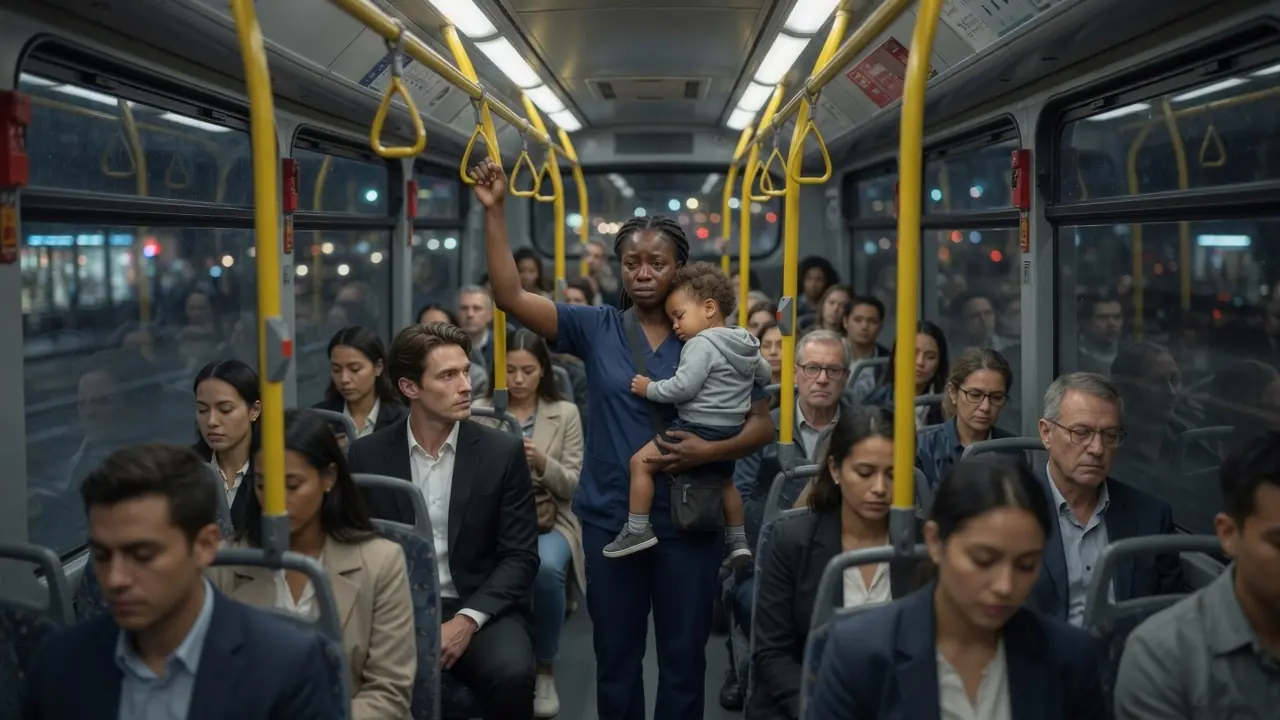
One small crack near the back where somebody had leaned too hard or sat down too fast years ago.
It sat against the wall of Baylen Street Station, between a vending machine that ate dollar bills and a faded poster advertising flu shots at a clinic two blocks away.
Most people walked past it without seeing it.
That morning, in the crowded waiting area of the station, it became the most important thing in the room.
Baylen Street Station stood in the center of Alderbrook, a busy town in the fictional state of East Marlow. It was not beautiful, but it was alive. Buses groaned along the curb. Trains rattled on the upper tracks. Coffee spilled. Shoes squeaked against wet tile. Announcements crackled overhead, always a little too late to be useful.
People moved through the station like they were trying to outrun their own lives.
A nurse in blue scrubs checked her watch every thirty seconds.
A college student balanced a backpack, a coffee, and a half-eaten muffin.
A man in a wrinkled suit shouted into his phone about missing a client meeting.
Nobody wanted to be there longer than necessary.
Everybody looked tired.
Near the entrance, a young mother stood with a baby pressed against her chest.
Her name was Maya Ellison.
She was twenty-six years old, Black, small-framed, with tired brown eyes and her hair pulled into a loose bun that had begun the morning neat and had since surrendered to the humidity. Her coat was too thin for the January cold, and the baby blanket over her son’s back had little yellow stars stitched along the edge.
Her son’s name was Noah.
He was five months old and had spent most of the night crying.
Not the loud, angry crying of a baby who wanted attention.
The weak, uneven crying of a baby who did not feel right.
Maya had taken him to the free pediatric clinic on West Lantern Avenue before sunrise. The doctor said Noah had an ear infection, gave her a prescription, and told her to keep him warm, keep him fed, and come back if his fever rose.
Keep him warm.
Keep him fed.
The doctor said it kindly, but Maya heard the weight behind the words.
Warmth cost money.
Food cost money.
Medicine cost money.
Everything a child needed seemed to arrive with a receipt.
Maya worked mornings at a bakery called Lottie’s Oven and evenings cleaning offices at a small legal firm downtown. Her husband, Andre, had left six weeks after Noah was born, saying fatherhood made him feel trapped, as if the baby had locked the door instead of opening one.
He sent apologies more often than money.
Maya had stopped answering both.
That morning, after the clinic, she needed to catch the Route 14 bus back across town to fill Noah’s prescription at a pharmacy that accepted her insurance. Then she needed to get home, feed him, and call her manager to explain why she had missed her bakery shift.
She had been standing for nearly forty minutes.
Every chair in the station was full.
Some seats held people.
Some held bags.
One held a folded newspaper and a half-finished coffee.
Maya shifted Noah higher against her shoulder and tried not to wince.
Her back hurt.
Her arms ached.
The diaper bag strap dug into her collarbone.
Noah made a soft sound against her neck, not quite a cry, but close enough to tighten every muscle in her body.
“I know, baby,” she whispered. “I know. We’re almost there.”
They were not almost there.
But sometimes mothers lie gently because hope needs something to hold on to.
Across the waiting area, Thomas Reed noticed her.
He was sixty-eight, white, retired, with a gray beard, a navy work coat, and hands permanently shaped by forty years of fixing engines. His knees hurt when it rained. His back complained when he sat too long. He had a bus ticket folded in his shirt pocket and a doctor’s appointment he did not want to attend.
Thomas had not planned to notice anyone that morning.
He had planned to drink his coffee, rest his bad knee, and catch the 9:15 bus to North Rill Medical Center.
That was all.
Life had become smaller since his wife died.
Eleanor had been gone three years, but Thomas still caught himself buying the cereal she liked and turning toward her side of the bed before remembering the silence there. Their only daughter lived two states away and called every Sunday. She asked if he was eating properly.
He lied.
Mostly.
That morning, Thomas sat in the plastic chair by the vending machine and watched the crowd move.
He saw the man in the suit yelling into his phone.
He saw the student drop her muffin and nearly cry.
He saw the nurse rub her temples.
Then he saw Maya.
At first, he saw only a young woman with a baby.
Then he saw the baby’s flushed cheeks.
The mother’s shaking arms.
The way she looked at every occupied chair and then looked away quickly, as if asking silently would cost too much.
Thomas knew that look.
Not from being a young mother.
But from being poor once.
Poor enough to stand in places where help existed all around him but felt too expensive to request.
He remembered being twenty-two with Eleanor, newly married, stranded in a bus depot during a snowstorm with five dollars between them. Eleanor had been pregnant with their daughter then. Her ankles had swollen so badly she could barely stand.
No one offered a seat for thirty minutes.
Then an old woman with a cane had stood up and said, “Honey, a baby outranks my knees.”
Thomas never forgot that.
He never forgot Eleanor sitting down, one hand on her belly, eyes full of tears she tried to laugh away.
He never forgot the old woman standing beside them, leaning on her cane, pretending it was nothing.
It had not been nothing.
Nothing is sometimes the name people give kindness when they do not want to embarrass the person receiving it.
Thomas looked at Maya again.
Then at his own knee.
It hurt.
Of course it did.
It always hurt.
He pushed himself up anyway.
The chair gave a small scrape against the tile.
Maya did not notice at first.
She was adjusting the blanket around Noah.
Thomas stepped closer, careful not to startle her.
“Ma’am,” he said.
Maya looked up quickly.
Her face carried the guarded politeness of someone used to being approached for the wrong reasons.
“Yes?”
Thomas gestured toward the chair.
“Please take my seat.”
She blinked.
“Oh, no. That’s okay.”
“It isn’t.”
“I’m fine.”
“You look like you’ve been fine for about as long as a person can be.”
For the first time all morning, her mouth twitched like it wanted to smile.
“I don’t want to take your chair.”
“You’re not taking it. I’m giving it.”
Her eyes moved to his knee.
The way he stood slightly uneven.
The way one hand rested against the back of another chair for balance.
“You need it too.”
Thomas shrugged.
“I’ve been sitting most of my life. This little man hasn’t had a turn yet.”
Noah made a tiny sound.
Thomas leaned slightly to look at him.
“See? He agrees.”
Maya let out a tired breath that almost became a laugh.
The station kept moving around them.
People rushed.
Announcements crackled.
Somebody cursed near the ticket machine.
But for one small moment, the world narrowed to a chair, an old man, a tired mother, and a baby too young to know he had just been honored.
“Thank you,” Maya said softly.
Thomas stepped aside.
She lowered herself into the chair with the care of someone afraid her body might give up once it realized rest was allowed.
The relief on her face was immediate.
And private.
Thomas looked away before it became too much for her.
Maya settled Noah against her chest, supporting his head with one hand. His crying eased. His tiny fist curled against the yellow-star blanket.
Thomas stood nearby, holding the pole beside the vending machine.
“You heading home?” he asked.
“Pharmacy first.”
“Long morning?”
She looked down at Noah.
“Long night.”
“Ear infection?”
Maya looked surprised.
“My daughter had them all the time when she was little. She’d scream until the walls begged for mercy.”
Maya smiled then.
A real one.
“That sounds about right.”
“What’s his name?”
“Noah.”
“Good name.”
“Thank you.”
“I’m Thomas.”
“Maya.”
They did not say much after that.
They did not need to.
Kindness, when done properly, does not demand conversation as payment.
Thomas stood.
Maya sat.
Noah slept.
That could have been the whole story.
A chair offered.
A chair accepted.
A baby soothed.
But small acts have a way of moving through rooms.
People noticed.
Not everyone.
The man in the suit was still arguing into his phone.
The college student was still trying to rescue her muffin with a napkin.
But the nurse in blue scrubs saw Thomas stand.
The nurse’s name was Carla Wynn.
She had worked a twelve-hour shift at Harrowgate Memorial and was on her way home to sleep before returning for another one. Her feet hurt. Her head hurt. Her patience had been scraped thin by a night of alarms, paperwork, and one family who blamed her for a doctor’s delay.
She saw Thomas give up the chair.
Then she saw the diaper bag slipping from Maya’s shoulder.
Carla stood from her own seat near the schedule board and walked over.
“Can I set that beside you?” she asked.
Maya looked up.
“What?”
“Your bag. It’s sliding.”
“Oh.”
Maya tried to adjust it one-handed.
Carla stepped in gently.
“May I?”
Maya nodded.
Carla lifted the diaper bag and placed it neatly beside the chair.
Then she reached into her tote and pulled out a small unopened bottle of water.
“For you.”
Maya hesitated.
Carla smiled tiredly.
“I’m a nurse. I’m physically incapable of watching a dehydrated person pretend she’s fine.”
Thomas chuckled.
Maya took the water.
“Thank you.”
The college student saw that.
Her name was Jenna Pike, nineteen, late for a psychology exam, certain her life was falling apart because she had spilled coffee on her notes and forgotten her umbrella.
She had been sitting on the floor beside her backpack, guarding the only working outlet with the intensity of a dragon.
She watched the nurse give Maya water.
Then she looked at the paper bag in her lap.
Inside was a banana she had packed and did not want.
She walked over awkwardly.
“Do you want this?” she asked Maya.
Maya looked startled.
“I’m okay.”
“It’s extra,” Jenna lied badly. “I brought two.”
Thomas glanced at the bag.
There was clearly no second banana.
Maya noticed too.
For a second, pride and need stood facing each other.
Then Maya took it.
“Thank you.”
Jenna nodded and fled back to her outlet, cheeks red.
The kindness kept moving.
A man who had been taking up two seats with his gym bag quietly moved the bag to the floor.
A teenage boy offered his seat to an older woman who had been standing near the doors.
A woman with a stroller helped another passenger pick up dropped papers.
Nothing dramatic.
No applause.
No music swelling.
Just a room remembering, one person at a time, that other people were not obstacles.
They were people.
Maya watched it happen with Noah asleep against her.
She looked at Thomas.
“Did you do that?”
He shook his head.
“I just got up.”
“That’s what I mean.”
The Route 14 bus was delayed.
Of course it was.
A mechanical issue at the depot, the announcement said.
Fifteen minutes.
Then twenty.
Then thirty.
Noah woke and began to fuss again.
Maya shifted him, whispering, bouncing slightly in the chair, trying to quiet him before strangers started giving her that look. The one that says, Control your baby, as if babies are radios.
Thomas saw the panic rise in her face.
Carla saw it too.
“You need to feed him?” Carla asked gently.
Maya’s shoulders tensed.
“I have a bottle, but it’s cold.”
Carla looked toward Maribel’s Coffee Stand across the waiting area.
“They might have hot water.”
Maya started to stand.
Thomas raised a hand.
“I’ll go.”
“No, you don’t have to—”
“I know.”
He walked to the coffee stand, his knee protesting with every step.
Maribel, a different Maribel than any other story might remember, owned the stand and knew half the station by face if not by name. She listened as Thomas asked for hot water to warm a baby bottle, then waved him away when he reached for his wallet.
“Tell her no charge,” Maribel said.
“People keep saying that to me today.”
“Then maybe listen.”
She placed hot water in a paper cup and added a lid.
When Thomas brought it back, Maya’s eyes filled.
She looked embarrassed by the tears.
“I’m sorry.”
“For what?”
“I don’t usually—”
“Need people?” Thomas finished gently.
She looked down.
He nodded toward the baby.
“He does. Nobody thinks less of him for it.”
Maya pressed her lips together.
Noah drank slowly once the bottle warmed.
His eyelids fluttered.
His tiny hand opened and closed against her coat.
Maya watched him with the fierce tenderness of someone whose entire world weighed eleven pounds.
Thomas looked away again.
It felt too sacred to stare at.
The delayed bus finally arrived at 10:08.
People gathered themselves quickly, irritation returning as movement resumed.
Maya stood carefully, diaper bag on one shoulder, Noah against her chest, prescription paper folded in her pocket.
Thomas stepped toward her.
“Do you have a way from the pharmacy home?”
“Another bus.”
“With him?”
“I do it all the time.”
Thomas did not doubt her.
That was the problem.
People often survive impossible routines so often that others mistake survival for ease.
Carla checked her phone.
“I’m going that direction,” she said suddenly.
Thomas looked at her.
She looked surprised by her own words.
“I mean, not exactly, but close. I can ride with you to the pharmacy.”
Maya shook her head.
“You just finished a shift.”
“I did. Which means I’m too tired to argue, so say yes.”
Maya stared at her.
Then smiled weakly.
“Yes.”
Jenna appeared again, backpack over both shoulders.
“I can help carry the bag to the bus.”
Maya opened her mouth.
Then closed it.
Then handed Jenna the diaper bag.
“Thank you.”
The four of them moved toward the bus together.
Thomas held the door rail while Maya stepped up.
Carla followed.
Jenna handed over the bag.
The driver waited without complaining, which was its own miracle.
Maya turned back before taking her seat.
“Mr. Thomas?”
He looked up from the curb.
“Yes?”
“Thank you for the chair.”
He smiled.
“You and Noah have a good day.”
She looked at him for a moment.
“It’s already better than it was.”
The bus doors folded shut.
Thomas stood in the exhaust and watched Route 14 pull away.
His own bus had left five minutes earlier.
He had missed it.
The old Thomas might have cursed.
The current Thomas only looked at the empty chair through the station window and laughed softly.
Eleanor would have loved that.
He could almost hear her.
A baby outranks your knees.
Thomas caught the next bus forty minutes later and arrived late to his appointment. The receptionist gave him a look over her glasses.
“You missed your check-in time.”
“I gave away a chair.”
She stared.
“That’s a new one.”
“I recommend it.”
The doctor scolded him mildly for being late and more seriously for not taking his blood pressure medication consistently. Thomas nodded, promised to do better, and thought about Maya and Noah while the cuff tightened around his arm.
That evening, he returned to his quiet duplex.
The lamp was on in the window.
The house smelled faintly of dust and coffee.
He took off his coat, sat at the kitchen table, and for the first time in months did not turn on the television just to fill silence.
Instead, he called his daughter.
Her name was Lila.
She answered on the third ring.
“Dad? Everything okay?”
“That’s a cheerful greeting.”
“You usually text first.”
“I’m allowed to surprise my own child.”
She laughed.
“What happened?”
Thomas looked at the old photograph on the refrigerator.
Eleanor at twenty-three, holding newborn Lila in a blanket.
“I saw a young mother at the station today,” he said. “Holding her baby. Nobody gave her a seat.”
“Oh, Dad.”
“So I did.”
“That sounds like you.”
“No,” he said quietly. “It sounded like your mother.”
Lila went silent.
Then softer, “Yeah. It does.”
They talked for almost an hour.
About nothing important.
About everything important.
Her job.
His knee.
The weather.
A recipe Eleanor used to make.
Before hanging up, Lila said, “I miss her.”
“Me too.”
“Maybe you should come visit next month.”
Thomas had been waiting for a formal invitation for three years, though no one told him to.
“I’d like that.”
“Good. And Dad?”
“Yes?”
“Take your medicine.”
He smiled.
“Yes, ma’am.”
Across town, Maya made it home just after noon.
Carla had ridden with her to the pharmacy, helped keep Noah calm while they waited, then insisted on carrying the bag to the next bus. Maya had protested three times. Carla had ignored all three.
By the time Maya reached her apartment, Noah was asleep again.
The medicine was in her pocket.
The bottle was empty.
The banana sat in the diaper bag, bruised but edible.
Maya placed Noah in his crib and stood beside it for a long moment.
Their apartment was small, on the third floor of a building called Willowgate Court. The carpet was old. The kitchen cabinets stuck. The heater clicked angrily before working.
But sunlight came through the window in the afternoon, and Maya had taped paper stars above Noah’s crib.
She sat on the edge of the bed and finally cried.
Not because she was sad exactly.
Because someone had seen her.
That can undo a person faster than hardship.
Hardship builds walls.
Kindness opens doors you forgot were there.
That night, Maya wrote a post on her phone.
She did not use Thomas’s last name because she did not know it.
She only wrote:
Today at Baylen Street Station, I was holding my sick baby and trying not to fall apart. An older man gave me his chair. A nurse gave me water. A student gave me a banana. A coffee stand owner gave hot water for my baby’s bottle. None of them made a big speech. They just helped. It was just a chair, but today it felt like the world making room for me. Please be kind. You never know who is standing because life hasn’t let them sit down.
She almost deleted it.
Then posted.
By morning, it had been shared 300 times.
By afternoon, local news called it The Chair at Baylen Street.
Thomas found out from Maribel at the coffee stand two days later.
He had returned to the station because his doctor ordered bloodwork, and because some part of him wanted to see whether the chair was still there.
Maribel pointed at him with a pair of tongs.
“You’re him.”
Thomas froze.
“I’m who?”
“The chair man.”
“That sounds like a furniture criminal.”
She turned her phone toward him.
There was Maya’s post.
Then a photo someone had taken from across the station.
Thomas standing beside the chair while Maya sat with Noah.
He read the words slowly.
His eyes blurred halfway through.
Maribel pretended not to notice.
“People have been leaving chairs open all week,” she said.
“What?”
She nodded toward the waiting area.
Small handwritten signs had appeared on several seats.
Please offer this seat to someone holding a child.
Priority chair: elders, pregnant people, disabled riders, parents with babies.
Kindness starts here.
Thomas stared.
“Who put those up?”
Maribel shrugged.
“Station manager tried to take them down. People complained. Now they’re official enough.”
Thomas laughed softly.
Then he sat down because his knee suddenly needed it.
Over the next month, Baylen Street Station changed in small ways.
Not perfectly.
People still rushed.
Still argued.
Still left coffee cups where they should not.
But something had shifted.
The station added a row of priority seats near the main gate.
Maribel’s Coffee Stand started keeping free hot water available for baby bottles and instant oatmeal.
Carla, the nurse, organized a small donation basket with diapers, wipes, and sealed snacks.
Jenna, the college student, began volunteering at the clinic after admitting she had been looking for “something useful to do that wasn’t just panicking about exams.”
Maya’s post kept moving.
People shared their own stories.
A bus driver who waited while a mother folded a stroller.
A teenager who carried groceries for an elderly man.
A stranger who paid for a bottle of water during a heat wave.
Nothing enormous.
Nothing that would make history books.
But maybe history is held together by things too small for monuments.
Thomas and Maya met again three weeks later.
This time, Maya saw him first.
Noah was better, round-cheeked and alert, staring at the station lights with great seriousness. Maya was heading to work, Noah bundled in a carrier against her chest because her neighbor could watch him near the bakery.
Thomas stood near the schedule board reading a notice.
“Mr. Thomas?”
He turned.
His face opened in surprise.
“Well, look at this little man.”
Noah stared at him.
Then drooled.
Thomas nodded solemnly.
“Strong opinion.”
Maya laughed.
“I wanted to thank you properly.”
“You already did.”
“My post embarrassed you?”
“A little.”
“Sorry.”
“No, you’re not.”
She smiled.
“No. But I’m grateful.”
Thomas looked toward the priority chairs.
“You started something.”
“I sat down. You started it.”
“I stood up. That’s all.”
“That was enough.”
They stood together in the noise of the station, both aware that a small moment had somehow become larger than either of them intended.
Maya shifted Noah gently.
“I think people forget how heavy life can get,” she said.
Thomas nodded.
“Until they see someone carrying it.”
The station manager, a woman named Denise Harlan, approached them then.
She had a clipboard, sharp glasses, and the efficient walk of someone who had not sat down since 7 a.m.
“Mr. Reed? Ms. Ellison?”
They both looked at her.
“We’re putting together a community kindness board near Gate 2. Stories, resources, small reminders. We wondered if you’d be willing to let us include your story.”
Thomas frowned.
“I don’t want my face on a poster.”
Denise smiled.
“No face. Just the lesson.”
Maya looked at Thomas.
“What lesson?”
Denise read from her clipboard.
“It was only a chair, but it meant someone noticed.”
Maya’s eyes softened.
Thomas cleared his throat.
“That’s fine.”
The board went up the following week.
At the top, in blue letters, it read:
MAKE ROOM WHEN YOU CAN.
Under it were small cards where people could write things they had seen or done.
Gave a stranger my umbrella.
Helped a man find the right bus.
Bought a snack for a kid who missed lunch.
Let a tired nurse go ahead of me in line.
Held the elevator.
Listened.
The last one became Thomas’s favorite.
Listened.
It was just one word.
But it weighed more than many sentences.
Months passed.
Winter loosened into spring.
Noah learned to sit up.
Thomas visited Lila and stayed four days instead of two.
Carla got promoted to charge nurse.
Jenna passed her exam.
Maribel’s coffee stand began selling a drink called The Chair Warmer, which was just hot chocolate with cinnamon, but people ordered it anyway.
Maya got promoted at Lottie’s Oven after her manager noticed she could handle the morning rush better than half the senior staff.
One afternoon, when Lottie’s was crowded and rain hammered the windows, Maya saw an elderly woman standing near the bakery counter with a cane, waiting for her order.
Every table was full.
Maya was on her break.
She had a chair.
She was tired.
Noah had woken twice the night before, and her feet ached from six hours behind the register.
She looked at the woman.
Then at the chair.
Then she heard Thomas’s voice in memory.
You’re not taking it. I’m giving it.
Maya stood.
“Ma’am,” she said. “Please take my seat.”
The woman hesitated.
“Oh, honey, I’m all right.”
Maya smiled.
“You look like you’ve been all right for as long as a person can be.”
The woman laughed.
And sat.
The kindness moved again.
That evening, Maya sent Thomas a message through Lila, who had helped them exchange numbers after the station board ceremony.
I gave away a chair today.
Thomas replied:
Your knees survive?
Barely.
Worth it?
Yes.
Then it was officially kindness.
A year after the first chair, Baylen Street Station held a small event.
Denise called it Community Care Day, which sounded too official for what it was. There were folding tables with local resources, free coffee from Maribel, a diaper drive, health screenings from Harrowgate Memorial, and a little play mat where babies crawled under the watchful eyes of exhausted parents.
Maya came with Noah, now toddling unsteadily in tiny sneakers.
Thomas came with Lila, who had driven down for the weekend.
Carla checked blood pressure at a table near Gate 2 and scolded Thomas about his medication in front of everyone.
Jenna handed out flyers for a student volunteer group.
The priority chairs were full, as they should have been, with an older man, a pregnant teenager, a woman with a toddler asleep across her lap, and a construction worker whose ankle was in a boot.
Thomas stood beside Maya near the kindness board.
Noah held one of Thomas’s fingers and attempted to walk in circles.
“He likes you,” Maya said.
“He has excellent taste.”
Lila smiled at them.
“You know,” she said to Maya, “my mother would’ve loved this.”
Maya looked at Thomas.
He blinked too quickly.
“What was she like?” Maya asked.
Thomas watched Noah wobble.
“She gave chairs away before anyone wrote signs about it.”
Maya nodded.
“Then she’s part of this.”
Thomas did not answer for a moment.
When he did, his voice was rough.
“Yes. I think she is.”
Denise asked him to say a few words.
Thomas tried to refuse.
Everyone ignored him.
So he stood near Gate 2, in front of the kindness board, holding a paper cup of Maribel’s coffee and looking deeply uncomfortable.
“I don’t give speeches,” he began.
Maribel called out, “We know. Try anyway.”
People laughed.
Thomas sighed.
“A year ago, I saw a young mother holding a baby. I had a chair. She needed it. That’s the whole story.”
He looked at Maya.
“But apparently the whole story was bigger than I knew. I thought I was giving up a seat. What I was really doing was remembering someone who once helped my wife when we were young and scared.”
The room quieted.
“Most kindness doesn’t feel important when you do it. It feels small. A chair. A bottle of water. A banana. Holding a door. Waiting an extra minute. Letting somebody be tired without punishing them for it.”
He paused.
“But small kindness is not small to the person carrying too much.”
Maya wiped her eyes.
Thomas looked toward the priority chairs.
“So if you have room, make room. If you have strength, share a little. If you have been helped before, don’t let that help end with you.”
He lifted the coffee cup slightly.
“That’s all.”
People clapped.
He sat down as quickly as possible.
Lila hugged him.
Maya hugged him too, careful not to knock Noah over.
Thomas complained that everybody was making a fuss.
Nobody believed him.
Later, when the event ended and the station returned to its usual noise, Maya stood near the original chair by the vending machine.
It was still there.
Still cracked.
Still ordinary.
A maintenance worker had tightened one of its legs, but otherwise it looked exactly the same.
Maya touched the back of it.
She remembered lowering herself into that seat with Noah feverish against her chest.
She remembered the shame of needing rest.
The relief of receiving it.
The way the room changed after one man stood.
Thomas came to stand beside her.
“Funny,” he said.
“What?”
“How a chair can become a witness.”
Maya smiled.
“To what?”
He thought about it.
“To the fact that people are still capable of noticing.”
Noah toddled between them, grabbed the chair leg, and babbled something important in a language only he understood.
Maya laughed.
Thomas bent down slowly, his knee protesting, and helped steady him.
Outside, buses came and went.
People hurried through the doors carrying groceries, briefcases, babies, grief, exhaustion, hope.
Some would be ignored.
Some would be helped.
That was the choice waiting inside every crowded place.
Not a grand choice.
Not heroic in the way movies like to define heroism.
Just the daily decision to notice when another person’s burden has become too heavy to carry standing up.
Years later, Maya would tell Noah the story.
Not as a lesson about charity.
As a lesson about respect.
“You were a baby,” she would say, “and I was so tired I could barely think. An old man saw us and gave me his chair. That was all. But it reminded me that kindness doesn’t have to be loud to be powerful.”
Noah would ask if the man was a hero.
Maya would smile.
“Yes,” she would say. “But not because he saved the world. Because he made room.”
And that, she would tell him, is where kindness begins.
Not with wealth.
Not with perfect timing.
Not with speeches or attention.
With the simplest things.
A chair.
A hand.
A bottle of water.
A moment of respect in a world moving too fast.
Someone noticing.
Someone standing.
Someone saying, without making a show of it:
You matter enough for me to be uncomfortable for a little while.
That was what Thomas gave Maya.
That was what Maya passed on.
And in the hustle and noise of Baylen Street Station, amid late buses, tired workers, crying babies, and lives rushing in every direction, that small kindness kept traveling.
Seat by seat.
Hand by hand.
Heart by heart.