The boy stood in front of the food counter with three dollars and seventeen cents in his palm.
He had counted it twice already.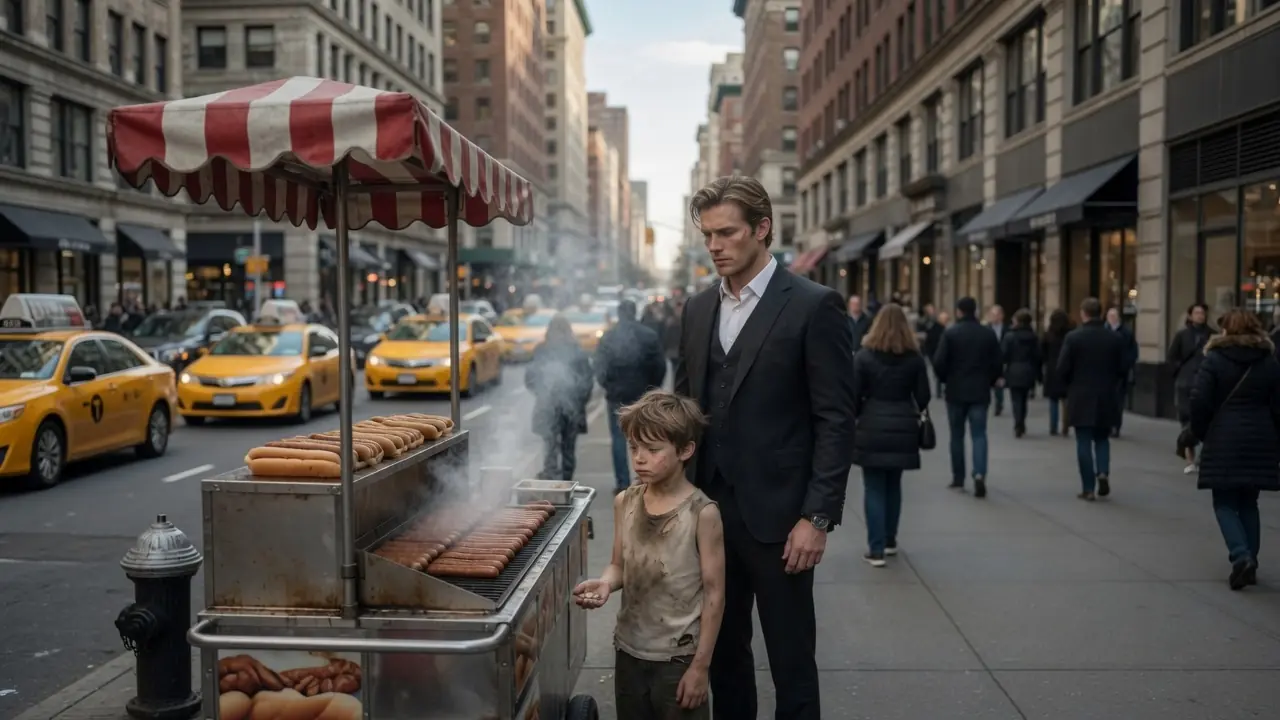
Then a third time, slower, as if the coins might become more if he looked at them carefully enough.
They did not.
Behind the glass case, the hot food at Maribel’s Corner Grill steamed under yellow lights. Fried chicken strips, mashed potatoes, green beans, biscuits brushed with butter, and a tray of macaroni and cheese that looked almost too bright to be real.
The boy kept staring at the macaroni.
His name was Caleb Ward.
He was eleven years old, thin in the way children get when they are growing faster than life can keep up with, with light brown skin, dark curls, and a navy hoodie that had been washed so many times the sleeves had started to fade gray. His backpack hung from one shoulder, heavy with schoolbooks and a folded math test he had not shown his mother yet.
He had gotten an A.
He wanted to tell her over dinner.
That was the plan.
But plans are easier when there is dinner.
Maribel’s Corner Grill sat inside the Rivergate Transit Market, a busy indoor stop in the small fictional city of Larkhaven, West Carolina. Buses came and went outside every fifteen minutes, groaning against the curb while people hurried through the automatic doors with umbrellas, grocery bags, work boots, strollers, and tired faces.
The place smelled like coffee, rain, fried onions, wet coats, and cheap soap from the restrooms.
It was the kind of place where no one stayed unless they had nowhere better to wait.
Caleb stood near the counter, trying not to look hungry.
That was a skill.
Not looking hungry.
He had learned it from his mother without her ever teaching him.
You kept your shoulders loose.
You did not stare too long at other people’s plates.
You did not ask how much food cost until you were close enough to see the menu clearly, because asking too soon made people look at you with pity.
Pity was worse than hunger sometimes.
The woman behind the counter, Mrs. Maribel Reyes, watched him with kind but tired eyes. She was in her late fifties, with silver strands in her black hair, a flour-dusted apron tied around her waist, and hands that moved quickly even when her face looked worn down.
“You ready, sweetheart?” she asked gently.
Caleb looked up at the menu board.
Chicken strip plate — $8.99.
Macaroni bowl — $5.49.
Biscuit — $1.25.
Small drink — $1.75.
He looked back down at his palm.
Three dollars and seventeen cents.
“I’m still deciding,” he said.
The man behind him sighed loudly.
Caleb moved a little to the side.
“Take your time,” Maribel said.
But her eyes went to the growing line behind him, and Caleb understood. Kindness did not stop business. People had buses to catch, shifts to work, children to pick up. The world could feel sorry for you and still need you to move.
He stepped away from the counter.
Not far.
Just enough to pretend he was looking at the condiment station.
He counted the coins again.
One dollar bill, folded soft as cloth.
Eight quarters.
One dime.
Seven pennies.
He could buy two biscuits.
Maybe one biscuit and a small drink if Maribel bent the price, but Caleb did not want her to do that. He knew she sometimes slipped extra fries into takeout bags for men who looked cold and mothers who looked embarrassed.
He also knew businesses could not run on mercy alone.
His mother said that once.
Not angrily.
Just tired.
Caleb had not meant to end up there.
That morning, his mother, Talia Ward, had left before sunrise for a double shift at Briarstone Laundry, a commercial washing plant on the south side of Larkhaven. She washed hotel sheets, hospital towels, and restaurant linens under fluorescent lights until her hands cracked from heat and detergent.
She had left a note on the kitchen table.
Caleb, I’ll be late. Eat the soup in the fridge. Proud of you always. Love, Mom.
But the refrigerator had stopped humming sometime before noon.
When Caleb got home from school, the soup smelled wrong.
He stood in their small apartment on Juniper Flats Road, holding the plastic container and trying to decide if wrong-smelling soup could still be eaten if heated enough. Then he thought of his mother’s face if she found out.
So he threw it away.
He found three dollars and seventeen cents in the jar beside the stove.
Emergency money.
The jar used to hold more.
Then the electricity bill came.
Then the inhaler copay.
Then his mother’s car needed a tire.
Now it held three dollars and seventeen cents.
Caleb took it because he thought maybe Maribel’s had something cheap.
Something warm.
Something he could eat half of and save half for his mother.
He had done that before.
A stranger noticed him while he stood near the napkin dispenser.
Not at first.
The stranger was not looking for a child to rescue.
He was a man with his own problems, his own wet coat, his own tired body moving through the transit market after a day that had stretched too long.
His name was Jonah Reed.
He was thirty-nine, tall, broad-shouldered, Black, with close-cropped hair, a trimmed beard, and the kind of eyes that made him look serious even when he was trying to be gentle. He wore a work jacket with Reedline Repairs stitched over the chest, jeans stained with machine grease, and boots that had seen too many job sites.
He had stopped at Rivergate Transit Market because traffic on the Eastbridge Loop was jammed from an accident, and his stomach had begun growling halfway through his last service call.
He wanted coffee.
Maybe chicken.
Then home.
That was all.
Home, for Jonah, was a rented duplex on Cedar Lantern Street, where a lamp in the front window came on automatically at six because he still liked returning to light even though nobody lived there but him.
His wife, Naomi, had died four years earlier.
His daughter, Brielle, lived with her mother’s sister in another city during the school year because Jonah’s work schedule had become too unpredictable after the medical debt swallowed his savings. That arrangement was supposed to be temporary.
Temporary had a way of growing roots when money was involved.
Jonah carried that guilt everywhere.
In his wallet.
In his truck.
In the quiet seat across from him at dinner.
He stepped into Maribel’s Corner Grill and got in line three people behind Caleb.
At first, he noticed only the boy’s hoodie.
Too thin for the rain.
Then the coins.
Then the way the boy kept looking at the food and looking away.
Jonah felt something move in his chest.
Not pity.
Recognition.
There is a difference.
Pity looks down.
Recognition sits beside you.
Jonah had been that boy once.
Not in Larkhaven.
Not at Maribel’s.
But in a bus station in a town called Elliston Ridge that existed only in his memory now, standing with seventy-two cents in his pocket and hunger making him dizzy while his mother pretended she was not hungry at all.
He remembered the exact smell of that day.
Diesel.
Coffee.
Wet wool.
Fried potatoes from a counter they could not afford.
He had been nine.
His mother had been leaving his father with two bags, a swollen cheek, and no plan except north.
They were supposed to buy one sandwich and split it.
But they did not have enough.
Jonah remembered the shame of the cashier saying, “That’s not enough, ma’am,” loud enough for the line to hear.
He remembered his mother turning red.
He remembered deciding, at nine years old, that he would never want anything again if wanting made his mother look like that.
Then a stranger had stepped forward.
An older man in a railroad jacket.
He paid for two sandwiches, two cartons of milk, and a bag of chips.
Not dramatically.
Not with a speech.
He only said, “I bought too much.”
Jonah knew it was not true.
His mother knew it too.
But the lie let them keep their dignity.
Jonah had never forgotten him.
He never knew the man’s name.
For thirty years, he had carried the memory like a small warm coal.
Now, standing in line at Maribel’s, he saw Caleb count three dollars and seventeen cents, and that coal flared.
The man in front of Jonah muttered, “Kid’s been standing there forever.”
Jonah looked at him.
The man suddenly found the menu interesting.
Caleb stepped back toward the counter with the bravery of someone lowering his expectations.
“Can I get two biscuits?” he asked.
Maribel looked at him.
“Just biscuits?”
“Yes, ma’am.”
“You want butter?”
“If it comes with it.”
“It comes with it.”
She rang it up slowly.
Two biscuits came to $2.50.
Caleb placed the coins on the counter one by one.
His hands were clean but cold.
Maribel took the money, then slid a paper bag toward him.
Jonah saw her hesitate.
She wanted to add something.
He knew that look.
He had worn it himself at times, wanting to help but not wanting to expose someone in front of strangers.
Before Caleb could step away, Jonah spoke.
“Hold on, buddy.”
Caleb froze.
That was the wrong first sentence.
Jonah knew it immediately.
The boy’s shoulders tightened.
Maribel looked up.
The line went quiet in the way lines do when people sense discomfort and decide whether to watch or pretend not to.
Jonah moved carefully.
“You like macaroni?”
Caleb stared at him.
“What?”
Jonah nodded toward the food case.
“The mac and cheese. You were looking at it like it might have answers.”
Maribel’s mouth twitched.
Caleb’s face flushed.
“I was just looking.”
“Nothing wrong with looking.”
Jonah stepped to the counter.
“Maribel, let me get the chicken plate, extra mac, green beans, two biscuits, and a lemonade.”
Caleb stepped back.
“I don’t know you.”
“That’s true.”
“I didn’t ask.”
“That’s also true.”
Jonah kept his voice calm.
“I’m not buying it because you asked. I’m buying it because when I was your age, somebody bought me dinner when I didn’t have enough. I’ve been looking for a chance to return it ever since.”
Caleb looked suspicious.
Good.
Jonah respected suspicion in hungry children.
It meant they were still protecting something.
“I can’t pay you back,” Caleb said.
“I didn’t ask.”
“My mom says not to take things from strangers.”
“Your mom sounds smart.”
“She is.”
“Then we can do it this way,” Jonah said. “I’ll buy too much food for myself. You can help me not waste it. That way you’re doing me a favor.”
Caleb studied him.
The line behind them had gone quiet.
Maribel put both hands on the counter.
“I can set it at the small table by the window,” she said gently. “Right where I can see.”
Caleb glanced at her.
That seemed to matter.
He trusted Maribel at least a little.
“Okay,” he said finally. “But I’m taking the biscuits to my mom.”
Jonah nodded.
“Deal.”
They sat at the small table near the window while buses pulled in and out beyond the glass.
Rain traced crooked lines down the pane.
Maribel brought the tray herself.
She added an extra container of mashed potatoes without mentioning it.
Jonah noticed.
So did Caleb.
Neither said anything.
That was part of dignity too.
Caleb ate slowly at first, trying to act like he was not starving. He used the plastic fork carefully. He took small bites of chicken, then green beans, then macaroni. But hunger is honest in the body, and soon he stopped performing.
Jonah looked away when the boy ate faster.
He knew that kindness sometimes meant not watching.
“What’s your name?” Jonah asked after a while.
“Caleb.”
“Jonah.”
Caleb nodded.
“You work fixing stuff?”
Jonah looked down at his jacket.
“Mostly commercial appliances. Restaurant refrigerators, laundry machines, HVAC units when the company overbooks me.”
“My mom works at a laundry place.”
“Which one?”
“Briarstone.”
Jonah’s expression changed.
“I’ve been there.”
Caleb looked up.
“You have?”
“Fixed two industrial dryers there last month. Loud place.”
“My mom says she can hear the machines in her sleep.”
“I believe it.”
Caleb wiped his mouth with a napkin.
“She works hard.”
“I bet she does.”
“She used to work at a school cafeteria, but they cut hours. Briarstone pays more if she takes extra shifts.”
Jonah nodded.
He knew the math of survival.
Jobs were not chosen only by dignity or dreams.
Sometimes they were chosen by which one kept the lights on one more month.
“Where is she tonight?” he asked.
“At work. She left soup, but the fridge stopped working.”
Jonah looked at him.
“The fridge stopped?”
Caleb realized too late he had said too much.
He looked down.
“It’s okay.”
“What’s okay?”
“The soup. I threw it out.”
“That was smart.”
“I wasn’t sure.”
“Food poisoning costs more than dinner.”
Caleb’s mouth twitched.
“My mom would say that.”
“Your mom sounds like someone who knows things.”
“She knows everything.”
The way he said it made Jonah’s chest ache.
Children should believe that.
As long as they can.
Caleb finished half the plate, then carefully put the remaining chicken, one biscuit, and most of the mashed potatoes into the takeout container Maribel provided.
“For your mom?” Jonah asked.
Caleb nodded.
“She says she’s not hungry when she gets home late. But she is.”
Jonah swallowed.
“My mother used to say that too.”
Caleb looked at him.
“You were poor?”
The question came without cruelty.
Just direct.
Kids sometimes do that before adults teach them to decorate truth.
“Very,” Jonah said.
“Are you still?”
Jonah considered lying.
Then chose better.
“Not the same way.”
Caleb seemed to understand that more than most adults would have.
“You got money now?”
“Enough for dinner. Enough to help sometimes. Not enough to stop worrying forever.”
Caleb nodded.
“My mom says people with money still worry, but they worry in warmer houses.”
Jonah laughed softly.
“She’s not wrong.”
For the first time, Caleb smiled.
A small smile.
Quick.
But real.
Jonah felt something in himself loosen.
“What grade are you in?”
“Sixth.”
“Good at school?”
Caleb shrugged.
“Sometimes.”
“That means yes.”
He hesitated, then reached into his backpack and pulled out a folded paper.
“My math test.”
Jonah took it only after Caleb held it out fully.
A in red ink.
At the top, the teacher had written: Excellent work, Caleb. You see patterns clearly.
Jonah smiled.
“That’s impressive.”
Caleb tried not to look pleased.
“My mom wanted me to show her.”
“You should.”
“I will. Over dinner.”
Jonah folded the test carefully and handed it back.
A bus groaned outside.
The loudspeaker crackled.
Route 8 to West Lark, boarding at Gate 3.
Caleb looked at the clock.
“I should go.”
“You taking the bus?”
“Yeah.”
“Which route?”
“Eight.”
Jonah looked toward the gates.
It was raining harder now.
“You got a ride from the stop home?”
“I walk.”
“How far?”
Caleb shrugged.
“Not far.”
Children without rides always say not far.
Jonah knew that too.
He reached into his pocket, pulled out a business card, and placed it on the table.
It read:
Jonah Reed
Reedline Repairs
Appliance and Mechanical Service
“If your mom wants the fridge looked at, she can call me.”
Caleb stared at it.
“We can’t pay a repairman.”
“I didn’t say anything about paying.”
“My mom won’t like that.”
“Then tell her I owe somebody from thirty years ago, and I’m paying the debt forward. She can argue with history if she wants.”
Caleb almost smiled again.
“She might.”
“I’ll risk it.”
Caleb took the card.
Then he slid something across the table.
Three pennies.
Jonah looked at them.
Caleb’s face was serious.
“For the food.”
“No.”
“My mom says we don’t take charity.”
Jonah held his gaze.
“My mother said the same thing. So let’s call it an investment.”
“In what?”
“You.”
Caleb did not know what to do with that.
So he picked up the takeout container and his backpack.
“Thank you,” he said.
“You’re welcome.”
He started to leave, then stopped.
“Did the person who helped you know you remembered?”
Jonah felt the question hit him somewhere deep.
“No,” he said. “I never saw him again.”
Caleb nodded slowly.
“That’s sad.”
“It is.”
Then the boy looked down at the takeout container.
“I’ll remember.”
He walked away before Jonah could answer.
Through the window, Jonah watched him hurry toward Gate 3, shoulders hunched under the too-thin hoodie, one hand protecting the food from rain.
Maribel came to the table and set down a coffee.
“On the house,” she said.
Jonah looked up.
“You can’t run a business on mercy alone.”
She smiled.
“No. But I can season it with some.”
He laughed.
Then his phone buzzed.
A message from his daughter, Brielle.
Dad, are you still coming Sunday?
Jonah stared at the screen.
He had almost forgotten.
Not because he did not care.
Because guilt makes people avoid calendars.
He typed back.
Yes. Wouldn’t miss it.
Then he added:
Can I bring you dinner from that place you like?
Her reply came fast.
Only if you eat with me this time.
Jonah closed his eyes.
There it was.
The debt inside his own house.
He had been so busy surviving, working, paying, fixing, running from old hunger, that he had become absent in a new way.
He had enough to buy strangers dinner.
But his daughter wanted him to sit down.
He typed:
I’ll eat with you. Promise.
That Sunday, Jonah kept the promise.
He drove to Greystone Parish, another fictional town two hours north, where Brielle lived with her Aunt Monique during the school year. Brielle was fourteen, tall, sharp-eyed, and polite in the way teenagers get when they are not sure whether they are allowed to be angry.
Jonah brought dinner from her favorite chicken place.
He also brought the story of Caleb.
Not all of it.
Just enough.
A boy at a food counter.
Not enough money.
A meal.
An old memory.
Brielle listened from across Monique’s dining table.
“So you helped him because someone helped you?”
“Yes.”
She poked at her fries.
“That’s good.”
Jonah heard the unsaid part.
He waited.
Brielle looked up.
“Do you ever think about how people can help strangers because strangers don’t expect anything every day?”
Monique, at the sink, went very still.
Jonah set his fork down.
“Yes,” he said. “I think I’ve been learning that.”
Brielle looked surprised by the honesty.
“I’m not saying you’re bad.”
“I know.”
“You send money.”
“I know.”
“And you call.”
“Not enough.”
She looked down.
“No.”
The word was soft, but it landed harder than anger.
Jonah nodded.
“I got scared after your mom died. I thought if I worked enough, paid enough, fixed enough, I could keep everything from falling apart.”
Brielle’s eyes filled, but she blinked fast.
“It fell apart anyway.”
“Yes,” Jonah said. “And I left you holding pieces you shouldn’t have had to hold.”
Monique turned away, wiping the counter too hard.
Brielle did not speak for a while.
Then she said, “Can we start with Sunday dinners?”
Jonah’s throat tightened.
“Yes.”
“Every Sunday?”
“Yes.”
“Even when you’re tired?”
“Especially then.”
She studied him.
“You promise?”
He thought of Caleb.
Of three pennies.
Of a man in a railroad jacket saying he bought too much.
“I promise.”
The next morning, Jonah got a call from an unknown number while replacing a walk-in cooler fan at a restaurant called Pike & Clover.
He answered with one hand inside a machine.
“Reedline Repairs.”
A woman’s voice came through, cautious and tired.
“Is this Mr. Reed?”
“Yes.”
“My name is Talia Ward. My son Caleb gave me your card.”
Jonah straightened.
“Ma’am.”
“He said you bought him dinner.”
“Yes.”
A pause.
“He also said you said you owed history.”
“I did say that.”
She sighed.
Not angry exactly.
Worn.
“Mr. Reed, I appreciate what you did. I do. But I don’t want my son thinking he can accept things from strange men at transit stations.”
“You’re right.”
That surprised her.
“I am?”
“Yes. He was cautious. He sat where Maribel could see. He took food, not a ride. He protected your dinner like it was gold. You’re raising him well.”
The line went quiet.
When Talia spoke again, her voice was softer.
“He brought me chicken and mashed potatoes. Told me about his math test. Said a man who fixes things said he sees patterns clearly.”
“He does.”
“You know that from one dinner?”
“I know enough.”
Another pause.
Then the hard part.
“The fridge,” she said.
“I can come after my last call.”
“I can’t pay today.”
“I’m not asking you to.”
“I can pay something next Friday.”
“Mrs. Ward, no.”
“I don’t take charity.”
“I respect that.”
“Then let me pay.”
Jonah leaned against the cooler door.
“How about this? I look at the fridge. If it’s small, I fix it. If it’s parts, I tell you what parts cost. You decide from there. No surprises.”
She hesitated.
“That’s fair.”
“And if it turns out to be a simple fix, maybe one day you help someone else when you can.”
“I already do that,” she said.
“I figured.”
That evening, Jonah climbed the stairs to Talia and Caleb’s apartment on Juniper Flats Road with his tool bag in one hand.
The building smelled like old carpet, boiled cabbage, and someone’s laundry detergent.
Caleb opened the door before Jonah knocked twice.
“Mom, he’s here.”
Talia stood behind him wearing her work uniform, hair tied back, eyes alert.
She was younger than Jonah expected. Early thirties maybe, but exhaustion had placed older shadows under her eyes. Her hands were dry and cracked, just like he imagined from the laundry plant.
“Mr. Reed.”
“Jonah is fine.”
“Talia.”
The apartment was small but cared for.
A couch with a blanket folded neatly over the arm.
A table with two chairs.
A shelf of library books.
A jar near the stove with no coins in it.
The refrigerator stood in the corner, silent and guilty.
Jonah pulled it away from the wall and got to work.
Caleb hovered nearby, fascinated.
“What’s that?”
“Compressor relay.”
“What does it do?”
“Helps the compressor start.”
“What’s the compressor?”
“The heart of the fridge.”
“Can hearts break?”
Jonah glanced at Talia.
She looked down.
“Sometimes,” he said. “But sometimes they just need the right part.”
The relay had burned out.
A cheap part.
Jonah had one in his truck.
He replaced it in fifteen minutes.
The refrigerator hummed back to life.
Caleb clapped once, then stopped as if embarrassed.
Talia’s face changed.
Relief can make people look suddenly younger.
“What do I owe you?” she asked.
“Nothing tonight.”
“Jonah.”
“The part cost me six dollars.”
“I can pay six.”
He considered refusing.
Then remembered dignity.
“Six is fine.”
She took money from her wallet slowly.
One five.
One single.
He accepted it.
Not because he needed it.
Because she needed to give it.
Caleb watched carefully.
Jonah put the bills into his pocket and said, “Officially paid.”
Talia nodded.
“Thank you.”
Before he left, Caleb ran to the table and grabbed his math test.
“I showed Mom.”
“I saw the grade.”
“She put it on the fridge.”
Jonah looked.
There it was, held by a magnet shaped like an apple.
Excellent work, Caleb. You see patterns clearly.
Jonah smiled.
“Best place for it.”
At the door, Talia walked him into the hallway.
Her voice lowered.
“He hasn’t had many men be kind without wanting something.”
Jonah understood what she was really saying.
“I don’t want anything from him.”
“I know. That’s why I’m saying thank you.”
He nodded.
Then she added, “He talked about you all night.”
Jonah looked toward the apartment.
Caleb was checking the fridge like it might stop humming if unsupervised.
“He’s a good kid.”
“He is.”
“You need anything else looked at while I’m here?”
Talia’s pride rose visibly.
He saw it and corrected himself.
“I mean the building. Sometimes landlords ignore things until a repairman writes it down.”
Her face softened.
“The heater knocks.”
“Have him call me.”
“He won’t.”
“Then I’ll write it down anyway.”
Two weeks later, Jonah found himself back at Rivergate Transit Market.
Not by accident.
He told himself he was checking on Maribel’s ice machine, which did need maintenance.
But after finishing the service, he ordered coffee and looked toward the table by the window.
Caleb was not there.
Jonah felt ridiculous for being disappointed.
Then Maribel came over with a plate.
“Chicken and mac,” she said.
“I didn’t order.”
“No, but you looked like a man waiting for a ghost. Food helps.”
He laughed.
“You always this observant?”
“I run a grill in a bus station. Observation is half the job.”
She slid into the chair across from him without asking.
“That boy came by yesterday.”
“Caleb?”
“With his mother. Paid full price for a biscuit and coffee. Left me a note.”
She pulled a folded napkin from her apron pocket.
Jonah opened it.
In careful handwriting, Caleb had written:
Thank you for helping us. Mom says the fridge works better than before. I got another A. I’m going to help someone too someday.
Jonah read it twice.
Then folded it carefully.
Maribel watched him.
“You know, there’s a homework program here on Wednesdays,” she said. “Kids waiting for late buses. Mostly just need adults who can help with math and keep them out of trouble.”
Jonah looked at her.
“I fix refrigerators.”
“You also bought a hungry boy dinner.”
“That doesn’t make me qualified.”
“No,” Maribel said. “But maybe being hungry once does.”
He hated how that landed.
Because it was true.
The next Wednesday, Jonah returned.
There were six kids at first.
Then nine.
Then twelve.
They sat at two pushed-together tables near Maribel’s counter, doing homework with donated pencils and eating whatever snacks Maribel could spare. Jonah helped with math because numbers behaved better than people.
Caleb came the second week.
He tried to act surprised.
Jonah did too.
“You again?” Caleb said.
“Apparently I work here now for crackers.”
Caleb grinned.
“My mom said I could stay if I finished homework before bus time.”
“Then let’s see what you’ve got.”
Week by week, the program became real.
Maribel called it Counterlight Club because the kids worked under the yellow counter lights after school.
A local teacher donated workbooks.
A church group brought fruit.
Jonah fixed Maribel’s freezer for free, and she pretended to be annoyed until he accepted pie as payment.
Talia came by some nights after work, uniform wrinkled, eyes tired, but proud as she watched Caleb explain fractions to a younger boy named Finn.
One evening, she stood beside Jonah near the drink station.
“You started something,” she said.
“No. Maribel did.”
“Don’t dodge.”
He smiled.
“Maybe Caleb did.”
“That I’ll accept.”
They watched Caleb lean over a worksheet.
Patient.
Serious.
Confident.
Talia’s voice softened.
“He looks different here.”
“How?”
“Less like he’s apologizing for needing things.”
Jonah understood that too well.
“He should never have had to.”
“No child should.”
But many did.
That was why the tables filled.
One rainy evening in March, Jonah arrived late after a brutal day repairing dryers at Briarstone Laundry. His shoulders ached. His hands were nicked and sore. He almost skipped Counterlight Club.
Then he thought of Sunday dinners with Brielle.
How she watched whether he kept promises.
So he went.
When he walked in, the kids were already working.
Caleb looked up.
“You’re late.”
“Bossy now?”
“You said patterns matter. Your pattern is 4:15.”
Jonah laughed.
“Fair.”
Caleb slid a paper across the table.
It was not homework.
It was an essay.
The prompt at the top read: Describe someone who changed the way you see the world.
Jonah looked at Caleb.
“You want me to check grammar?”
“Maybe.”
He began reading.
The essay was titled Three Dollars and Seventeen Cents.
Jonah made it through the first paragraph before his vision blurred.
Caleb had written about standing at the food counter.
About being hungry and trying not to look hungry.
About a stranger who did not make him feel small.
About learning that help could be a circle instead of a debt.
One sentence stopped Jonah completely.
Mr. Reed did not save my life with chicken and macaroni, but he saved something that was getting tired inside me.
Jonah had to set the paper down.
Caleb looked alarmed.
“Is it bad?”
“No,” Jonah said, voice rough. “It’s very good.”
“You’re crying.”
“Allergies.”
“It’s March.”
“March has pollen.”
“We’re inside.”
“Very aggressive indoor pollen.”
Caleb smiled, but gently.
He knew.
Children like Caleb always knew.
That essay won second place in the Larkhaven Youth Writing Showcase.
Talia took a morning off work to attend the ceremony at the community arts center. Brielle came too, sitting beside Jonah in the second row. When Caleb read his essay aloud, Jonah stared at the floor because looking proud in public felt too large for his chest.
Afterward, Brielle nudged him.
“You okay?”
“No.”
She smiled.
“Good.”
Caleb found him in the lobby.
“You heard it?”
“I heard it.”
“Was it weird?”
“Yes.”
“Bad weird?”
“No.”
Caleb nodded.
Then he handed Jonah something small.
Three pennies.
Jonah stared at them.
“I tried to pay you before,” Caleb said. “You wouldn’t take it. But my essay won fifty dollars. Mom said I can donate some to Counterlight Club. These are just for you.”
Jonah closed his hand around the pennies.
This time, he accepted them.
“Thank you.”
Caleb smiled.
“Officially paid?”
Jonah swallowed.
“Officially continued.”
Years passed, as they do in stories and real life, unevenly.
Counterlight Club became a program.
Then a nonprofit.
Maribel’s Corner Grill expanded into the empty space next door and added a long table just for students. Jonah handled repairs. Talia joined the board after she became shift supervisor at Briarstone. Brielle volunteered every summer and eventually wrote her college application essay about Sunday dinners and the mathematics of showing up.
Caleb grew taller.
His hoodie sleeves finally fit because Talia insisted on buying new clothes when she could, and because Jonah learned to give gift cards through Maribel so pride had room to breathe.
He kept getting A’s.
Not always.
But often.
When he struggled, he did not hide it as much.
That mattered more.
At seventeen, Caleb received a scholarship to study mechanical engineering at North Fenwick Institute, a fictional college four hours away. At his graduation party, held at Maribel’s after closing, he stood near the same counter where he once counted coins.
He wore a white shirt, borrowed tie, and the stunned expression of a young man discovering the future had actually opened a door.
Talia cried before the cake was cut.
Maribel cried while pretending she had spilled lemonade.
Brielle cried openly because she had grown into the kind of young woman who refused to apologize for feeling things.
Jonah did not cry until Caleb handed him an envelope.
Inside was a photograph.
Caleb at eleven, standing beside Maribel’s counter with a paper bag in one hand.
Jonah did not remember anyone taking it.
On the back, Caleb had written:
You said someone once bought too much. I hope I live like that too.
Jonah stepped outside after reading it.
The evening air smelled like rain and fried onions.
Buses moved in and out of Rivergate Transit Market just as they always had. People hurried through doors with bags, uniforms, tired children, and private burdens. Somewhere inside, a child was probably counting coins. Somewhere else, an adult was deciding whether to notice.
Caleb found him near the curb.
“You disappeared.”
“Needed air.”
“You do that when you’re emotional.”
“I’m a mysterious man.”
“You are not.”
Jonah laughed.
For a moment, they stood watching the buses.
Then Caleb said, “Do you ever wonder about the man who helped you?”
“All the time.”
“What would you say if you found him?”
Jonah thought about the railroad jacket, the sandwiches, his mother’s red face softening with relief.
“I’d say he didn’t just buy food. He interrupted a story I was telling myself.”
“What story?”
“That needing help made me less of a man.”
Caleb nodded.
“I used to think needing help made me less of everything.”
“I know.”
“Not anymore.”
Jonah looked at him.
That was enough.
More than enough.
The summer before college, Caleb worked at Maribel’s and helped run Counterlight Club for younger kids. One evening, a girl named Ava stood at the counter with two dollars and a hungry little brother. She was trying to calculate what they could share without asking too many questions.
Caleb saw her.
Jonah saw Caleb see her.
The young man walked to the counter, pulled out his own wallet, and said casually, “Maribel, I ordered too much again. Can you make that two chicken plates?”
Ava looked suspicious.
Good.
Caleb smiled.
“You’d be helping me out. I hate wasting food.”
Jonah sat at the window table and looked away.
Kindness had come full circle.
Not perfectly.
Not magically.
There were still bills.
Still broken refrigerators.
Still late buses.
Still mothers working double shifts and children learning too early how much dinner cost.
But there was also this.
A table under yellow lights.
A boy who had been fed becoming a young man who fed someone else.
A stranger’s old memory becoming a community’s habit.
Maribel set a coffee beside Jonah.
“Indoor pollen?” she asked.
He wiped his face.
“Aggressive as ever.”
She sat across from him.
“You did good, Jonah Reed.”
He watched Caleb carry the trays to Ava and her brother.
“No,” he said softly. “Somebody did good by me once. I just finally stopped holding it for myself.”
Outside, rain began to fall again over Larkhaven.
It streaked the windows and shone under the bus lights.
Inside Maribel’s Corner Grill, the counter lights glowed warm and steady.
A hungry child ate.
A mother somewhere would receive leftovers.
A young man learned that generosity did not make him empty.
And Jonah Reed, once a boy with seventy-two cents and a shame too heavy for his age, sat in the place between memory and hope, knowing at last what the stranger in the railroad jacket had given him all those years ago.
Not charity.
Not pity.
A meal.
A moment.
A quiet message passed from one wounded life to another.
You are not invisible.
You are not less because you need help.
Eat now.
Someday, when you can, help someone else eat too.