The debts are cleared. She is yours. The contract is signed. The debt is settled. The day my father traded me to the mad duke.
He never expected I would be treated like a queen. The document was four pages long. Rose Wentworth had read all four of them through the gap in the library door on the morning of the 14th of January, standing on the cold flagstone floor in her stocking feet, her dark curly hair still unpinned, her breath held so completely that she noticed the absence of it only when the door closed and the voices inside became indistinct. Four pages. Her name appeared 11 times. She was 22 years old.
She had her mother's eyes and her grandfather's mind and 17 pounds and four pence in the household account that she had been managing since the autumn when it became apparent that her father had stopped being capable of managing it himself. She knew the exact quantity of coal left in the cellar, the outstanding debt to the butcher on Cavendish Row, and the precise figure of what it would require to keep the roof above their heads through February. She had not, until this morning, known that she was also a figure in her father's accounting. Lord George Wentworth, Baron of Ashden, had accumulated debts with the systematic thoroughness of a man who had convinced himself that the next card would correct the previous ones. The town house was mortgaged.
The Yorkshire estate, her mother's estate, the one that smelled of lavender in summer and whose kitchen garden Rose had been mapping in her head since childhood as the place she would return to, was gone. Sold in November to a merchant banker who had not bothered to visit it. What remained was the Wentworth name. Specifically, the Wentworth daughter attached to the Wentworth name. And a man who wanted both.
Callum James Ashford, seventh Duke of Ravenmore, had a reputation that preceded him through London drawing rooms like weather, not a specific event, but a condition, something that changed the atmosphere of any room it entered. They called him the Mad Duke, which Rose had always suspected was the aristocracy's preferred method of describing a man they found too direct to be comfortable with. He had served eight years in the military before his uncle died and the dukedom found him. He had returned from service without the social polish that eight years absence was supposed to have been replaced by. He said what he meant.
He declined invitations that bored him. He had been engaged once, five years prior, to a woman named Miss Clara Dunning who had died of fever before the wedding, and the story that had grown around this, as stories will, had become a thing of considerable gothic elaboration. By the time it reached Rose's drawing room it involved a locked room and a portrait and a grief that had broken something essential in him. Rose, who understood the specific mechanics by which ordinary misfortune became legend in idle mouths, was prepared to discount most of it. She was less prepared for her father's voice, floating out through the gap in the library door, arranging her life with the particular casualness of a man who had confused his daughter with a negotiable instrument.
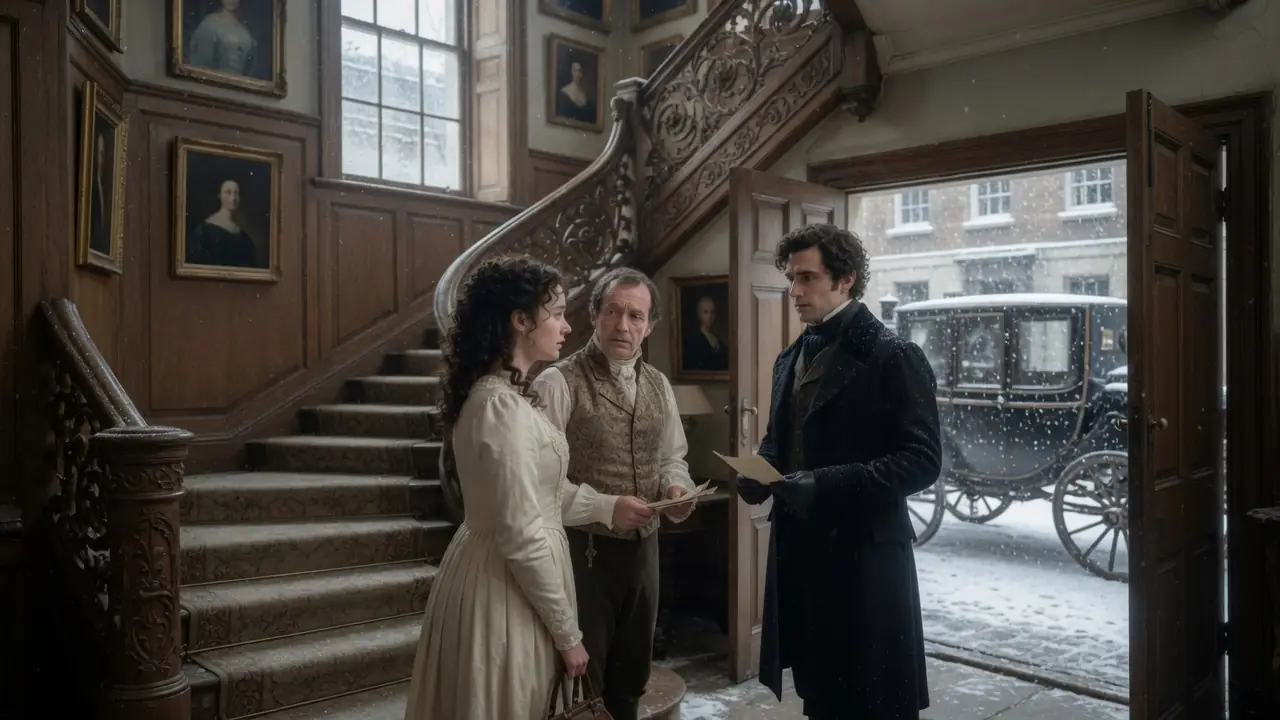
"Rose," Lord George's voice carried to the staircase. "Come down." She descended. Not because she had been given no alternative. She was still calculating alternatives, rapidly and without showing it, the way she calculated everything. But because the document had her name on it 11 times and the meeting was already assembled and the Duke of Ravenmore was already in her father's entrance hall, and the only leverage available to her in the next 60 seconds was how she appeared in the doorway at the bottom of the stairs.
She appeared with her chin level. Callum Ashford looked at her. He was taller than she had expected, six feet and three inches of absolute unhurried stillness in a black greatcoat dusted with snow at the shoulders. His dark curly hair disordered from the cold. His dark gray eyes moving from her face downward and then back up in a single complete assessment that lasted three seconds and contained, as far as she could determine, nothing prurient.
Placed them inside his coat. His dark gray eyes returned to Rose's face. She looked back at him with everything she had, the total undeflected regard of a woman who has decided that what she does with the next three seconds will say something true about who she is and who intends that truth to be intentional. "The carriage is waiting," Callum said. Two words. Quiet, even, carrying no particular inflection.
Not a command. Not an invitation. Simply the next fact of the situation offered without ornament. Rose turned to her father. Lord George Wentworth was not looking at his daughter.
His pale blue eyes were on the document folded inside the Duke's coat, the document that represented the clearing of his debts, the postponement of his reckoning, the price that made the transaction feel, to the mind of a man practiced at this particular arithmetic, like a reasonable exchange. Rose looked at him for four full seconds. He did not raise his eyes. She turned back to the door, picked up her traveling bag from the floor where she had placed it before coming downstairs. She had packed it herself two hours ago because she had read the document through the library door and understood that packing it herself was the first available act of autonomy and walked out of her father's house into the winter cold.
The snow was falling on Wentworth Street in the specific indifferent way that London snow falls, muffling the city, making everything briefly equal under white, completely unconcerned with the human arrangements happening beneath it. Rose stood on the step. Behind her, the door of the house that had her name in its lintel closed with a soft definitive sound. Beside her, without hurry, Callum Ashford descended the steps and held open the carriage door. Rose looked at the carriage.
She looked at the dark snow-dusted moors visible at the end of the London street in her imagination, Raven Moor, which she had never seen, which was entirely unknown to her, which was now where she was going. She looked at Callum. He was watching her with the dark gray eyes that gave nothing away and took everything in. He was not performing patience. He was simply waiting with the absolute stillness of a man who has made his decision and is giving the situation its due time.
Rose stepped up into the carriage. The door closed. The carriage moved. She did not look back.
For the first two hours, neither of them spoke. This was Rose's choice as much as his. She had observed, in the few minutes of their acquaintance, that Callum Ashford occupied silence the way most people occupy a room, with complete and unselfconscious presence, and that attempting to fill that silence with the conventional social pleasantries of a first meeting would tell him a great deal about her that she was not yet prepared to share. She looked out the window instead. The city gave way to the northern roads with the gradual shedding of the urban particular, first the density of buildings, then the gas lamps pacing themselves further apart, then the lamp posts gone entirely and the road lit only by the carriage lantern swinging against the dark and the occasional cold moon emerging from the cloud cover to lay a pale path across the frozen fields.
She watched all of this with the complete absorbing attention she brought to everything she did not yet understand. Callum sat across from her in the dark interior of the carriage, his gloves removed now that they were inside, his hands resting with characteristic stillness on his knees. He was reading. A small leather-bound volume held in the lamplight, read with the total concentrated attention of a man who was actually reading and not performing it. Rose found this more interesting than she intended to.
Most men of her limited acquaintance who read in company did so demonstratively, positioning the book, glancing up to confirm they had been observed, adjusting the angle of engagement. Callum simply read. The book had his complete attention. She was not a distraction requiring management. She was simply present in the same space, which he was apparently entirely comfortable with.
After the second hour, he looked up. Their eyes met across the carriage interior in the swaying amber light of the interior lamp. Rose, whose preparation for this journey had included the full range of social strategies available to a woman in her situation, pliability, deflection, the careful manufacture of an impression, abandoned all of them in the specific instant that she looked into his dark gray eyes and found that they were already looking at her with the kind of attention that social strategies are designed for precisely because they are so rarely encountered. "You read the document," Callum said. It was not a question.
His voice was low, even, carrying the particular quality of a man stating an observation rather than making an accusation. Rose's chin was level. "All four pages through the library door before the meeting. She paused once. Your solicitor's handwriting is very small.
Something shifted in his expression, not quite amusement, not quite the formal response the situation would conventionally require. It was more careful than either. More interested. "Your father had the impression," Callum said, returning his gaze to the window, "that you had not been consulted in advance." Rose looked at the middle distance between them. The impression was accurate.
She waited a single beat. "The consultation that would have preceded it was not made available to me." The carriage moved through the dark. The moon came out again, laying cold light across the fields on Rose's side of the carriage. "I intend to make it available to you now," Callum said.
His eyes came back to her face. "Whatever the document stipulates, I consider it a document between your father and my solicitor rather than between you and me. There are things I require of this arrangement, and there are things I do not. I will tell you which is which, and I will ask you to tell me the same in return." Rose studied him.
The carriage swayed. Outside, the first moors had begun, the great flat dark of the northern landscape stretching away on both sides, empty and immense and entirely without the social architecture of the city. "What do you require?" she asked. He looked at her with the direct, unperforming attention that she was already understanding was simply the ordinary condition of his engagement with the world. "Someone who will not perform contentment she does not feel," Callum said.
"Someone who will tell me what she thinks in preference to what she believes I wish to hear." His voice remained level. "I have had sufficient experience of managed impressions to find them entirely exhausting. And someone who will manage Ravenmore's household correspondence, which is currently 3 months in arrears because I find it, without exception, the most tedious aspect of my existence. The last admission was entirely unexpected.
A fraction of a second too late, the left dimple appeared in Rose's cheek. Callum saw it. Something moved in his dark gray eyes, brief, quickly returned to stillness, but present. The carriage rolled north into the dark. The estate appeared at dusk on the second day, rising from the moor like something the landscape had generated rather than something human beings had constructed upon it.
Rose pressed her fingers to the cold carriage window glass. The house was vast, a great irregular sprawl of dark Yorkshire stone built across two centuries by different hands with different visions, the result being not a single coherent statement, but a genuine accumulation, layer upon layer, each generation's addition embedded in the previous one's stone like geological strata. Towers at the eastern corner. A walled kitchen garden to the north, enormous, its walls dark with age. The moors pressing close on three sides, treeless and enormous, in winter a palette of gray and brown and the occasional white where the snow had found a purchase.
And behind the house, barely visible in the dusk, the dark flash of a lake, small and perfectly still and the specific black of deep water in fading winter light. No cracked floor tiles here. No half-lit chandelier. Every window blazed. The carriage rolled through the gate and into the courtyard, and before the wheels had fully stopped, Mrs.
Clara Aldridge was at the door, silver-haired, chatelaine at her waist, her dark brown eyes moving from the carriage to the duke who stepped down first and then to Rose who followed. Mrs. Aldridge executed a curtsy that was not the diminished deference of a woman performing a social duty, but the genuine acknowledgement of a woman who has spent 30 years running a household of significant consequence and intends to extend that precision to its newest occupant. "Your Grace," Mrs. Aldridge said to Rose. "The rooms are ready.
The fire has been burning since noon." Rose's chin was level. Her expression carried composure. Underneath it, something had shifted with the precision of a lock mechanism encountering the right key. "Your Grace."
She had been called many things in 22 years. Lord Wentworth's daughter, the girl with the books, the one who manages the accounts, the one without prospects since the estate went. Nobody, in 22 years, had called her Your Grace. She followed Mrs. Aldridge through the great double doors of Raven Moor and into the entrance hall.
The hall was everything the carriage window had suggested and more. Paneled in dark oak that had been maintained to a deep, warm luster. The Raven Moor crest on the far wall above the fireplace. A raven on a field of midnight blue, rendered in carved stone and painted with specific, expensive care. A staircase rising on the left that was large enough to be architectural statement and was clean enough to be a moral one.
On the long dining table along the right wall, candles, fresh-cut, impossible winter flowers from a glasshouse, white and impossible. Rose stopped walking. She stood in the center of the entrance hall and looked at the flowers. Her capable, slightly roughened hands hung at her sides. Mrs. Aldridge, beside her, "His Grace had them cut this morning.
When the carriage time was confirmed." Rose's eyes moved to the flowers. Then to the staircase. Then, across the hall to Callum Ashford who stood at the far end of the entrance in conversation with his steward, his great coat still on, entirely absorbed in whatever business had accumulated in his absence. He had not arranged this for her inspection.
He had not looked up to observe her receiving it. He had simply had the flowers cut and the fires lit and the household in order because that was how he maintained things, and she was now one of the things he maintained. This was a more disorienting form of kindness than Rose had been equipped to handle. Mrs. Aldridge led her up the staircase and along a corridor lit by wall sconces casting warm amber at intervals, and opened a door at the corridor's end. The room inside was large.
The fireplace, white marble, blazing, occupied the wall opposite the door. The four-poster bed had curtains of midnight blue velvet. The tall windows showed the moors at dusk, gray-purple and immense, and against the dusk the first stars were becoming visible. On the writing desk under the window, fresh paper, two ink bottles, a new quill, and a small folded card. Rose crossed the room and opened it.
The handwriting on the card was cramped, angular, and entirely legible. The household correspondence begins in the study at nine o'clock. Bring whatever system you prefer. CA Rose read the card twice. She set it on the desk, face up, beside the fresh paper.
She looked out at the darkening moors for a long moment, at the strange, enormous, silent landscape that was entirely unlike anything she had ever inhabited. Her chin stayed level. But in her chest, something that had been compressed since the library door that morning quietly, fractionally, and entirely without permission, began to loosen. The study at Raven Moor was a room that told the truth about its occupant with the artless honesty of a space inhabited for its function rather than its impression. The books were not arranged for aesthetics.
They were arranged by subject, within each subject by date of publication, and within that by frequency of reference. The most consulted volumes within reach, the rarely opened ones at height, the working ones flat on the desk with their spines broken from regular use. The maps on the walls were annotated in that same cramped, angular hand. Margins filled with observations, dates, cross-references to other documents. The fireplace was clean and blazing, and the room was warm in the specific way of a room used consistently by one person who has specific thermal requirements and ensures they are met.
Rose stood in the doorway at nine o'clock precisely. Callum was already at the desk. His frock coat was on, his cravat immaculate, but his dark hair had the specific quality of someone who had been awake for longer than the morning. He was reviewing a document with the total concentration of a man for whom focus was a default condition rather than an effort. He looked up, pointed at the secondary chair already placed at the desk's right end, returned to his document.
Rose sat down. The correspondence was in a leather box to her left. She opened the lid. Three months, four inches deep, a system of organization suggested urgent matters had been separated from routine ones with admirable intent and then abandoned mid-process because something more pressing had claimed the relevant hour and the system had never been resumed. Rose extracted the first letter. Tenant petition regarding the Northfield drainage, dated November the 4th.
Rose made a note at the top in her own handwriting, small, precise, each letter fully formed, and placed it in the first pile she was constructing. Callum, without looking up from his own document, asked, "What system are you using?" Rose answered, "Date of urgency rather than date of receipt." A letter requesting attention in December ranks below one requiring action before the end of the month, regardless of which arrived first. A brief pause in which the sound of his pen did not cease.
Then Callum said, "There are two letters from the tenant on the South Farm that are likely related. They should be considered as a single matter." Rose reached into the box, found both letters. She had read them in passing and noted the connection without mentioning it, and placed them together. "Yes. And both require a site visit rather than a letter in return," Rose said.
She paused, not performing the pause, but using it. "Has anyone visited the South Farm since October?" Callum's pen stopped. He looked up at her across the desk with dark gray eyes that carried, for the first time in their short acquaintance, something that was not the careful, controlled assessment of a man managing a situation. It was the expression of someone who has just been told something accurate that they had not found the time to articulate to themselves.
"No," he said. "Then the drainage letter and the South Farm petitions belong in the same pile as a physical problem, rather than a correspondence one," Rose said. She made a third stack, separate. Problems requiring presence, rather than paper. Callum looked at the three stacks she had constructed in 6 minutes from a box of documents he had been avoiding for 3 months.
He set down his pen. After a moment, he rose and walked around the desk to her side. He stood behind her, looking at the three piles over her shoulder, and the proximity was close enough that she could hear him breathe and was aware of the warmth of him in the cold study, and chose to be entirely focused on the correspondence. "The South Farm," he said. "I will go next week."
Rose made a note. She wrote his initials and the date beside the South Farm petition. The handwriting was neat and quick and left no space for revision. Callum looked at her handwriting on the margin of his document. He looked at it for a moment with the specific attention he gave everything, which was total and unhurried.
Then he returned to his side of the desk and picked up his pen. The fire burned. The wind came down off the moors and pressed at the study windows. The two of them worked in the specific silence of two people whose minds operate at a compatible frequency and have discovered this not through announcement, but through the simple, undeniable evidence of working together in the same room for an hour. By noon, they had cleared two months of correspondence.
By the South Farm visit six days later, Rose had reorganized the entire estate filing system, drafted 12 letters requiring only Callum's signature, identified three outstanding legal matters that the solicitor had neglected to flag as time sensitive, and discovered, in a box in the lower drawer, the previous duchess's household accounts, meticulous, beautiful records kept by a woman who had run Raven Moor with evident love and thoroughness for 20 years. She left the box on top of the desk where Callum would see it when he returned from the farm. She said nothing about it. He came in at four o'clock with mud on his boots and the cold moor air still on his coat and stopped at the sight of the box. Rose was at the secondary desk working.
Callum stood at the main desk for a moment with his hand on the box. Rose did not look up. He opened the box. Looked at the top page, his mother's handwriting. Rose had identified it from a letter in the files.
He looked at it for a long moment. He closed the box. He sat down. He picked up his pen. He said, without looking up, "Thank you."
Two words, quiet, even. The same quality as all his words, nothing performed in them. Simply the thing he meant. Rose made a notation in the estate ledger. "You are welcome."
The study was quiet. Outside, the moors were going gray in the failing winter afternoon, and the wind was starting, and somewhere in the far distance a raven called once and was answered by the dark. The dinner was not a dinner, technically. It was eight o'clock on a Thursday evening in the third week of Rose's residence at Raven Moor, and she had been so absorbed in cross-referencing the estate's timber contracts against the county surveyor's maps from 1855 that she had not noticed the hour until Mrs. Aldridge appeared in the study doorway with the expression of a woman who has allowed a reasonable amount of late working and has now reached the limit of what she considers reasonable.
"The kitchen," Mrs. Aldridge said, with great clarity, "prepared dinner at seven o'clock." Rose looked up. Across the desk, Callum's side was empty. He had left an hour ago for what he had described, briefly, as a matter in the east corridor.
She had not registered his departure. She followed Mrs. Aldridge to the small dining room. Callum was already there. Not in the formal dining room, the small one, the one used when the household was not assembled for occasion. A fire.
Two places set. Candles. Simple food presented with the precise elegance that Mrs. Aldridge apparently deployed as a default condition regardless of whether occasion warranted it. Rose sat down. For a moment, the ordinary sounds of the house, the fire, the wind outside, the distant business of the kitchen, filled the silence.
Callum looked at her across the candles. His dark gray eyes in the candlelight were warmer than they appeared in the daylight of the study, or rather, the warmth that was always in them and never performed was more visible in lower light, as though the social armor that daylight demanded required a kind of visual restraint that candlelight made unnecessary. "You were reading the 1855 surveys," he said. Rose replied, "The timber contracts reference boundary markers that don't correspond to the current county maps. Either the maps are wrong, or the contracts are wrong, or the boundaries moved in 1862 when the eastern drainage work was done."
She picked up her fork. "I need the original drainage survey." Callum said, "It is in the East Room archive. Third cabinet, second shelf." He paused. "The label says grain tariffs because my uncle misfiled it."
Rose looked at him. He was already looking at her with the expression that had become, over three weeks, the one she associated with the study and the correspondence and the specific quality of working alongside someone whose mind moves in a compatible direction, a look that was not warm in the conventional social sense and was entirely warm in the only sense that mattered to her, which was the sense of complete, genuine, undisguised regard. "You already knew about the boundary discrepancy," she said. "For approximately eight months," he said. His voice held the specific flatness of a man who has known something needed attention and has not had the organizational machinery to address it.
"The situation required someone who could cross-reference the timber contracts against the original drainage survey and identify the specific year the boundary shifted," he said. He looked at her across the candles. "It has been waiting eight months for someone to come and do it." The fire moved. The candles between them threw small warm shadows across the dinner plates and the tablecloth and the two faces on either side.
Rose set down her fork. She looked at him with the complete, absorbing attention she brought to problems she intended to understand entirely, not the managed regard of a woman navigating a social situation, but the genuine, direct engagement of someone who has been working alongside a person for three weeks and has arrived at the evening when they look at them across a candle and discover that the problem they have been solving together is not only in the estate files. "You are not mad," she said. The particular quality of the stillness that followed was entirely different from his ordinary stillness. Rose continued, not as an accusation, not as a performance of insight, simply as the next accurate observation in a sequence of them.
You are simply someone who thinks in systems and finds the absence of a compatible system in another person exhausting. She picked up her fork again. They called you mad because you wouldn't pretend the systems they offered were sufficient. She paused. They weren't. Callum was looking at her with dark gray eyes that had, in the candlelight, undergone the specific transformation that occurred when a controlled, managed exterior of a very private man encounters something that bypasses the management entirely. He said nothing.
But his hand, resting on the table beside his plate, turned very slightly, the fingers opening, palm upward, a small and entirely involuntary movement that took perhaps a second and was the most unguarded thing Rose had witnessed from him. She looked at his open hand. She looked at him. She placed her own hand, capable, ink-stained, slightly roughened at the fingertips, on the table beside his. Not touching his. Beside.
In the specific proximity that was not yet a decision, but was the territory a decision inhabits just before it is made. The candles burned. The moors outside pressed their enormous darkness against the window glass. Raven Moor was entirely quiet, and entirely warm, and entirely theirs. Lord George Wentworth received a letter in February.
It was addressed in a handwriting he did not immediately recognize, small, precise, every letter fully formed. It was brief. It thanked him for the information it contained rather than for any sentiment. It informed him that the Yorkshire estate, his wife's estate, Rose's childhood landscape of lavender and kitchen gardens, had been repurchased from the merchant banker. It informed him that the deeds had been placed in Rose's name.
It informed him in a postscript written in a different but equally precise hand that if the Baron of Ashden experienced any further difficulties of a financial nature, he was invited to apply through the Raven Moor estate solicitor rather than through his daughter. Lord George read the letter twice. He touched the back of his neck. He poured himself a glass of port. He sat in the library where the document had been signed and looked at the wall and thought with the slow and uncomfortable clarity of a man who has been wrong about what a transaction was for, that he had intended to use his daughter to buy himself time.
Instead, it appeared he had given her a kingdom. In Yorkshire, on a February morning when the moors were white and the kitchen garden at the repurchased estate was being assessed by a woman in a forest green wool dress and her husband who stood beside her with his hands in his coat pockets and his dark gray eyes on her face. Rose looked at the frost on the kitchen garden wall, at the dormant lavender rows, at the stone path she had walked as a child, at everything that had been taken and had come back in a form she could not have calculated. She looked at Callum. He was looking at her.
"Tell me what you want here," he said. "What would you build?" Rose looked at the garden. She looked at the house beyond it, her mother's house, restored. She thought of the lavender in summer, the kitchen garden mapped in her memory since childhood, the weight of the documents in her name.
"Everything," she said. Callum's mouth moved, not the cautious near expression she had learned to read over the weeks in the study, but the full uncalculated thing. The smile under the stillness finally arrived. "Then we have work to do," he said. They did.
They had a great deal of work to do, and they did all of it together, and the father who had traded his daughter to a mad duke died at 61 having never quite understood what he had arranged. The Duke of Ravenmore was not mad. He was simply waiting for someone whose mind moved in the same direction as his. The woman he married was not traded. She was, as it turned out, simply in transit.
And the kingdom she built was larger and more precise and more entirely her own than anything her father's four-page document had ever imagined.