The news came to Grosvenor Street on a bright, cold morning in the middle of the season, carried by Mrs. Ambrose Feld, who prided herself on being first with everything, and was, on this occasion, very nearly right. She swept into the Dowager Duchess of Kelvinridge's morning room in a rustle of pelisse and self-importance, and she did not so much sit as deposit herself. She said, before she had well got her breath, that it was settled at last.
He was coming. The new Duke of Kelvinridge would be in town within the fortnight, and would open the great house in Berkeley Square, and would, everyone agreed, be looking at last for a wife. "Every mother in England has heard it by now," Mrs. Feld said with relish. "You have never seen such sharpening of arrows. A duke, and not above five-and-thirty, and unmarried, and grieving, which, as you know, only makes them more determined.
The poor man will be hunted to ground before Whitsun." The Dowager Duchess, who was 80, and had buried a husband and both her sons, and was not easily impressed by anything, received this intelligence with a dryness that would have withered a lesser visitor. "He is my grandson, Amelia," she said. "I am tolerably aware of his movements, and I will thank you not to speak of my Marcus's death as though it were a convenience for husband-hunting." Mrs. Feld colored and recovered, and talked of other things, and did not once, in the whole of her visit, look at the young woman sitting quietly in the window with the dowager's workbasket mending a torn flounce with small even stitches. People did not, as a rule, look at Hesper Whitgrove. She had grown used to it.
There was a time, years before, when she had minded very much, and that time was past, and its passing had cost her something she did not often examine. She was six and twenty. She had been, once, a gentleman's daughter with modest expectations and a pretty enough future. And then her father had died with more debts than sense, and the future had gone the way of the money.
And Hesper had learned the particular arithmetic of the genteel poor. She had no fortune, no protector, and no prospects that a sensible woman would call prospects. What she had was a clear head, a steady hand, three languages, and a dignity that she wore the way other women wore their good pearls, quietly and every day, and never for show. For the last two years, she had been companion to the dowager Duchess of Kelvinridge, which meant that she read to the old lady, and wrote her letters, and managed her shawls and her tempers and her appointments, and was paid a wage that a scullery maid might have thought thin.
She did not complain of it. The dowager was sharp and imperious, and often unreasonable. She was also, underneath all of that, the first person in five years who had troubled to see Hesper at all. And Hesper had learned to love her with the wary, unspoken love of a woman who has been taught not to expect affection and receives it anyway.
When Mrs. Feld had gone, the dowager sat a while in silence, tapping the arm of her chair with one ringed finger. "You heard all that?"she said. It was not a question. "I could hardly help it, ma'am."said Hesper. "Mrs. Feld is not a quiet woman.""She is a fool."said the dowager. "But she is not wrong.""They will hunt him.""He has been Duke a little more than a year.""And in that year, I have watched every matchmaking mother in the kingdom fall upon him like gulls upon a dropped loaf.""And I have watched him grow colder and harder under it than any man of his years has a right to be. "She turned her fierce old eyes on Hesper. "He was not always cold.""You would not know it to look at him now.""He was the second son, you understand.""Marcus was the heir.""Marcus was the Duke.""And Everett was only Lord Everett.""The clever younger brother nobody troubled about.""And it suited him.""He had his books and his travels and a modest independence.""And no one hunted him.""Because a younger son with no title is not worth the hunting.""And then Marcus took a fever and died in a week.""And the whole weight of it came down on Everett like a roof falling.""And the same women who had looked straight through Lord Everett for 10 years could not throw themselves at the Duke of Kelvinridge fast enough.""He has not forgiven them for it.""I am not sure I blame him.
Hesper said nothing. It was not her place to have opinions on the Duke of Kelvinridge. And in any case, she had none. He was a name to her.
A rumor, a cold, rich man she would very likely never be in a room with. And if she was in a room with him, he would not see her because no one saw her. And she had long ago stopped minding. She was wrong about that, as it happened.
But she did not yet know she was wrong. And she went back to her mending. And the bright, cold morning wore on toward noon. The 10 days passed as Hesper's days always passed, which is to say, quietly and full of small, useful tasks, and unmarked by anyone but herself.
She rose before the dowager and saw to the fires and the correspondence. She read the newspapers aloud over chocolate, skipping the columns the old lady found tedious and lingering on the ones she did not. She wrote three letters in the dowager's name and one in her own to a former governess in Bath who was the last soul on earth who wrote to Hesper for her own sake. She went out on the dowager's errands to the circulating library and the linen draper and the apothecary.
And moved through the bright, loud streets of the great town like a woman moving through a country not quite her own, seen by shopmen as an account to be settled and by no one else at all. She did not resent it. That was the thing people never understood about Hesper Whitgrove on the rare occasions they troubled to wonder about her at all. She had made a kind of peace with her smallness in the world, and the peace was real.
It was not the bitter resignation of a woman who has given up. It was the harder one calm of a woman who has looked her life full in the face and decided to live it with her back straight. She had wanted things once. A home of her own, a husband who was kind, children, the ordinary blazing wants of an ordinary young woman.
She had folded those wants away one by one as the money went and the years went, the way one folds away the clothes of the dead, with care and without display. And she kept them folded. She did not take them out to look at them because a woman in her position who takes out her folded wants and looks at them too often does not survive it. The one thing she had not been able to fold away was the dowager.
She had not meant to love the old woman. It was a great inconvenience to love one's employer and Hesper had come to Grosvenor Street two years before with every intention of serving the dowager Duchess of Kelvinridge faithfully and feeling nothing at all, which was how she had served the two ill-tempered old ladies before this one. But the dowager had defeated her. The dowager was rude and exacting and entirely without patience.
She was also, when she thought no one was watching, unexpectedly and piercingly kind. And she saw things. She saw everything. She had seen within a week that her new companion was a woman of quality fallen on hard ground and had begun, without ever once saying so, to treat her as one. "You will dine with me tonight."the dowager had said that first week and had not meant at the servants' table. "You will call me Tabitha when we are alone."she had said that first month. "I am 80 and I am tired of being a duchess in my own drawing room and you are the only creature in this house with the wit to talk to me. "And Hesper, who had not been treated as a person by anyone of consequence in 5 years, had felt something she had thought quite dead stir painfully back to life and had been careful ever after never to presume upon it and had loved the fierce old woman the more for never being asked to.
So, the 10 days passed and on the 10th, the dowager announced that they would go to Lady Southerton's musicale and that Hesper would come. "I do not wish to go."the dowager said when Hesper began gently to observe that musicales tired her and that the Southerton rooms were always a crush. "I wish to have gone. There is a difference and at my age, it is the only difference that signifies. My grandson will be there. It is his first appearance of the season and every harpy in London will be circling and I mean to see it because I am a wicked old woman and the spectacle will entertain me.
You will carry my fan and my vinaigrette and my opinions. You will stand behind my chair and tell me afterward everything I was too proud to be seen squinting at. Wear the gray silk. Not the good gray.
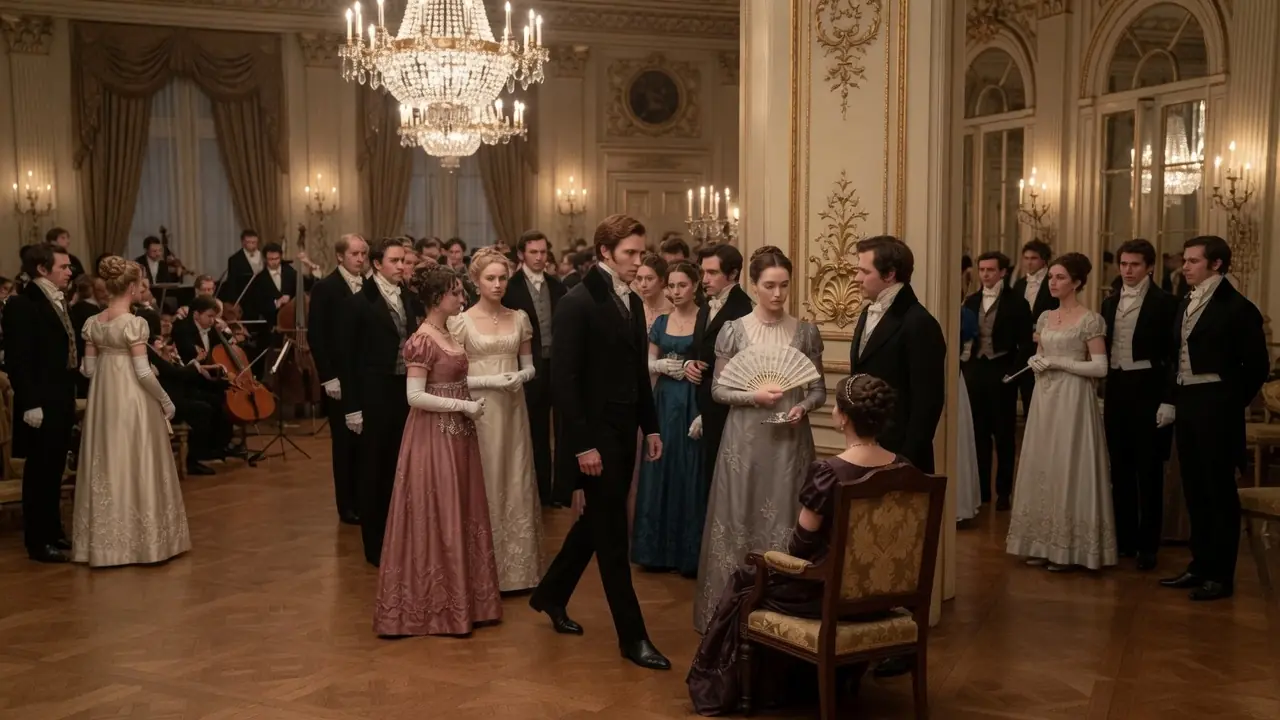
The other one. She met him then, at Lady Southerton's musicale, on a warm evening near the middle of the season, in the gray silk that was not the good gray. The musicale was a crush. The great rooms were full to suffocation, and the heat was tremendous, and the singing, when it could be heard over the talk, was indifferent.
The talk did not stop, exactly, but it changed the way a field changes when a cloud crosses the sun. And every fan in the room began to move a little faster. And every unmarried woman under 30 arranged herself, without appearing to, toward the door. He was tall, and he was auburn-haired, which she had not expected.
And he had a hard, handsome, closed face, and eyes of a cold, clear, sea gray that moved over the assembled company with an expression of such thorough and weary distaste that Hesper felt, absurdly, a flicker of sympathy for him. He looked like a man walking into a trap he had walked into a hundred times before and expected to walk into a hundred times again. He looked besieged. He looked under the coldness tired to the bone.
And then the hunt began as the dowager had said it would. Hesper watched it with the same detachment she watched everything. She watched the mothers steer their daughters into his path. She watched Lady Genevieve Castell glide toward him with the serene confidence of a woman who has never been refused anything.
Lady Genevieve was generally held to be the most beautiful woman in London that season. And she had made it known without ever quite saying so that she considered the matter of the Kelvinridge Duchess as good as settled in her own favor. She watched him receive all of it with a cold correct courtesy that gave none of them the smallest thing to hold. And she thought without envy and without much interest that it must be a strange and lonely business to be wanted so much and liked so little.
She watched one encounter in particular because it happened close enough to the dowager's chair for her to hear it. A mother of formidable brow and a daughter of about 18 pretty and frightened had run the duke to ground by a pillar. The mother was talking rapidly and brightly of nothing at all of the heat and the music and the sad thinness of the season's company. The daughter stood beside her with her eyes down and a look on her face that Hesper knew.
The look of a young creature being made to perform and hating it. The Duke of Kelvinridge listened to the mother with a stillness that was not politeness, but its cold opposite. A stillness like a shut door. He answered in words of one syllable.
He did not once look at the daughter. The whole small transaction went on for perhaps 2 minutes, and then the mother, defeated, bore her mortified child away to try elsewhere. He had not been unkind, exactly. He had said nothing rude.
But there had been a contempt in the perfect economy of his answers that was worse than rudeness. And Hesper, watching, thought that the contempt was not for the frightened girl, who after all had wanted none of it, but for the whole machinery that had shoved her forward. And she thought, too, that a man cannot go on pouring contempt on the world, however deserving, without some of it curdling in him and turning inward. She was sorry for him again, and then was impatient with herself for being sorry, because the private sorrows of dukes were no business of a companion in a made-over gown.
Lady Genevieve Castell managed the thing better. Hesper watched her do it. Where the other women rushed, Lady Genevieve waited. Where they talked, she was serene.
She did not pursue the Duke across the room, but arranged, by some art Hesper could not name, for the currents of the room to carry him past her. And when he passed, she gave him only a cool inclination of her lovely head and a single remark and let him go. So that she alone among all the women in the room appeared not to want him. Hesper, who was a shrewd judge of performances, having spent her life at the edge of them, recognized at once that this was the most dangerous performance of all.
Lady Genevieve Castell had studied the Duke of Kelvinridge's particular weariness and meant to be its cure and would very likely succeed. It did not occur to Hesper, watching, that Lady Genevieve's studied indifference and her own true indifference might look to a tired man across a crowded room like different things entirely. It did not occur to her because nothing about the Duke of Kelvinridge was or ever could be anything to do with her. She did not try to catch his eye.
The thought would not have occurred to her. She had nothing to catch it with and no reason to try and a companion who makes eyes at a duke is a companion who will shortly be looking for a new situation. So she looked after the dowager's comfort and fetched a glass of lemonade the old lady did not much want and stood quietly against her wall and was, as far as she knew or cared, invisible. She was not invisible.
That was the thing she did not know. From across the crowded room, the Duke of Kelvinridge, hemmed in by mothers and daughters and the endless soft artillery of the hunt, had found, without meaning to, the one still point in all the moving room. A young woman against the far wall, plainly dressed, holding an old lady's fan, watching the whole performance with a calm, gray gaze that wanted nothing from him at all. She was not arranging herself toward him.
She was not looking at him. She was the only person in the room who was not. And to a man who had spent a year being looked at by everyone who wanted something, the sight of one person who did not was like cool water. He asked his grandmother about her later, when he had fought his way to the dowager's corner, as much to escape the hunt as to pay his respects. "Who is that?"he said low when the civilities were done. "The young woman behind your chair. "The dowager did not turn her head.
She had lived 80 years, and she had not lived them stupidly. "That," she said,"is my companion, Mrs. Whitgrove. Miss Whitgrove, I should say. She is not married.
A gentleman's daughter, ruined by her father's debts, entirely without fortune, entirely respectable, and the most sensible creature I have met in 20 years. Why do you ask?""No reason," said the Duke of Kelvinridge, which was a lie, and his grandmother knew it was a lie, and said nothing, and filed it away. He crossed the room to her a quarter of an hour later. It should not have been remarkable.
A duke may speak to whomever he pleases. But the Duke of Kelvinridge had spent the entire evening being pursued and giving nothing, refusing cold courtesy to single out any woman in the room. And when he set down his glass and walked deliberately the whole length of Lady Southerton's crowded drawing room, past the beauties and the heiresses and Lady Genevieve Castell herself, and stopped in front of a penniless companion against the wall, the room noticed. The room noticed very much.
The fans stopped. "Miss Whitgrove," he said. Hesper was so unaccustomed to being addressed by anyone of consequence that for a moment she thought he must be speaking to someone behind her. She glanced round and found only the wall and understood with a small cold shock that the Duke of Kelvinridge was standing in front of her and had said her name. "Your Grace," she said, and curtsied and did not simper and did not flutter and did not do any of the things the room was watching to see whether she would do. She simply waited with her gray eyes level on his to be told what he wanted because in her experience great people who addressed her wanted something fetched. "You are the only person in this room," said the Duke,"who has not looked at me all evening.
I confess I came across to discover why.""I had no particular reason to look at you, Your Grace," said Hesper quite honestly. "You are very much looked at already. I did not think you would miss one pair of eyes and I was occupied with Her Grace's fan. "It was not meant as wit. She was answering his question because he had asked it and she answered questions honestly, having found long ago that honesty saved a great deal of trouble. But the Duke of Kelvinridge looked at her for a moment as though she had said something remarkable, and something moved at the corner of his hard mouth.
Not a smile, the almost of one. "No," he said,"I don't suppose I would. "And then, after a pause, in a lower voice,"It is a novel sensation, Miss Whitgrove, not to be looked at. I find I have missed it more than I knew. "He bowed and moved away, and the evening closed over the moment like water. But the room had seen, and across the room Lady Genevieve Castell, who had watched the Duke of Kelvinridge cross a crowded floor past herself to speak to a nobody in a made-over gown, smiled a small smile that did not reach her eyes, and began very quietly to think. What happened next happened quickly, and it happened because Lady Genevieve Castell was not a woman who left important matters to chance.
She had decided some time ago that she would be the Duchess of Kelvinridge. She had decided it, in truth, before the present Duke inherited. When the title had seemed likely to pass to a cousin she could more easily have managed. When it came instead to the cold, auburn-haired second son, she had simply transferred her intention to him, as one transfers a wager to a better horse.
She was beautiful. She was well-born. She was accomplished. And she had never in her life encountered an obstacle that beauty and birth and patience could not remove.
She did not intend to lose the Duke of Kelvinridge to a season of being cold at her. And she certainly did not intend to lose him to a penniless companion whom he had crossed a room to speak to, an event she had witnessed and had not liked at all. So, Lady Genevieve did what such women have always done. She arranged matters.
At the great ball that the Duke's own grandmother gave a fortnight later to open the Kelvinridge house in Berkeley Square, Lady Genevieve arranged to be found. She let it be understood by a whisper here and a hint there that she had an understanding with the Duke. And then she arranged the appearance of one. She would draw him aside on some pretext to the library, which she had established was quiet.
She would ensure that certain persons, chaperones and gossips of unimpeachable authority, would happen upon them there alone. And the Duke of Kelvinridge, a man of honor, would have no choice when found in a compromising privacy with an unmarried lady of quality, but to offer for her on the spot. It was neatly planned. It had worked for cleverer women than Lady Genevieve on colder men than the Duke.
It did not work because Hesper Whitgrove was in the library. She had gone there to escape. The dowager, exhausted and triumphant, had retired early to her rooms above and had told Hesper to go and sit somewhere quiet for an hour and stop hovering. And Hesper, who found the great glittering crush of the ball as wearing as the dowager did, had slipped away to the one room in the house where no one ever went during a ball, the library.
She had curled into a deep chair in the corner with a book in the half dark, entirely content, and had lost herself in it. So that when the Duke of Kelvinridge came into the library some while later, drawn there by a note he had been handed, a note he already half suspected, he found not the empty room the note had promised, but a companion asleep over a book in the corner. He stopped. And in the stopping, the whole shape of the evening changed.
Miss Whitgrove. She woke and was mortified and rose apologizing, the book sliding from her lap. Your Grace, forgive me. I did not mean to.
Her Grace told me to sit somewhere quiet. I will go at once. Do not go, he said. And there was something urgent under the coldness, something she had not heard before.
Miss Whitgrove, I am going to ask you to do a strange thing. And I have no time to explain it properly and no right to ask it at all. In a very few moments, this room is going to be entered by several people who have been brought here to find me alone with a lady so that I must marry her. It is a trap and a clumsy one, and I've walked into cleverer.
But I have walked into this one, and there is only one way out of it that does not end in my marrying a woman I do not want, and I am ashamed to name it to you, because it uses you badly. Hesper understood him faster than he expected. She was a quick woman, and she had lived among the schemes of the great long enough to know one when it was described to her. "You wish them to find you with me instead?"she said. So that the trap catches no one, because there is no scandal in a duke speaking with his grandmother's companion, and the lady who laid it cannot spring it without revealing that she laid it.
He stared at her. "You are very quick.""I have had to be. "She was thinking rapidly, coldly, the way she thought about the dowager's accounts. "It will not answer, your grace. You are wrong that there is no scandal in it. A duke found alone at night in a dark library with an unmarried woman of no fortune is precisely as compromised as a duke found with a woman of quality. More, because the world will assume the worst of the poorer woman.
If they find us here, they will not say nothing happened. They will say you and I are lovers, or they will say you must marry me, and either way I am ruined, and you are trapped exactly as you feared, only in a poorer bargain. I'm sorry. Your escape uses me, and does not even save you. "Voices then in the passage.
Very close. The Duke of Kelvinridge looked at her and at the door and at the impossible arithmetic of the next 10 seconds. And he made in that moment the decision that changed both their lives. And he made it not out of calculation but out of something he did not yet have a name for. "Then we had better be engaged."he said. "It is the only version of the story that ruins neither of us.
Will you let me announce it? I will release you the instant it is safe. You have my word. "And the door opened. There was no time to answer him with words.
So Hesper Whitgrove answered him with the only thing she had which was silence and stillness and the decision not to contradict him which is its own kind of speech. She let him take her hand. She let him turn with her to face the little crowd in the doorway. The two dowager gossips and Lady Genevieve behind them with her face composed and her eyes gone flat with fury.
And she heard the Duke of Kelvinridge say in a voice of perfect cold composure that they must wish him joy. Miss Whitgrove had that evening done him the honor of accepting his hand. And he had brought her to the library to ask her privately away from the crush as any man would. It was said so smoothly and with such ducal finality that no one in the doorway dared to question it.
One did not question the Duke of Kelvinridge. The gossips wished him joy avid and astonished already composing the letters they would write. And Lady Genevieve Castell wished him joy, too, in a voice like sweet ice, and looked at Hesper Whitgrove over the Duke's shoulder with an expression that promised, very quietly and very sincerely, that this was not finished. The Dowager Duchess of Kelvinridge learned of her grandson's engagement at breakfast the next morning from her grandson, who came to tell her himself before the gossip could, and who told her the whole truth of it, because he had never lied to her in his life and did not mean to begin.
She heard him out. She sat very still, a small, fierce old woman in a vast bed, and she heard the whole of it, the trap, the library, the sleeping companion, the impossible 10 seconds, the lie he had told to save them both. And when he had finished, she said only,"And you mean to release her once the season is over and the thing can be quietly dropped?""That is what I promised her.""I see. "The Dowager looked at her grandson for a long moment at the cold, closed face that had not been cold when he was a boy, at the sea-gray eyes that had learned in one hard year to give nothing away. "And how do you find, Everett, the prospect of being engaged for a season to Hesper Whitgrove?""I find it convenient," said the Duke. "It ends the hunt. A man who is engaged is not pursued.
I shall have a season's peace, which I have not had in a year, and she will have a season's protection and a handsome settlement when we part, which will keep her from ever having to fetch another old woman's fan. It is a fair bargain on both sides, and no one is harmed by it.""Hmm."said the dowager, and let him go. And lay a long while afterward looking at the canopy of her bed and thinking her own thoughts. For she had seen her grandson's face when he spoke of finding it convenient, and she had heard the thing he had not said, which was the thing under the words.
She had lived 80 years and buried two sons, and she knew, as certainly as she knew anything, that the Duke of Kelvinridge was already, though he did not yet know it himself, a good deal more than conveniently engaged. She said nothing of this. It was not a thing that could be told. It was a thing that had to be waited for.
But she smiled alone at her bed canopy, the first true smile she had smiled since Marcus died, and she resolved to do nothing whatever to hasten the quiet dropping of the engagement, and a good deal, very quietly, to prevent it. For Hesper, the days that followed were the strangest of her life. She had been invisible for 5 years, and now, overnight, she was the most looked at woman in London, and she discovered that she did not much like it, and that she was rather good at it all the same. The dowager took her in hand at once.
There would be no half measures, the old lady declared. If Hesper was to be the affianced bride of the Duke of Kelvinridge, fiction or no fiction, she would be dressed and turned out as such, and the whole of society could choke on it. So, there were modistes and gowns in colors Hesper had not worn since her girlhood. Deep greens and soft grays that were not the grays of a servant, but the grays of a woman who had chosen them.
There was a lady's maid of her own. And there was the slow, strange business of learning to walk into rooms as though she had a right to be in them, which Hesper found was less a matter of learning than of remembering. She had been born to it before the money went, and the body does not entirely forget. She bore the scrutiny with a composure that surprised everyone who had wagered against her.
And there was a great deal of scrutiny. Society could not make her out. A nobody, a companion, and the cold Duke had crossed a room for her and offered for her within the fortnight. So, society did what society does with a thing it cannot make out.
It watched and it whispered and it waited, half of it hoping she would fail. And half of it, the kinder half, quietly delighted. For there is always a part of any crowd that loves to see the overlooked one lifted up. Hesper did not fail.
She was not grand, and she did not try to be. She was simply unfailingly herself, plain-spoken and dignified, and impossible to fluster. And it turned out that being oneself, when oneself is a woman of real quality, is a great deal more compelling than being fashionable. The kinder half of society began slowly to be won.
The other half waited for Lady Genevieve to strike. The whispers reached her as whispers do. She heard herself discussed at a morning call by two ladies who had not troubled to lower their voices on the theory, Hesper supposed, that a companion is a kind of furniture and does not hear. They wondered aloud what the Duke could possibly see in her.
They observed that she was well enough in a quiet way if one liked that sort of thing, though of course no one did any longer, brown-haired quiet women having gone quite out of fashion. They speculated with a delicacy that was its own insult on what arts a penniless nobody must have used to catch what the loveliest women in England had not. One of them said, laughing, that it must have been witchcraft, for she could think of nothing else that would answer. And the other laughed, too.
Hesper sat 3 ft away with the dowager's shawl over her arm and her face perfectly composed and did not give them the satisfaction of a flush. She had borne worse. That was the thing that steadied her through all of it. She had buried a father in disgrace and been turned out of the only home she had known and had walked at one and twenty up the area steps of a stranger's house to take a servant's wage.
And she had done it with her back straight. Besides that, the whispers of idle women were nothing. They were less than nothing. They were a summer wind.
She had learned a long time ago the one lesson that such women never learn because they have never needed to. The opinion of people who do not know you cannot touch the part of you that is real unless you let it. And the letting is a choice. And the choice is yours always.
And is the one thing in all the world that poverty and disgrace and invisibility can never take away. So, she let them talk and she carried the dowager's shawl and she was though not one of them could have said how entirely untouched. And it was this more than any gown the dowager put her in that began by slow degrees to turn the tide. And the Duke of Kelvinridge who had entered into the whole business as a convenience found that the convenience was becoming something he had not bargained for.
They were much together of necessity. An engaged couple must be seen. So, they rode in the park and attended the same dinners and stood up together at balls and sat side by side at endless interminable evenings. In all of it, they had to talk.
And it was the talking that undid him as it had undone him the first night because Hesper Whitgrove talked to him as no one else did. She did not flatter him and she did not fear him and she did not, above all, want anything from him. The one thing she might have wanted the marriage she knew to be a fiction. And so, she was free with him in a way no other woman in England was free.
Free to be honest. Free to be dry. Free to tell him plainly when he was wrong. Which he was sometimes.
And to say so. Which no one had said to him since Marcus died. He found himself saving things to tell her. He found himself at the dreary dinners watching the door for her.
He found that the cold weary distaste with which he had come to regard the whole world lifted in her company. Like a fog burning off. And that he could not always account for the lightness that came in its place. And did not at first try.
They rode out together in the park one gray afternoon. Because an engaged couple must be seen to ride. And the fashionable hour found them walking their horses side by side down the long avenue. While all of society took note.
For a time they said the things one says. And then past the worst of the crowd where the avenue thinned and the bare trees closed over them. The Duke fell silent. Hesper who had learned his silences by now.
Let him keep it. After a while he spoke. Not of anything in particular. Only of the park.
He spoke of how his brother had taught him to ride not a quarter mile from where they now were. On a fat pony called Barnabas. That had bitten everyone but Marcus. He told her how the two of them had raced along this very avenue as boys at dawn.
Before the fashionable world was awake to be scandalized by it. You loved him very much," said Hesper. "Everyone loved him. "It came out flat, worn smooth by repetition. "I'm told so at every dinner in London. What a loss to the world. What a gate his death has opened. "He was quiet a moment. "No one asks whether I loved him.
They ask whether I mean to open the Scottish house, and whether I shoot, and whether I have views on the marriage of their daughters. They do not ask about Marcus, because Marcus is over, and I am what is left. And a thing that is over is of no further use. "He glanced at her and away. "You asked on the first evening, before you had any reason to trouble yourself with me, you asked what he was like. No one else has asked me that in a year.""Then no one else has been paying attention," said Hesper. "A man does not become a title the day his brother dies.
He only becomes a title in the eyes of people who were never looking at the man to begin with. "She kept her eyes on the avenue ahead. "For what it is worth, your grace, I did not ask to be kind. I asked because I wanted to know. There is a difference. Kindness can be performed.
Curiosity cannot. I was curious about the brother you never speak of, because it seemed to me a great sad silence in the middle of a man. I have a weakness for the truth of people. It has cost me a great deal in my life, and I have never learned to cure it. "The Duke of Kelvinridge did not answer for a long moment.
When he did, it was very low, and not at all cold. "Do not cure it."he said. "I forbid it. It is the only interesting thing anyone has said to me since I inherited. "And Hesper laughed before she could stop herself. A real laugh surprised out of her. The Duke turned to look at her as though he had never heard the sound before.
Which in a sense he had not. And something in his hard face came open just for an instant. Then a rider hailed them from the avenue. And the fashionable world closed back over the moment.
And they rode home talking of nothing. And both of them were quiet that evening in different rooms of the same great house thinking. There was an evening at the great house in Berkeley Square. A family dinner.
Only the dowager and the two of them. At the enormous table in the great cold dining room where the Kelvinridge Dukes had dined in state for 200 years. The three of them were marooned at one end of an acre of mahogany. The footman stood like statues.
And the talk was stiff. And Hesper watching the Duke sit rigid and unhappy at the head of the table his brother should have been sitting at said quietly when the covers were changed that it seemed a great pity to keep so much table between three people who could perfectly well hear one another across a smaller one. "If it were her house."she said. She would have the leaf taken out. And dine cosily.
And let the mahogany rest. The Duke looked at her. And looked at the vast table, and something in his face changed. "My mother used to say that," he said, low. "She used to beg my father to shorten the table. He never would.
He said a Kelvinridge dined in state, or not at all. "He was quiet a moment. "Marcus kept it long after. I have kept it long. I do not know why. Habit, I suppose.
The habit of doing a thing because it was always done. "He signaled to the butler. "Take the leaf out tomorrow," he said. "We will dine cosily. Her Grace is quite right. "And the Dowager, at his other hand, said nothing, and ate her fish, and smiled to herself. She had begged her son to shorten that table for 40 years, and never once been heeded. And a companion of six and twenty had done it in a sentence.
And the reason the companion had done it in a sentence was sitting plain on her grandson's face for anyone with eyes to read. The library became theirs. It was where the whole business had begun, and it became, over that strange season, the one place they went to be out of the glare. The Duke had a great library, floor to ceiling, two stories with a gallery, and Hesper loved it helplessly, the way she loved all books.
He found her there often, and began to come there on purpose. And they spent long, quiet evenings in it, while the Dowager dozed by the fire, he at his letters, and she with a book, saying little, and the little they said easy and unforced. It was in the library that she stopped. At some point she could not afterward name being afraid of him.
And it was in the library that he showed her one night the thing he had shown no one. They had been speaking of his brother. She had asked about him plainly because no one else would and because she had noticed that the Duke never spoke his brother's name and that the not speaking sat on him like a stone. And the Duke of Kelvinridge in the low firelit quiet with the books rising into the dark around them told her about Marcus.
He told her that Marcus had been the best of men warm where he was cold easy where he was stiff loved by everyone born to the title and worthy of it. And he told her that he Everett had spent his whole life comfortably in his brother's shadow and had been glad of the shadow because the shadow was freedom. He had never once wanted what was Marcus's. Not the title, not the burden not the great cold house.
He told her how quickly it had happened. A fever a week no time even to be sent for properly so that he had arrived to find his brother already past speaking. He had sat by the bed and held a hand that did not know him and had watched the best of men die for no reason at all in the space of seven days. He told her that he had not wept that he had not been able to that he had stood up from the deathbed the Duke of Kelvinridge with the whole weight of it on him and had never since been able to set it down long enough to grieve the brother underneath.
From the moment his brother died, the world had stopped seeing Marcus, whom it had loved, and started seeing the duke, whom it wanted. And there had been no room left anywhere in all the wanting for a younger brother's plain grief. "They did not even mourn him," he said, and his voice was not steady. And he did not trouble to make it steady, which he would not have done for anyone else alive. "Within the month, they were throwing their daughters at me across his very grave, as though he had been nothing but a gate that had swung open. As though the only thing his death meant was that the title was in play again.
And I have hated them for it, every one of them. Every mother, and every daughter, and every arranged encounter, because every one of them was a person who had come to profit from the death of my brother, and did not even know his name. "He looked at her. The sea-gray eyes bright and unashamed in the firelight. "You never asked me for anything from the first evening. You are the only person since Marcus died who has looked at me and seen a man and not a title.
I do not think you know what that has been worth. "Hesper did not fill the silence. She had learned in a hard school that a grief does not want to be answered, only witnessed. And she gave him the one thing she had, which was to sit with him in it and not look away, and not offer comfort he had not asked for. After a while, she said quietly,"The only thing that was both true and worth saying.""He was real to me the moment you spoke of him.
Marcus. Not the late Duke. Your brother. I never knew him and I am sorry I never knew him.
And I am glad you told me because a man should be able to say his brother's name in his own house. "She paused. "You will grieve him properly one day. Not yet, perhaps. But the grief is not gone because you could not reach it. It is only waiting.
It will keep until you are ready. And when you are ready, it will come. And you must let it. And it will not break you.
Though it will feel as though it must.""Everett. "She added. And it was the first time she had used his name. And she had not planned to. And she heard it land in the quiet room and did not take it back. "I think you have been very brave and very alone for a very long time.
And I'm glad, whatever comes of this strange arrangement of ours, that I was in the library that night. "The Duke of Kelvinridge looked at her for a long moment and did not speak because he could not. And the moment held. And something passed between them in the fire-lit quiet that neither of them named because it could not yet be named. And both of them knew it was there.
The Dowager Duchess of Kelvinridge missed very little. She was old and her joints ached and she slept badly. And she used the long wakeful hours the way she had always used her time in watching. She had been watching her grandson and her companion for weeks now with a particular attention of a woman who has decided to meddle and is only waiting to learn how.
She saw what neither of them saw because she stood outside it. She saw that Everett who had come back from his brother's deathbed, a locked and bolted man, was being very slowly unlocked. And that the hand on the key belonged to a penniless woman of six and twenty who did not know she held it. She saw the way he watched the door at dinner until Hesper came through it.
She saw that he had begun to save things, small dry observations, the kind he had once saved for Marcus, and to bring them out at the table for the pleasure of watching Hesper receive them. She saw, above all, that he had begun to laugh again. Not often and not easily, but at all, which he had not done in a year. And he laughed only ever at things Hesper said and did not seem to know it.
She saw Hesper, too, which was harder because Hesper had spent five years learning to give nothing away and gave nothing away still. But the dowager was 80 and she had loved and lost enough to know the signs of it in another woman even under the deepest guard. She saw the stillness that came over her companion when the duke entered a room, the particular careful stillness of a woman holding herself very hard in check, and she understood it. And her old heart ached for the girl.
For the dowager knew, as Hesper did not yet let herself know, exactly how this would end if it were let alone. It would end in Hesper breaking her own heart out of honor. The dowager had seen it a hundred times. Good women, poor women, women who had been taught that they must not want, arranging their own quiet ruin out of a scrupulous care for everyone's dignity but their own.
Not this one, the dowager said aloud to her dark bedroom at 3:00 in the morning. Not if I have anything to say to it. And I generally have. And she lay awake a while longer plotting and was happier than she had been in a year.
Lady Genevieve Castell did not accept defeat. She was too well-bred to do anything so vulgar as to show it. But she had not for a moment abandoned the field. And she chose her own methods, which were quiet and patient and aimed with great precision at the one target she judged vulnerable.
Not the duke, whom she could not reach. Hesper, whom she could. She found her chance at a ball in the ladies' withdrawing room, where she came upon Hesper alone and arranged to remain so. And she was, for the space of 5 minutes, everything that was gracious.
She admired Hesper's gown. She said how well Hesper bore it all, the sudden elevation, the staring, when it must be so very trying for a woman unused to notice. She said she quite understood the appeal of it to the duke, the novelty, a plain, sensible creature after so many polished ones, like plain bread after too many sweets. Men did tire of sweets.
And then, having smiled all the while, she delivered the thing she had come to deliver, gently, as though in kindness. "I only hope," said Lady Genevieve,"that you are not letting yourself grow too fond. It would be natural, of course. Any woman would. But you are sensible, and you will have seen, as I have, that the duke is a man who wanted, above all, to be let alone this season.
An engagement is a wonderfully effective way of being let alone. It ends the pursuit. It grants a man peace. I am sure it has granted him a great deal of peace. "She let that rest a moment. "Novelty fades, Miss Whitgrove.
Peace, once a man has it, he begins to take for granted. And then he begins to look about him again. I say it only because no one else will trouble to, and because I should hate to see a sensible woman mistake a convenience for a devotion. Do forgive me.
I speak from friendship. "And she pressed Hesper's hand and smiled her smile that did not reach her eyes, and went out, leaving the poison behind her, exactly where she had meant to leave it. It was cruel, and it was clever, and its cleverness lay in this, that every word of it was something Hesper had already said to herself in the dark. That was why it went so deep. Lady Genevieve had not told her a single thing she did not know.
She had only said it aloud in the daylight, in a stranger's voice. And there is a particular terror in hearing one's own secret fears repeated back by an enemy, for it makes them seem no longer fears, but facts. Hesper went home that night and lay a long while awake and told herself that Lady Genevieve was a jealous woman and a liar and knew it was true and could not, all the same, unhear a word of it. The liar had aimed at the truth and hit it.
It was not long after that night that Hesper Whitgrove understood she was in danger and named the danger to herself plainly, alone, as was her way, and did not pretend it was anything but what it was. She was coming to love him. It was the most foolish thing she had ever done, and she had done a great many foolish things in her time, but none so foolish as this. She was a penniless companion and he was the Duke of Kelvinridge and their engagement was a fiction that both of them had agreed to end.
If she allowed herself to forget that, if she allowed the fiction to become, in her own secret heart, a hope, then she was no better than the hundred women he despised, the women who wanted the title, except that she wanted worse. She wanted the man, and the man was not hers to want. He had made a bargain with her. He had promised to release her.
And a woman of any honor at all does not take a bargain struck in a crisis and quietly reshape it in the dark into a trap. So, Hesper did the thing that cost her more than anything had cost her since her father's grave. She decided to release him. She did not tell him at once.
She waited for the right moment, which is to say she waited for her own courage. And while she waited, the season wore on toward its great climax, the Duke's own midsummer ball. It was the ball that would open the Kelvinridge house fully to the world at last. And mark, everyone assumed, the formal celebration of his engagement.
And as that ball approached, two things happened. The first was that the Duke of Kelvinridge, who had spent the season slowly and unwillingly falling in love with his fictional betrothed, resolved to make the fiction true. He did not know how to say it. He was a man 10 years out of the habit of wanting anything he was allowed to have, and the wanting frightened him, and he circled it for days like a man circling a fire.
He settled at last that he would tell her at the ball. He would ask her truly to be his wife in fact and not in fiction. And he would do it well and publicly if she liked, so that the whole world should know he had chosen her. The second was that Lady Genevieve Castell discovered that the engagement was a lie.
She discovered it because she was clever and patient and had been watching. And because she had at last got a servant of the Berkeley Square house to talk. The servant had overheard weeks before a conversation in the library between the Duke and Miss Whitgrove, in which the words fiction and release and when the season is over had figured plainly. It was enough.
Lady Genevieve did not need proof that would stand in a court. She needed only enough truth to make a story and she had it. And she chose her moment with the care of a woman who has waited a whole season to be revenged. And her moment was the Duke's own ball.
Hesper found her chance to speak to the Duke on the afternoon before it. She had meant to release him gently in private before the ball. She owed him that, she thought, before the whole world gathered to celebrate a thing that was not real. She found him in the library and she had her whole speech prepared.
And she got perhaps four sentences into it before it all went wrong. Your Grace, she began, because she had gone back deliberately to the formal address as a way of putting the necessary distance between them. The season is nearly over. You have had your peace and I am glad of it.
And I think the time has come to speak of ending our arrangement as we agreed before the ball makes it harder to end. I do not want you to feel bound by a promise made in a crisis. I release you from it. Whatever is said afterward, whatever the gossip, I will bear it.
I have borne worse and I would rather bear it than hold you to a fiction a moment longer than honor requires. You have been more than fair to me. I only wish to be fair to you in return. She had rehearsed it a hundred times and she got through it steadily.
And it was, she thought, rather well done, dignified and clear, and giving nothing of herself away. And she looked up when it was finished, expecting relief in his face, and found instead something she had not prepared for at all. He looked as though she had struck him. "You wish to end it," he said. "I wish to free you from it," said Hesper. "There is a difference. It was never a thing you chose.
You reached for the nearest hand in a burning room. I have been glad to be that hand. But a man should not have to marry the hand he reached for. And I will not let this arrangement become the very trap you were trying to escape.
That is all. It is the only honorable thing, and we both know it. "And the Duke of Kelvinridge, who had spent three days composing the words with which he would ask her to stay, found that every one of them had deserted him. The woman he loved was standing in his library releasing him from the only good thing that had happened to him in two years. She was doing it out of honor, out of a scrupulous care for his freedom, out of the plain unselfish decency that was the very reason he loved her.
And he could not find, in the wreck of his prepared speech, a single word to tell her so. So, he said the wrong thing. He said, stiffly, coldly, because coldness was the armor he reached for when he was hurt past bearing, that if that was her wish, he would not stand in the way of it, and that they would speak of the particulars after the ball. And he turned away to the window.
And the moment broke. Hesper, who had come to free him, and had somehow contrived to feel as though she had been dismissed, gathered the pieces of her dignity, and left the library. And neither of them had said the one true thing that would have mended it. Because both of them were too proud and too frightened and too certain of being unwanted to risk it.
The ball that night was the most brilliant of the season. All of London came to the great house in Berkeley Square, thrown open at last, blazing with light. And Hesper moved through it on the Duke's cold, correct arm, and smiled the smiles that were required of her, and felt as though she were made of glass. They did not speak of what had passed in the library.
They did not, in truth, speak of much at all. And Lady Genevieve Castell watched them from across the ballroom, and saw the stiffness between them, and understood that whatever had been between the Duke and his companion was cracking of its own accord. And she decided that she would give it the final blow herself, in front of all the world, and take back what she considered her own. She made her move at the height of the ball, in the great gallery, before the largest possible crowd, in the pleasant, caring voice of a woman who has planned every word.
She began by wishing the Duke joy, sweetly, and Miss Whitgrove, too. And then she said, with a little laugh, that it was such a romance, was it not? Such a very sudden romance. And so touching that the Duke should have chosen so far beneath him.
And she did hope, she really did, that dear Miss Whitgrove was not distressed by the foolish story going about. The unkind story. The story that the whole engagement was nothing but an arrangement. A fiction got up in a moment of difficulty.
And always meant to be quietly ended once the season was safely over. She said she was sure it was not true. She said it in the voice of a woman entirely sure it was true. And pitching every word to carry.
And watching Hesper's face as she said it. With the bright avid eyes of a cat at a mouse hole. The gallery went very quiet. This was better than anyone had hoped.
The kinder half of society held its breath for the overlooked girl. And the other half leaned in. And Hesper Whitgrove stood in the blazing light with a hundred eyes upon her. And felt the whole fragile edifice of the season come down around her.
She knew, with a strange calm, that it was over. That the truth was out. And could not be put back. In a moment, she would have to say something.
And whatever she said, the world would see that Lady Genevieve had struck true. She would not lie. She had never been able to lie. She opened her mouth to say the only thing left to a woman of honor.
Which was some quiet, dignified admission that would free the Duke publicly and ruin herself for good. And she got as far as drawing the breath to say it. She never said it. Because the Duke of Kelvinridge crossed the room.
He crossed it as he had crossed Lady Southerton's drawing room three months before, deliberately, the whole length of the great gallery, past the beauties and the gossips and Lady Genevieve Castell herself. And this time the whole of London watched him do it. And this time he did not stop at a polite distance. He came to Hesper's side and he took her hand, a plain ungloved hand, in front of everyone.
He turned with her to face the room. And he spoke into the ringing silence in a voice of such cold ducal finality that not one soul in that gallery would ever afterward dare to doubt a word of it. "Lady Genevieve is misinformed," he said. "There is a story going about, as she says. I'm glad of the chance to correct it before all of you, since you are all so kind as to be interested in my affairs. The story is that my engagement to Miss Whitgrove is a fiction, got up for convenience and meant to be ended. "He paused.
One second, two, three, and let it hang. "It is not true. It was true once. I will not lie to you, even to spare myself. Miss Whitgrove would not wish me to, and I have learned to want what she wishes.
When I asked her to let our engagement be announced some months ago, it was indeed to escape a difficulty. And we did indeed agree, the two of us, that it should be quietly ended when the season was done. The gallery did not breathe. Lady Genevieve's smile had begun very slightly to fix.
But that was some months ago, said the Duke of Kelvinridge, and I was a colder and a stupider man some months ago, and I did not yet know what I had been given. I know it now. Miss Whitgrove came to me this very afternoon and released me from our engagement. She did it out of honor because she believed I did not truly want it, and she would not hold me to a promise made in a crisis.
She freed me. That is the kind of woman she is. And I stand here before all of you to tell her, since I was too great a fool to tell her this afternoon, that I do not want to be freed. I want to be held to it.
I never wanted anything so much in my life. He turned from the room to her. The coldness was gone from his face entirely, gone as though it had never been, and there was nothing in it now but a naked, terrified, entirely unducal hope. And he said low, but not so low that the room could not hear, because he meant the room to hear, because he meant the whole world to hear.
You told me once that I was the only man in the room who had been crossed to. It was the other way about, Miss Whitgrove. You are the only person in the world I have ever wished to cross a room to reach, and I have now done it twice in front of half of London, which I hope will persuade you that I mean it, since I am told I am not always able to say what I mean. I refused a hundred women who wanted my title.
I am asking the one woman who never wanted anything from me at all. Not the arrangement. Not the fiction. You.
Will you have me, Hesper? Truly. And for good. And by your own choice.
Which is the only thing in this whole business I have ever cared about. Because I do not want a wife who is trapped into me anymore than I wanted to be trapped myself. Choose me. Or refuse me.
But do it freely. And do it now. And put me out of my misery. Because I find I cannot bear another moment of not knowing.
And Hesper Whitgrove who had come to the ball made of glass and who had stood a moment before at the very edge of ruin looked at the Duke of Kelvinridge at Everett at the man and not the title at the naked hope in the sea gray eyes. And she understood that she was being offered in front of all the world the one thing she had spent five invisible years teaching herself never to want. That it was real. That it was hers.
And that she had only to reach out her hand and take it. She did not simper. She did not weep. She did the thing she had always done.
Which was to tell the plain truth plainly. And she told it not to the room but to him. In a clear, steady voice that carried nonetheless to the furthest corner of the gallery. She had decided that if she was going to say it she would say it so that no one could ever again pretend she had been anything but chosen.
Chosen freely. Chosen first. "I released you this afternoon," she said,"because I loved you, and because I would not trap a man I loved. That was the whole of it, and I did not tell you because a woman in my position does not say such things to a duke. I will say it now, since you have been so foolish as to make it possible.
I have loved you since the night you told me your brother's name in this house's library. Not the duke. You, Everett. I wanted nothing from you.
That is true, and it is still true. I want nothing from you. Not the title, and not the great house, and not the settlements. I would take you with none of them.
I only want you. And so, yes, freely and for good, and by my own choice, in front of all of London, and my own dignity, and everything I have ever believed about what a woman like me is permitted to hope for, yes, I will have you. There was a silence of exactly 3 seconds, and then the great gallery of the Kelvinridge House erupted, because even the unkind half of society cannot, in the end, resist the sight of the overlooked one lifted up. The kinder half was already weeping, and somewhere near the front, the Dowager Duchess of Kelvinridge was heard to say, to no one in particular, in a voice of enormous satisfaction, that she had known it since the musical, and had merely been waiting for the two of them to catch her up.
And the Duke of Kelvinridge, in front of all the world, lifted his companion's plain, ungloved hand to his lips and did not let it go. Lady Genevieve Castelle left London within the week. There was nothing left for her there. She had staked a whole season and a good deal of her pride on becoming the Duchess of Kelvinridge and she had lost.
And worse than lost, she had been seen to lose publicly at the hands of a penniless companion. Society, which had feared her a little, did not fear her any longer. And a beauty who is no longer feared is a beauty on borrowed time. She married the following year a baronet of comfortable fortune and to no particular distinction and lived a life of moderate consequence in a county far from London.
She was, by all accounts, neither happy nor unhappy, only diminished. And if there was a cruelty in her defeat, there was a sadness in it, too. She had never learned to want anything but the winning and had built her whole self upon it and did not know, when the winning was taken away, what was left of her underneath. Hesper, who might have exulted, found that she could not and thought of Lady Genevieve sometimes afterward with something that was not quite pity, but was near neighbor to it and was glad her own worth had never had to rest on so thin a thing as being chosen first.
The Duke of Kelvinridge married his companion in the autumn quietly at his country seat with the dowager in the front pew looking as though she had arranged the whole of it, which, in every way that mattered, she had. Hesper wore a gown the color of the turning fells, chosen by herself, and she was not overlooked at her own wedding. And she found, walking up the aisle to the man waiting for her at the end of it, that the being seen, which she had feared and half hoped for in equal measure for so many years, was the easiest thing in the world to bear when it came at last, and came from the right person. The great table in Berkeley Square was never made long again.
They dined cosily, the two of them, at the near end of it, close enough to talk. And in time, there were more than two, and the house that had been cold for a generation grew warm. The library, where the whole strange business had begun, remained the heart of it, the place they went of an evening to be quiet together while the fire burned down. The grief came, in the end, as Hesper had told him it would.
It came one winter night, more than a year after the wedding, unbidden and enormous, the whole of the grief for Marcus that he had never been able to reach. It came at the worst hour, and it felt as though it must break him. And it did not break him because she was there, as she had promised she would be. And she did not try to cure it, or to hurry it, or to fill its silences.
She only stayed, and let him not be alone in it. And held his hand in the dark. And in the morning, the grief had done its long delayed work. And he could say his brother's name at last without the stone in his chest.
He was, though the loss remained and would always remain, a man who had finished mourning, which is a different thing from a man who has forgotten. Society, which forgets nothing and forgives everything, provided it is entertaining, decided in the end that it had always known the Duke of Kelvinridge would choose brilliantly and told the story of his courtship as a great romance and got most of the details wrong. And it did not much matter. Only two people knew the whole truth of it.
And one old woman who had guessed. They knew that it had begun with a lie told in a burning room and had become the one wholly true thing in either of their lives. They knew that the world had looked straight through both of them. Once, the second son no one troubled about, and the companion no one saw.
And they knew that they had found each other precisely in the not being seen. Two invisible people who had turned out, when someone finally looked, to be the realest things in any room. And on winter evenings, in the warm library, the Duke of Kelvinridge would sometimes look up from his letters at his wife across the fire. The woman he had crossed a crowded room to reach on a night when she had not troubled to look at him.
And he would think that of all the hundred women who had wanted the Duke, the only one worth having had been the one who had wanted nothing but the man. She had told him so, plainly, in front of all the world. And she had been from the first cool, gray, unimpressed glance to the last the only person who had ever truly seen him.