The Bikers Mocked The Old Veteran’s Hat | Then The Colonel Walked Through The Door

The Bikers Mocked The Old Veteran’s Hat | Then The Colonel Walked Through The Door
Reader Theme:
Font Size:
24px

“Take that hat off, old timer.”
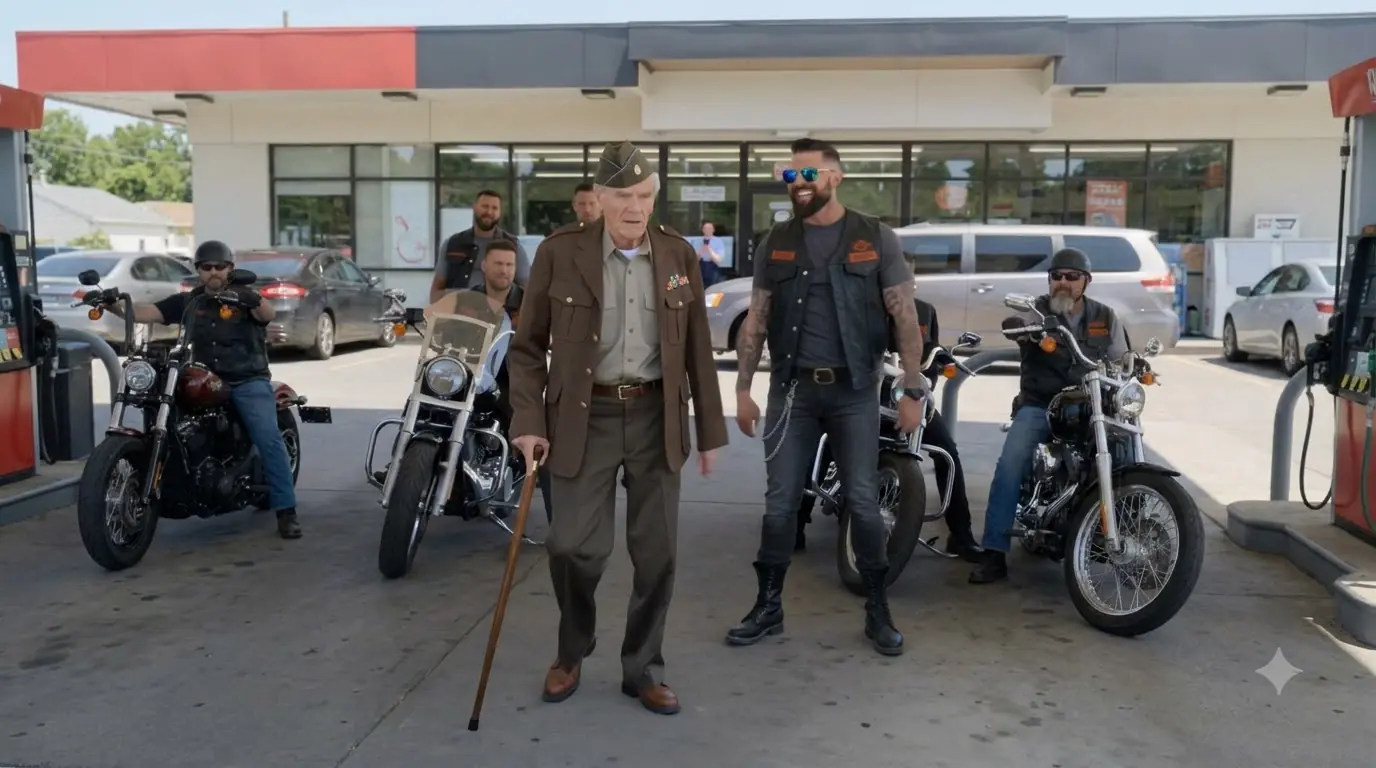
The voice cut across the gas station lot just as Harold Whitaker reached pump three.

He was seventy-eight years old, with silver hair showing beneath a faded olive cap and a polished wooden cane in his right hand. The cap had once been bright, but years of sun, rain, and careful hands had softened the fabric until the Marine Corps emblem on the front looked almost ghostlike. His brown field jacket hung loose on his shoulders, but the ribbons above the left pocket were still pinned straight.

Harold had not worn them for attention.

He wore them because that morning he had visited the grave of a man whose name most people had forgotten.

The five bikers saw him before he finished crossing the concrete.

They had been sitting near the front of the store for nearly half an hour, leaning against polished motorcycles, drinking from paper bags, laughing too loudly, and making the station feel smaller than it was. Their black leather vests carried a patch across the back that read Iron Jackals, stitched in red thread over a snarling wolf skull. They looked like men who had borrowed toughness from noise and confused cruelty with strength.

The biggest of them stepped away from his motorcycle.

His name was Mason Rourke.

He was thirty-two, thick through the shoulders, with tattooed arms, mirrored sunglasses, and a beard trimmed sharp enough to look deliberate. He moved like a man who had learned early that most people stepped aside when he wanted them to. That kind of lesson can ruin a person if no one ever teaches him what courage actually costs.

Harold kept walking toward the store.

Mason blocked him.

“I said take it off.”

Harold looked at him.

“Why would I do that?”

Mason pointed at the cap.

“Because you don’t deserve to wear it.”

The other bikers laughed.

One of them leaned forward on his handlebars and nodded toward the medals on Harold’s jacket.

“Those real, Grandpa? Or did you order the whole hero costume online?”

Another biker reached for the brim of the cap.

Harold caught his wrist.

The movement was not quick in the way young men expect quickness to look. It was small, clean, and exact, like a door closing before a hand could slip through. Harold’s fingers trembled slightly from age, but the grip itself did not tremble at all.

The younger biker’s smile disappeared.

For one quiet second, Harold looked into his eyes.

There was no anger on the old man’s face. Anger would have made the moment easier for the bikers to understand. Instead, there was a cold, tired steadiness, the kind that belongs to people who have seen real danger and no longer feel impressed by imitation.

Harold released the wrist.

“Don’t touch the hat.”

Mason stepped closer.

The laughter behind him came back louder because pride always hates a pause.

“You threatening my brother?”

“No.”

Harold adjusted the cap with two fingers.

“I’m asking you to behave like men.”

For half a second, nobody laughed.

Then Mason threw his head back as if Harold had told the funniest joke in the county. The others joined him, loud enough that a woman at pump one hurried her two children back into the minivan. A trucker near the diesel lane stopped filling his tank and watched without pretending not to.

One of the bikers kicked Harold’s cane.

The cane spun across the oil-stained concrete and struck the base of a trash can with a hollow crack.

Without it, Harold staggered.

His left shoulder clipped a newspaper box, and pain shot through his hip so sharply that his breath caught in his chest. A piece of shrapnel had lived near that hip since 1969, too dangerous to remove and too stubborn to forget. Most days, it rested quietly inside him like an old secret.

That afternoon, the pain woke up.

The bikers laughed again.

Inside the convenience store, twenty-year-old cashier Ethan Porter stood frozen behind the register. He had watched the Iron Jackals arrive, watched them insult a delivery driver, watched them complain about beer prices, and watched them take up space like the world owed them a stage. He had thought about calling the sheriff earlier, but thoughts are easier than action when five angry men stand outside your workplace.

Now Ethan reached slowly beneath the counter for his phone.

Harold crossed the concrete toward his cane.

Each step hurt.

He did not ask anyone to pick it up. He did not look around for sympathy. He reached the trash can, bent carefully, lifted the cane, and wiped dust from the carved handle with the same patience a man might use to clean a rifle after rain.

The bikers watched him.

The laughter thinned.

Something about Harold’s silence began to change the air. It no longer felt like the silence of an old man too afraid to speak. It felt like an accusation none of them had the language to answer.

Mason’s smile tightened.

He had expected the old man to shout, curse, leave, or beg to be left alone. Instead, Harold simply straightened his jacket and continued toward the store. Sunlight touched the old ribbons on his chest, faded but cared for, small pieces of cloth carrying weight none of the young men understood.

Harold pushed open the glass door.

The bell above it gave a bright little ring.

The five bikers followed.

The sound felt wrong inside the store, too cheerful for what had entered behind him.

Ethan placed his phone near the register, screen down but recording.

“Afternoon, sir,” he said to Harold.

“Pump three,” Harold replied. “Forty dollars, please.”

His voice was low and rough, but steady.

Ethan glanced at the bikers gathering near the chip rack.

“Are you okay?”

Harold removed his wallet.

“I’m fine.”

Mason leaned against a display of beef jerky.

“Listen to him. Still acting like he marched straight out of a war movie.”

Harold opened his wallet.

The leather was cracked, softened by decades of use. Inside was a photograph of a young woman standing beside a blue pickup in front of a white farmhouse, smiling into the sun. Her name had been Ruth, and she had been gone six years, though Harold still spoke to her every morning before coffee.

Mason noticed the photograph.

“That your girlfriend from the nursing home?”

Harold ignored him and counted his cash.

One biker, a narrow-faced man named Troy, stepped closer and flicked one of the medals pinned above Harold’s pocket.

The tiny metallic sound moved through the store.

Harold’s hand stopped above the counter.

For one second, the fluorescent lights vanished.

The store vanished.

The clean shelves and soda coolers became wet heat, red mud, torn jungle, and the smell of smoke. Somewhere nearby, a radio crackled through static. Men shouted for ammunition. Mortar rounds hit the ridge so hard the ground seemed to jump beneath his chest.

He was twenty-one again.

Private Jimmy Rourke was beside the field radio, one sleeve soaked dark, refusing to leave the set even as bullets cut leaves above them. Harold remembered shouting for him to get down. Jimmy shook his head, pressed the handset closer to his ear, and kept calling coordinates through the noise.

“Keep them talking!” Harold had yelled.

Jimmy had grinned through blood and fear.

“Somebody’s got to, Whit!”

Then the ridge disappeared under fire.

Harold returned to the present.

Troy’s finger still hovered near the medal.

Harold raised his eyes.

“Remove your hand.”

The biker pulled back before he knew why.

Mason pushed away from the display.

“What are you going to do if he doesn’t?”

Harold turned toward him.

“I’ve met louder men than you.”

Mason smirked.

“And what happened to them?”

Harold looked past him, through the glass doors, toward the hot highway outside.

“They stayed behind.”

The words were not a threat.

They sounded like grief.

That made them heavier.

Ethan watched the bikers exchange glances. For the first time, Mason looked uncertain, and that uncertainty made him more dangerous. Men like him do not always know how to step back from humiliation unless someone gives them a way to do it.

No one did.

So Mason stepped close enough for Harold to smell stale beer and cigarettes.

“Maybe we should take that hat ourselves.”

Harold’s fingers tightened around the cane.

“You don’t know what you’re touching.”

“Then educate me.”

Mason grabbed the brim of the Marine cap.

The bell above the door rang again.

A man stepped in from the afternoon heat.

He was tall, late fifties, broad without looking bulky, wearing a black T-shirt, faded jeans, and dusty boots. Dark sunglasses covered his eyes. A pale scar ran from the corner of his temple into his hairline, and another crossed the knuckles of his right hand.

He stopped just inside the doorway.

Mason released the cap and turned.

“This is private.”

The stranger removed his sunglasses.

He did not answer.

His eyes moved through the room once.

Five bikers.

One elderly veteran.

A young cashier trying not to look terrified.

A chain clipped to Mason’s belt.

A folding knife inside Troy’s pocket.

The store cameras.

The exits.

The distance between each man.

He noticed everything with the calm of someone who had spent much of his life entering rooms where seconds mattered.

The bikers felt the shift before they understood it.

The stranger carried no visible weapon.

Still, every man in the store suddenly became aware of his hands.

Mason forced a laugh.

“You lost?”

The stranger looked at Harold’s ribbons.

Then at the faded cap.

His attention settled on a small red-and-yellow ribbon near Harold’s heart.

“That ribbon is real,” he said.

His voice was quiet, but it filled the store.

Harold turned slightly.

The stranger nodded toward his chest.

“Third Marine Division.”

Harold studied him.

“Middle East?”

“Iraq. Afghanistan.”

The stranger held his gaze.

“Seventy-Fifth Rangers.”

Nothing more needed to be said.

The two men recognized the language of posture, silence, and old injuries. Some introductions do not require names. They require only the way a man stands when trouble enters a room.

Mason looked between them.

“So what? You two about to trade sad stories?”

The stranger faced him.

“No.”

He placed his sunglasses in his pocket.

“You’re going to apologize.”

Mason laughed, but this time none of the Iron Jackals joined him.

“To him?”

“Yes.”

“And if I don’t?”

The stranger took one step forward.

He did not puff out his chest. He did not raise his voice. He simply made the space between them smaller.

“You should.”

Mason glanced toward his men.

Five of them.

One stranger.

One old Marine who could barely walk.

Numbers should have helped him.

They did not.

“Who are you supposed to be?” Mason demanded.

“Nathaniel Reeves.”

The name meant nothing to Mason.

It meant something to Ethan.

The cashier had seen that face on the local news the previous winter during a ceremony at Fort Ainsley. Colonel Nathaniel Reeves, retired Army Ranger, had received a state commendation for decades of service and for organizing veteran crisis response teams after leaving the military.

Ethan’s eyes widened.

Troy leaned closer to Mason.

“He said Rangers.”

Mason ignored him.

“There are five of us, Nathaniel.”

Colonel Reeves looked at him with no visible concern.

“I counted.”

The answer landed harder than a threat.

Mason reached toward the chain hanging from his belt.

Harold planted his cane firmly against the floor.

“Don’t.”

For the first time, Mason looked directly at the old veteran, not at the cap, not at the cane, not at the wrinkles, not at the medals. Something in Harold’s face stopped him. The old man was not preparing to fight. He was trying to keep Mason from making a decision that would follow him for the rest of his life.

Reeves looked at Harold again.

“Where did you serve?”

Harold hesitated.

“Vietnam.”

“Where?”

“Near Da Nang. August of ’69.”

Reeves’s eyes sharpened.

“What outfit?”

Harold gave the unit designation.

Reeves stood a little straighter.

He knew the account.

Most career soldiers who studied small-unit endurance knew some version of it. A Marine position had held an exposed ridge against a larger enemy force long enough for wounded men to be evacuated and artillery coordinates to be corrected. The official record was thin in places, as combat records often are when the living are too injured and the dead too silent to complete them.

But Reeves knew the name.

“Staff Sergeant Harold Whitaker,” he said.

The store went still.

Harold lowered his eyes.

Mason’s hand slipped away from the chain.

Reeves continued.

“Bronze Star. Purple Heart. Navy Commendation with valor.”

Ethan whispered, “How do you know that?”

Reeves did not look away from Harold.

“My father was one of the wounded men evacuated from that ridge.”

Harold’s face changed.

“What was his name?”

“Lieutenant Edward Reeves.”

Recognition moved slowly across Harold’s features.

“He had a chest wound.”

“Yes.”

“He kept trying to go back.”

“For his radio operator,” Reeves said.

Harold nodded.

“He was stubborn.”

“My father said a young Marine carried him down through smoke and kept telling him not to close his eyes.”

Harold looked toward the floor.

“There were several of us.”

“My father remembered one.”

Reeves stepped closer.

“He said that Marine wore a broken watch and cursed every time the straps slipped.”

Harold’s left hand moved unconsciously toward his wrist.

No watch had rested there for nearly forty years.

Reeves’s voice softened.

“He lived long enough to meet six grandchildren. Because of you.”

Harold’s jaw worked once.

“When did he pass?”

“Five years ago.”

“I’m sorry.”

“He spoke about you until the end.”

Reeves extended his hand.

Harold accepted it.

The old Marine’s fingers trembled now, not from fear, but from the weight of a name returning after half a century.

Outside, a low rumble began along the highway.

At first, it sounded like weather moving in.

Then it grew steady.

Deeper.

The windows of the store vibrated slightly.

The bikers turned toward the parking lot.

Motorcycles appeared at the far end of the road.

Not five.

Not ten.

Nearly twenty.

They rode in two disciplined lines, equal distance, clean formation, engines low and controlled. Their machines were black, silver, and dark blue, the chrome catching afternoon light as they entered the station lot and parked with military neatness.

Each rider wore a leather vest marked with a silver eagle and the words:

LIBERTY ROAD VETERANS
BROTHERS IN SERVICE — FAMILY ON THE ROAD

The engines shut off almost together.

The sudden silence carried more authority than the noise.

A woman dismounted from the lead motorcycle.

She was in her early fifties, Black, short-haired, steady-eyed, with a Navy pin on the front of her vest and the walk of a person who had once given orders that mattered. She crossed the lot toward the store while the rest of the riders removed their helmets and waited.

The bell rang again.

She entered, looked once at Reeves, and saluted.

“Colonel.”

Reeves returned it.

“Commander Price.”

She lowered her hand and turned toward Harold.

At first, she only studied him.

Then recognition arrived.

“Staff Sergeant Whitaker?”

Harold looked confused.

“I’m sorry. Do I know you?”

“No, sir.”

Her voice softened.

“I know your record.”

Harold glanced at Reeves.

“What is all this?”

Reeves stepped aside.

“Liberty Road was holding a benefit ride nearby. I was meeting them here.”

Commander Alicia Price looked at the medals on Harold’s jacket.

“Your ridge held for more than three hours after communications started failing. Fourteen Marines protected the evacuation route while wounded men were moved down under fire.”

Harold shook his head.

“More than fourteen held.”

“The report names fourteen.”

“The report missed too many.”

Commander Price went quiet.

Harold looked down at his medals.

“I didn’t earn anything alone.”

Mason and his men stood by the drink coolers, no longer laughing.

Troy, the one who had flicked the medal, stared at the floor as if the tile might open and hide him.

Commander Price looked toward the Iron Jackals.

“Did one of you kick away his cane?”

No one spoke.

Reeves pointed toward Mason.

“He was leading the lesson.”

Mason swallowed.

“It wasn’t like that.”

Commander Price’s face did not change.

“What was it like?”

“We were joking.”

Reeves looked at the dust still clinging to the cane.

“He wasn’t.”

Mason opened his mouth, but no good answer came out.

His whole posture had changed. The broad shoulders remained, the tattoos, the vest, the beard, but the performance had drained out of him. He looked younger without it. Less threatening. More exposed.

Then something in the old Marine’s name seemed to reach him late.

“Whitaker,” Mason said quietly.

Harold turned.

“My grandfather served in Vietnam.”

Reeves watched him closely.

“What was his name?”

“James Rourke.”

The store became completely still.

Harold’s hand tightened around the cane.

“James Rourke?”

Mason nodded.

“He was a radio operator. My dad said he died over there.”

Harold closed his eyes.

The red mud returned again.

The broken radio.

The young man pressing a bloody sleeve against his side while forcing words through static.

James Rourke, twenty-two years old, laughing at bad coffee, writing letters to a girl named Anne, swearing he would open a motorcycle repair shop if he ever made it home.

Harold opened his eyes.

“He stayed on the radio after the evacuation order.”

Mason’s face changed.

“You knew him?”

“Yes.”

“How did he die?”

Harold looked at him for a long moment.

The whole store seemed to lean into the answer.

“He died keeping the line open so wounded men could get out.”

Mason’s breathing turned shallow.

“My father never told us that.”

“Maybe he didn’t know.”

“He hated anything military. He said the war took his father before he was born.”

“It did.”

Harold’s voice was gentle now.

“But it did not take his courage.”

Mason looked at the cap he had nearly pulled away.

His face reddened, but not with anger this time.

“I didn’t know.”

“No,” Harold said. “You didn’t.”

Mason took off his sunglasses.

His eyes were wet.

“I’m sorry.”

Harold remained silent.

Mason’s voice broke.

“I mean it.”

The other Iron Jackals lowered their eyes.

Harold stepped toward Mason slowly, each movement measured by pain and age. When he reached the younger man, he rested one hand on his shoulder. Mason looked up like a boy waiting for punishment.

Harold said, “Regret is not proven by saying it.”

Mason swallowed.

“How do I prove it?”

“You live differently after today.”

Commander Price removed her riding gloves.

“This Sunday, Liberty Road is holding a memorial service at the county veterans hall. James Rourke’s name is on the Vietnam wall.”

Mason stared at her.

“No one ever told us.”

“You’re invited.”

He nodded slowly.

Reeves looked at the other Iron Jackals.

“So are they.”

The men stood awkwardly beneath the fluorescent lights, surrounded by chips, soda coolers, lottery signs, and a silence much too large for the store. They had entered the afternoon believing intimidation made them bigger. Now they stood before people who had seen war and somehow kept enough dignity not to humiliate the weak.

One by one, the Iron Jackals removed their sunglasses.

Then their caps.

Mason picked up Harold’s Marine cap from where it had shifted on the counter, held it carefully with both hands, and gave it back.

Harold placed it on his head.

Outside, the flag above the station snapped in the wind.

Commander Price opened the door and signaled to the riders waiting beside their motorcycles. Nearly twenty veterans removed their helmets and faced the store. Then, together, they raised their hands in salute.

Harold froze.

His eyes moved across them.

Men and women from different branches.

Different wars.

Different wounds.

Some carried scars on their faces, some in their posture, and others behind ordinary expressions that had learned how to pass in daylight. The salute was not for him alone. He understood that immediately.

It was for Lieutenant Edward Reeves.

For James Rourke.

For the Marines who held the ridge.

For every name that survived only because someone else kept remembering.

Harold lifted his hand to the brim of his cap.

The gas station fell completely silent.

Even the road seemed to quiet for the length of that salute.

When Harold lowered his hand, his voice nearly failed.

“Thank you.”

Reeves stood beside him.

“You deserved to hear it a long time ago.”

Harold looked at Mason.

“No,” he said. “We needed to hear it today.”

The memorial service took place the following Sunday.

Mason arrived without the Iron Jackals vest.

He wore a plain white shirt, dark jeans, and boots polished badly enough to show effort. In his hands was a small framed photograph his father had kept buried in a drawer for decades. James Rourke stood in the picture at twenty-two, one hand resting on a radio set, grinning into the sun like the war had not yet decided his ending.

Harold stood beside Mason before the memorial wall.

He told him the parts his family had never heard.

James hated canned peaches.

He sang off-key when the nights were too quiet.

He wrote letters every Thursday to a woman named Anne and asked everyone how to spell words he was too proud to admit he knew. He talked about motorcycles constantly, not because he owned one, but because he planned to when the war ended.

During the final hour on the ridge, James had refused to leave the radio.

“He was afraid,” Harold said.

Mason looked surprised.

“I thought men like him weren’t afraid.”

Harold touched the name on the wall.

“Every brave man is afraid.”

He looked at Mason.

“Courage is deciding something else matters more.”

Mason stayed at the wall long after the service ended.

His friends waited outside without complaining.

That was new too.

In the weeks that followed, the Iron Jackals began to change.

Not all at once.

Not in a clean, inspiring movie way.

A few members left because they had joined for intimidation, not brotherhood. Others stayed and did the uncomfortable work of becoming men they had only pretended to be. They helped repair the roof at the veterans hall. They gave rides to older veterans who no longer drove. They cleaned neglected graves in the county cemetery and learned names instead of taking pictures for attention.

Mason showed up every time.

He stopped drinking before rides.

He removed the Iron Jackals patch from his vest and replaced it with a small stitched radio tower in honor of James Rourke. The club eventually changed its name to Rourke Road Crew, not because Mason wanted credit, but because he wanted every ride to begin with a name that required remembering.

He never called himself changed.

He knew better.

He called himself responsible.

The gas station changed too.

Ethan spoke to the owner about creating a small veterans display near the entrance. The owner agreed to one shelf at first, mostly because Ethan would not stop asking. One shelf became one wall, and one wall became something the whole town contributed to.

Families brought photographs.

Old uniforms.

Letters.

Dog tags.

A black-and-white photo of James Rourke appeared beside a picture of Lieutenant Edward Reeves. Harold donated a copy of his own unit photograph, though he insisted the label include every name they could identify, not just his.

At the center of the display was a photograph taken outside the station on the day everything changed.

Harold stood with his cane.

Colonel Reeves stood beside him.

Commander Price stood on the other side.

Mason stood several feet away, head lowered, both hands holding his sunglasses.

Beneath the photo, a bronze plaque read:

THE ROAD REMEMBERS WHAT TIME TRIES TO FORGET.

People began stopping at the station for more than fuel.

Travelers left flowers.

Children asked about the uniforms and why the men in the old pictures looked so young. Veterans who had avoided their own memories for years brought photographs in shoeboxes and finally told someone the names of the people beside them.

Ethan cleaned the glass every morning.

Sometimes Harold visited and sat on the bench near the memorial wall with a cup of black coffee.

He did not ask for attention.

He did not tell the story unless someone asked with care.

Mostly, he watched people stop, read, soften, and remember. There were days when that felt heavier than the medals and lighter than grief.

One afternoon in late October, Mason found him there alone.

The younger man wore his new vest with the small radio tower patch sewn above his heart. He carried no sunglasses. No swagger. In his palm was a small metal signal badge that had belonged to James Rourke, given to him by his father after the memorial service.

Mason sat beside Harold.

For several minutes, neither man spoke.

Then Mason opened his hand.

“My dad gave me this,” he said. “He said maybe it belonged on the wall.”

Harold studied the badge.

“It belongs with your family.”

“I thought it should be displayed.”

Harold closed Mason’s fingers around the metal.

“The wall is for memory. That is for responsibility.”

Mason frowned.

“I don’t know if I understand.”

Harold tapped the closed fist gently.

“You carry it. When you feel yourself becoming the man you were that afternoon, remember who carried it before you.”

Mason looked down.

“The best way to honor the dead,” Harold said, “is to live a life worthy of what they lost.”

Mason nodded slowly.

Commander Price arrived a few minutes later with three coffees and a folder tucked beneath one arm.

“We’re holding another service next month,” she told Harold. “We want you to speak.”

Harold gave her a tired smile.

“I’ve spoken enough.”

“You gave Mason a story his family needed.”

“That was different.”

Price sat on the bench beside him.

“Then give the town the stories it needs.”

Harold looked at the photographs along the wall.

So many faces.

Some smiling.

Some serious.

Some barely old enough to shave.

“So many of them,” he said quietly.

“So many still waiting to be remembered,” she answered.

He took the coffee from her.

“Maybe it’s time somebody else told them too.”

Colonel Reeves could not attend that afternoon, but a letter from him had been framed near the memorial. It was short, written in careful block handwriting.

Some battles never end. They only change shape. Honor survives when one generation teaches the next what must never be forgotten.

Visitors often stopped to read it.

Some read it quickly.

Others stayed longer.

That evening, Harold, Mason, and Commander Price sat beside the memorial wall while sunlight turned the highway gold. Motorcycles passed in the distance, their engines blending into a low steady rhythm. The station door opened and closed behind them as ordinary life moved around something sacred without disturbing it.

Mason looked at the photograph of his grandfather.

“I spent my whole life thinking nobody remembered him.”

Harold rested both hands on his cane.

“Someone always remembers.”

“What if they never say it?”

“Then the next generation has to ask.”

The last sunlight touched the bronze plaque until the letters seemed to glow.

The road remembers what time tries to forget.

Harold looked at the faces behind the glass.

Some had lived long lives.

Some remained forever young in photographs that refused to age.

He thought of the ridge, the broken radio, the men who carried one another through smoke, and the young radio operator who stayed until staying cost everything.

“They aren’t gone,” Harold said quietly.

Mason looked at him.

Harold smiled faintly.

“They just went home before we did.”

The wind moved through the gas station lot.

A dry leaf crossed the concrete where Harold’s cane had once been kicked aside. This time, no one laughed. A father near pump two removed his cap while his daughter looked at the memorial through the glass. A truck driver who had watched the first confrontation weeks earlier stepped inside and left a folded photograph of his uncle beneath the display.

Mason stayed beside Harold, holding his grandfather’s badge.

The old Marine had arrived that summer afternoon intending only to buy fuel.

He left behind something the whole town had not known it needed.

Not punishment.

Not fear.

Not a viral moment where arrogant men were humiliated for entertainment.

Remembrance.

Because real courage does not always enter a room with noise.

Sometimes it looks like an elderly man bending to pick up his cane without surrendering his dignity. Sometimes it walks through a glass door in dusty boots and says the one sentence everyone else was too afraid to say. Sometimes it begins when a man who chose cruelty lowers his head and finally learns the name of the person he should have been honoring all along.

Years later, people still told the story of the gas station.

They said five bikers mocked an old Marine.

They said a retired Ranger colonel walked in.

They said a whole line of veteran riders arrived like thunder and made the men take off their sunglasses.

That version was true.

It was also too small.

The real story was about a hat that carried more than fabric, medals that carried more than metal, and a cane kicked aside by men who had no idea they were standing near history. It was about a young cashier who recorded when his hands were shaking, a colonel who recognized a ribbon, a commander who brought a community with her, and a bully who learned that his own grandfather had died helping men like Harold come home.

Most of all, it was about the chain of service.

One man saved another on a ridge.

One son grew up because of it.

One grandson walked into a gas station decades later and found the man his family had never known how to thank.

And one cruel afternoon became a memorial because an old Marine refused to let disrespect decide what the day would mean.

Harold kept visiting the station until winter came.

He would sit near the wall, drink black coffee, and watch travelers pause before the photographs. Sometimes Mason sat with him. Sometimes Commander Price. Sometimes no one at all. Harold did not mind the quiet.

The quiet had changed.

It no longer sounded like being forgotten.

It sounded like names being kept.

News in the same category

News Post