“Take that hat off, old timer.”
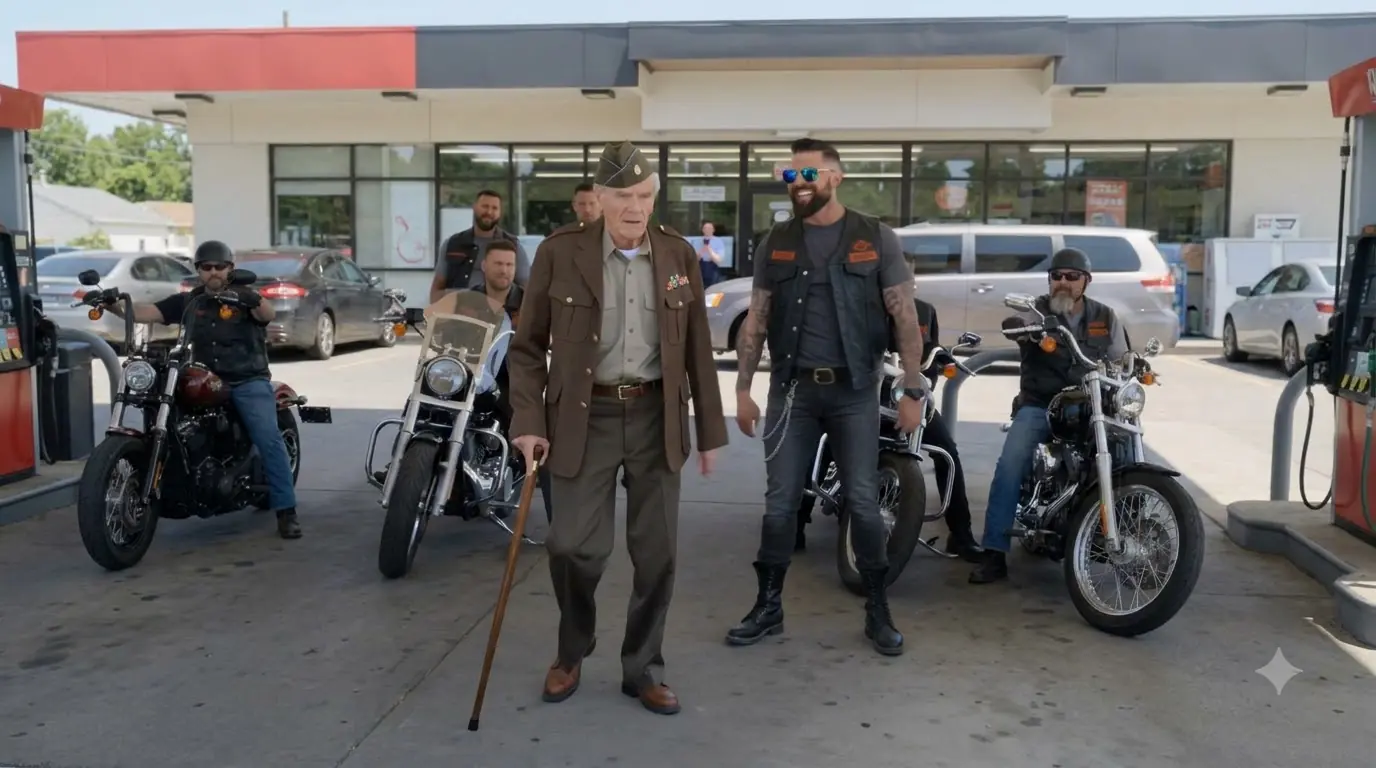
The voice cut across the gas station lot just as Harold Whitaker reached pump three.
He was seventy-eight years old, with silver hair showing beneath a faded olive cap and a polished wooden cane in his right hand. The cap had once been bright, but years of sun, rain, and careful hands had softened the fabric until the Marine Corps emblem on the front looked almost ghostlike. His brown field jacket hung loose on his shoulders, but the ribbons above the left pocket were still pinned straight.
Harold had not worn them for attention.
He wore them because that morning he had visited the grave of a man whose name most people had forgotten.
The five bikers saw him before he finished crossing the concrete.
They had been sitting near the front of the store for nearly half an hour, leaning against polished motorcycles, drinking from paper bags, laughing too loudly, and making the station feel smaller than it was. Their black leather vests carried a patch across the back that read Iron Jackals, stitched in red thread over a snarling wolf skull. They looked like men who had borrowed toughness from noise and confused cruelty with strength.
The biggest of them stepped away from his motorcycle.
His name was Mason Rourke.
He was thirty-two, thick through the shoulders, with tattooed arms, mirrored sunglasses, and a beard trimmed sharp enough to look deliberate. He moved like a man who had learned early that most people stepped aside when he wanted them to. That kind of lesson can ruin a person if no one ever teaches him what courage actually costs.
Harold kept walking toward the store.
Mason blocked him.
“I said take it off.”
Harold looked at him.
“Why would I do that?”
Mason pointed at the cap.
“Because you don’t deserve to wear it.”
The other bikers laughed.
One of them leaned forward on his handlebars and nodded toward the medals on Harold’s jacket.
“Those real, Grandpa? Or did you order the whole hero costume online?”
Another biker reached for the brim of the cap.
Harold caught his wrist.
The movement was not quick in the way young men expect quickness to look. It was small, clean, and exact, like a door closing before a hand could slip through. Harold’s fingers trembled slightly from age, but the grip itself did not tremble at all.
The younger biker’s smile disappeared.
For one quiet second, Harold looked into his eyes.
There was no anger on the old man’s face. Anger would have made the moment easier for the bikers to understand. Instead, there was a cold, tired steadiness, the kind that belongs to people who have seen real danger and no longer feel impressed by imitation.
Harold released the wrist.
“Don’t touch the hat.”
Mason stepped closer.
The laughter behind him came back louder because pride always hates a pause.
“You threatening my brother?”
“No.”
Harold adjusted the cap with two fingers.
“I’m asking you to behave like men.”
For half a second, nobody laughed.
Then Mason threw his head back as if Harold had told the funniest joke in the county. The others joined him, loud enough that a woman at pump one hurried her two children back into the minivan. A trucker near the diesel lane stopped filling his tank and watched without pretending not to.
One of the bikers kicked Harold’s cane.
The cane spun across the oil-stained concrete and struck the base of a trash can with a hollow crack.
Without it, Harold staggered.
His left shoulder clipped a newspaper box, and pain shot through his hip so sharply that his breath caught in his chest. A piece of shrapnel had lived near that hip since 1969, too dangerous to remove and too stubborn to forget. Most days, it rested quietly inside him like an old secret.
That afternoon, the pain woke up.
The bikers laughed again.
Inside the convenience store, twenty-year-old cashier Ethan Porter stood frozen behind the register. He had watched the Iron Jackals arrive, watched them insult a delivery driver, watched them complain about beer prices, and watched them take up space like the world owed them a stage. He had thought about calling the sheriff earlier, but thoughts are easier than action when five angry men stand outside your workplace.
Now Ethan reached slowly beneath the counter for his phone.
Harold crossed the concrete toward his cane.
Each step hurt.
He did not ask anyone to pick it up. He did not look around for sympathy. He reached the trash can, bent carefully, lifted the cane, and wiped dust from the carved handle with the same patience a man might use to clean a rifle after rain.
The bikers watched him.
The laughter thinned.
Something about Harold’s silence began to change the air. It no longer felt like the silence of an old man too afraid to speak. It felt like an accusation none of them had the language to answer.
Mason’s smile tightened.
He had expected the old man to shout, curse, leave, or beg to be left alone. Instead, Harold simply straightened his jacket and continued toward the store. Sunlight touched the old ribbons on his chest, faded but cared for, small pieces of cloth carrying weight none of the young men understood.
Harold pushed open the glass door.
The bell above it gave a bright little ring.
The five bikers followed.
The sound felt wrong inside the store, too cheerful for what had entered behind him.
Ethan placed his phone near the register, screen down but recording.
“Afternoon, sir,” he said to Harold.
“Pump three,” Harold replied. “Forty dollars, please.”
His voice was low and rough, but steady.
Ethan glanced at the bikers gathering near the chip rack.
“Are you okay?”
Harold removed his wallet.
“I’m fine.”
Mason leaned against a display of beef jerky.
“Listen to him. Still acting like he marched straight out of a war movie.”
Harold opened his wallet.
The leather was cracked, softened by decades of use. Inside was a photograph of a young woman standing beside a blue pickup in front of a white farmhouse, smiling into the sun. Her name had been Ruth, and she had been gone six years, though Harold still spoke to her every morning before coffee.
Mason noticed the photograph.
“That your girlfriend from the nursing home?”
Harold ignored him and counted his cash.
One biker, a narrow-faced man named Troy, stepped closer and flicked one of the medals pinned above Harold’s pocket.
The tiny metallic sound moved through the store.
Harold’s hand stopped above the counter.
For one second, the fluorescent lights vanished.
The store vanished.
The clean shelves and soda coolers became wet heat, red mud, torn jungle, and the smell of smoke. Somewhere nearby, a radio crackled through static. Men shouted for ammunition. Mortar rounds hit the ridge so hard the ground seemed to jump beneath his chest.
He was twenty-one again.
Private Jimmy Rourke was beside the field radio, one sleeve soaked dark, refusing to leave the set even as bullets cut leaves above them. Harold remembered shouting for him to get down. Jimmy shook his head, pressed the handset closer to his ear, and kept calling coordinates through the noise.
“Keep them talking!” Harold had yelled.
Jimmy had grinned through blood and fear.
“Somebody’s got to, Whit!”
Then the ridge disappeared under fire.
Harold returned to the present.
Troy’s finger still hovered near the medal.
Harold raised his eyes.
“Remove your hand.”
The biker pulled back before he knew why.
Mason pushed away from the display.
“What are you going to do if he doesn’t?”
Harold turned toward him.
“I’ve met louder men than you.”
Mason smirked.
“And what happened to them?”
Harold looked past him, through the glass doors, toward the hot highway outside.
“They stayed behind.”
The words were not a threat.
They sounded like grief.
That made them heavier.
Ethan watched the bikers exchange glances. For the first time, Mason looked uncertain, and that uncertainty made him more dangerous. Men like him do not always know how to step back from humiliation unless someone gives them a way to do it.
No one did.
So Mason stepped close enough for Harold to smell stale beer and cigarettes.