The German Shepherd's bark pierced the solemn quiet of Riverside Funeral Home like a siren in the night.
Max stood rigid, hackles raised, his powerful body trembling as he stared at Chief Richard Harrison's mahogany coffin. His desperate barks echoed off the walls, drowning out the minister's prayers and the muffled sobs of the bereaved.
“Someone get that damn dog out of here!” hissed Deputy Chief Parker, his face flushed with anger. “Show some respect!”
Detective Michael Carson watched as two officers attempted to drag Max away, but the dog broke free, plunging toward the coffin with such force that the floral arrangements toppled. The mourners gasped. Sarah Harrison, the chief's widow, covered her mouth with trembling hands.
Max's behavior wasn't just grief. Carson had seen the dog at countless death scenes. This was different. The animal wasn't mourning. He was alerting.
When Max suddenly launched himself at the coffin, tearing at the silk lining with his teeth, chaos erupted. As hands reached to restrain him, Carson stepped forward, a cold realization washing over him.
“Wait,” he commanded, raising his hand. “Open it. Open the coffin now.”
In the stunned silence that followed, only Max's persistent growls could be heard. What happened next would haunt everyone present for the rest of their lives.
Detective Michael Carson had spent 23 years with the Riverside Police Department, 15 of them under Richard Harrison's leadership. At 46, Carson's weathered face told the story of a man who'd seen too much, the creases around his eyes deepened by both laughter and grief, his salt-and-pepper hair cropped military short, his blue eyes retaining a sharpness that missed nothing.
Three years ago, Carson had lost his wife, Emma, to ovarian cancer, leaving him alone in a house too big and too quiet.
What most of Riverside didn't know was that Carson's connection to Chief Harrison went back much further than his police career. As a troubled 16-year-old caught breaking into the corner market, Carson had encountered Officer Harrison, who saw something worth saving in the angry young man.
Instead of processing him through the system, Harrison had taken him home for dinner, introduced him to Sarah, and over meatloaf and mashed potatoes offered him a deal: community service and weekly check-ins instead of juvenile detention.
That night changed Carson's life trajectory forever.
“You've got good instincts, son,” Harrison had told him years later, when Carson made detective. “Trust them, even when everyone tells you you're wrong.”
Chief Richard Harrison had been a fixture in Riverside for over 30 years. At 58, he still cut an imposing figure, 6'2" with broad shoulders and a military posture that commanded respect without a word. His steel-gray hair and trimmed beard framed a face known for fairness and integrity. The wrinkles around his eyes spoke of someone who smiled easily, but could turn deadly serious in an instant.
Harrison and his wife Sarah had no children of their own, though they'd informally adopted countless troubled youth over the decades. Their childlessness wasn't by choice. Sarah had suffered three miscarriages early in their marriage. Instead, they poured their nurturing instincts into their community and into Max, the German Shepherd who'd been Harrison's partner before retiring to become their family pet.
Max had come into Harrison's life seven years ago during a warehouse raid that went wrong. The drug bust had triggered an explosion that killed Max's handler and left the dog badly injured. Harrison had stayed with Max throughout his recovery, and the bond formed couldn't be broken. When Max was deemed unfit to return to active K9 duty due to hearing damage in one ear, Harrison had brought him home permanently.
Sarah Harrison was her husband's equal in compassion, but possessed a quiet strength all her own. At 56, her auburn hair now streaked with silver, she'd taught third grade at Riverside Elementary for 28 years. Her students, past and present, filled three rows at the funeral, clutching handmade cards and tissues.
Deputy Chief William Parker had been Harrison's second-in-command for eight years. At 49, his ambition was an open secret in the department. Trim, meticulous, with carefully maintained blonde hair and a politician's smile, Parker had always been respected, but never loved like Harrison.
Dr. Elizabeth Miller, the county medical examiner, stood apart from the mourners, her analytical gaze moving between the coffin and Max. At 38, she was relatively new to Riverside, but had quickly earned a reputation for thoroughness. Something about the chief's death report had bothered her from the beginning.
Riverside itself was changing. Once a peaceful manufacturing town of 75,000, it had been hit hard by factory closures in recent years. A growing opioid crisis had transformed certain neighborhoods, bringing violence and desperation. Chief Harrison had been leading a major investigation into a trafficking ring that reached surprisingly high into Riverside's power structure, or so the rumors went.
Now, as Max's barking echoed through the funeral home, the threads of loyalty, suspicion, and secrets began to unravel in ways no one could have predicted.
The call came at 6:42 p.m.
Carson was hunched over case files in his cramped office when his phone vibrated against the coffee-ringed desk. Officer Jenny Ramirez's voice cracked as she delivered the news that would shatter his world.
“Detective Carson, it's about Chief Harrison. He's…”
Her voice faltered.
“He's gone. Heart attack, they think. At home. Sarah found him on the couch when she got back from grocery shopping.”
The words hit Carson like physical blows. His hand gripped the phone so tightly his knuckles whitened.
Chief Harrison dead?
The man was a force of nature, ran five miles every morning, had just laughed with Carson yesterday about retirement being at least a decade away.
“That's impossible,” Carson said reflexively. “He… I just saw him this morning. He was fine.”
“I'm sorry, sir. The paramedics confirmed it an hour ago. They've already taken him to Riverside Funeral Home. Ms. Sarah requested immediate arrangements.”
Carson's mind raced through their last conversation. They'd met for coffee at 7:00 a.m. to discuss the East Side drug trafficking case, a sprawling investigation that the chief had been personally overseeing.
Harrison had seemed preoccupied, asking Carson to meet him again tomorrow with strict instructions.
“Tell no one we're meeting. Not even Parker.”
“He mention anything unusual to you lately? Anyone threatening him?” Carson asked, already reaching for his jacket.
“No, sir, but Deputy Chief Parker is handling everything now. He said to inform all senior officers, but to proceed with arrangements quickly for Sarah's sake.”
The rush to bury Harrison struck Carson as odd, unsettlingly so. Standard procedure for any officer's death, let alone the chief's, would include a thorough examination.
“Who pronounced him? Was Miller called in?”
“I don't think so. The paramedic said it was clear-cut natural causes.”
By the time Carson arrived at Riverside Funeral Home, the parking lot was already half-filled with patrol cars. The stately Victorian building, with its somber façade and manicured gardens, had hosted the funerals of three officers during Carson's career. Never had he imagined the chief would be the fourth.
Inside, the central viewing room had been quickly prepared. Harrison's body lay in an open casket, dressed in his formal blues, medals gleaming under soft lighting. Sarah sat nearby, surrounded by fellow officers' wives, her face ashen with shock.
When she saw Carson, something flickered in her eyes, relief perhaps, or recognition of shared grief.
“Michael,” she said softly as he knelt beside her chair. “Thank you for coming so quickly.”
“Sarah, I'm so sorry.”
The inadequacy of the words burned his throat.
“What happened? He was fine this morning.”
A shadow crossed her face.
“They said his heart just stopped. But Richard was healthy as a horse, you know that. His physical last month was perfect.”
She leaned closer, lowering her voice.
“He's been working late, Michael. Very late. Wouldn't tell me why, but he was worried about something. I could tell.”
Carson nodded, filing away the information.
“Where's Max?”
“At home. Parker suggested leaving him there, but I couldn't bear it. My neighbor's bringing him over soon.”
As if summoned by discussion, the funeral home door swung open and a petite woman entered, struggling with Max's leash.
The German Shepherd's disciplined demeanor vanished the moment he entered the viewing room. He froze, ears alert, then began pulling frantically toward the casket, whining in distress.
“I'm so sorry,” the neighbor apologized as Max dragged her forward. “He's never like this.”
Carson moved to take the leash. “I've got him.”
The moment Carson took control, Max's behavior intensified. The dog stared at the coffin, his whines turning to sharp, insistent barks that echoed through the hushed room.
“Detective, please control that animal,” Deputy Chief Parker appeared at Carson's elbow, his voice tight with irritation. “This is highly inappropriate.”
William Parker had always been meticulous in appearance and demeanor. Today his uniform was impeccable, his composure controlled, perhaps too controlled for a man who'd just lost his superior and mentor of eight years.
“Max was Harrison's dog, Bill. He deserves to be here.”
“The dog is clearly distressed and disrupting the service. Take him outside.”
Carson made no move to leave. Instead, he watched Max intently, the detective in him noting every detail of the animal's behavior.
Max wasn't just upset. He was alerting. The same way he'd been trained to signal when finding evidence or detecting danger.
“Something's wrong,” Carson murmured, more to himself than to Parker.
“The only thing wrong is you're allowing that animal to disrupt the chief's dignified send-off,” Parker hissed. “Sarah doesn't need this additional stress.”
Across the room, Dr. Elizabeth Miller slipped in quietly, nodding briefly to Carson. Her presence was unexpected and, by the look on Parker's face, unwelcome.
“Was Miller called to examine the body?” Carson asked.
Parker stiffened. “There was no need. The paramedics confirmed cardiac arrest.”
“For a police chief, there should be an autopsy.”
Parker's jaw tightened. “Sarah declined. She didn't want Richard subjected to that indignity.”
Before Carson could respond, Max's barking reached a new intensity. The dog lunged toward the coffin, nearly pulling Carson off his feet.
Several officers moved to help restrain him.
“Get him out of here now, or I'll have him removed,” Parker ordered.
Carson reluctantly dragged Max toward the exit, the dog fighting him every step.
In the lobby, he encountered Dr. Miller.
“That's interesting behavior,” she commented, watching Max struggle.
“You think so too?”
Miller glanced over her shoulder, then spoke quietly.
“I wasn't officially called in, but I have questions about the chief's death. Sudden cardiac arrest in a man with his medical history? No prior symptoms.”
Carson's instincts, already on high alert, sharpened further.
“Can you get access to examine him?”
“Not without authorization, which Parker seems determined to prevent.”
She hesitated.
“The funeral's scheduled for tomorrow morning. Very rushed, don't you think?”
As they spoke, Max continued to bark toward the viewing room, straining at his leash with growing desperation.
Carson made a decision.
“I'm staying overnight. Funeral home staff will be here, but I want someone from the force present.”
“I don't think Parker will authorize that.”
“I'm not asking for authorization.”
Carson's voice hardened.
“Something isn't right. And I trust Max's instincts almost as much as I trusted Harrison's.”
As night fell on Riverside, Carson settled into an uncomfortable chair in the funeral home's anteroom, Max lying alert at his feet. Both man and dog kept their vigil, neither knowing that by morning everything would change in ways impossible to imagine.
The funeral home grew eerily quiet as midnight approached. The staff had retired to their quarters in the adjacent building, leaving Carson alone with Max in the dimly lit viewing room.
Outside, rain began to fall, droplets tapping against the high windows like impatient fingers.
Carson had positioned his chair with a clear view of Chief Harrison's casket, which now stood closed per funeral home protocol. Max had finally settled, though his rest was fitful. Every few minutes the German Shepherd would raise his head, ears pivoting toward the casket, a low whine building in his throat before subsiding.
Carson absentmindedly stroked the dog's head, his own thoughts churning with memories and questions.
“What were you working on, Chief?” he murmured.
The East Side drug trafficking case had consumed Harrison's attention for months, but lately something had changed. The chief had become more guarded, keeping unusual hours, meeting contacts alone, behavior out of character for a man who believed in transparency and teamwork.
At precisely 12:17 a.m., Max suddenly leapt to his feet, a deep growl rumbling from his chest.
Carson was instantly alert, hand moving instinctively to his holstered weapon. The dog's focus was locked on the far corner of the room where shadows gathered thick and impenetrable.
“Who's there?” Carson called, rising slowly.
Silence answered him, broken only by the intensifying rain.
Max continued growling, taking a protective stance between Carson and the darkness.
“Police officer. Identify yourself now.”
A slight movement caught Carson's eye, a shadow detaching from deeper shadows.
A figure emerged, male, medium height, wearing a dark overcoat and hat pulled low.
“My apologies, detective. I didn't mean to startle you.”
The voice was cultured, with the slightest accent Carson couldn't place.
“I'm an old friend of Richard's. Came to pay my respects privately.”
“Visiting hours ended at nine,” Carson replied evenly, noting how Max's hackles remained raised. “And I don't recall the door opening.”
“The young lady at reception was kind enough to let me in through the side entrance.”
The man took a step forward, then hesitated as Max's growl deepened.
“I see Richard's dog remembers me. Not fondly, it seems.”
Carson didn't lower his guard. “Your name.”
“James Marshall. Richard and I served together years ago.”
The man gestured vaguely.
“I was passing through town and heard the terrible news.”
Carson studied the visitor carefully. Nothing about him suggested immediate threat, yet every instinct warned Carson that something was off. The man carried himself with military precision, but his eyes darted repeatedly to the casket in a way that spoke of anxiety rather than grief.
“I don't recall Chief Harrison mentioning a James Marshall.”
“We lost touch. My work takes me overseas frequently.”
Marshall reached into his coat pocket, causing Max to bark sharply.
“Hands where I can see them!” Carson ordered.
Marshall slowly withdrew his hand, showing a business card.
“Just my contact information, detective. Perhaps we could speak tomorrow about Richard's legacy.”
Before Carson could respond, a sound interrupted them. A faint but distinct thump that seemed to emanate from the casket itself.
Max immediately whirled, racing to the coffin and pawing frantically at its side, barking with renewed urgency.
Marshall's face drained of color. Without another word, he turned and moved swiftly toward the side exit, disappearing into the rain-soaked night before Carson could stop him.
Carson hurried to the casket, his heart pounding. Surely he'd imagined the sound, grief and exhaustion playing tricks on his mind. Yet Max's behavior had escalated to frenzy, desperation, the dog now attempting to climb onto the casket platform.
“Easy, boy,” Carson murmured, though his own hands shook slightly as he laid them on the polished wood. “Easy now.”
The night passed with agonizing slowness.
Carson attempted to contact Dr. Miller, but his calls went unanswered. He considered calling Sarah, but couldn't bear to disturb her with what might be nothing more than his overwrought imagination.
Instead, he documented the strange visitor in his notebook and maintained his vigil, Max never leaving the casket's side.
By dawn, the funeral home stirred to life again. Staff arrived to prepare for the 10:00 a.m. service, eyeing Carson and Max with a mixture of sympathy and concern.
Sarah arrived at eight, accompanied by her sister and Parker, whose face tightened upon seeing Carson.
“You stayed all night?” Sarah asked, touching Carson's arm gently.
“I wanted to make sure everything was properly respected,” Carson replied, not mentioning the midnight visitor or the strange sound.
“Max was unsettled.”
“That dog needs to be taken home,” Parker interjected. “We can't have a repeat of yesterday's disruption.”
Sarah shook her head firmly. “Max stays. Richard would want him here.”
As they spoke, funeral home staff began the final preparations. Floral arrangements were positioned, the guest book set up, programs distributed.
Carson noticed Parker checking his watch repeatedly, speaking in hushed tones with the funeral director about keeping things moving efficiently.
More mourners began to arrive, officers in dress uniforms, city officials in somber suits, community members whose lives Harrison had touched. Each paid their respects to Sarah before taking seats in the rapidly filling room.
Dr. Miller slipped in, catching Carson's eye with a significant look before sitting near the back.
At 9:45, the funeral director approached.
“Mrs. Harrison, if you're ready, we'll begin the procession to the cemetery after the brief service. The pallbearers should take their positions now.”
Six officers, including Carson, moved to surround the casket.
Max, who had remained remarkably calm until now, suddenly began barking again. Not the alert barks of last night, but panicked, desperate sounds that echoed through the crowded room.
“Someone control that animal!” an elderly city councilman demanded.
Parker stepped forward. “I warned you. Carson, get him out now.”
But Max had broken free, launching himself directly at the casket. His powerful jaws clamped onto the silk lining draping over one side, tearing it away with violent force.
Women screamed. Men jumped to their feet. Sarah stood frozen, one hand pressed to her mouth.
“Stop him!” Parker shouted, reaching for his ceremonial sidearm.
“Wait!”
Carson moved to protect Max, dropping to his knees beside the frantic dog.
“Listen to me, all of you. Something's wrong.”
“The only thing wrong is your inability to control that beast!” Parker snapped.
“No.”
Carson stood, facing the shocked crowd.
“Max is trying to tell us something. Chief Harrison trained him himself. This dog doesn't behave this way without reason.”
“Michael, what are you saying?” Sarah whispered.
Carson took a deep breath, knowing his next words would either destroy his career or possibly save a life.
“I'm saying we need to open this casket. Now.”
A collective gasp rippled through the room.
Parker stepped between Carson and the casket.
“This is outrageous. You're desecrating Harrison's memory based on a dog's behavior.”
“Richard always said Max could sense things we couldn't,” Sarah said quietly, her voice gaining strength. “If Michael thinks something's wrong, I want the casket opened.”
“Sarah, you're emotional. This isn't appropriate,” Parker insisted.
“I am his wife.”
Sarah's voice cracked like a whip.
“Open it.”
In the tense silence that followed, Carson noticed Dr. Miller moving closer, medical bag in hand.
The funeral director looked between the opposing parties, clearly distressed by this unprecedented situation.
“Mrs. Harrison, are you absolutely certain?”
Sarah nodded, tears streaming down her face.
“Do it.”
As the funeral director reluctantly moved to unlock the casket lid, Max fell silent at last, watching intently with dark, knowing eyes.
The entire room held its breath.
No one was prepared for what they were about to discover.
The funeral director's hands trembled as he unlocked the casket's brass latches. The heavy lid creaked open, revealing Chief Richard Harrison still form-dressed in his formal police uniform, hands folded across his chest.
For a moment, the room remained in stunned silence, mourners uncertain what they had expected to see.
Dr. Miller pushed forward, medical instincts overriding protocol. She pressed two fingers against Harrison's neck. Her expression remained professionally neutral.
After ten seconds that felt like eternity, her eyes widened.
“There's a pulse,” she announced, her voice cutting through the silence. “Faint, but it's there.”
The room erupted in chaos.
Sarah collapsed against her sister, half sobbing, half laughing in hysterical relief. Officers crowded forward, their training overcome by shock. Max barked triumphantly, his tail whipping back and forth.
“Everyone back!” Dr. Miller commanded. “Give him air. Someone call an ambulance. Now!”
Carson was already on his phone, reporting the impossible situation in clipped, urgent tones. As he spoke, his eyes never left Parker, whose face had drained of all color. The deputy chief stood rigid, mouth working silently, looking not like a man overjoyed at a miracle, but like someone witnessing his worst nightmare materialized.
“Let me see him,” Sarah pleaded, pushing through the crowd to kneel beside the casket. “Richard! Richard, can you hear me?”
No response came from the chief, though Miller confirmed his breathing was shallow and irregular, but present.
As she continued her examination, she suddenly frowned, her fingers discovering something at Harrison's collar.
“Detective Carson,” she called sharply, “look at this.”
Carson leaned in. Partially hidden by the uniform collar was a tiny puncture mark surrounded by a faint bruise, nothing that would be noticed during casual preparation of the body, but unmistakable to trained eyes.
“That's not from normal embalming,” Miller murmured, for only Carson to hear. “And there's another mark here on his inner arm.”
Carson's mind raced. Injection sites. Someone had administered something to Harrison, something that mimicked death closely enough to fool paramedics working under pressure.
The realization hit him with physical force.
This wasn't a medical mistake.
This was attempted murder.
The wail of approaching sirens cut through the commotion. Emergency medical technicians burst in with a gurney, equipment bags slung over shoulders.
Dr. Miller briefed them rapidly as they transferred Harrison from casket to gurney, attaching monitors that confirmed the miracle. A heartbeat, faint but persistent.
“BP's dangerously low. Pupils sluggish, but reactive,” the lead paramedic reported. “We need to move him now.”
As they wheeled Harrison out, Sarah clutching his limp hand, Carson turned to find Parker had disappeared.
The revelation wasn't surprising, but it confirmed his darkest suspicions. Scanning the crowd, he spotted Officer Ramirez.
“Jenny, I need a crime scene team here immediately. This funeral home is now an active investigation site. No one leaves until they've been questioned.”
“Sir?” She looked bewildered. “What crime?”
“Attempted murder of Chief Harrison.”
The words rippled through the remaining guests.
“And get an APB out on Deputy Chief Parker. Consider him a person of interest.”
Carson followed the ambulance to Riverside Hospital, Max in the backseat of his cruiser. His mind worked mechanically through the implications of what had just happened.
If Harrison had been poisoned rather than suffering natural cardiac arrest, the speed with which the funeral had been arranged made terrible sense. Someone wanted the chief buried before anyone could look too closely.
The midnight visitor, James Marshall, clearly had been checking to ensure Harrison remained in his chemically induced deathlike state.
The sound Carson had heard might have been the first sign of Harrison's body fighting the effects of whatever he'd been given.
At the hospital, Harrison was rushed to intensive care. Carson paced the waiting room, making calls to secure the scene at the funeral home and Harrison's residence. Sarah sat nearby, shocked into near-catatonia, clutching Max's leash like a lifeline. The dog had refused to leave the hospital entrance until Carson convinced security to make an exception to their no-animals policy.
Dr. Levine, the attending physician, emerged after what felt like hours.
“Mrs. Harrison, your husband is stable, but critical. We found traces of a powerful synthetic compound in his system. Something that drastically slows heart rate and respiration.”
“Another few hours…”
He left the implication hanging.
“Will he recover?” Sarah's voice was barely audible.
“It's too soon to tell. The poison caused oxygen deprivation, and there may be neurological damage. We're administering the appropriate counteragents, but this substance isn't common. We've had to consult with toxicologists in the city.”
“Was it administered recently?” Carson asked.
“Within the last 24 hours. Based on the breakdown in his bloodstream, I'd estimate it was given approximately 36 hours ago. The concentration suggests multiple small doses, possibly over several days, with a final larger dose.”
The timeline aligned with Harrison's death report.
Carson's phone buzzed with a message from the forensic team at the funeral home. They'd found a broken hypodermic needle tip embedded in the lining of the casket. Someone had attempted to administer another dose after Harrison was already in the coffin.
“I need officers outside his room around the clock,” Carson told Ramirez when she arrived. “No one enters without proper ID and authorization.”
“Already arranged, sir. And we've secured the chief's house. CSI team is processing it now.”
She hesitated.
“There's something else. The chief's home office was broken into. His safe was open, and according to Mrs. Harrison's sister, several files are missing.”
“The East Side drug case files,” likely, Carson thought.
“And, sir, Deputy Chief Parker's cruiser was found abandoned at the train station. He's gone.”
Carson wasn't surprised. Parker's hasty exit confirmed his involvement, but the depth and nature of that involvement remained unclear. Was he the mastermind, or merely a pawn in a larger conspiracy?
The hospital room where Harrison lay was a fortress of medical technology. Monitors beeped steadily, tracking every flutter of his heart, every molecule of oxygen in his blood. Tubes and wires connected him to machines that breathed for him, fed him, measured him.
Sarah sat beside the bed, Harrison's limp hand in hers. Max curled at her feet.
“He was trying to tell me something,” she said when Carson entered. “These past few weeks. Working late. Taking calls in his study with the door closed. I thought it was just the pressure of the drug investigation.”
“Did he mention any names? Any specific concerns about someone in the department?”
She shook her head.
“Not directly, but…”
She hesitated.
“Three days ago, he came home early. I was in the garden and overheard him on the phone in his study. He said, ‘I can't believe it goes that high.’ When I asked about it later, he brushed it off.”
That high could mean many things in a corruption investigation, but in Carson's experience it usually meant someone with authority, someone presumably above reproach.
Carson's phone rang. The forensics team at Harrison's house.
“Detective, we found something unusual. The chief's home computer has been accessed recently, after he was supposedly deceased. Someone used his passwords to download files.”
“Parker.”
“Can't confirm yet, but the timing suggests it happened while the chief was already at the funeral home.”
Another piece of the puzzle fell into place. Parker had orchestrated the quick funeral arrangements, giving himself time to clean up evidence of whatever conspiracy Harrison had uncovered.
As night fell, Carson found himself standing at the window of Harrison's hospital room, watching raindrops trace patterns on the glass. Sarah had finally been convinced to go home for a few hours of rest, leaving Carson and two uniformed officers guarding the chief.
Max refused to leave, maintaining his vigilant position beside the bed.
A soft knock at the door brought Carson's hand to his weapon. Dr. Miller entered, looking exhausted.
“I've completed preliminary toxicology on the needle fragment,” she said without preamble. “It's a compound called tetrodotoxin, modified to slow metabolic signs to near-death levels without actually killing the victim. Very sophisticated. Very rare.”
“Military or high-level criminal organizations?”
“This isn't street-level stuff.”
She handed him a file.
“I also reviewed the paramedics' initial report. They followed protocol, but this poison is designed to fool standard death confirmation methods. The person who did this knew exactly what they were doing.”
Carson nodded grimly.
“Someone wanted him to wake up inside that coffin. Underground.”
“A particularly cruel death,” Miller agreed.
“We're nearly foolproof. No autopsy, no questions, just a respected chief who died of natural causes.”
A text from Officer Ramirez broke Carson's concentration.
Security breach at hospital. Unknown subject attempted to access ICU through service entrance. Security pursuing.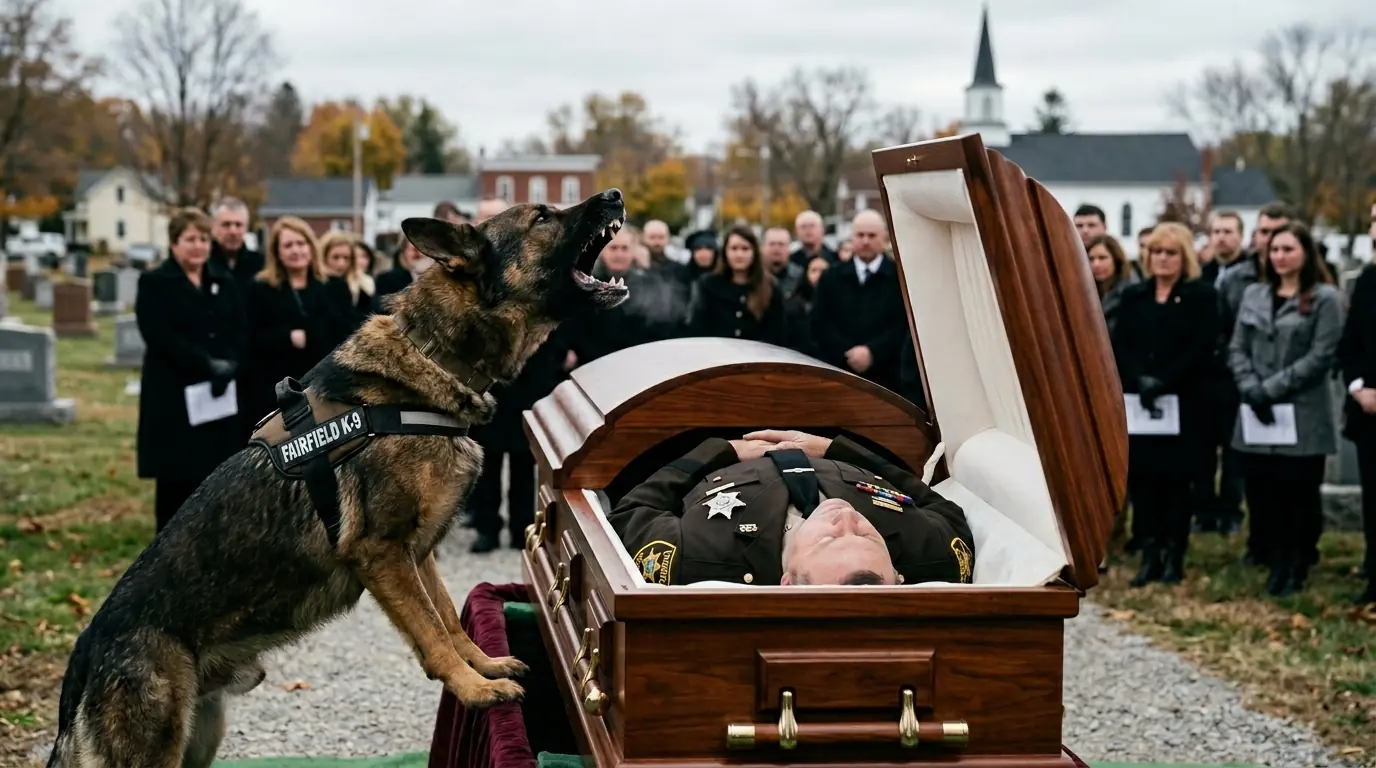
Carson slammed the laptop shut and drew his weapon, positioning himself between the door and Harrison's bed. Max growled low, sensing the tension.
“Lock this room down,” he ordered the guard outside. “No one enters. Not doctors, not nurses, without my explicit approval.”
The assassination attempt had failed once. Carson knew with grim certainty that Kingfisher wouldn't leave the job unfinished. With Parker gone and Harrison still alive, the entire operation was at risk.
Desperate people made desperate moves, and whoever was behind this had already proven their willingness to kill.
As if confirming his fears, the hospital light suddenly flickered, then went out completely, leaving only the emergency backup lighting casting eerie shadows across Harrison's vulnerable form.
The hospital's emergency generators hummed to life, casting the ICU in a dim amber glow. Medical equipment beeped erratically before stabilizing on backup power.
Carson pressed himself against the wall beside the door, gun drawn, every sense heightened in the semi-darkness. Max took a protective stance at the foot of Harrison's bed, hackles raised, a low, continuous growl rumbling from his throat.
“This is Detective Carson,” he spoke into his radio. “We have a security situation in the ICU. Chief Harrison may be the target. I need all available units to the hospital immediately.”
Static answered him.
The radio system was down, likely not a coincidence.
Through the door's small window, Carson could see the hallway filling with confused medical staff and patients. Perfect cover for someone trying to reach Harrison's room undetected.
“Officer Mendez,” he called to the guard outside, “don't let anyone approach, regardless of their credentials.”
“Yes, sir,” came the steady reply, though Carson noted the slight tremor in the young officer's voice.
Minutes stretched like hours.
Carson's phone vibrated. Ramirez.
Security cameras down. Three officers en route to your location. Suspect described as male, medical scrubs, surgical mask.
Carson's eyes narrowed. The description could match dozens of legitimate hospital personnel currently scrambling to manage the power outage.
He texted back:
Coordinate with hospital security. I want all access points to this floor locked down.
A scuffle in the hallway drew his attention.
Through the window, he glimpsed Officer Mendez confronting someone in blue scrubs. The figure seemed to be arguing, gesturing urgently toward Harrison's room.
Carson couldn't make out the words, but the body language suggested increasing agitation.
Suddenly, the figure lunged at Mendez. There was a flash of metal, a muffled cry. The officer staggered backward, clutching his side, as the assailant shoved past him toward the door.
Carson braced himself.
“Max, guard!” he commanded sharply.
The dog instantly positioned himself between the bed and the door, teeth bared, every muscle tensed for action.
The door burst open.
The attacker froze momentarily at the sight of Carson's leveled weapon.
In that split second, Carson recognized him, not from his partially masked face, but from his distinctive stance and build.
“Parker,” Carson said coldly. “Should've known you wouldn't run far.”
The deputy chief's eyes darted between Carson, Max, and Harrison's unconscious form. Blood stained the surgical gloves on his right hand, Mendez's blood.
“You don't understand what you're involved in, Carson.”
Parker's voice was tight, controlled despite the circumstances.
“This goes beyond Harrison. Beyond Riverside.”
“Drop the scalpel. On your knees. Now.”
Parker's laugh held no humor.
“You think I'm here alone? This entire hospital is compromised. You've already lost.”
As if to confirm his words, the sound of gunfire echoed from somewhere in the building. Screams followed.
The distraction was minimal, but enough.
Parker lunged forward, scalpel aimed at Carson's throat.
Carson fired. The bullet caught Parker in the shoulder, spinning him sideways. The deputy chief crashed into medical equipment, but remained upright, face contorted with pain and rage.
Before Carson could reposition, Parker was on him, driving both men to the floor.
The scalpel slashed downward. Carson caught Parker's wrist. The blade hovered inches from his eye. They struggled, locked in a desperate contest of strength. Parker had the advantage of position, using his weight to force the blade closer to Carson's face.
“You should have stayed out of it,” Parker hissed. “Harrison was supposed to die peacefully. Now you'll both suffer.”
A blur of tan and black fur launched across the room.
Max attacked with precision, powerful jaws clamping onto Parker's forearm. The deputy chief screamed, the scalpel clattering to the floor.
Carson drove his knee upward, throwing Parker off balance, then delivered a sharp blow to his temple.
Parker slumped, momentarily stunned.
Carson scrambled to his feet, retrieving his weapon.
“Max, hold!”
The German Shepherd maintained his grip on Parker's arm, intelligent eyes fixed on Carson for further commands.
“Police!” Carson ordered, training his gun on Parker's chest.
Max reluctantly let go, remaining poised to attack again if necessary.
Parker sat up slowly, cradling his bleeding arm.
“You've got no idea what's coming for you, Carson,” he spat. “Kingfisher doesn't forgive failure.”
“Who is Kingfisher? Give me a name.”
Parker's eyes moved past Carson to the doorway. His expression shifted from defeat to something like triumph.
Carson sensed the new presence too late.
Pain exploded at the base of his skull, a brutal impact that sent him crashing to his knees. Vision blurring, his gun slipped from numbed fingers.
And through the haze he saw a second figure in the room, tall, well-dressed, holding a heavy metal oxygen tank like a club.
“Finish it,” the newcomer ordered.
Parker, already retrieving the scalpel from the floor.
Max launched himself at the second attacker, but the man anticipated the move. He swung the oxygen tank with terrible precision. There was a sickening thud, a high-pitched yelp of pain, and Max collapsed in a heap.
“No!”
Carson lunged toward the fallen dog, but Parker's boot slammed into his ribs, driving the air from his lungs.
“I told you,” Parker sneered, twirling the scalpel. “You've already lost.”
Carson struggled to focus, fighting waves of nausea and pain.
The second man approached Harrison's bed, producing a syringe from his jacket pocket.
“Make it look natural,” he instructed Parker.
The man paused, turning toward Carson with mild surprise.
“Very good, detective. Though that's not my real name, of course.”
Carson fought to remain conscious, to find some way, any way, to protect Harrison.
“You're Kingfisher.”
A thin smile.
“Among other names.”
He uncapped the syringe, moving with unhurried precision.
“Nothing personal, you understand. Just business.”
Parker kept his boot firmly planted on Carson's chest, the scalpel now pressed against his throat.
“What about him?”
“Similar complications,” Kingfisher replied coldly. “But a tragic night for Riverside Memorial Hospital.”
As the needle approached Harrison's IV line, a strange sound filled the room, a wet, gurgling cough.
Max was struggling to his feet, blood matting his fur, but determination undiminished. The dog staggered, then gathered himself for one final desperate lunge at Kingfisher.
The distraction was minimal, but enough.
Carson drove his elbow upward into Parker's knee with all his remaining strength. The deputy chief howled, momentarily thrown off balance.
Carson rolled, grabbing for his fallen weapon.
The hospital room exploded with sound and motion.
The door burst open as officers poured in. Ramirez led the charge, weapon drawn.
“Police! Freeze!”
Kingfisher reacted with startling speed, driving the syringe not into Harrison's IV but into Parker's neck as he used the deputy chief as a human shield.
Parker's eyes widened in shock and betrayal.
“You promised—” he gasped as Kingfisher shoved him toward the advancing officers.
Chaos erupted. Parker collapsed, convulsing violently. Officers shouted conflicting commands.
Kingfisher backed toward the room's window, producing a small handgun from beneath his jacket.
But Carson, still dazed but functioning on pure adrenaline, saw what was about to happen.
“Gun!” he shouted, diving toward Max to shield the wounded animal.
Two shots rang out in rapid succession.
Kingfisher staggered, blood blooming across his expensive shirt. Ramirez had fired first, her aim true. But Kingfisher had managed to discharge his weapon as well.
Carson felt a searing heat tear through his left shoulder, spinning him back to the floor.
The room swam in and out of focus.
Carson was vaguely aware of officers securing Kingfisher, of medical staff rushing in, of voices calling his name. Max whimpered nearby, dragging himself closer to Carson despite his injuries.
“The dog. Save the dog,” Carson managed before darkness claimed him.
Carson awoke to steady beeping and the antiseptic smell of hospital disinfectant. His body felt leaden, his mind foggy from painkillers.
Slowly, memories filtered back. The power outage. Parker's attack. Kingfisher. Max.
“Max…”
He tried to say it, but his throat was too dry for more than a rasp.
“He's going to be okay.”
Sarah Harrison sat beside his bed, looking exhausted but composed. She offered him water, helping him drink through a straw.
“Max has a fractured rib and a concussion, but the veterinarian says he'll make a full recovery. They're keeping him at the animal hospital across town.”
Relief washed through Carson.
“And the chief?”
Sarah's expression softened slightly.
“Stable. The doctors are cautiously optimistic. He regained consciousness briefly yesterday, asked for you and Max.”
“Yesterday?”
Carson had lost time.
“How long have I been out?”
“Almost 36 hours. The bullet went clean through your shoulder, but you lost a lot of blood.”
“Parker?”
Sarah's face hardened.
“Dead. Whatever was in that syringe worked quickly.”
“And Kingfisher?”
“In surgery. He'll live to stand trial.”
Her hand tightened around the water cup.
“It was Judge Collins, Michael. The judge. Collins, who's been on the bench for 20 years. The one who married Richard and me.”
Carson closed his eyes briefly. The betrayal would cut Harrison deeply when he learned of it.
“I know. His name was in the files, along with Mayor Hastings.”
“They arrested Robert this morning. The FBI had been building their own case, apparently. Richard had been working with them for months.”
She shook her head in disbelief.
“A judge and the mayor, both on a cartel's payroll. It doesn't seem possible.”
“Money corrupts,” Carson said simply. “And Collins and Hastings had expensive tastes.”
A soft knock interrupted them. Officer Ramirez entered, looking as tired as Carson felt.
“Sir, glad to see you awake.”
She handed Sarah a paper cup of coffee before continuing.
“Thought you'd want an update. The FBI has taken over the case. They've made 17 arrests so far, including three more officers from our department and the county commissioner.”
Carson nodded, unsurprised by the extent of the corruption. Harrison had uncovered something far larger than anyone had suspected.
“Collins is talking,” Ramirez continued, trying to cut a deal. “He claims Parker was the primary contact with the cartel, bringing him and Hastings in later when they needed judicial and political cover.”
“And the attempt on Harrison's life?”
“Parker's idea, apparently. The chief was getting too close, had too much evidence.”
She hesitated.
“Sir, there's something else. They found a detailed burial plot in Collins's home office with your name on it. You were next.”
The revelation sent a chill through Carson despite the room's warmth. He'd suspected as much, but confirmation brought the danger into sharp focus.
“There's more,” Ramirez said, her voice dropping. “The toxicology report on Chief Harrison showed something unexpected. The poison was administered in small doses over weeks, most likely in his coffee. They found residue in the break room coffee machine at the station. It was targeted specifically at him.”
“Who had access to the break room?”
“Everyone in the department. But the machine was replaced three months ago. Only four people knew the specific brand Harrison preferred. You, Parker, the chief's assistant…”
“And Sarah,” Carson finished.
The pieces fell into place.
Sarah Harrison's face drained of color.
“No. That's impossible. I would never—”
“Not you,” Carson interrupted gently. “Your sister. She's been staying with you, hasn't she? Since before Richard got sick.”
Sarah stared at him, uncomprehending.
“Linda? But why would she—”
Ramirez nodded grimly.
“We found payments to her account. She's been dating Collins for the past year. Kept it quiet because of his position and connection to your family.”
The coffee cup slipped from Sarah's fingers, spilling across the sterile hospital floor.
Her hand flew to her mouth, eyes wide with horror and betrayal.
“She brought coffee to Richard every morning,” she whispered. “Said it was our special way of showing we cared while he was under so much stress.”
Carson reached for her hand, his own pain forgotten in the face of her anguish.
“Sarah, I'm so sorry.”
Before she could respond, alarms blared throughout the hospital corridor. A voice over the intercom called urgently for medical personnel to report to the ICU.
“Harrison,” Carson realized, struggling to sit up despite the searing pain in his shoulder. “It's the chief.”
Ramirez was already moving, hand on her weapon.
“Stay here. I'll check.”
But Sarah was on her feet already, rushing toward the door.
“Richard!”
Carson forced himself upright, ignoring the pull of stitches and the wave of dizziness that threatened to overwhelm him.
Harrison was still in danger, would remain in danger as long as anyone connected to Kingfisher's operation remained free. And if Linda had been working with Collins and Parker all along, the realization hit him with sickening clarity, she would have access to Harrison's hospital room as family, would know about the security measures, the guard rotations.
“Ramirez!” he called, staggering toward the door. “Find Linda Harrison. Now.”
The ICU corridor had transformed into a scene of controlled chaos. Medical personnel rushed in and out of Harrison's room, their faces tense with urgency. Monitors wailed in electronic distress as a crash cart was wheeled through the doorway.
Carson staggered forward, each step sending waves of pain through his injured shoulder, his hospital gown flapping undignified around his knees.
Sarah stood frozen in the hallway, one hand pressed against the observation window, her face a portrait of renewed anguish.
Inside the room, doctors performed CPR on Harrison's still form, his body jerking lifelessly with each compression.
“What happened?” Carson demanded of the nurse attempting to block his approach.
“His heart stopped suddenly. No warning signs. All vitals were stable and then…”
She broke off, turning at the sound of the defibrillator charging inside the room.
“Clear!”
Another jolt.
The monitor beeped once, twice, then settled into a fragile rhythm.
“We've got him back,” someone called.
Sarah sagged against Carson, her relief palpable, but the respite was brief. A doctor emerged, pulling his mask down, his expression grave.
“Mrs. Harrison, your husband is stabilizing for now, but his condition is extremely critical. The toxicology team believes he's received another dose of the same compound. We're administering the counteragent, but…”
“But what?” Sarah pressed, clutching Carson's arm for support.
“The first poisoning caused significant organ damage. This second exposure… his system may simply be too compromised to fight anymore.”
Her words fell like stones.
Carson felt Sarah trembling beside him, her composure finally beginning to crack under the relentless assault of betrayals and near losses.
“There must be something more you can do,” Carson insisted.
The doctor hesitated.
“There's an experimental treatment protocol. It's aggressive, with significant risks, but it might help neutralize the toxin more effectively.”
“Do it,” Sarah said immediately.
“Mrs. Harrison, I need to be clear. This could save his life, or the strain could kill him outright. And even if he survives, the combined neurological damage from both poisonings might be substantial.”
“Meaning?” Carson asked, though he already knew the answer.
“He might never fully recover consciousness. Or he might wake up with significant cognitive impairment. There's no way to predict the outcome.”
Sarah straightened, finding steel within her grief.
“Richard would rather fight, no matter the odds. He's never given up on anything in his life. Do whatever you can.”
As the doctor returned to Harrison's room, Ramirez's radio crackled. She listened intently, then turned to Carson.
“They spotted Linda in the parking garage. She's in custody.”
“I need to see her,” Sarah said, her voice suddenly cold.
“That's not advisable,” Ramirez began.
“She's my sister. She poisoned my husband. I need to know why.”
Carson understood her need for answers, however painful they might be.
“Bring her to the security office. We'll meet you there.”
The small security room felt airless, its fluorescent lighting harsh against Linda Harrison's tear-streaked face. She sat handcuffed to a metal chair, her designer clothes incongruous with her circumstances.
When Sarah entered, Linda's composure crumbled entirely.
“Sarah, please. You have to believe me. I didn't know what they were planning. I thought it was just to make him sick enough to retire.”
“You poisoned him.”
Sarah's voice was eerily calm.
“Day after day, you came into our home and poisoned my husband.”
Linda's shoulders slumped.
“Collins said it was harmless. Just something to cause stress symptoms, force Richard to step down before he ruined everything.”
“Before he exposed the judge's corruption, you mean,” Carson interjected.
Linda shot him a venomous look.
“Michael doesn't understand what it's like for people like us.”
“Sarah, living on a teacher's salary, a cop's pension. Collins offered me, us, a way out. Comfort. Security.”
“In exchange for helping a drug cartel operate in our city? For poisoning my husband?”
“It wasn't supposed to go this far,” Lindy insisted, desperation edging her voice. “When Richard didn't retire, Collins said they needed something stronger, just to put him in the hospital for a while. But then Parker came to me yesterday, said the plan had changed.”
“So you tried to finish the job today,” Carson said coldly.
Linda's face crumpled.
“He threatened my son. Said if I didn't give Richard one final dose, they'd go after Tommy next. What choice did I have?”
Sarah stared at her sister, a stranger wearing a familiar face.
“You could have come to me, to the police, to anyone.”
“And say what? That I'd been poisoning the chief of police? That I was sleeping with the judge who's been protecting drug dealers?”
Linda's laugh held no humor.
“I was trapped.”
Before Sarah could respond, a sharp knock interrupted them. Dr. Miller entered, her expression somber.
“Detective. Mrs. Harrison. I'm sorry to interrupt, but there's a situation with Chief Harrison.”
The dread in Miller's voice sent Carson's pulse racing.
“What's happened?”
“The experimental protocol caused a severe reaction. His kidneys are failing, and the latest brain scan shows…”
She hesitated, glancing at Sarah.
“There's evidence of significant damage to the frontal and temporal lobes.”
Sarah pressed a hand to her mouth.
“What does that mean?”
“If, when he regains consciousness, he may not recognize you. He may not remember his life, his career. His personality could be fundamentally altered.”
The news settled like a physical weight on Carson's shoulders. Chief Harrison, the man who'd saved him as a teenager, who'd mentored him, whose integrity had been the backbone of the department, might effectively be gone even if his body survived.
“There's something else,” Miller continued. “Max was brought in this morning for follow-up treatment. He's exhibiting concerning symptoms as well. The impact trauma was more severe than initially diagnosed.”
“The veterinary neurologist believes there may be permanent damage.”
It was too much. Harrison's condition. Max's uncertain fate. The conspiracy that had hollowed out Riverside's institutions like a cancer.
Carson felt the room tilting, his injury and exhaustion finally overwhelming his determination.
“Detective,” Miller's voice seemed to come from a great distance, “you need to sit down before you fall down.”
He allowed himself to be guided to a chair, vaguely aware of Sarah's quiet weeping. Linda sat stone-faced, the full consequences of her actions finally sinking in.
“I need to be with Richard,” Sarah said finally.
“Of course.”
Miller nodded.
“But there's one more decision that needs to be made urgently. The hospital has a limited supply of specialized dialysis equipment, with both Richard and Detective Carson requiring treatment.”
Carson understood immediately.
“Give it to the chief.”
“Michael, no,” Sarah protested. “You were shot. You need treatment too.”
“I can wait,” Carson insisted, though the pain in his side had intensified, suggesting his injury might be more severe than he'd acknowledged.
Miller looked unconvinced.
“Detective, your blood work shows early signs of kidney compromise from blood loss and medication. Delaying treatment could lead to permanent damage.”
“Harrison needs it more.”
Carson's tone left no room for argument.
As Sarah was led back to the ICU, Carson found himself alone with Linda. The silence between them was heavy with recrimination.
“Was it worth it?” he asked finally. “Whatever Collins promised you. Was it worth all this?”
Linda stared at her hands.
“I never thought it would end this way.”
“It always ends this way,” Carson said tiredly. “Every deal with the devil does.”
Outside the window, dusk had fallen on Riverside. In the fading light, Carson could see police vehicles still surrounding the hospital, their lights flashing silently. The department was in shambles, its leadership decimated, its reputation destroyed. Harrison had spent decades building something honorable, only to have it corroded from within.
The following hours passed in a blur of pain and deteriorating consciousness.
Carson refused pain medication, needing to stay alert despite his body's protests. Reports filtered in. Three more arrests connected to Collins and the cartel. Evidence secured from Harrison's hidden files. FBI agents taking over the station.
By midnight, Carson was burning with fever, his wound infected despite treatment. Each breath brought stabbing pain. Each movement a study in endurance.
Still, he refused the dialysis treatment, knowing Harrison's need was greater.
“You're being a damn fool,” Dr. Miller told him bluntly during a lucid moment. “Heroic, but foolish.”
“How's Max?” Carson asked, ignoring her assessment.
“Holding his own. Better than you.”
A nurse rushed in, her expression urgent.
“Doctor, we need you in the chief's room. His oxygen levels are dropping critically.”
Miller hurried out, leaving Carson alone with his pain and the increasingly certain knowledge that despite everything, despite Max's warning, despite opening the coffin, despite arresting Collins and Parker, they might still lose Harrison after all.
And in the darkest hours of the night, as his own condition worsened, Carson confronted the possibility that his sacrifice might be for nothing, that sometimes even doing everything right couldn't undo the damage of so much betrayal.
Dawn broke over Riverside Hospital, pale light filtering through half-drawn blinds. Carson drifted in and out of consciousness, each awakening bringing fresh waves of pain and the same persistent worry.
Harrison.
No news had come during the night, which Carson interpreted as a grim sign. In his experience, good news traveled quickly. Silence often preceded sorrow.
A soft knock roused him from uneasy sleep. Dr. Elizabeth Miller entered, accompanied by a tall silver-haired man in a crisp suit who introduced himself as Special Agent Thomas Reynolds, FBI.
“Detective Carson,” Reynolds began without preamble, “Dr. Miller tells me you've been refusing critical treatment. That ends now.”
Carson attempted to sit up, wincing as his shoulder protested.
“Harrison needs it more than I do.”
“Chief Harrison is currently receiving treatment from a specialized medical team that arrived from the city an hour ago. They brought additional equipment.”
“Federal resources,” Miller added. “Agent Reynolds expedited the transfer.”
The news momentarily stunned Carson.
“You brought in specialists for Harrison? Why?”
“Because the chief has been working with us for nearly a year on this case,” Reynolds replied. “And because loyal officers are worth saving.”
“His condition?”
Miller's expression softened slightly.
“Stabilized. The new team administered an advanced counteragent to the toxin. His kidney function is improving, though the neurological prognosis remains uncertain.”
Relief flooded through Carson, momentarily dulling his own pain.
“And Max?”
“The canine officer is also receiving specialized veterinary care,” Reynolds replied. “Apparently he's quite the hero in this case.”
Carson nodded, grateful, but suspicious of the federal agent's sudden appearance.
“Why are you really here, Agent Reynolds?”
Reynolds glanced at Miller, who took the hint and excused herself.
Once alone, the agent pulled a chair closer to Carson's bed.
“What I'm about to tell you is highly classified. Under normal circumstances, you wouldn't be briefed, but these are extraordinary times.”
He paused, choosing his words carefully.
“Chief Harrison wasn't just investigating a local drug operation. He uncovered evidence linking Riverside's cartel to an international criminal network with connections to terrorism financing.”
Carson absorbed this revelation silently, but it explained the ruthlessness of the attempt on Harrison's life, the high-level involvement of Collins and Hastings.
“The operation Harrison infiltrated extends far beyond your city limits,” Reynolds continued. “When he realized how deep the corruption went in Riverside, he contacted us directly. But for the past 10 months he's been gathering evidence while maintaining the fiction that he was working a standard drug trafficking case.”
“Parker suspected,” Carson realized aloud. “That's why he moved against Harrison when he did.”
“Precisely. Harrison was scheduled to meet with our task force last Thursday to turn over the final evidence needed for coordinated arrests across three states. Parker somehow learned of the meeting and activated a contingency plan.”
Carson's mind raced, fitting this new information into the puzzle.
“But something doesn't add up. If Harrison was FBI's inside man, why didn't you protect him better? Where were you when he was being poisoned?”
Reynolds had the grace to look discomfited.
“Harrison insisted on maintaining complete operational secrecy. He believed, correctly as it turned out, that the corruption extended into multiple agencies. He refused protection, communication devices, even regular check-ins.”
“So you just left him exposed,” Carson said bitterly.
“We respected his methodology,” Reynolds corrected. “Harrison was a skilled operative who understood the risks.”
A new thought struck Carson.
“Does Sarah know about Harrison's work with the FBI?”
“No. Complete compartmentalization was essential. Harrison protected his wife by keeping her entirely in the dark.”
The weight of Harrison's isolation settled heavily on Carson. The chief had carried this burden alone, suspecting betrayal from his closest colleagues, unable to confide even in his wife. The loneliness of such a position was staggering.
“There's more,” Reynolds said, reaching into his jacket. “When we secured Judge Collins's residence, we found this hidden in his personal safe.”
He handed Carson a small USB drive, identical to the one recovered from Harrison's uniform.
“A backup?” Carson asked.
“No. This one contains different information. Specifically about you.”
Carson's eyebrows rose in question.
“It seems Harrison wasn't just gathering evidence against the cartel. He was also building a file to protect you.”
“Protect me from what?”
“False accusations. Collins and Parker had constructed an elaborate frame, documenting fictional evidence that would have implicated you in the drug operation. Bank records, witness statements, even photographic evidence. All fabricated, but convincingly so.”
The revelation hit Carson like a physical blow.
“They were setting me up to take the fall.”
“If Harrison had died and stayed dead, you would have been arrested within days of his funeral. The evidence was meticulously prepared.”
Carson closed his eyes briefly. The full scope of the conspiracy finally coming into focus. Not only had they planned to eliminate Harrison, but they had prepared to neutralize his most loyal detective as well, a clean sweep, as the operation name suggested.
“Why are you telling me this now?”
Reynolds leaned forward.
“Because we need your help. Despite our arrests, we believe there are still active members of the organization operating in Riverside. People we haven't identified yet.”
Before Carson could respond, the door opened again.
A nurse entered, pushing a wheelchair in which sat an unexpected visitor.
Max.
His head bandaged, one leg splinted, but unmistakably alert.
The German Shepherd's ears perked up at the sight of Carson, a soft whine escaping him.
“He wouldn't settle,” the nurse explained. “He kept trying to get out of his bed. The veterinarian thought a short visit might calm him.”
Max struggled to rise from the wheelchair, his determination evident despite his injuries.
Carson extended his hand, and the dog pressed his nose into the detective's palm with palpable relief.
“Hey, buddy,” Carson said softly. “You did good. Real good.”
Reynolds watched the reunion with interest.
“That animal's instinct saved two lives. Remarkable.”
“Three,” Carson corrected. “He took down Parker before he could finish me off.”
As Max settled beside Carson's bed, a new commotion arose in the hallway. Raised voices. Hurried footsteps.
Reynolds rose, hand moving instinctively toward his concealed weapon.
Officer Ramirez burst into the room, breathless with excitement.
“Detective, he's awake. Chief Harrison is awake and asking for you.”
Carson attempted to stand, but his body betrayed him. Weakness and pain forced him back onto the bed.
“Take me to him.”
“You can barely sit up,” Reynolds objected.
“I don't care if you have to carry me. I need to see him.”
Ten minutes later, Carson found himself wheeled into Harrison's ICU room, Max limping determinedly alongside.
Sarah sat beside the bed, clutching her husband's hand, her face transformed by cautious joy.
And there, propped up against pillows, was Chief Richard Harrison. Pale, haggard, tubes still connecting him to various machines, but unmistakably present in a way he hadn't been before.
“Carson.”
Harrison's voice was a rasp, barely audible above the equipment's hum.
“You look terrible.”
A laugh escaped Carson, unexpected and painful.
“You're one to talk, Chief.”
Harrison's eyes moved to Max, who had positioned himself as close to the bed as his injuries allowed.
“Both my guardians looking worse than I do.”
The simple exchange confirmed what Carson had feared to hope. Harrison's mind, his essential self, had survived the ordeal. Whatever neurological damage the poison had inflicted hadn't erased the man they knew.
“The doctor says it's a miracle,” Sarah said, her voice thick with emotion. “They can't explain it. By all medical indicators, he should have suffered permanent brain damage.”
Harrison's lips curved in the ghost of a smile.
“Too stubborn to let a little poison scramble my brains.”
Reynolds, who had followed Carson's wheelchair, stepped forward.
“Chief Harrison, good to see you conscious. We have much to discuss when you're stronger.”
Harrison's expression shifted, becoming more guarded.
“My wife knows everything now?”
Carson assured him. “About your work with the FBI. The conspiracy. All of it.”
“And Linda?” Harrison asked, turning to Sarah.
Her face tightened with pain.
“In custody. She's cooperating, for whatever that's worth.”
Harrison closed his eyes briefly.
“I suspected someone close was involved. Never wanted it to be her.”
“None of us did,” Sarah said softly.
A doctor entered, frowning at the crowded room.
“This is excessive stimulation for a patient in Chief Harrison's condition. I must insist—”
“Two minutes,” Harrison interrupted with surprising firmness. “I need two minutes with Detective Carson.”
With a maze of reluctant departures, Sarah kissing her husband's forehead, Reynolds nodding respectfully, Max being coaxed away with promises of a quick return, Carson found himself alone with his mentor.
“I left something for you,” Harrison said without preamble, his voice stronger now that he was focusing all his energy on this conversation. “In case things went badly.”
“The SD card. We found it.”
“Not just that. There's a safety deposit box at Riverside National. Key's in my desk at home, false bottom in the right drawer.”
Harrison paused, breathing labored from the effort of speaking.
“Contains evidence against our final target.”
Carson leaned forward.
“You know who Kingfisher is reporting to?”
A nod.
“Collins and Hastings were just middle management. The real power behind Riverside's corruption hasn't been touched.”
“Who?” Carson asked.
Harrison's eyes held Carson's.
“Commissioner Lawrence Wilson.”
The name hit Carson like electricity.
Wilson. The county commissioner who had personally appointed Harrison as chief 15 years ago. The man who controlled Riverside's budget. Who had championed police reform. Who was currently leading the public outcry against the corruption scandal.
“Wilson?” Carson repeated. “But he's been supportive of the investigation, offered additional resources.”
“Perfect cover,” Harrison whispered. “He's been running everything for years. The ultimate inside man.”
The pieces realigned in Carson's mind. Wilson's position gave him oversight of all law enforcement in the county. His political connections extended to state level. If Harrison was right, they had only scratched the surface of the conspiracy.
“The evidence in the box is conclusive,” Harrison continued. “Count numbers, meeting recordings, direct communications with cartel leadership. Enough to bring him down.”
“Why didn't you give this to the FBI?”
Harrison's expression hardened.
“Because I wasn't sure who there I could trust. Wilson has contacts everywhere. That's why I kept you out of it as long as possible, to protect you.”
“But now…”
“Now we finish this together.”
Harrison's hand found Carson's, gripping with surprising strength.
“Wilson doesn't know I survived. Doesn't know what evidence I secured. We have one chance to end this completely.”
Carson nodded, understanding both the opportunity and the danger.
“I'll get the key today.”
“Be careful,” Harrison warned. “If Wilson suspects you're on to him, he won't hesitate. He's already tried to have us both killed once.”
As if summoned by the conversation, a text message alert sounded on Carson's phone.
Ramirez. Commissioner Wilson just arrived at the hospital. Says he wants to visit the chief.
Carson and Harrison exchanged knowing looks.
The final confrontation was coming sooner than expected.
“Let him come,” Harrison said grimly. “One way or another, this ends today.”
With renewed purpose, Carson straightened in his wheelchair. His pain seemed distant now, eclipsed by determination. Harrison had risked everything to expose this corruption. Max had nearly died protecting them both. Now it was Carson's turn to complete the mission.
As he prepared to face Wilson, Carson realized that the tragedy they had endured might yet transform into triumph. Harrison was alive. The truth was emerging. Justice, delayed but not denied, was finally within reach.
Commissioner Lawrence Wilson swept into the hospital with an entourage of aides and security personnel, his imposing figure clad in an impeccable charcoal suit despite the early hour. At 62, Wilson embodied authority. Silver-haired, broad-shouldered, with the confident bearing of a man accustomed to command. His public persona as Riverside's incorruptible leader had remained untarnished through decades of service, making Harrison's accusation all the more shocking.
Carson had positioned himself outside Harrison's room, his wheelchair a temporary concession to Dr. Miller's insistence. Agent Reynolds stood nearby, ostensibly reviewing documents, but maintaining clear sightlines to all approaches.
Max had been reluctantly returned to the veterinary floor despite his protests.
“Detective Carson,” Wilson called, his deep voice carrying practiced concern, “I came as soon as I heard the chief regained consciousness. A miracle, they're saying.”
Carson nodded, studying the man he'd respected for years with new awareness.
“Quite miraculous, sir.”
“And you as well. Shot in the line of duty while protecting him.”
Wilson placed a heavy hand on Carson's uninjured shoulder.
“Riverside's finest, living up to their reputation.”
“Just doing my job, Commissioner.”
Wilson's sharp eyes assessed Carson's condition, then glanced toward the closed door of Harrison's room.
“Is he receiving visitors? I'd like to speak with him personally.”
“The doctors have limited his visitors to family for now,” Carson replied carefully. “His condition remains fragile.”
Disappointment flickered across Wilson's features, too quickly masked.
“Of course, of course. His recovery must take priority.”
He lowered his voice conspiratorially.
“Between us, I've spoken with the governor. We're arranging a special commendation for Harrison once he's well enough, and for you and that remarkable dog.”
“That's very generous, sir.”
“Not at all. Heroism should be recognized.”
Wilson straightened.
“Perhaps you could deliver a message. Let Richard know I'm coordinating with federal authorities to ensure this corruption investigation proceeds without political interference.”
“I'll tell him.”
Carson promised, noting the commissioner's emphasis on his cooperation with federal authorities, a man establishing his alibi before being accused.
Wilson hesitated, something calculating behind his affable expression.
“Has Richard said anything about who might be behind all this? Beyond those we've already arrested?”
And there it was. The real purpose of Wilson's visit. Not concern for Harrison, but anxiety about what the chief might have revealed.
“He's still quite weak,” Carson evaded. “Mostly focusing on his recovery.”
Wilson nodded, seemingly satisfied.
“Naturally. Well, please extend my best wishes. I'll return when he's stronger.”
He turned to leave, then paused.
“Oh, one more thing, detective. I understand you're pursuing access to a safety deposit box connected to this case.”
Carson's blood ran cold. The only way Wilson could know about the box was through surveillance or an informant still embedded in the department.
“Standard evidence collection, sir.”
“Of course. I've instructed the bank to provide full cooperation. No warrants necessary.”
Wilson smiled benevolently.
“Let me know if you encounter any obstacles.”
After Wilson departed, Reynolds approached immediately.
“He knows about the box. We need to move now.”
“He's trying to draw us out,” Carson agreed. “Probably has people watching the bank already.”
Reynolds made a quick call, speaking in clipped phrases before turning back to Carson.
“I've got a team securing the Harrison residence to retrieve the key. Another unit will create a diversion at the bank. You're staying here.”
“Like hell I am.”
Carson retorted.
“Harrison trusted me with this, not the FBI.”
“You can barely stand, detective.”
“Then find me some crutches.”
Two hours later, Carson found himself in a nondescript FBI surveillance van three blocks from Riverside National Bank. Despite his protests, Reynolds had refused to allow him at the actual retrieval site, a compromise Carson had grudgingly accepted given his physical condition.
“Team one in position,” crackled the radio. “Harrison residence secured. Key recovered from specified location.”
“Team two status?” Reynolds demanded.
“Approaching bank now. Diversion ready on your command.”
Carson watched the bank's main entrance on the surveillance monitor.
Wilson hadn't been subtle. Four men in plain clothes, but with the unmistakable bearing of private security, positioned themselves around the building. They weren't there for standard protection.
“Commissioner's men are in place,” he observed. “He's not taking any chances.”
Reynolds nodded grimly.
“Wilson's career, freedom, and life are at stake. Men like that are most dangerous when cornered.”
The radio crackled again.
“Key team five minutes out. Ready for diversion.”
“Execute,” Reynolds ordered.
On the monitor, Carson watched as a dark SUV with government plates pulled up directly in front of the bank. Six agents in FBI windbreakers emerged, moving with conspicuous purpose toward the entrance.
Immediately, Wilson's watchers activated, two speaking urgently into communication devices, the others moving to intercept the federal agents.
“Diversion working,” Reynolds observed. “Now for the real approach.”
A second team, this one in unmarked vehicles and civilian clothing, approached the bank from the service entrance. Among them was a petite woman carrying what appeared to be standard banking documents.
“Agent Chin,” Reynolds explained. “One of our best. She'll access the box.”
The operation proceeded with precision. While Wilson's men were occupied with the obvious FBI presence at the front, Chin and her team entered unnoticed.
Twenty minutes passed, the diversion team maintaining their performance of executing a warrant, creating a deliberate bureaucratic tangle that kept attention focused on them.
“Package secured,” came Chin's voice finally. “Contents intact. Exiting via northeast route.”
Carson exhaled slowly, tension draining from his shoulders.
“Now what?”
“Now we spring the trap,” Reynolds said, reaching for his phone. “With your permission, I'd like Harrison to make a call.”
Back at the hospital, Chief Harrison had been prepared for his role. Though still weak, he rallied his strength for what might be the most important phone call of his career.
Carson and Reynolds listened on speakerphone as Harrison dialed Wilson's private number.
“Lawrence.”
Harrison greeted when Wilson answered, his voice deliberately frail.
“Thought you should hear directly from me. I'm improving.”
“Richard!”
Wilson's surprise seemed genuine.
“This is wonderful news.”
“The doctors are optimistic. Cautiously. But I wanted to thank you.”
“Thank me? For what?”
“Your loyalty all these years,” Harrison replied, “and to let you know I've been thinking a lot about our last conversation. About securing our legacy.”
A pause.
“I'm not sure I follow, old friend.”
“The investments we discussed. The offshore arrangements. I've been worried about documentation being discovered during my absence.”
The silence lengthened.
When Wilson spoke again, his voice had dropped to a near whisper.
“What exactly are you saying, Richard?”
“That I've been protecting certain information. Information that could be problematic for both of us if it fell into the wrong hands.”
“I see.”
Wilson's tone sharpened.
“Where is this information now?”
“Safe, for the moment. But I'm concerned about Carson. He's been asking questions, looking into things better left alone.”
“Has he accessed anything sensitive?”
“Not yet. But he knows about the Cayman account.”
Another prolonged silence.
“Then I'll handle Carson. You focus on recovery. We'll speak more privately soon.”
The call ended.
Reynolds smiled grimly.
“We have him. That's a clear response to an implied conspiracy. Combined with the contents of the safety deposit box, it's enough for an arrest warrant.”
“He'll come after me first,” Carson pointed out. “Harrison just painted a target on my back.”
“Counting on it,” Reynolds confirmed. “We've prepared a special reception for the commissioner.”
The trap was baited, but it took three days to spring.
Three days during which Carson was discharged from the hospital, ostensibly returning to his home, while actually being moved to a secure location. Three days of careful monitoring of Wilson's increasingly desperate communications, as revealed by court-authorized surveillance.
On the evening of the third day, Wilson made his move. Not personally, men of his position never dirtied their hands directly, but through hired professionals.
Two men approached Carson's darkened house, bypassing the security system with practiced efficiency. They entered silently, tactical weapons ready, moving room to room with methodical precision.
The flash-bang grenade took them by surprise, as did the coordinated FBI tactical team that swarmed the building from concealed positions.
The would-be assassins were captured without a shot fired, their employer's identity confirmed through phones and payment records.
Commissioner Lawrence Wilson was arrested at his lakeside mansion at dawn, the evidence from Harrison's safety deposit box laid out before him. Financial records documenting millions in payments from the cartel, encrypted communications outlining trafficking routes, and, most damning of all, explicit instructions regarding the elimination of Chief Harrison and Detective Carson.
The commissioner's arrest sent shockwaves through Riverside and beyond. Six more officials were taken into custody in the following days, the conspiracy's tentacles extending into state politics, the county prosecutor's office, even the regional DEA task force.
The operation Harrison had helped uncover proved more extensive than anyone had imagined.
Four weeks after the funeral that wasn't, Chief Richard Harrison was released from the hospital. Though still requiring physical therapy and ongoing treatment, his recovery had defied medical expectations. Sarah remained constantly at his side, their bond strengthened through the crucible of betrayal and near loss.
Carson's own recovery progressed more slowly, his kidney function permanently compromised by his decision to defer treatment. The irony wasn't lost on him. He would carry a physical reminder of this case for the rest of his life, just as Riverside would carry the scars of Wilson's corruption.
Max, true to his stubborn nature, recovered fastest of all. Within three weeks, the German Shepherd was moving with only a slight limp, his energy returning in bounds that tested his veterinarian's instructions for limited activity.
On a bright morning, six weeks after Harrison's miraculous recovery in the funeral home, a small ceremony took place in the mayor's office, not Robert Hastings, who awaited trial, but the newly appointed interim mayor, a respected community leader with no political aspirations beyond serving during the crisis.
“For extraordinary bravery and devotion to duty,” the citation read as Harrison pinned the department's highest commendation to Carson's uniform.
The chief moved slowly, but deliberately, his hand shaking, but firm, as he met his detective's eyes.
“Couldn't have done it without you,” Harrison said quietly.
“Or without Max.”
Carson smiled, nodding toward the German Shepherd sitting at attention nearby, his own specially designed medal gleaming against his fur.
After the ceremony, the three made their way to Riverside Park, Harrison walking with a cane, Carson still moving gingerly, Max trotting between them. Sarah waited at a picnic table, a modest celebration prepared.
“The doctors say Richard might be able to return to limited duty next month,” she told Carson as they watched Harrison throw a ball for Max, the simple activity representing a triumph of recovery.
“Will he want to?” Carson asked. “After everything that happened?”
Sarah considered the question.
“He says Riverside deserves a fresh start with untainted leadership.”
She smiled softly.
“But he also says he can't leave the department in anyone's hands but yours.”
Carson looked up, startled.
“Mine?”
“He's recommending you as his replacement when he retires. Says you're the only one he trusts to rebuild properly.”
The weight of that trust settled on Carson's shoulders, heavy, but not crushing.
If anyone had asked him two months ago whether he was ready for such responsibility, he would have dismissed the notion outright.
Now, having faced betrayal and corruption at the highest levels, having nearly lost his mentor and his own life, the perspective was different.
Riverside needed healing. Perhaps he could help provide it.
As the afternoon sun filtered through autumn leaves, Harrison joined them at the table, Max contentedly settling at his feet. The conversation turned to the future, the rebuilding of the department, the restoration of community trust, the long process of healing that lay ahead.
“We'll get there,” Harrison said with quiet confidence. “One honest step at a time.”
Carson watched as Sarah took her husband's hand, as Max rested his head on Harrison's shoe, family in all its forms, loyalty tested and proven, trust broken and rebuilt.
“Yes,” he agreed. “One step at a time.”
In the distance, church bells rang, marking the hour. Not funeral bells this time, but a simpler, clearer sound, the steady rhythm of life continuing, of time moving forward, of a community beginning again.