The room goes silent.
Hundreds of millions of dollars are seated around white linen tables. Champagne glasses half raised. Eyes locked on a chessboard that most of them don't fully understand, but they feel it. The way people who are used to winning always feel it. The exact moment the board shifts beneath someone's feet.
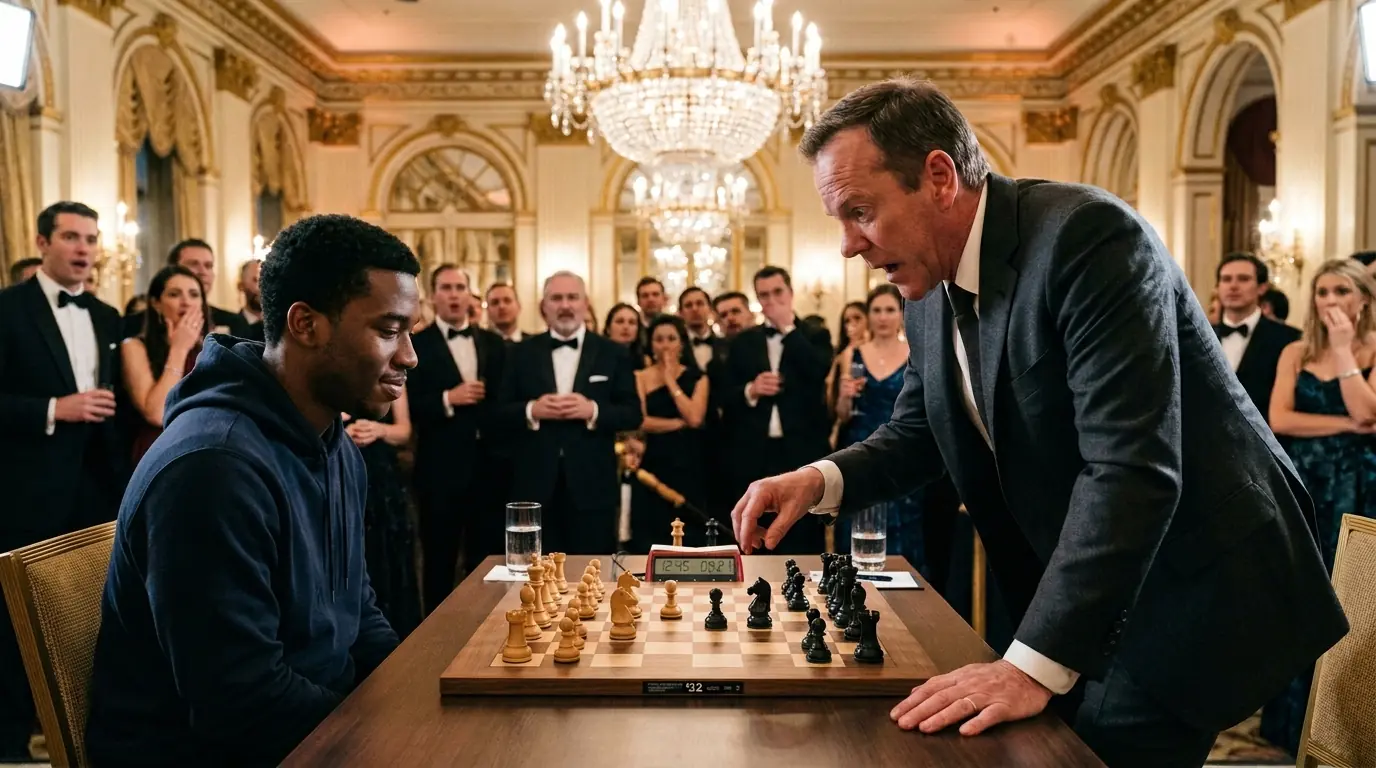
Spencer Whitmore takes the queen. His smile doesn't waver. It's the smile of a man who has never seriously considered that a maintenance worker's son could have set this trap before the first piece was ever touched. Malik Carter doesn't smile back. Doesn't look at Spencer. Doesn't look at the cameras pointed at his face. He looks at the board as if the chandeliers, the designer suits, the entire performance of power filling this room simply does not exist.
Have you ever met someone so prepared that staying calm wasn't even a choice they had to make? And have you ever wondered what's more dangerous? A person with power, or a person who has spent years quietly learning exactly how that power works?
This is the story of a 20-year-old with no title, no connections, no one standing behind him, who walked into a room full of people who could erase his name with a single phone call. And when it was over, the person who truly lost wasn't the one checkmated on the board. It was the one who never believed the game was real until it was already finished.
But before we get to that night, let me tell you how he got there and why what he did was more unsettling to powerful people than any chess move could ever be.
Malik's alarm goes off at 5:47 a.m. Not 5:45, not 6:00. 5:47, because that's exactly how long it takes to shower, pack his bag, and walk to the bus stop before the 6:15 comes. He figured that out in September. He hasn't changed it since.
The apartment is small. Two bedrooms, one bathroom, a kitchen where the overhead light flickers if you don't hit the switch at the right angle. His father, Raymond, already has coffee going by the time Malik gets up. Not because Raymond is a morning person, but because Raymond has been doing maintenance shifts since before Malik was born, and his body simply stopped knowing how to sleep past 5.
They don't talk much in the mornings. They don't need to. Raymond sets a mug on the counter. Malik picks it up. That's the whole conversation.
By 7:30, Malik is in his first class, Applied Probability, third row from the front, same seat every day. Not because it's assigned, because from that seat he can see the board clearly without straining, catch the professor's corrections in real time, and not get distracted by the people in the back who are halfway through their second hour of scrolling.
He takes notes by hand, always has. There's something about writing it down that forces you to understand it before you can record it. You can't write fast enough to copy everything. So you have to decide in real time what actually matters. That habit didn't come from a productivity book. It came from watching his father diagnose broken HVAC systems without a manual, just by listening to what the machine was trying to say.
After class, he eats lunch at his desk. Usually something he packed, because the campus cafe runs $11 for a sandwich. And that $11 has a different weight when you're also calculating whether the metro card lasts until Friday.
By 4:00 p.m., he's on a bus headed to Hawthorne Prep. The campus is something out of a different century. Iron gates, stone buildings, grass that looks like it gets individually apologized to if anyone walks on it wrong.
Malik has a key card for the maintenance wing, not the front entrance. He's never needed anyone to tell him which door was his. He just noticed a long time ago that the people who use the front entrance rarely think about who keeps the lights on inside.
There's a version of Malik's story that gets told at places like Hawthorne all the time. Hardworking kid from a tough background, grateful for the opportunity, humble enough to know his place. It's a comfortable story for the people telling it. Malik has never been interested in being that version. Not because he's angry, not because he carries a chip on his shoulder through every hallway he mops or every boiler room he checks at 9:00 p.m. on a Tuesday, but because he made a decision somewhere around 16 that there is a difference between being humble and being invisible. And he was only willing to be one of those things.
He doesn't announce himself. He doesn't argue with people who underestimate him. He doesn't correct professors mid-lecture or remind co-workers that he scored in the 97th percentile on his math placement exam. None of that. What he does instead is prepare quietly, systematically, without asking anyone's permission.
He reads before bed. Not fiction, not for escape, but actual theory, game theory, probability structures, logic systems, not because someone assigned it. Because understanding how systems work is the only leverage a person has when they don't own any part of the system.
His father taught him that without ever saying it out loud. Raymond Carter has worked in buildings like Hawthorne for 23 years. He knows where every pipe runs, which circuit breaker controls which wing, which door sticks in winter, and which alarm panel has a 3-second delay. He has never been invited to a single event held inside the rooms he maintains, and he has never once complained about that to Malik. Not because it doesn't register, but because Raymond operates on a different principle. Do the work so well that the work speaks before you have to.
Malik inherited that, and then he pushed it further. In the quiet of his room, late at night, with his notes spread across the desk, he sometimes thinks about what power actually is. Not the kind that comes with a title or a donor list, but the kind that lives inside a person who has thought through every possible outcome and is no longer afraid of any of them.
He's never said that out loud either. He doesn't need to.
Raymond Carter has worked at Hawthorne Prep for 11 years without a single formal complaint filed against him. That matters more than it sounds, because three weeks before the gala, Malik found out that Hawthorne's board had quietly opened a review of all non-faculty contractor positions, framed as a budget realignment. No names attached, no specific targets mentioned, just a clean administrative process that could eliminate up to four maintenance roles before the end of the fiscal quarter.
The fiscal quarter ends in 31 days.
Raymond doesn't know the details. Malik overheard two administrators talking near the east corridor supply closet. The one with the door that doesn't fully latch. The one Malik has been meaning to report for 2 months. He stood still. He listened. He didn't write anything down, because he didn't need to. He has his father's habit of remembering exactly what the machine is trying to say.
What the machine was saying was this. Someone wants leverage. And the cleanest leverage available is the job of a man who can't easily replace it at 53, with a bad knee and no college degree.
Raymond's salary isn't large, but it's the number their rent is built around. It's the number that keeps Malik's tuition payments on schedule. It's the number that means Malik can finish his degree instead of dropping to part-time and watching everything he's been building quietly collapse.
Malik sat with that information for 2 days before he told anyone. He didn't panic. He mapped it. He thought through every possible sequence. Who benefits from his father losing that job? What timeline makes sense? What the connection might be to the contract he had already refused to sign?
Because the contract came first.
Spencer Whitmore's offer arrived 9 days before that overheard conversation. And Spencer Whitmore is on Hawthorne's board. That's not proof of anything. Malik knows that correlation isn't causation. He writes that on his probability notes at least once a week. But pattern recognition isn't the same as paranoia.
31 days. His father's job. His own tuition. The unsigned contract sitting on his desk like a question he's already answered but hasn't yet been allowed to close. The clock isn't dramatic. It doesn't announce itself. It just keeps moving.
It started with a small thing, the kind of thing most people would walk past.
2 days after the gala was publicly announced, Malik was running a routine check on the third-floor electrical panel in Hawthorne's east wing, the one near the faculty lounge that trips if three appliances run simultaneously. Standard Tuesday. Nothing unusual, except when he turned the corner toward the panel, he saw Logan Whitmore standing in the hallway.
Not unusual on its own. Logan was a senior at Hawthorne. He was allowed to be in the east wing. But Logan wasn't walking anywhere. He was standing near the library entrance, phone in hand, talking to two people Malik didn't recognize. Older, not students, wearing the kind of casual clothes that are specifically chosen to not look expensive.
They stopped talking when Malik appeared. Not the natural pause of people who notice someone walking by. A different kind of stop. The kind where the conversation doesn't just pause, it closes.
Malik didn't slow down, didn't make eye contact, checked the panel, logged the reading, left. But he noted it the way his father had taught him to note things that don't fit the pattern of a room.
Over the next 4 days, he noticed two more things.
First, a post appeared on a chess forum he occasionally reads. Anonymous account created that week, questioning whether the Massachusetts State Scholastic Championship results from six years ago had been properly verified. No specifics, no accusations, just a question, floated gently into a public space.
Second, one of the Hawthorne kitchen staff, a woman named Dolores, who had worked there for 9 years and occasionally left Malik a covered plate on long shift nights, stopped making eye contact with him in the hallways. Not rudely, just carefully, the way people go careful when they've been told something and haven't decided what to do with it yet.
None of these things were evidence of anything. But Malik had spent enough time studying probability to know that three independent anomalies in four days, all pointing loosely in the same direction, stopped being coincidence somewhere around the second one.
6 days before the gala, Malik found something he wasn't supposed to find.
He was doing a late walkthrough of the administrative corridor, checking a reported water pressure issue near the east bathrooms, when he noticed the door to the secondary conference room was slightly open. Not unusual, except the light inside was on and the voices were low in the specific way that people lower their voices when they want the words to stay in the room.
He wasn't trying to listen, but the door with the broken latch has a way of carrying sound.
"The Carter kid refuses to sign. We move to the secondary option. The review gives us enough cover. Nobody questions a budget process."
A pause.
"And Raymond? Raymond's a liability. If the son keeps being difficult, we document what we need to document. The rest handles itself."
Malik stood in the hallway for exactly 4 seconds. He knows it was four because he counted, a habit he developed during timed chess matches, keeping internal rhythm when everything external is noise. Then he kept walking, checked the pressure valve, logged it, left.
On the bus home, he sat with what he'd heard and ran it through the same filter he applies to everything. What do I actually know? What am I assuming? And what's the difference?
What he knew? Someone in that room was prepared to manufacture documentation to remove his father from a job he had held without incident for 11 years. Specifically because Malik wouldn't sign a contract that would hand over the rights to his own story.
What he assumed? That this was Spencer's directive, not just a rogue administrator going off script.
What he didn't yet know? Whether anyone else had heard it, whether there was any record, whether saying something would protect his father or simply accelerate the timeline.
Here is the question that sat with him the entire ride home. If you have information that could protect someone you love, but using it too early might destroy your only chance of using it at all, what do you do with it?
Malik didn't sleep well that night. Not because he was afraid, or not only because of that, but because his mind wouldn't stop running the sequences. He laid out the situation the way he lays out a chess problem, not emotionally, structurally.
If he went public with what he heard, no recording, no witness, no documentation, his word against a conference room full of people with lawyers on retainer. The story becomes maintenance worker's son makes accusations against board member, and that headline buries itself before it ever gets to print.
If he said nothing and played the match anyway, he wins on the board. Spencer loses face publicly, and the retaliation against his father accelerates quietly behind the scenes. Documented, procedural, impossible to challenge without evidence.
If he withdrew from the match entirely, Spencer controls the narrative. The contract pressure doesn't disappear, and his father's job review still moves forward, because the leverage doesn't need the match to exist. It only needs Malik to be in a position where he can't push back.
Every option had a cost. None of them were clean.
This is the part of the situation that people on the outside rarely understand. That sometimes the choice isn't between a good option and a bad one. Sometimes it's between three bad options. And the only real question is which one you can live with and which one leaves you with something to work with afterward.
He thought about his father. Not the conversation he should have with him, but the one he'd never actually heard, the one where Raymond must have at some point over 23 years stood in a hallway not unlike that one and made a calculation about what it would cost to say something versus what it would cost to stay quiet.
Raymond had stayed quiet and kept his job and kept the lights on. Malik understood that. He respected it. But he also understood that the reason Spencer Whitmore had never been seriously challenged was precisely because every person who reached that hallway had run the same calculation and arrived at the same answer.
And someone eventually had to arrive at a different one.
By Thursday morning, Malik had made his decision. Not dramatically, not with a speech in his head or a moment of cinematic resolve. He made it the way he makes most decisions, by eliminating every option that required him to become someone he didn't recognize and seeing what was left.
What was left was this. He would play the match. He would not sign the contract. And he would spend the 5 days between now and the gala building something that didn't depend on anyone believing him, something that could stand on its own if he wasn't in the room to explain it.
He started that evening.
First, he went back through every document he had received from Whitmore's Foundation, the initial invitation, the follow-up emails, the contract itself. He printed copies and stored them in two separate locations. Not because he thought someone would break into his apartment, but because a person who plans for continuity isn't paranoid. They're just honest about how things sometimes go.
Second, he began keeping a written log. Dates, times, specific words he remembered from overheard conversations, behavioral changes he had observed in people around him. Not accusations, just a factual record of what he had witnessed, timestamped, written in the same precise language he uses for probability proofs, the kind of language that doesn't leave room for interpretation.
Third, and this was the part that required the most discipline, he kept showing up to work exactly as he always had, same hours, same quality, same quiet professionalism, because the moment his behavior changed, the narrative changed with it. And he needed the narrative to stay boring for exactly five more days.
There is a specific kind of courage that doesn't look like courage from the outside. It looks like someone just doing their job, going through the motions, keeping their head down. But on the inside, every move is deliberate. Every day is preparation. And the person who looks like they've accepted their position is actually the most dangerous person in the room.
The night before the gala, Raymond came home later than usual. He set his keys on the counter without saying anything, didn't touch the coffee Malik had left warm on the stove, just sat down at the kitchen table with the particular stillness of a man who has been carrying something heavy since before he walked through the door.
Malik waited.
"They pulled my access log," Raymond said finally. "HR said it was routine, part of the budget review." He paused. "Asked me about my hours, whether I'd been in areas outside my assigned zones."
Malik kept his expression neutral. "What did you tell them?"
"The truth. Same thing I always do."
Raymond looked at his hands. "They wrote things down. Didn't tell me what for."
He didn't ask Malik if this was connected to the match. He didn't need to. Raymond Carter had worked in institutional buildings long enough to understand exactly how a process gets pointed at a person cleanly, administratively, with no fingerprints on it. He just sat there, tired in the specific way that has nothing to do with physical labor.
Malik wanted to say something reassuring. He had the words ready. He'd been preparing for this conversation in the back of his mind for days. But when the moment actually arrived, he understood that reassurance wasn't what his father needed.
What Raymond needed was for this to be over.
And the only way to make it over was to walk into that gala tomorrow night and finish what Spencer Whitmore had started, on the board and off it.
The gala started at 7. By 7:45, Spencer Whitmore had already given a speech. It was a good speech. Malik had to admit that. Polished, warm, precisely calibrated. The kind of speech that makes a room full of wealthy donors feel like they are personally responsible for something meaningful happening in the world.
Spencer mentioned opportunity. He mentioned access. He mentioned the importance of lifting up young talent from every corner of our community. He did not mention the contract. He did not mention the access log review.
He smiled at Malik from across the room with the specific warmth of a man who believes he has already won.
The match was scheduled for 8:30. At 8:15, Logan Whitmore materialized near the small group of journalists covering the event. Not obtrusively, just present. The way someone is present when they want to be overheard without being quoted.
Malik was close enough to catch fragments.
"Not trying to make it a thing, but people who know the chess community have been asking questions for a while now. Apparently, there were irregularities in how some of those junior tournament results were verified back then. I'm just saying, if you're going to put someone on a stage in front of donors, you'd want to make sure the story holds up."
By the time Malik sat down across from Spencer at the board, at least two journalists had their phones out in a way that had nothing to do with photographing the match setup.
Spencer leaned forward slightly as the event moderator finished the introduction.
"Glad you could make it," he said quietly. Just for Malik, just under the ambient noise of the room. "Still time to reconsider the contract. No one would think less of you. These things are complicated for someone in your position."
Malik picked up a black pawn, set it back down, looked at the board.
"Someone in my position," he said. Not as a question.
Spencer smiled. "You know what I mean."
Malik looked up then, not with anger, not with nerves, but with the calm focus of someone who has already thought further ahead than the person speaking to him.
"I do," he said. "That's the problem."
The match lasted 31 moves.
Spencer played aggressively from the opening, the kind of aggressive that isn't really about chess. It's about performance. He narrated moves for the audience. He paused at calculated moments for effect. He played to the room the way a man who has spent 30 years controlling narratives plays to every room he enters, with the confidence of someone who has decided the outcome before the curtain goes up.
Malik responded with clean, patient defense. To anyone watching casually, Spencer looked dominant. Malik looked like he was surviving. That was fine. Malik had planned for that, too.
Then came move 24, the queen sacrifice.
The room gasped.
Spencer took it without fully understanding why it was being offered. Three moves later, his king was exposed. Knight fork. Discovered check. Rook cutting off every escape square.
Move 31. Checkmate.
The applause was real, unscripted, the kind that surprises even the people producing it. By the following morning, the clip had 4 million views. By afternoon, it had a headline: "Maintenance worker son defeats tech billionaire in charity chess match."
Spencer Whitmore lost control of the story in approximately 11 hours.
What happened next took exactly 48.
First came the anonymous sources, routed through a mid-tier sports and culture blog with just enough credibility to be picked up by larger outlets. The claim? Malik had received unauthorized coaching assistance from Hawthorne staff members during work hours, using school resources to prepare for a match that was supposed to be a casual charity exhibition.
Then came the formal notification, a letter delivered to Raymond Carter, citing irregularities identified during routine access log review and announcing a 30-day administrative investigation into his building access patterns over the previous quarter.
30 days. The same timeline Malik had calculated weeks earlier.
The process was immaculate. Every step documented, every action framed as standard procedure, no names attached to decisions, no fingerprints on anything, just a clean institutional mechanism pointed with precision at two people who had done nothing wrong. Moving forward with the quiet, unstoppable momentum of a system that knows exactly how to protect itself while appearing to protect everyone else.
This is what power looks like when it stops smiling.
There was one person at Hawthorne who knew exactly what had happened in that conference room. Her name was Patricia Oay. She was the administrative coordinator for Hawthorne's facilities department, which meant she scheduled maintenance shifts, processed contractor paperwork, and sat in on operational meetings that most people considered too routine to pay attention to.
She had worked at Hawthorne for 14 years. She was precise, professional, and almost entirely invisible to the people whose schedules she managed.
She had been in the conference room that night, not as a participant, as the person who sets up the room, arranges the water glasses, tests the projector, confirms the dial-in number for remote attendees, and then stays to take notes because someone always needs notes afterward, and Patricia is the person who does that without being asked.
She had heard everything.
Malik knew she had been there. He'd seen her name on the facility schedule that covered that corridor that evening, one of the details he had logged in his written record without fully knowing why it mattered yet.
It mattered now.
He found her in the copy room on the second floor 2 days after the investigation notice arrived. He didn't ambush her. He waited until she was alone, kept the door open, and stood far enough away that leaving was easy if she wanted to leave.
He told her what he was facing. Not emotionally, plainly. The way you explain a problem to someone you respect enough to give them the full picture.
She listened without interrupting. When he finished, she was quiet for a long moment.
Then she said, "I have a daughter in 8th grade. She wants to go to college. I've been at the school for 14 years, and I still don't have tenure protection."
Malik nodded. He understood exactly what she was saying.
"I'm not asking you to do anything," he said. "I just wanted you to know that I know, and that whatever you decide, I won't make it harder for you."
He left her there with the copy machine running. He didn't know if she would come forward. He couldn't build his case around the assumption that she would, but he understood something his probability courses had confirmed more than once. Sometimes the most important variable in a system isn't the one you can control. It's the one that's already decided and just hasn't moved yet.
17 days into the 30-day investigation, Raymond stopped sleeping.
Malik could tell, not because his father said anything. Raymond never said anything, but because the coffee was always made by 4:30 now instead of 5:00, and the kitchen light was on when Malik got up at 5:47, and there were small things moved around on the counter in the particular pattern of a person who has been awake for hours and needed something to do with their hands.
Raymond had worked his whole life inside systems that could remove him without explanation. He understood that reality. He had built their entire life around navigating it carefully, keeping his head down, his record clean, his access to those rooms just wide enough to do his job, and not wide enough to become a problem.
And now, through no fault of his own, he was a problem.
The investigation had expanded. What started as a review of building access logs had quietly grown to include a performance audit, response times on maintenance requests, documentation of completed work orders, even a review of whether Raymond had followed proper sign-out procedures for equipment over the previous 18 months. Every item individually defensible. Together, they formed the shape of a case being built by people who already knew the conclusion they needed.
Malik had 12 days left.
He had his written log. He had the printed contract with its clauses intact. He had a timeline that connected Spencer's offer to the investigation's launch with a gap of exactly 9 days. And he had one more thing, something he had been sitting on carefully, waiting for the right moment. The way you wait on a piece that isn't ready to move yet.
3 days earlier, a journalist named Dana Reyes had reached out through the chess forum where the anonymous post had appeared. She covered education and institutional accountability for a midsized investigative outlet.
She wasn't chasing the chess story. She was chasing the contract story.
Someone had forwarded her a screenshot of language that matched the non-disclosure clauses Malik had been handed. She wanted a conversation.
Malik hadn't responded yet. Not because he wasn't ready, but because timing, in chess and in everything else, is the difference between a move that changes the game and a move that simply gets absorbed by it.
On day 19, Malik found the thread he had been looking for. Not dramatically, not through a breakthrough or a lucky break, through the same method he had been applying since the beginning, paying attention to things that don't fit the pattern of the room.
He had been reviewing the anonymous chess forum post again, the one questioning the legitimacy of his state championship result from six years ago. He had read it so many times he had it memorized, and something had been bothering him about it in the specific way that details bother him when his brain has noticed something his conscious mind hasn't caught up to yet.
It was the phrasing.
The post used a particular construction, improperly verified through back-channel adjudication, that wasn't chess terminology. It wasn't forum language either. It was the kind of phrase that comes from someone who spends their professional life writing institutional documents, compliance language, the vocabulary of people who draft policies for a living.
Malik ran that phrase through every public document he could access. Board meeting minutes, foundation press releases, Whitmore Dynamics published governance reports. It took him two evenings and a legal pad full of cross references.
He found it in a Whitmore Foundation internal newsletter from three years ago, a piece about ensuring verified pathways for scholarship recipients, written under the communications department's standard byline, but formatted in a template Malik recognized from the sponsorship contract he had been handed. Same document architecture, same stylistic fingerprint, same phrase, slightly reworded, dropped into a public forum by an account created 6 days before the gala.
It wasn't proof of direct coordination. Not yet.
But it was something more useful than proof at this stage. It was a traceable pattern, a connection between Logan's whisper campaign and Whitmore's professional communications infrastructure that hadn't been laundered carefully enough because the people running it had never seriously considered that anyone would look.
That was the assumption Malik had been counting on since the beginning. Not that he would find something dramatic, but that careful, patient attention to detail would eventually surface something that powerful people had left behind, not out of carelessness, but out of the quiet arrogance of those who have never had to cover their tracks before.
On day 23, Raymond was formally suspended pending investigation outcome. Not fired, suspended, with a particular administrative precision that allows an institution to remove someone from their role while maintaining complete plausible deniability about whether the removal is permanent.
His key card was deactivated at 9:00 a.m. on a Tuesday. He found out when it stopped working at the maintenance entrance, the one he had used every working day for 11 years.
He called Malik from the parking lot.
He didn't say much, just that he'd been told to go home and wait for written notification, that HR had been professional about it, that nobody had been unkind.
That last part was somehow the worst thing he said.
Malik sat in his probability lecture for 20 minutes after that call, not hearing a single word. He had his notebook open, his pen was in his hand, the page stayed blank.
He had prepared for this. He had mapped this outcome as one of the possible sequences weeks ago, had assigned it a likelihood, had planned responses to it, had told himself rationally that preparation means accounting for the bad scenarios, not preventing them.
None of that helped, because the difference between knowing something might happen and receiving a phone call from your father in a parking lot at 9 in the morning is not a difference that probability theory covers.
He left class early for the first time all semester.
On the walk home, he ran through everything again. The log, the contract, the linguistic analysis, the journalist waiting for his response. He had the pieces. He had the timeline. He had a pattern that connected the forum post to Whitmore's communications infrastructure.
What he didn't have was anything that would stop the suspension from becoming a termination before his 30 days ran out.
7 days left.
He sat at his kitchen table that afternoon, the same table where his father had told him about the access log review. And for the first time since this started, he genuinely considered whether he had miscalculated, whether his confidence in the process had been a form of arrogance he hadn't recognized in himself, whether he had protected his principles at the direct expense of his father's stability.
The thought didn't break him, but it stayed the way true doubts stay. Not loud, just present, sitting at the edge of every decision still ahead.
That evening, Raymond cooked, not because it was a special occasion, because that's what Raymond does when he doesn't know what else to do with himself. He finds something useful, something with clear steps and a definite outcome, and he works through it until the thing in his chest settles enough to breathe around.
He made the same meal he had been making since Malik was 9 years old. Rice, black beans, chicken thighs braised low and slow with garlic and a bay leaf. The kind of food that takes time on purpose. The kind that fills a small apartment with something that feels like stability, even when everything outside the kitchen is uncertain.
Malik sat at the table and watched his father cook without offering to help. Raymond didn't want help. He wanted to do this one thing correctly, completely on his own terms.
They ate without talking much.
Halfway through the meal, Raymond set down his fork.
"I know what this is about," he said, not accusatory, just stating a fact he had been sitting with all day. "I've known since the contract."
Malik didn't deny it.
"You should have told me."
"I know."
Raymond picked his fork back up, took another bite, looked out the window at nothing in particular.
"I would have told you to sign it," he said quietly. "That's why you didn't tell me."
It wasn't a question. Malik didn't answer it like one.
They sat with that for a while. The specific silence of two people who understand each other completely and are both carrying the weight of what that understanding costs.
Before Malik went to his room, Raymond said one more thing.
"Your grandfather used to say, 'The people who build the room never get invited to sit in it.'"
He paused.
"I always thought that was just the way things were."
He didn't finish the sentence. He didn't need to.
Malik went to his desk, opened his laptop, and wrote one sentence in reply to Dana Reyes.
I'm ready to talk. I have documentation.
The press conference was Spencer Whitmore's idea. He framed it as a gesture of transparency, an opportunity to clarify misunderstandings before they hardened into something more damaging.
It was scheduled for 11:00 a.m., 5 days before Raymond's suspension review deadline. The location was a midsized hotel conference room, neutral ground, professional setting.
Spencer arrived with two communication staff and a lawyer positioned quietly in the back row.
Malik arrived alone.
He had been invited as the subject of clarification. The young man whose tournament history needed context, whose coaching allegations needed addressing, whose cooperation with the foundation sponsorship offer remained, Spencer's team implied, an open and generous possibility.
The room had 11 journalists. Dana Reyes was third from the left.
Spencer opened with a prepared statement. Measured, reasonable, constructed with the precision of someone who has done this before. He expressed admiration for Malik's chess ability. He reiterated the foundation's commitment to supporting underrepresented talent. He acknowledged that questions had been raised about the circumstances surrounding the gala match and suggested that a formal review process was simply due diligence, not accusation.
He was careful never to say anything that could be quoted against him.
Then he invited Malik to respond.
Malik stood up. He had one folder in front of him. He opened it.
"I'd like to start with this," he said, and slid a single document across the table toward the press pool.
Dana Reyes picked it up first. The others leaned in.
It was the sponsorship contract, not a summary, not a description, the full document with the attribution clause highlighted in yellow. The clause requiring Malik to publicly credit Whitmore's mentorship program for his chess development. The media restriction provision preventing him from discussing the terms of the agreement with journalists. The exclusivity requirement binding him to Whitmore Dynamics Foundation for representation in all future competitive opportunities.
"This is the contract I was handed 9 days before the gala," Malik said. "I didn't sign it. That is the complete context for everything that has happened since."
The room shifted. Spencer's communications staff exchanged a look. His lawyer sat forward slightly.
Malik continued.
He didn't raise his voice. He didn't perform outrage. He moved through the documentation the way he moves through a chess problem, sequentially, precisely, without leaving gaps.
He presented his written log, dated entries from the week before the gala, recording specific observations, overheard language, behavioral changes in people around him. He noted the 9-day gap between the contract refusal and the launch of his father's access log review. He presented the timeline as a sequence, not an accusation.
Here is what happened. Here is when it happened. Here is the order in which it happened.
Then he presented the linguistic analysis. He explained in plain language how the phrasing from the anonymous forum post matched the stylistic fingerprint of Whitmore Foundation communications documents. He had printed three comparison examples, the forum post, the foundation newsletter, the sponsorship contract, with the recurring phrases marked in parallel columns.
He didn't claim this proved direct authorship. He said exactly what it showed, a traceable pattern connecting Logan Whitmore's whisper campaign to Whitmore's professional communications infrastructure, documented and independently verifiable by anyone willing to look.
That was the moment Spencer Whitmore's lawyer stood up, which was, without intending to be, the most clarifying thing that happened in that room all morning.
Because a lawyer doesn't stand up to protect a client from false accusations. A lawyer stands up when something true has just been said in a room full of people writing things down.
Dana Reyes was already typing. Two other journalists had their phones out, not for photographs, but to pull up the forum post in real time, cross-referencing the language against the documents in their hands.
One of them looked up with the specific expression of a person who has just independently confirmed something.
Spencer attempted a response. It was measured. It was professional. It addressed none of the specific documents on the table.
Within 48 hours, three additional journalists had independently verified the linguistic connection. Logan Whitmore's online accounts were traced by two separate outlets to a coordinated posting pattern originating from devices registered to Whitmore Dynamics communications department.
No one needed to declare a winner. The documentation did it without them.
Spencer Whitmore resigned as Hawthorne's board chairman 12 days later. Not under criminal charge. Not in disgrace in the dramatic sense that headlines prefer. He resigned the way powerful people resign when the cost of staying exceeds the cost of leaving, with a prepared statement about pursuing other commitments, released on a Friday afternoon when news cycles are quieter.
Raymond Carter's suspension was lifted 4 days before that. His access log review was closed without findings. No explanation was offered for why it had been opened.
Patricia Oay had submitted a written account to Hawthorne's newly convened independent ethics inquiry. Not dramatically, not publicly, just a precise factual record of what she had heard in that conference room, submitted through proper channels, signed with her full name.
She kept her job.
Malik declined every exclusive sponsorship offer that arrived in the 6 weeks following the press conference. He qualified for the international tournament through his independent ranking, a ranking he had been building quietly for three years through regional competitions entered on his own registration fees, on weekends between shifts and study blocks.
The community fundraising campaign that covered his travel costs hit its goal in 71 hours.
He didn't make a speech about any of it.
6 months later, in a renovated community center six blocks from Hawthorne's iron gates, Malik opened the Carter Initiative. Free chess and logic programming for students from underfunded schools across the district. No application requirements, no means testing beyond demonstrating interest.
The room had 12 boards, donated equipment, and a waiting list within the first week.
On the first night, a freshman named Darius, 14 years old, nervous hands, too-big hoodie, watched Malik set up a demonstration position and asked the question that had clearly been sitting with him since he walked in.
"Weren't you scared playing someone that powerful?"
Malik placed a pawn in the center of the board, considered it for a moment.
"On the chessboard," he said, "he only had one king, and every king can be checkmated."
Darius looked at the pawn, then at the board, then back at Malik.
"But what about off the board?"
Malik looked at him. This kid with the nervous hands and the question that cut straight to the thing nobody else had asked directly.
"Off the board," he said, "you prepare, you document, you find the people who know the truth, and you make it easy for them to tell it."
He set another pawn beside the first one.
"And then you just keep showing up."
Here's the real question this story leaves behind. Not about chess, not about Spencer Whitmore, but about all of us. How many times have we stayed quiet in a hallway, run the calculation, and chosen the safe answer? Not because we were wrong, but because we couldn't afford to be right.