You think you know the measure of a person by the way they smile at a duke. But if you want the truth, look at how they treat the maid holding the tea tray. One woman did exactly that, and it brought a greedy family to its knees.
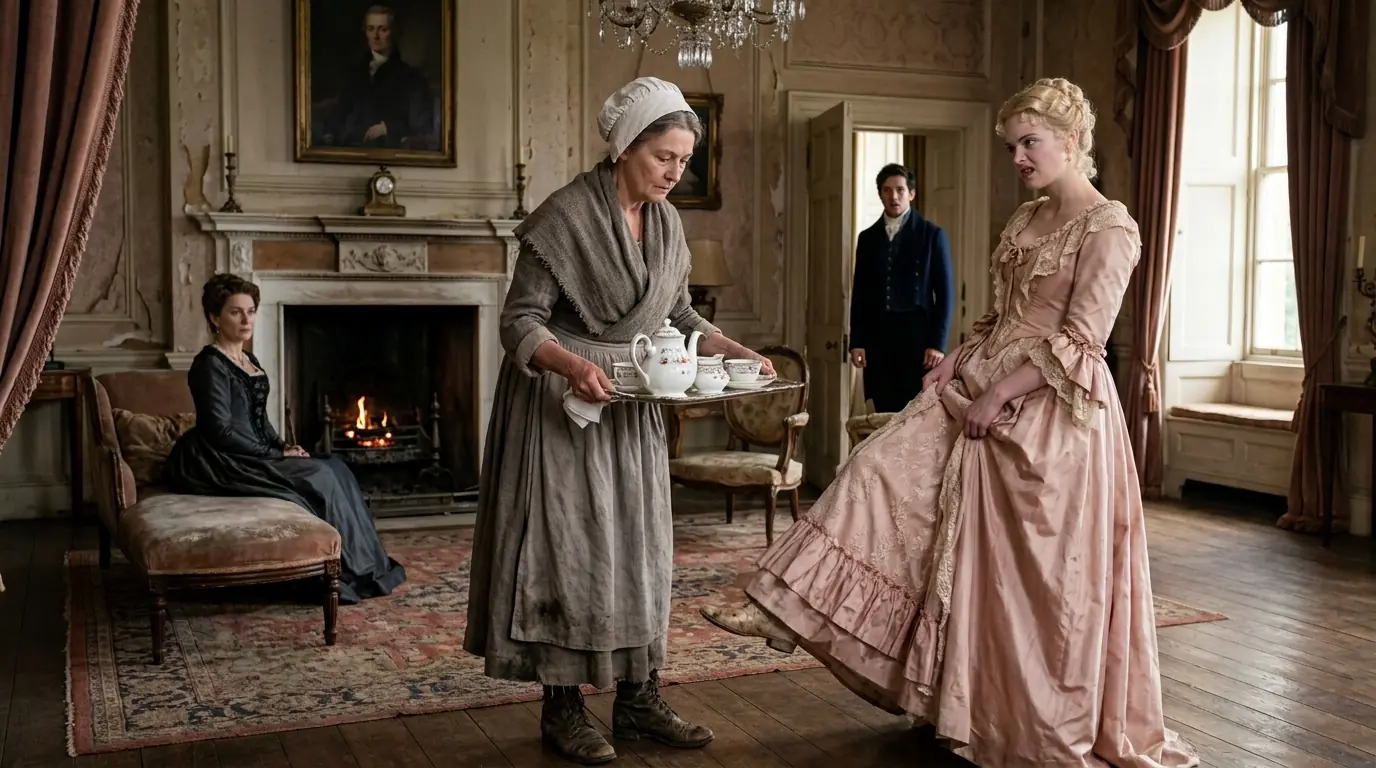
Constance, the Dowager Duchess of Aylesbury, did not believe in love. She believed in alliances. She believed in property, in quiet respect, and in the ironclad security of a well-negotiated contract.
Her son Lucas, unfortunately, believed in poetry. He was twenty-four, the newly elevated Duke of Aylesbury, and entirely too gentle for the title. He possessed a staggering fortune, a kind heart, and a slight limp from a childhood fall that made him self-conscious in the ballrooms of London. For two years, he had deflected the aggressive maneuvers of ambitious mothers and their polished daughters. Then he met Josephine Trent.
Josephine was the daughter of a minor, financially ruined baron. To Lucas, she was an angel who looked past his limp and saw his soul. To Constance, she was a math equation that didn't add up.
"She is perfect, Mother," Lucas had said, pacing the length of the Aylesbury library a week before. "She doesn't care about the title. She prefers the country. She reads Wordsworth."
Constance had merely sipped her tea. "So, a penniless girl who does not care for titles is a girl who lies very well, Lucas."
They had fought. It ended with Lucas storming out and riding ahead to Oakhaven, the Trent family estate in Hampshire, to prepare for the wedding. Constance was meant to follow three days later in the grand ducal carriage, announced by outriders and heralded by the pomp required of her station. Instead, she stopped her carriage at a grim little posting inn five miles from Oakhaven.
"Your Grace?" Martha, her lady's maid of twenty years, stared at her as if she had gone mad.
"Take off the gray wool, Martha," Constance said, her voice brooking no argument. "And the apron. Give me the boots as well."
"The boots, Your Grace? They are cobbled for a peasant. They will blister your heels."
"That is the point."
It took twenty minutes to strip away the silk and lace of a duchess and replace it with the coarse, heavy linen of a scullery maid. The wool scratched violently against Constance's collarbone. The boots were stiff, smelling of beeswax and damp earth. She wrapped a drab brown shawl around her shoulders, covering the elegant sweep of her neck, and pinned her silver-streaked hair beneath a stark white cap.
She looked at herself in the warped glass of the inn's mirror. The Duchess of Aylesbury was gone. In her place stood an aging, anonymous laborer.
"Wait here with the men," Constance ordered. "If I do not send for you by tomorrow evening, bring the carriage to the estate. Do not speak of this."
She walked the remaining five miles. It was mid-November. The Hampshire wind was merciless, carrying the bitter promise of sleet. The mud on the country road was thick and glutinous. It sucked at the soles of her borrowed boots, dragging her down with every step. Constance's legs, accustomed to padded carriages and smooth marble floors, began to burn. The cold seeped through the thin wool of her shawl, settling deep into the marrow of her bones.
A carriage sped past her at one point, spraying dirty water against her skirts. The driver did not even shout a warning. Why would he? She was nothing. She was part of the scenery.
By the time the iron gates of Oakhaven appeared, Constance was shivering. Her hands were raw and red, her hem heavy with wet dirt.
Oakhaven was a tragedy of architecture. From a mile away, it held the silhouette of a grand manor. Up close, it was rotting. The stone lions at the gate were chipped. The driveway was overgrown with weeds, the gravel sparse, the paint on the window frames peeling in long, sad strips. This was not a family living in quiet, rustic peace. This was a family bleeding to death, desperate for a tourniquet. And Constance was the tourniquet.
Constance bypassed the grand front steps and walked around to the rear courtyard. It was chaotic. Servants were rushing back and forth carrying crates of wine, plucking chickens, scrubbing pots. The impending arrival of a duke and a wedding had thrown the understaffed household into a frenzy.
She stepped through the heavy oak door into the kitchen. The heat hit her like a physical blow, thick with the smell of boiling onions and wood smoke. A large woman with a flushed face and a stained apron rounded on her immediately.
"Who are you?"
Constance lowered her eyes, a gesture she had never practiced in her life. "I heard you needed extra hands, from the village."
The housekeeper, Mrs. Higgins, didn't even ask for a name. She looked at Constance's dirt-stained hem, her weathered but clean hands, and shoved a heavy iron bucket toward her.
"You're late. The Duke is already installed in the east wing and the Dowager arrives tomorrow. If this house isn't spotless, Lady Trent will have our hides. Take this water, scrub the hearth in the secondary parlor, then fetch coal for the drawing room. Move."
Constance gripped the handle of the bucket. It was agonizingly heavy. The iron bit into her palms. She did not say a word. She just nodded, turned, and carried the water into the bowels of the house.
For four hours, Constance scrubbed. She learned very quickly that to be a servant was to be invisible, yet constantly in the way. She scrubbed the soot-stained bricks of the secondary parlor hearth until her knuckles bled. Her knees, already stiff from age and the damp cold, throbbed with a dull, sickening ache. Dust coated her throat. No one looked at her face. They only looked at her hands to see if they were moving fast enough. It was a profound and terrifying loss of self. When she was the Duchess, her silence was interpreted as profound wisdom. Here, her silence was merely the expected dumbness of a beast of burden.
By late afternoon, her back felt as though it had been beaten with a rod. Mrs. Higgins thrust the heavy brass scuttle filled with coal into her arms.
"The drawing room. Lady Trent and Miss Josephine are in there. Mind you don't speak. Don't look them in the eye. And for God's sake, don't drop the tongs like the last idiot."
Constance carried the coal down the long, drafty corridor. The drawing room door was slightly ajar. She nudged it open with her hip and slipped inside. The room was grander than the rest of the house, clearly the only space where the Trents spent their remaining coin to keep up appearances. Heavy velvet curtains blocked the gray light. A fire was dying in the grate.
Lady Trent sat on a chaise, fiercely stabbing a needle into a hoop of embroidery. She was a thin, severe woman whose face seemed permanently pulled tight in a grimace of calculation.
On the sofa, lounging in a pool of pale blue silk, was Josephine, Lucas's angel. Up close, without the candlelight of a London ballroom, Josephine's beauty was sharp. Her eyes were not the soft, soulful blue Lucas had described, but pale and flat, like winter ice. She was eating a peach, letting the juice run over her fingers before lazily wiping it on a linen napkin.
Constance knelt by the fireplace, keeping her back to them. She picked up the iron tongs and began to arrange the coals. The metal scraped lightly against the stone.
"Must you make that infernal noise?" Josephine snapped.