"You can tell a great deal about a man," the old grooms used to say, "by the way he speaks to a horse. You can tell everything about him by the way he speaks to those who can do nothing for him at all." The Duke of Aldemore had heard that saying his whole life, and he had come, at the age of three-and-thirty, to wonder whether it might be turned the other way around. Whether you might tell everything about a woman not by how she spoke to a duke, for he had heard a hundred women speak to a duke and learned nothing from any of them, but by how she spoke to a man she believed to be no one at all.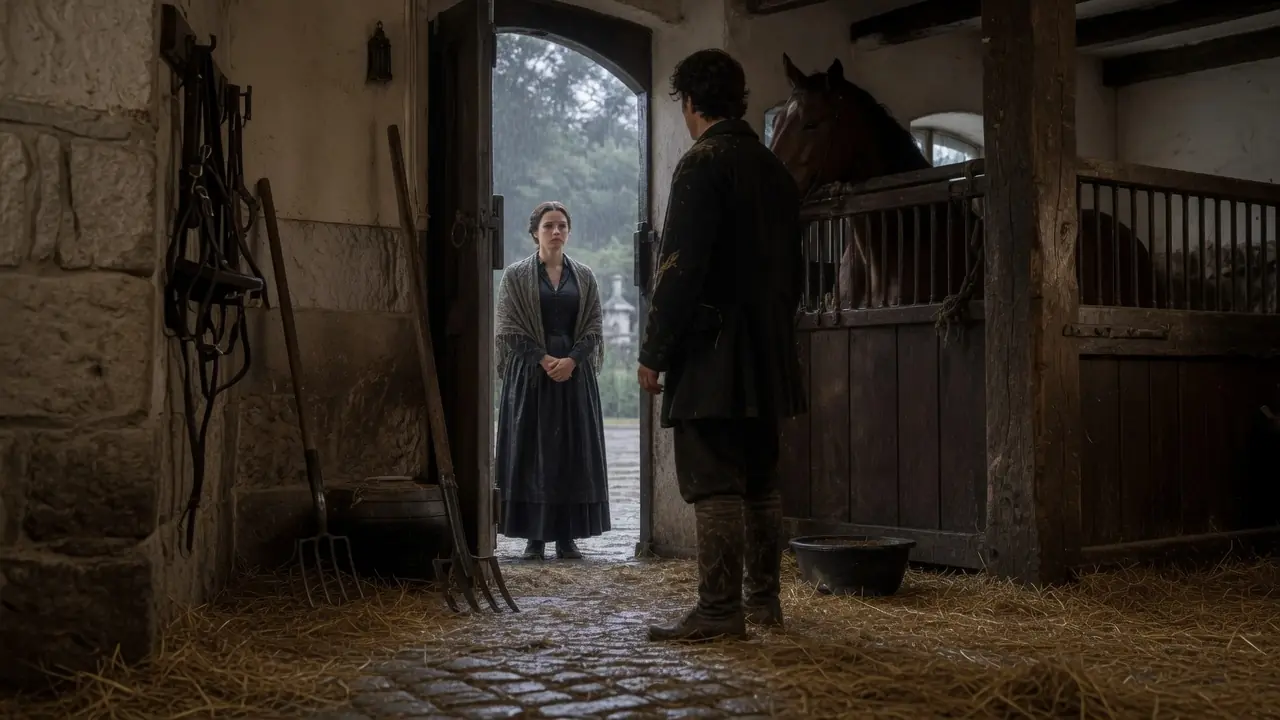
So, he had become no one at all. He stood in the gray of an early summer morning in the stable yard of a house called Withycombe, in a plain coat that had cost him nothing, and a name that belonged to nobody, and he waited to be told what to do. His own grooms, had they seen him, would not have known him.
His valet would have wept. The coronet that had stood between him and every honest word ever spoken to him was three counties away in a locked room. And here he was, simply Jack, a hired hand come down from the north looking for work, with good hands and a closed mouth, and no history that anyone need trouble themselves to learn.
The yard was small and old and clean. That was the first thing he noticed, that for all the house wore its poverty plainly, the stable was swept and the water trough was full, and the one old carriage horse and the two saddle hacks that lived there looked at him over their half doors with the calm, bright eyes of animals that have never once been struck. A poor house.
A cared for house. Those two things did not always go together. And the Duke, who had seen a great many rich houses where the horses flinched, noted it and filed it away and did not yet know what to make of it.
The old man who had let him in was called Davey. And Davey was perhaps seventy and moved as though every joint in him had its own separate complaint to make about the weather. He looked the new hand over without much hope.
"You'll do the heavy of it," Davey said.
"My back's gone. I'll not pretend it hasn't. Three horses in a yard and the master's gig and the lawn when the grass wants it and whatever else the mistress finds. It's not grand work."
"I didn't come for grand work," said Jack.
"No," said Davey, and looked at his hands which were not a laborer's hands, not quite.
Then he looked at his face which gave nothing away and decided, in the way of old men who have stopped expecting the world to make sense, to ask no questions.
"No. I don't suppose you did. Well, there's the fork." Julian took the fork.
He had not held one in twenty years. He held it now and mucked out a stall in the gray light with the steam of the horses rising around him and the morning coming up green and wet over the orchard beyond the wall and somewhere in the house a window opened and a voice, a woman's voice, low and unhurried, said good morning to someone, and the day at Withycombe began. He did not see her until the middle of that first morning.
He was leading the old carriage horse out to the paddock when she came down the path from the kitchen garden with a basket of cut herbs on her arm, and he stopped because one is meant to stop and stand aside when the family passes. And he stood aside, and he looked at the ground as a groom looks at the ground, and he waited for her to pass him the way the family always passed him, which was to say as though he were a post, a gate, a thing that opened and shut, and required no more notice than a gate requires. She did not pass him as though he were a gate.
She stopped.
"You're the new man," she said.
"From the north," Davey said.
And then, when he lifted his eyes, because there was nothing else to do, she did the thing that he would think about for a long time afterward, in the dark, when he could not sleep. She looked at him, not at the coat, which was a servant's coat, and not past him, which was where people of her station looked, but at him, at his actual face, the way you look at a person whose name you intend to remember.
"I'm glad you've come," she said.
"Davey's back is very bad, and he won't say so, and Captain there pulls to the left and pretends he doesn't. You'll have your hands full. What are you called?"
"Jack, miss."
"Jack," she said, as though it were worth saying.
"I'm Eleanor Caro. Welcome to Withycombe, Jack. It isn't much, but the horses are happy, which is more than can be said for some grander places. And that's chiefly Davey's doing. So, be kind to him."
"I will, miss." She went on up to the house with her herbs.
He stood holding the old horse and watched her go. And the old horse, sensing the stillness in the man at the end of his rope, turned his great head and breathed against Julian's shoulder. And Julian, the Duke of Aldemore, who had come to a poor house in a borrowed coat to learn whether a woman could speak to a nobody as though he were a king, stood in the wet grass and understood that the test had already, in some way he did not yet have the words for, begun to go wrong.
Because he had not expected to be moved. He had expected to be reassured or disappointed, to gather his evidence and to draw his cool conclusion. He had not expected the simple animal warmth of being looked at by a stranger on a gray morning as though he were a man worth the looking.
He had been a duke for eleven years. He could not remember the last time anyone had been glad he had come. The house, he learned over the days that followed, was sinking.
Not all at once, and not in any way the family would name aloud, but sinking the way an old boat takes water, a seam at a time, quietly, while the people aboard go on with their tea. Withycombe had been a gentleman's house, a small one, comfortable once, the seat of the Caros for a hundred years and more. And the late Mr. Caro had been by every account a kind man and a poor manager.
The worst of all combinations. A man who could not say no to a friend or to a horse or to a bottle. And who had died two winters past leaving a widow, two daughters, a leaking roof, and a debt.
And then on the fourth day he heard it from the man himself. Because Sir Lionel Crayle came to Withycombe in a very fine curricle behind a pair of very fine bays. And Jack the groom went to hold the horses' heads.
And so the Duke of Aldemore had his first sight of the man who owned the family's future. Crayle was perhaps fifty. Well-made, well-dressed, with a heavy handsome face and a smooth unbothered manner of a man who has never in his life had to wonder whether he would be obeyed.
He stepped down from the curricle and he handed the reins to Jack without looking at him. Which was correct. Which was what one did.
And Julian took them and bowed his head. And then Crayle paused and looked back and did a thing that gentlemen did not generally do. Which was to take notice of a groom.
"You're new," Crayle said.
"Yes, sir."
"Hm." Crayle looked him over slowly, the way a man looks over a horse he is thinking of buying and is determined to find fault with.
"You've a look about you I don't care for. Insolent. Mind your eyes, fellow, and mind your place, and we'll have no trouble." He smiled when he said it.
That was the thing about Crayle that Julian would come to understand. He always smiled when he said the cruel thing. He found the cruelty and the smile to be the same muscle.
"Where's your mistress?" She was on the step.
She had come out at the sound of the wheels, and she stood in the doorway of the sinking house in a gown that had been turned and mended and turned again, with her chin up and her hands folded, and she said, "Good afternoon, Sir Lionel." in a voice that gave him nothing, no warmth and no fear, only the bare courtesy that the laws of the country require one to give a guest, and Julian, holding the bays, watched her and learned the second thing he had come to learn. She was afraid of this man, and she would die before she let him see it. Crayle stayed an hour.
Through the open windows of the small drawing room, the groom in the yard could hear the shape of it if not the words. The low pressing rumble of the man's voice going on and on, reasonable, patient, relentless, and now and then the short cool note of her answers, fewer and fewer as the hour wore on, until at the end, there was a long silence. And then, Crayle came out smiling, and called for his horses.
And Eleanor Caro did not come out to see him go.
"Well, Jack," Crayle said, climbing up, gathering his reins, in great good humor now, "You've a pretty mistress. Make the most of the view while you have it. The place won't be hers much longer, nor will she." And he laughed, and touched his whip to the bays, and was gone down the lane in a rattle of fine wheels, leaving the groom standing in the empty yard with a coldness in him that had nothing to do with his station, and everything to do with the man.
That evening, Julian wrote a letter. He wrote it at the little table in the room over the stable that was his now. By the light of a single tallow candle that smoked and stank in the cramped hand he used when he did not wish to be known.
And he addressed it to Mr. Penrose, his man of business three counties away, the only living soul who knew where the Duke of Aldemore had gone, or why. He wrote that he had arrived. He wrote that the family was as his aunt had described, gentle and ruined.
He wrote three lines about the debt, and the man who held it, and asked Penrose to learn quietly what he could of Sir Lionel Crayle, his holdings, his character, the precise sum and terms by which he had got his hand around the throat of the house of Caro. He did not write the other thing. He did not write that the daughter of the house had looked at him, a hired man in a borrowed coat, as though he were a person and not a post.
He did not have the words for it yet. And a duke does not write what he cannot say plainly. And so he left it out and sealed the letter and lay a long time awake in the smoke and dark listening to the horses move below him and thinking about a turned gown and a lifted chin and a fear that would die before it showed itself.
He had come to test her heart. It had not occurred to him, fool that he was, that he had brought his own along with him. The thing about being no one, Julian discovered, was that no one troubled to perform for you.
He had spent eleven years among people performing. The whole of the great world was a theater got up for his benefit and he had known it. And the knowing had made him lonely in a way he had stopped being able to describe because a loneliness you cannot describe is the worst kind.
It simply sits in you like a stone in a shoe and you learn to walk on it and you forget that other men walk without it. Every word spoken to a duke is spoken to the dukedom. Every kindness is an investment.
He had learned, young, to discount it all, to halve every compliment and quarter every smile and the habit had spread, as such habits do, until he discounted everything. Until he could not tell any longer whether anyone in all the world had ever wanted his company for its own sake or only for the 11,000 a year and the house in town and the strawberry leaves on the carriage door. There had been one.
He had thought there had been one. Two seasons passed. There had been a young woman, Sybil, clever, and lovely, and warm, who had seemed, against all his training, to see him.
And he had let himself believe it. Had been on the very edge of speaking until the night he passed an open door and heard her explaining to a friend in a voice gone suddenly businesslike the exact figure of his income and the exact degree of his rank and the exact reasons these made him worth the trouble of appearing to adore. She had said it without malice.
That was what he could not forget. She had not been cruel. She had simply been counting the way everyone counted.
And he had been a sum the way he was always a sum. And he had gone home that night and looked at himself in the glass a long time and understood that he would never, as long as he carried his name, know whether he was loved or only reckoned. And so when his Aunt Augusta had begun her campaign when she had told him over and over of a girl in the West Country well-born and badly off a gentleman's daughter with nothing but her character to recommend her the very sort of sensible, unfrightening match a duke in his position ought to make he had listened and he had thought and he had formed his strange resolve.
He would not go to her as a duke. He would not give her the chance to count. He would go as nothing, as no one, as a hired man she could gain nothing by.
And he would watch. And he would know at last and for once what a person was when there was nothing to be had from him. It was not, he could see now, an honorable plan.
He had told himself it was prudence. It was closer to cowardice. The cowardice of a man so tired of being lied to that he would rather lie himself than risk one more sweet untruth.
But he had not seen that yet. On the fifth day at Withycombe he still believed himself the wronged party in some great trial of the world. The judge come down in disguise to hold the human heart to account.
And he went about the yard with his fork and his curry comb. And he watched. And he gathered his evidence.
And every day the evidence broke his case to pieces. Because Eleanor Caro who did not know he was anyone treated him as though he were everyone. She thanked him.
That was the small absurd thing he kept catching himself on. When he carried in the coals she thanked him by name as though carrying coals were a thing a person did and not a thing a servant was. When the old horse came up lame and Julian sat with it half the night in the straw she came down in the morning in her shawl with a cup of tea in her own hands for him for the groom.
And she sat on the upturned bucket beside him and asked him what he thought was wrong with the animal. Asked his opinion. Listened to the answer as though it had weight.
And when he gave it, when he forgot himself and spoke of hocks and heat and the look of a hoof with the fluency of a man who had kept the finest stables in the north, she did not seem to find it strange that a hired hand should know so much. She seemed only glad of it.
"You've a gift," she said.
"Davey said you had. He doesn't say it of many." And she drank her tea in the cold stable beside a man she believed to be a servant and talked to him as an equal. And the Duke of Aldemore sat in the straw with his hands around a cup of common tea and felt something in his chest that he had thought long dead turn over slowly and begin to ache.
There was a market day in the second week and Sir Lionel Crayle came again. For Crayle came to Withycombe on any pretext and on none. And this time, he came on horseback with a friend, a loud young man down from town.
And the two of them rode into the yard expecting their horses to be taken. And Jack came to take them. He took the friend's horse first.
And then he reached for Crayle's bridle. And Crayle, who was in a humor to be admired before his guest, did a thing he had not troubled to do before. He made sport of the groom.
It began small, the way such things do. A complaint that the horse had not been brought quickly enough. A remark to the friend, not lowered in the least about the quality of help one found in houses that had let themselves go.
Then, warming, finding his audience pleased, Crayle leaned down from the saddle and flicked the groom's collar with the butt of his whip. Lightly, contemptuously, the way one might flick dust from a chair before sitting.
"Stand straight when a gentleman speaks to you," he said.
"Where were you trained, fellow? In a ditch? Look at the hands on him. Soft as a curate's. I'll wager you've never done an honest day's labor in your life. You've a sly look. The look of a man who's run from somewhere. Has he papers, I wonder? Has anyone troubled to ask this fine fellow where he's run from?" Julian stood and took it.
He could have ended it with a sentence. He had only to lift his head and say his name and the loud young man would have fallen off his horse and Crayle would have gone the color of ash. And the Duke of Aldemore felt the sentence sitting in his mouth, the whole glittering weight of who he was, ready to be brought down on this smiling cruelty like a hammer.
It would have been so easy. It would have been so sweet. He did not say it.
He held the horses and he looked at the ground and he let the man flick his collar and call him a runaway because that was the price of the coat and because a duke who cannot bear an hour of what a groom bears every day of his life had no business wearing the coat at all. Julian was beginning, dimly, to understand that he was learning something here that no amount of bowing had ever taught him. The thing the world looks like from below.
And then Eleanor came out. She came out at the sound of the loud voice. And she took in the scene in a glance.
The mounted men, the whip, the groom standing with his eyes down and his jaw set. And the color came up in her face. Not the color of fear that Crayle's pressing always raised in her, but a different color entirely.
And she crossed the yard. And she did not raise her voice. And what she did was far worse than raising it.
"So, Lionel," she said, "you will take your whip off my servant." The yard went very quiet.
"My dear Miss Caro," Crayle began with a smile.
"He is not your fellow. And he is not from a ditch. And he is under the protection of this house," she said in a voice of perfect level courtesy that was somehow the coldest thing any man in that yard had ever heard.
"And you will not lay your whip on him in my yard. Nor your tongue either while I have breath to forbid it. He is worth ten of the company you keep. And I think you know it. Which is why you trouble to torment him. A man who is sure of himself does not make sport of the help to amuse a guest. Only a small man does that. Now, you have had your horses held. You may get down and come in and be civil. Or you may turn and ride home. But the choice will be civility or the road, Sir Lionel, and not anything in between, and not ever again anything in between in this yard while it is mine." It was, considering that the man before her held the whole future of her family in his fist, possibly the most dangerous thing Eleanor Caro had ever done, and she did it without a tremor for a hired man she had known a fortnight, because someone with a whip was using it on someone who could not strike back, and that, to Eleanor, settled the matter past all calculation of what it might cost her.
Crayle's smile did not move, but his eyes did, and Julian, watching, saw the man recalculate, saw him understand that he had overplayed, and saw the particular ugliness of a vain man deciding to retreat and to remember.
"You are tender of your servants," Crayle said at last, lightly.
"It does you credit. I am sure he is a paragon." He gathered his reins.
"We will not stop, after all. Good day, Miss Caro. I shall call again when the house is in a sweeter temper." And he turned his horse and rode out with his friend, and the menace of him hung in the yard after he had gone like smoke after a gun.
Eleanor let out a breath. Then she turned to the groom, and the cold fury went out of her all at once, and she was only herself again, a little shaken at her own daring.
"I am sorry, Jack," she said.
"You should not have had to stand there and bear that. No one should. Are you, that is. Are you all right?" And the Duke of Aldemore, who had been called a runaway and flicked with a whip not 10 minutes since, and who had just been defended before his enemy by a poor woman with everything to lose and nothing to gain by it, looked at her and found that his voice was not entirely under his command, and said, "Yes, miss. Thank you, miss."
"You needn't thank me," she said.
"It was only the truth." And she went back into the house, not knowing that she had just spoken to a duke as though he were the lowest man in the county and defended him as though he were the highest.
And that the man himself, standing in the wreck of his disguise with two horses to put away, had never in all his titled life been given anything he valued half so much. Once, he forgot himself badly. The vicar had come to dinner, and after, the family being too poor to keep a man to do it, Eleanor herself came out to the yard in the dusk to see the vicar's gig brought round.
And while they waited, she fell to talking the way she did easily, as though talk between a lady and a groom in a darkening yard were the most natural thing in the world. And somehow, they came to be speaking of a line of poetry. And Julian, weary, off his guard, the long summer dusk and her nearness having loosened something in him, answered her with the other half of the line.
She went quiet. He heard too late what he had done. A groom did not finish a lady's poetry.
A groom did not know the poetry to finish. He waited for the question. Where did you learn that?
Who are you? What are you? He had his lie ready.
A clergyman father, a good charity school, a fall in the world. He had it all built and waiting. She did not ask.
She looked at him for a moment in the blue dark, and something passed over her face that he could not read. And then she said gently, "You're a strange sort of groom, Jack." And she said it not as an accusation, but almost almost as a kind of tenderness, the way you might speak to a person you had decided, for reasons of your own, to let keep his secrets. And then the vicar came out, and the moment closed, and she handed the old clergyman up into his gig, and bid him good night.
And as she turned to go in, she touched the new groom's sleeve briefly, lightly, the way one touches the arm of a friend, and said, "Good night, Jack. Thank you for the horses." And went into the house, and left him standing in the dark, with his sleeve burning where her hand had been. That night, he did not write to Penrose.
He sat at the smoking candle, and he did not write anything at all. He sat, and he thought about the fact that he had come here to find out whether she was true, and that he had got his answer. That she was true straight through.
True to the marrow. True in the dark when no one was watching. There was nothing in all the world to be gained by it.
And that he ought, therefore, the test being passed, to put off the coat and the false name and stand before her as himself and ask her honestly to be his wife. And he understood, sitting there, that he was afraid to. He was afraid because the moment he became the Duke of Aldemore again, she would begin to count.
She would have to. He would put 11,000 a year and a coronet into the scale. And he would never again know whether the warmth in her face was for him or for the strawberry leaves.
And the one clean, true thing he had found in eleven years, the thing he had crossed three counties in a beggar's coat to find, would be poisoned in the instant of his speaking. And he would have killed it himself with his own name, the way his name killed everything. So, he did not speak.
Not yet. He told himself it was caution. He stayed Jack a little longer.
He told himself there was no harm in it. He was wrong about that. There was a great deal of harm in it.
But he could not see it because he was looking at the wrong heart. He had come all this way to test hers. And he never once thought to test his own.
To ask whether a man has the right to take the truth of a person without giving the truth of himself in exchange. Whether love studied from behind a mask is love at all or only theft with better manners. He would learn it.
He would learn it the hard way, which is the only way that teaches. But not yet. For now, there was the summer and the green yard and the woman who called him by his servant's name as though it were an honorable one.
And he let himself, fool and coward and duke that he was, be happy in it a little longer. He could not stay hidden from all the world and there was one part of the world that knew exactly where he was. His aunt Augusta had not approved of the scheme.
She had said so at length in the library at Aldemore before he left in the carrying voice of a woman who had buried a Welsh earl and three lesser relations and feared nothing that walked. It was she who had found him the girl. She who had spent a year telling him of the Caros good blood and bad luck a daughter raised right and ruined by circumstance exactly the steadying sort of wife a great moping creature like himself required.
And it was she who when he announced he meant to go and inspect the girl in the disguise of a groom had looked at him a long moment and said that he was a greater fool than his father and that his father had once tried to ford a river in flood to save a hat. She had a house some twelve miles off where she repaired each summer to take the waters and to terrorize the local society. And once a fortnight by arrangement the Duke of Aldemore rode out from Withycombe of an evening as plain Jack on a borrowed hack and turned once out of sight of the house, into a quiet lane, and met his aunt's own carriage, and climbed into it, and was a duke again for an hour in the failing light, while his aunt told him what she thought of him.
"You look dreadful," she said the second week.
"You look like a man with a conscience. I did not know you had one. What has happened?"
"Nothing has happened."
"Something has happened to your face. You have the look your uncle wore when he had lost money he could not own to losing. Out with it. Is the girl a disappointment? Have I sent you to court a shrew? I shall be very much surprised. I had her from three good sources."
"She is not a disappointment," said Julian, looking out the window.
His aunt watched him with her bright old eyes, which missed very little, and had missed very little for 70 years.
"Ah," she said after a moment in quite a different voice.
"I see. Not a disappointment at all. Worse than that. She is the thing itself." She let that sit.
Then she said, more gently than was her habit, "And you are sitting in a stable in a borrowed coat, letting her come to love a groom, while a duke watches from inside the groom to see whether she is worthy of him. Julian, my dear boy, do you hear yourself? Do you hear even now the wrongness of it?"
"I am protecting myself," he said.
"You of all people know why."
"I know that a woman counted you once, and you have decided to punish the whole sex for it ever since. His aunt said crisply, "Yes, I know about Sybil. And Sybil was a cold little adding machine of a girl.
And you are well rid of her. And it taught you the wrong lesson. As a wound always does.
You decided that no one could love you for yourself. And so you have arranged matters so that the one woman who might do precisely that can never be told who you are. Which means that even when she loves you, you will get to go on doubting it.
Because you will always be able to tell yourself she did not know. Do you not see the trap of it? You have built yourself a doubt that no truth can ever reach.
You will be loved and you will call it ignorance. It is the cleverest way I have ever seen a frightened man arrange never to be happy. The carriage went on through the green dusk.
Julian said nothing because there was nothing to say. Because the old woman had reached into him and named the thing he had been refusing to look at. The trap with no floor under it.
The doubt he had built himself a house inside of.
"Tell her." his aunt said.
"Tell her soon. Tell her before something forces it. Because something always forces it. And a truth that is forced out of a man is worth nothing. It is only a truth that was caught. Go to her as yourself and let her count if she must. And trust her, you great coward. Trust her to come out on the right side of the sum. Because from what you have not been able to stop telling me for the last half hour, she will. Tell her, Julian, before the world tells her for you." He did not tell her. Not then. He meant to. He rode back to Withycombe in the dark with his aunt's words sitting in him like a sentence handed down. And he meant, truly, to put off the coat and speak. But the next day was ordinary. And the day after that. And it is the easiest thing in the world to put off a hard truth for one more ordinary day. And then the days ran out the way they always do, all at once, with the rain. For Eleanor, the summer was a slow closing of doors. She did not speak of it. She had learned, in the two years since her father died, that to speak of a fear is to feed it. And that a woman who keeps a sinking house must, above all things, keep her face. Because the moment her mother saw despair in her, her mother would break. And Lucy would see her mother break. And the whole fragile structure of pretending they were not drowning would go down at once. So she kept her face. She did the accounts at night when they were asleep. And she did not let the figures show on her in the morning. She turned her gowns. And she mended the linen. And she made the one bottle of wine last three dinners. And she smiled. And only the horses, perhaps, and lately the strange, quiet groom who tended them, ever saw her when the smile came off. She thought about Crayle, the way you think about a coming winter. He had been patient at first, two years ago. Almost kind. The rich neighbor gently carrying the debt of the poor widow next door. And she had been grateful. And her mother had been more than grateful. Her mother had been relieved nearly to tears. And it was only slowly over the long months that Eleanor had come to understand that Sir Lionel Crayle did nothing without a reckoning. And that the reckoning in this case was herself. He had never said it outright. He did not need to. He let the debt sit and grow. And he came to dinner. And he looked at her across the table with his heavy handsome smiling face. And he spoke of how a house wanted a man's hand. How a family wanted protection. How unfortunate it was. How very unfortunate that her dear father had left things in such a state. And how easily how very easily it might all be set right between neighbors. Between friends. Between, he said, and let the word hang. Family. She knew what he was. She had no illusions left about what he was. A cold man. A vain man. A man who collected. And who had decided for reasons that had nothing to do with love and everything to do with the particular pleasure some men take in acquiring a thing that does not wish to be acquired. That he would have Eleanor Caro. And the house. And the satisfaction of both. And she knew which was the worst of it. That she would very likely have to let him. Because there was Lucy. Lucy was sixteen and bright as a field of barley in the wind. Lucy who deserved a season. and a future and a chance. Lucy, who would have nothing. Less than nothing. If Withycombe was sold over their heads for the debt. And they were turned out to the four genteel winds with their mended gowns. And their good name. And not a penny to bless themselves with. And there was her mother. Who could not survive it. Who had buried a husband. And could not also bury a home. Eleanor was three and twenty. And she was the eldest. And the house was hers to save or to lose. And Crayle was holding out the one rope. And the rope was himself. And a woman who will not take the only rope offered. Because she does not care for the hand that holds it. Is a woman indulging a luxury her family cannot afford. She had nearly decided. By midsummer, she had nearly decided. She would take the rope. She would marry the man she did not love to save the sister she did. And she would keep her face while she did it. And no one would ever know what it cost. And that, she told herself. Was simply what it was to be the eldest. To be the one the roof rested on. People in stories were always being asked to choose between love and duty. It was a great deal simpler than that in life. There was no love in the scale at all. There was only duty. And the dread of the man. And the rope. Lucy made it harder by not knowing. That was the thing about keeping a face. The people you kept it for went on living lightly. Which was the whole point. And the lightness which you had bought with your own held breath, was a knife in you every time you saw it. Lucy, at sixteen, knew that money was tight, the way the young know such things, as a weather one waits out. And she did not know, because Eleanor had made very sure she did not know, that her sister was within a month of selling herself to keep the rain off her head. So, Lucy laughed and practiced her dancing in the empty parlor to no music, and coaxed the cook into teaching her to ice a cake they could not often afford the sugar to ice, and fell in and out of love with the curate and the doctor's son and a poet she had read but never met. And she was, in the middle of that sinking house, a small, bright, burning argument for why the house must not be allowed to sink. And Lucy liked Jack. She liked him in the open, untroubled way of a girl who has not yet learned that there are people one is not supposed to like. And she would perch on the paddock rail while he worked and chatter at him by the hour about everything, about nothing. And he answered her gravely and exactly as he answered everyone, as though her opinions on the curate were a matter of genuine weight. And Eleanor, watching from the kitchen window, would feel her heart do something complicated and painful in her chest. Because here was the proof of him again, the poor man with nothing taking the time and the trouble to be gentle with a silly, happy girl who could do nothing for him when he might have ignored her, as every other man of every other station did. "You can tell everything about a man," her father used to say. She was tired of how often, lately, the saying pointed her at the one man she was forbidden to want. "He is the nicest man who has ever come to this house," Lucy announced one evening, with sixteen's magnificent certainty. "I have decided."
"Nicer than the curate?"
"The curate is nice at you. You can feel him being nice, like a man wearing his good coat. Jack is just nice, the way water is wet. He does not even notice he is doing it." She considered. "It is a pity he is a groom."
"Lucy?"
"Well, it is. I do not mean it unkindly. I only mean the world is stupid about such things." And she wandered off to torment the cook, leaving her elder sister standing very still by the window, undone by the careless wisdom of the young, who see before life teaches them not to, exactly how stupid the world is about such things. And then there was Jack. She did not know what to make of Jack. She had not meant to notice him. One did not notice the groom. But he was, from the first, impossible not to notice. Not because he pushed himself forward. He never did. He was the quietest man she had ever known. But because of a quality she could not name and kept circling and could not leave alone. He carried himself wrong for a servant. He was too still. He listened too well. He had hands that knew work, but had not been broken by it. And a way of going quiet and watchful when Crayle was near that was not a servant's fear but something colder and more level. The watchfulness of a man taking a measure. And he knew things. He finished her line of poetry in the dusk. And she had lain awake that night turning it over. A groom who knew his verse. A groom who spoke to a lame horse in the dark in a voice she had wanted absurdly to go on listening to. She told herself she was being a fool. A lonely woman in a sinking house half in love with a kind voice in the stable because there was no kindness anywhere else in her life. She knew the shape of that folly. She had read enough to know exactly the shape of it. The gentlewoman and the handsome servant. The oldest, cheapest story there was. And she despised it. And she was living it. And she could not stop. Because it was not the handsomeness. She tried to tell herself it was the handsomeness because that would have been simple. And she could have scolded herself out of it. It was not. It was that when she talked to him he listened as though what she said were the only thing happening in the world. It was that he had sat up all night with an old horse that was worth nothing and would never be worth anything for no reason but that the animal was in pain. It was that he treated Davey half lame and half useless and proud with a gentleness so careful that the old man had bloomed under it like a plant brought in from frost. "You can tell everything about a man," her father used to say, "by how he treats those who can do nothing for him." And here was a hired man with nothing and no one who treated the nothing people, the old groom and the lame horse and the worried lady, as though they were the only people that mattered. And Eleanor Caro, who was about to sell herself to a rich man she hated, found that she could not be in the yard with this poor man who had nothing without feeling, for the first time in two years, like a person and not a roof. One evening, she came on him unaware. It was late, the house abed, and she could not sleep for the figures going round in her head, and she had come down and out to the paddock rail for the air. And he was there before her in the dark, not knowing she was near. He was standing at the rail with his back to her, looking at nothing, at the dark shapes of the hills. And there was something in the line of his shoulders, some weight, some grief, that stopped her where she stood. She had thought of him always as a man at peace, a still, quiet man. She saw now that the stillness was holding something, the way a frozen pond holds a current, and that whatever it was, it was heavy and old and lonely past speaking. She should have gone in. A lady did not intrude on a servant's private hours, but she did not go in. She came to the rail and stood beside him, and he startled and made to straighten to be a groom again. And she said quietly, "No. Stay. It's only me." And something in the only me, some fellowship of the sleepless, made him stay. They stood a while without speaking. The night was warm. An owl went over. "You're far from home, Jack," she said at last. "Do you miss it? The north?" He was quiet so long she thought he would not answer. Then he said in a low voice she had not heard him use before, "I miss being known. I don't think I miss the place. I think I miss being a person someone knew." And then, as though he had said too much, as though the dark had drawn it out of him against his will, he went silent again. And she understood that she had been let for a moment through a door that this man kept shut against all the world. And that what was behind it was the same thing that was behind her own shut door. The great human loneliness of being unseen, of being a function and not a soul, a roof to her family and a son to whatever world had made him so watchful and so sad. "I know you," she said. She had not meant to say it. It came out of her low and plain and true into the dark. And it was the most reckless thing she had said in two years. And she could not call it back and did not want to. "I know you, Jack," she said again. "Whatever you were before you came here, whatever it is you carry that you won't say, I see you. I should like you to know that someone here sees you and is glad you came and would be sorry, very sorry, if you went." He turned his head and looked at her in the dark and she could not see his face, only the shape of it and the shine of his eyes. And for one long moment that she would remember for the rest of her life, neither of them spoke or moved and the whole impossible thing hung in the air between them, unsaid, undeniable, a lady and a groom at a paddock rail at midnight, two lonely people who had each, against all sense, been seen.
And then she did the only thing that her honor and her sense and her duty left her to do. She said good night. She said it gently.
She turned and walked back up to the dark house and she did not look behind her because she knew that if she looked behind her, she was lost. And she had a sister to save and a mother to keep and a rich man's rope to take and no right in all the world to the warmth she was walking away from. She did not see the man at the rail put his face in his hands.
She did not see because he had hidden it from her the way he had hidden everything that the Duke of Aldemore stood in the dark of a poor paddock and wept for the first time in his adult life out of something that was not grief, but its opposite, the unbearable thing, the being known, the being seen and chosen by a woman who believed there was nothing under his name to choose because she did not know he had a name because he had not let her because he was a coward in a borrowed coat who had taken the truth of her heart and given her a lie in exchange and who understood now, far too late, exactly and entirely what he had done.
The reckoning came with the rain. It had been a wet week. The lane to Withycombe gone to mud.
And on the Thursday of it, Sir Lionel Crayle came again. And this time, he did not come patient and smiling. He came with a paper.
Eleanor was in the hall when he was shown in, dripping, grim, the heavy face for once not smiling at all. And he did not wait for the drawing room or the courtesies. He put the paper into her mother's hands in the hall.
And Eleanor watched her mother's face go white reading it. And then her mother looked up at her with the particular helplessness that Eleanor had spent two years keeping off her own face. And Eleanor took the paper and read it and understood that the slow closing of doors was over.
And the last door had shut. He had called in the debt. The whole of it.
Within the month or the house was forfeit. It was within his right. It was, the paper made coldly clear, entirely within his right.
And there was no rope now but the one rope. And they all three knew it, standing in the wet hall with the rain coming down.
"I am sorry to press," Crayle said.
And he was not sorry. But a man must order his affairs.
"Of course," he went on into the silence with the first return of the smile.
"There is the other arrangement. The arrangement we have spoken of. That would settle everything, and gladly. The debt forgiven, the house secured, the family provided for, your sister given her chance in the world. I am not, whatever you may think of me, an unreasonable man, Miss Caro. I ask only what any man might ask. An answer. By the month's end, an answer one way or the other." And he bowed.
And he left them in the hall with the paper and the rain. And Eleanor put her arm around her mother, who had begun to shake. And over her mother's bowed head, she looked out at the gray yard, where a man in a wet coat was leading the bays back from the curricle.
The man she could not have. The poor, kind, nameless man who had nothing. And she made her decision.
The last and hardest of her decisions. The one she had been circling for a year. And could circle no longer.
She would take the rope. She would marry Crayle. There was Lucy.
And there was her mother. And there was the roof. And there was no one in all the world coming to save them.
No rescue. No reprieve. Only the cold, rich hand held out.
And she would take it. And she would be done with foolish midnight warmth and groomsmen who knew their poetry. And she would keep her face while she did it.
And that would be the end. She told Jack the next morning. She did not mean to tell him.
She found that she could not not tell him. She came to the stable in the early light. And he was there.
And she stood in the door. And she said, in a voice she kept very level, "I am going to be married to Sir Lionel Crayle. It will be announced at the month's end." And she watched it land on him.
Watched the stillness in him go absolutely still. And she made herself go on because if she stopped, she would not be able to start again.
"I wanted you to hear it from me and not from the others. You have been a good friend to this house, Jack, and to me. I shall see that you are kept on, whatever happens. He will not turn you off. I will make it a condition." She heard her own voice begin at last to fail.
"You have been kind to me," she said, "and there has been very little kindness, and I shall not forget it. And I am sorry. I am sorry for... I am sorry." And she could not finish it because there was no end to that sentence that she was allowed to say.
And so she stopped and stood. And the two of them looked at each other across the straw in the gray light. The lady who was selling herself to save her house and the man she would have chosen in any world but this one.
And neither of them said the thing because the thing could not be said. And the not saying of it was the loudest sound in all that quiet morning. And then Jack the groom did an extraordinary thing.
He said, "Don't." Just that. One word, low, rough, torn out of him. A word no servant had any right to say to the daughter of the house.
"Don't." And he took a step toward her.
His face no longer still at all. His face open and stricken and full of something enormous. And he said, "Eleanor, don't. Don't marry him. Listen to me. There is another way. There is... I can... I have to tell you." And she saw with alarm that he was about to say something, to confess something, to fling away his place and perhaps his very living for her.
And she could not let him. She could not let this poor man ruin himself for a thing that could come to nothing. And so she stopped him with her hand up, with her face turned away, with the hardest words she had ever spoken.
"There is no other way," she said.
"Don't make this harder. There is nothing you can do, Jack. You have nothing. I know you would if you could. I know it. That is why I cannot let you say whatever it is you are about to say. You have nothing to offer and I have a family to save. And that is the whole of it. And there is no use. There is no use in either of us pretending the world is other than it is. You have nothing." She said it to be kind.
She said it to release him, to make it impossible, to spare them both the agony of hope that had no floor under it. She said it as the plainest fact she knew, the fact that had governed her whole life, that had governed his, as she believed, the iron fact of having nothing in a world that asked everything. She did not know that she had just said the one sentence in the English language that the Duke of Aldemore could not survive hearing from her.
Because it was not true. And he had made it not true. He had stood before her with 11,000 a year and a coronet and the power to lift her family out of the mud with a stroke of his pen and the freedom to marry where he chose.
And he had let her believe he had nothing. He had let her grieve for an impossible love that was not impossible at all. That had never been impossible.
That was impossible only because of his lie. And now she was going to sell herself to a man she hated. Was going to spend her one life under Crayle's cold hand to save a family that he, Julian, could have saved with the truth at any moment in the last six weeks.
And had not because he had been protecting himself. Because he had been afraid to be counted. Because he had wanted to be loved as a nobody.
And had not once considered the cost of his game to the somebody he was playing it with. He stood in the straw and he looked at her. And the whole architecture of his clever cowardice came down around him at last.
"Eleanor," he said.
And he reached up and he took off the thing he had been wearing for six weeks. Not a hat. There was no hat.
But something. Some final screen. And when he spoke again, his voice had changed.
It was not the groom's careful voice. It was lower and surer and older. The voice of a man accustomed past all thought to being obeyed.
And it frightened her. That voice coming out of the man she thought she knew.
"My name is not Jack," he said.
"I have lied to you. I have lied to you since the morning I came, and I would give my soul to take it back, and I cannot. And so I will give you the truth instead. All of it, now. And you may do with it whatever you think I deserve." He drew a breath.
"My name is Julian. I am the Duke of Aldemore. I came here in this coat and this lie because I was a coward and a fool who had stopped believing that anyone living could love him for himself and not for his name. And I contrived a wretched, dishonorable test, and I made you the subject of it without your knowing. And you passed it. You passed it on the first morning. You have passed it every hour of every day since, and I have gone on lying to you anyway, because I was afraid that the moment you knew what I was, you would stop seeing me as you see me now. And in my cowardice, I have let you come to this. I have let you stand here and tell me you must marry that man because you have a family to save, when I could have saved them. When I can save them. When I would have given the whole of it to you freely at any moment these six weeks, if I had only had the courage to be a man instead of a mask. I have wronged you past forgiving. I know it. I am not here to be forgiven. I am only here at last, too late, to stop being a liar." The silence in the stable was the largest silence Eleanor had ever stood inside.
She did not faint and she did not weep and she did not, as a woman in a story might, fly to him. She stood very still and her face, which she had kept for two years, which she had kept through her father's death and Crayle's pressing and every long night of figures did something it had not done in all that time. It came apart into grief, into something worse.
Something he had not foreseen and would never forget. It came apart into shame.
"You watched me," she said.
He said nothing.
"You watched me." Her voice was barely above a whisper and it was terrible.
"All of it. You stood in the dark and you let me tell you. You let me say that I... that someone saw you. That someone was glad. You let me. Oh." She put her hand to her mouth.
"I told you I knew you. I stood at that rail and I gave you... I gave you the truest thing in me. The only true thing I had left. And the whole time you knew. You knew exactly what I was doing. You knew I believed you were a poor man with nothing and you let me grieve over it. You let me break my own heart at midnight over a man who had a coronet in his pocket the whole time and was watching me do it to learn whether I was good enough for him." She took a step back from him.
"You did not come here to court me. You came here to inspect me. You came to find out whether I would pass like... like a horse at a fair. And you stood there in your borrowed coat and you weighed me and you let me fall in love with a man who does not exist so that you could be sure so that you could be safe so that your precious name would never have to risk being loved for itself. Your name." Her voice cracked at last.
"You were so afraid of being treated as a duke that you let me treat you as something far better and far rarer. And you took it from me under false colors. And you call it a test. I call it theft. I spoke to you as though you were a king, your grace. And you let me, knowing all the while that you were one. And that is the cruelest thing anyone has ever done to me. And I have had a cruel two years."
"Eleanor?"
"Miss Caro," she said.
It stopped him as a wall stops a man.
"You will call me Miss Caro," she said.
And her face was setting again, hardening. The two years came back into it like frost reforming on a thawed pane.
"And you will hear me, your grace, as you have heard everything else in this house from behind your lie. I am glad to know your family's debt is nothing to you. I am glad of it for my mother's sake and my sister's. And if your conscience moves you to do them kindness, they will take it, because the poor must take what is offered and be grateful, as you have had six weeks to learn. But you will not buy me with it. Do you understand? You will not stand there and lift my family out of the mud and expect me to fall into your hand in payment, because that, your grace, that would make me exactly the creature you came here so very much hoping I was not. A woman who can be had for a settled debt. And I will starve in a ditch before I will prove your test right at the end of it. You wanted to know if I could love a man with nothing. I could. I did. But I find I cannot love a man who would let me, to be sure of me. Good day."
And she walked out of the stable into the rain with her chin up and her two years of kept face wrapped around her like the only garment she had left.
And the Duke of Aldemore stood in the straw of a poor man's stable in a poor man's coat and understood that he had got at last exactly what he had come for.
The unvarnished truth of a true heart.
And that the truth of a true heart, when you have wronged it, is the heaviest thing a man can be made to carry.
He did not go after her. He had that much sense left.
There are apologies that must not be rushed, because the rushing of them is only one more way of serving the self. And he had served the self quite enough.
He went instead and did the one thing he could do that asked nothing back.
He went to Crayle.
What passed between the Duke of Aldemore and Sir Lionel Crayle was witnessed by no one, and Julian never spoke of it. But its results were plain enough within the week.
The Duke did not threaten, or not in any way a magistrate could have named. He simply sat in Crayle's fine, cold drawing room as himself, in his own coat now, with his own name on the card that had so astonished the baronet's footman.
And he bought the Caro debt.
The whole of it.
He bought it for rather more than it was worth, because a man like Crayle does not give up a possession cheaply. And Julian paid what was asked and did not haggle, because the money was nothing to him and had never been anything to him.
And that, he understood now, was rather the whole of his sin.
When the paper was his, the paper that held the house of Caro in its fist, the Duke did not keep it.
He had it copied fair, and he sent the original to Mrs. Caro with a letter.
The letter said, in the plainest words he could find, that the debt of Withycombe was discharged in full, that the family owed nothing to any man, that the house was theirs free and clear forever, that this was a matter of simple justice and the righting of a wrong done by a neighbor who had used a debt as a chain, and that it carried no condition of any kind.
None.
No Caro was beholden to him by so much as a farthing or a thank you, and they need never see him again unless they wished it.
He freed them.
He freed them with no string upon it, no claim, no expectation, nothing held back to be redeemed in a daughter.
He made certain, with the cold thoroughness of a man who had finally understood his crime, that when Eleanor Caro next made a choice, any choice, about her life or her heart, she would make it as a free woman who needed nothing from anyone, who could not be bought, who owed him precisely nothing, so that whatever she chose would be hers entirely, untainted, the way a choice ought to be, the way he had never in his counted life been able to believe a choice could be.
And then he packed his borrowed coat into a bundle, and he gave old Davey every coin in his purse and a letter of character that would have astonished the old man had he ever shown it to anyone.
And he had his own horses brought, and he prepared to go, because he had done the one honest thing and had no right to ask for more.
And a man who has freed a woman does not then stand about waiting to be thanked, for that is only the old theft in a new and prettier coat.
He was in the yard, mounted, turning his horse toward the lane, when she came out of the house.
She came out bareheaded into the clearing weather, the rain done, the light coming through, and she stood on the step where he had first seen her.
"Your grace."
He stopped his horse.
"You are leaving," she said.
"Yes."
"Without a word?"
"I have said all my words," he said. "They were not good ones. I thought I would spare you the rest."
She came down the steps. She came across the wet yard to his stirrup, and she looked up at him. Her face was not hard now, and it was not ashamed now. It was only open and tired and searching, the face of a woman trying to read the truth of a thing in the last light before it goes.
"You paid the debt," she said. "All of it. With nothing asked."
"It was owed to be paid."
"Not by you."
"By the world that let a man use money as a whip. I had the money. It seemed the least the money was good for."
"And you mean to ride away?"
"I mean to let you be free," he said low. "I took something from you that was not mine to take. I cannot give it back. The only thing I can give you is the thing I never gave you: a choice with nothing weighing on it. You owe me nothing. You are beholden to no one. Marry or do not. Love or do not. But do it as a free woman, Eleanor. Because you are one now. You are entirely one. I have seen to that. And that is the whole of what I have to offer. And it is the only thing I have ever offered you that was not a lie."
He gathered his reins.
"Goodbye. I am more sorry than I have any right to say."
"You have not asked me anything," she said.
He went still.
"You have made me free," she said. "And freed my family. And humbled yourself. And confessed. And you are about to ride away having very carefully not asked me the question. Because you have decided all on your own, in that high-handed way you have, that you have no right to ask it. But the asking is mine to permit or forbid, your grace. Not yours to spare me. You took a great many choices from me these six weeks. I will thank you to leave me this one."
The Duke of Aldemore looked down at Eleanor Caro in the wet, bright yard. And something came up in his ruined face that had not been there in eleven years.
A thing close to fear and closer to hope.
And he got down off his horse. He got down and he stood before her in the mud.
Not above her now, level with her.
A man and a woman in a yard.
And he said, with the whole of his battered heart, "Then I will ask it. And you may do with it what you like. Eleanor Caro, knowing what I am and what I did, and the coward I was, and the lie I told, and the wrong I cannot undo, could you, in time, with no debt between us and nothing owed and nothing held, could you ever look at the Duke of Aldemore and see in him the man you said you knew? Because that man was real. I swear to you, he was the realest thing about me. The lie was the coat. The man at the rail was true. And he loves you past all sense and all forgiveness. And he is asking freely of a free woman whether there is any world in which you might love him back."
The owl was long gone.
The yard was full of light. Somewhere in the house, a window opened and Lucy's voice called something careless and bright and was hushed. Eleanor looked at him a long time.
And then she did the thing she had done on the first morning. The thing that had undone him in the beginning and undid him now at the end.
She looked at him.
Not at the coat, which was a duke's coat now, and not past him, but at him, at his actual face. The way you look at a person whose name you intend to keep.
"You are a strange sort of duke, Julian," she said.
And it was an answer.
And he knew it.
The wedding was at the small church in the valley when the orchards were heavy and the hay was in. And it was not a grand wedding, because the bride would not have a grand one.
The bride having developed, her new husband said, an unaccountable suspicion of grandeur.
And the Duke of Aldemore, who could have filled a cathedral, stood up in a country church no bigger than a barn and married Eleanor Caro of Withycombe before her weeping mother and her radiant sister and one ancient groom in his Sunday black, who cried harder than anyone and would never, to his dying day, quite understand how the quiet northern lad who mucked his stalls had turned into a duke.
Except that he had always said, had he not, that the boy had a look about him.
They did not sell Withycombe. Eleanor would not have it sold.
It was repaired instead, the roof and the seams and the leaking parts of it. And her mother lived in it, comfortable at last. And Lucy had her season after all, and broke a satisfactory number of hearts, and married, in time, a man she chose for herself and no other reason, which her sister had made very sure was possible.
Sir Lionel Crayle left the county before the year was out. He was not ruined. Julian had not ruined him, having discovered in himself, somewhere in those six weeks, a distaste for using power as a whip, even against a man who deserved it.
Crayle simply found the neighborhood grown cold and his pleasures gone flat. And the one possession he had truly wanted was lost to him forever. So he went elsewhere to be rich among strangers.
Eleanor saw him only once more, years on, by chance at a watering place. An older man alone at the edge of a crowded room.
And she found that she could not hate him any longer. He looked only lonely and small, like a man who had spent his whole life buying things in the hope that one of them would love him, and had never understood why none of them did.
She inclined her head to him across the room.
He bowed stiffly and looked away.
And she let him be. There had been enough cruelty. She had no wish to add to the sum of it.
Even his.
At Aldemore, the great house in the north, there was a stable that the Duke kept himself, or kept a particular eye on. And there was a fine old lame carriage horse named Captain, who had been brought up from the west country at unreasonable expense to live out his days in clover.
The grooms there learned that the surest way into the Duke's good graces was to be kind to that useless old horse. And the surest way out of them was to be unkind to anyone, of any station, who could do nothing for you.
The new boys thought it an odd house at first, where the Duke himself would stop and take the fork from your hands of a morning and show you, not unkindly, the right way to do a thing he seemed unaccountably to know how to do.
They got used to it.
Great houses have their ways.
And sometimes, on a fine evening, the Duchess of Aldemore would come down to that stable in her plain shawl with two cups of common tea in her own hands, and she would sit on an upturned bucket beside her husband in the straw, and they would talk the way they had talked the very first time, as equals, as two people, each of whom had once been seen by the other when there was nothing in all the world to be gained by the seeing.
And sometimes, only sometimes, in the private dark, she called him by the name he had worn when she fell in love with him, the poor man's name, the nothing name.
Jack.
And he answered to it more gladly than he ever answered to all his others, because it was the name of the man she had chosen when she believed there was nothing to choose.
And a man may spend his whole life among the bowing of the world and never once be given a gift so great as that.
You can tell everything about a person, the old grooms used to say, by how they speak to those who can do nothing for them.
A poor woman in a sinking house had spoken to a nobody as though he were a king when there was nothing under heaven to be had by it, because that was simply the shape of her heart, and she knew no other way to be.
And the nobody had turned out to be a duke, and the duke had spent the rest of his days trying, and not always failing, to be worthy of the way she had looked at him on a gray morning before she knew he was anything at all.
That was the whole of it in the end. Not the title and not the test and not the debt or the lie or the rich, cold man with his paper.
Only a woman who treated a nobody as a king, and a man who learned too slowly, and only just in time, that the kingdom worth having was the one she had seen in him when he was no one.
And it made all the difference.