She had buried her father with nothing but cracked hands and a broken heart. And then she built an empire from the dust he left behind. But on the morning Nathaniel Caldwell stepped through her door, shook the rain from his coat, and held it out to her like she was hired help. Abigail Whitmore didn't flinch. She didn't correct him.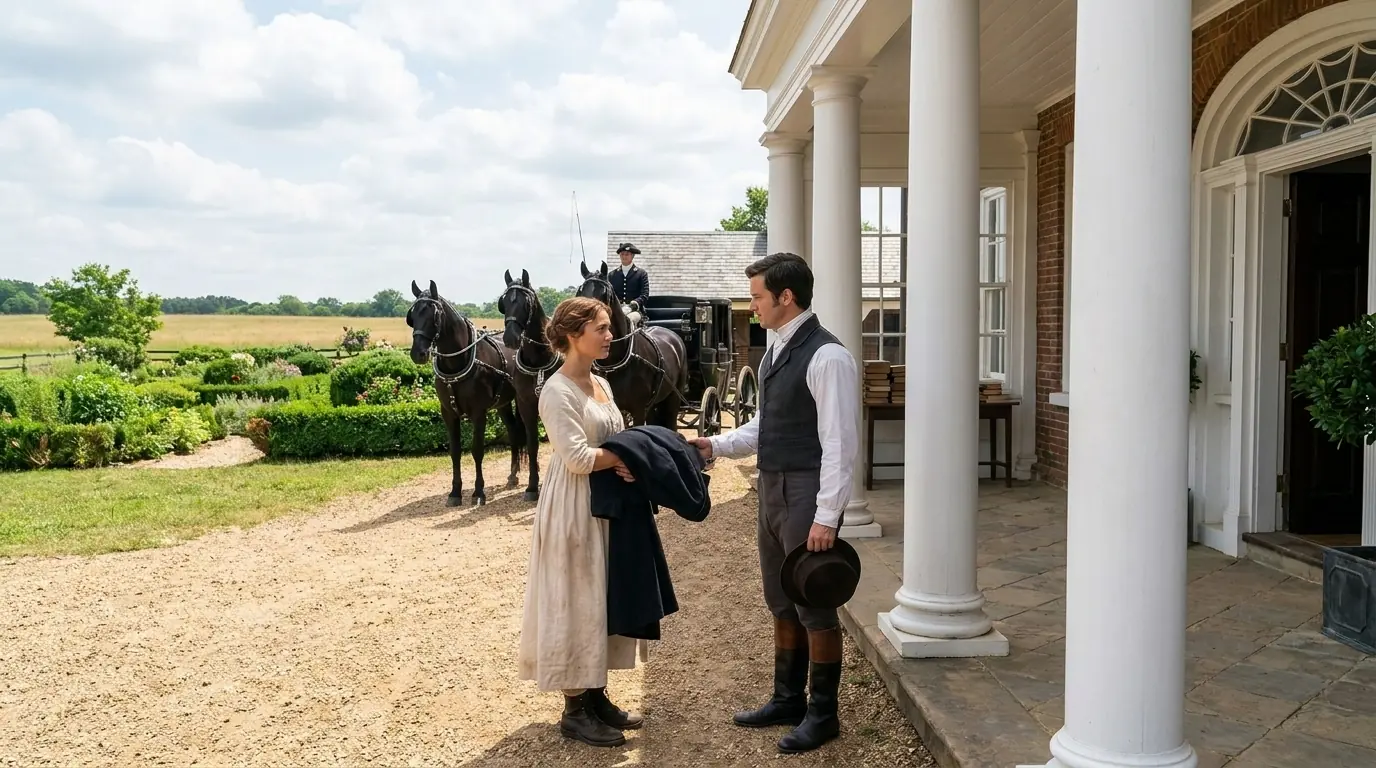
She just took the coat, folded it over her arm, and looked him dead in the eye with a calm that cut deeper than any insult ever could. Virginia, Summer 1817. The horse was still breathing hard when Abigail Whitmore stepped off the porch. She hadn't slept. Three nights running, she'd been awake before dawn, working the books by candlelight, crossing numbers, recrossing them, praying they'd come out different.
They never did. The eastern field had flooded after the rains in May, and she'd lost two weeks of labor and nearly $400 worth of crop. The workers still needed to be paid. The supply merchant in Charlottesville was already sending letters with a sharper tone than usual. And now there was this.
She stood at the fence line and watched Thomas, her best stable hand, circle the gray mare, slowly running his hand along the animal's left flank. The horse stepped sideways, ears pinned flat. "She's been favoring that leg since Sunday," Thomas said without looking up. "Could be a sprain, could be worse," Thomas added. Abigail didn't answer right away. She rested her forearms on the top rail and studied the mare—the way she shifted her weight, the slight tremble in the muscle above her knee, the dullness in her eye that no amount of feed was going to fix.
"Pull her from the rotation," she said finally. Full rest, cold water on the leg twice a day. If she's not better by Friday, send for Dr. Hale. That'll cost us.
It'll cost us more if she breaks down on the road. Abigail pushed off from the fence. Do Thomas nodded. He knew better than to argue. He'd worked for Abigail Whitmore for six years, and in that time, he'd never once seen her make a decision in a hurry or without thinking it through twice.
It was one of the things that made working for her different from every other landowner he'd served. She listened, she thought, and when she gave an order, she'd already counted the cost. Abigail walked back toward the house with the sun climbing behind her, the heat already pressing down on the fields like a hand. It was going to be another brutal summer. The kind that split the earth and turned the creek to a trickle and made you remember whether you wanted to or not that Virginia didn't owe you anything.
She was 29 years old. She'd been running this estate for four years. She was tired in a way that had nothing to do with sleep. Inside the house was cool and dim. The morning air still moved through the front windows, carrying the smell of honeysuckle and damp earth.
Martha, who had cooked and kept house at Whitmore Estate since before Abigail was born, was already in the kitchen. The smell of cornbread and coffee drifted through the hallway. "You eat?" Martha asked when Abigail came through. "Not yet." "Then sit," Abigail sat. She spread the ledger open on the kitchen table and uncapped the ink while Martha set a plate down in front of her without being asked.
Letter came this morning, Martha said. From Richmond. Abigail looked up. Left it on the desk. Abigail wiped her fingers pushed up from the table and went to the small side room she used as an office.
The desk was buried under maps, contracts, seed orders, and two months' worth of correspondence she hadn't had time to properly file. She found the letter near the top. The seal was from the firm of Whitfield and Marsh, a land brokerage out of Richmond she'd done business with twice before. She broke it open and read, "It was short. A certain party name, not disclosed, was interested in purchasing a portion of Whitmore land along the northern boundary.
The figure offered was fair, not extraordinary, but fair." The broker asked if she would consider a meeting. She folded the letter and set it down. She had no intention of selling, not one acre, not now, not ever. Her father had died owing money to half the county. He'd been a good man, a kind man, but he'd trusted the wrong people, and refused to ask for help until it was too late.
When he passed, there was almost nothing left. The house was mortgaged. The fields were in poor shape. Several of the workers had already begun looking for other employment because they hadn't been paid in 2 months. Abigail had been 25.
She'd had $200 in savings ahead for numbers that her father had always called unnatural for a girl and exactly no one willing to take her seriously. She'd paid the workers first. Then she'd walked into the bank in Charlottesville and asked for a loan, knowing they would say no. Knowing she would have to sit in that chair and listened to a man explain to her why a woman alone could not be trusted with credit. She'd listened.
Then she'd opened her ledger and shown him three years of projections she'd worked out herself. He'd laughed. She'd taken the ledger to four more banks before one of them, the youngest loan officer, a nervous young man named Collins, who looked like he was afraid of his own shadow, finally looked at the numbers instead of at her. She'd paid that loan back in 18 months. That was four years earlier.
Now, Whitmore Estate ran 240 acres, employed twenty-three people, and produced more per harvest than any comparable holding in the county. She wasn't rich, but she was solvent. She was stable, and every inch of this land was hers. She wasn't selling. She went back to her breakfast.
The letter from the broker had named no buyer. That wasn't unusual. Wealthy men often preferred to keep their interest private until negotiations were underway. It was a negotiating habit she'd learned to recognize. They thought anonymity gave them leverage.
It usually didn't. What she hadn't expected was for the buyer to come in person. She was in the South Field by midmorning walking the row with her foreman when one of the household boys came running down the slope. Miss Whitmore, there's a carriage at the gate. A big one.
Very fine black horses. She looked at her foreman. He shrugged. No one told me. No one told me either, she said.
She handed him the notebook she'd been carrying and started back toward the house. The carriage was black, well-built, and clearly expensive. The kind of rig that announced itself before you even saw who was inside. The horses were matched perfectly, deep black with no markings, their coats gleaming despite the heat. A man stood beside the driver's seat wearing the stiff formality of a wealthy household's livery.
He held the carriage door without expression. And the man who stepped down from it, Abigail saw him the moment she came around the corner of the garden wall. Tall, dark coat despite the heat. A bearing that she recognized immediately, not from having met him, but from knowing the type. The way he moved through a space as though it had been arranged for him in advance.
The way his eyes moved across the property without settling on any person in particular. The way he straightened his cuffs when his feet hit the ground. A small unconscious gesture of a man who was accustomed to stepping into places where people would be waiting to receive him. She'd dealt with this type before. Wealthy, titled, and probably used to things proceeding according to his expectations.
She came through the gate and walked toward him. He was looking up at the house, taking in the white columns, the wide porch, the yard that she kept trimmed and clean, not for show, but because order helped her think. When she was close enough to speak, she stopped. "Good morning," she said. He turned.
He looked at her at the plain cotton dress, the sun on her face, the soil she hadn't had time to clean from her boots, and his expression shifted into something perfectly polite and perfectly impersonal. The look of a man acknowledging the help. "Good morning," he said. "I'm looking for the owner of this estate. I believe a meeting may have been arranged." He paused.
"Would you let them know the Duke of Caldwell has arrived?" She held his gaze for just a moment. "Of course," she said. She turned and walked back into the house. In the two minutes it took her to cross the hallway, wash her hands in the basin by the back door, straighten her dress, and walk into the main sitting room. Abigail had already decided how this was going to go.
She did not correct him outside. She could have, but she wanted to see what he was like, how he treated the person he believed to be a servant. A man who was genuinely decent showed that in how he behaved when he thought no one important was watching. She sat down behind the wide desk in her office, her father's desk, refinished and repaired and now covered in her own papers and waited. It was less than 5 minutes before Martha showed him in.
He came through the doorway already speaking. I appreciate the courtesy of seeing me. I understand the broker communicated my interest in. He stopped. He looked at her.
She looked back at him. The silence lasted perhaps 4 seconds. She counted them. I'm sorry, he said slowly. I was told the owner would receive me.
You were told correctly, Abigail said. She set down her pen. My name is Abigail Whitmore. This is my estate. Please sit down, Mr.
Caldwell. "Duke," he said almost reflexively. "Mr. Caldwell," she said again with no change in tone whatsoever. Another silence, shorter this time.
He sat down. She watched him recalibrate. It wasn't subtle men like him rarely were, but she gave him credit for doing it quickly. His jaw tightened, loosened. His hands folded over his knee, stayed still.
He looked at her with the fixed expression of a man who had just understood that he had miscalculated something and was deciding whether to acknowledge it. He did not acknowledge it. I understand you may have received a letter from my brokers, he began. I did. And your position on the matter?
I'm not selling. A pause. You haven't heard the offer? The offer in the letter was fair. My answer is still no.
He studied her. She got the impression he was used to people leaving gaps in conversation that he could fill. Used to silence being a form of difference. She didn't fill it. Miss Whitmore, he said finally.
The parcel in question is the northern boundary, forty acres of land that according to the county survey has been lying largely for the past two seasons. It's resting, she said. I beg your pardon. The land is resting. It was under heavy cultivation for three consecutive years.
I rotated it out to let the soil recover. It will be back in production next spring. He blinked. You are personally managing the agricultural planning. I manage everything," she said.
She watched him process that. He hadn't expected it. She could see it not in his expression, which remained controlled, but in the way his eyes moved briefly quickly across the papers on her desk, looking for some sign of a steward, a manager, a male figure who was actually in charge and simply not present for this meeting. There was no such person. There never had been.
I see, he said. The northern acreage is not for sale, Abigail said. But since you've come a considerable distance, I'm willing to discuss the purchase of horses. That was the secondary purpose of your inquiry as I understood it. He looked at her again differently this time.
Not recalibrating now, just looking. Yes, he said. It was. She took him out to the stables herself. She noticed that he didn't argue about it, didn't ask for a hand or a stable boy to escort him.
He simply walked alongside her, his hands clasped behind his back, and was quiet. That surprised her. She'd expected more resistance. Men of his standing usually pressed harder on the first refusal, made some remark about reconsidering, promised to improve the offer. He hadn't done that.
She filed that away. The stables at Whitmore were clean and well-kept. Eight stalls, six currently occupied. She'd built the breeding program from two mares her father had purchased before his health declined. And in four years, she'd developed a reputation for producing horses that were sound, well-tempered, and honest qualities she valued for obvious reasons.
He looked at the leg, the chest, the eye. He ran his hand along the animals neck with the flat of his palm, the way someone does when they've spent real time around horses and not just on top of them. "What's his name?" He asked. "Emerson." Good-tempered, honest, she said. "He'll let you know when something's wrong.
Some people find that irritating. He glanced at her sideways. And you? I find it useful. He almost smiled.
Just barely. She caught it and set it aside. They looked at three more horses. He asked questions, specific informed questions, not the kind designed to impress, but the kind that meant he actually wanted to know the answers. She answered directly.
He listened. It was in its way the most functional conversation she'd had with a man in months. When they came back out into the yard, the heat had built into something serious the way it did in Virginia in July, when the sun had no mercy. She could feel the back of her dress sticking. He looked warm, but gave no indication of caring.
I'd like the bay, he said. And the roan mare if you're willing to part with her. She's not for sale. He accepted that without a word. She gave him credit for it again.
The bay, then? What are you asking? She named a price. It was fair, the same price she'd charged the last three buyers. He didn't negotiate.
He nodded. Done, he said. I'll have the papers drawn. She put her hand out. He shook it.
His grip was firm and brief. The grip of a person who had shaken hands as an act of agreement and not just gesture. That was rarer than it should have been. You can have him by the end of the week, she said. I'll need two days to prepare the papers and have the vet sign off.
Acceptable. He picked up his hat from where he'd set it on the fence post. Miss Whitmore. Mr. Caldwell.
He almost smiled again. This time she was sure of it. She watched the carriage pull away down the road, and then she stood there for a moment in the heat, one hand on the fence post, thinking he had come in expecting one thing and found another. She'd seen that in him clearly enough. The adjustment, the moment at the desk, when he'd understood who she was and what he'd done, had been real.
She'd watched him decide not to make a performance of it, not to apologize in a way that was really about his own comfort, not to explain himself or diminish what had happened by rushing past it. He just moved forward. She didn't know yet what to make of that. She went back inside. Martha was waiting for her in the kitchen.
Well, Martha said he bought Emerson the land. No. Martha set down the pot she was holding and gave Abigail a long look. He come all this way for a horse. He came all this way for forty acres.
He's going home with a horse. Abigail pulled out a chair and sat down. He'll be back. Martha was quiet for a moment. He treat you right.
Abigail thought about it honestly. He made a mistake when he arrived. He didn't know me. Most men make a mistake and then explain it to death. He didn't, Abigail said.
Martha went back to the stove. Hm. He came back three days later, not for the horse, the papers weren't ready yet, and she hadn't sent word. He arrived midmorning in the same black carriage. And this time, when the household boy came running to tell her she was already in the office and already knew, she'd heard the carriage on the road, she waited.
He knocked on the office door himself. Didn't have Martha announce him. Knocked and waited. "Come in," she said. He opened the door and stood in the frame.
His coat was off. She noticed that he was in shirt sleeves and a waist coat, and he held his hat in his hands, which was a small thing, but not a nothing thing. "I owe you an apology," he said. She looked at him across the desk. "You don't need to.
I think I do." He came in and sat down in the chair across from her, not waiting to be invited this time, which she found she didn't mind. When I arrived the first day, I assumed. He stopped, set the hat on his knee. I assumed who you were based on what you were wearing and where you were standing. That was a failure of judgment on my part, and I want you to know I'm aware of it." Abigail studied him for a moment.
Why come back to say that? Because it needed saying most men in your position would consider it settled once they'd moved past it. I'm not most men, he said. It was said plainly without arrogance, just as a statement of fact. She wasn't sure she believed it yet, but she noted it.
Then consider it settled now, she said. He nodded. And then he said, I have a question if you're willing. Depends on the question. How did you build this?
He meant the estate. She could tell from the way he said it. Not the house, not the fields, the whole of it. The broker's report was thorough, but numbers don't explain things. She leaned back in her chair.
It was an unusual question. Most men who came here wanted to know what she'd do with it, whether she'd sell, whether she'd marry, whether there was a man somewhere who was actually running things. He'd asked something different. He'd asked how. My father left debts, she said, and a house with a bad roof and fields that hadn't been properly rotated in six years and twenty-three people who depended on this land for their livelihood.
That's a great deal to inherit. It wasn't inheritance, she said. It was a decision. I could have sold what remained and moved to my cousin's house in Fredericksburg. She paused.
I didn't want that life. What life did you want? The question landed quietly. She looked at him. This one, she said.
He was quiet for a moment. She couldn't tell what he was thinking. His face didn't give much away. She'd noticed that about him. Most men's faces did more work than they intended.
His was composed. Not cold, just composed. I have another question, he said. You came with a list. I came with several.
She looked at him. How many is several? Five or six? She almost laughed. She caught it.
Ask them then. He asked them. She answered honestly. They talked for two hours about the soil, about the horse breeding program, about the merchant relationships she'd built in Charlottesville in Richmond, about the system she'd developed for tracking the weather and adjusting the planting schedule accordingly. He listened in a way she wasn't used to, not as a man listening to be polite.
As a man listening because he wanted to understand. He told her about his own holdings in turn three estates in Virginia and one in Maryland overseen by stewards he now wasn't certain were giving him accurate information. He asked her what she would do in his position. She told him he didn't ask whether she was sure or whether she'd talk to her husband about it. By the time Martha appeared in the doorway with a look that meant it was well past a reasonable hour, the afternoon light had shifted from gold to amber, and the first hint of the evening's coolness had begun to come through the open window.
Nathaniel Caldwell stood gathered his coat, picked up his hat. "I'll be back for the horse at the end of the week," he said. "I know." He paused at the door. "Miss Whitmore, thank you for the horse. For the conversation," he said.
He left. Abigail sat at the desk for a while after he was gone. The light moved. The house settled into its evening sounds. Martha in the kitchen, the distant calls of the field workers heading home, the birds beginning their dusk chorus out along the fence line.
She thought about his questions, not the questions themselves so much as the space he'd left around them. He hadn't told her what he thought she should have done differently. He hadn't redirected the conversation toward his own experiences. Every time she finished a thought, he had just listened. It was a small thing.
It felt larger than it should have. She opened the ledger and went back to the numbers. They didn't look as hard as they had that morning. He came on Friday for the horse as agreed. Thomas had Emerson ready in the yard, brushed and sound, his papers in a leather envelope that Abigail handed over herself.
Nathaniel examined the papers, nodded, and tucked them under his arm. "He'll do well," she said. "I know." He ran his hand once more along Emerson's neck. "I know good when I see it." He glanced up at her brief and direct. Eventually, she held his gaze.
"Eventually," she agreed, and that was the beginning. From that Friday in July, nothing at Whitmore Estate looked quite the same. Not to Abigail and not to the man who had once stood in her doorway and handed her his coat like she was meant to carry it. But what came next, what the county would say, what society would demand, and what it would cost both of them to stand still when everything pressed them to move, that was a story neither of them had finished yet.
He came back the following Monday. Abigail knew before Martha said a word. She heard the carriage on the gravel road the same deliberate pace, the same matched horses, and she set down her pen and waited without moving from her desk. Martha appeared in the doorway. That Caldwell man again.
Send him in. You sure? Because Thomas says he's been asking around town, asking about you. Abigail looked up. Asking what?
Asking how long you've been running the place, who helps you, whether you've got family. Martha's expression was careful. People are talking, Miss Abigail. People always talk, Abigail said. Send him in.
Martha pressed her lips together and went. Nathaniel came through the door 2 minutes later. He was dressed more simply than the first time. No formal coat, just a riding jacket, boots that had actual mud on them. He'd come on horsep back this time, not by carriage, she noted that.
Miss Whitmore. Mr. Caldwell, you're back sooner than I expected. Emerson threw a shoe 2 miles out from your gate, he said. I need your farrier.
She stared at him. That's not why you came, she said. He paused. Then he sat down in the chair across from her desk, the same chair as before, without being invited, and looked at her squarely. No, he said it isn't.
She waited. I've been thinking about what you said last week. He started about rotating the fields, about the merchant in Charlottesville who tried to renegotiate your contract mid-season. He stopped, started again. I had my steward pull the accounts from my Maryland estate.
The numbers don't match the reports I was given. I'm sorry to hear that, she said. I want to know how you caught it, he said. In your own operation. How you knew to look.
Abigail folded her hands on the desk. You rode out here in the mud to ask me about accounting. Yes, you have advisers, solicitors, men paid a great deal of money to manage your affairs. They're the ones who gave me the wrong numbers, he said flatly. She looked at him for a long moment.
There was no performance in him today, no careful composure. I was frustrated, genuinely frustrated, and he'd come here to her instead of to anyone else in the county who might have been the more obvious choice. She thought about that. "The first thing you look for," she said slowly, "isn't where the numbers are wrong. It's where they're too smooth." He frowned.
"What do you mean? Real accounts have friction," she said. "Unexpected costs, bad weather, a horse that throws a shoe," she glanced at him. Things go wrong in real operations. If every quarter looks clean and every projection comes in within 2% of estimate, something is being hidden.
He was very still. My Maryland estate, he said. Three years of clean accounts. Yes, she said. He sat back in the chair.
He ran one hand across his jaw, the gesture of a man absorbing something he didn't want to be true. Then he looked at her. Would you be willing to look at them? Abigail said nothing for a moment. The accounts that he said I could bring them here or he stopped.
Or I could ask you to come to Richmond. I have an office there. More space. He paused. I recognize that's an unusual request.
It's an extraordinary request, she said. I know. You're asking me to travel to your offices in Richmond to review your private accounts. Yes. Why?
She asked directly. You could hire any solicitor in Virginia. I don't trust any solicitor in Virginia right now, he said. And I trust you. The words landed in the room like something dropped from a height.
Abigail heard them. She felt the weight of them. You've known me for a week, she said. Long enough, he said. She held his gaze and said nothing.
The silence stretched between them, not uncomfortable exactly, but full. The kind of silence that had substance to it. "Bring the accounts here," she said finally. "I'll look at them." He exhaled just barely, just a small release of something that had been held. "Thank you.
Don't thank me yet. I might tell you something you don't want to hear." "I know," he said, and then quietly. "That's why I'm asking you." He brought the accounts three days later. Four leatherbound ledgers and a crate of receipts going back five years. He carried them in himself, didn't send a man, didn't have his driver bring them to the door.
He walked them up the porch steps and set them on her desk with the careful hands of someone who understood they contained something serious. "My steward's name is Weston," he said. "He's been with the Maryland estate for eight years. My father hired him. That makes it harder," she said.
Yes. She opened the first ledger. Sit down. This will take a while. He sat.
He didn't speak while she worked. She appreciated that more than she could have explained the ability to be quiet in a room where someone was thinking. Most men couldn't do it. They'd ask questions or offer opinions or shift in their chair until you had to look up and reassure them that you were still paying attention. Nathaniel sat like a man who knew how to wait.
She went through the first two ledgers in an hour and a half. She made notes in her own hand on a separate sheet of paper, cross- referencing figures, tracking the places where the numbers smoothed out in ways that real numbers didn't. When she set down her pen and looked up, he was watching her. "Your farrier costs," she said, consistent to within $4 every quarter for five years. "That seems orderly.
Horses don't get their shoes done on a quarterly schedule." She said they need shoeing when they need it. In five years, you should have at least four or five quarters that are significantly higher or lower than average. A horse goes lame, you spend more. A mild winter, the horses travel less, you spend less. This number never moves.
He stared at the ledger. He's adjusting it. After the fact, she said he's building the receipt totals backward from a predetermined figure. She turned the ledger around and slid it across the desk toward him. "Look at the ink on the farrier entries.
Compare it to the line above." He leaned in, looked carefully. "The ink is different," he said. His voice had gone very flat, slightly darker. "He is going back and filling in costs after the ledger page is already written," she tapped the page. "This isn't a small error, Mr.
Caldwell. This is systematic. He's been doing it long enough that he got sloppy." Nathaniel sat back. He didn't speak for a long moment. She watched him, the jaw that tightened and released the hands that gripped the arms of the chair once and then let go.
He was angry. She could see that clearly. But underneath the anger was something worse. Something closer to grief. Eight years, he said quietly.
Yes, my father trusted him. I know. She said it simply, not trying to soften it, not trying to rush past it, just acknowledging it as the truth it was. He stood up abruptly and moved to the window, stood there with his back to her hands, clasped, looking out. She gave him the moment.
She knew what it felt like, that specific hollow feeling of discovering that someone you'd trusted had made a fool of you without your ever knowing. "What's the total?" He asked without turning around. I'd need to go through all four ledgers and the receipts. She paused. My estimate from what I've seen so far is somewhere between $3,000 and $4,000 over five years.
The number landed like a stone. He was still. Then he turned back around. His face had changed. The composure was back, but it was harder now.
Deliberate. I want to go through the rest, he said. Today, all of it. Can you do that? Clear your afternoon, she said.
I went to the door and told his driver he wouldn't be leaving before evening. He came back in and sat down. They worked for four more hours. Martha brought food. At some point, she simply appeared with bread and cold meat and two glasses of water and set it on the edge of the desk without a word, the way she did when she decided that someone working in this house needed to eat, whether they'd asked or not.
Nathaniel glanced up, surprised. Abigail watched him look at Martha. Really look at her and say, "Thank you, ma'am." With exactly the tone he would have used with anyone else. Martha gave him a long look on her way out. Abigail caught it and said nothing.
They ate while they worked. By the time the evening light had turned the office gold and the nightbugs had started up outside the window, she had a full accounting. She turned the final page and set it down. $4,312. She said over five years. Some of it may be harder to prove without confronting him directly.
He's careful, but the core pattern is clear enough to take to a court if you need to. Nathaniel was looking at the stack of ledgers. His expression was the expression of a man staring at something that had permanently changed his understanding of his own life. What would you do? He asked.
In my position, Abigail thought about it. Confront him privately first. Give him the chance to make it right. If he refuses, then the court. She paused.
He served your family a long time. That deserves a private conversation before a public one. He looked at her. You're more generous than I feel right now. I'm not generous, she said.
I'm practical. A public accusation is costly even when you win. And courts take time you'd rather spend on something else. He almost smiled at that. You always think three moves ahead.
Somebody has to, she said. He left when the stars were out. The ledgers back in their crate loaded into his carriage by the driver who had clearly been resigned to the long wait from the moment he'd been told. Abigail walked him to the door, not out of courtesy. Exactly.
More because it was the natural end of the thing. The same way you walk someone to the gate. When a long conversation is finally done, he stopped on the porch, turned. I'll go to Maryland next week, he said. Deal with Weston.
Good. After that, he stopped. After that, I'd like to come back. He held her gaze. Not for accounts.
The night air was warm around them. Somewhere in the yard, a bird called once and went quiet. "Why?" She asked. Because I find that I think more clearly after talking to you than at any other point in my week, he said simply without decoration, and that isn't something I'm willing to give up easily. She looked at him for a long moment.
You should know, she said, that the county will have opinions about that. The county has opinions about everything. About this especially, she said. A man of your standing, coming repeatedly to see an unmarried woman who lives alone. You're not alone, he said.
You employ twenty-three people and appear to manage them better than I manage anyone. She looked at him. That isn't the point, and you know it. I know it, he said. I'm telling you, I don't care.
She didn't answer right away. The porch creaked softly under her feet. She looked out at the dark yard. The fireflies just starting up along the garden hedge, the shapes of the barns and stables beyond. Come back after Maryland, she said finally.
We'll see. He put on his hat. Good night, Miss Whitmore. Good night, Mr. Caldwell.
He was gone for eleven days. She didn't expect to notice. She had accounts of her own to manage a harvest to plan for a merchant dispute to settle and three letters to write to the loan officer in Charlottesville about extending the credit line for the fall purchases. She had more than enough to fill eleven days without thinking about Nathaniel Caldwell once. She thought about him anyway, not constantly, not in a way that alarmed her, but she'd be in the middle of the morning's work and catch herself listening for a carriage on the road.
She'd be at the fence in the evening watching the horses and realize she was rehearsing something she might say to him. Arguments mostly observations, things she'd noticed and had no one to tell who would find them interesting. That was the thing that nagged at her most. Not the way he looked or the way he spoke or the careful way he shook her hand as though it mattered. It was the fact that she wanted to tell him things that was new.
That was strange and she wasn't sure what to do with it. On the ninth day, a letter came. The seal was his. She broke it open at the desk. It was short.
Three sentences. Weston confessed. He will repay what he can. I will be back by Thursday. She read it twice.
Then she set it face down on the desk and went back to work. On Thursday, the carriage came before noon. He looked tired, not undone. He was too composed for that, but the tiredness was there in the set of his mouth and the small hollows under his eyes. He sat down across from her and accepted the coffee Martha brought without comment, which she'd learned was unusual for him.
Normally, he declined things he hadn't asked for. Today, he wrapped both hands around the cup. "How did it go?" She asked. "Badly and well," he said. He confessed immediately when I laid out your findings.
I think he'd been waiting for it. Honestly, eight years is a long time to carry a thing like that. Did he explain himself? Debts, Nathaniel said. His brother had borrowed money from the wrong people.
Weston started taking small amounts to help. Small amounts became larger ones. He paused. He wept. What did you do?
I didn't call the constable. He set the cup down. I gave him two weeks to settle his affairs and I told him to go. He'll repay what he can over time. I don't have much hope for the full amount.
A pause. I found a reference in his papers for a family in Maryland who might take him on. I didn't say anything to discourage it. Abigail stared at him. You gave him a reference.
I didn't give him one, he said. I simply didn't destroy the one he had. She was quiet for a moment. That was generous. You said I should give him a private conversation before a public one.
He looked at her. You were right. She looked at him across the desk. Something had shifted in him. She could see it.
Not broken, not diminished, quieter, like a man who had walked through something difficult and come out the other side still standing, but holding himself a little differently. How are the accounts now? She asked. Accurate, he said. Finally.
A small pause. I hired a new steward, a young man from Fredericksburg. Methodical. I had him review the Virginia holdings as well. He paused.
He found two additional discrepancies. Smaller, different hands. Abigail said nothing. It seems I was not paying close enough attention to my own affairs, he said. His tone was controlled, but there was something harder underneath it.
Self-directed. You trusted people you'd inherited, she said. That's not carelessness. That's loyalty. It cost me, he said.
Yes, she agreed. Loyalty often does. He looked at her sharply, and then his expression changed just slightly into something she hadn't seen on him before. Curious, intent. Did it cost you?
He asked, trusting people. She didn't answer right away. She folded her hands on the desk. My father trusted a man named Crawford with the estate finances the last two years of his life. Crawford kept the books and told my father what he wanted to hear and took a percentage that was never agreed to.
What happened when you found out? I found out after my father died. Crawford came to me three days after the funeral with a bill for services rendered. Her voice stayed level. He expected me to be overwhelmed.
Expected me to pay and be grateful he hadn't taken more. Nathaniel's expression was very still. What did you do? I went through every receipt in my father's desk. Took me three days.
She paused. Then I wrote him a letter specifying the exact amount he had overcharged, the exact dates, and the exact legal consequence if he brought the bill to me again. He backed down. He tried to argue. She met his eyes.
I let him. And then I showed him the letter I'd already drafted to his other clients. A beat of silence. Then Nathaniel let out a breath that was almost a laugh, just barely low and short, the kind that comes when something is both terrible and precisely what it should be. How old were you?
He asked. 25. He shook his head slowly, not in disbelief, in something closer to recognition. That first day, he said quietly, when I handed you my coat. Yes, I owe you a real apology for that, he said. Not the one I gave you last week.
That one was accurate, but not enough. She looked at him carefully. Most men would have rather pretended it hadn't happened. I'm not most men, he said. It was the same thing he'd said before.
She'd noted it then without believing it fully. Now watching him hold the coffee cup and look at her with that steady, undefended attention, she was starting to think he might mean it. It was one moment, she said. One assumption quickly corrected. It wasn't the coat, he said.
It was what was behind it. I walked up to this house and I looked at you and I decided who you were before you'd said a single word. I based it on what you were wearing and where you were standing and the fact that you were a woman. And I didn't question any of it for a second. He paused.
That kind of blindness doesn't come from one moment. It's accumulated. And a man ought to be honest with himself about that. The office was very quiet. Outside the fields hummed with summer cicadas, the distant sound of the workers calling to each other, a horse blowing in the stable yard.
Inside, nothing moved. "You're harder on yourself than I would be," she said finally. "I've had eleven days to think about it." "And was this the conclusion you came to?" She asked. "In Maryland, between confronting your steward and hiring a new one, among other conclusions," he said. "What were the others?" He looked at her, then he looked down at the coffee cup, then back at her.
That I've been managing things from a distance for too long, he said. The estates, the accounts, the people who work for me. He paused. The question of what I'm actually building and for what? That's a large question for eleven days.
It's been building longer than eleven days, he said. I think it started the moment I walked into this office and found you sitting at that desk. She held very still. I don't mean that as he stopped recalibrated. I mean that coming here changed what I was seeing in my own life.
I came here for forty acres of land and I found a woman running an operation better than anything I own on her own with half the resources. He met her eyes. That does something to a man if he's paying attention. And if he isn't, she asked. Then he goes home and tells himself the land wasn't worth the price and moves on.
He said, "I didn't want to do that." She looked at him for a long moment. "The cicadas outside climbed and fell." Somewhere in the kitchen, Martha set something down with a small clatter. "You should know," Abigail said, that I don't have much use for men who come here to find something for themselves. "I know," he said. I've built everything you see without anyone's help and I don't need it now.
I know that too. Then what do you want? She asked directly. He looked at her steadily. I want to know you, he said.
That's all. Not your land, not your management methods, though they're extraordinary. Not what you can do for me or what my name might do for you. He set the cup down. I want to know who you are and I'd like the chance to show you who I am.
Whatever comes from that or doesn't, I'll accept. The words were honest. She could hear it. Not practiced. She'd heard practiced.
She knew the difference. This was a man saying something he'd worked out in the privacy of his own head and hadn't dressed up before saying aloud. She looked at him for what felt like a very long time. "Thursday," she said finally. There's a problem with the east fence line and I need someone to walk it with me.
Come at seven before the heat sets in, he blinked. Then his expression settled into something she hadn't seen from him yet. Something open without the careful composure over the top of it. Seven, he said. I'll be here.
He was there at a quarter to seven. She was already at the fence when he arrived. Boots on notebook in her coat pocket, her hair pulled back the way she wore it for working. He came through the gate on horseback alone, no driver, and dismounted and tied the horse at the post without ceremony. You're early, she said.
So are you, he said. She turned and started walking. He fell into step beside her. The east fence ran for half a mile along the property boundary, following the edge of the field where she'd planted winter wheat the previous year and intended to rotate into corn this fall. Three sections had gone soft over the winter posts, sinking rails, loosening, and she needed to assess whether she could repair in place or needed to pull and reset.
She explained this while they walked. He listened and asked practical questions, not questions designed to show he was listening. Questions that indicated he'd actually been following what she said and wanted to know more. When they reached the first damaged section, she pushed against the post with her shoulder. It gave too much.
Pull and reset, he said, looking at it. Yes. How many posts in this section? 14, She wrote it in the notebook. If it's the same at the other two, that's 40 posts minimum. Labor cost.
I'll do the calculation tonight. She moved to the next post, tested it. This one, too. He took hold of the top rail and applied pressure himself, feeling the give. His hands were more capable than she'd expected.
She noticed that. Not the hands of a man who had never done physical work. "You've done fence work before," she said. Not quite a question. "Before I had people to do it for me," he said.
"My father believed a man should understand the work before he assigned it." She glanced at him. He sounds like someone I'd have respected. "You'd have argued with him," Nathaniel said. "He was very certain he was right about most things." "That does sound familiar," she said. He looked at her sidelong.
"Present company not accepted." "Present company frequently accepted," she said. He smiled. It was the first full smile she'd seen from him. Not the almost smile, not the barely caught expression. A real one.
It changed his face entirely, knocked the composure loose, and left something younger underneath. She looked away before she could think too long about it. They walked the full half mile. She documented every problem section, every post, every rail. He carried the end of the measuring cord without being asked marked intervals when she needed them, held things when she needed two hands.
He did it without commentary or performance. Just helped. When they reached the end and turned back toward the house, the sun was properly up and the day's heat was beginning to gather. Forty-six posts, she said. I counted forty-seven.
She looked down at the notebook. Counted again. Forty-seven, she said. I'll send men, he said. She stopped walking.
I have men. Yours are busy with the harvest prep, he said. You told me this morning the corn rotation starts next month. You don't have the labor right now for fence work and field prep both. He said it plainly without offering or asking, just stating what he'd heard and calculated.
I have three men currently unoccupied at the Richmond property. I'll send them no charge. Call it return on the favor of the accounting review. She looked at him. That was different.
That was my expertise and this is mine, he said. Available labor. I don't like being in someone's debt, she said. Then I'll accept payment in kind, he said. When you rotate the North Field in the spring and the yield is what I suspect it will be, sell me the first ten bushels at market price and we'll call it square.
She stared at him. "That is an absurd arrangement." It's a perfectly reasonable arrangement, he said. It keeps the accounting clean. I believe you care about that. She almost laughed.
She stopped it before it escaped, but she could feel it in her chest, warm and involuntary and entirely unwelcome. Fine, she said. Send the men. Tuesday. Tuesday, he agreed.
They walked back toward the house without speaking. The morning light was long and gold across the fields. The wheat stubble from last season still showing through the soil. A hawk circled once above the far treeine and then was gone. Can I ask you something?
He said you usually do, she said. What do you want? He asked. Not for the estate, for yourself. What does Abigail Whitmore want that she hasn't built yet?
She walked two more steps before she answered. I want people to walk onto this land and not wonder where the man is, she said. I want to sign a contract and have the man across the table not look behind me for someone to confirm it. She paused. I want to build something that lasts past me, that carries my name on it the way this county carries the names of men who did half of what I've done.
She stopped walking. I want to be seen. She said it quietly, not with bitterness. She'd long since used up her supply of bitterness. Burned it off in those first brutal years when she'd needed the energy for something more useful.
She said it the way she said everything plainly and exactly as she meant it. He stopped beside her. He didn't say, "I see you." He didn't say anything at all for a long moment. He just looked at her with that steady attention she'd been learning to recognize as one of his most genuine qualities. Then he said, "I walked onto this land and looked right past you." And I've been reckoning with that ever since.
The wind moved through the wheat stubble. The hawk was gone. The morning settled around them, both quiet and bright, and entirely ordinary in the way that only the most uncommon moments ever are. Abigail looked at him. You should come to dinner.
She said, "Martha's been making enough food for four people since you started showing up, and she'll be insufferable if I don't let her feed someone eventually." He looks slightly startled. It was the first time she'd seen him startled. She found she liked it. Thursday, he said. Thursday, she said.
Six o'clock. Don't be early. He was early. He was early again, and this time he brought wine. Martha opened the door before Abigail could get there, took one look at the bottle in his hand and said nothing, which from Martha was a form of approval.
Abigail came down the hall to find him standing in the entryway with his hat in one hand and the wine in the other. Looking around the house, the way he hadn't allowed himself to look on his previous visits, taking in the shelves of ledgers, the framed map of the county that her father had drawn by hand, the worn patch on the floorboard in front of the sitting room door where three generations of feet had crossed the same threshold. "You're early," she said. "You said not to be," he said.
"And yet he handed her the wine. Consider it an apology in advance for whatever I say at dinner that I shouldn't." She looked at the bottle. It was good wine. She knew enough to know that. Better than anything she kept in the house.
You're expecting to say something you shouldn't. I generally do, he said. "In honest company," he said.
She turned and walked toward the dining room. "Then we're going to have an interesting evening." Martha had cooked enough for six people.
She always did when there was company. She decided to approve of and she clearly had made her decision sometime between the fence walking Tuesday and now because the table was set with the good dishes, the ones Abigail's mother had brought from her own family and which only came out for people who mattered. Abigail noticed and said nothing. Martha caught her noticing and said nothing either. That was their particular language.
They sat. Martha served and then made herself scarce in the way she had present enough to be useful, absent enough to allow actual conversation. For the first few minutes, it was the estate. It was always the estate, and she didn't mind that because the estate was her life, and talking about it was talking about herself in the only way she was fully comfortable doing. He asked about the corn rotation timing, about the merchant contract she'd mentioned, resolving about the south pasture she'd said needed drainage work in the fall.
She answered and watched him listen and thought not for the first time that there was something restful about a man who didn't need to make everything about himself. Then he set down his fork and said, "Tell me about your mother." She looked up. "You've mentioned your father several times," he said. "You've never mentioned her." Abigail was quiet for a moment. She died when I was 11.
I'm It was a long time ago. That doesn't always make it smaller, he said. She looked at him carefully. No, she said. It doesn't.
She picked up her wine. She was a practical woman. Practical in the way that women of her time had to be. She managed the house, kept the accounts. When my father got distracted, raised me, and did all of it as though it cost her nothing.
She paused. It cost her a great deal. I understand that better now than I did then. What did she teach you? To write clearly, Abigail said.
To read a contract before I signed it. To never tell a man what I needed from him if I could find another way to get it myself. A pause. She didn't say that last part in those words, but that was the lesson. Nathaniel was looking at her with the same steady attention she'd come to expect.
She sounds like someone who understood the rules of the world she lived in. She understood them perfectly, Abigail said. She just didn't think they were fair. Did she tell you that? Not directly.
Abigail set the wine down. She told me once that the best thing a woman could do was to make herself so capable that the question of whether she was allowed became irrelevant. She looked across the table at him. I've spent my adult life trying to figure out whether she was right. What's your conclusion?
He asked. That she was right about the capability, Abigail said. And wrong about the question becoming irrelevant. The question never becomes irrelevant. People just run out of good arguments against you.
He looked at her for a moment. Then he said, "That is possibly the most accurate description of how power actually works that I've heard in my life." She raised an eyebrow from a man who has it. "Precisely because of that," he said. "The wine was good. The food was better.
The evening moved the way good evenings do when you're in the middle of one and not yet aware. It's one of the ones you'll remember quickly without your permission. Each hour arriving before you've finished with the last one. He told her about his father. She hadn't asked, but he offered it the way she'd offered the story of her mother, not as autobiography, but as explanation.
His father had been a man of deep principle and absolute certainty, a combination that made him genuinely great in some respects and genuinely difficult in others. He believed that the natural order of things was correct. Nathaniel said that society's structure reflected some kind of earned hierarchy, that the people at the top were there because they deserved it. And now, she asked, he looked at her. And now I've met you.
She held his gaze. That's a large conclusion to draw from one acquaintance. You're not an acquaintance, he said quietly. And I suspect you know that. The table between them felt suddenly narrower.
The good dishes and the good wine and Martha's cooking and the map her father had drawn on the wall. All of it still exactly as it was and somehow different. Abigail looked down at her plate. Then back up. It's late, she said.
It isn't, he said. Not yet. She looked at him. He looked back. Neither of them moved.
Nathaniel, she said. It was the first time she'd used his name. She hadn't planned it. It came out the way things did when you'd been thinking them for longer than you realized. Something shifted in his face, just barely.
But she saw it. "Abigail," he said, as though he'd been waiting for permission. The clock in the hallway ticked outside. The night insects had started up their long, tireless song. "It's complicated," she said finally.
Whatever this is, I know I have a reputation to protect. You have a position to protect. And this county has opinions that would make both of our lives considerably harder. I know that, too, he said. I'm not asking you to ignore any of it.
Then what are you asking? He was quiet for a moment. I'm asking for more Thursday evenings, he said. That's all for now. She looked at him for a long time.
The honest answer was that she wanted that too. Had wanted it if she was being entirely truthful since the morning at the fence when he'd smiled and it had changed his face entirely. But wanting something and being wise about it were different skills. And she'd spent her whole life practicing the second one when the first one got inconvenient. More Thursday evenings, she said, and occasional Monday mornings, he said, if the fence needs walking, she pressed her lips together against the smile that wanted to come.
I'll see what I can do about the fence. The county noticed before the month was out. She'd expected it. She'd told him it would happen, and it did with the swift efficiency of small communities who had little else to organize their attention around. By the third week of August, she was hearing it from three different directions at once.
The first was a woman named Mrs. Hargrove, wife of the county clerk, a person of determined respectability, who had never once spoken directly to Abigail at any social gathering, but who had apparently developed strong feelings about Abigail's conduct. She conveyed these feelings through Mrs. Prior at the dry good store, who conveyed them to Abigail while pretending to discuss fabric. "People are saying," Mrs.
Prior said carefully, straightening bolts of linen. She didn't need to straighten that a certain gentleman has been seen coming to Whitmore Estate with some regularity. He has, Abigail said. He purchased a horse several months ago. He has additional business interests in the area, Abigail said, which was not precisely untrue.
Mrs. Prior looked at her with the expression of a woman who knew exactly what she was being told and exactly what wasn't being said. People are concerned, she said, for your reputation as a woman alone. Abigail picked up the fabric she'd come for and set it on the counter. Two yards of that, please.
Miss Whitmore, Mrs. Prior, Abigail said pleasantly. I've been managing this county's opinions of my choices for four years. I appreciate the concern. I'll take two yards of the linen and a spool of the white thread.
She paid. She left. She felt the eyes on her back all the way to the door. The second came from the man she least wanted it from. His name was Gerald Hartley.
He was 44 years old, owned the next largest estate in the county after Whitmore, and had been trying in various ways to either purchase her land or marry her for the better part of 2 years. He'd been refused on both counts clearly and repeatedly. He had continued his efforts with the persistent optimism of a man who was not accustomed to being told no by a woman who meant it. He arrived at the estate on a Tuesday without invitation while Nathaniel's men were still working on the east fence.
Abigail came out of the house to find him standing in the yard looking at the fence crew with an expression that contained several things at once. Recognition, calculation, and something that wanted to pass itself off as concern. Miss Whitmore, he said. Mr. Hartley.
She kept her voice level. I don't recall expecting you. I was passing, he said. He wasn't. Thought I'd pay my respects.
His eyes moved to the fence crew again, to the man in charge, who was clearly not one of her usual workers. I see you've taken on extra hands. I have fence work to do, she said. Called Wells men, he said. Not a question.
He'd recognize them somehow or heard in this county. It could be either. You seem well informed, she said. He looked at her directly. Abigail.
He rarely used her first name. When he did, it was designed to remind her of a familiarity she'd never offered. "I say this as someone who has always had your best interests at heart." "Then I'd welcome you to say it briefly," she said. He didn't like that. She watched it move across his face.
The flash of a front quickly covered. Nathaniel Caldwell is not what he appears to be, he said. She waited. He's been in financial difficulty. Hartley said his Maryland estate particularly.
There are men in Richmond who know him well who will tell you he's been looking for a favorable marriage to shore up his position. He paused, letting that land. A woman with land and no family to protect her interests would be a very attractive prospect. The yard was very quiet except for the sound of the fence crew at work in the distance. Abigail stood in the heat and looked at Gerald Hartley and felt something in her go absolutely still.
"Thank you for your concern," she said. "Abigail, Mr. Hartley," she said. Her voice was perfectly pleasant. "You have been trying to purchase this land for 2 years.
You have proposed marriage to me twice. I declined both times for reasons I stated clearly. You are standing in my yard uninvited, warning me about a man you've assessed from a distance on the subject of men who might want my property for their own benefit. She looked at him steadily. I trust you can hear what I'm pointing out.
His jaw tightened. Good day, she said. Don't come without an invitation again. He left. She went back inside and stood in the kitchen for a long moment, her hands flat on the table, her heart moving faster than she would have liked.
What if he wasn't entirely wrong? That was the thought she didn't want. That was the thought that had been sitting in the back of her mind for weeks, quiet and patient, waiting for an opportunity. She had the full accounting of Nathaniel's Maryland estate. She knew the $4,000 had been Weston's theft, not Nathaniel's mismanagement.
She knew his Virginia holdings were sound. She'd seen the numbers herself, but knowing something in the ledger and knowing it in the rest of yourself were different things. And she had spent four years building a life that nobody could take from her. And she wasn't willing to be a fool about this. Not about anything, not even this.
She went to the desk and opened the drawer where she kept his letters. Three of them now, each one brief, all of them precisely what they said they were, and nothing more. She read them again. She put them back. She was still standing there when Martha came in from the garden.
Hartley was here. Martha said it wasn't a question. Yes. Saw his horse from the window. Martha sat down what she was carrying and looked at Abigail squarely.
He say something to upset you. He said something I needed to think about. Abigail said honestly. Martha was quiet for a moment. That man came here for himself.
She said same as he always does. He's not worried about you. He's worried about what he's not getting. I know that, but you're thinking about it anyway. I'm always thinking about it, Abigail said.
That's the problem. Martha looked at her for a long time. Child, she said, and she only called her that when she meant it. You have been so careful for so long that you've started to think caring about something is the same as being stupid about it. She picked up her basket again.
It isn't. Abigail didn't answer, but she heard it. She said nothing to Nathaniel about Hartley's visit when he came Thursday. She'd thought about it, had decided against it, then back again, and ultimately said nothing because she wasn't ready to put his reaction to that test yet. She needed more time to know what she was watching for.
But something in her must have been different because he noticed they were finishing dinner. Martha's lamb better than last week. As if she were escalating in proportion to her approval when he set down his glass and looked at her with that specific attention that she was learning to recognize as his version of asking. "What happened?" He said. "Nothing happened," she said.
"Something happened," he said. "You've been a half step back from the conversation all evening. You're not usually." She looked at him. "You think you know my patterns? I'm learning them," he said simply.
The same way you're learning mine." She held his gaze for a moment. Then she said, "Gerald Hartley came to the estate Tuesday, uninvited." Nathaniel was very still. "What did he want to warn me about you?" She said. A pause. His expression didn't change, but something in it concentrated.
"What specifically? That you might be interested in my property more than my company?" She kept her voice even that a man in financial difficulty might find an unmarried woman with land an attractive prospect. The silence that followed was a particular kind of silence. She watched him sit with it, not rushing to defend himself, not performing outrage, just sitting with it the way a person does when they're deciding whether to be honest or strategic. He chose honest.
She saw the moment he made the decision. My Maryland estate was in difficulty, he said. Before your review of the accounts, my steward was bleeding it. I didn't know how bad it was. He met her eyes.
I was not looking for a favorable marriage. I have enough land. What I don't have. He stopped, started again. What I didn't have was anyone who talked to me the way you do.
That's not an accounting, she said. No, he agreed. It isn't. He leaned forward slightly. Abigail, if I wanted your land, I'd have kept pressing on the forty acres.
I stopped the moment you said no. That's not how a man behaves who wants your property. She studied him. Hartley says you need capital. Hartley wants your land more than I ever have.
He said flatly. He's been trying to acquire the northern boundary for years. I know I've heard it from three different men in Richmond. He's telling you exactly the story most likely to make you distrust me. He paused.
He's not wrong that I had financial trouble, but the source of it is resolved and the motivation he's attributing to me is his own. She looked at him for a long time. She told herself she was not going to decide this on feeling. She was going to decide it on evidence. The evidence was he'd come back to apologize when he didn't have to.
He'd listen to her when other men didn't. He'd accepted her know about the land without argument or manipulation. He'd walked her fence line and sent her workers and never once made her feel that any of it came with an expectation attached. "I'm telling you this," she said carefully, because I think you deserve to know what's being said. "Not because I've decided what to make of it." "That's fair," he said.
"I'm careful about my decisions," she said. "That won't change. I'm not asking it to," he said. Be as careful as you need to be. Take as long as you need.
I'm not going anywhere. The last sentence was said quietly without drama. He wasn't declaring something. He was simply stating a fact the same way he stated things he was certain of. She felt it settle somewhere in her chest, and she didn't try to argue it away.
Hartley will come back, she said. He's persistent. I know his type, Nathaniel said. So do I, she said. I've been managing his type for four years.
I know, he said. I'm not offering to manage him for you. Good, but if it would help, he said, I could be visibly present at the harvest gathering next month, the one at the Pryor Farm. She looked at him. The Pryor gathering was the largest social event of the fall season in the county.
Every landowner, every merchant, every person of standing for 20 m. It was where reputations were made and unmade over the course of one afternoon. If you come to that with me, she said slowly, there will be no question left about what people think is happening. No, he said there won't be. You understand what that means for both of us.
Yes, he said. And you're suggesting it anyway. I'm suggesting it, he said, because I'm tired of being halfpresent. And because you shouldn't have to walk into that room alone and manage Hartley and Mrs. Hargrove and everyone else who has opinions about your choices while I sit at home pretending we don't.
He stopped. His jaw tightened slightly, pretending this is nothing. The word this hung in the air between them. Abigail breathed in, breathed out. The gathering is the 14th, she said.
I'll be here at noon, he said. She looked at him. This man who had walked into her house and handed her his coat and been wrong about everything in that first moment, and who had spent every subsequent moment trying to be right, who asked questions and listened to the answers, who had gone to Maryland and come back humbler and more honest, who sat across her table week after week and talked to her like she was the most interesting person in the room because she was slowly understanding he actually believed she was. "All right," she said.
He nodded once, the movement of a man who had been given something and understood its weight. "All right," he said. The next morning, she was at the desk by seven, the way she always was. The ledger was open. The figures were the same figures they'd been yesterday.
But something sat differently in the room with her, something that felt like the particular alertness of standing at the edge of a decision that hasn't quite arrived yet. She was so focused that she almost didn't hear Martha in the doorway. "A letter came," Martha said. "Hand-delivered early this morning."
Abigail looked up. Who from? Martha held it out. "I don't know the seal." She took it, broke it open, read it, read it again. Her face did something she couldn't stop.
Martha, who had been watching, said quietly, "Bad news." Abigail looked up from the letter. It's from a solicitor in Richmond, she said. Her voice was very steady. On behalf of a consortium of investors. She looked back down at the page.
They are offering to purchase Whitmore Estate in full. She paused. The offer is considerable. Martha stared at her. Who sent them?
The letter doesn't say. She set it down on the desk, but the timing. She stopped, looked at the date, looked at the seal again more carefully, thought about Hartley standing in her yard four days ago. The timing is not a coincidence. Martha's expression went hard.
That Heartley man. Possibly, Abigail said, possibly others. This kind of offer doesn't come from one person. She was very still. This is a formal move, legal, documented.
You're not going to sell, Martha said. It was not a question. It was a statement of absolute certainty, the kind that comes from knowing someone's character better than they know it themselves. No, Abigail said. I'm not.
Then why does it bother you? Abigail looked at the letter at the number on the page, the extraordinary, uncomfortable, meticulously chosen number that was large enough to make her breathe differently and small enough to insult what she'd actually built. Because it means they're organized, she said. This isn't Hartley at my gate. This is a coordinated offer with legal backing.
She looked up at Martha. Someone has decided that the polite options aren't working, and it's time to apply pressure. You've had pressure before, Martha said. Not like this, Abigail said quietly. Not organized like this.
The two of them stood in the morning stillness of the office, the letter on the desk between them, and the weight of it was real. This was not gossip at the dry good store. This was not a man she'd refused twice trying one more time. This was a formal documented attempt to move her off this land. Abigail picked up the letter, folded it once, twice, put it in the desk drawer, picked up her pen, opened the ledger.
Martha, she said without looking up. Send word to Mr. Caldwell. Please tell him I need to see him before Thursday tomorrow if he can manage it. Martha was already moving.
I'll send Thomas now. Thank you. The pen scratched across the page. The figures were the same figures they'd always been. But Abigail Whitmore's jaw was set in the particular way it set when she was done being careful and had decided to be something else instead, and that had always been when she was most dangerous.
Thomas rode out before 8:00 in the morning, and Nathaniel arrived before noon. He didn't knock. He came through the gate on horseback, dismounted before the horse had fully stopped, and walked through the front door with the kind of controlled urgency that told Abigail he'd read something in Thomas's face and written hard to get here. She was at the desk when he came in. She held out the letter without a word.
He read it standing up. She watched him read it twice the same way she had watched his jaw set on the second pass. He set it on the desk. When did this arrive? Yesterday morning, hand delivered before seven.
No seal you recognize. Richmond solicitor firm I've never dealt with. She folded her hands, but the language is specific enough that whoever drafted it had access to the county land survey. The acreage figures are exact. That's not public information, he said.
No, she said. It isn't. He was quiet for a moment. She could see him working through it the same way she'd worked through it the night before, sitting at this desk until the candle burned low, tracing the edges of who could have organized this and how fast. Hartley, he said, that's my first thought.
But Hartley doesn't have this kind of capital alone, this offer. She tapped the letter. This is a consortium, multiple investors pooling resources. That takes coordination, planning. Someone organized this weeks ago, possibly longer.
Nathaniel pulled the chair around and sat down across from her. Not behind the desk, not beside her, across from her the way he always positioned himself. Equal ground. She'd noticed it early on and never forgotten it. They're betting you'll take it, he said.
They're betting I'll feel isolated enough to consider it, she corrected. There's a difference. The amount is calculated. It's large enough to be serious, but not so large that it looks like desperation. They want me to feel like this is my best offer and it won't come again.
Will it come again? It will keep coming in different forms until I either sell or make it more expensive to keep pushing than it's worth, she said. That's how these things work. He looked at her. You've dealt with this before.
Not at this scale, but the same principle. She paused. When I first took over the estate, two men from Charlottesville came with a joint offer on the south parcel smaller than this. I said no three times before they stopped. What made them stop?
I filed a counter complaint with the county clerk alleging they'd misrepresented the parcel boundaries in their initial offer, she said, which they had technically by eleven feet. She held his gaze. It cost them more in legal standing than the land was worth to them. He stared at her. Eleven feet.
Eleven feet. She said calmly. He was quiet for a moment. Then he said, "What do you need from me?" She'd been waiting for that question. Had been thinking about it all night, actually, about what she was willing to ask for and what she wasn't, and where the line was between accepting help and creating a dependency she'd spend years trying to undo.
I need to know who is behind the consortium. She said, "You have connections in Richmond that I don't. Men who will tell you things they won't tell me because I'm a woman asking and you're a man they drink with." "Yes," he said. "That's all," she said. "Names.
I'll handle the rest." He looked at her carefully. "Abigail, I mean it," she said. "I don't need a rescue. I need information. I know you don't need a rescue," he said.
But I want you to hear me say this clearly. He leaned forward slightly. Whatever I find out, whatever names are behind this, I'm not going to act on it without telling you first. No intervention on your behalf without your instruction. This is your land and your fight, and I am here in whatever capacity you need me, and no more." She looked at him for a long moment.
The morning light was full and the room was warm and he was looking at her with that steady undefended expression that she'd spent two months learning was not a performance. "All right," she said. "All right," he said. "I'll ride to Richmond tomorrow." He was gone four days. She worked.
She always worked. It was the only reliable constant in her life, the thing that held her upright when everything else felt unsteady. She went through the harvest projections, finalized the corn rotation schedule, wrote three letters, and received two. She walked the fence line again, which had been repaired to better condition than before. She stood at the east boundary and looked at forty-seven straight new fence posts and felt, despite everything, a cold and useful satisfaction.
Martha watched her the way she always watched when something was wrong. Not hovering, just present. Appearing with food at the right times, keeping the house quiet, asking nothing. On the third night, Abigail sat at the desk after dinner and did something she rarely allowed herself. She thought about what losing this would mean, not practically.
She knew the practical consequences with the precision of someone who had calculated them involuntarily since the letter arrived. She thought about what it would mean in the part of herself she didn't put in ledgers. This land was her father's voice. This land was her mother's lessons and her own 10,000 early mornings and every no she'd ever said to every man who'd told her she couldn't. If she lost it, if they took it from her through money and coordination and the legal maneuvering of men who'd never set foot on the soil they were purchasing, then what was left of the last four years?
She sat with that question until it became too heavy to hold, and then she put it down and went to bed. She didn't sleep particularly well, but she was up before dawn as always, and that felt like its own kind of answer. Nathaniel came back on the fourth day with four names. He sat across from her at the desk and read them from a small piece of paper, and she wrote them down in her own hand. And when he was done, she looked at the list and felt something cold move through her.
Gerald Hartley was second from the top, but the name at the top was one she recognized for a different reason. Richard Morley, 60 years old, former county magistrate, a man who had been a friend of her fathers in the years before the debts, who had attended her father's funeral and stood beside Abigail at the grave and told her that her father had been a good man, and that if she needed anything, she need only ask. She hadn't asked. She'd never had occasion to, but she'd thought of him as one of the few people in the county who had watched her build the estate without suspicion or resentment.
She'd been wrong. Morley, she said. The word came out flat. He's been buying up distressed land in this county for six years, Nathaniel said. His voice was careful.
Quietly, always through intermediaries, never directly. He currently holds partial interest in four properties through third parties. He paused. The man in Richmond who told me said, "My has been watching Whitmore Estate since your father died. He assumed you'd fail within the first year.
He assumed wrong, she said. Yes, Nathaniel said, and he's been waiting for a different opportunity ever since. He hesitated. There's more. She looked up.
Morley sits on the county deed review board, Nathaniel said. He's been there for 12 years. The room went very quiet. Abigail understood immediately. The deed review board had limited authority, but specific authority.
They reviewed transfers, challenged contested boundaries, and most critically, they had the power to flag properties for compulsory assessment under certain conditions. It was a power almost never used. It existed for cases of genuine dispute or abandonment. He wouldn't, she said. But even as she said it, she was calculating.
The grounds would have to be documented, Nathaniel said. But if the board raised a question about title clarity, your father's debts, the original mortgage, a disputed boundary line. The boundaries were surveyed and settled two years ago, she said. A surveyor can be challenged, he said quietly, especially if the man who chairs the board knows how to frame the questions. She stood up from the desk.
She needed to move. She walked to the window and stood there, her back to him, her hands clasped, working through it, the same way she worked through accounts line by line, consequence by consequence. If the board flags the title, she said, it goes to review. During review, I can't sell or transfer the property. I can't take on new debt against it.
If the review drags long enough, she stopped. The consortium makes a second offer during the uncertainty. Lower. "The offer comes when I'm most constrained."
"That's my understanding," Nathaniel said. She turned around.
How long do I have before they move? I don't know. My contact thought it was recent planning, weeks rather than months. So, before the harvest gathering, she said, possibly. She came back to the desk, sat down, picked up the list, and looked at it again.
Four names, four men who had decided without consulting her that her land would suit them better than it suited her. I need a solicitor, she said. Not in Charlottesville. Someone from outside the county. I know someone in Richmond, he said.
Good man. I trust him. Is he expensive? Yes. Worth it?
Yes. Send word today, she said. He was already reaching for his coat. Nathaniel. He stopped.
She looked at him directly. "This is going to get worse before it gets better." "I know," he said. "You should understand what you're standing next to before it does," she said. "These men have money and position, and they've been planning this longer than either of us knew. This won't be resolved with a letter and a counter complaint.
I know that, too," he said. He met her eyes without flinching. I haven't changed my mind about Thursday evenings or about the gathering or about any of it. He paused. I'd like to be clear about that.
She held his gaze. I am not a safe person to be associated with right now. Neither am I to certain people, he said. I've been managing the opinions of men who think they know better than me about my own affairs for my entire life. He put on his coat.
I'm accustomed to it. She said nothing, but something in her chest did something that felt like relief, and she was too honest with herself to pretend otherwise. The solicitor's name was Harmon Wells. He arrived from Richmond three days later, a small, precise man in his 50s with inkstained fingers and an expression that suggested he had heard most things human beings were capable of, and was rarely surprised by any of them. He sat across from Abigail's desk, reviewed the letter, reviewed her title documentation, reviewed the survey records, and asked 17 questions in rapid succession, all of which she answered without pause.
At the end of it, he said, "Your title is clean." "I know it is," she said. Then the question is whether Morley knows it too and is betting on your not having the resources to defend it or whether he genuinely believes there's a vulnerability. Either way, his aim is the same, she said. Yes. Wells tapped his pen against his notebook.
The deed review board requires a formal petition to open an inquiry. That petition must be signed by two board members. Morley is one. Do you know who the second would be? No, she said.
Can you find out? I can try. He paused. If we can identify the second signatory before they file, we may be able to apply our own pressure. What kind of pressure?
The legitimate kind, he said. Documentation of Morley's other property interests submitted to the county clerk as a matter of public record. A formal question about whether a man with undisclosed financial interests in surrounding properties ought to be sitting on a deed review board at all. He looked at her over his spectacles. It's an uncomfortable question, the kind of question a man might prefer not to have asked publicly.
Abigail looked at him. You're suggesting we make his position on the board uncomfortable enough that moving against me becomes more costly than leaving me alone. I'm suggesting, Wells said carefully, that sunlight is the best disinfectant. She looked at Nathaniel, who was sitting to the side of the room and had been silent for the past 40 minutes in the particular way he was silent when he was thinking hard and didn't want to interrupt something functioning well without him. He met her eyes and gave a small, almost imperceptible nod.
Your call. She looked back at Wells. Do it. Do it, she said. The week that followed was the longest she could remember since the weeks after her father died.
Wells moved fast. He was worth every dollar she decided by the end of the first day. He filed the documentation on Morley's property interests with the county clerk on a Wednesday, which meant it was public record by Thursday morning, which meant by Thursday afternoon it was the only thing anyone in the county was talking about. She heard it from three different people before noon. Mrs.
Prior sent a note, not gossip this time, a genuine note in careful handwriting, saying that the whole town was talking about Morley and that people were saying things about the deed board that they'd apparently been holding for years. One of her workers, a man named Eli, who had been with the estate since her father's time, told her that two other farmers had quietly approached Wells in town, asking whether there was a process for reviewing other board decisions. Morley had apparently been a problem longer than she'd known. She felt that land in her chest, the way you feel something heavy, suddenly understood.
Not satisfying exactly, more like a recognition. She hadn't started a campaign to expose a corrupt official. She'd defended her own property. Those were the same thing in this instance, but they were also different, and she held both of those truths at once without trying to collapse them into something cleaner. The consortium's letter received a formal legal response from Wells's office on Friday, two pages precise and documented, declining the offer and noting that any further attempts to petition the deed review board regarding Whitmore Estate would be met with a request for full disclosure of all board members financial interests under the county charter.
Saturday morning, Nathaniel came to the estate. He wasn't scheduled. He knocked this time she'd noticed he did that when he was uncertain of his welcome, which she found she wanted to tell him was unnecessary and had not yet found the exact right moment to say. She opened the door. He looked at her.
He looked like a man who had spent a week being careful and was done being careful. "It's working," he said. "I know," she said. "Come in." He followed her to the office. She sat.
He sat. She poured him coffee from the pot Martha had left. She'd started doing that without thinking, reaching for the second cup automatically and had registered the habit and decided not to examine it too closely. Morley's been quiet, he said. My contact in Richmond says the consortium is regrouping.
Two of the four names apparently didn't know the full strategy when they came in. They thought it was a straightforward purchase offer, not a board pressure play. Now that it's in the open, he stopped. Two of them may withdraw. Hartley won't, she said.
No, he agreed. Hartley won't. But two out of four changes the capital picture, she said. And it changes the risk calculation. If Morley's board position is under scrutiny, the petition option gets considerably harder to use.
Yes, she drank her coffee. He drank his. The office was warm with the late September light, and the window was open. And somewhere outside, one of the workers was moving equipment across the yard. "You're going to win this," he said.
"I'm going to make it not worth their while," she said. "That's close enough to winning." He looked at her. "Is that how you see it?" "That's how it works," she said. "You can't always defeat people. Sometimes you just make the cost of coming at you higher than the reward.
Eventually, they find someone easier." "That's a hard way to live," he said. It's realistic, she said. It's both, he said. I'm not disagreeing with you. I'm just He stopped, looked at his coffee cup.
Aware of what it costs you? The room was quiet. What does it cost me? She asked carefully. He looked up.
Trust, he said. Every time someone like Hartley or Morley does something like this, it costs you a little more of whatever's left of it. And you already started with a smaller supply than most people because you had to. He held her gaze. I noticed that.
That's all I'm saying. She didn't answer for a long time. The afternoon light moved across the floor. My mother told me, she said finally that trust was a renewable resource that the right people would always give you reason to rebuild it. She paused.
I believed her for a long time. Then my father died and Crawford came with his false bill and two men misrepresented a boundary line by eleven feet and Morley stood at my father's grave and called himself a friend. And now he asked she looked at him across the desk. And now I think she was right? She said, "And wrong, and I'm still working out which parts were which." He held her gaze for a long unguarded moment.
I'd like to be one of the right parts, he said, if you'll let me. The words were so simple and so direct that they hit harder than something dressed up would have. She felt them in her chest and in her throat and in the precise center of the part of her that she'd kept most carefully guarded for four years. You're doing reasonably well so far, she said. He almost smiled.
High praise. Don't push it, she said. The prior gathering was on the 14th. She spent the morning of it the same way she spent every morning at the desk before dawn ledger open working through the week's accounts. She told herself this was because the accounts needed doing and not because routine made her feel steady.
She dressed carefully. Not elaborately she didn't own elaborate and she wouldn't have worn it if she did, but carefully. The dark blue dress, the good boots, her hair pinned properly and not just functionally. She stood in front of the small mirror in the bedroom and looked at herself for a moment. Martha appeared behind her in the reflection.
"You look fine," Martha said. "I know," Abigail said. "Then stop looking." "I'm not nervous," Abigail said. Martha said nothing, which was her version of a very loud opinion. "He arrived at noon exactly.
She heard the carriage and was already at the door, which meant she was standing on the porch when he came through the gate, and she watched him come up the path and think about what it looked like. "This man, this particular man, walking toward her door in the mid-September light, and decided not to think about it further." "Miss Whitmore," he said, stopping at the foot of the porch steps. "Mr. Caldwell," she said, "you're on time. You said noon, he said, not before." I did.
He looked at her. Something moved in his expression, something warm and unguarded that he didn't bother to compose away. You look, he stopped. Careful, she said. I was going to say formidable, he said.
Which is accurate. She came down the steps. Then let's go give them something to talk about. The Pryor Farm was loud with people by the time they arrived. She felt the moment they noticed it moved through the crowd the way things did in small places.
A wave of attention subtle on the surface and unmistakable underneath. Heads turning, conversations pausing, the particular stillness that meant people were recalibrating. She had expected that. She walked into it without slowing down. What she hadn't expected was Mrs.
Hargrove. The woman materialized from the left side of the gathering with the precision of someone who had been watching the gate and waiting, and she came directly toward Abigail with an expression that was managing to be both socially gracious and clearly furious about it. "Miss Whitmore," she said, "what a surprise, Mrs. Hargrove," Abigail said. "Lovely to see you." The woman's eyes moved to Nathaniel with the speed of someone who couldn't help it.
She caught herself and brought them back. And this must be Nathaniel Caldwell, he said with a courtesy so complete that it was almost its own rebuke. A pleasure, ma'am. Mrs. Hargrove blinked.
Whatever she'd been preparing to say rearranged itself. Of course, she managed. Welcome. They moved on. Abigail said nothing.
Nathaniel walked beside her at the precise distance of someone who was there with her and not simply near her. And she was aware of that distance in a way she hadn't been aware of physical proximity to another person in a long time. The next 20 minutes were social navigation of the most exacting kind. She was good at it. She'd had years of practice at being the woman in the room that everyone underestimated and managing it without showing effort.
But doing it with him beside her was different. He didn't manage people. He simply spoke to them directly and his directness had the effect of making performance unnecessary. People responded to him by becoming more genuine. She watched it happen three times in a row and found it remarkable.
Then Hartley appeared. He came from the right a glass in his hand and he stopped in front of them with the practiced ease of a man who had been stealing himself and was committed. Now Caldwell, he said, not Miss Whitmore. Caldwell. Hartley.
Nathaniel said, "I understand, Hartley said, looking at Nathaniel with the tone of a man settling a private score. That there's been some documentation filed with the county clerk." "I understand that, too," Nathaniel said pleasantly. "Morley is a well-respected man," Hartley said. He holds financial interests in four county properties through third parties while sitting on the deed review board, Nathaniel said in exactly the same pleasant tone. That's a matter of public record now.
Wellrespected men are not exempt from public records. Hartley's jaw tightened. He turned to Abigail. You'd be wise to consider, he said, that there are people in this county who have long memories. So do I, she said simply.
This isn't finished, he said. She looked at him steadily. "I know," she said. "I'll be here." Something moved across his face, frustration, and something behind it that looked almost like unwilling recognition. He turned and walked away.
The space he left was quiet for a moment. "Well done," Nathaniel said quietly beside her. "I've had four years of practice," she said. With Hartley specifically with the version of Hartley that comes with every room I walk into, she said. He was quiet for a moment.
Then I was that version. When I arrived at your estate, she looked at him sideways. You were a less organized version, she said. He almost laughed. She caught it in the corner of his expression and felt it move through her like something warm.
I should have seen you, he said quietly. Not for the first time, but differently than before. Not as an apology, more as a statement of something he was still working out how to carry. You did eventually, she said. Not quickly enough.
No, she agreed. Not quickly enough, she paused. But you stayed long enough to get there. That counts for something. The gathering moved around them.
Someone called across the yard and a group of children ran past and the September afternoon settled its particular gold light across everything. He stood beside her and didn't say anything more. And she stood beside him and didn't either. And that was its own kind of conversation. The comfortable substantial silence of two people who had run out of things to perform for each other.
She thought about what her mother had said, about trust being renewable, about the right people giving you reason to rebuild it. She thought about the list of four names in her desk drawer. About Morley at her father's grave, about Hartley in her yard, and then she thought about this, a man walking through her gate at noon on a Tuesday because she'd sent word she needed him. A man who'd read her numbers and listened to her talk and shaken her hand like it was an agreement between equals because to him it was.
She thought about that. She didn't resolve it. She wasn't built for resolving things prematurely. But she held it carefully in the same part of herself where she kept the things that mattered most, and she didn't put it down. The letter from Wells arrived on a Monday, three weeks after the Pryor gathering, and it said two words that Abigail had been working toward for months without letting herself believe she'd actually get there.
They withdrew. Not Hartley—Hartley never withdrew from anything in his life on principle alone. Hartley never withdrew from anything in his life on principle alone. But the other three, Morley included, had quietly, formally, and without public comment, retracted their interest in Whitmore Estate. Wells's letter was precise about the reasons.
Morley's board position was under informal review by the county charter committee, triggered by the public documentation of his undisclosed property interests. Two of the other investors had decided the legal exposure wasn't worth the land. The consortium without its capital base and without its board leverage had no mechanism left. She read the letter twice. Then she sat it down on the desk and sat very still for a long moment.
She didn't cry. She wasn't built for that kind of release. Her emotions moved inward rather than outward settling deep rather than spilling over. But she felt something shift in her chest that she recognized as the particular weight of something you'd been carrying so long you'd stopped noticing it. And then it was gone.
Martha found her sitting there 20 minutes later. "Good news," Martha said, reading her face the way she always could. "The consortium withdrew," Abigail said. Martha sat down in the chair across from the desk, the same chair Nathaniel always used and put her hands flat on her knees and looked at Abigail for a long moment. "Your father would have been proud," she said.
Abigail looked at the letter. "He would have been terrified," she said. "And then proud." She folded the letter Carefully. "He was always terrified first." "So are you," Martha said. "You're just better at not showing it." Abigail looked up.
Martha met her gaze with the direct unornamented honesty of someone who had known you since you were 11 years old and had no patience for anything less than the truth. Send word to Mr. Caldwell, Abigail said. Please. Martha nodded and stood at the door.
She paused. How should I word it? Abigail thought for a moment. Tell him it's over, she said. He'll know what that means.
He came the next morning, early earlier than she'd expected, which meant he'd ridden through the night or close to it. And when she opened the door and saw the state of his coat and the dust on his boots, she understood that he had. You didn't have to come immediately, she said. I wanted to, he said. She stepped back and let him in.
They sat in the kitchen this time, not the office. Martha put coffee on without being asked and then made herself absent with the practiced invisibility of someone exercising deliberate tact. The kitchen was warm and ordinary and smelled like the cornbread Martha had made that morning, and Abigail sat across from Nathaniel at the kitchen table, not the desk, the table, and felt the difference in her bones. Wells sent me a copy of the withdrawal, he said. He sent me the original, she said.
How do you feel? She considered the question honestly, like I've been bracing for a blow for 3 months and just found out it isn't coming. She wrapped both hands around the coffee cup. My body doesn't quite believe it yet. Give it time, he said.
I'm already behind on the harvest schedule, she said. I don't have a great deal of time to give. He looked at her with the expression she'd come to know as his version of fond exasperation. The harvest will wait 10 minutes. It won't actually Abigail.
She looked at him. You won, he said simply. Take 10 minutes. She held his gaze. The kitchen was quiet around them.
Outside she could hear the workers starting the morning, the sounds of the estate she'd built alive and functioning and still hers. "All right," she said. "10 Minutes," he smiled. The full one, the real one that undid his composure and left something younger and warmer underneath. She'd been seeing it more often lately and had stopped trying not to notice it.
"What will you do about Hartley?" He asked. "Nothing," she said. "He didn't file anything. He made a threat and retreated when it became costly. If I go after him now, I'm the aggressor." She drank her coffee.
I'll let him sit with what he knows, which is that he tried and failed. That's its own consequence for a man like him. Generous, he said. Strategic, she corrected both, he said. She didn't argue.
He set his cup down. He looked at her across the table, not at the desk, not across a formal space, just across the kitchen table, like two people who had been somewhere difficult together and had come out the other side. She felt the shift in the air. The way she felt weather changing, not the fact of it yet, but the pressure. I want to say something, he said.
Then say it, she said. He was quiet for a moment. Not composing himself. He was already composed. Deciding how honest to be and then deciding fully.
I came to this estate four months ago because a broker told me there was land for sale and horses worth buying. He said, "I walked up to your door and I looked at you and I made an assumption so automatic I didn't even register making it. I handed you my coat like you were hired to carry things." He paused. I've thought about that moment more than I've thought about most things in my life. You've apologized for it, she said.
I have, he said. But this isn't an apology. I'm past apologies. He met her eyes. What I want to say is that meeting you has been the most clarifying experience of my adult life.
Not because you're remarkable though you are, but because of what I learned about myself by being wrong about you, about what I was willing to see and what I wasn't. She looked at him steadily. I was a man who moved through the world assuming the order of things was correct. He said that the people with power had earned it and the people without it hadn't. I didn't examine that.
I didn't need to because the order served me. He stopped. You broke that open without trying to just by existing and being who you are while I was paying attention. The kitchen was very quiet. The sounds of the estate moved around the edges of the silence.
"That's a great deal to put on one person," she said finally. "I know," he said. "I'm not putting it on you as a debt. I'm telling you because I think you should know what you did." He paused. What you changed?
She breathed in and breathed out. Nathaniel, she said. He waited. I have not let myself. She stopped.
Started again. I've spent four years building something that no one could take from me. And I've been very careful the whole time not to want anything I couldn't protect. She held his gaze. That's a lonely way to live.
I didn't let myself feel how lonely until recently. He didn't move. He was listening in that absolute way he had. I think about telling you things, she said. During the day, when something happens, my first thought is often that I want to tell you about it.
I've been telling myself that's just, she stopped. That it's just the habit of good conversation. Is that what you think it is? He asked. His voice was quiet.
She looked at him. No, she said. I don't think that's what it is. The room held its breath. He reached across the table and set his hand over hers.
Not a gesture of claiming nothing possessive about it. Just his hand over hers. Warm and still. The way you hold something you understand the value of. She looked down at it then and back at him.
I'm still careful, she said. I know, he said. I'm not asking you to stop. I'll always put the estate first. I know that too, he said.
And I'll never, Abigail, he said with a gentleness that stopped her. I know who you are. I've been paying attention, he held her gaze. I'm not asking you to be anything other than what you are. I've never wanted that.
She believed him. That was what settled in her chest, like something clicking into place. Not hope exactly, more like recognition. The particular recognition of something you've been looking at sideways for a long time. Finally looked at directly.
More Thursday evenings, she said. Yes, he said. And the occasional Monday morning. Whenever the fence needs walking, he agreed. She almost smiled.
She let it come this time all the way. He saw it and something happened in his face that she didn't try to analyze. "Then we'll start there," she said. He didn't let go of her hand. She didn't pull it away.
October came in fast and cold, the way Virginia October's did, and the harvest was everything she'd projected and slightly more. The corn rotation performed beyond her estimates. The winter wheat was in the ground on schedule. The horses, all six of them now. Emerson, long since at Nathaniel's Richmond property, were sound and well-fed, and the east fence line stood straight and true in forty-seven places.
She walked it one afternoon alone, the way she walked it every fall, checking each post, each rail, the solidity of the work done, and the ground that held it. She did it the same way she'd done it every year since she'd taken over the estate, quietly, methodically, with the specific satisfaction of a person accounting for what they've built, and finding it still standing. At the east boundary, she stopped. The land ran to the property line and beyond it to the open country that belonged to no one in particular yet or belonged to itself, which was the better way of thinking about it.
The afternoon light was low and gold, and the air had the particular clarity that came after the first cold nights. She stood there for a while. She thought about the letter from the consortium folded in her desk drawer. She thought about Morley at her father's grave. She thought about Crawford with his false bill and the bank officer who had laughed and the four more officers she'd sat in front of before one of them looked at the numbers instead of at her.
She thought about a man stepping out of a black carriage and handing her his coat. She thought about what had come after. Then she turned and walked back toward the house, the afternoon light at her back, the estate around her in every direction, the fields and the stables, and the good fence, and the house at the center of all of it, with its white porch, and its worn threshold, and Martha's smoke coming from the kitchen chimney, still hers, completely unambiguously, legally, and morally, and in every way that mattered, hers. He proposed on a Thursday evening in November, which she hadn't expected, though afterward she thought she should have.
They'd finished dinner. Martha had cleared. They were in the sitting room. They'd moved there from the dining room weeks ago, somewhere in the shift from visits to something that felt less like visits and more like evenings at home. He was in the chair by the fire.
She was on the small sofa with the ledger she'd told herself she was going to look at and hadn't opened. He said her name and something in the way he said it made her look up. He was looking at her with the expression she'd cataloged over months. The composed one with the warmth behind it and it was different now. Both things fully visible at once nothing held back.
I want to marry you, he said. Not a question precisely, more like a statement he was making about something he was certain of presented to her for her consideration. She set the ledger aside. You know what marriage means under the law? She said, "I do." He said, "My property becomes yours." She said, "This estate, the accounts, everything I've built under the law," he said.
"Yes, I won't do that," she said. Her voice was level because she meant it level-headedly and not in anger. I won't sign something that transfers Whitmore Estate out of my name. Not for anyone, not for any reason. I know, he said.
She looked at him. Then what are you proposing? He reached into his coat and set a document on the table between them. She looked at it. He nodded.
She picked it up and read it. It was a prenuptial agreement, a marriage contract drafted in legal language three pages long. She read every word. She read the paragraphs twice. She read the specific clause on the second page that stated in unambiguous legal terms that Whitmore Estate, its land, its structures, its accounts, its livestock, and all future income derived from it would remain the sole and exclusive property of Abigail Whitmore in her name alone in perpetuity, irrespective of her marital status.
She read it a third time. She set it down. She looked at him across the small table. You had this drafted, she said, three weeks ago. He said, before you asked me, I wanted to ask you the right way, he said.
And the right way for you meant this came first. She looked at the document at her name written into the legal language as the owner, not the wife of, not the holder in trust for the owner, her name, her land. You spoke to Wells, she said. I did. He said he drafted it.
He said a pause. He said it was the most sensible marriage contract he'd ever been asked to prepare. She looked up. What did you say to that? I said I was marrying a sensible woman.
Something moved through her chest—warm, sharp, enormous, entirely inconvenient, and completely welcome.
"Nathaniel," she said.
"Abigail," he answered. She looked at him. This man who had walked into her house wrong and spent every moment since trying to get it right, who had listened when other men talked, who had gone to Maryland and come back humbler, who had stood beside her at the Pryor gathering without being asked, and had held her hand across the kitchen table without making it a demand, who had called Wells and had a contract drafted before he proposed, because he understood without being told what would make the asking real.
"You understand what you're signing," she said. Your name attached to a woman who will always put her land first, who will argue with you, who will be right more often than you find comfortable. I've been aware of all of those things for months, he said. They're not deterrence. They should be.
They aren't. He said he met her eyes. I want your hand, Abigail. Not your land, not your name, not what marrying you does for my position. He paused.
I want you. The version that put 11 feet in a legal complaint and won. The version that sat across from four hostile banks and didn't flinch. The version that handed me the worst truth about my steward with the same calm she uses to discuss crop rotation. Another pause quieter.
The version that lets me come on Thursday evenings and doesn't say it out loud, but has the second cup ready before I sit down. The fire shifted in the grate. The house was quiet around them. She breathed in. She felt four years of careful, necessary, exhausting armor sitting on her shoulders, and underneath it, something she'd kept protected long enough.
Something that had been waiting. "Yes," she said. He looked at her. "Yes, yes," she said again plainly, without decoration. The same way she said things she was certain of.
He reached across the table, and she met him halfway, coming to him on her own terms and at her own pace. They married in December quietly at the estate. No large gathering, no county spectacle. Martha was there. Thomas was there.
Wells witnessed the documents. The ceremony was brief and genuine and conducted by a minister who had baptized Abigail as an infant and who wept slightly and tried not to show it. She wore the blue dress. He wore no coat, which surprised and pleased her. When it was done, they stood on the porch in the December air, and she looked out at the estate, at the fields, lying quiet under their winter cover, at the stables and the fence line, and the road her father had built, and the house she had rebuilt, and the land that was and had always been and would always be hers.
Nathaniel stood beside her. "Do you remember," he said, "the first morning you met me?" "You mean the morning you handed me your coat?" she said.
"I mean the morning I was wrong about everything that mattered," he said.
She looked at him. "I remember."
"What were you thinking?" he asked.
When she had taken the coat, she had considered it honestly, the way she considered everything. "I was thinking that you had made an assumption about me, and that the most interesting thing about it wasn't that you were wrong," she said. She paused.
"It was whether you were the kind of man who could discover that and stay. And you stayed." He looked at her with the full unguarded expression she'd watched emerge over months from behind four careful layers of composure. The one that had been there all along, waiting to be seen. "I wasn't going anywhere," he said.
She looked back out at the land, the winter fields, the fence line standing true, the road her father built leading away from this place, and always, always back to it. Abigail Whitmore, who had buried her father with cracked hands and borrowed money, and the stubborn, undefeatable belief that what she built was worth building, stood on her porch in December 1817. Her name was on the deed, on the contract, and on the gate at the end of the drive, and for the first time in four years, she was not standing there alone. That was everything.
It was enough. It was finally and completely and without qualification hers.