The rider came up the Comb End lane at the hour that showed the house at its very poorest.
It was the middle of a bright autumn morning. Sunlight was an unkind thing to a house like theirs. It found the bald patch worn into the hall carpet and the place on the stair where the banister had been mended with a length of plain deal.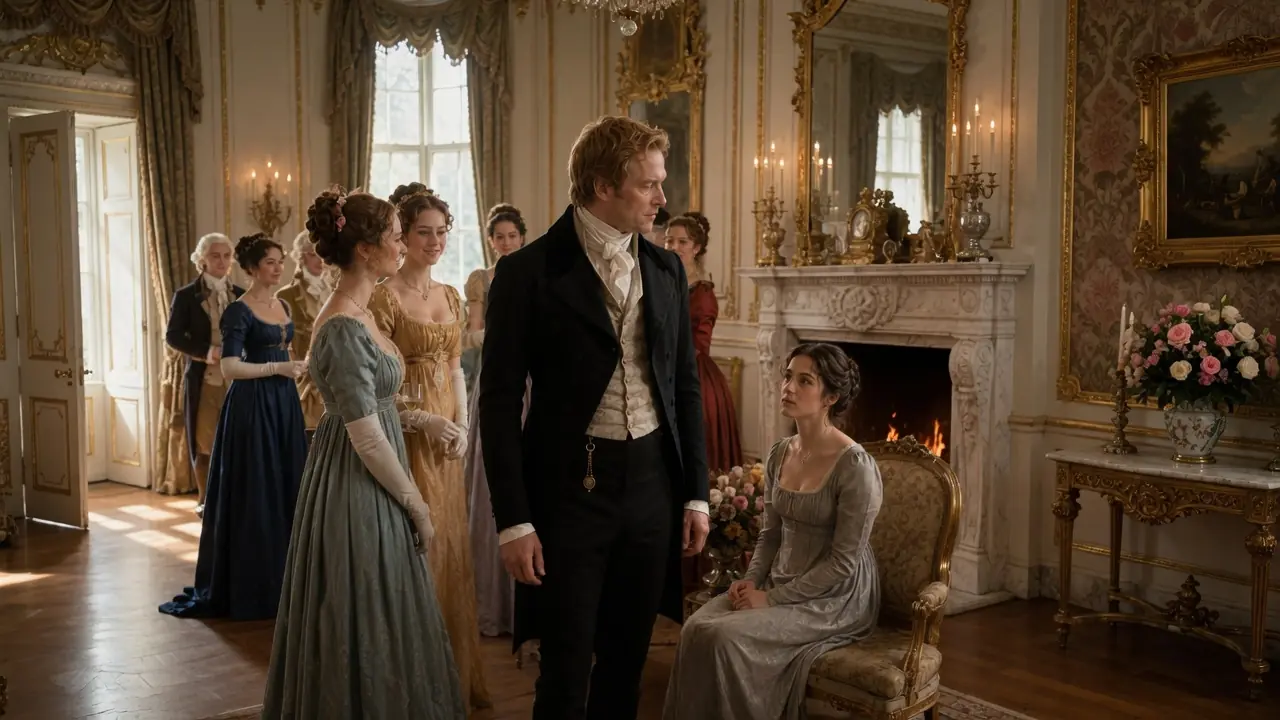
It lay across the letters Susanna Heath had spread on the table to be answered, or rather, to be put off a little longer.
She heard the horse before she saw it, and knew it for a good one from the sound alone. It was no farmer's cob, nor the doctor's tired mare, but something bred for distance and kept in condition. Horses like that did not often turn down the Comb End lane, and when they did, it was rarely good news.
She went to the window. The rider wore a livery she did not know, a deep green coat with silver at the cuff, and he sat his horse as though he had been born in the saddle. He was looking at the house with the faint doubt of a man who suspects he has come to the wrong door.
"Susanna." Her father's voice came thinly from the parlor. "Who is it? Is it Sowerby's man?"
"No, Papa." She kept her voice even. "It is nobody we owe."
That was not quite true. As it turned out, it was only that the debt had not yet been named.
The rider gave his letter to Agnes at the door, refused ale, and said he was to wait for no answer. Then he was gone back down the lane, and the house settled again into its patient silence, and Susanna stood in the hall with a folded sheet of heavy paper in her hand.
The seal was green wax, and the hand was a lady's, old and firm. It requested, that was the very word, requested, as though refusal were a thing that existed, the presence of Miss Susanna Heath at Lowwood, seat of the Duke of Yardwood.
She was wanted for such weeks of the autumn as suited her, in company with certain other young women of good family. A carriage would be sent, and the date was set. There was no explanation offered, for a duke's house does not explain itself to a mortgaged one.
Susanna read it twice, then folded it along its own crease and stood very still. She was five and twenty, and had been out in the world long enough to know that letters like this did not come to girls like her by accident. She had learned, too, to distrust every accident that wore the face of fortune.
She had a plain gray gown that had been turned once already, and a father who could not climb the stairs without stopping halfway. She had a name that had once been respectable and was now merely old. Dukes did not send green-sealed letters to such names, not without a reason someone somewhere had arranged.
"Well?" Her father had come to the parlor door and held the frame to steady himself. He had been a big man once. He was not a big man now. "What is it, child? You have gone white."
"It seems I am invited to stay at a duke's house," she said.
He blinked at her, and for one terrible moment she saw hope wake in his face. It was that old greedy hope she hated, not because it was greedy, but because it was hers to disappoint.
Then he understood a little more, and the hope curdled into something like shame.
"Yardwood," he said. "That is Cranmer country. Bridget's people."
He lowered himself into the hall chair. "Your aunt has done this."
Aunt Bridget arrived that afternoon, because of course she did, for she had a nose for the exact moment a scheme of hers came to fruit. She came in a hired gig in her second-best pelisse, full of a brightness Susanna had learned to fear more than any frown.
"You have had the letter," she said before her bonnet was even off. "I see you have had it. Now, Susanna, you are not to spoil this by thinking too hard. You do think too hard. It is your one great fault, that and the gray."
"Aunt, what have you done?"
"I have done you the greatest kindness of your life." Bridget sat, arranged herself, and accepted tea she had not been offered. "You know the Duke of Yardwood is looking for a wife. All the world knows it. He has grown particular and cold, they say, since the business two winters ago. So he does not go to town to dance and choose in the ordinary way. He has the young women brought to him at Lowwood in parties, and there he looks at them."
"Looks at them," Susanna repeated.
"Watches them over weeks, to see what they are when they are not on show." Bridget said this with relish, as though it were a very clever thing. "There are to be thirty of them across the autumn."
"Thirty."
"Every worthy girl in three counties has begged for a place, and I," she pressed her hand to her breast, "have got you the last of them."
"The last? The thirtieth?"
"No, the thirty-first, if we are exact. I prevailed, and it was not easy."
Bridget's eyes slid away, only a little, but Susanna had spent her life reading the small movements of the people who managed her, and she caught it.
"Aunt, why would Lady Cranmer trouble herself to have me added? She is putting her own daughter forward. Veronica is to be there. You have told me a hundred times that Veronica will be a duchess by Christmas."
"And so she may be." Bridget set down her cup. "Susanna, I will be plain because you will worry it out of me otherwise. Lady Cranmer wished for a contrast, a girl of decent birth and no fortune and no arts, to stand near Veronica so that the difference should be felt."
There it was, named at last. Susanna did not flinch, for she had a great deal of practice in not flinching. She only looked at her aunt for a long moment until Bridget grew pink and busied herself with her gloves.
"I am to be a shadow," Susanna said. "Thrown behind another girl to make her seem the brighter."
"You are to be given a month in a duke's house," Bridget said sharply. "Fed at his table, dressed under his roof, in the company of the best people in the county. Girls have married curates on less. And if you are sensible, if for once you will smile and hold your tongue and let yourself be liked, who is to say a gentleman there might not look at you? A steward, a cousin, some younger son with a decent living?"
She leaned forward. "Susanna, your father owes eleven hundred pounds. You know this. Sowerby holds the note, and Sowerby is not a patient man. Comb End will go. This spring, next spring, it will go, and your father with it into rooms in Bath, if you are lucky, and a debtor's ward, if you are not. A month at Lowwood costs us nothing. It may save everything. Do you understand me? It costs nothing."
It cost, Susanna thought, only herself.
But she did not say it because there was a truth under her aunt's cruelty that she could not argue with. The debt was real, and her father's ruin was real, and it had not even been a sin that made it. He had put his name to his brother's canal scheme out of love and foolishness. The canal had drowned in a wet season. The brother had died, and the note had come home to roost on the only Heath left standing.
There was no villain in it, only the slow arithmetic of a good man's mistake, and the sum came due on her.
"I will go," Susanna said.
Bridget's face opened with triumph.
"But I will not be a shadow," Susanna went on quietly, before the triumph could settle. "I will go, and I will be civil, and I will eat the duke's dinners and thank him for them. But I will not flatter him. I will not simper for him, or the steward, or the cousin, or the younger son. If a month of my honest face cannot pay a debt, then it will not be paid. So that is my price for going, Aunt. My own face. I will keep it."
Bridget laughed, relieved, not understanding, thinking it girlish temper.
"Keep your face then, and welcome, so long as you keep it pleasant."
She did not yet know that it was the one thing at Lowwood that could not be bought, nor that this would make it in that house worth more than any fortune in three counties.
She spent her last evening at Comb End with her father, who wished to talk of the duke, and of prospects, and of what she should say to please. She let him for a while, understanding that his hope was the only medicine left to him.
Then he ran down the way he did now, like a clock nobody wound, and they sat together in the failing light without candles, to save the candles.
"I never meant it to come to you," he said at last. "The debt. I meant to have it cleared before you were grown. I meant a great many things."
He turned his old hands over in his lap. "You will not sell yourself for it. Promise me, whatever your aunt says. I would sooner face the bailiffs than that."
"I will not sell myself, Papa," she said. "I have quite decided. I mean to be so plainly myself that no one there could possibly wish to buy me. It is the safest course."
He laughed, which he had not done in months, and the laugh turned into a cough, so that she fetched him water and sat with him until he slept.
Then she packed her two gowns into a box: the gray turned once, and the one good one kept for church. She looked at them a long while by the last of the light. They seemed very small things to carry into a house of a hundred rooms.
The carriage that came for her was better than any room she had ever slept in. She sat in it alone, her two gowns in their box at her feet, and watched the country change as they went west.
The land grew wide and pale, and the chalk downs rose and fell like the backs of great sleeping animals. Beechwoods stood in the folds, already going to copper. She had never been so far from home and found she was not frightened, which surprised her until she understood why.
A person cannot be frightened of losing a place she has already decided not to want.
They came to Lowwood in the last of the light. It was not a house so much as a statement, standing at the head of a long avenue of limes, gray stone, tall windows, a hundred rooms behind a face that gave nothing away.
Lamps were being lit within. She counted the windows as they approached, as a way to steady herself, and lost count at forty. Somewhere in that great cold pile, a man was choosing a wife the way another man might choose a horse, having thirty led past him so that he might watch how they went.
The carriage stopped and a footman opened the door, and Susanna Heath, thirty-first and last, stepped down onto the gravel of a house that had not the smallest expectation of remembering her name.
She was right about that at first.
The other young women had been arriving for a fortnight in their rotations, and the newest party was assembled in the great drawing room when she was shown in, still in her traveling dress, aware of every crease.
There were perhaps a dozen of them that evening, bright as a bank of flowers. Every eye turned to the door to measure the newcomer, and every eye, having measured, turned away. She had been weighed and found to be nothing.
It was a familiar sensation, one she had felt in every assembly room in Somerset, and though she did not enjoy it, she knew its shape. And knowing the shape of a thing takes away half its power.
At the center of the flowers stood the brightest of them. Miss Veronica Cranmer was as beautiful as her reputation, which is a rare thing, for reputation usually flatters. She was fair and tall, with a color that owed nothing to the pot, and she wore her looks the way a general wears a decoration, as proof of a campaign already half won.
When she laughed, the room laughed. When she turned, the others turned to see what had caught her eye.
A little behind her sat an older woman in violet silk, whose face was Veronica's own face thirty years on, gone hard at the mouth. This was Lady Cranmer, who had made the beauty and meant to spend it well.
Lady Cranmer saw Susanna, and her glance moved over the gray gown, the traveling dust, the plain dark hair, until something in her settled, satisfied. Here was the shadow she had ordered, delivered on time.
But Susanna met the look and did not lower her eyes, and Lady Cranmer, finding the shadow bolder than expected, frowned very slightly and looked away.
"You will be Miss Heath."
The voice came from a chair by the fire, dry as a turned page.
"Come here, child, where I can see you. My eyes are not what they were, and I have looked at nothing worth the trouble all evening."
The whole room went carefully still. The speaker was very old and very upright, dressed in a gray that made no apology for itself, with a face like a fine blade kept sharp on purpose.
This, Susanna would learn, was Cornelia, Dowager Duchess of Yardwood, grandmother to the duke and mistress of the house in all but name, and the one person under that roof whom Lady Cranmer feared.
Susanna crossed the room and curtsied. "Your grace."
"Heath." The old woman studied her. "Somerset Heaths. The ones who came to grief over a canal."
"The very ones," Susanna said. "We came to grief thoroughly, your grace. There is not a Heath in England who came to grief so completely on so little water."
For a moment nobody breathed, for one did not, it seemed, speak of one's own ruin in this room lightly, as a matter of plain fact. Then the dowager's mouth twitched at the corner. It was not quite a smile. It was the near side of one.
"Sit down, Miss Heath," she said. "You may as well be comfortable while they look at you."
He came in late.
Susanna felt the change in the room before she saw its cause. The bright talk sharpened, the flowers arranged themselves, and Veronica's chin lifted a half inch, no more, with the beautiful economy of a woman who has practiced in a glass.
Susanna looked up from the dowager's fire, and in the doorway stood the man for whom thirty women had come across three counties.
The Duke of Yardwood was tall and dressed with the plainness only the very great can afford. Dark coat, no jewels, nothing to catch the eye but the man himself. His hair was sandy fair, his features sharp and still. His eyes, as they moved across the room, were a cool, clear gray.
They seemed to take the temperature of everything they touched and be warmed by none of it. He was four and thirty and looked older, not in the face, but in the manner, as though something in him had stopped some while ago and never started again.
He greeted the room with a bow correct to the inch, said the right things, and let the flowers turn their faces up to him. And Susanna, watching from the low chair by the fire, saw that he was not, in any true sense, present at all.
He was doing something else behind the good manners. He was watching.
He watched Miss Foley laugh a little too long at his small joke, and Miss Prendergast contrive to drop her fan where he must retrieve it. He watched Veronica be perfectly, flawlessly charming, and Susanna could not read whether it pleased him, for his face gave up nothing, nothing at all, like the front of his own great house.
Then those gray eyes came to the fire, and to her. She did not smile. She had promised herself she would not, and in any case, she found she did not wish to.
She looked back at him plainly, a plain girl in a plain gown, giving him the frank attention one gives a landscape or a change of weather. She let him see that she expected nothing and would pretend nothing.
It lasted perhaps three seconds. One. Two. Three.
Then he inclined his head a fraction, as one does to a stranger, and moved on to the flowers, and she thought that was the end of it.
She was wrong, but she did not know it yet. And neither, to be fair, did he.
Dinner at Lowwood was served at a table so long that conversation died in the crossing of it. Susanna had never seen such a table. It ran the length of the dining room like a road dressed in white and silver, and the guests were set along it at intervals that made talk a public performance, shouted across acres of damask.
The duke sat at the head, the dowager at the foot, and the thirty, or such of them as were in residence that week, were ranged between, in an order that was not accidental.
Veronica sat near the head, within reach of the duke's voice. Susanna sat near the foot, within reach of no one's. It was, she thought, a table designed to prevent the very thing a dinner is for.
No one could be known across it. No one could say anything that was not overheard by ten people, and therefore said for them. It was a machine for producing charm and preventing truth.
She wondered whether that was the point, or whether the duke had simply inherited the table with the house and never thought to change it. She said as much when the dowager at the foot asked her how she found Lowwood.
"I find it very grand, your grace," Susanna said. "And I find your table a marvel of engineering. It is the longest thing I have ever eaten at. I could not tell you whether the gentleman at the far end ever truly smiles or only arranges his face into the shape of one. He might be anyone, a very good actor hired for the week, with none of us near enough to catch him out."
The dowager set down her spoon. "You think my grandson an actor?"
"I think this table would make an actor of anyone, your grace. It is very hard to be a person when you must be heard by twelve. One says the safe thing because the safe thing carries. The true thing is generally quiet, and it does not travel well down forty feet of silver."
For the second time that day, the old woman's mouth moved toward a smile and stopped just short of it.
"Beck," she said to the butler, not loudly, though the whole table heard, because the whole table was built for hearing. "Tomorrow the small table is to be brought into the blue room. We dine there, all of us, close enough to quarrel if we like. Miss Heath finds the great one prevents her knowing her company, and she is right. I have thought so for forty years and been too idle to say it."
Down the length of the table, thirty faces turned to look at the girl at the foot, who in one evening had done the thing none of them had dared. She had told the house it was wrong, and the house had listened.
Veronica's lovely face was quite composed. Only her hand, resting by her glass, closed slowly into a fist, and then opened again, smooth as ever.
Lady Cranmer did not trouble to compose herself, but stared down the length of the table with the frank hatred of a woman who had ordered a shadow and been sent a flame.
At the head of the table, the Duke of Yardwood said nothing at all, but he had heard.
And that night, in the room where he kept his private accounts, he took out a book bound in dark leather. He turned to a page near the end. Beside a name and a number written in his own hand, he made a small mark. Then he sat looking at it for a long time before he closed the book.
The book was a list, and the whole strange apparatus of Lowwood turned upon it, though Susanna did not know of it yet.
The Duke of Yardwood, two winters before, had learned a lesson in the way that leaves a mark, and he had built the list to make certain he never learned it again.
He had been engaged. The world knew that much.
He had been engaged to a beauty as celebrated as Veronica Cranmer, and he had loved her in the guarded way of a guarded man, which is to say completely and without any grace at showing it. She had flattered him. She had told him he was the finest man of her acquaintance, the cleverest, the most generous, and he, being lonely under all his rank, had believed her because he had wished to.
Then a lawsuit clouded his estate for the better part of a season, so that his fortune looked, for some months, less certain than it truly was. She had jilted him inside a fortnight for a marquis whose money was in land and could not be sued.
He learned afterward, as one always learns afterward, that she had privately called him a cold purse with a title. She had even wagered with her friends on how long she could keep her face straight while she praised him.
It had not broken his heart exactly, for hearts are tougher than the poets allow. It had done something colder and more lasting.
It had taught him that he could not tell the difference between a woman who esteemed him and a woman who flattered him. The words were the same words. He had believed the false ones as readily as he would have believed the true.
He resolved never to be fooled so again, and because he did not trust his own ear, he built a machine that did not rely on it.
He would not court. He would observe.
He would have the eligible young women brought to Lowwood in their parties, thirty across an autumn, and he would watch them, not in the ballroom where everyone performs, but in the plain hours, at breakfast, in the wet, with the servants, with the child, in the long dull stretches when no one thinks the test is running.
He would write down what he saw and keep the ledger cold and fair, and at the end he would choose. Not the woman who pleased him most, for he no longer trusted his own pleasure, but the woman whose private conduct, set down in ink, deserved to be chosen.
It was, he believed, the only honest way left to a man who could no longer hear the truth when it was spoken to him.
It did not once occur to him that a machine built to catch flattery would have no idea what to do with a woman who refused to flatter at all.
The plain hours began at breakfast, and the ladies had learned to perform even over their eggs. Each came down freshly dressed and freshly charming, and each contrived some small display for the empty chair at the head, though the duke rarely took it before ten.
Miss Prendergast quoted a poet she plainly had not read. Miss Foley admired the weather as if she had arranged it herself. Veronica arranged her own beauty against the window light where it did its best work and waited.
Susanna came down early, ate what was before her, and read a book propped against the coffee pot.
When Kitty's nursemaid brought the child through on the way to the schoolroom, it was Susanna who looked up and asked the girl what she was learning, and listened to the answer as though it were news of consequence.
The other ladies did not see the child at all. A duke's niece was no use to their campaign, being neither the duke nor a witness he valued. In this they were mistaken, though they had no way of knowing it, and Susanna had no design in it. She simply liked the child better than the eggs.
The duke came down that morning a little before his hour. He saw the whole tableau from the door before anyone saw him: the ladies at their performance, the plain girl reading, his niece being spoken to like a person.
He did not come in. He went away again and took his coffee alone and thought about it longer than a cup of coffee warrants.
There was at Lowwood a child.
Susanna found her on the third morning in the cold gallery where the family portraits hung. She was a small girl of perhaps six, sitting on the floor beneath a picture of a young woman in a blue gown.
She was not crying, only sitting in the particular stillness of a child who has learned that grief is not welcome and has taken it somewhere quiet.
"Good morning," Susanna said, and sat down on the floor beside her, gray gown and all.
She did not ask what the matter was. She had been a child who was told grief was not welcome, and she knew the last thing such a child wants is to be asked.
The girl looked at her sidelong. "You are not supposed to sit on the floor. You will spoil your dress."
"My dress is already spoiled," Susanna said. "It was spoiled before I came. So, you see, I have nothing to lose, which is a very comfortable way to be."
She looked up at the portrait. "Who is the lady in blue?"
The child was quiet a moment. "My mother," she said. "She died. My father, too. There was a fever. I live with my uncle now. He is the duke."
She said it the way a child recites a fact she has been made to learn without weight because the weight is too much to lift all at once.
"I am Kitty."
"I am Susanna. Your mother had a kind face, Kitty. I can see it from here. It is a face that would have sat on the floor with you and not minded about the dress."
Kitty turned and looked at her fully then, with the sudden fierce attention of a child who has been handed unexpectedly exactly the thing she needed.
"Yes," she said. "She would have. She did."
And she leaned only a little, the smallest fraction of her weight, against Susanna's arm.
They sat together on the cold floor under the picture of the woman in blue, and neither of them said anything more, because nothing more needed saying.
That was all it was, a quarter of an hour on a gallery floor. Susanna thought no one had seen it, and she was nearly right. But at the end of the gallery, a door stood half open onto the stair, and the Duke of Yardwood, who had meant to pass through it, did not pass through.
He stood in the shadow of the door and watched the makeweight girl from Somerset sit on the floor in her spoiled gray gown. He watched her give his silent niece the one thing that fifteen governesses and a house full of servants had failed in two years to give her.
It was company in her grief, offered without the smallest wish to be thanked for it.
He did not go and speak to them, for he was not a man who knew how to walk into such a moment. He went back down the stair.
Later, in his cold accounting room, he opened the leather book to the page near the end, and read the words he had written beside the number thirty-one on the first evening.
The makeweight. Poor, wellborn, no arts, sent as a foil for the Cranmer girl.
He took up his pen and drew a line through the makeweight, and did not that night know what to write in its place.
The servants were part of the test, too, though only the duke knew it. For a person's true measure shows most plainly in the treatment of those who cannot answer back.
He had written it into the design of the thing from the first.
Watch them with the servants.
Most of the thirty did not see the servants at all. A footman was a piece of furniture that moved. A housemaid was a thing one stepped around like a chair set wrong.
Susanna saw them. She had lived these last poor years near enough to service herself to know how the work went, and she could not unknow it.
One morning, young Nell, the under-housemaid, dropped a tray of glasses on the stair. She stood white and shaking, waiting to be scolded.
It was Susanna who knelt with her in the wreck of it, gathered the broken stems into her own apron, and said, "Now, there it is. Only glass. Glass is cheaper than nerves. Go and say I knocked it if it comes to that. No one will scold a guest."
And she helped the girl carry the pieces down before the housekeeper could come.
Old Beck the butler saw it, for Beck saw everything. It was his trade. He had served the house forty years, and had views he never spoke aloud.
He mentioned it that evening to the duke, not as talebearing, but as the one small offering a loyal servant may make to a master he has begun to hope for.
"The Somerset lady, your grace. She stood between Nell and a scolding this morning and took the blame of a dropped tray that was none of hers. I thought you might wish to know the sort she is. You keep an account of such things, I believe."
He said the last very dryly, for Beck knew more of the leather book than the duke supposed.
The duke said only, "Thank you, Beck."
But he did not write it down. He had stopped writing her down.
He only carried it about with him the rest of the day, the picture of the makeweight girl kneeling in broken glass to spare a housemaid's nerves. It warmed a cold place in him that he had long since given up expecting anything to warm.
And below stairs, where the real weather of a great house is made, a thing began that none of the thirty could have bought with all their arts. The servants of Lowwood began quietly to be on her side.
A fire was laid a little earlier in the plain girl's cold room. Her turned gray gown came back from the laundry pressed with a care no one had paid for.
None of it was spoken of, for servants do not speak of such things. It was simply that a house knows its own and had begun to know her.
Cook sent up an extra egg at breakfast without a word. The boy who cleaned the boots gave hers a shine they had not seen in years. It was the small free coin of people who have nothing else to give.
Susanna felt it and was grateful, and said her thanks plainly to each. It surprised them, for a guest did not commonly trouble to learn a boot boy's name, nor thank a scullery girl as though she were a person of consequence.
They had watched thirty fine ladies pass through Lowwood and be waited on as their due. Here was one who looked at them and saw them, and it cost her nothing, and it was worth in that house more than she knew.
The blue room, with its small table, changed the weather of the house, for you cannot sit eight feet from a person night after night and remain a stranger.
The thirty, or the dozen of them in residence, began, despite themselves, to become people. Miss Foley turned out to have a real wit under her nervous laugh, and Miss Prendergast, freed of the need to drop fans across acres of dining room, revealed herself to be shy rather than sly.
Susanna had expected to spend her month invisible at the foot of the long table. Instead, she found herself within arm's reach of the duke three evenings in seven, because the dowager had taken to placing her there on purpose, with the bland ruthlessness of an old woman arranging an experiment.
"You will sit by my grandson, Miss Heath," she said the first night in the blue room, as though it were the most natural thing in the world. "He is very dull company, and it will do you good to practice your patience."
So Susanna sat by the duke and did not flatter him. This, she slowly understood, was a thing he did not know how to withstand.
He would say something, a remark about the harvest, the road, the weather on the downs, pitched to draw the usual response, the eager agreement, the little laugh, the turning of every subject back to his own excellence, and Susanna would simply answer it truthfully, as she would answer anyone.
"The new planting on the south slope will fail," she told him on the fourth evening when he mentioned it, expecting praise for his improvements.
He turned his head and looked at her. It was the first time he had properly looked at her since the first night.
"Will it?"
"The larches? Yes. You have put them where the frost sits. I grew up in a hollow like that one. My father planted larches in the cold pocket of our own ground the year I was ten because a book told him larches were hardy. Every one of them was dead by the second winter. Hardy is not the same as fond of frost. Your slope holds the cold the way a cup holds water. In three years, you will have a hundred pounds of dead timber and a very good lesson."
She returned to her soup. "The oaks will do, if you had asked me, which you did not. Oaks do not mind a cold cup. But it is your slope, your grace, and your hundred pounds."
There was a silence around the small table, for to speak so to the Duke of Yardwood was simply not done. To tell him plainly that he had made an error and would pay for it was not done at all.
Veronica, two places down, gave a small musical laugh to smooth the moment over and said something charming about how his grace's judgment was surely to be trusted above any book.
The duke did not so much as glance at her.
"Why did you not tell me before I planted them?" he asked Susanna.
"You did not ask me before you planted them, your grace, and I have been at your house four days. It is not my habit to correct a man's forestry inside the week."
She almost smiled. "Inside the fortnight, perhaps."
Something moved at the corner of his mouth. Not quite a smile. The near side of one, the same near smile his grandmother had. Susanna realized the family resemblance surfacing for half a second in a face that had been shut for two years.
Then it was gone, and he turned the talk to other things, and the evening went on, but he had looked at her twice, and that night the leather book stayed shut.
There are some things a man does not wish to reduce to a line of ink, even when the reducing of things to ink is the whole apparatus of his safety.
There was a music evening later that week, and it showed Susanna the machine at its cruelest work.
One by one, the young women were led to the instrument, and each played or sang or did both, and each played not for the music, but for the man in the far chair.
Miss Prendergast trembled through an air and looked to see if he approved. Miss Foley sang prettily and turned the last note toward him like a flower to the sun.
Then Veronica rose, and there was a change in the room, for she was genuinely accomplished, and knew exactly the worth of what she had. She sang a slow Italian piece, and sang it well. All the while her eyes returned to the duke, offering him the performance as one offers a gift that expects a gift in return.
"Miss Heath must play for us," said Lady Cranmer sweetly when Veronica had done.
She said it because she believed Susanna could not, and wished the contrast made plain.
"You do play, I am sure. All well-bred girls play."
"I play a little, madam," Susanna said. "Badly. But I will, if the company wishes it."
She went to the instrument, and she did not look at the duke, which was the whole of her method, if it could be called a method.
She played a simple country air, the kind a mother teaches a child, plain and unshowy, and she played it for its own sake, for the pleasure of the small, clean tune. She made a mistake in the second part and did not pretend she had not. She simply went back three bars and took it again correctly, the way one does when one is playing to please oneself and no one is watching.
Then she finished, rose, curtsied to the room and not to the man, and sat down.
It was nothing. It was the least accomplished performance of the evening by a wide measure, and Lady Cranmer's mouth curved in satisfaction.
But the duke had watched her play a tune to no one, correct herself before no one, thank the room and not him.
He found, to his own confusion, that it was the only music that evening he had actually heard. It was the only music that had not been aimed at him like a bright arrow.
He did not applaud. He was afraid that if he applauded, she would understand he had noticed, and he was not ready to be understood.
The library at Lowwood was the one room in the house that did not seem to be holding its breath. Susanna found it by accident, escaping a morning of the other ladies' company, and she stopped on the threshold, as one stops at the edge of good water.
It was a long room, warm, low-lit, walled in books to the ceiling. A fire was kept up. Deep chairs stood about, and over it all lay the particular hush of a place that is used and loved.
She had not expected it. Everything else at Lowwood was arranged to be looked at. This room was arranged to be lived in.
"You may come in, Miss Heath."
The duke's voice came from the far chair. She had not seen him. He did not rise, which she was glad of, for rising would have made it a scene, and this was not a room for scenes.
"You need not stand in the door as if you had walked into the wrong church."
"I did not know you were here, your grace. I will go."
"You will not. You have been looking for this room for four days, whether you knew it or not. I can always tell. The house sorts people. Most of my guests find the card room by the second evening. The rest find the library by the end of the week, and there are never many in the second kind."
He turned a page. "Sit down. I shall not talk to you, which I am told is my chief accomplishment."
She sat and found a book, and for the better part of an hour they did not speak at all. Two people reading on either side of a good fire.
It was, Susanna thought afterward, the most comfortable hour she had spent in another person's company in longer than she could easily remember.
He did not perform for her, and she did not perform for him. There was nothing to be gained from either of them by the other. Or so she believed. And in the absence of gain, there was simply peace.
When at last she rose to go, he spoke again without looking up.
"You do not ask me anything."
"Your grace?"
"The others ask me things. They ask my opinion, and which of the pictures I love best, and whether I do not find London tedious, so that they may agree with whatever I answer. You have sat an hour and asked me nothing."
Now he did look up, and the cool gray eyes were for once not appraising, but simply curious.
"Why?"
Susanna considered it honestly because he had asked it honestly.
"Because I do not want anything from you, your grace," she said. "The others ask because they wish you to know they are listening. I am not trying to be chosen. I was sent here to make another girl look brighter, and I have known it from the first hour, and it has set me quite free."
She held the book against her waist.
"A person who is not trying to be chosen has no reason to ask questions she does not care to know the answers to. So I read your book and warmed myself at your fire and let you alone. It seemed the kindest thing. You looked like a man who was asked a great many questions."
He was quiet for a moment.
"I am," he said. "You are the first person to come to Lowwood in two years and not ask me a single one."
"Then you have been keeping poor company, your grace, and I am sorry for it."
She curtsied. "Good morning."
She left him there in the warm room. The duke sat a long while with his book unread on his knee, turning over in his mind a strange new fact.
The one woman in his house who wanted nothing from him was the only one whose company he had not, in two years, wished to end.
He wrote about her that night, or tried to, for it was the habit of two years. He opened the leather book, dipped his pen, and found he did not know what to set down. The list wanted a line, a cold, clear line, weighing her worth.
But every phrase he tried was a lie by omission.
She reads and asks nothing. True, and nothing.
She corrects my forestry. True, and nothing.
He sat with the pen drying in his hand and understood slowly that the trouble was not that he could not describe her. The trouble was that to fix her in a line and file her under a number was to do to her the one thing she had refused to do to him.
It was to reach for advantage.
He closed the book without writing, the first evening in two years he had left a day unaccounted, and felt absurdly as if he had left a door unlocked and slept the better for it.
The dowager sent for her the next afternoon to a small, warm sitting room that smelled of dried roses and beeswax.
"Sit down, Miss Heath. I do not bite, whatever they tell you in the corridors."
The old woman looked at her over a tapestry. She was not really working.
"You have upset my house. You have shortened my table, corrected my forester, and made my grandson leave off his eternal scribbling for an evening. I should like to know what you mean to do next."
"Nothing, your grace," Susanna said. "I mean to go home when the month is out. I did not come to upset anything. I came because my aunt arranged it, and my father is in debt, and I thought a plain girl might pass a quiet month unnoticed."
"Unnoticed." The dowager gave a short dry laugh. "You are the only creature in this house anyone notices, precisely because you take such pains not to be noticed. Do you know why my grandson keeps that wretched book?"
"I did not know there was a book until you have this moment told me of it, your grace."
The old woman's eyes sharpened, then softened, as if she had let slip more than she meant and decided not to mind.
"Then I have told you too much, and you will forget it. But understand this, child. He was taught at some cost that a kind word is a kind of theft. He is not cold. He is guarded, which looks the same from the outside and is not the same at all. A guarded man may still be reached. He may only be reached by someone who is not trying to reach him."
She returned to her tapestry. "You may go. Come again on Thursday. I find you restful, which at my age is the highest praise I have left to give."
The fine spell held, and one afternoon the duke found Susanna in the walled garden below the terrace, where the last of the season's roses stood brown on the stem.
"My grandmother approves of you," he said, falling into step beside her without ceremony. "She has told me so twice, which for her is a proclamation. She does not approve of people. She tolerates them at best, as one tolerates weather."
"Then I am honored to be weather she does not mind, your grace."
He almost smiled.
They walked a while in the thin gold light, and he did not fill the silence, and neither did she, and it was, both of them privately noticed, an easy thing rather than an awkward one.
At the end of the walk, he stopped by the dead roses and looked at them as though they had asked him a question.
"You do not like this house," he said. It was not quite an accusation.
"I do not dislike it, your grace. It is a very fine house. I only think it is lonely, and I think it has taught its master to be lonely and to call it dignity."
She said it gently, but she said it.
"You have a hundred rooms and you live in one, the warm one with the books. You have thirty women under your roof and you dine among them like a judge at the assizes. Forgive me. You asked me once why I do not ask you questions. It is because I already know the answers, and they are sad, and it would be unkind to make you say them aloud."
He was silent a long moment, looking at the roses.
"You are a very uncomfortable guest, Miss Heath," he said at last.
But there was no anger in it, only something that sounded almost like relief.
"I find I do not want you to leave when the month is out. I have not yet decided what to do about that, and I would be obliged if you would not decide it for me before I have had the chance."
It could not last, of course, for machines built to catch flatterers are watched most closely by the flatterers themselves, and Veronica Cranmer had not come to Lowwood to lose.
She was cleverer than her mother, which is to say she understood that beauty alone had stopped being enough. She had seen the small table, and the duke turn his head at the plain girl's plain talk, and his failure to glance at her own careful charm.
She had felt the thing shift under her feet, the way a swimmer feels the ground go, and she had begun very quietly to be afraid.
Fear made her watchful, and watchfulness showed her the child.
"You are fond of the little girl," she said to Susanna one gray afternoon, coming upon her in the gallery, where Kitty now sought her out most days. Veronica's voice was warm, admiring, kind, a beautiful instrument, and she played it well.
"It is sweet in you, though I wonder you have the leisure. If I were placed as you are, forgive me, dear Miss Heath. I think I should spend my hours where they might do me some good. I should not spend them on a child who is nothing to me and can do me no service at all."
"I dare say you would," Susanna said. "Good afternoon, Miss Cranmer."
But Veronica had learned what she came to learn. The plain girl loved the child, and a person's love is the softest place to press when one wishes to do them harm.
Before the harm came, though, there was a night that undid the duke more thoroughly than any of his own contrivance.
Susanna woke in the small hours to the sound of a child crying. It was not loud. It was the worse for not being loud, for it was the muffled, exhausted crying of a child who has been at it a long while and expects no one to come.
She rose, lit her candle, and followed it along the cold passage, past doors she did not know, until she came to the nursery wing. The door stood ajar. She looked in, meaning only to help, and stopped on the threshold because she was not the first to come.
The duke was there.
He sat on the edge of the child's bed in his shirt sleeves, with Kitty in his arms, and he held her the way a man holds a thing he is afraid to hold wrongly. He was not good at it, and that was what undid Susanna, standing unseen in the dark. He was not good at it and was doing it anyway.
Kitty had had a dream of the fever, of the blue-gowned lady going gray and cold. The duke had no words for such a dream, no soft practiced comfort, only his own clumsy arms and a low, broken voice saying the same plain thing over and over.
"I am here. You are not left. I am here."
Susanna did not go, though she should have gone. Instead, she stepped in quietly, set her candle down, came to the other side of the bed, and began very softly to sing.
It was the plain country tune from the music evening, the one she had played to no one. She sang it low to the child, not to the man.
Kitty's sobbing slowed, then hitched, then eased, until at last the small body went heavy with sleep between them.
For a time neither grown person spoke. The candle guttered, and the house held its breath around them.
"She has these," the duke said at last, very low. "In the night. Two years, and still I never know what to do. I sit with her. It is all I have. I have a hundred rooms and eleven thousand a year, and the only thing my sister's child wants from me at three in the morning is a person who will not leave. And I am so poor at even that."
He looked across the sleeping child at Susanna, and in the candlelight his face was not shut at all. It was wide open, and years younger, and afraid.
"How did you know the song would answer?"
"I did not know," Susanna said. "I only knew that a frightened child does not want to be reasoned with. She wants to be kept company until the fear grows tired."
She looked at him, and her voice softened.
"You were doing it exactly right, your grace. You are staying. That is the whole of it, and the only thing that has ever worked on any frightened creature in the history of the world. Someone who will not leave."
He looked at her a long moment, then down at the child, and his throat worked, and he said nothing because there was nothing to say that would not have been too large for the hour.
But something passed between them over the sleeping girl that no line in any ledger could have held. It was the first thing he had ever let a woman at Lowwood see that he could not have borne to have written down.
The harm came on the day of the shooting party, though it did not look like harm at first. It looked, as the cruelest things at Lowwood always looked, like a kindness.
The gentlemen were out with their guns on the downs, the duke among them, and the ladies were to walk out and meet them at noon with a cold luncheon. It was a long ramble across the chalk to a spinney, where the servants had gone ahead with the hampers on a fine, sharp day.
Kitty, wild with the rare freedom of it, was permitted to come.
And it was Veronica, sweet, thoughtful Veronica, who suggested that dear Miss Heath, who was so good with the child, should have charge of her on the walk, since the nursemaid was needed elsewhere.
It was a reasonable suggestion. Susanna took Kitty's hand and thought nothing of it.
She should have thought more.
For an hour, Veronica was all sisterly warmth, drawing Susanna and the child to the front of the party, praising Kitty's bonnet, pointing out hares. Then, at the top of the long down, the path forked, and the party bunched and scattered in the confusion of a fine view.
"Oh, Miss Heath, look," Veronica said brightly. "A kestrel there. Do you see it? Over the far wood."
She pointed and Susanna looked, as anyone looks when a thing is pointed out, for the space of five seconds, no more.
When she looked back, Kitty was not beside her.
What followed, Susanna would remember for the rest of her life, not as fear, but as a cold and total clarity.
The child had been there. Now she was not.
The party had scattered along two paths, and Veronica was already several steps down the left fork, calling in a voice pitched to carry.
"Miss Heath, where is the little girl? Were you not minding her? Oh, but the quarry. The old chalk quarry is just below, is it not? Surely she has not..."
The words did their work exactly as they were built to do. They planted in a dozen minds at once the picture of the makeweight girl who had let the duke's motherless niece wander toward a fifty-foot drop while she gawked at a bird.
Susanna did not defend herself. There was no time, and in any case she understood in an instant that defense was what she was meant to waste her minutes on.
She let Veronica have the crowd, turned her back on all of them, and thought coldly, clearly, not the quarry.
Kitty is afraid of heights. She would never go toward a drop. She went toward the thing she loves.
And Kitty loved above all things the horses. The luncheon hampers had gone ahead by cart, and the cart had horses.
So Susanna walked fast, not toward the quarry where the panicked party was streaming, but down the right fork, toward the spinney where the cart waited.
She found Kitty there inside four minutes, standing on tiptoe with her cheek against a great brown flank, entirely happy, having simply gone to say good afternoon to the horses, as any sensible child would.
"There you are," Susanna said, and knelt and did not scold. She held her only a moment, once, hard, so the child would not feel the fright of the grown people fall upon her.
"Come. There are people up the hill being very silly, and we must go and mend them."
By the time she came back up the down with Kitty's hand in hers, the duke had been fetched from the guns. He came at a dead run, his gun broken over his arm. His face, for the first time since she had known it, was not shut at all, but wide open with a terror he had no arts to hide.
And Susanna understood, seeing it, exactly what this man had been protecting behind two years of cold. It was not his pride, nor his fortune. It was the one small living thing left to him of a sister he had loved.
He reached them, went down on one knee in the chalk, heedless of the whole staring party, and took Kitty by the shoulders, and looked at her the way a man looks who is counting a child's limbs.
Kitty, bewildered, said, "Uncle, you are kneeling in the mud."
Something broke in his face that was almost worse to watch than the fear had been.
"So I am," he said, and his voice was not steady. "You will forgive me."
"Where were you, Kitty?"
"With the horses. Susanna found me. She knew where I would be. She always knows."
The child said it simply, as a child states the order of the world. Then she added, because children keep no secrets, "The other lady told her to look at a bird. Miss Cranmer said, 'Look at the kestrel,' and Susanna looked, because when someone points, you have to look. And then I was minding the horses, and everyone was shouting."
The down went very quiet.
The duke rose slowly. He did not look at Veronica at first. He looked at Susanna. Then he looked at last, and for a long moment, at Veronica Cranmer, who stood among the flowers of the party with her lovely face composed and her color a little high.
She understood in that moment, watching him understand, that she had lost, not because she had done a wicked thing. Half the party would tell the story kindly. An accident, a fright, no harm done.
She had lost because the duke had seen.
He had built a whole cold machine to see people as they truly were when they thought the test was not running. The test had been running on the down. It had caught her exactly in the one clear picture that could not be argued with.
She had risked a child to ruin a rival, and the plain girl had walked calmly to the horses.
"Miss Heath," the duke said, "thank you."
Two words, but he said them as if they cost him, as a man says a thing who is unused to owing anything and has just discovered that he owes everything.
And Susanna, who wanted no thanks, found she could not answer him at all.
That night the house was full of the story told a dozen ways, and Susanna wanted no part of any of them. She wanted air. She went late, when the candles were being put out, to the library, thinking to sit alone by the last of the fire.
She found the duke there before her, at his desk, with the leather book open under the lamp, carried in that night from the cold room where it usually lived.
She saw it before he could close it. She saw the pages of names, thirty-one of them numbered, each with a line of writing beside it in his own cold, clear hand. She saw the machine at last, entire, laid open.
She understood what Lowwood was and what she had been brought into. Something in her chest went very still and very cold.
He rose quickly. "Miss Heath..."
"That is a list," she said. "Of us. Of the thirty of us."
She was not shouting. She never shouted.
"You have been writing us down all this while, weighing us like corn, a line each, marking us."
She looked at him, and the plainness that had been her armor all these weeks turned now into something harder.
"May I see what you have written by my name, your grace? Number thirty-one, the makeweight. May I see it?"
"Susanna."
It was the first time he had used her name, and it landed in the quiet room like a dropped glass.
"It is not what you think. You do not understand what it is."
"I understand exactly what it is." Her voice did not rise, but it shook once and steadied. "It is a man who was so badly used that he decided he would never again risk being a fool for love. So he built a machine to do his feeling for him. You would not court because courting means trusting your own heart, and yours had been broken. So you locked it up and gave the key to a ledger."
She stood very still.
"You have had thirty women brought to your house so that you need never take the terrible chance of simply choosing one. It is the chance of looking a woman in the face and saying, 'I do not know if you are true, but I will risk it.' That is what the rest of us do, your grace. We poor people who have no thirty women to test. We look in a face and we risk it."
"You do not know what it cost me to be a fool the once," he said low.
"No, I do not. But I know what it will cost you to be a coward the rest of your life. And do you know what the machine cannot see?"
She stepped closer to the desk.
"It cannot see that the moment you write a person down, you have already stopped looking at them. A line is a place you file a thing so that you need not look at it again. I would rather be no one's than be a line in that book. Even a kind line, even the kindest line you could write."
She was breathing hard, and he had gone white.
"That is why I will not flatter you," she said more quietly. "Not because I am proud, but because flattery is what one offers a machine to make it choose you. And I do not want to be chosen by a machine. I would rather go home to my ruined father and my gray gown and be no one's wife at all than be selected like the winning marrow at a fair by a man too frightened to simply want me."
She drew a breath.
"Good night, your grace. I shall be gone in the morning. You may write that by my number."
She left.
"It will be the truest line in your book."
The door closed behind her. The Duke of Yardwood stood alone with his open ledger in the lamplight, and for the first time in two years, he was not cold at all. He was burned through entirely by the plain and unanswerable truth that a girl in a turned gown had just walked out of the only room in his house where he had ever felt at peace.
She did not sleep.
Before it was light, she was dressed and packed, her two gowns in their box. She went down to ask that the carriage be brought, or failing a carriage, that she be let walk to the village and take the common coach.
She would not stay to be looked at over the ruin of the thing. She would keep her own face and carry it out of Lowwood the way she had carried it in.
In the cold hall she met, of all people, Veronica.
The great beauty was sitting alone on the stair in the gray light in her traveling dress. Without her audience, without her mother, without the lamps and the company, she looked oddly small. She had been crying and did not trouble to hide it from Susanna.
Perhaps because Susanna was leaving, too. Perhaps because there is a kind of honesty that comes only among the defeated.
"You are going," Veronica said.
"Yes."
"So am I. My mother sent word to have the horses put to at six. We are not to wait for a formal dismissal. She says we must leave before we are asked to."
Veronica gave a small broken laugh.
"She is very wise, my mother. She has managed my whole life to bring me to a house like this and a man like that. Twelve years. Masters and modistes and the right rooms and the right words. And I have lost it in a month to a girl in a gray gown who would not even try."
She looked up.
"How did you do it? What is your art? I should like to know, since it has beaten mine, so that I may know what I lacked."
Susanna might have hated her, and had cause, but found that she could not. She saw in the small crying figure on the stair the whole sad machine of Veronica's making. Here was a girl trained from the nursery to be a prize, taught that her only worth was in the winning. She had been handed to a mother who would love her exactly as long as she was winning and not one hour longer.
Veronica had risked a child on the down, not because she was a monster, but because she was terrified. She had been taught that to lose this was to lose everything. And for her, with such a mother, it very nearly was.
"I had no art," Susanna said gently. "That was the whole of it. You lacked nothing, Miss Cranmer. You lacked only the freedom not to need him. I did not need to be chosen, and it made me easy, and he had never in his life met anyone easy, so he mistook it for something rare. It was not rare. It was only that I had already lost everything you are afraid of losing. So I had nothing left to guard."
She hesitated, then said the true thing because it was the morning for true things.
"You will do better away from her. Your mother, I mean. I do not say it to be cruel. I have a father who cannot help wanting things through me, and I love him, and I have had to learn to keep my own face even from him. You may have to learn the same. I hope you do. You are cleverer than she knows. You would be a great deal more than a prize if anyone had ever let you find it out."
Veronica stared at her, and the lovely composed face crumbled once, then put itself back together with an effort Susanna respected more than any of her charm.
"Go and take the nearer carriage," Veronica said thickly. "It is the better sprung. I shall wait for the other. It is the least I owe, Miss Heath. Go, before he wakes."
But he was already awake.
He had not slept at all.
Susanna was three miles down the Bath road, alone in the borrowed carriage, her box at her feet, and her own face composed and dry, watching the pale downs go by for what she was sure was the last time.
Then she heard behind her the sound she had heard on the very first morning of all this at Comb End, in the poor bright light, the sound of a good horse ridden hard.
She did not tell the coachman to stop. She would not do that. But the coachman stopped of his own accord because a duke on a lathered horse had drawn level and put up his hand.
One does not, if one is a hired coachman in the Duke of Yardwood's own county, drive on past the Duke of Yardwood.
He was hatless. He had ridden out in whatever he had thrown on. He looked nothing like the cold, still man of the drawing room, and everything like the man who had knelt in the chalk with his terror bare on his face.
He came to the carriage window, breathing hard, and gripped the door as if it might get away from him.
"You forgot something," he said.
"I forgot nothing, your grace. I have very little to forget."
"You forgot to let me answer you." He said it fast, roughly, a man who has composed a speech at a gallop and is afraid of losing it. "You said your piece last night, and you were right in all of it, and you did not stay to hear one word back. That was ill done of you, Miss Heath, for a woman who prizes truth so highly. You do not get to tell a man the whole truth of himself and then drive off before he can agree with you."
He drew a breath.
"I burned it."
She went still. "Burned what?"
"The book. The list. This morning before it was light. Every page, thirty-one names and thirty-one cold, clever lines. I put the whole of it on the library fire and watched it go."
His grip tightened on the door.
"You were right that I built it because I was a coward, and right that a man who writes a woman down has stopped looking at her. You were right about all of it. And the worst of it is that you were right. The machine could not see the one thing that mattered. The one thing that mattered would not perform for it. So it wrote her down as number thirty-one and nearly let her drive away."
He stopped, then went on more quietly in the plainest voice she had ever heard him use.
"I am not asking you to be chosen, Susanna. I have nothing left to choose you with. I burned it. I am asking you the frightening ordinary thing that poor people ask, the thing you said you would rather have. I do not know for certain that you are true. I think you are. I have never in my life wished so much to be a fool for anyone. Will you risk it with me? Not as thirty-one. As the only one. There is no list now. There is only a man standing in the road who cannot go back to that house if you are not in it."
The wind moved over the downs, and somewhere a lark went up.
"There is a difficulty," Susanna said at last, and her voice was not quite steady either. "My father owes eleven hundred pounds to a man named Sowerby, and Comb End will go for it. I cannot say yes to you while that debt is standing, because then neither of us will ever know whether I said yes to you or to the money. I will not have it between us. I would rather drive on."
The duke looked at her for a long moment. Then, to her astonishment, he smiled. Not the near side of a smile, not the almost, but the whole thing, sudden and unguarded, and years younger than his face had any right to be.
"Then let me take it out from between us," he said. "I will pay Sowerby this week and clear the note, and settle Comb End on your father for his life. I will do it whether you marry me or take the common coach to Bath and never speak to me again. It is done regardless of your answer. There. Now there is nothing between us but the frightening ordinary thing, no debt, no list, no machine, only a man in the road asking."
He opened the carriage door.
"Come and be no one's, or come and be mine, if you would rather, which I very much hope you would. But come down out of the carriage, Susanna, and say it to my face, whichever it is. I find I would rather hear the truth than be flattered, even now. Especially now. You taught me that."
And Susanna Heath, thirty-first and last, who had come to Lowwood to be a shadow thrown behind a brighter girl, looked into the plain, unguarded face of a man who had burned his safety to the ground for her, and found that the thing she had guarded so long, her own honest face, kept back from every buyer, was, after all, a thing she wished to give.
She wished to give it freely to exactly one person, and only because he had stopped trying to buy it.
She came down out of the carriage.
They did not speak of love standing in the road, for neither of them was ready for so large a word so soon, and both distrusted large words on principle. They spoke of smaller, truer things. He asked whether she had eaten. She had not.
There was an inn at the crossroads a mile on, the Blue Boar, and they went to it, the duke leading his tired horse and Susanna walking beside him, with her box left in the carriage.
They sat in the low parlor of a country inn like any two travelers and ate bread and cold beef. And it was, she thought, a far better wedding feast than any at the long table of Lowwood.
Though it was not a wedding. Not yet. Only the beginning of the honest work that comes before one.
"Kitty will be pleased," he said over the bread. "She told me a week ago that I ought to marry you. She said you were the only one who knew where things were. I told her it was not so simple. She said it was, and that grown people made everything difficult on purpose."
He turned his cup. "She was right. Of course, she generally is. It runs in the family, the women being right and the men taking two years to notice."
"Your grandmother will say she arranged it all."
"My grandmother did arrange it all. She placed you next to me at every dinner and told me you were dull company. She has not been so pleased with herself in thirty years."
He looked at her across the scarred table, and the cool gray eyes were not cold at all now. Perhaps they had never truly been cold, only frozen over, and were now running clear.
"I do not deserve you. I want that written down somewhere, since I have given up keeping books. I built a cruel, foolish machine, and it worked in exactly the wrong direction, and delivered me the one woman it was designed to fail to notice. I shall spend a great while being grateful for its incompetence."
"You may be grateful," Susanna said, "by never once, as long as you live, telling me I am the finest or the cleverest or the most anything of your acquaintance. I could not bear it. I have heard what such words did to you. Tell me when I am wrong about the larches. Tell me the true thing quietly, close enough to hear. That will be worth more to me than all the flattery in three counties."
"Agreed," he said. "You are wrong about the oaks, by the way. The oaks will do on the south slope, but slowly, and I have had a better notion since. I mean to leave the cold pocket to itself, and let the frost have it, and plant nothing there at all, and see what comes of its own accord."
He almost laughed.
"Some ground, I have lately been taught, does its best work when it is left unmanaged and simply watched with kindness. I had that from a woman in a gray gown. She charged me nothing for it, which is how I knew it was true."
They were married in the spring, quietly, in the small church at Lowwood, with the beeches coming into leaf. It was not a grand wedding. The dowager duchess wore gray and wept once fiercely and denied it.
Kitty carried the ring on a ribbon and did not drop it, which she had practiced for a month.
Comb End stood clear of debt, and Ambrose Heath, walking now with only one stick, gave his daughter away with a hand that did not shake, having been given back his home and with it some portion of himself.
Sowerby's note was ash. Another book had gone on a fire.
Veronica Cranmer was not there, but she wrote, and it was a short letter, and an honest one, which was new for her. She had left her mother's house and gone to a widowed aunt in the north, who wanted a companion and asked nothing of her but company. And she found, she wrote, that she was a great deal more than a prize when no one was keeping her for one, exactly as Miss Heath had said.
She signed it with her own name only, no flourishes.
Susanna kept the letter and answered it, and in time they became, if not friends, then two women who understood something about each other that no one else quite did. That is its own kind of friendship, and not the smallest.
As for the list, it was never rebuilt.
There was at Lowwood after that spring no ledger of anyone's worth, no cold, clear line beside any name. The duke, having burned the book, found he no longer wished to keep accounts of people at all.
He learned it slowly, with a plainness that cost him and that Susanna loved him the more for. He learned to do the frightening ordinary thing every day: to look a person in the face and not know for certain, and risk them anyway.
On the first fine evening of that first married summer, they walked out together to the head of the long down, to the fork in the path where a child had once slipped away toward the horses. The chalk was warm underfoot. Below them the great house held the last of the light in its tall windows. It was no longer a face that gave nothing away. Only a home now, with a child in it who knew where everything was because she had someone to ask.
"I have been thinking," the duke said, "of the first evening. You told my grandmother the long table was a machine for preventing the thing a dinner is for. You have a great gift for naming what a thing is truly for."
He was quiet a moment.
"I built a whole autumn to prevent the thing that courting is truly for. And you would not be prevented. You came last, and you would not perform. And you were the only true thing in a house full of my own contrivance."
"I came last," Susanna agreed, and slipped her hand into his plainly, the way one does a thing one need no longer guard. "Number thirty-one, the makeweight sent to make another woman shine."
"You made the whole house shine," he said. "You have not stopped."
And she did not flatter him by denying it, because it was true, and because she had promised him only ever the truth, quietly, close enough to hear.