The music room at Linfield Park had been built, as these rooms so often are, not for music but for the performance of having music. On the evening in question, candles were lit in their dozens, and the gathered guests had been performing for one another for the better part of ten days, about as long as a country-house party can sustain the effort before the performances begin to crack at the edges and the real people underneath start showing through. I want you to understand what kind of room that was before I tell you what happened in it. It was the kind of room that counts you. It counts your gown and your jewels and the name your father left you, assigns you a number, and leaves you to spend the evening pretending you do not know exactly what that number is.
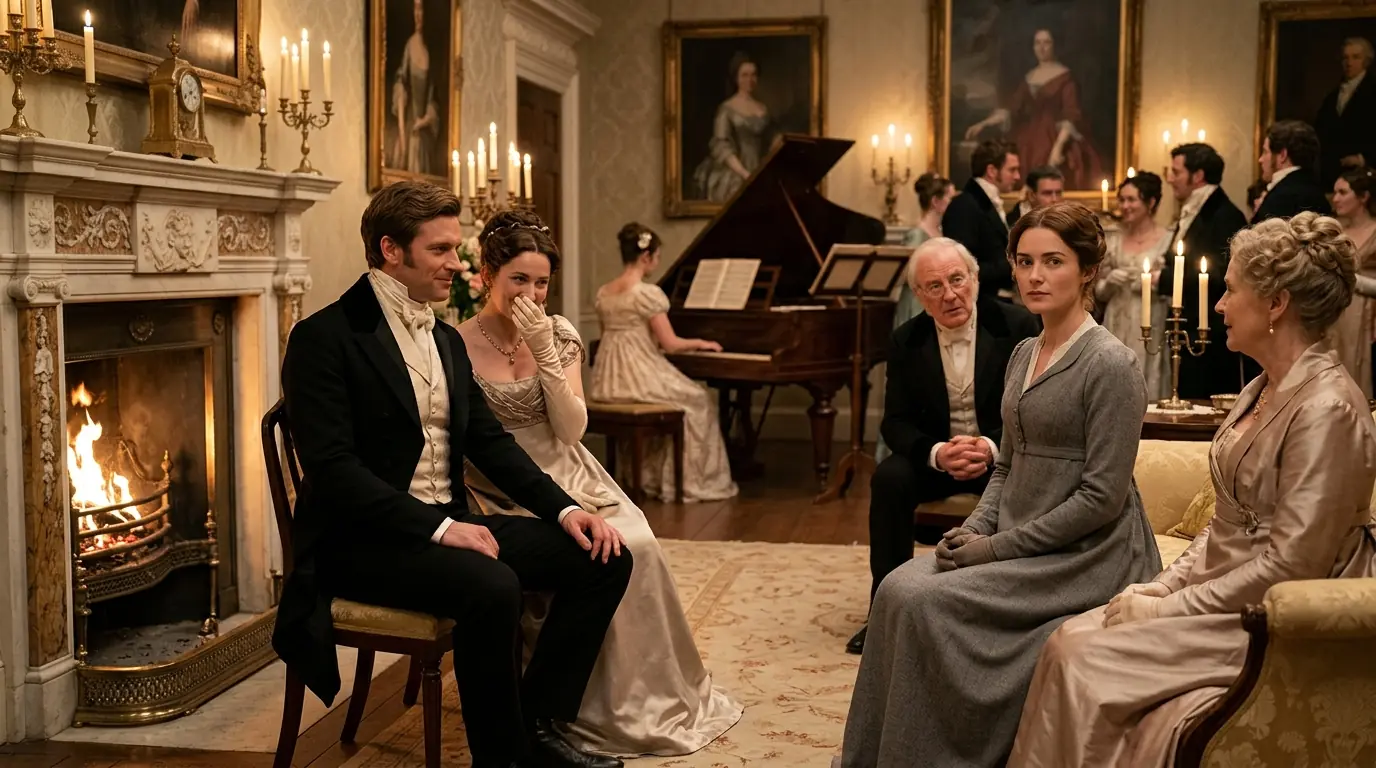
At the center of it, in the chair nearest the fire, because he had taken it without asking and no one had dared ask for it back, sat Gareth Wendall Harcourt, the Earl of Strathmore. I have told you stories of cold men before, and I want to be careful here, because this one was cold in a way that deserves its own description. He was not cold the way a winter morning is cold, sharp and immediate and over by noon. He was cold the way a stone floor is cold, the kind of cold that has lived in the bones of a house for so long it no longer needs a cause. He had been the most brilliant man in every room he entered for fifteen years, and he had used that brilliance the way a man uses a fence post, to mark his territory and keep people out.
His Latin was impeccable. His French was the real kind. He had read Homer in the original Greek, which in 1815 was something perhaps two dozen men in England could honestly say, and he had done it not with joy but with the cool, possessive pleasure of a man adding a weapon to his arsenal. He was thirty-six. He was unmarried, and, as the world of these gatherings would have it, the greatest catch in three counties, a reputation he endured the way a man endures a low ceiling, with a permanent weary stoop of the spirit.
On this particular evening, with the candles all lit and the performance well underway, he had turned his attention to the least consequential person in the room. Her name was Miss Linnea Hale, and she was a companion. I will tell you who she really was in a moment, who her father was, what he gave her, and what it had cost her to keep it hidden. But for now, you need only know what the Earl of Strathmore knew, which was nothing of any significance, and what he assumed, which was a great deal. He saw a woman of perhaps seven-and-twenty in a gray wool gown that was serviceable rather than fashionable, seated near her employer, the cheerfully oblivious Lady Brentwood, with her hands folded in her lap and her gaze fixed on the middle distance in the way of a woman who has taught herself to take up as little space as possible.
He saw nobody. Because he was bored, and because a man of his particular temperament becomes dangerous when he is bored, he decided to amuse himself. He did not address her directly; that would have been beneath the evening's entertainment.
Instead, he leaned toward the woman on his right, a Mrs. Langford, who collected the Earl's cruelties the way other women collect calling cards. In Latin, and in a voice pitched with the precision of a man who knew exactly how sound carried in a room, he said, “Tantum laborat ut bene nata videatur. Paene miserabile est.”
I will not leave you in suspense about the meaning, because the meaning is rather the whole point. What he said, in the classical Latin of a man who had read Cicero at twelve and never let anyone forget it, was this: “All that effort to appear well-born. It is almost pitiable.” He said it the way he had said such things a hundred times before, with the serene certainty that the woman in gray could not understand a word of it. That was the architecture of the cruelty. The elegant cruelties are always architected.
The joke exists in a language the victim does not speak. The room's educated members hear it and exchange glances behind their teeth. The victim sits there unknowing while the clever people enjoy themselves.
He had done it a great many times. It had never once failed. Mrs. Langford gave the expected small, swallowed laugh.
Miss Linnea Hale lifted her head. She lifted it the way she did everything, carefully, without calling attention. She looked at the Earl of Strathmore with an expression that was not anger and was not hurt, but something more unsettling than either. When she spoke, her Latin was not the careful recitation of a woman who had learned it by rote in a schoolroom. It was living Latin, the Latin of a child raised on Pliny and Virgil at her father's knee, corrected at supper, drilled on the road between one city and the next until the language was no longer something she knew but something she was.
“Recte dicis, mi domine,” she said, quiet and clear into the hush that had begun to form around her. “Sed erras in subiecto. Non ea est quae tantum laborem ostentat hac nocte.”
Then she gave him the meaning in English. “You are right, my lord. But you are wrong about the subject. It is not she who is making so much effort this evening.”
The Earl of Strathmore understood because the Earl of Strathmore was not a fool, and for one moment something crossed his face that was not quite the expression of a man losing at chess, but was closely related to it. Then she continued. She did not stop with Latin. She moved into French, not the careful phrasebook French of an English drawing-room but the French of someone who had dreamed in it as a child. She gave him a line from Montaigne, the old essayist, on the subject of pride, choosing the observation that the highest throne in the world is still only a seat upon one's own backside.
She delivered it lightly, without heat, as a fact rather than an insult, which made it considerably worse. Then, because two languages had not quite completed the point to her satisfaction, she finished in Greek. I want you to understand that this was not showing off. It was something more like grief expressing itself in the only vocabulary it had. She gave him three words from the Iliad, a line about men who mistake the sound of their own voices for wisdom, saying it the way one says something known for a very long time and only now finding the occasion to speak aloud.
Then Miss Linnea Hale folded her hands in her lap and looked at the middle distance again, and the room went so quiet that you could hear the fire thinking. The Earl of Strathmore sat in his chair, the best chair in the best light, and did not move. Mrs. Langford's laugh was still fading at the edges. Lady Brentwood stared at her own companion as though the woman had grown a pair of wings she had neglected to mention.