The first time Lord Adrian Wycliffe accused Eleanor Finch of stealing from his family, she was standing beneath a wall of leather-bound books with a volume open in her hands.
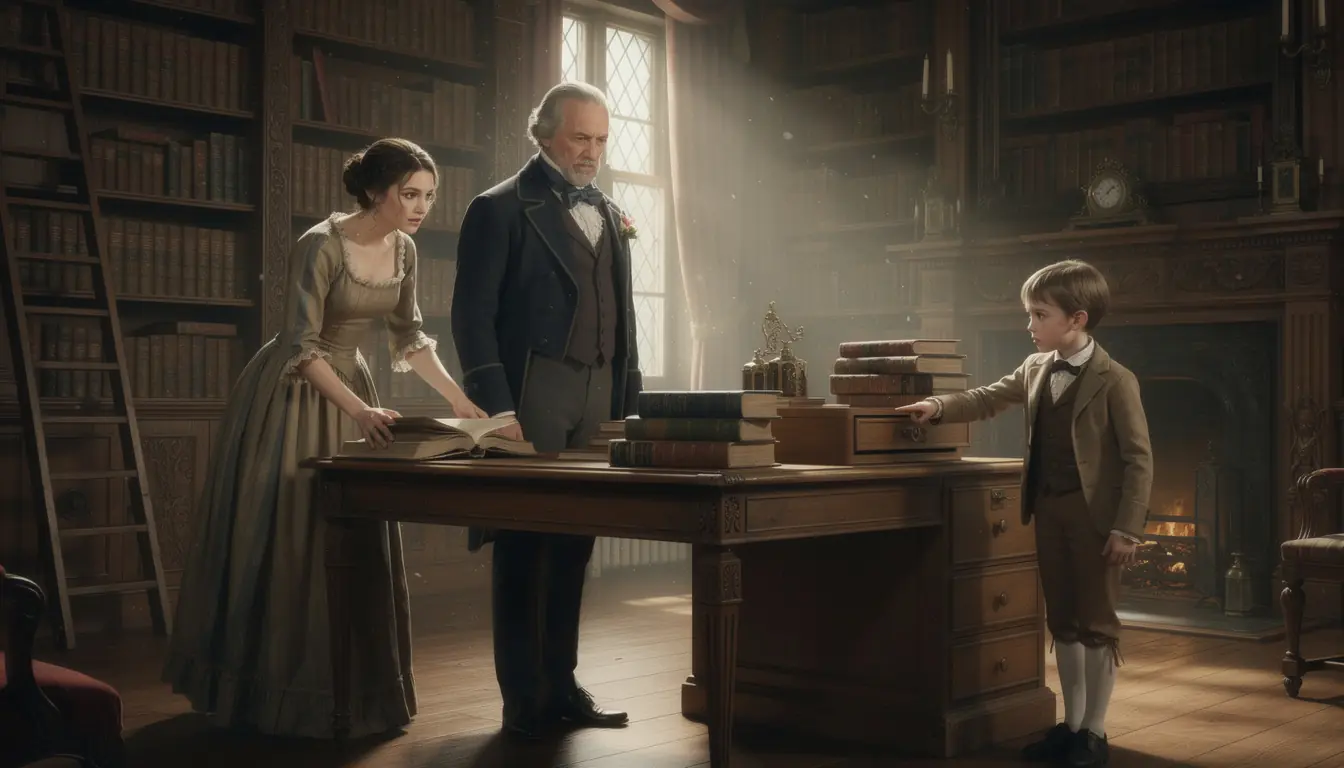
The library fire snapped behind her, the morning rain tapped against the tall windows, and the Earl of Greymere looked at her as though the sight of a governess reading was a personal insult.
He had come into the room so suddenly that she had not even heard the door open. By the time he crossed the carpet, his expression had hardened into the certainty of a man who believed he had caught a thief.
“Put the book down,” he said. “You were warned that the private library was not part of your duties.”
Eleanor did not close the volume. “I was warned not to remove anything, my lord. I have removed nothing.”
“Mr. Fenwick tells me you have been asking about the accounts my father kept here. And now I find you with one of his books.”
“Then Mr. Fenwick has neglected to tell you why I was asking.”
Adrian stepped closer, his dark green coat sweeping past the corner of the writing desk. Eleanor could see the exhaustion beneath his anger, the sleeplessness of a man who had inherited debts, angry tenants, and a title that seemed to give him power over everything except the truth. She was frightened of losing her position, but far more frightened of what would happen if she lowered her eyes now. She opened her mouth to answer him again, and the door behind them creaked.
A small boy stood in the doorway in a green jacket and brown trousers, clutching a wooden horse against his chest. Thomas Wycliffe, Adrian's nine-year-old nephew, had scarcely spoken since the death of his mother. Yet at that moment he raised one hand, extended a trembling finger, and pointed past the adults toward the locked drawers beneath the library shelves. His lips moved, and the first words he had spoken to his uncle in weeks came out in a thin but unmistakable voice.
“She said the truth was in there.”
Six weeks earlier, Eleanor had arrived at Greymere Hall with one worn suitcase, two references, and the humiliating knowledge that her father's name was still spoken with suspicion throughout the county. The carriage had carried her through wet fields and villages where smoke rose from cottages whose occupants could no longer afford enough coal for the winter. On the hill beyond the village stood Greymere Hall, an enormous stone house with a long terrace, narrow chimneys, and windows that reflected the gray Yorkshire sky. Eleanor had thought it beautiful until she saw the weary faces of the servants waiting beneath its entrance.
She was twenty-four, the daughter of a schoolmaster who had once been trusted to keep the accounts of the Greymere Winter Relief Fund. That fund had provided grain during bad harvests, coal during hard winters, and small payments to widows whose husbands had died in the estate's mills. Her father, William Finch, believed that a person's usefulness was measured by how carefully he treated those who had the least. For twelve years he had made his calculations at the kitchen table after supper while Eleanor read aloud to him from whatever book they could afford to borrow.