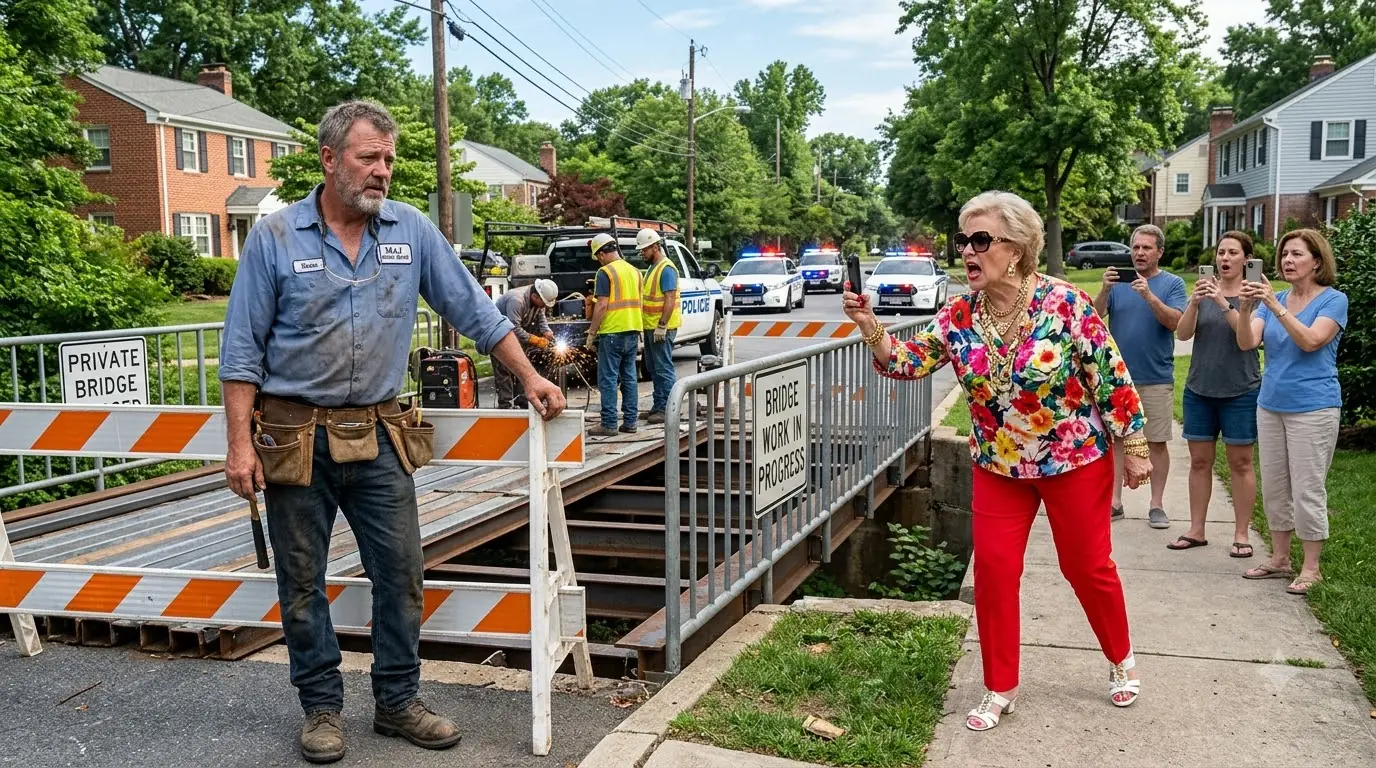
When I lowered the barrier arm on my own maintenance bridge to replace two rusted steel beams, the president of the homeowners association called emergency dispatch and told them I was blocking the only escape route out of the neighborhood. Three patrol cars showed up with their lights flashing at the foot of my driveway and half the residents on the other side of the water gathered to film me like I was some kind of criminal holding their street hostage. I did not raise my voice. I did not argue. I walked to the nearest deputy and handed him a folder of paperwork that had been sitting in a waterproof box since before that woman ever moved into Brier Glenn.
10 minutes later, he looked straight at her and asked why she had been charging homeowners a maintenance fee for a bridge that never belonged to her association in the first place. My name is Caleb Rowan. And before any of this turned into a spectacle with flashing lights and neighbors recording on their phones, it was just a quiet piece of land beside a drainage channel called Willow Run. My father built his pump repair business on that land three decades ago. And the bridge crossing the channel was never meant for anyone but us.
It was a single lane of riveted steel, wide enough for a service truck, and nothing more, connecting our workshop to the county road on the far side of the water. The engineering drawings my father kept in a metal filing cabinet labeled it exactly what it was, a private maintenance crossing built to move equipment, not a public thoroughfare for an entire subdivision that did not exist yet. When the developers broke ground on Brier Glenn, a young project manager named Owen Pierce came to my father with a request. They needed a way to haul soil and machinery across the channel while they built the main road, and our bridge was the only crossing for nearly a mile in either direction. My father agreed to an 18-month temporary arrangement, and in exchange, the developer reinforced the deck and covered any damage their heavy trucks caused.
That agreement had a clear expiration date tied to construction, and nothing in it transferred ownership or created a permanent right of passage for anyone who would eventually live in those new houses. Once the subdivision opened, the developer built the main entrance road that connects Brier Glenn directly to the county highway, exactly as the permits required. But people are creatures of habit and residents kept cutting across our bridge anyway because it shaved almost 10 minutes off their drive to the grocery store and the elementary school. My father never made an issue of it. A few cars a day crossing a bridge he already maintained felt like a small kindness, not a legal surrender.
And he was not the kind of man who picked fights with people he waved to every morning. After he passed, I kept that same quiet arrangement going without ever thinking twice about it. I repainted the railings myself, tightened the bolts every spring, and cleared fallen branches after every storm that rolled through the valley. The homeowners association never paid a cent toward any of it. Not one invoice, not one phone call offering to split the cost of materials.
Then Marissa Vale became president of the board. And one morning I drove past the entrance to my own bridge and found a freshly installed sign that read Brier Glenn West Bridge entrance bolted right into the ground on my side of the property line. I asked her politely at first to have it removed because it was misleading residents into believing the bridge belonged to the association. She told me in that smooth and unbothered tone she used for every conversation that her residents had been using it longer than I had owned the land beneath it. I reminded her that using something and owning it are two very different concepts under any law I had ever heard of.
But she looked at my work boots and the grease still under my fingernails and said she managed an entire community while I fixed pumps for a living. And that experience like hers should be the one making these decisions. I pulled that sign out of the ground myself and left it propped against the door of the HOA office without another word. A week later, a violation notice arrived in my mailbox warning me not to unilaterally alter what it called the shared western entrance of a brier Glenn. The letter was printed on official association letterhead with a case number and a fine schedule attached to it as if I were a homeowner who had painted his mailbox the wrong shade of gray.
The trouble was simple and it should have ended the conversation immediately. My house, my workshop, and that bridge had never once been part of the homeowners association, and no amount of confident language on a letterhead was going to change a property line that had been recorded at the county courthouse for over 30 years. The following spring brought weeks of hard rain, and I started hearing a sound under the bridge deck that I did not like, a kind of hollow groan every time a heavier vehicle crossed. I crawled underneath with a flashlight and found a cross beam near one of the welds eaten through with rust and a second beam beginning to bow under a load it was never designed to carry. It was not simply age catching up with old steel.
It was years of Brier Glenn residents driving pickup trucks, delivery vans, and landscaping equipment across a structure my father built for the occasional service call. And nobody in that subdivision had ever asked whether the bridge could actually handle it. I hired a structural engineer named Mason Vic to give me an honest assessment before I made any decisions I would regret. Mason walked the length of the deck, tested the welds, and told me the bridge was not in danger of collapsing that same week, but it absolutely could not keep carrying civilian traffic in its current condition. He recommended replacing both compromised beams, raising sections of the decking, and inspecting the anchor points before allowing another vehicle across.
And he estimated the repair would take about 10 days if the weather cooperated. I trusted his judgment completely because unlike Marissa, Mason had actually put his hands on the steel before offering an opinion. I sent Marissa everything before I touched a single bolt because I wanted no confusion about my intentions. I included the engineering report, photographs of the corroded beam, the exact dates I plan to close the bridge, a map showing the existing main entrance as an alternative route, and a note explaining pedestrians could still cross on foot during the first day so people could adjust their routines. Marissa never read past the first page.
She called me directly and demanded I delay any repairs until the board could hold a formal vote on the matter, as if a committee meeting could somehow reinforce rusted steel. I explained as calmly as I could that the association had no authority to vote on repairs to property it did not own. But she insisted the bridge functioned as an emergency exit for the entire neighborhood and that closing it could expose me to liability if a fire or a storm ever trapped residents inside Brier Glenn. I pulled up the county's official emergency response plan that same afternoon, and it listed only two approved routes, in and out of the subdivision, the main entrance and a northern access road. My bridge appeared nowhere in that document, not as a primary route, and not even as a backup, and I forwarded the exact page to her within the hour.
Her response was that the county document was simply outdated and did not reflect how residents actually used the neighborhood day-to-day. The association then sent a mass notice to every household claiming I intended to close the bridge over what they called a personal dispute without mentioning a single word about corroded steel or the engineer's warning. Within a day, my phone would not stop ringing. And people I barely recognized started showing up at my workshop, asking why I was trying to punish an entire community for one disagreement with their president. I stayed patient through every one of those conversations, explaining again and again that I would be the one held responsible if I let vehicles keep crossing a bridge an engineer had already flagged as unsafe.
Marissa organized a gathering right at the foot of the bridge, standing in front of a small crowd and announcing that the association would not allow me to, in her words, sabotage the community's infrastructure. Halfway through her speech, a heavy delivery truck rumbled across the deck behind her, and the entire structure shuddered so hard that a chunk of rusted steel broke free and dropped into the channel below, right in front of everyone watching. I decided to move the closure up by 2 days rather than wait for a confrontation that clearly was not going to resolve itself through conversation. Before I did, I gave the association one final chance to actually look at the documentation instead of arguing around it. And I brought my deed, the original construction drawings, and my father's old building permits to the next board meeting.
Marissa arrived with a laminated map pulled straight from an old Brier Glenn sales brochure, the kind realtor's handout to prospective buyers, and it showed the bridge drawn as a direct extension of the subdivision under the label West Access. I explained that a marketing brochure was not a deed, a survey, or any kind of legal instrument, and that no title company on Earth would treat it as proof of ownership. She waved that off entirely and insisted residents had purchased their homes, believing they had two ways in and out of the neighborhood and that I could not simply take that belief away from them. Now, I brought in a real estate attorney named Lena Barrett to help me untangle three separate issues that Marissa kept deliberately blending together. The ownership of the bridge itself, the developer's temporary construction easement, and the informal courtesy my family had extended to residents for years out of pure goodwill.
Lena confirmed that none of those three things had ever granted the homeowners association permanent ownership or a lasting right of passage. She also discovered something Marissa clearly had not expected anyone to dig up. An old condition buried in the original construction permit requiring the developer to complete a second access road on the northern edge of the property. That road still existed on paper, but a landscaping hedge and a small seating area built by the association now covered most of it. Disguised as a community beautification project.
Marissa had proudly announced two years earlier. I drove out to see it for myself and found the second exit essentially erased, replaced by decorative shrubs and a stone bench nobody ever sat on. The association had quietly closed its own legitimate secondary exit and then turned around and treated my private bridge as the community's only remaining alternative route. When I asked Marissa directly why the northern road had been buried under landscaping, she told me it simply did not match the aesthetic standard she wanted for Brier Glenn, as if visual appeal outweighed a documented emergency access requirement written into the county permit. I pointed out that her association had closed its own approved exit and then claimed my bridge as shared community property to fill the gap they created.
And she had no real answer for that. Only another warning about fines and mounting legal costs and the anger of the entire neighborhood. I asked her to show me the specific bylaw that allowed the association to fine a non-member for maintaining his own private property, and she could not produce one. Instead, she sent a letter threatening that the association would cut the lock on my new barrier if I proceeded with the closure. A letter that supposedly came from their attorney, but that Lena noticed was missing any actual attorney signature.
On a Monday morning, I set up reflective barricades at both ends of the bridge along with printed copies of the engineering report, the repair schedule, and clear directions to the main entrance road. Mason and his crew began pulling up sections of the deck to reach the two damaged beams. And less than 30 minutes later, Marissa arrived with a group of association members demanding the crew stop what she called the destruction of community infrastructure. I handed her the same deed and engineering report for what felt like the 10th time, and she did not so much as glance at either page. She claimed she had consulted an adviser who confirmed the bridge had to remain open for residents, though she never named who that adviser was or produced anything in writing.