The paint hit the windshield sometime between 4:11 and 4:13 on a Wednesday afternoon.
Darius Bennett knew that because his kitchen clock read 4:14 when he heard a metal bucket strike the driveway.
He had been standing barefoot near the refrigerator, still wearing the charcoal T-shirt and dark plaid lounge pants he had changed into after finishing a remote meeting, when the sound came through the front windows. At first he thought one of the contractors renovating the house across the street had dropped something.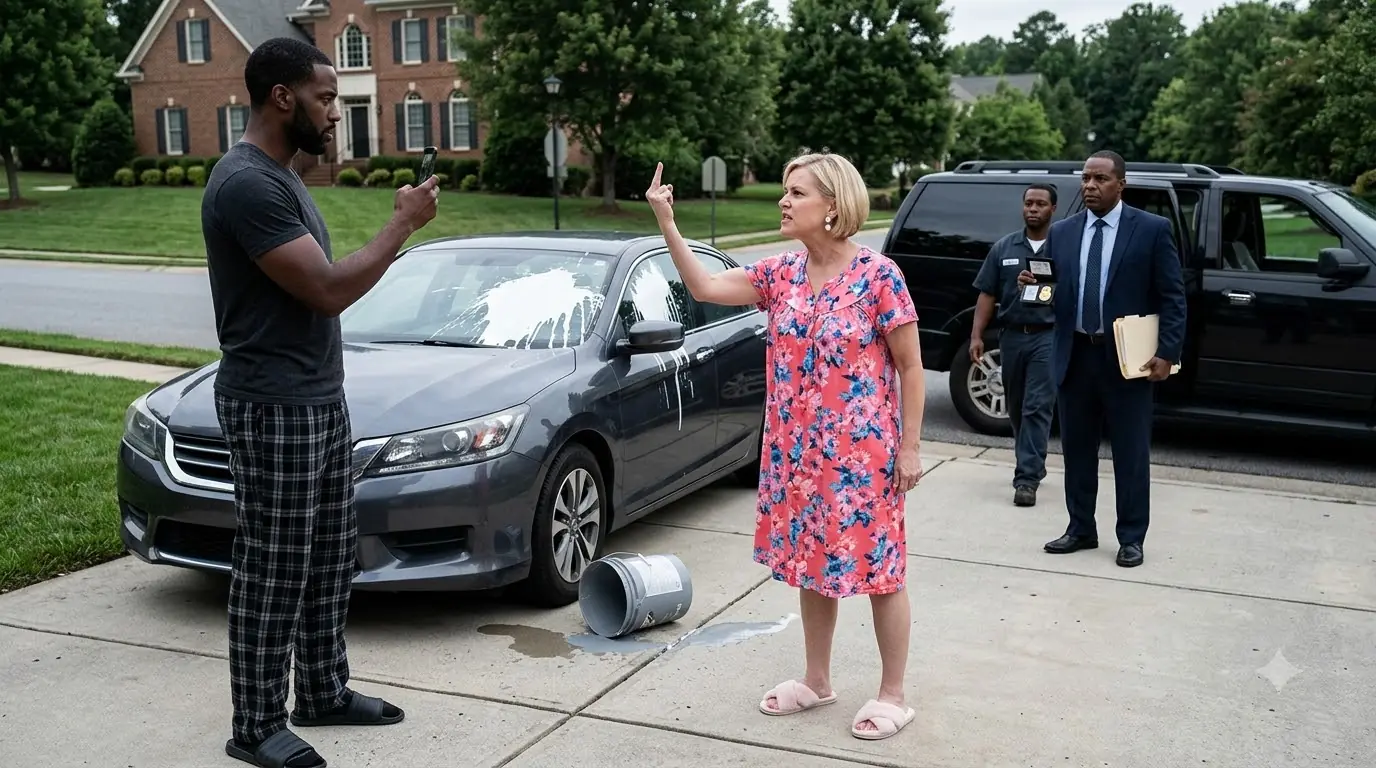
Then he heard a woman shouting.
“Maybe now you’ll learn.”
Darius stopped.
He knew the voice.
Everyone in Wellington Crest knew the voice.
Linda Mercer, fifty-six-year-old president of the Wellington Crest Homeowners Association, had spent almost eight years transforming neighborhood administration into something closer to personal government.
Darius crossed the living room.
When he opened the front door, he smelled wet paint.
His dark-gray sedan sat near the curb.
A thick river of white exterior paint ran down the windshield, across the hood, and over the driver-side window. A five-gallon gray bucket lay on its side beside the front tire, slowly leaking the last of its contents onto the concrete.
Linda stood beside it.
She wore a floral pink-and-blue house dress, pearl earrings, and fuzzy pale-pink slippers.
She looked less like a powerful neighborhood official than someone who had walked outside to collect a newspaper.
Her expression said otherwise.
She pointed toward Darius.
“That car was supposed to be moved yesterday.”
Darius looked at the car.
Then at her.
“My car?”
“You heard me.”
“From my driveway?”
Linda folded her arms.
“It has been visible from the common street for four consecutive days.”
Darius stared.
“Cars are usually visible from streets.”
“Don’t get smart.”
“I’m trying not to.”
“You received notice.”
“No.”
“You received three.”
“I received one email asking why my registration sticker was temporarily removed.”
Linda lifted her chin.
“That was notice.”
“No.”
“That was a question.”
She stepped closer.
Darius noticed white paint on the side of one of her slippers.
“You’re violating vehicle-presentation standards.”
He looked toward the sedan again.
The vehicle was clean.
Registered.
Insured.
No mechanical damage.
Parked entirely inside his private driveway.
“What presentation standard?”
Linda pointed toward the windshield.
“The same standards everyone else follows.”
“You just poured paint on my car.”
She smiled.
“Consider it community compliance.”
Darius stood very still.
He was thirty-nine years old, six-foot-two, broad-shouldered, and had spent most of his adult life learning that calm could be more useful than volume.
He worked as a commercial cybersecurity consultant.
His job involved people lying while assuming computers had forgotten.
Computers rarely forgot as much as people hoped.
Neither did cameras.
Darius slipped one hand into his pocket.
Started recording.
Linda did not notice.
She continued.
“If you had simply complied with board instructions, this wouldn’t have happened.”
“What exactly was I supposed to comply with?”
“Move the vehicle into the garage.”
“My garage is being used for flooring materials.”
“Not my problem.”
“My driveway is private property.”
“Your driveway exists inside a covenant-controlled community.”
“That does not mean you can vandalize my car.”
Linda’s face hardened.
“Be careful with that word.”
“Which word?”
“Vandalize.”
Darius looked at the paint.
“Would you prefer decorate?”
She stepped forward.
“You people always want to make everything dramatic.”
There it was.
Not explicit enough for her to be forced to explain.
Clear enough that Darius heard what she intended.
He did not react.
Instead, he looked past Linda.
Half a block away, near the corner, a white utility truck sat idling.
Small green lettering ran along the door.
Wellington Crest Property Services.
Darius had seen the truck before.
Something about it bothered him.
Linda turned slightly toward the vehicle.
Then raised her right hand.
Two fingers.
Hooked inward.
A short downward flick toward the street.
The truck’s brake lights illuminated.
Darius felt the entire moment shift.
The paint stopped mattering for half a second.
He knew that gesture.
He had seen it three times.
Always on video.
Always immediately before someone’s property was damaged.
He looked back at Linda.
She had no idea he recognized it.
“Do that again.”
Her expression changed.
“What?”
“The hand thing.”
“What hand thing?”
“That little signal you just made.”
Linda laughed.
“You’re imagining things.”
The truck began moving.
Slowly.
Darius raised his phone.
“Funny.”
“What?”
“I’ve seen you make it before.”
Linda’s smile disappeared.
He continued.
“Three nights.”
“Three different houses.”
“Same truck.”
“Same signal.”
The truck accelerated.
Linda stepped toward him.
“Put that phone down.”
Darius smiled faintly.
“Now we’re getting somewhere.”
“You are not authorized to record me.”
“I’m standing on my property.”
“You’re harassing an HOA officer.”
“You poured paint on my car.”
“That is not what happened.”
Darius looked down at the bucket.
Then at the paint on her slipper.
Then at his phone.
“Good.”
She frowned.
“Good what?”
“Keep talking.”
Darius had moved to Wellington Crest fourteen months earlier.
He did not expect trouble.
The subdivision sat twenty-five minutes outside Raleigh, North Carolina, and had the kind of pleasant, carefully arranged appearance real-estate brochures described with words like serene, exclusive, and community-oriented.
Three hundred twelve homes.
A clubhouse.
Two pools.
Walking trails.
A small lake.
Tree-lined streets.
No golf course.
No gates.
No private security.
Darius liked it precisely because it seemed boring.
He had divorced three years earlier.
No children.
No desire to live downtown.
He wanted a quiet house with a small office, a decent kitchen, and enough garage space to restore the 1972 Chevrolet pickup his father left him.
Wellington Crest fit.
At first.
Linda Mercer introduced herself three days after closing.
She arrived carrying a binder.
Not flowers.
Not cookies.
A binder.
“Welcome packet.”
Darius opened the door.
“Thanks.”
“I’m Linda Mercer.”
“HOA president.”
“I know.”
Her eyebrows lifted.
“How?”
“Closing documents.”
She smiled.
“Good.”
“We appreciate residents who read.”
Darius almost laughed.
“I read everything.”
That sentence should have warned her.
Instead, Linda stepped inside without being invited and began pointing.
“The wreath will need seasonal approval after January.”
Darius looked toward the front door.
It was October.
“That wreath came with the house.”
“Still.”
She pointed toward the driveway.
“And commercial vehicles cannot remain overnight.”
“My SUV isn’t commercial.”
“I’m talking about future use.”
Darius stared.
Linda continued.
“Trash bins must be behind the side fence within two hours of pickup.”
“Exterior lighting below three thousand lumens.”
“Holiday displays off by January tenth.”
“No political signs beyond election periods.”
“No visible work equipment.”
“Mailbox color must remain association black.”
Darius finally interrupted.
“Do you always do this?”
“Do what?”
“Walk into new homeowners’ houses and read rules aloud?”
Linda looked offended.
“I’m helping.”
“I have the binder.”
For the first time, her smile tightened.
Then she recovered.
“Some residents appreciate guidance.”
Darius stepped toward the door.
“I’ll call if I get confused.”
She understood.
Left.
That should have been the end.
It was not.
The first violation came six weeks later.
Darius had left a folded ladder leaning beside his garage for forty-eight minutes while installing a security camera.
Fine:
$75.
He appealed.
The fine disappeared.
Second violation:
Mailbox flowers extending four inches beyond approved planter dimensions.
Darius did not own mailbox flowers.
He emailed a photograph.
Violation withdrawn.
Third:
Unapproved driveway work vehicle.
The “work vehicle” belonged to his sister Monica Bennett, who had visited for Thanksgiving in a company-owned crossover.
Darius appealed again.
Withdrawn.
None of it seemed serious.
Annoying.
Petty.
But ordinary HOA behavior, perhaps.
Then Darius met Erica Thompson.
Erica lived four houses down.
Forty-three.
Elementary-school counselor.
Single mother with one teenage son.
One afternoon she approached Darius while he was checking mail.
“You getting Linda letters?”
He smiled.
“Everybody gets Linda letters.”
“No.”
“I mean a lot.”
Darius looked toward her.
“What counts as a lot?”
“Seven in five months.”
He stopped smiling.
“For what?”
Erica counted.
“Grass.”
“Trash.”
“Curtains.”
“My son’s basketball hoop.”
“Car.”
“Christmas lights.”
“Then they said my fence stain was wrong.”
Darius frowned.
“What did you do?”
“Appealed.”
“Won?”
“Some.”
She lowered her voice.
“Then somebody dumped used motor oil on my flower bed.”
Darius stared.
“What?”
“Middle of the night.”
“Camera?”
“No.”
“I installed one after.”
“Police?”
“Report.”
“Nothing.”
“Could’ve been random.”
Erica’s expression said she did not believe that.
Darius asked:
“Why would Linda care enough to do that?”
Erica looked toward the clubhouse in the distance.
“I challenged her at a board meeting.”
“About?”
“Reserve spending.”
Darius listened.
Erica had asked why nearly $84,000 had been transferred from landscaping reserves into what the board labeled community appearance initiatives without a detailed vendor breakdown.
Linda dismissed the question.
Two days later, violations started.
Three weeks later, the flower bed was destroyed.
Darius still thought coincidence was possible.
Then he met Harold Chen.
Harold was sixty-eight and lived on Wellington Court near the lake.
Retired accountant.
Quiet.
Precise.
Exactly the kind of person Linda should have feared.
He approached Darius after seeing him photographing his mailbox.
“You keep records?”
Darius smiled.
“Occupational problem.”
“What do you do?”
“Cybersecurity.”
Harold nodded approvingly.
“Then you might appreciate this.”
He invited Darius inside.
On Harold’s dining table sat a folder.
Not HOA records.
Photographs.
Fence before.
Fence after.
A section had been smashed inward.
Not wind.
Not accident.
Someone had struck the posts deliberately.
“When?”
“August.”
“Why?”
Harold laughed without humor.
“Three days after I asked for vendor invoices.”
Darius sat.
“What invoices?”
“Property services.”
Same company whose white truck Darius would later see idling outside his house.
Wellington Crest Property Services.
According to Harold, the HOA paid them almost $160,000 annually for landscaping support, cleanup, signage, minor maintenance, and emergency services.
“Who owns it?”
Darius asked.
Harold looked toward him.
“That’s the problem.”
“What?”
“LLC.”
“Registered agent is a law office.”
“I traced the managing member to a holding company.”
“Then?”
“Nothing.”