The first thing Nora Bennett noticed was that the little girl was pretending to sleep.
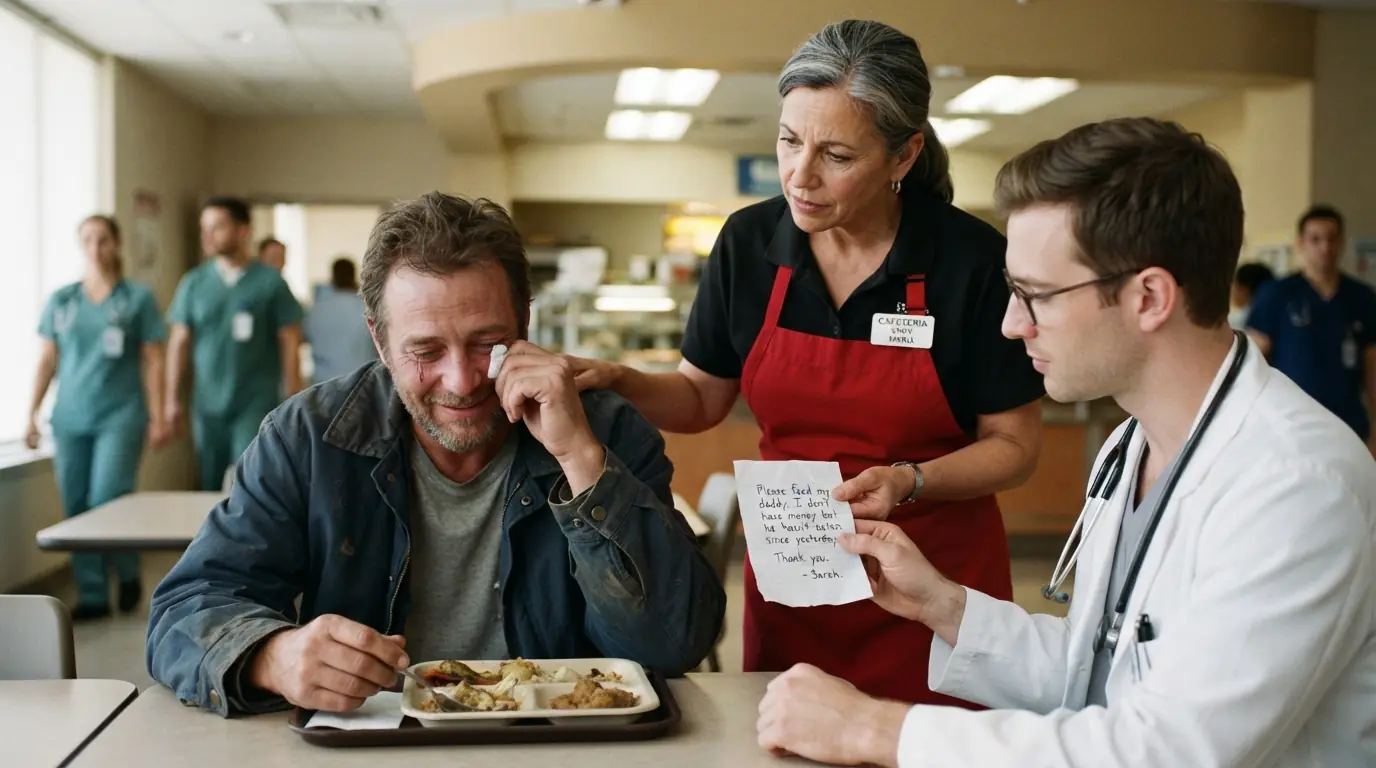
The child had her cheek pressed against her father's navy jacket, her eyelids lowered and her hands folded in her lap, but every time the doors to St. Agnes Medical Center's cafeteria swung open, her small shoulders tightened. She was listening for footsteps that might belong to someone carrying news about her mother.
Her father was listening too.
He sat so straight that Nora wondered how he could possibly be comfortable, one arm curved around the girl in a yellow cardigan and the other resting beside a paper cup of cold coffee. His white shirt had come untucked at the waist, and the collar stood open where someone had pulled away his tie hours earlier.
There were no trays on the table, no crumbs, and no evidence that either of them had eaten.
At seven twenty-three on a rainy November evening in Cleveland, the hospital cafeteria was almost empty. A vending machine hummed near the windows, fluorescent lights reflected in the polished floor, and the kitchen crew had begun covering the steam tables for the night.
Nora was supposed to be counting the cash drawer.
Instead, she found herself watching the father's right hand. It kept moving toward the pocket of his jacket, stopping halfway, then returning to the tabletop as though he had forgotten what he meant to do.
She recognized that motion.
It was the helpless movement of someone who had spent too long waiting for an answer that nobody could give him.
Nora took a clean tray and set a bowl of chicken soup in its center. She added rice, two pieces of baked chicken, a cup of apple juice, a fresh coffee, and an extra napkin because the girl looked like the sort of child who might still want to wipe her own hands.
Her supervisor, Bill Stanton, caught her at the counter.
"They ordered that?" he asked, glancing at the register.
"Not yet," Nora said.
Bill looked toward the nearly empty dining room. "You know the policy. Nothing leaves the line without a ticket."
"I'm using my staff meal," she replied, holding up the voucher clipped behind her name badge. "And I'll pay for the extra coffee."
He opened his mouth, then apparently decided that arguing with Nora Bennett over a bowl of soup wasn't worth the trouble of staying late.
"Clock out on time," he said, and went back to the kitchen.
Nora carried the tray across the room. Up close, the father looked younger than his exhaustion suggested, perhaps forty, with careful hands, a neat mustache, and an expression that tried to be alert even while the rest of him was slipping toward sleep.
"Excuse me," she said gently. "The kitchen made a little extra. Would you mind helping us keep it from going to waste?"
He stared at the tray as if she had brought it from somewhere very far away.
"I didn't order anything."
"I know."
"I can pay."
"I believe you," Nora said. "But right now, I'd rather you ate."