Marcus Reed had been called many things during sixteen years in law enforcement.
Detective.
Sergeant.
Investigator.
Lieutenant.
Internal Affairs.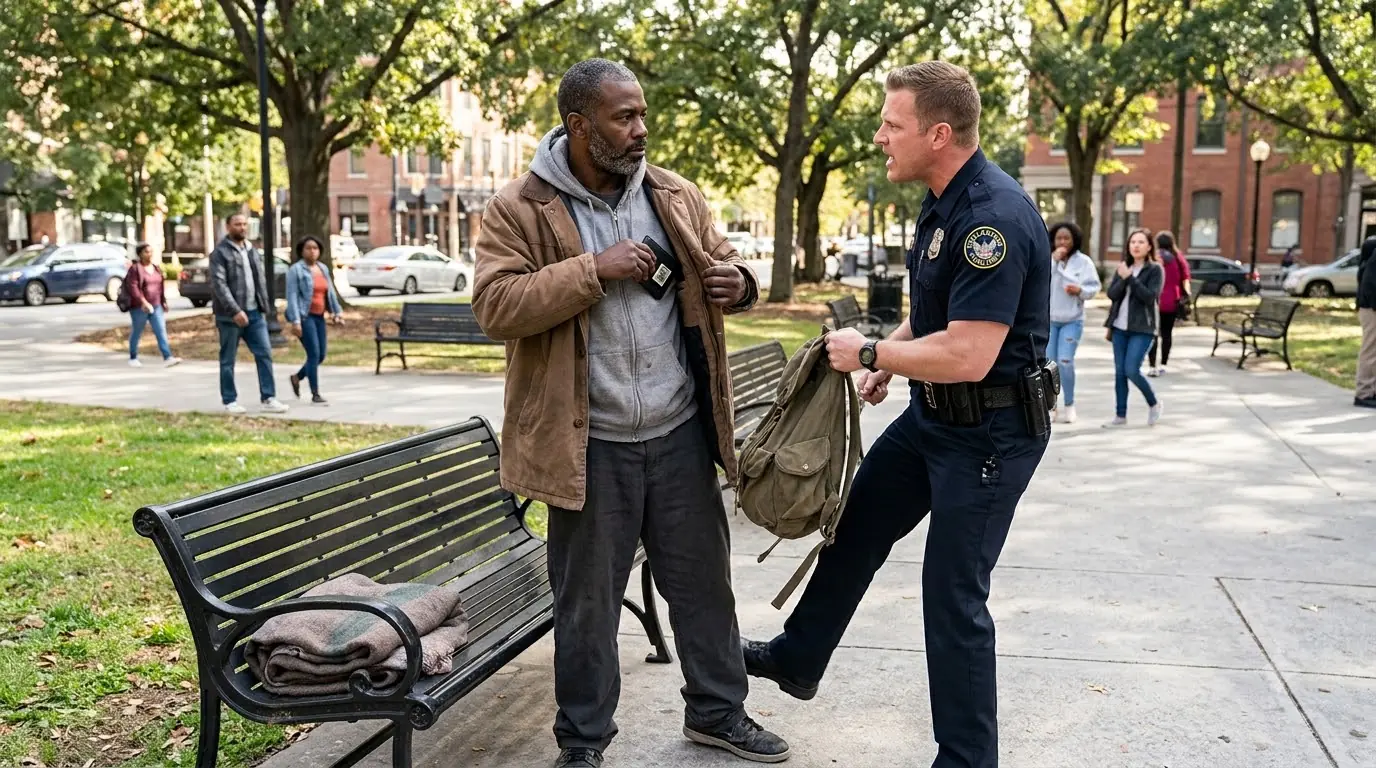
The last title changed rooms faster than any of the others.
People sat straighter when they heard it.
Officers suddenly remembered exact wording.
Supervisors opened files they had previously described as unavailable.
Body-camera batteries seemed to become much more reliable.
Marcus disliked that effect.
He understood why it existed, but he disliked it.
Because for the investigation he was conducting that Tuesday morning, he needed to know what happened before anybody realized someone important was watching.
That was why, at 7:42 a.m., Marcus Reed looked like a man most people had already trained themselves not to see.
His expensive watch was locked in his office.
His clean leather shoes had been replaced by scuffed sneakers purchased at a thrift store.
He wore loose charcoal trousers, a faded gray hoodie, and a worn brown coat with one cuff deliberately frayed.
A canvas backpack sat beside him.
Inside it were a folded blanket, two empty water bottles, an old paperback novel, a wrapped sandwich, and enough harmless clutter to make the disguise believable if somebody searched it.
Under the hoodie, clipped near his chest, was a miniature authorized recording device.
The operation had been approved in writing.
That mattered.
Marcus was not freelancing.
He was not trying to bait an officer into misconduct.
He had been instructed to enter Grant Park, behave lawfully, remain passive, and observe.
Nothing more.
If Officer Travis Cole ignored him, the operation would produce almost nothing.
Marcus would have considered that a good result.
He sat on a bench beneath an enormous oak tree and watched Atlanta wake around him.
Joggers moved along the path.
Parents pushed strollers.
A maintenance worker emptied trash bins.
Two teenagers crossed the lawn carrying soccer cleats.
Traffic hummed beyond the trees.
The morning was bright and clean, the sort of spring weather that made a city park feel temporarily innocent.
Marcus opened the old paperback.
He did not read.
He counted patrol passes.
7:51.
No officer.
8:03.
A bicycle officer crossed the far path, waved at a groundskeeper, kept moving.
8:17.
A patrol SUV appeared on Cherokee Avenue.
Dark blue.
Unit 318.
Marcus knew the number.
Travis Cole.
Thirty-seven.
Eight years with the department.
No criminal history.
Two departmental commendations.
Three documented civilian complaints during his first four years.
Then eight complaints in the previous eighteen months.
That sudden increase was what had brought Internal Affairs into the picture.
Or more accurately, what finally brought Internal Affairs into the picture.
The complaints themselves were strange because none looked extraordinary by itself.
A homeless veteran said Cole had emptied his backpack onto wet pavement and told him to “clean up his garbage.”
No video.
No corroborating witness.
Closed.
A street musician said Cole threatened to confiscate his guitar because he had “seen his type before.”
Cole denied saying it.
Body camera had reportedly failed to activate.
Unsubstantiated.
A woman living in her car claimed Cole ordered her to move from a legal parking area after telling her, “People like you attract crime.”
No citation.
No arrest.
No dispatch note.
No proof.
Closed.
Another man claimed Cole kicked his sleeping bag.
Another alleged Cole poured out a cup of coffee while clearing a bench.
One said the officer had shoved him against a wall after he asked for a badge number.
None of those allegations produced an obvious disciplinary case.
Together they bothered Marcus.
Then came the complaint that changed things.
A twenty-two-year-old social-work student named Hannah Price had been volunteering with a street-outreach group when she saw Cole order two homeless men out of Grant Park.
She recorded part of the interaction from across the lawn.
The video was shaky.
Audio weak.
But one detail was clear.
Cole told one man:
“Nobody cares what happened here but you.”
That sentence made Marcus request every complaint, dispatch record, and body-camera retention notice connected to Cole’s park assignments.
The response exposed gaps.
Not proof of misconduct.
Gaps.
Four body-camera clips were missing because of retention expiration.
Two were categorized under unrelated incident numbers.
Three complaints had never been linked to Cole’s personnel record because they were filed as “service concerns” instead of formal misconduct allegations.
One supervisor had written:
Pattern of communication difficulty with transient population. Informal coaching recommended.
No follow-up documented.
Marcus read that sentence three times.
“Communication difficulty.”
Bureaucracies could make almost anything sound harmless if they chose the right noun.
So Internal Affairs approved a controlled observation.
Marcus volunteered.
His captain objected.
“You're forty-six.”
Marcus stared.
“And?”
“Cole is thirty-seven and built like a linebacker.”
“I’ve noticed.”
“You don't need to play homeless man yourself.”
“No.”
“Then why?”
Marcus looked at the complaint file.
“Because he’s accused of changing behavior depending on who he thinks can complain effectively.”
His captain understood.
That was the problem.
A uniformed observer would ruin the test.
A known city employee would ruin it.
Someone with a camera openly displayed would change conduct.
Marcus needed to look powerless.
Not because homelessness meant powerlessness.
Because Cole’s alleged behavior suggested he believed it did.
At 8:19, Unit 318 pulled to the curb.
Marcus kept his eyes on the book.
Door opened.
Boots on pavement.
A voice:
“Morning.”
Marcus looked up.
Officer Travis Cole stood twenty feet away.
White.
Short blond-brown hair.
Muscular shoulders.
Dark navy uniform.
Sunglasses hooked at the front of his shirt.
His body camera sat centered on his chest.
Marcus immediately checked one detail.
Red indicator light.
Active.
Good.
“Morning,” Marcus replied.
Cole looked toward the backpack.
“You staying here?”
“No.”
“Been sleeping here?”
“No.”
Cole stepped closer.
“You sure?”
“Yes.”
The officer looked around.
“Park opens at six.”
Marcus waited.
Cole continued.
“You got somewhere to be?”
Marcus closed the book.
“I’m sitting in the park.”
“I can see that.”
Silence.
Marcus did nothing.
That was important.
No challenge.
No accusation.
No deliberate provocation.
Cole pointed toward the backpack.
“Pack your stuff.”
“Why?”
“Move along.”
Marcus looked toward the path.
“Is the bench closed?”
Cole’s jaw shifted slightly.
“No.”
“Then why do I need to leave?”
The first change happened there.
Subtle.
Cole’s posture stiffened.
“You want to argue?”
“No.”
Marcus kept his voice even.
“I’m asking why I need to leave.”
Cole took another step.
“Because I'm telling you.”
Marcus held his gaze.
“Am I violating a park rule?”
Cole smiled without humor.
“You guys always want to make it complicated.”
Marcus noticed the phrase.
You guys.
“What guys?”
Cole stared.