The Officer Thought The Black Boy Was Stealing A Package | Then His Little Brother Told The Truth

Eli Brooks had been thinking about the package since breakfast.
Not just thinking.
Counting toward it.
At twelve years old, he understood that delivery trucks did not move faster because a kid kept refreshing the tracking page. His younger brother, Tyler, had told him that twice on the bus ride home, with all the confidence of an eleven-year-old who had never spent three months saving for one thing and watching the mail like his future depended on it.
Eli knew Tyler was right.
He also refreshed the page again.
The package was supposed to arrive before dinner.
Inside was a new video game Eli had bought with his own money, and that made it feel different from birthdays, Christmas, and the small gifts adults gave when they wanted kids to say thank you quickly. He had earned every dollar cutting grass for Mr. Donnelly, carrying groceries for Mrs. Vega, and walking an old golden retriever named Biscuit after school when Mrs. Harlan’s knees got bad.
It was the first thing he had bought that felt completely his.
His name would be on the label.
Eli Brooks.
Not foster paperwork.
Not school records.
Not some old file where adults described him in careful sentences.
Just his name on a box sitting on his porch.
That mattered more than he knew how to explain.
Tyler did not fully understand that part. He loved Eli fiercely, but he moved through the world like most kids on Maple Ridge Court did, without wondering whether somebody might question why he was standing in front of his own house. He had light brown hair, pale skin, bright eyes, and the kind of easy trust that made neighbors smile before he even spoke.
Eli loved him for that.
Sometimes he envied him for it too.
Their house sat near the end of Maple Ridge, a white two-story with blue shutters, an uneven front walk, and a porch swing that squeaked whenever the wind pushed it. Eli had lived there for almost five years. He knew the loose board near the back steps, the drawer where his mother hid batteries, the smell of spaghetti sauce on Sunday nights, and the sound Tyler made when he tried to sneak cookies after bedtime.
Still, every now and then, someone looked at Eli standing outside that house and decided he was a visitor.
Or worse.
The bus dropped them two blocks away.
Tyler jumped off first, already tossing his football between his hands. Eli followed with his backpack over one shoulder and his phone in his hand, checking the tracking page again as they walked.
“Bro,” Tyler said, laughing, “you’re going to wear out the screen.”
“It says out for delivery.”
“It said that at lunch.”
“That means it’s close.”
“That means a guy in a truck is somewhere in the state.”
Eli tried not to smile.
Tyler ran ahead, spun around, and pointed down the sidewalk.
“Go long.”
“No,” Eli said.
“Go long.”
“Tyler, we’re almost home.”
“Exactly. Last throw.”
Eli rolled his eyes, then ran anyway.
He was faster than Tyler, and both of them knew it. His sneakers hit the sidewalk in quick rhythm, his backpack bouncing against his spine, the afternoon sun warm against his face. For three seconds, he forgot the package, the tracking number, the neighbors, and everything else.
He was just running.
Tyler threw the ball too hard.
It sailed over Eli’s fingertips, bounced once near the curb, and slammed into the side of a parked pearl-white sedan with a hollow metallic thud.
Both boys stopped.
The football rolled into the gutter.
The dent on Mrs. Agnes Whitmore’s driver-side door was small, but on that car, small did not matter.
Tyler’s face went pale.
“Oh no.”
Eli stared at the dent.
“Tyler.”
“I know.”
“Mrs. Whitmore’s going to lose her mind.”
“I know.”
The front door opened before either of them could move.
Mrs. Whitmore stepped onto her porch in a cream cardigan, pressed slacks, and house shoes that tapped sharply against the concrete. She was in her late sixties, narrow-faced, silver-haired, and known on Maple Ridge Court for reporting trash cans, barking dogs, loud lawn mowers, crooked mailbox posts, and children who played outside too close to what she called “the quiet hour.”
Nobody knew when the quiet hour started.
Mrs. Whitmore seemed to decide it whenever children were having fun.
Her eyes went to the dent.
Then to Tyler.
Then to Eli.
Eli felt the outcome arrive before she said a word.
“You,” Mrs. Whitmore snapped.
Tyler stepped forward immediately.
“I’m sorry, Mrs. Whitmore. I threw it. I hit your car.”
She did not look at him for more than half a second.
Her finger stayed pointed at Eli.
“You damaged my vehicle.”
“I didn’t,” Eli said. “Tyler threw the ball.”
Tyler nodded hard. “I did. It was my fault.”
Mrs. Whitmore’s face softened when she looked at him, almost tenderly.
“Oh, sweetheart, don’t lie for him.”
Tyler blinked.
“I’m not lying.”
“Yes, you are.” Her voice became syrupy, and somehow that made it worse. “You’re a good boy. I know you wouldn’t do something like that.”
Eli’s stomach tightened.
There it was.
Good boy.
As if goodness had already been assigned before the football ever left Tyler’s hand.
“I saw enough,” Mrs. Whitmore said.
“No, you didn’t,” Tyler argued. “I threw it.”
She gave him a patient smile.
“You don’t have to be scared of him.”
Eli looked down.
Tyler looked confused first.
Then angry.
“He’s my brother.”
Mrs. Whitmore laughed once, short and dry.
“Your brother?”
“Yes.”
“You live in that nice house with your mother.” She pointed toward the Brooks home. “He does not.”
Eli felt heat crawl up his neck.
“Yes, I do.”
Mrs. Whitmore’s eyes narrowed.
“Don’t talk back to me, boy.”
The word landed hard.
Not because Eli had never heard it before.
Because he knew when it was not just a word. He knew when it carried history in its mouth. He knew when an adult used it to make him smaller without needing to raise a hand.
Tyler stared at her.
“He does live there. My mom adopted him. He’s my brother.”
Mrs. Whitmore looked past him as if the explanation was inconvenient.
“I know who belongs on this street.”
For a moment, Eli wanted to tell her everything.
He wanted to tell her that his mother, Rachel Brooks, had signed every paper, sat through every hearing, showed up at every school meeting, and stayed by his hospital bed when asthma turned one winter night into a blur of alarms and oxygen. He wanted to tell her that she learned how to take care of his hair because she refused to make him feel like his body was a burden. He wanted to tell her that belonging was not something Mrs. Whitmore got to hand out from behind curtains.
But Eli had learned another lesson before most kids his age.
Some adults do not ask questions to learn.
They ask questions so they can punish the answer.
“It’s fine,” he said quietly.
Tyler turned on him. “No, it’s not.”
“I’ll fix it.”
“You didn’t do it.”
“I know.”
Mrs. Whitmore folded her arms.
“That’s the first sensible thing you’ve said.”
Tyler’s face crumpled with disbelief.
“I’ll tell Mom.”
Eli lowered his voice.
“Please just go home.”
“No.”
“Tyler. Go.”
Something in Eli’s voice made Tyler stop arguing.
Not because he agreed.
Because he heard fear beneath the calm, and he did not know what to do with it yet. He backed away slowly, still holding the football like it had turned into evidence against him.
Mrs. Whitmore disappeared into her garage and came back with a dent puller, a towel, and a bucket of soapy water.
“Careful,” she said, handing them to Eli. “And if you make it worse, I’m calling the police.”
Eli looked at the dent.
Then at the house down the street where his package might already be waiting.
“Yes, ma’am.”
For nearly an hour, he worked in her driveway.
The sun shifted lower. Cars passed. A few neighbors slowed enough to see, but not enough to stop. Mrs. Whitmore stood over him the entire time, correcting things she did not understand and sighing loudly whenever he paused to wipe sweat from his forehead.
Eli kept his head down.
He had gotten good at that.
At home, Tyler burst through the front door so fast the football bounced out of his hands and rolled under the console table.
Rachel Brooks looked up from the kitchen, where she was setting plates for dinner. She was thirty-eight, a nurse at St. Catherine’s, with tired eyes, gentle hands, and a voice that could become steel when either of her sons was in danger.
“Where’s Eli?”
Tyler stood in the doorway, breathing hard.
“Mom, don’t get mad.”
Rachel put down the plates.
“Tyler.”
“I hit Mrs. Whitmore’s car with the football. I told her it was me. I told her like five times. But she blamed Eli.”
Rachel’s face changed.
“Where is he?”
“At her house. She made him fix it.”
“She made him?”
“He told me to come home.”
Rachel closed her eyes for one second.
When she opened them, Tyler saw something he did not often see in his mother. Not panic. Not confusion. Fury pressed flat enough to become useful.
“Why wouldn’t she believe me?” Tyler asked.
Rachel walked to the table and pulled out a chair.
“Sit down.”
“Mom, we have to get him.”
“We will. Sit down first.”
Tyler sat, knees bouncing.
Rachel sat across from him.
“There are people,” she said carefully, “who look at Eli and decide what kind of boy he is before he says a word.”
Tyler’s brow furrowed.
“Because he’s Black?”
Rachel did not soften it.
“Yes.”
“That’s stupid.”
“It is.”
“He’s my brother.”
“Yes.”
“He lives here.”
“Yes.”
“She said he didn’t.”
Rachel reached across the table and took Tyler’s hand.
“Eli has had to deal with that more times than you know.”
Tyler looked toward the front window.
“Why didn’t he fight back?”
“Because sometimes he has learned that staying quiet feels safer than being right.”
Tyler’s eyes filled with tears.
“I didn’t know.”
Rachel squeezed his hand.
“Now you do.”
Outside, Eli returned the dent puller to Mrs. Whitmore. The dent was smaller now, though not gone. She inspected it like a judge inspecting a bad apology.
“It will do,” she said.
Eli waited.
Mrs. Whitmore waved him away.
“Next time, stay where you belong.”
Eli did not answer.
He walked home with tight shoulders and his eyes on the sidewalk. His hands smelled like soap and metal. His knees were dusty from kneeling in her driveway, and his chest felt heavy in a way that had nothing to do with asthma.
Then he reached his own house.
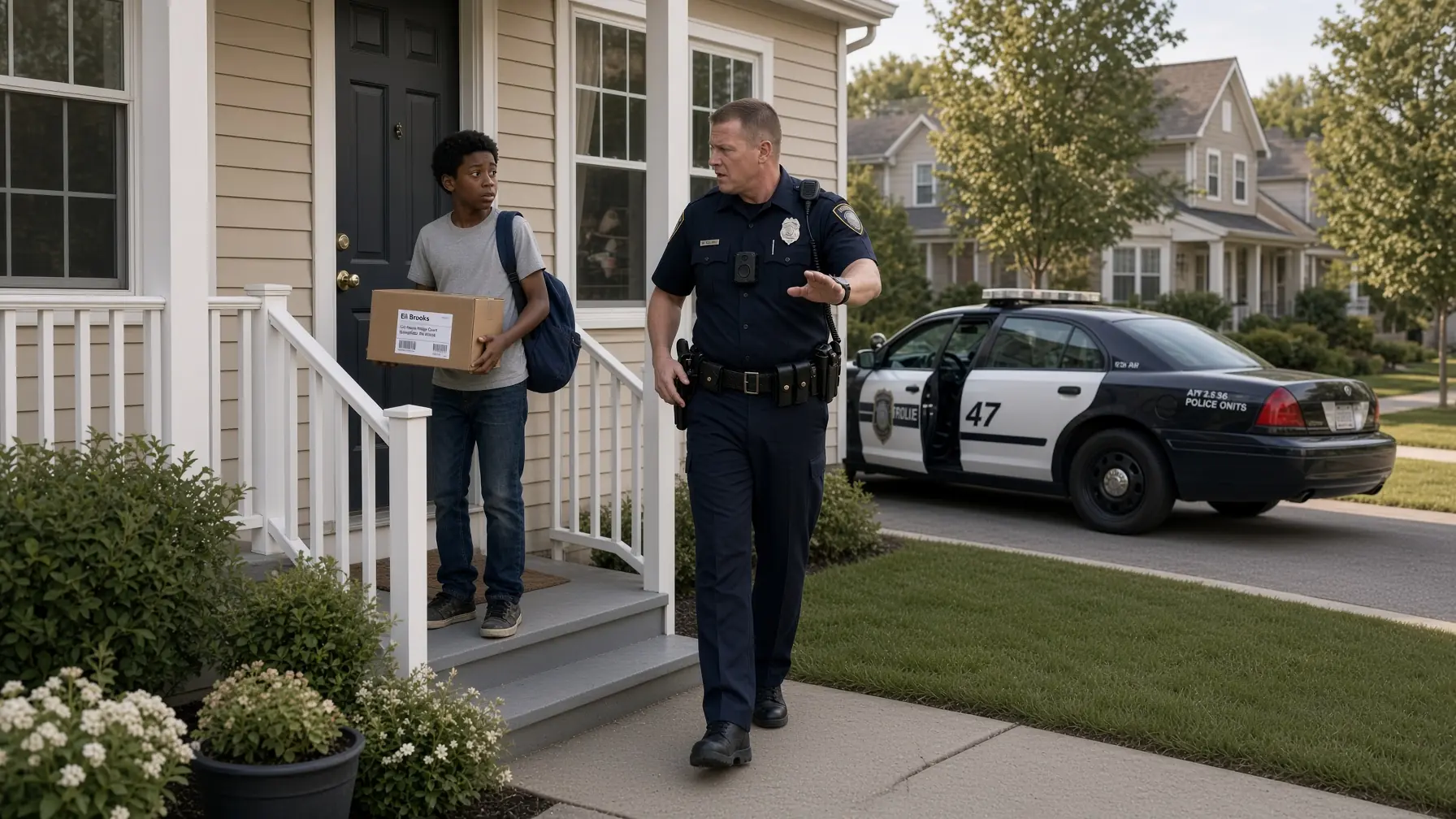
A cardboard package sat on the porch.
For one second, the entire afternoon loosened its grip.
The package was square, clean, and perfect, tucked beside the front door under the porch light. Eli climbed the steps slowly, almost afraid it might vanish if he moved too fast. He bent down and saw his name printed on the label.
Eli Brooks.
A smile broke through before he could stop it.
He crouched and reached for the box.
A police cruiser rolled to the curb behind him.
Eli turned.
The officer who stepped out was tall, broad, and pale, with close-cropped hair and sunglasses hooked to the front of his uniform. His nameplate read Officer Grant Keller. He shut the cruiser door and looked at Eli the way adults sometimes looked at messes they expected someone else to clean up.
“Hey,” Keller called. “What are you doing?”
Eli stood with one hand still on the package.
“I live here.”
“Put the box down.”
“It’s mine.”
“Put it down.”
Eli set the package on the porch rail.
His heartbeat changed.
Fast.
Too fast.
“This is my house,” he said.
Keller walked up the driveway.
“We received a call about a boy matching your description causing property damage down the street and now stealing packages off porches.”
Eli swallowed.
“Mrs. Whitmore called you?”
“So you know why I’m here.”
“She lied. My brother hit her car with a football. I fixed it anyway.”
“Your brother.”
“Yes.”
Keller looked at the house.
Then at Eli.
Then at the package.
“What’s your name?”
“Eli Brooks.”
Keller’s eyes moved toward the label, but he did not step close enough to read it.
“You expect me to believe that package has your name on it?”
“It does.”
“That could be anybody’s package.”
“It’s a game I ordered.”
“Taking mail off someone else’s porch is a crime.”
“It’s not someone else’s porch.”
Keller stepped closer.
“Back away from the door.”
Eli glanced toward the living room window. The curtains were half drawn. His mother and Tyler were inside, less than twenty feet away, but suddenly that distance felt enormous.
“Mom!” Eli shouted.
Keller’s voice snapped.
“Do not yell.”
“My mom is inside.”
“Hands where I can see them.”
Eli lifted both hands.
“They are.”
“Step down from the porch.”
“I live here.”
“Step down now.”
Eli’s back pressed against the front door.
“Please. Just knock. My mom is inside.”
Keller’s jaw tightened.
“I’m not playing games with you.”
Eli saw his hand move.
Slowly.
Then not slowly enough.
The officer’s fingers closed around the taser on his belt.
Eli’s breath caught.
“No,” he whispered. “Please don’t.”
“Step away from the door.”
“This is my house.”
“I said step away, or you’re going to get tased.”
Inside, Tyler heard the fear in Eli’s voice.
Not regular fear.
Not the kind that came from a jump scare or a scraped knee or getting caught with snacks in his room.
This was different.
This was the sound of his brother trying not to disappear.
“Mom!” Tyler yelled.
Rachel was already running.
She moved through the hallway so fast her shoulder hit the wall near the entry table. She yanked the door open and found Eli pressed against it, hands raised, eyes wide. Officer Keller stood three feet away with his taser half drawn.
For one terrible second, Rachel saw the whole world narrow around her child.
Then she stepped in front of him.
“Put that away.”
Keller startled.
“Ma’am, step back. This individual was caught attempting to steal a package from your porch.”
Rachel’s face went cold.
“This individual?”
Eli’s voice broke behind her.
“Mom.”
She reached back and touched his arm without looking.
“I’m here.”
Keller looked from Rachel to Eli, confusion flickering across his face.
“Do you know this boy?”
Rachel stared at him.
“He is my son.”
Keller blinked.
“Your son?”
“Yes. My son. His name is Eli Brooks. He lives here. The package is addressed to him. He was not stealing anything.”
Keller lowered the taser slightly, but he did not put it away.
“I was responding to a complaint.”
“From Agnes Whitmore?”
“I cannot disclose the caller.”
Rachel stepped onto the porch fully.
“She blamed my son for a dent after my other son admitted he caused it. Then she made Eli repair her car. Then she called you because he picked up a package from his own porch.”
Keller’s jaw tightened.
“Ma’am, from my perspective—”
“Say it.”
He hesitated.
Rachel’s voice dropped.
“Say what your perspective was.”
Keller looked toward Eli, then away.
“He did not appear to live here.”
Silence fell.
Tyler appeared behind his mother, face pale.
Eli stood with his hands still raised because his body had not yet learned the danger was supposed to be over.
Rachel looked at Keller.
“Why?”
“Ma’am—”
“No. You said my son did not appear to live here. Why?”
Keller did not answer.
Tyler did.
“Because he’s Black?”
Keller looked at him sharply.
Tyler was shaking now, but he did not stop.
“That’s what Mrs. Whitmore thought too. She didn’t believe me because I’m white and he’s Black.”
Rachel kept her eyes on the officer.
“My son is twelve years old. He was standing on his own porch. You threatened him with a taser because a neighbor told you a story, and you believed that story before you read the package, before you knocked on my door, before you asked one real question.”
Keller finally slid the taser back into its holster.
“I apologize for the misunderstanding.”
Rachel laughed once.
There was no humor in it.
“A misunderstanding is when a delivery driver leaves a box at the wrong house. This was you turning my child into a suspect because he did not match the picture in your head.”
Doors opened across Maple Ridge Court.
Neighbors had heard the shouting.
Mr. Donnelly stepped onto his lawn with gardening gloves still on. Mrs. Vega stood near her mailbox, one hand pressed against her chest. A teenager named Caleb from two houses down lifted his phone and started recording.
Then Mrs. Whitmore appeared at the end of the driveway.
She had followed the cruiser or watched from her window. Either way, she arrived with the same confidence she had carried all afternoon, as if the street existed to support her version of events.
“Officer,” she said sharply, “why is he not in your car?”
Rachel turned slowly.
Mrs. Whitmore pointed at Eli.
“That boy damaged my vehicle, then tried to steal a package.”
Tyler stepped forward.
“I hit your car.”
Mrs. Whitmore’s voice softened.
“Sweetheart, you don’t have to protect him.”
“I’m not protecting him. I’m telling the truth.”
“You’re confused.”
“I’m not confused!” Tyler shouted. “I threw the football. He didn’t do anything.”
Eli looked at his brother.
Mrs. Whitmore’s face tightened.
Rachel walked down the porch steps.
“Agnes, you made my son fix a dent he did not cause.”
“He needed discipline.”
“You called the police on him for picking up his own package.”
“I was protecting the neighborhood.”
“You lied.”
Mrs. Whitmore lifted her chin.
“I reported suspicious behavior.”
“You reported a child standing in front of his home.”
Mrs. Whitmore looked past Rachel to Eli.
“I know who belongs on this street.”
“No,” Rachel said. “You know who you are willing to see.”
Officer Keller stepped between them.
“Everyone needs to calm down.”
Rachel turned on him so fast he took a step back.
“No. You do not get to ask for calm after you brought a weapon to my child’s fear.”
The teenager recording whispered, “I got that.”
Keller heard him.
For the first time, worry crossed his face.
Mr. Donnelly stepped forward from his yard.
“I saw Eli working on Mrs. Whitmore’s car earlier. He looked scared. I should have said something then.”
Mrs. Vega raised her voice from the mailbox.
“That boy carries my groceries when my arthritis is bad. He walks Mrs. Harlan’s dog. He belongs here.”
Another neighbor, Mr. Chen, crossed his arms.
“My doorbell camera faces the street. I may have the football hitting the car.”
Mrs. Whitmore went red.
“This is ridiculous. You people are making everything about race.”
Rachel’s voice stayed steady.
“You made it about race when you decided my son could not be my son.”
Officer Keller called for a supervisor.
Twenty minutes later, Sergeant Elena Morales arrived in a second cruiser.
She was short, firm, and calm in the way people become when they have spent years learning that the first version of a story is rarely the whole truth. She listened to Keller first, then Rachel, then Tyler, then Eli. She examined the package label. She watched Caleb’s recording. She asked Mr. Chen to preserve his doorbell footage.
Her expression changed with every answer.
Finally, she turned to Keller.
“You drew your taser on a twelve-year-old?”
Keller shifted.
“I believed he was stealing a package.”
“Did you read the label?”
“No, Sergeant.”
“Did you knock on the door?”
a package.”
“Did you read the label?”
“No, Sergeant.”
“Did you knock on the door?”
“No.”
“Did he threaten you?”
“No.”
“Did he display a weapon?”
“No.”
“Did you verify the caller’s claim before escalating?”
Keller said nothing.
Sergeant Morales looked toward Eli.
Her voice softened.
“Eli, are you hurt?”
He shook his head.
Then he touched his chest.
“My breathing feels weird.”
Rachel turned immediately.
“He has asthma.”
Sergeant Morales called paramedics.
Keller’s face tightened, as if the word asthma had made the situation heavier than he wanted it to be. But it had been heavy before. He had simply refused to feel the weight.
Mrs. Whitmore tried to leave during the call.
Sergeant Morales stopped her.
“Mrs. Whitmore, I need your full statement.”
“I already gave it.”
“You gave a report that appears to be false.”
Mrs. Whitmore stiffened.
“I saw suspicious behavior.”
“You reported a child stealing a package. The package is addressed to him. You also accused him of damaging your car after another child admitted responsibility.”
Mrs. Whitmore’s eyes flicked toward the neighbors.
“I was concerned.”
Sergeant Morales did not blink.
“Concern does not make a false report true.”
By dusk, Maple Ridge Court looked ordinary again, but it did not feel ordinary.
The ambulance cleared Eli after a breathing treatment. Keller had been ordered back to the precinct. Mrs. Whitmore had retreated into her house after being informed that her report would be reviewed as potentially false. Neighbors stood in small groups longer than usual, speaking quietly in driveways and on porches.
Inside the Brooks house, the package sat unopened on the kitchen table.
Eli sat beside it wrapped in a blanket.
Tyler sat across from him with red eyes and both hands around a mug of hot chocolate he had not touched.
“I’m sorry,” Tyler said.
Eli frowned.
“For what?”
“For leaving you at her house.”
“I told you to.”
“I should have stayed.”
“I didn’t want her getting mad at you too.”
Tyler’s face crumpled.
“She wasn’t going to.”
Eli did not answer.
That was the moment Tyler understood more than he wanted to.
Rachel sat down between them.
“What happened today was not Eli’s fault,” she said. “And Tyler, what happened with the football was a mistake. You told the truth right away. That is what you were supposed to do.”
Tyler nodded.
“What Mrs. Whitmore did after that was wrong. What Officer Keller did was wrong. Adults are supposed to protect children, not decide which children deserve protection because of what they look like.”
Eli stared at the table.
Rachel reached for his hand.
“You should not have had to make yourself smaller to feel safer.”
Eli’s mouth trembled.
“I thought if I fixed the car, it would stop.”
“I know.”
“It never stops if you just do what they say.”
Rachel held his hand tighter.
“No,” she said softly. “Not unless somebody makes it stop.”
The video spread that night.
Caleb posted only the part after Rachel opened the door, but it was enough. Eli with his hands raised. Officer Keller with the taser half drawn. Rachel asking why her son did not look like he lived there. Tyler asking if it was because Eli was Black. Mrs. Whitmore insisting she knew who belonged on the street.
By morning, the video had thousands of views.
By afternoon, news vans were parked near the entrance to Maple Ridge Court.
Rachel refused to let reporters speak to Eli.
She stood on the porch alone and gave one statement.
“My son is twelve,” she said. “He was picking up a package addressed to him at his own home. A neighbor’s false assumption put him in danger, and an officer’s failure to verify that assumption made the danger immediate. We are filing formal complaints, and we are asking for policy changes so no child in this city is ever treated like a threat for standing on his own porch.”
Inside, Eli watched through the curtain.
Tyler stood beside him.
“Mom sounds scary,” Tyler whispered.
Eli nodded.
“Good.”
The department moved quickly because the video left little room for slow walking.
Officer Keller was placed on administrative leave. His body camera footage confirmed that he never read the package label, never knocked, ignored Eli’s repeated statements that he lived there, and drew his taser on an unarmed child who had not threatened him.
Internal Affairs pulled his file next.
Three prior complaints surfaced.
A Black teenager stopped while riding his bike through a neighborhood where he delivered papers.
A Latino father questioned while loading groceries into his own car.
A Black college student handcuffed outside her aunt’s garage after a neighbor reported “someone suspicious.”
Each complaint had been closed with the same phrase.
No policy violation.
This time, that phrase could not survive the evidence.
Mrs. Whitmore’s own doorbell footage made things worse for her.
It showed Tyler admitting he hit the car.
It showed her dismissing him.
It showed Eli being made to repair the dent.
Later, it showed her watching from the window as Eli approached his own porch, phone already in hand before he ever touched the package.
She had not called because she saw a theft.
She called because she wanted the world to confirm the story she had already written.
The neighborhood changed, but not neatly.
Apologies arrived in awkward shapes.
A casserole from Mrs. Vega.
Cookies from Mr. Donnelly.
A handwritten note from Mr. Chen saying he should have checked his camera sooner.
Eli accepted them because his mother told him grace was not the same thing as forgetting. But he also learned that apologies after a video feel different from courage before one.
Tyler changed more visibly.
At school, when a classmate said Eli was famous now because everyone felt sorry for him, Tyler stood up so fast his lunch tray slid forward.
“He’s not famous,” Tyler said. “He was scared. That’s not the same thing.”
The cafeteria went quiet.
Eli looked at him from across the table.
Tyler sat back down with shaking hands.
“You okay?” Eli asked.
“No.”
Eli bumped his shoulder.
“Me neither.”
Three months later, Officer Keller was terminated.
The official report cited failure to investigate, improper escalation involving a minor, unjustified display of a taser, and a documented pattern of biased enforcement that supervisors had failed to address. Sergeant Morales testified at the hearing. So did Rachel. So did Tyler, who insisted on speaking even though his voice shook.
Eli did not speak.
He wrote a letter.
Sergeant Morales read it aloud.
“My name is Eli Brooks. I am twelve years old. I live at 917 Maple Ridge Court. I know my house. I know my name. I know my mother. I should not have to prove those things with my hands in the air. When Officer Keller saw me, he saw a suspect before he saw a kid. Being wrong for one minute can scare somebody for a long time.”
The room stayed silent after the final sentence.
Sergeant Morales folded the letter carefully and placed it on the table.
Mrs. Whitmore sold her house before winter.
Some said she moved closer to family. Some said she could no longer stand the way people looked at her in the grocery store. Eli did not ask.
He watched the moving truck from the porch swing, Tyler beside him, the game controller in his hands.
“Are you glad she’s leaving?” Tyler asked.
Eli thought about it.
“No.”
“Really?”
“I just want her to understand why she had to.”
Tyler nodded slowly.
He was still learning that justice did not always feel like happiness.
Nearly a year later, the city settled with the Brooks family.
Rachel did not talk about the money. What mattered more to her were the changes attached to it: officers were required to verify property complaints involving children before confrontation, supervisors had to review calls involving minors and suspected package theft, and officers could not draw a taser on an unarmed child unless there was an immediate threat of serious harm.
Rachel asked for one more thing.
A youth advisory board.
City officials smiled politely at first, the way adults smile when they think a mother is asking for something symbolic.
Then Eli became the first member.
At the first meeting, he sat at a long table with six other kids from different neighborhoods. Some were angry. Some were quiet. Some had stories that made the room feel older than it was.
A girl named Tasha talked about being followed in a store by an off-duty officer.
A boy named Mateo said he had been stopped on his bike three times in one summer.
A quiet kid named Jamal said sirens made his little sister hide under the kitchen table.
Sergeant Morales sat across from them, not to defend the department, but to listen.
Eli did not speak for a long time.
Then he raised both hands slowly, palms out, the same way he had on his porch.
“This,” he said, “should not be how a kid learns to survive.”
That became the title of the board’s first report.
Years later, people on Maple Ridge told the story in different ways.
Some called it the package incident.
Some called it the video that got an officer fired.
Some called it the day the neighborhood learned a lesson.
Rachel never liked that last version. It made Eli’s fear sound too useful, as if a child’s terror had been a classroom and everyone else simply took notes. For her, the story would always be about how close the world came to harming her son because two adults trusted suspicion more than truth.
For Eli, the story remained simpler.
He came home excited about a video game.
He was blamed for something he did not do.
He was threatened for picking up a package with his own name on it.
And then his mother opened the door.
His brother told the truth.
The neighbors finally spoke.
Too late, but still.
The game stayed on Eli’s shelf long after he stopped playing it.
Not because the game mattered so much anymore.
Because he kept the shipping label tucked inside the case.
Eli Brooks.
Plain black letters on white paper.
Proof that he had not been stealing.
Proof that he had been home.
Proof that sometimes the smallest label can expose the biggest lie.
On Eli’s sixteenth birthday, Rachel found him sitting on the porch swing with the old game case beside him. He was taller now, his voice deeper, his shoulders broader. Tyler was inside ruining a birthday cake with too much frosting, and the kitchen smelled like chocolate and smoke because Tyler had insisted he knew how to bake.
Rachel sat beside Eli.
“You okay?”
He smiled a little.
“You always ask that when you already know.”
“I’m your mother. It’s part of the job.”
Eli looked across the street at the house where Mrs. Whitmore no longer lived.
“I used to think belonging meant nobody questioned you.”
Rachel listened.
“Now I think belonging means when someone does question you, people who know the truth say it before you have to beg.”
Rachel’s eyes filled.
Eli leaned his head briefly against her shoulder, just as he had when he was eight and newly home, still afraid to ask for anything twice.
A delivery truck rolled slowly down Maple Ridge Court.
It stopped at their house.
The driver climbed out with a box under one arm and came up the walk.
“Eli Brooks?”
Eli stood.
“That’s me.”
The words came out steady.
The driver handed him the package, and Eli signed without thinking twice about whether he had the right to stand there.
Behind him, the front door was open.
His mother was inside.
His brother was shouting about cake.
The porch light glowed even though the sun had not gone down yet.
This was his house.
His name was on the box.
His family was waiting.
And this time, no one on Maple Ridge Court dared pretend otherwise.