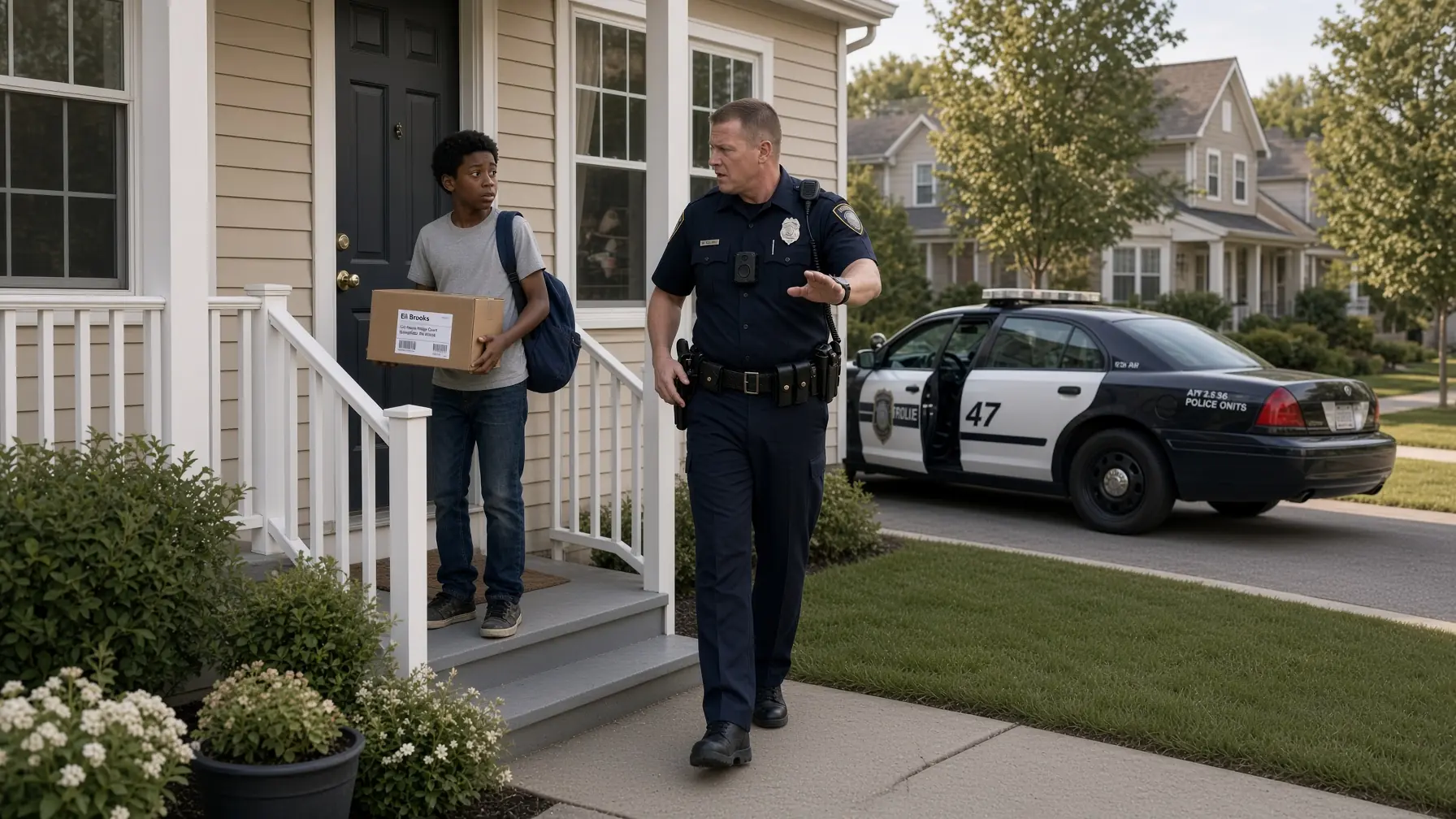
Eli Brooks had been thinking about the package since breakfast.
Not just thinking.
Counting toward it.
At twelve years old, he understood that delivery trucks did not move faster because a kid kept refreshing the tracking page. His younger brother, Tyler, had told him that twice on the bus ride home, with all the confidence of an eleven-year-old who had never spent three months saving for one thing and watching the mail like his future depended on it.
Eli knew Tyler was right.
He also refreshed the page again.
The package was supposed to arrive before dinner.
Inside was a new video game Eli had bought with his own money, and that made it feel different from birthdays, Christmas, and the small gifts adults gave when they wanted kids to say thank you quickly. He had earned every dollar cutting grass for Mr. Donnelly, carrying groceries for Mrs. Vega, and walking an old golden retriever named Biscuit after school when Mrs. Harlan’s knees got bad.
It was the first thing he had bought that felt completely his.
His name would be on the label.
Eli Brooks.
Not foster paperwork.
Not school records.
Not some old file where adults described him in careful sentences.
Just his name on a box sitting on his porch.
That mattered more than he knew how to explain.
Tyler did not fully understand that part. He loved Eli fiercely, but he moved through the world like most kids on Maple Ridge Court did, without wondering whether somebody might question why he was standing in front of his own house. He had light brown hair, pale skin, bright eyes, and the kind of easy trust that made neighbors smile before he even spoke.
Eli loved him for that.
Sometimes he envied him for it too.
Their house sat near the end of Maple Ridge, a white two-story with blue shutters, an uneven front walk, and a porch swing that squeaked whenever the wind pushed it. Eli had lived there for almost five years. He knew the loose board near the back steps, the drawer where his mother hid batteries, the smell of spaghetti sauce on Sunday nights, and the sound Tyler made when he tried to sneak cookies after bedtime.
Still, every now and then, someone looked at Eli standing outside that house and decided he was a visitor.
Or worse.
The bus dropped them two blocks away.
Tyler jumped off first, already tossing his football between his hands. Eli followed with his backpack over one shoulder and his phone in his hand, checking the tracking page again as they walked.
“Bro,” Tyler said, laughing, “you’re going to wear out the screen.”
“It says out for delivery.”
“It said that at lunch.”
“That means it’s close.”
“That means a guy in a truck is somewhere in the state.”
Eli tried not to smile.
Tyler ran ahead, spun around, and pointed down the sidewalk.
“Go long.”
“No,” Eli said.
“Go long.”
“Tyler, we’re almost home.”
“Exactly. Last throw.”
Eli rolled his eyes, then ran anyway.
He was faster than Tyler, and both of them knew it. His sneakers hit the sidewalk in quick rhythm, his backpack bouncing against his spine, the afternoon sun warm against his face. For three seconds, he forgot the package, the tracking number, the neighbors, and everything else.
He was just running.
Tyler threw the ball too hard.
It sailed over Eli’s fingertips, bounced once near the curb, and slammed into the side of a parked pearl-white sedan with a hollow metallic thud.
Both boys stopped.
The football rolled into the gutter.
The dent on Mrs. Agnes Whitmore’s driver-side door was small, but on that car, small did not matter.
Tyler’s face went pale.
“Oh no.”
Eli stared at the dent.
“Tyler.”
“I know.”
“Mrs. Whitmore’s going to lose her mind.”
“I know.”
The front door opened before either of them could move.
Mrs. Whitmore stepped onto her porch in a cream cardigan, pressed slacks, and house shoes that tapped sharply against the concrete. She was in her late sixties, narrow-faced, silver-haired, and known on Maple Ridge Court for reporting trash cans, barking dogs, loud lawn mowers, crooked mailbox posts, and children who played outside too close to what she called “the quiet hour.”
Nobody knew when the quiet hour started.
Mrs. Whitmore seemed to decide it whenever children were having fun.
Her eyes went to the dent.
Then to Tyler.
Then to Eli.
Eli felt the outcome arrive before she said a word.
“You,” Mrs. Whitmore snapped.
Tyler stepped forward immediately.
“I’m sorry, Mrs. Whitmore. I threw it. I hit your car.”
She did not look at him for more than half a second.
Her finger stayed pointed at Eli.
“You damaged my vehicle.”
“I didn’t,” Eli said. “Tyler threw the ball.”
Tyler nodded hard. “I did. It was my fault.”
Mrs. Whitmore’s face softened when she looked at him, almost tenderly.
“Oh, sweetheart, don’t lie for him.”
Tyler blinked.
“I’m not lying.”
“Yes, you are.” Her voice became syrupy, and somehow that made it worse. “You’re a good boy. I know you wouldn’t do something like that.”
Eli’s stomach tightened.
There it was.
Good boy.
As if goodness had already been assigned before the football ever left Tyler’s hand.
“I saw enough,” Mrs. Whitmore said.
“No, you didn’t,” Tyler argued. “I threw it.”
She gave him a patient smile.
“You don’t have to be scared of him.”
Eli looked down.
Tyler looked confused first.
Then angry.
“He’s my brother.”
Mrs. Whitmore laughed once, short and dry.
“Your brother?”
“Yes.”
“You live in that nice house with your mother.” She pointed toward the Brooks home. “He does not.”
Eli felt heat crawl up his neck.
“Yes, I do.”
Mrs. Whitmore’s eyes narrowed.
“Don’t talk back to me, boy.”
The word landed hard.
Not because Eli had never heard it before.
Because he knew when it was not just a word. He knew when it carried history in its mouth. He knew when an adult used it to make him smaller without needing to raise a hand.
Tyler stared at her.
“He does live there. My mom adopted him. He’s my brother.”
Mrs. Whitmore looked past him as if the explanation was inconvenient.
“I know who belongs on this street.”
For a moment, Eli wanted to tell her everything.
He wanted to tell her that his mother, Rachel Brooks, had signed every paper, sat through every hearing, showed up at every school meeting, and stayed by his hospital bed when asthma turned one winter night into a blur of alarms and oxygen. He wanted to tell her that she learned how to take care of his hair because she refused to make him feel like his body was a burden. He wanted to tell her that belonging was not something Mrs. Whitmore got to hand out from behind curtains.
But Eli had learned another lesson before most kids his age.
Some adults do not ask questions to learn.
They ask questions so they can punish the answer.
“It’s fine,” he said quietly.
Tyler turned on him. “No, it’s not.”
“I’ll fix it.”
“You didn’t do it.”
“I know.”
Mrs. Whitmore folded her arms.