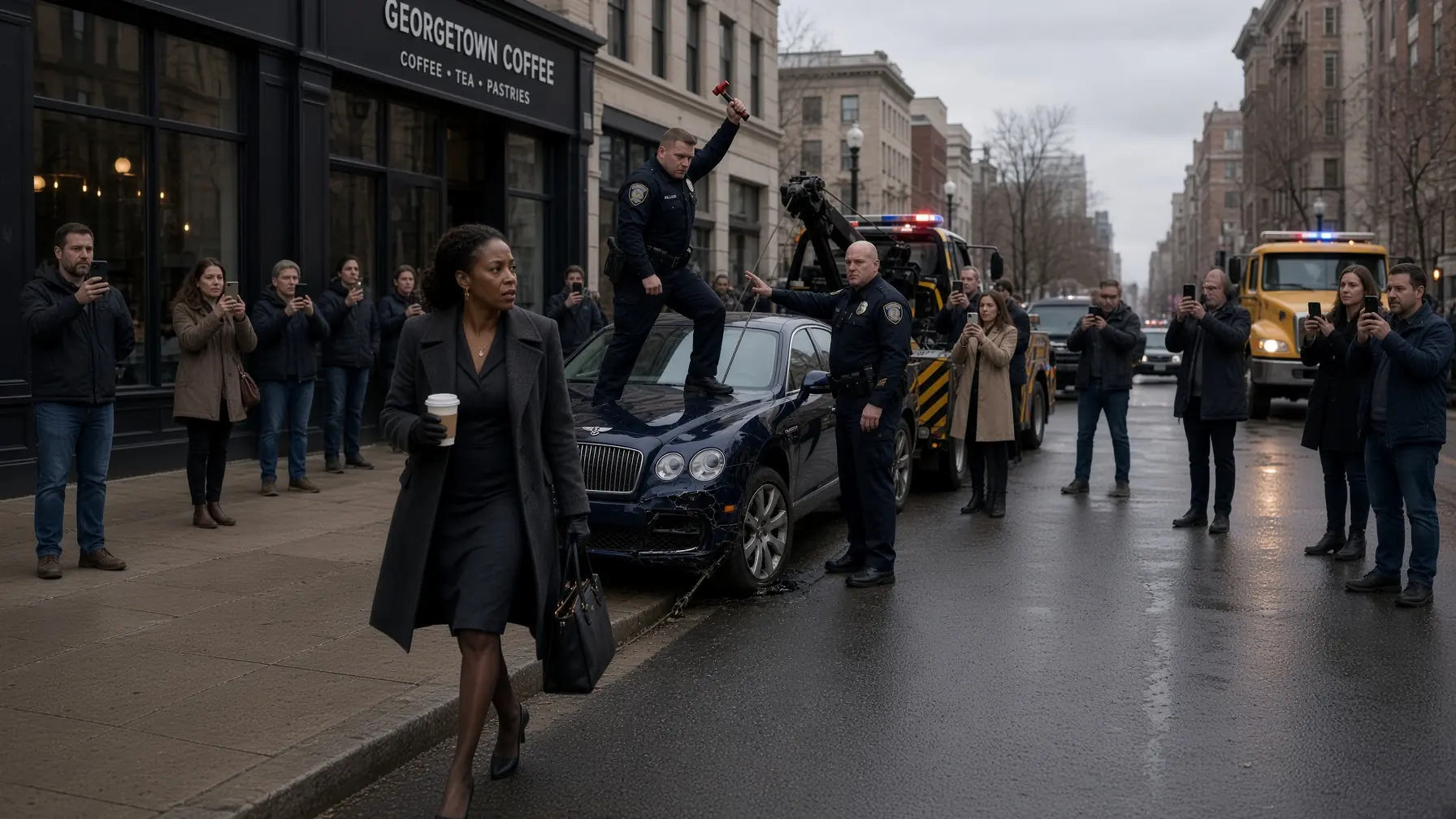
Dr. Camille Warren stepped out of a sealed intelligence briefing into the gray weight of a Washington afternoon.
The sky above the city hung low and colorless, pressing down on the rooftops like the entire capital was holding its breath. She had spent the last six hours in a windowless room beneath federal headquarters, listening to threat briefings, encrypted field updates, and quiet warnings about problems the public would never know had nearly reached them. Every voice in that room had needed something from her.
Authorization.
Judgment.
Final approval.
Now, all Camille wanted was coffee.
Not a press conference. Not another motorcade. Not another aide whispering that a senator was waiting, or that a deputy director needed three minutes, or that the word urgent had once again been abused by someone with a calendar problem. Just coffee from a small Georgetown shop where the barista knew her only as Camille, the woman who ordered black coffee and always left cash in the tip jar.
So she dismissed her detail for twenty minutes.
Her chief of staff hated when she did that.
Her security team hated it more.
But there were days when the Director of the Federal Bureau of Investigation did not want to enter a room as a title. There were days when she wanted to walk down a sidewalk, open her own car door, and exist as a private citizen for as long as the city allowed.
Camille drove herself.
The car was a deep midnight-blue Bentley Flying Spur, hand-finished, quiet as a secret, and polished so thoroughly the Washington clouds seemed to move across its hood. She had bought it for herself after a life spent earning rooms that had not been built with women like her in mind. It was not a gift from anyone. Not a favor. Not a symbol borrowed from someone else’s success.
It was hers.
That mattered more than people understood.
Camille had grown up in Cleveland with a mother who cleaned offices at night and a father who fixed city buses until his hands never fully relaxed again. She had learned early that people often decided what you were worth before you opened your mouth. At law school, classmates asked if she was in the right seminar. As a young federal prosecutor, courthouse staff mistook her for a clerk so often she stopped correcting them immediately and let their embarrassment teach the lesson later.
By the time she reached the top of the bureau, underestimation no longer surprised her.
It simply informed her.
She parked the Bentley legally near the curb, fed the meter, checked the posted sign twice out of habit, and walked into the coffee shop wearing a charcoal wool coat and low black heels. No visible badge. No security pin. No obvious symbol that she had just left a room where national threat assessments passed across the table under armed guard.
The bell above the coffee shop door rang softly.
The barista looked up.
“Afternoon, Camille. Same?”
“Please.”
She paid, took her coffee, and chose the small table by the window.
For nearly four minutes, the world asked nothing of her.
Then her phone rang.
The call came from the bureau’s counterintelligence desk, and Camille knew from the first sentence that the coffee would go cold. What should have been a quick update stretched into eighteen minutes of layered risk, a foreign liaison request, and a decision that could not wait until she returned to headquarters. When she finally stepped outside, her coffee remained forgotten beside the window.
Across the street, her Bentley was being hooked to a tow truck.
Camille stopped at the curb.
The front of the car had already been lifted half an inch. A police tow truck sat angled in front of it with steel cables looped under the frame. Two patrol cars were parked behind it, lights rotating lazily against the gray afternoon. A small crowd had formed near the sidewalk, the way crowds always form when authority turns ordinary pavement into theater.
Phones were already out.
Camille crossed quickly.
“That is my vehicle,” she said, stopping beside the nearest officer. “Please stop the tow.”
The officer did not look at her fully.
He glanced once at her coat, once at her face, then back at the tow truck driver as if the person speaking to him were background noise. He was in his thirties, broad through the shoulders, with the tired arrogance of someone who had mistaken impatience for professionalism.
“Step back, ma’am.”
“I am the registered owner of that car.”
A younger officer near the second patrol car snorted.
“Of course you are.”
Camille turned toward him slowly.
The laugh had been quiet, but not quiet enough.
“I can provide registration, insurance, and identification,” she said. “The car is legally parked. There is no basis for removing it.”
The tow driver looked toward the officer for direction.
The officer gave a small hand signal.
Continue.
The winch groaned.
The cable tightened.
The Bentley’s front suspension dipped under the strain.
Camille’s voice sharpened, though it never rose.
“Stop the truck. Now.”
Nobody stopped.
That was the moment the sidewalk changed.
The delivery driver across the street stopped unloading boxes. An elderly woman with a small white dog pulled the leash close and stared. Two college students near the corner lifted their phones higher. A man in a tan overcoat lowered his newspaper and watched with the stillness of someone recognizing a problem before the people causing it did.
Camille knew the shape of the moment.
She had lived versions of it for most of her life.
It was not only the words. It was the tone around the words. The refusal to check facts before forming certainty. The casual disbelief. The tiny delay before addressing her with respect, as if dignity needed documentation before it could be issued.
She reached slowly into her handbag.
“I am taking out my wallet,” she said clearly. “My identification and registration are inside.”
“Keep your hands where I can see them,” the younger officer snapped.
Camille paused.
The crowd heard it.
She let the silence sit long enough to mark the sentence.
“My hands are visible,” she said. “I am attempting to provide the documents you claim to require.”
A third officer walked over from the patrol car.
His nameplate read HAWKINS.
Lieutenant Darren Hawkins had a square jaw, a shaved head, and the kind of posture that suggested he expected his presence to end questions rather than answer them. He looked at Camille, then at the Bentley, then at the growing crowd.
“What’s the issue?”
“This is my vehicle,” Camille said. “Your officers are towing it without cause.”
Hawkins’s expression did not change.
“We received a report matching this vehicle to a luxury auto theft operation out of Maryland.”
“May I see the report?”
“No.”
“What is the case number?”
“That’s not your concern.”
“Did you run the VIN?”
He looked away.
That was answer enough.
“Did you run the plate?”
“Ma’am, we know how to do our jobs.”
“Then do it,” Camille said. “Run the plate, confirm the registration, and this ends in two minutes.”
The young officer laughed again.
“She thinks because she talks fancy, we’re supposed to believe she owns a Bentley.”
Camille turned toward him.
“What is your name?”
He smiled.
“Officer Mullins.”
“Badge number?”
He tapped the badge on his chest without reading it aloud.
“You got eyes.”
A woman in the crowd murmured, “That’s not right.”
Hawkins heard it.
His jaw tightened.
He stepped closer to Camille, lowering his voice just enough to pretend restraint while making sure the threat remained visible.
“You’re approaching obstruction.”
“No,” Camille said. “I am requesting lawful procedure.”
“You’re interfering with an active vehicle recovery.”
“You have not established that this is a lawful recovery.”
The tow truck jerked.