For 80 years, that line split her family's ground in half. The week it was abandoned, she was the only one at the county office.
3 mi of elevated grade, 100 years of drainage, for $1,200. Every neighbor said she'd bought herself a 3-mi headache of rust and gravel.
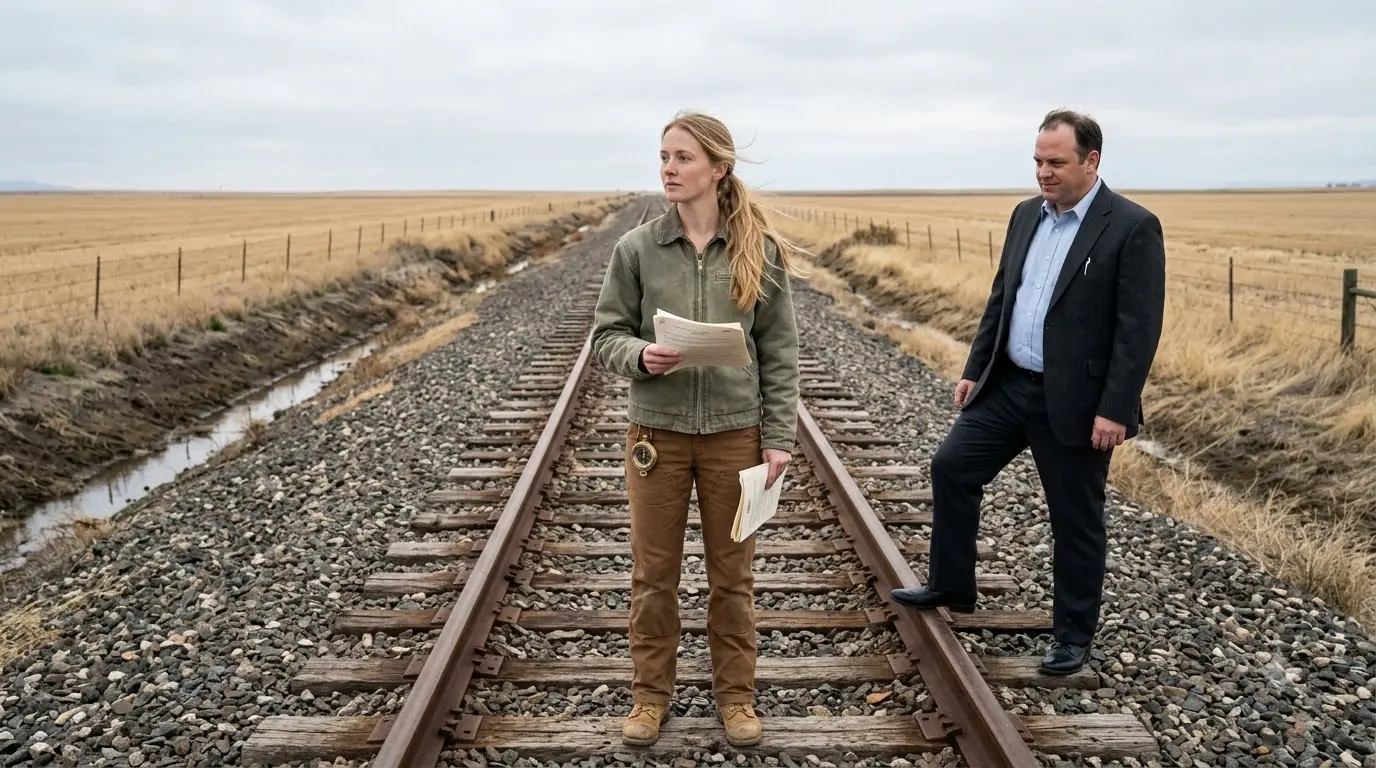
The ballast crunched under her boots like broken teeth. 3.1 mi of it, stretching north to south through the flattest ground in Harney County, Oregon. 280 acres of dry land wheat stubble on either side. And right down the middle, this raised spine of gravel and rust that the Southern Pacific hadn't bothered to run a train on since 1983.
Clara Engstrom walked the corridor with her hands in the pockets of that faded olive-green canvas jacket. A brass surveyor's compass swung from her belt loop. Her wheat-blonde ponytail caught the late October wind. Loose strands stuck to the freckles on her cheeks.
She didn't brush them away. She was counting ties. She was 24 years old, responsible for 280 acres. It had been 11 months since they put Eugene in the ground at the Lutheran Cemetery in Burns.
And already, the place felt like it was asking questions she didn't have answers for. Her father had left when she was small. Just gone one morning. His truck missing from the drive. A note on the counter that said nothing useful.
Eugene raised her after that. He taught her to read soil like a sentence and to watch water like it owed her money. He left her the farm, the tools, and the journal with its brass clasp.
That left her alone on flat ground in the high desert with wheat prices dropping and diesel going up. And not one living relative inside 400 miles. The Southern Pacific Spur Line, officially designated the Harney Branch, filed formal abandonment with the federal regulators on September 14, 1987. Paperwork went through in 6 weeks.
Nobody fought it. The corridor went up for disposition the first week of November. And Clara drove her grandfather's pickup 32 miles to the county office at 7:00 in the morning. Breath steaming in the cab because the heater hadn't worked since '84.
$1,200. That's what 3.1 miles of railroad right-of-way cost her. 60 ft wide, which works out to about 22 and 1/2 acres of land that had been maintained, graded, drained, compacted by professional railroad engineers for the better part of a century. She wrote the check from an account that had $2,100 left in it after property taxes.
The clerk looked at her like she'd ordered something off menu. Word got around fast. Small towns run on two fuels, diesel and gossip. And Clara had just handed them a full tank of the second one.
Down at the feed store in Crane, a man named Roy Kubiak said it loud enough for the whole counter to hear. 3 miles of rust and creosote. Said she'd bought herself a Superfund site for the price of a decent quarter horse. Couple others laughed.
Dale Firth, the county extension agent, clipboard man, clean truck, never seen with dirt on his knees, cornered her in the parking lot the following Tuesday. Talked for 11 minutes about contamination liability, about creosote leaching into groundwater, about how the railroad's lawyers would disclaim responsibility, and she'd be left holding a bill from the DEQ that would swallow the whole farm. He used the phrase "due diligence" four times. Clara listened with her arms crossed, pale gray-blue eyes fixed on a point somewhere past his left shoulder.
"The farm is not for sale," she said. He blinked. "I didn't say..." "I'll need a receipt for the soil test kits you mentioned," Clara replied. She walked to her truck.
He stood there with his clipboard. Holt Driscoll was the railroad's land disposition agent. Charcoal sportcoat, pale blue button-down, pressed so crisp you could cut yourself on the collar. Polished black oxfords that had never touched gravel before this assignment.
Silver pen clipped to his breast pocket like a medal he'd awarded himself. Stocky, broad-chested, dark hair thinning at the crown. The kind of man who stands military straight because he thinks posture is a substitute for respect. He'd processed the sale personally and driven out from Portland to close the file on the Harney Branch dispositions.
And when Clara walked in as the sole bidder on the corridor, he'd looked at her. Really looked. Chin tilted up. That little dimple pulling on his right cheek. And smiled.
"You understand what you're purchasing," he said. Not a question. A test. Clara set the check on the counter.
"3.1 miles, 60-ft corridor, fee simple." "The railroad spent $14,000 per mile rebuilding that grade in 1942 dollars." He clicked the silver pen once. Twice.
"You're getting it for less than a used truck. Makes you wonder why nobody else is here." That smile again. Amused. Entertained.
Like watching a dog try to open a door handle. She took her deed and left. Dusk found her walking the corridor again.
Alone this time. No clipboard men. No feed store philosophers. No railroad agents clicking their pens.
Just the crunch of ballast under her scuffed tan boots. And the wind pouring across the flat ground like water over a table. She stopped at the quarter-mile marker and crouched. Ran her fingers through the crushed rock.