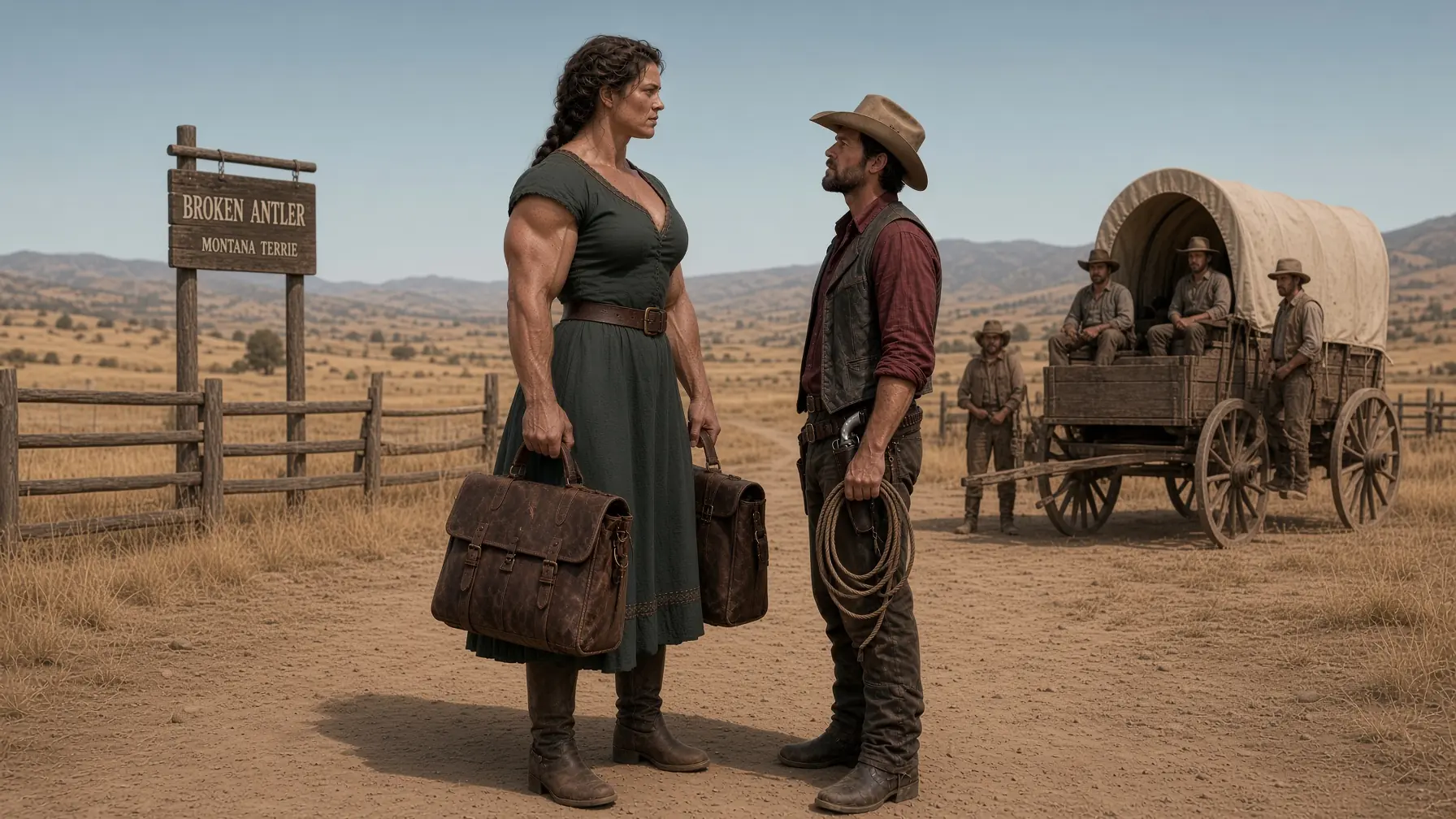
Caleb Rourke woke before sunrise to the sound of wind scraping along the loose boards of his cabin.
It came down from the Bitterroot hills cold and dry, slipping through every crack the house had collected since his father built it. The stove had burned low in the night, leaving the room gray and bitter around the edges. A tin cup rattled once on the shelf, then went still.
Caleb lay there, listening.
A horse shifted in the barn.
The north shutter tapped twice against the wall.
Somewhere past the creek, a coyote gave one short cry and then seemed to think better of it.
He sat up slowly, rubbed one hand across his face, and remembered.
His bride was arriving today.
The thought still felt like a sentence that belonged to another man.
Bride.
It sounded too soft for a place like Broken Antler Ranch.
It sounded like church bells, pressed flowers, clean gloves, and rooms with curtains that had never smelled of woodsmoke. It did not belong in a one-room cabin with a rifle above the mantel, mud by the threshold, coffee grounds in a cracked tin, and seven years of silence packed into every corner like old dust.
But Caleb had answered the Matrimonial Register anyway.
Or more honestly, Mrs. Edna Vale at the post office had pushed the paper across the counter and told him loneliness had made him bad company.
“You need a wife,” she had said.
“I need rain.”
“You need both, but I can only help with one.”
Caleb had not argued because Edna Vale had known him since he was fourteen and had the dangerous habit of being right without asking permission first.
He was thirty-nine, broad-shouldered, quiet, and too used to eating supper with only the stove for company. His parents were dead. His sister had married east. The ranch remained because Caleb remained, and most days he could not tell whether loyalty had kept him there or whether the place had simply held him too long to let go.
When Edna asked what sort of woman he wanted, Caleb had written one line.
Someone who won’t run from hard weather.
Edna read it and frowned.
“That sounds like you’re advertising for a mule.”
“It says what I mean.”
“It says you have no idea how to speak to women.”
She added the rest herself.
Montana Territory rancher. Owns land and livestock. Sober, steady, churchgoing when work permits. Seeking practical wife willing to build a household in the West.
Caleb had stared at the word practical for a long time.
He liked it.
It sounded safe.
Months later, a letter came from Nebraska.
Her name was Abigail Truett.
She wrote without ornament.
I am thirty-two.
I am tall.
I am stronger than most women men say they want, and plainer than most women men imagine.
I can mend fence, cook without complaint, splint a foal’s leg, swing an axe, ride a horse with poor manners, and keep accounts clean enough to make a banker nervous.
I do not faint.
I do not flutter.
If you want a porcelain woman to sit in a parlor and make your neighbors comfortable, do not answer this letter.
Caleb read it by lamplight.
Then he read it again after breakfast.
He told himself he admired her plainness.
Still, somewhere in his mind, he shaped her into something easier for the world to accept. Not weak. Not helpless. Just softer than the words. Maybe a tall woman, yes, but narrow at the waist, tired around the eyes, strong in the way frontier women were allowed to be strong as long as they did not make men feel small beside them.
By noon, that foolish picture would be gone.
By evening, Caleb would be ashamed that he had built it.
He missed the train.
The mistake started with the longhorn bull.
A storm had torn loose the east fence during the night, and Goliath, a red-black brute with a mean eye and the patience of a grudge, found the weakness before dawn. Caleb spent the morning in freezing mud, driving posts back into the earth while the bull paced ten yards away as if waiting for the fence to become a suggestion.
By the time Caleb washed his hands, changed his shirt, and hitched the wagon, the train had already whistled through Mercy Crossing.
He cursed once.
Then twice.
Then went back outside and stood near the gate because there was nothing else to do but wait for the shame to come down the road.
It came just after noon in Edna Vale’s wagon.
Edna drove with her bonnet tied tight beneath her chin and her mouth set in a line that promised opinions. Beside her sat a woman who made the wagon look smaller than it was.
Abigail Truett was not what Mercy Crossing had expected.
She was tall, nearly Caleb’s height, with shoulders broad enough to fill her brown wool coat honestly. Her hands were bare despite the cold, red at the knuckles from travel and work. Her face was not delicate, but it was not hard either. It had the open steadiness of land that had survived drought, plain at first glance, then larger the longer a man looked.
Two heavy valises rested at her boots.
Before Caleb could step forward, she climbed down and lifted both herself.
Edna watched his face as if she had come to collect a debt.
“Mr. Rourke,” she said, “this is Miss Abigail Truett.”
Abigail looked at him with hazel eyes that missed very little.
“You missed the train.”
Caleb cleared his throat.
“Fence broke.”
Her gaze moved past him to the east pasture.
“Bull?”
“Yes.”
“Smart one?”
“Too smart.”
She looked toward the patched fence.
“Smart animals find where men got lazy.”
Edna made a sound in her throat that might have been laughter.
Caleb lowered the hammer in his hand.
“You know fences?”
“I know what escapes when they are built poorly.”
From the road behind them came a chuckle.
Two riders had slowed near the outer fence. One was Hiram Tate from the feed store, a man who had never built anything lasting but had opinions on everything. He leaned toward the other rider and spoke loudly enough to be heard.
“That the bride? Thought Caleb ordered a wife, not another ranch hand in a skirt.”
The other man laughed.
Abigail heard it.
Of course she heard it.
Caleb saw the smallest change in her face, not surprise and not quite hurt, but the weary recognition of someone meeting an old insult in a new place.
She did not turn around.
She picked up both valises and walked through the gate.
“Where should these go?” she asked.
Caleb looked toward the cabin.
“Inside. I can carry one.”
“I have them.”
She crossed the yard, stepped onto the porch, ducked slightly through the doorway, and entered his cabin as if she had already decided the laughter outside the fence did not deserve a place beside her.
Edna climbed down from the wagon and stood next to Caleb.
“Well?” she asked.
“Well what?”
“Are you ashamed of yourself yet?”
Caleb looked at the cabin door.
He wanted to say no.
A decent man would have said no quickly.
Instead, he heard his own silence answer first.
“I don’t know what I am.”
Edna’s eyes narrowed.
“Then start by being kind until you grow into better.”
She climbed back into the wagon and drove away.
By late afternoon, Caleb understood one thing with absolute certainty.
Abigail Truett had not come west to be arranged.
She changed into work trousers, a plain shirt, and boots worn nearly smooth at the heel, then returned to the east fence without asking him. Caleb had expected her to unpack. Maybe rest by the stove. Maybe recover from the long train ride and the colder welcome waiting at the end of it.
Instead, she crouched beside the broken rail and examined the post with a practical frown.
“This split before last night.”
“Yes.”
“Then the storm only told the truth.”
Caleb blinked.
“What?”
“Rot starts quiet. Weather just makes it public.”
She took a hammer from his tool bucket and went to work.
They rebuilt the fence properly.
Not patched.
Rebuilt.
Caleb cut fresh rails while Abigail set braces. He held a post steady while she drove wedges into packed mud around the base. She did not wait for praise, and she did not pretend the work was lighter than it was.
The cold sharpened toward evening.
Their breath rose white in the yard.
They spoke only when needed.
“Higher.”
“Here?”
“Half an inch.”
“Good.”
The word startled Caleb.
Not because it was sweet.
Because it was precise.
By sundown, the fence stood square.
Goliath approached and pressed one shoulder against the new rail. The post held. The bull snorted, offended by competence, then turned away and lumbered back toward the pasture.
Abigail wiped her hands on her trousers.
“That will hold unless he learns carpentry.”
Caleb nearly laughed.
Nearly.
That night, supper was beans, fried potatoes, and salt pork.
It was too plain for a bride’s first meal and too honest for apology. Abigail ate with a clean appetite, tearing biscuits by hand and looking around the cabin between bites. She noticed everything.
“Roof leaks?”
“Back corner.”
“Chimney draws?”
“When it feels charitable.”
“North shutter taps.”
“I know.”
“Knowing is where fixing should begin, not where it ends.”
Caleb looked at her across the table.
There it was again.
Not insult.
Not scolding.
Expectation.
After supper, she washed dishes and he dried them. The kitchen was small, forcing them to learn each other’s movements sooner than either of them expected. Twice his hand reached where hers already was. Twice she moved first, not shyly, just aware.
Caleb realized marriage might be built from a thousand such adjustments.
When Abigail retired to the small back room, Caleb stayed at the table.
An envelope lay partly tucked inside her coat pocket, the corner visible where the coat hung from a peg. He did not touch it. Still, he saw the address written across the front.
Wainwright & Cole, Attorneys At Law
Omaha, Nebraska
The paper had been folded and unfolded many times.
Whatever was inside mattered.
Caleb looked away, then back, then cursed himself under his breath and stood.
She was not a package delivered by train.
She was a woman with a life before him.
He was not entitled to all of it before she offered it.
The next morning, Abigail was awake before him.
When Caleb stepped into the kitchen, the stove was already breathing properly and coffee was boiling strong enough to stand a spoon. Abigail stood near the chimney with a piece of bent wire in one hand and soot on her sleeve.
“What are you doing?”
“Correcting what you tolerate.”
“I meant to fix that.”
“When?”
He paused.
She turned.
“That was not a trick question.”
“Soon.”
“Soon is where chores go to be buried.”
Caleb stared at her.
Then, before he could stop himself, he laughed.
The sound felt strange in the cabin.
Rough at the edges.
Unused.
Abigail looked back at the stove, but he saw the corner of her mouth move.
Over the next week, Mercy Crossing made a meal of her.
That was what small towns did when they were hungry for something mean.
By Sunday, everyone knew Caleb Rourke’s mail-order bride was “large.” By Monday, she was “plain.” By Tuesday, Hiram Tate had called her “a plow horse with hair” outside the mercantile, where Edna Vale told him she hoped judgment day had a mirror.
At church, women looked at Abigail’s shoulders.
Men tried not to stare and failed.
Abigail sat beside Caleb in the third pew wearing a deep blue dress she had clearly made herself. It fit her properly, which seemed to offend people more than if it had fit badly. Her hair, dark brown and thick, was pinned low beneath her hat. She looked neither delicate nor embarrassed.
That bothered the town.
A woman named Mrs. Larkin whispered, “I suppose some men need a wife who can lift the stove.”
Abigail did not turn her head.
After service, when Mrs. Larkin dropped her hymnal and bent too slowly to retrieve it, Abigail picked it up and handed it back.
“You dropped this.”
Mrs. Larkin flushed.
Abigail’s voice had no sting in it.
That somehow made it sharper.
Caleb watched it all with a tightness in his chest.
Not because the town embarrassed him.
Because part of him recognized their first glance as a uglier version of his own. He had not mocked Abigail aloud, but silence could still reveal a man to himself if he had the courage to listen.
That recognition did not leave him easily.
On the third week, Goliath broke loose.
It happened just before dawn.
The yard was pale with frost, and the world had that brittle quiet that comes before weather changes. Caleb heard the crack of wood from the cabin and was outside before his shirt was fully buttoned.
The bull stood in the yard, black-red hide steaming in the cold.
The fence they had rebuilt had held.
The rail beside the water trough had not.
Goliath pawed the ground once. His head lowered. His horns caught the first gray light like old bone.
Caleb grabbed a rope from the porch peg.
“Stay inside,” he shouted when he heard the door open behind him.
Abigail stepped onto the porch barefoot, hair unpinned, shawl around her shoulders.
She did not stay inside.
Instead, she came down the steps slowly, one hand lifted, palm low.
“Abigail.”
“Don’t sharpen the air.”
“He’ll charge.”
“Maybe. Especially if you keep promising him he will.”
Caleb wanted to argue.
There was no time.
Goliath snorted, head lowered.
Abigail moved left, then stopped. Her whole body changed. She became quieter than stillness, her shoulders loose, her breathing slow, her voice low enough that Caleb could not make out the words.
The bull’s ears twitched.
His head lifted slightly.
Caleb stood frozen with the rope in his hand.
Abigail took one step.
Then another.
She came within ten feet.
Then six.
Caleb’s heart beat so hard he felt it behind his eyes.
“Easy,” she murmured.
Goliath shook his head once.
Abigail placed one broad hand against his shoulder.
The bull did not charge.
He exhaled.
Long and heavy.
Like weather leaving a valley.
She stroked his neck once, took the rope from Caleb without looking at him, looped it cleanly, and led the bull back through the broken rail as if he were a stubborn milk cow.
When the pen was secured, Caleb realized he had hardly moved.
Abigail examined the broken rail.
“He did not attack the strongest part. He went to the next weakness.”
Caleb stared at her.
“You could have been killed.”
“Yes.”
“You knew that?”
“Yes.”
“And you still walked toward him?”
She looked at the bull.
“He was not wicked. He was crowded.”
“That matters?”
“It usually does.”
Caleb had no answer.
After that morning, Mercy Crossing’s laughter changed.
It did not vanish. Cruelty rarely gives up after one defeat. But it became uncertain, less comfortable in its own chair. Stories traveled faster than weather, and by noon half the town had heard that Abigail Rourke had walked up to Goliath and led him home by hand.
Some doubted it.
Some added details.
Some claimed Caleb must have exaggerated to save face.
Then Hiram Tate watched Abigail lift one end of a broken wagon tongue while two men argued about leverage.
The jokes became quieter after that.
Still, another trouble had been moving beneath the surface long before Abigail arrived.
Ambrose Pritchard owned the bank in Mercy Crossing.
He owned no ranches outright, but he held paper on enough of them to make men nervous when he smiled. He wore fine black suits, kept his nails clean, and spoke in the gentle voice of a man who preferred threats to look like concern.
Ambrose had tried to buy Broken Antler twice after Caleb’s father died.
Caleb refused both times.
Ambrose did not forgive refusal.
One afternoon, Edna Vale drove to the ranch so fast her wagon wheels hit every rut in the road like a warning bell.
Caleb was splitting kindling.
Abigail was in the barn, rubbing liniment into the leg of a sorrel mare.
Edna stepped down with an envelope in her hand.
“Caleb,” she said, “read this before Ambrose Pritchard arrives pretending God sent him.”
Caleb wiped his hands and opened the envelope.
Inside was a copy of an old promissory note.
His father’s name.
A debt from twenty-three years earlier, tied to a bad cattle partnership that had nearly ruined the ranch before Caleb was grown. Caleb knew the story. His father had paid the debt in full before dying.
But the release paper had vanished.
Now Ambrose claimed the note remained valid.
With interest, it could put Broken Antler under the bank’s control.
Caleb read the paper twice.
Then a third time.
Abigail came out of the barn and took one look at his face.
“What is it?”
He told her.
Not well.
Not smoothly.
Enough.
When he finished, she removed the cloth from her hands and stood very still.
“There is more,” she said.
Edna looked between them.
“I will go inside, make coffee, and develop temporary deafness.”
She left them in the yard.
Abigail reached into her coat and pulled out the envelope from Omaha.
“I came here because I needed legal standing.”
Caleb felt something hard settle in his stomach.
“My mother left me two hundred acres outside Platte Crossing,” Abigail said. “My cousin Silas Truett is contesting the will. He claims a woman unmarried at thirty-two is unstable, unsuitable, and easily manipulated. His attorney said marriage would strengthen my claim.”
Caleb stared at her.
“You answered my ad for that.”
“Yes.”
The truth hit colder because she did not decorate it.
“When were you going to tell me?”
“Soon.”
His laugh had no humor.
“Soon is where chores go to be buried?”
She closed her eyes briefly.
“I deserve that.”
“Yes.”
He looked toward the barn.
“Were your letters lies?”
“No.”
“Was saying you meant to stay a lie?”
“No.”
“Was this marriage a bargain?”
“At first.”
The answer struck harder than denial would have.
Then she looked at him.
“But not only that. Not after I got here.”
Caleb hated how badly he wanted to believe her.
He hated more that some part of him already did.
“What is in the letters?”
“Court notices. Witness challenges. My cousin’s filings. A lawyer’s warning that time is against me.”
She handed him the packet.
“I meant to show you tonight.”
“That sounds convenient.”
“Yes,” she said quietly. “It does.”
There was no defense in her voice.
Only regret.
That made anger harder to hold cleanly.
Before Caleb could answer, a rider appeared on the road.
Not Ambrose Pritchard.
His wife.
Lydia Pritchard rode a gray mare sidesaddle, black cloak snapping behind her. She was rarely seen without gloves, composure, and her husband’s shadow. That day, she had lost all three.
Her hair had escaped its pins.
Her face was pale.
In her gloved hand was a sealed envelope.
“I need to speak to Mrs. Rourke,” she said.
Abigail stepped forward.
Lydia looked at Caleb, then toward the cabin where Edna was not even pretending to be deaf through the window.
“My husband has kept a release document hidden for years,” Lydia said. “Your father’s debt was paid, Mr. Rourke. Ambrose knew it.”
Caleb felt the yard narrow around him.
Lydia handed the envelope to Abigail.
“I copied it from his desk last night. I should have done it sooner.”
Her voice shook, but did not break.
“I told myself business was not my place. I told myself obedience was peace. I was wrong twice.”
Abigail opened the envelope.
Inside was a copy of the debt release.
Ambrose’s handwriting.
The amount paid.
The date.
Two witness names.
Enough to begin a war.
Caleb looked at Lydia.
“Why now?”
Lydia’s gaze moved to Abigail.
“Because I heard how they spoke of your wife at church. I heard my husband laugh.”
Her mouth tightened.
“Then I saw her bring that bull back while three men pretended not to admire it.”
No one spoke.
Lydia swallowed.
“I have been married twenty-eight years to a man who measures people by how easily he can frighten them. I am tired of being counted among his furniture.”
She turned her horse and rode away before anyone could thank her.
Edna stepped onto the porch with a coffee cup in her hand.
“Well,” she said. “That woman just kicked the door off the whole valley.”
Abigail folded the copy carefully.
“We need witness statements.”
Caleb looked at her.
“For my father’s release and your mother’s will.”
“Yes.”
She held his eyes.
“If you still want to stand with me in this, I will stand with you.”
The wind moved across the yard.
Caleb could have said no.
A proud man might have.
But pride, he was learning, had a talent for burning down the house while claiming to defend the door.
“We ride tonight,” he said.
Abigail’s shoulders eased by the smallest measure.
“Together?”
He looked down the road where Lydia had disappeared.
“Together.”
The next two weeks were dust, ink, coffee, sworn statements, and very little sleep.
They rode first to Judge Whitlock in Mercy Crossing, who read Lydia’s copied release and frowned so deeply Caleb wondered if the man’s face might stay that way. Then they found the old cattle partner, half-blind and living above his son’s blacksmith shop. He remembered Caleb’s father paying the note with cash, horses, and a winter’s worth of labor.
He signed a statement with shaking hands.
Abigail wrote down every detail.
Her handwriting was firm.
Better than Caleb’s.
Then Caleb rode with her to Nebraska.
Not because she asked.
Because she did not.
They reached Platte Crossing after four days of bad roads and worse coffee. Silas Truett met them at the law office wearing a smug expression that weakened when he saw Caleb beside her.
“Abigail,” he said. “You brought your rancher.”
Abigail removed her gloves.
“No. I brought my husband.”
The distinction mattered.
Caleb heard it.
So did Silas.
Inside the law office, Silas’s claim collapsed faster than he expected. The supposedly unreliable witness to Abigail’s mother’s will was an old schoolteacher named Mrs. Halloway, whose back was bent but whose mind was sharp enough to slice paper.
She recited the signing day in exact detail.
The weather.
The ink spill.
The Bible on the table.
The words Abigail’s mother used when leaving the land to the daughter who had worked it.
The lawyer had no clean place left to stand.
The land was Abigail’s.
No man’s appetite could make it smaller.
When the decision came, Abigail sat very still with both hands flat on the table.
Caleb thought she might cry.
She did not.
She only breathed out once, long and slow, like someone setting down a load she had carried so long that relief itself felt heavy.
Outside, Silas tried one last cruelty.
“You still look like a hired man in a dress.”
Caleb took one step forward.
Abigail touched his arm.
Not to stop him.
To answer for herself.
“I would rather look like work than theft.”
Silas had no reply.
On the ride back to Montana, something between Caleb and Abigail changed.
Not dramatically.
No confession beneath moonlight.
No sudden kiss in the rain.
Just small adjustments.
She handed him coffee before he asked.
He tightened her saddle cinch without making a speech of it.
They spoke more at night beside the fire. She told him about her mother, who had taught her accounts because she said numbers were harder to bully than people. Caleb told her about his father, who planted apple trees near the creek and died before they ever gave fruit.
Abigail listened.
Not politely.
Fully.
That was harder to receive than Caleb expected.
Back in Mercy Crossing, Ambrose Pritchard tried to fight.
Men like him always did.
He claimed the copied release was incomplete. He claimed Lydia had acted irrationally. He claimed Caleb had been manipulated by a “woman of questionable purpose.”
That phrase traveled through town by supper.
By morning, Edna repeated it at the post office and said, “Every small man calls a strong woman questionable when she stops being convenient.”
By noon, no one wanted to defend Ambrose loudly.
Lydia produced the original release three days later.
She did it in church.
After the closing hymn.
While everyone still stood in their pews, Lydia walked to the front, placed the document on the pulpit, and faced the room.
“My husband concealed this paper to steal land from a man whose father paid his debt,” she said. “I concealed my knowledge because comfort made cowardice look respectable. I repent of both.”
The church did not breathe.
Ambrose rose from the second pew.
“Lydia.”
She turned toward him.
“No.”
One word.
Twenty-eight years late.
Solid as stone.
Judge Whitlock took possession of the document. Ambrose’s claim died that afternoon. By the following week, three more ranchers came forward with old notes they believed had been settled. Ambrose’s ledgers began to look less like business and more like organized theft.
Mercy Crossing had never loved paperwork so much.
Abigail’s role became impossible to ignore.
She compared dates.
Organized witnesses.
Sat in the post office three evenings with Edna, a pot of coffee, and a ledger thick enough to make dishonest men sweat.
Men who had laughed at her size now stood awkwardly near the counter and asked whether she might review their papers too.
She did not gloat.
That made it worse for them.
One afternoon, Hiram Tate came to Broken Antler with his hat crushed in both hands.
Caleb saw him from the barn and nearly sent him away.
Abigail reached the yard first.
Hiram looked at her boots.
Then at her face.
“Mrs. Rourke,” he said. “I owe you an apology.”
Abigail waited.
“I laughed when you arrived.”
“Yes.”
“I said things.”
“Yes.”
“Ugly things.”
“Yes.”
Caleb leaned against the barn doorway and watched Hiram discover the discomfort of confession without rescue.
“I’m sorry,” Hiram said finally.
Abigail studied him.
“Do not say sorry so you can feel clean. Say it, then become harder to recognize.”
Hiram nodded.
“Yes, ma’am.”
She pointed toward a broken trough beside the barn.
“You can start by helping Caleb lift that.”
Hiram blinked.
Then looked at Caleb.
Caleb smiled for the first time in days.
“I would not argue.”
By winter, Broken Antler was not the same place.
The north shutter no longer rattled.
The chimney drew properly.
The east fence held even when Goliath leaned on it like an old enemy testing a treaty.
Abigail’s Nebraska land was leased to a widow and her sons under terms so fair that Edna said it would give bankers a rash. Caleb admired the way Abigail made decisions. Not soft decisions. Not sentimental ones. Just decisions shaped by knowing how close she had come to being robbed under the name of law.
Ambrose lost his bank position after the territorial inquiry.
Lydia moved into a small house near the church and began keeping books for Edna at the post office. People expected her to look broken. She did not. She looked lighter.
Silas Truett never wrote again.
No one mourned the silence.
Through all of it, Caleb and Abigail remained legally married and emotionally careful.
They shared a house.
Shared work.
Shared meals.
Shared enemies.
But trust did not arrive simply because a preacher had once said words over them. Trust came slower. It came by proof, by apology, by mornings when neither person left, by nights when anger could have hardened but did not.
On the first deep snow of the season, Caleb found Abigail in the barn beside Goliath’s stall.
The bull had gone gray around the muzzle and had developed the insulting habit of behaving better for Abigail than for anyone else. He stood with his great head lowered while she scratched the ridge between his horns.
Caleb leaned against the stall door.
“You never told me the whole truth before you came.”
“No.”
“You should have.”
“Yes.”
She did not defend herself.
He had come to value that.
“I was afraid you would refuse,” she said.
“I might have.”
“I know.”
They stood in the smell of hay, cold wood, and animal warmth.
Then she said, “I was tired of men deciding whether I was useful enough to keep.”
Caleb looked at her.
“I do not want to keep you.”
She turned.
Snowlight through the barn window softened her face. She looked strong, tired, uncertain, and more beautiful than any foolish picture his mind had once tried to make.
“What do you want?” she asked.
Caleb reached into his coat pocket.
He pulled out a ring.
Not gold.
Not silver.
A plain ring carved from apple wood, sanded smooth and oiled carefully. It was imperfect where his knife had slipped. Too wide in one place. Too narrow in another.
Abigail stared at it.
“That is not a jeweler’s ring.”
“No.”
“It may not fit.”
“I know.”
“Then why offer it?”
“Because the first thing I make for you should be honest about the man offering it.”
Her mouth trembled slightly.
Caleb held the ring between them.
“Abigail Truett Rourke, I asked for someone who would not run from hard weather because I was afraid to admit I wanted someone who might choose me when the weather cleared.”
She looked down.
“You came for legal standing,” he said. “That is true. I can live with true things.”
His voice grew rough.
“But you stayed through mud, bulls, bankers, bad coffee, gossip, and every foolish corner of me that expected you to be smaller than you are.”
A tear slipped down her cheek.
She did not wipe it away.
“I do not want you grateful,” he said. “I do not want you quiet. I do not want you trapped by law or pity. I want you beside me because this ranch breathes better when you argue with it.”
Abigail looked at the ring.
Then at him.
“Ask it plainly.”
He nodded.
“Stay. Not because you need to. Not because the law already says you did. Stay because you want to build here with me.”
She held out her hand.
He slid the ring onto her finger.
It stopped halfway.
She looked down at it.
Then she laughed.
A real laugh, deep and warm enough to fill the barn.
“We will have to make another.”
“Yes.”
“Oak next time.”
“Why oak?”
“Apple is too sentimental.”
Caleb looked at her.
Then he laughed too.
In spring, they married again.
Not for law.
That had already been done.
For choice.
They stood in the little church at Mercy Crossing with Edna Vale as witness, Lydia in the front pew, Hiram Tate quiet for once, and half the valley watching the woman they had mocked become the one they trusted to read fine print.
Abigail wore a green dress she had made herself.
It did not make her look smaller.
It made the room look insufficient.
Caleb wore his best black coat and looked so solemn that Edna whispered, “Smile, fool, before she decides you are not worth the trouble.”
He did.
Abigail saw it.
And smiled back.
When the preacher asked if Caleb took Abigail as his wife, Caleb said, “Again. This time with my eyes open.”
The church laughed.
Not at her.
With them.
There is a difference, and Abigail heard it.
Years later, people told the story poorly.
They said Caleb Rourke ordered a bride and got a woman strong enough to wrestle a bull. They said she saved his ranch, ruined a banker, beat her cousin in court, and made the men of Mercy Crossing think twice before laughing at any woman with broad shoulders.
Some of that was almost true.
But Caleb knew the real story was quieter.
A woman stepped from a wagon carrying her own bags.
A man saw her and had to face the smallness of his own imagination.
A town laughed because it did not know what to do with strength in a shape it had been taught to mock.
Then papers surfaced.
A wife told the truth.
A banker’s polished theft came apart.
And slowly, one witness, one ledger, one apology at a time, the valley learned that beauty was not always delicate, marriage was not ownership, and a woman who did not fit a man’s dream might be exactly the person strong enough to build a real life beside him.
Broken Antler grew.
A second room.
A larger kitchen.
A porch wide enough for two chairs, muddy boots, and winter silence that no longer felt empty.
The north shutter never rattled again.
Goliath grew old and selectively mean, but he let Abigail scratch his forehead when no one else was near. Caleb pretended not to notice. Abigail pretended not to care.
On cold evenings, when the wind came down from the hills and the stove held steady, Caleb sometimes opened the drawer beside the table and took out the first apple-wood ring.
Too small.
Uneven.
Honest.
He kept it to remember.
Not that he had measured wrong.
But that some lives become larger only after the old measurements fail.
And in Mercy Crossing, when a new bride arrived from the east with fear in her hands and judgment waiting on every porch, Edna Vale would point toward Broken Antler Ranch and say, “Go see Abigail Rourke.”
“She knows what to do when the world tries to make you smaller.”
Abigail usually gave the same advice.
“Let them look,” she would say.
Then she would smile in that plain, steady way of hers.
“And then let them learn.”