3 Types of Coffee That Can Boost Longevity and Help Prevent Heart Disease & Stroke
News 12/12/2025 22:38
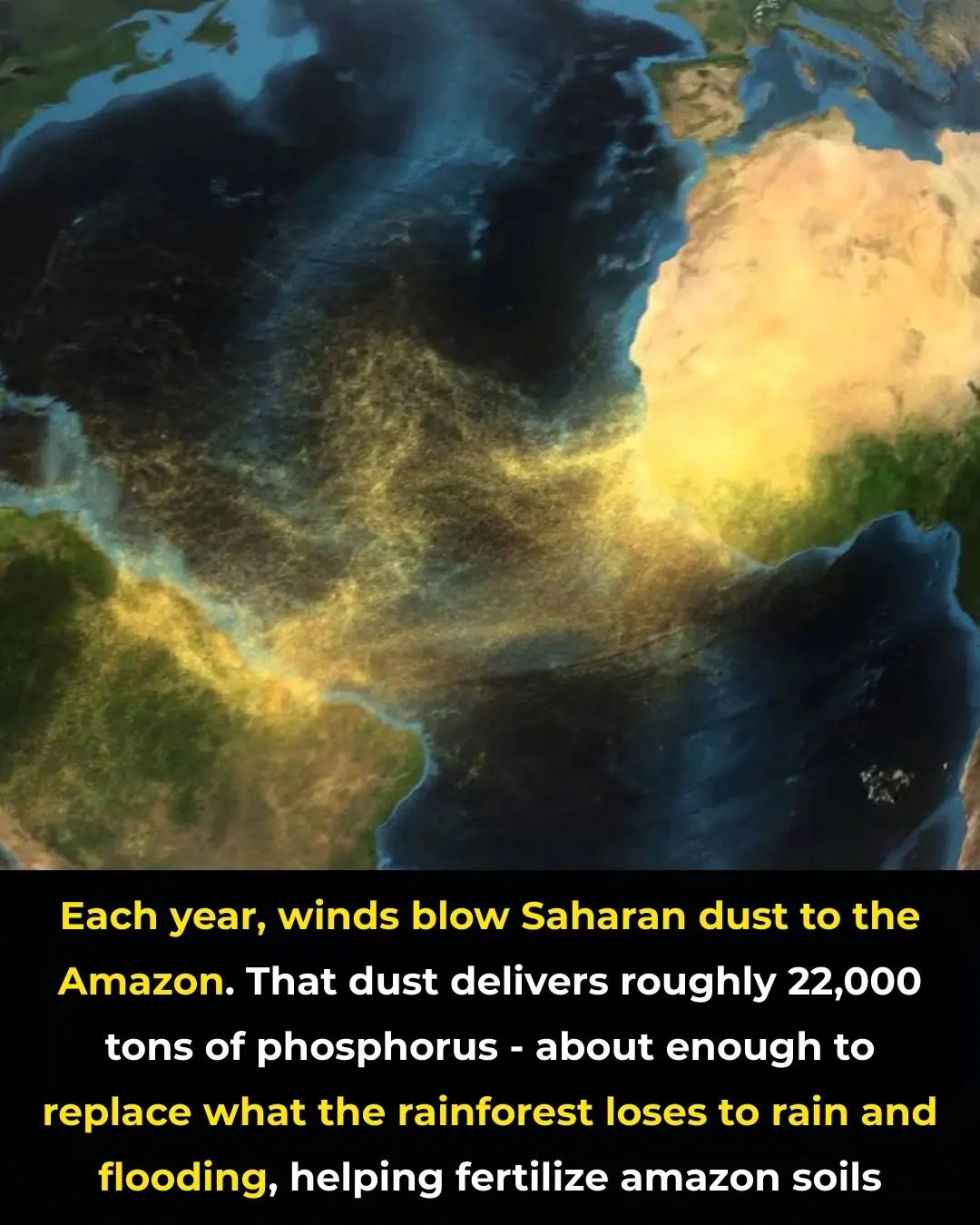
A Hidden Lifeline Connecting Two of Earth’s Most Extreme Landscapes**
From space, they couldn’t look more different:
One is the world’s largest desert — vast, dry, and hostile.
The other is the planet’s most vibrant rainforest — dense, humid, and overflowing with life.
And yet, in one of nature’s most unexpected partnerships, the Sahara Desert helps keep the Amazon Rainforest alive.
Every year, powerful seasonal winds sweep across northern Africa, lifting millions of tons of Saharan dust into the atmosphere. What happens next seems almost unbelievable:
That dust travels roughly 5,000 miles across the Atlantic Ocean…
…before falling like a nutrient-rich rain over the Amazon.
This isn’t random. It’s one of Earth’s most remarkable ecological connections — a natural conveyor belt delivering life to a place that desperately needs it.
This airborne dust isn’t just sand.
It’s filled with phosphorus, a mineral essential for plant growth.
And not just a little — about 22,000 tons of phosphorus reach the Amazon each year. Amazingly, that’s almost the exact amount the rainforest loses annually due to heavy rainfall, erosion, and flooding.
It’s as if the Sahara is refilling the Amazon’s nutrient “bank account” right when it needs it most.
From above, the rainforest looks unstoppable: endless green canopy, millions of species, and some of the richest biodiversity on the planet.
But beneath the surface lies a surprising truth:
Amazon soil is actually nutrient-poor.
Millions of years of rain have washed vital minerals out of the ground. Plants don’t thrive because of the soil — they thrive because the ecosystem constantly recycles nutrients.
Without outside reinforcement, many forest systems would slowly weaken.
That’s where the Sahara steps in.
Most of the dust making this astonishing journey comes from a specific place — the Bodélé Depression in Chad.
Long ago, this region was an enormous lake teeming with microscopic life. As the waters dried up, the remains of these microorganisms settled into the soil, creating a layer rich in phosphorus and other nutrients.
Today, intense winds whip through the area, lifting these ancient sediments into the sky — and sending them halfway around the world.
Think about it:
A desert once shaped by ancient lakes…
sends the remains of ancient organisms…
across an ocean…
to feed a rainforest that supports 10% of Earth’s species.
It’s a powerful reminder that the planet works as one interconnected system — a place where even the harshest deserts and lushest jungles depend on each other in ways we’re only beginning to appreciate.
The next time you see a satellite photo of the Sahara and the Amazon, remember this invisible thread linking them.
Two landscapes — one dry, one drenched — working together to keep life thriving.
In nature’s grand design, even the dust matters. 🌍✨