Staff Sergeant Daniel Mercer had imagined his homecoming so many times that the moment had become almost more real to him than the deployment itself.
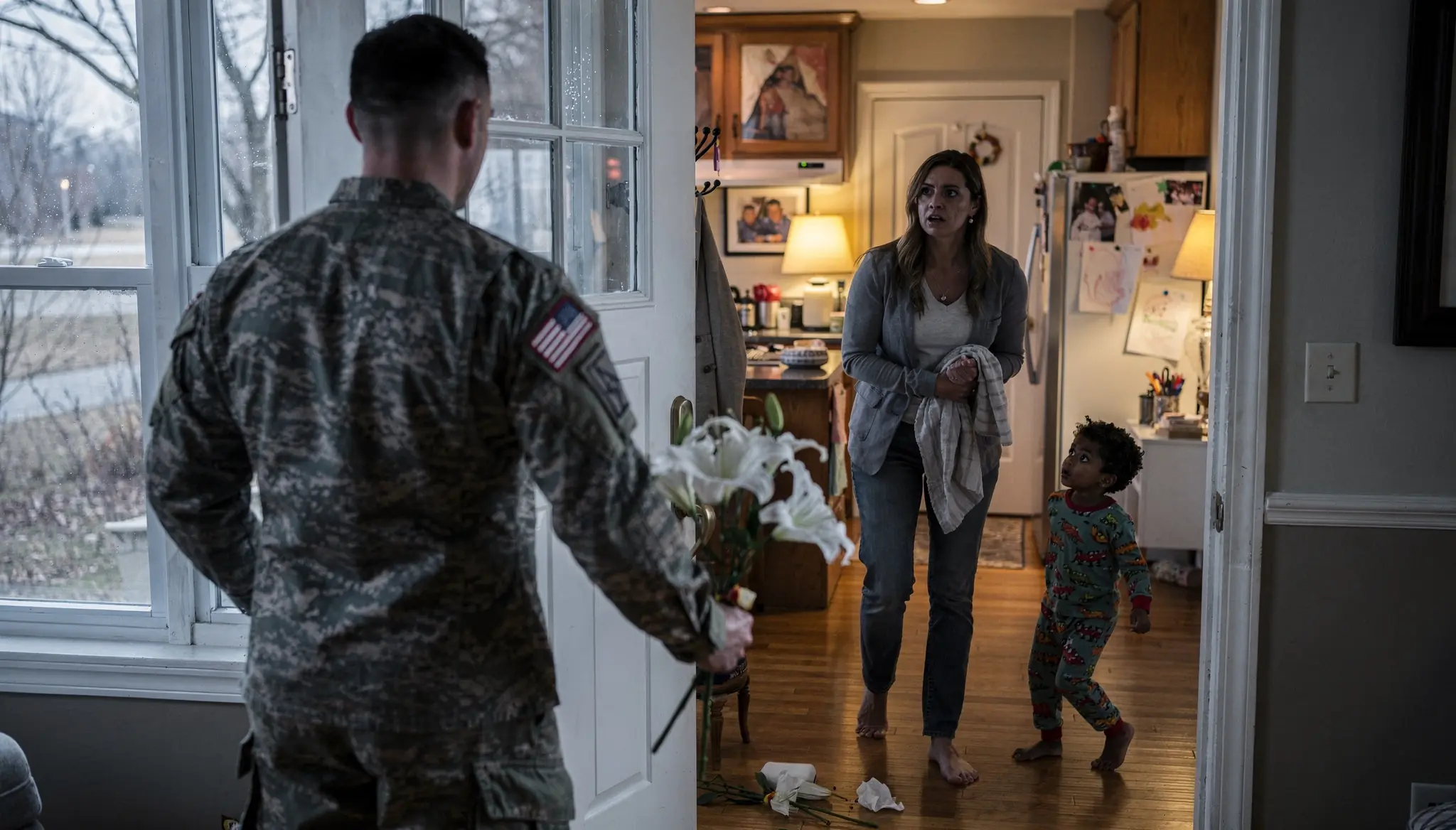
During nights when mortar fire rolled across the distant hills and the men in his unit slept in their boots, Daniel would close his eyes and picture the small blue house at the end of Willow Creek Road.
He would see the white porch railing he had promised to repaint.
He would picture the maple tree in the front yard, the crooked mailbox with MERCER written on the side in fading black paint, and the living room window where his wife used to stand whenever he pulled into the driveway.
Most of all, he imagined Emily.
He imagined her running out before he could even get his duffel bag out of the truck.
He imagined dropping everything, wrapping his arms around her, and hearing her laugh into his shoulder.
Sometimes he imagined her crying.
Sometimes he imagined himself crying too.
Daniel had been gone for almost three years.
Not continuously.
There had been a short leave fourteen months earlier, but it had lasted only six days, and nearly half of it had been consumed by travel delays, mandatory briefings, and a family emergency involving his mother.
The marriage had survived deployments before.
This one had been different.
Emily's messages had slowly changed.
At first, she wrote almost every day.
She sent photographs of the dog sleeping on Daniel's side of the bed, updates about the neighbors, pictures of the garden she had tried to start and accidentally killed.
Then the messages became shorter.
A few paragraphs turned into a few lines.
A few lines became heart emojis, weather updates, and promises that she was tired but fine.
Daniel told himself that this was normal.
Distance had its own rhythm.
People ran out of things to say.
Sometimes survival meant accepting silence without turning it into suspicion.
He refused to become the soldier who interrogated his wife over video calls.
He refused to ask why she sometimes let the phone ring.
He refused to demand explanations when she said she had fallen asleep early or had gone to help a friend.
For nearly ten years, Emily had been the person Daniel trusted most.
They had met when he was twenty-one and she was nineteen.
He had been a young private with more confidence than money.
She had been studying to become a physical therapist and working evenings at a diner just off base.
Daniel had ordered coffee four times during one shift because he couldn't think of another excuse to stay.
By midnight, Emily had finally walked over, set the coffee pot down, and said, "If you're going to keep drinking that just to talk to me, you might as well ask for my number before you end up in the hospital."
He had married her two years later.
They had survived his first deployment, his father's death, a miscarriage that neither of them knew how to talk about, and years of fertility appointments that ended with doctors using phrases like "very unlikely" and "consider alternative options."
Daniel had wanted children.
So had Emily.
But eventually they stopped talking about it.
It hurt too much.
Their house became quiet.
The dog died the year before Daniel's latest deployment.
And when Daniel left this time, the silence inside the house followed both of them in different ways.
He did not know it then.
But silence had created space for secrets.
The military transport landed shortly after dawn on a gray November morning.
Daniel stepped onto American soil carrying one duffel bag and a weight in his chest that felt strangely heavier than everything he had carried overseas.
There was no family waiting at the terminal.
He had told Emily not to come.
He wanted to surprise her.
For months, she had believed he would not return until after Thanksgiving.
His commanding officer had approved an earlier release, and Daniel kept it to himself.
He bought flowers in the airport.
White lilies.
Emily's favorite.
On the drive home, he watched familiar highways roll past the window of his rental truck.
Fast-food signs.
Gas stations.
Church billboards.
A high school football field.
Everything looked too clean.
Too ordinary.
He had forgotten how peaceful America could look from inside a moving vehicle.
By the time he turned onto Willow Creek Road, his hands were shaking.
He laughed quietly at himself.
Staff Sergeant Mercer.
Twelve years in the Army.
Three combat deployments.
And he was nervous to knock on his own front door.
The neighborhood looked almost exactly the same.
Mrs. Talbot's plastic geese still wore seasonal clothes.
The Hendersons had painted their garage dark green.