Coralee Dahlquist baked one pie a night, and she baked it at one in the morning, and she had done this every night she worked for three years and two months, which was the same length of time she had been sober, and was not a coincidence.
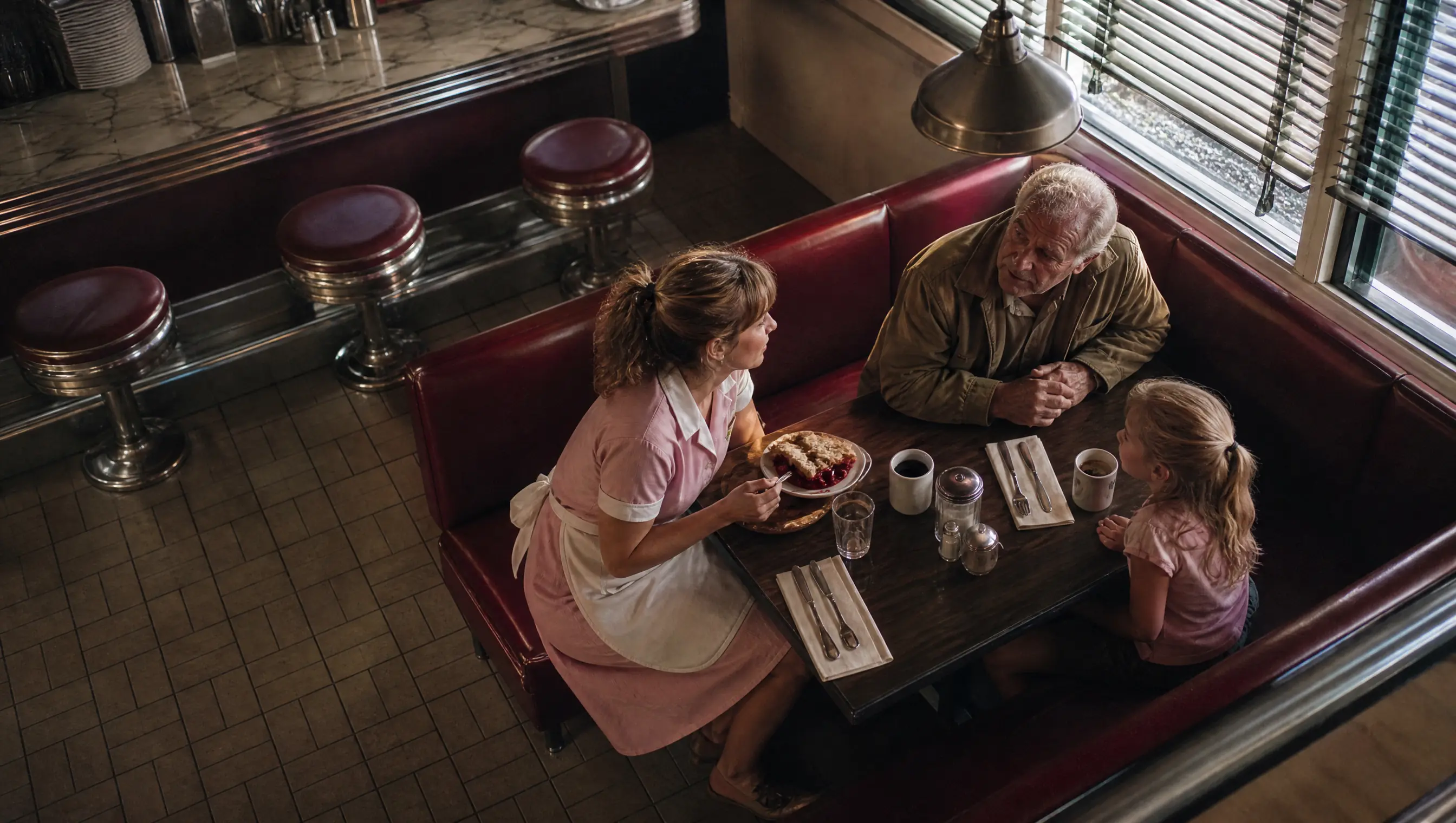
The Cattail Cafe sat on the west shoulder of U.S. 95 a mile and a half north of Hawthorne, Nevada, at the place where the highway quits the town and swings out along the edge of Walker Lake. In daylight you could see the whole long blade of the lake from the front windows, gray-green and flat, and behind it the Wassuk Range going straight up out of the water to Mount Grant, which had snow on it from October to June.
At night you could see nothing but your own face in the glass and, if a truck was coming, a pair of lights far up the road toward Schurz that took a full minute to grow big enough to matter. The cafe was open twenty-four hours because the Army ammunition depot ran three shifts, and because the long-haul men coming up from Tonopah and Las Vegas wanted somewhere to stop that wasn't a casino, and because Benicio Arrieta, who owned it with his wife Encarna, believed that a light left on at the side of a desert road was a kind of promise, and that you did not break a promise because it got late.
Coralee had the graveyard. Ten at night to six in the morning, five nights a week, Thursday and Friday off. She had asked for it. He had hired her in September of 1980 on the strength of a five-minute conversation and a piece of pie. She had brought the pie with her. She had walked in on a Tuesday afternoon with it in a pie carrier on the seat of her Chevy Nova, and she had set it on the counter and said, "I can wait tables and I can bake this, and I've got eleven days without a drink, and I'd just as soon you knew that last part now so it isn't a surprise later." Benicio had eaten a slice standing up. Then he had said, "The oven is free after midnight. The flour is mine and the sour cream is mine. You put the pie in the case in the morning and the money from it goes in a can, and the can is yours. I don't care what you do with the can." She had cried a little in the Nova afterward. Eleven days was a long time to go without crying, too.
The pie was sour cream raisin. It was her grandmother's, Grandma Hutto's, who had cooked for a hay crew outside Lovelock for thirty years and had made this pie the way other people breathed, without thinking about it and without any measuring cups. Raisins plumped in hot water until they were fat as ticks. Sour cream and sugar and egg yolks stirred over low heat in a heavy pan, never walked away from, never once, until it went thick enough to hold a line when you drew the spoon through it. A little cinnamon. A little clove, less than you think. A pinch of salt. A shell blind-baked the day before if you could manage it, the same day if you couldn't. And on top, the egg whites beaten stiff with sugar into a meringue that you pulled up into points with the back of a spoon so that, when it browned, it looked like the Wassuks in January. Grandma Hutto had called the points her mountains. "You leave the mountains on top," she used to say, "so they'll know you meant it."
The ritual was the thing, though, and the ritual was the part nobody at the Cattail understood except Benicio, who understood it without being told. At one o'clock, when the depot swing shift had come and gone and the truckers had thinned out to one or two, Coralee went back and put the raisins on to soak. By one-thirty she was stirring the filling. By two the pie was in the oven, and by two-twenty-five it was out, the mountains gone the color of toast, and it sat on the rack by the back door, where the cold could get at it through the screen. And at two-forty, which was the hour, the exact hour, at which for nine years of her life Coralee had poured her first drink of what she called the second half of the night, she cut herself one slice and sat down at the end of the counter with a cup of coffee and ate it slowly, with a fork, one bite at a time, until the hour had gone by.
Her sponsor in Fallon had told her, in the beginning, that she needed something to do with her hands at two-forty in the morning. Coralee had chosen the pie. It had worked for one thousand, one hundred and sixty-some nights. There was a a bronze coin in her apron pocket with a triangle on one side and the Roman numeral III on it, and that if she put her thumb on it she could feel the edges.
The rest of the pie went into the case in the morning. Benicio charged ninety-five cents a slice, and the depot men bought it, and the truckers bought it, and old Mrs. Seevers from the Mineral County Library bought a whole one every Saturday for her bridge club, and all of the money went into a Folgers can on the shelf above the time clock with CORALEE written on a strip of masking tape. Since August it had been paying for something else. Since August it had been paying for Mr. Halvard Quayle, attorney at law, of Maine Street in Fallon, who had an office over a saddle shop and charged forty dollars an hour and had told her, on the first visit, that he thought she had a fair shot, which was the most hopeful thing a man in a necktie had said to her since 1979.
The hearing was December ninth. Nineteen days. Coralee Dahlquist, petitioner, in the matter of the custody of Rory Lamar Dahlquist, age twelve, presently residing with his paternal grandmother, Lorene Dahlquist, at 418 Sheckler Road, Fallon, Nevada. Petitioner seeks joint legal and physical custody. Petitioner has maintained continuous sobriety since September of 1980. Petitioner is employed. Petitioner has maintained regular visitation. Petitioner has a two-bedroom trailer on Fifth Street in Hawthorne with a room painted blue that nobody sleeps in.
That last part was not in the papers. That last part was hers.