The Wyoming wind did not simply cross the plains. It clawed at them, tearing through sagebrush, rattling fence wire, and carrying dust hard enough to sting exposed skin. Jonah Mercer had listened to that wind for thirty-one years, long enough to believe it knew more about him than any living person. Out on the southern boundary of the Blackstone Claim, surrounded by cattle and open sky, silence was the closest thing he had ever known to peace.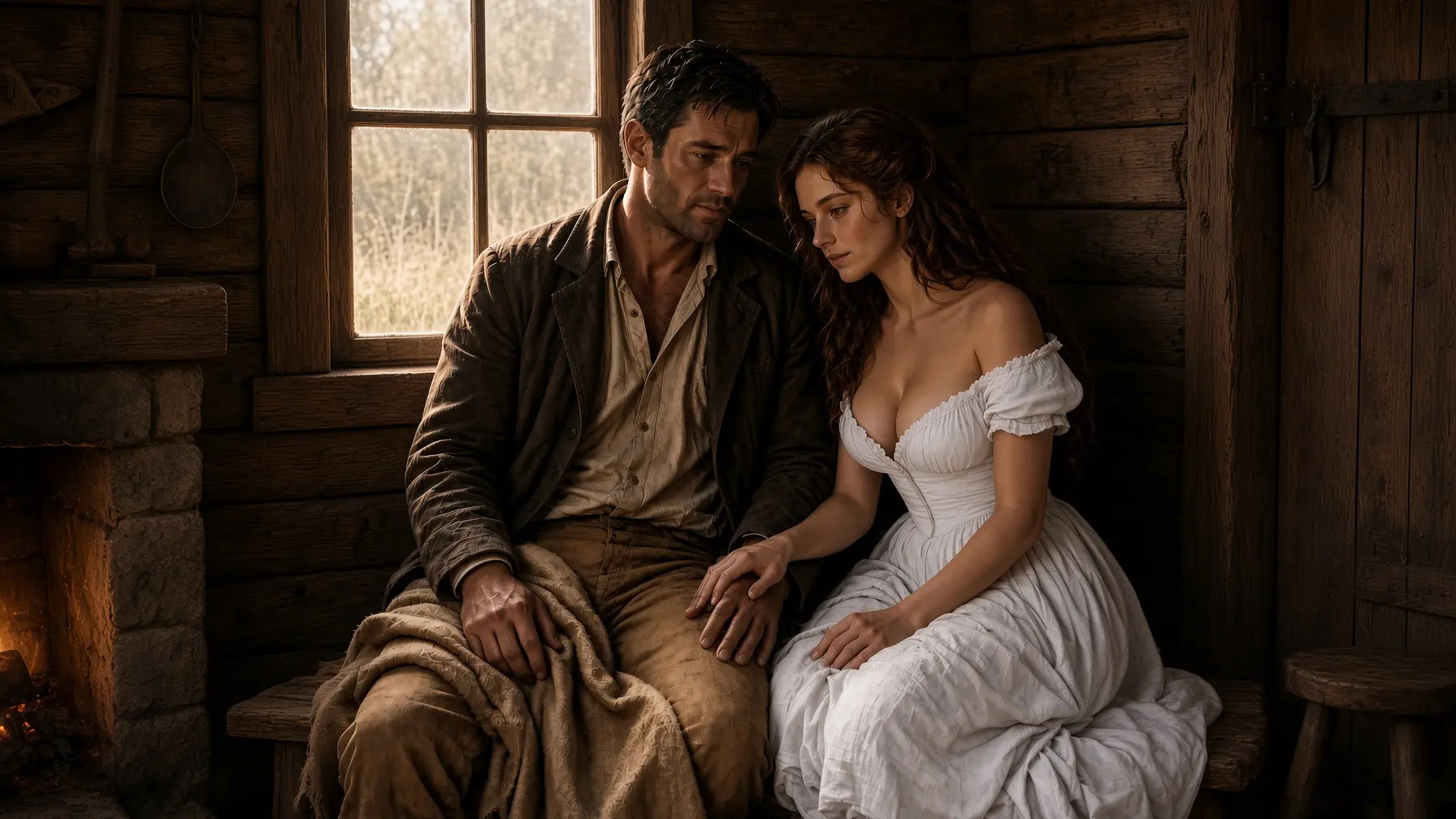
Jonah was tall, broad through the shoulders, and uncomfortable with nearly every inch of himself. Around animals, his hands moved with patience and confidence, but put him inside a room with strangers and he seemed to fold inward. His father used to call him soft because Jonah hated shouting, hated crowds, and hated looking men directly in the eye when tempers rose. What his father never understood was that Jonah feared anger precisely because he knew how much of it lived inside him.
That morning, Jonah stopped repairing fence and looked north. A wall of dust rolled along the distant ridge, too wide and steady to be weather. Thousands of cattle belonging to Gideon Rusk, the wealthiest rancher in the region, were moving toward Willow Creek. The creek ran along a disputed boundary, and whoever controlled it controlled the survival of nearly every herd in that corner of the territory.
Jonah knew what Rusk wanted. His father had left him Blackstone Ranch, but he had also left him nearly six hundred dollars in debt and several questionable filings surrounding the water claim. Gideon Rusk had quietly purchased the largest note from the bank and then convinced two land attorneys that Jonah was an unstable bachelor occupying acreage better suited to a growing cattle syndicate. If Jonah could not demonstrate that Blackstone was a permanent household rather than a temporary bachelor holding, the territorial court might let Rusk absorb the water access.
It was absurd law, but absurd law could still take land. Jonah had spent one winter evening staring at the court notice until desperation became stronger than shame. Three days later, he answered an advertisement from a matrimonial agency operating through Santa Fe. The agency arranged marriages for widowers, frontier bachelors, and women seeking to leave cities where survival had narrowed their choices.
Jonah did not write about love. He wrote that he owned eighty acres, a modest house, cattle enough to provide food, and a legal need for a wife willing to establish residency. He promised separate rooms, fair treatment, and the right to leave if either party decided the arrangement was impossible. He also sent almost every dollar he had left for train and stage fare. A month later, a letter arrived telling him Mara Bell had accepted.
He had read her reply until the paper became soft at the folds. She wrote only six sentences about herself. She was twenty-seven, capable of cooking, sewing, bookkeeping, and hard work, and had no surviving family willing to claim her. Her last line said simply, I understand this is an arrangement, and I will not expect more than you offered.
Jonah rode toward the town of Dry Creek that afternoon with the letter in his vest pocket. Storm clouds gathered over the western hills, turning the bright sky purple before he reached the first buildings. He hated town even on clear days. On a day when half the settlement already knew a mail-order bride was arriving for the awkward Mercer bachelor, every porch seemed to contain a set of eyes.
The stage was late. Jonah stood beneath the depot awning while sleet turned the dirt road into brown sludge. Across the street, several Rusk cowhands lounged beneath the saloon porch, watching him with open amusement. One raised a glass and shouted, “Hope they sent you one that talks, Mercer.”
Jonah lowered his eyes. Fighting back was always dangerous because once he started, he never trusted where the anger might stop. The town interpreted his silence as weakness. Gideon Rusk had built half his strategy around that mistake.
The stage finally emerged from the storm shortly before sunset. Horses foamed at the mouth as the driver hauled them to a stop, and two traveling salesmen jumped out and sprinted toward the hotel. Then one worn brown boot appeared beneath the coach door. A woman stepped into the rain.
Mara Bell stood beside the wheel clutching a battered carpetbag barely large enough to contain a week’s clothing. She wore a charcoal wool dress, travel-stained at the hem, and a dark shawl pulled tightly around thin shoulders. Several strands of auburn hair had escaped from beneath her bonnet and stuck wetly to one cheek. What Jonah noticed most were her eyes.
They did not search for welcome. They searched for danger. When Jonah approached, Mara’s gaze moved immediately to his hands, then his gun belt, then his face, measuring him in the careful sequence of someone who had learned survival through observation. Jonah removed his hat.
“Miss Bell?” His voice cracked slightly. Mara looked directly at him.
“Jonah Mercer?” He nodded.
“Yes, ma’am.” She tightened her grip on the bag. “Then I suppose I belong with you.”
The sentence made Jonah flinch. “You don’t belong to me.” Mara looked surprised.
Before he could explain, two women standing beneath the mercantile awning began whispering loudly enough for both of them to hear. One said Mara’s references came from a woman who ran a boardinghouse near the New Mexico border. The other laughed and said respectable women did not require references from places like that.
“Probably worked in one of those saloons.” The first woman looked Mara up and down. “Poor Mercer must be desperate.”
Jonah expected Mara to react. She did not. She simply turned her back toward the women and faced him again.
“I’m ready.” Jonah took her carpetbag.
It weighed almost nothing. The realization disturbed him more than the insults. Everything she owned in the world apparently fit inside something a child could carry.
He helped Mara onto the buckboard. When his fingers touched her elbow, her entire body locked. Jonah immediately pulled his hand away.
“Sorry.” Mara stared ahead. “It’s fine.”
The ride to Blackstone took more than two hours through mud and freezing wind. Jonah kept his attention on the horses because every sentence he considered sounded foolish before leaving his mouth. He wanted to apologize for the town. He wanted to promise that the ranch was warm and that nobody there would insult her.
Instead, he said almost nothing. Mara interpreted the silence differently. She watched the broad man beside her and wondered whether disgust explained his refusal to speak.
Men in the border settlements often went quiet right before violence. She had known smiling men who became cruel after whiskey and quiet men whose anger arrived behind closed doors. Jonah’s hands on the reins were gentle, though. He never struck the horses, even when they stumbled through deep mud.
At one difficult incline, he leaned forward and murmured, “Easy, girl, you’ve got it.” Mara looked at him from the corner of her eye. Men revealed themselves around creatures they believed could not judge them. That was one thing she trusted.
Blackstone Ranch appeared after dark beneath a break in the storm clouds. The house was small, built from weathered pine and fieldstone, with a barn leaning slightly behind it and cattle pens stretching toward the creek. Smoke rose from the chimney. Jonah pulled the wagon beside the porch.
“We’re home.” Mara climbed down before he could offer help.
The word home almost hurt. She had slept in rented rooms, storage lofts, kitchen corners, and once beneath a wagon outside Socorro, but she had not used that word seriously since childhood. She followed Jonah inside.
The main room surprised her. It was sparse but clean. A table, two chairs, iron stove, simple shelves, and no bottles scattered across the floor.
Jonah had banked the fire before leaving. He added two logs, then pointed toward a small bedroom. “That room is yours.”
Mara stared. “Mine?”
“I sleep in the loft.” Jonah rubbed the back of his neck. “I thought you’d want a door.”
Mara stepped inside. There was a narrow bed covered by a patchwork quilt, a wash basin, one chest, and curtains made from plain white cotton. On a shelf rested a roughly carved wooden horse beside a faded yellow ribbon. Mara touched the ribbon with one finger.
“Please don’t.” Jonah’s voice came sharply from behind her.
Mara spun around. Her breathing changed instantly. Jonah’s face went pale when he saw her fear.
“I’m sorry.” He crossed the room but moved toward the shelf rather than her. He shoved the ribbon and wooden horse into the drawer.
“They belonged to my mother.” His hands shook. “I should’ve moved them.”
Mara forced herself to breathe. “I didn’t mean to pry.”
“You didn’t.” Jonah closed the drawer. “Supper’s ready.”
He left quickly. Mara watched him disappear through the doorway. The panic in his face had not looked like anger.
It had looked like grief. She understood grief better. Grief, unlike cruelty, did not usually require defense.
They ate venison stew at the small table. Mara finished everything in her bowl and scraped up the last piece of potato with bread. Jonah noticed but said nothing.
She had learned never to leave food behind because meals had not always belonged to her. Outside, the wind faded until the house became almost painfully quiet. Mara began wondering when the transaction would finish.
Jonah had paid for her travel. The marriage papers waited to be signed with the circuit clerk the following week. He had fed her and given her shelter.
Every exchange in Mara’s life had eventually required payment. She understood this one too, or believed she did. After Jonah washed the dishes, Mara stood.
“Mr. Mercer.” Jonah looked over his shoulder.
“Jonah,” he corrected softly. Mara nodded.
“Jonah.” She raised one hand toward the top button of her dress. “I know what is expected.”
His expression changed. “What?”
Mara’s fingers trembled as she opened the first button. “I’m your wife.”
Jonah went completely still. Mara took another breath and forced herself not to look away.
“I can do what a wife is supposed to do.” Her voice thinned. “You paid for me to come.”
The dish towel fell from Jonah’s hand. “No.”
Mara flinched. She assumed disgust until she saw that he had backed himself against the stove.
“No.” Jonah lifted both hands, palms toward her. “Please button your dress.”
Mara stared at him. “I don’t understand.”
“I didn’t buy you.” His voice shook. “I paid your fare because you agreed to help me make a household.”
“That’s buying me with polite words.” Mara’s voice turned hard from embarrassment.
Jonah looked stricken. “Then I wrote it badly.”
He ran one hand through his dark hair. “My father took anything he wanted.”
Mara said nothing. Jonah’s breathing became uneven.
“He hit my mother.” Jonah looked toward the floor. “He believed being her husband made every part of her his.”
“I watched him become that man.” Jonah swallowed. “I’m not going to become him.”
Mara stared. Jonah finally met her eyes.
“I won’t touch you unless you ask me to.” His voice was low but steady now. “Not tonight.”
“Not next month.” Another breath. “Not ever if that’s what you want.”
“You are safe here.” Mara almost laughed because the words sounded impossible. “You don’t know that.”
“I know what I will do.” Jonah’s hands remained raised. “That is the part I can promise.”
Something inside Mara cracked. Her legs began trembling so badly she had to grip the table. Jonah took one careful step toward her and stopped.
“I don’t know how to be safe.” The confession escaped before she could swallow it. Jonah’s eyes softened.
“Neither do I.” He moved another step. “Maybe we learn.”
His hands touched her upper arms lightly. Mara could have moved away. She did not.
Instead, she leaned forward until her forehead rested against his chest. Jonah stiffened before carefully wrapping both arms around her. He held her as though holding was the only thing being asked.
That night, Mara slept with the bedroom door closed but unlocked. Jonah lay in the loft listening to her breathing below. He realized the marriage arrangement had already become more dangerous than he expected.
He wanted her. The wanting itself terrified him because desire had always been connected in his mind with his father’s cruelty. Jonah stared into the darkness and promised himself that wanting Mara would never become a reason to frighten her.
At dawn, Jonah found the front gate hanging open. Three sets of horse tracks cut across the frost. A sheet of paper had been nailed to a fence post.
He pulled it free. Sell Blackstone before month’s end or misfortune will choose for you. Beneath the words was a crude letter R.
Jonah folded the threat and put it inside his coat. Smoke was beginning to rise from the chimney. Mara was awake.
He looked toward the distant ridge where Rusk’s cattle moved like black insects against the pale horizon. For the first time in years, Jonah did not lower his eyes. Blackstone was no longer only land.
Someone was sleeping inside the house. Someone who had trusted him enough to stay. Gideon Rusk had just made the fight personal.
The first month was hard on Mara. Frontier work attacked every soft place on her body and found very few left. Water buckets blistered her palms, chopping wood split the skin between her thumb and forefinger, and saddle leather rubbed her legs raw.
She never complained. Complaining had once attracted men who enjoyed weakness. Jonah gradually taught her that hardship did not always require humiliation.
One morning, she tightened a saddle girth incorrectly. Jonah approached behind her and said, “Easy.” Mara immediately dropped the strap and stepped away.
Jonah saw the fear. He stopped. “I wasn’t scolding you.”
Mara stared. Jonah turned toward the mare and ran one hand along her neck.
“She’s sensitive around the belly.” He demonstrated. “Two fingers between leather and hide.”
Mara stepped closer. Her fingers slid beneath the cinch. Jonah did not touch her hands.
“Like that?” He nodded. “Perfect.”
Then he smiled slightly. “Animals trust you.”
Mara watched him walk away. Every day he behaved gently made her more nervous because she kept expecting a hidden price. Weeks passed.
No price appeared. Gradually, fear began losing arguments against evidence. Then Dry Creek reminded her that the world outside Blackstone remained unchanged.
They entered town for flour, nails, coffee, and lamp oil. The mercantile grew noticeably quieter when Mara walked inside. She selected a sack of beans.