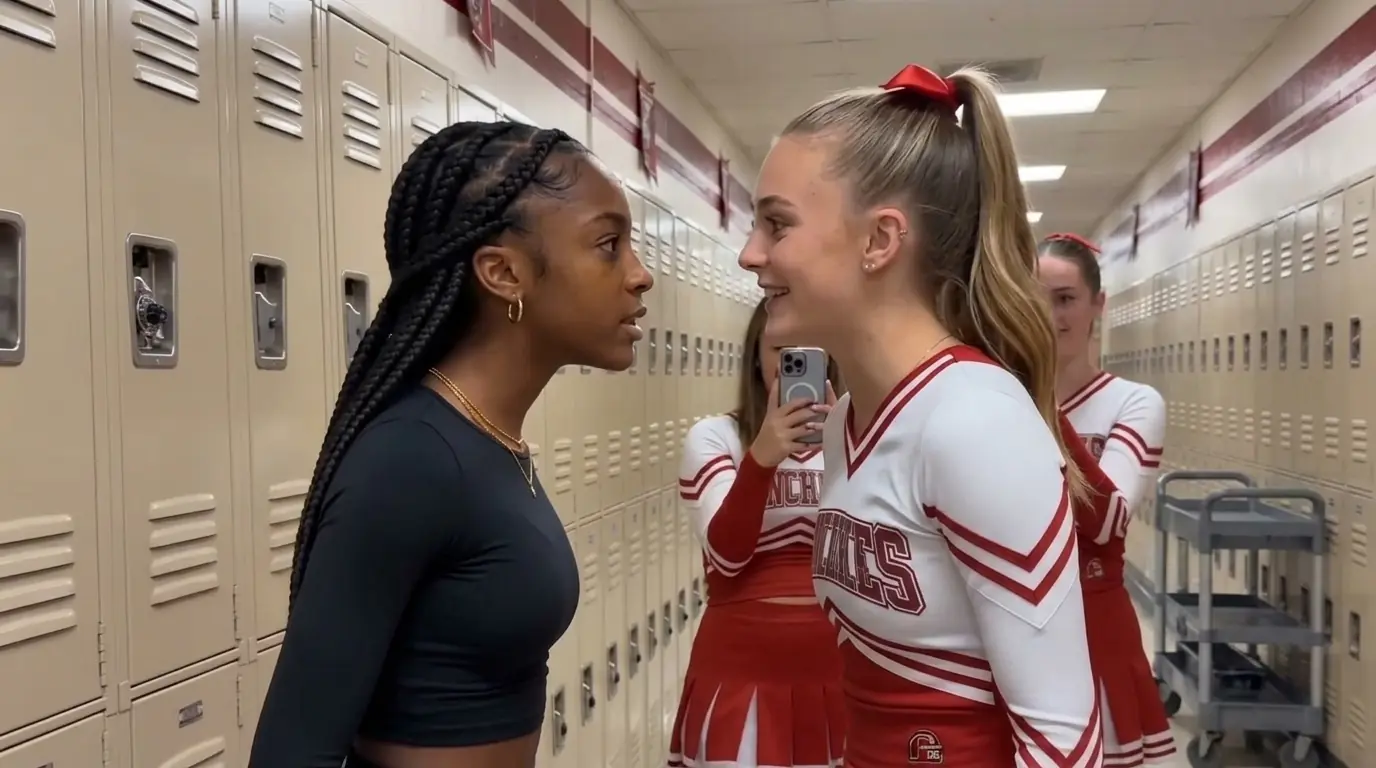
For the first three months of senior year, Zaria Bennett learned how to make herself invisible at Crestmont High School without actually disappearing. She walked quickly between classes, ate lunch with the same two people, kept her headphones around her neck without always turning them on, and never stayed in the hallway longer than necessary. She had transferred to Crestmont in August after her mother accepted a job at a rehabilitation hospital across town, and by September she understood that being the new girl was easier when nobody had a reason to talk about you. Her plan was simple: finish the year, graduate, and leave for college before Crestmont ever became important enough to hurt her.
That plan lasted until she met Samantha Pierce.
Samantha was the kind of seventeen-year-old whose name seemed to belong to the school before she did. She was captain of the varsity cheer squad, president of the senior spirit committee, and daughter of one of the women who had organized Crestmont fundraisers since Samantha was in elementary school. Teachers called her Sam, coaches trusted her with keys, and younger cheerleaders moved when she walked into a room. If Crestmont had an unofficial royal family, the Pierces would have occupied one of the front rows.
Zaria did not know any of that the first time they spoke.
She had been walking out of the girls’ locker corridor after physical education when Samantha and three cheerleaders came around the corner carrying red duffel bags. One of them almost walked directly into Zaria because she was looking backward while laughing at something Samantha had said. Zaria stepped aside, the girl recovered, and the entire group continued without apologizing. Zaria would have forgotten the moment completely if Samantha had not turned around.
“New girl.”
Zaria stopped.
Samantha looked at her from ten feet away.
“You might want to stay out of this hallway after three. Cheer practice uses the whole area.”
Zaria glanced at the lockers lining both walls.
“It’s a school hallway.”
One of the girls laughed.
Samantha did not.
“I’m just letting you know.”
“Okay.”
Zaria kept walking.
That should have been the end of it.
Instead, Samantha watched her leave with an expression Zaria did not see.
Crestmont had rules that were written in student handbooks and rules that lived entirely in people’s expectations. Samantha understood the second kind better than anybody. When she told a freshman to move, the freshman moved; when she asked somebody to save a seat, the seat remained empty; when she said a hallway belonged to the cheer squad after three, nobody usually stopped long enough to discuss public property.
Zaria had not challenged her.
That was what made it worse.
She had simply treated Samantha’s authority as irrelevant.
Two weeks later, Zaria saw her again in the cafeteria.
Zaria was sitting with Maya Collins, a girl from her AP Government class, when the cheer squad entered wearing matching red warm-up jackets. Samantha’s group occupied two tables near the windows, and the noise level around them rose almost immediately. Zaria barely noticed until Maya lowered her voice.
“Don’t look now.”
Zaria looked immediately.
Samantha was staring at her.
“What?”
Maya shook her head.
“I said don’t look.”
“That guarantees I’m going to look.”
“She’s been asking about you.”
Zaria put down her fork.
“Why?”
Maya shrugged.
“She asked Jasmine if you used to cheer at your old school.”
Zaria laughed.
“That’s weird.”
“You did, though, right?”
“For like two years.”
Maya stared at her.
“You never told me that.”
“There wasn’t much to tell.”
That was not entirely true.
At her old school in Dayton, Zaria had been on varsity cheer from sophomore year until the middle of junior year. She had loved the athletic part—the tumbling, jumps, lifts, timing, and discipline—but hated almost everything surrounding it. Her old coach allowed certain girls to humiliate younger teammates as long as routines looked good on competition day, and eventually Zaria quit after seeing a freshman reduced to tears during practice.
Leaving had cost her friends.
It had also given her peace.
She had no intention of returning.
But a week after Maya mentioned Samantha’s questions, Crestmont’s assistant cheer coach approached Zaria after gym class.
Coach Lena Ortiz was young enough that students still sometimes mistook her for a graduate assistant. She had seen Zaria perform a standing back tuck during a gymnastics unit and immediately asked where she had learned it. When Zaria explained her background, Coach Ortiz’s face lit up.
“We need another tumbler.”
Zaria laughed.
“No.”
“I didn’t even finish.”
“You were going to ask me to join cheer.”
“I was going to ask if you’d consider filling an open alternate position.”
“No.”
Coach Ortiz folded her arms.
“That was fast.”
“I’ve already done cheer.”
“And?”
“And I’m retired at seventeen.”
Ortiz smiled.
She did not pressure her again.
Unfortunately, somebody had heard the conversation.
By the next morning, half the cheer squad believed Zaria was trying to join the team without attending summer tryouts.
Samantha found her near the vending machines before second period.
“So you’re taking Rachel’s spot.”
Zaria looked around.
“Who’s Rachel?”
That answer somehow made Samantha angrier.
“Our alternate.”
“I’m not taking anybody’s spot.”
“Coach Ortiz asked you to join.”
“She asked. I said no.”
Samantha stared at her.
“Then why was she talking to you?”
Zaria almost smiled.
“You’d have to ask her.”
Samantha stepped closer.
“I’m asking you.”
“And I answered.”
For several seconds, they stood facing each other while students moved around them.
Then Samantha smiled.
It was a small, controlled smile.
“Good.”
She walked away.
Zaria watched her go.
Something about the conversation bothered her.
Not enough to report.
Not enough to worry her mother.
Just enough to remember.
Her mother, Monica Bennett, had already spent the last year fighting battles much larger than teenage social politics. After seventeen years working as a physical therapist in Dayton, Monica accepted a supervisory position in Cincinnati that paid enough to finally let her stop working weekend shifts. The move meant more money, better insurance, and a chance to save something for Zaria’s younger brother’s college fund.
It also meant uprooting both children.
Zaria had promised not to make the transition harder.
So when Monica asked about school every night, Zaria gave easy answers.
Classes were fine.
Teachers were fine.
People were fine.
Fine became a wall built one brick at a time.
The trouble might have remained small if Crestmont had not announced its Winter Spirit Showcase.
Every December, the cheer squad performed a major halftime routine during the last home basketball game before winter break. The showcase was filmed, attended by alumni, and heavily promoted because a regional athletic foundation sponsored the event. This year, representatives from two college cheer programs were expected in the audience.
Three weeks before the showcase, one of Crestmont’s strongest tumblers fractured her wrist.
Suddenly Coach Ortiz’s question became relevant again.
This time, head coach Melissa Avery called Zaria into the athletic office.
“We need someone for one routine.”
Zaria shook her head.
“I really don’t want to join the team.”
“You wouldn’t be joining.”
Coach Avery turned a laptop toward her.
“We have a tumbling sequence with three athletes. Without the third, the entire center formation collapses.”
“Change the routine.”
“We could.”
The coach paused.
“But there are fourteen girls who have worked four months on it.”
Zaria looked at the screen.
The routine was good.
Very good.
She hated that.
Coach Avery played the video again.
“You’d attend practices for three weeks. You perform one night. After that, you’re done.”
Zaria exhaled.
“Does the team know you’re asking me?”
Avery hesitated.
That was enough.
“Samantha doesn’t want me there.”
“This isn’t Samantha’s decision.”
“That wasn’t my question.”
Coach Avery leaned back.
“No. She doesn’t.”
Zaria looked toward the office door.
“Then maybe find somebody else.”
Coach Avery did not argue.
She simply said, “Think about it.”
Zaria thought about it for two days.
Maya told her not to do it.
Her younger brother, Jordan, told her absolutely to do it because he wanted to see whether high-school cheerleading was “actually a sport.”
Monica asked a different question.
“Do you want to?”
Zaria sat at the kitchen counter.
“I don’t know.”
“That usually means yes with complications.”
Zaria laughed.
“The captain hates me.”
“Why?”
“Apparently existing incorrectly.”
Monica waited.
Zaria finally told her everything.
The hallway.
The vending machines.
The rumors about the open position.
Monica listened without interrupting.
When Zaria finished, her mother stirred sugar into her tea.
“Are you afraid of her?”
“No.”
“Do you dislike her?”
“Yes.”
“That wasn’t the question.”
Zaria sighed.
“I don’t know her.”
“Exactly.”
Monica looked at her daughter.
“Don’t give somebody you barely know enough control to decide what you’re allowed to enjoy.”
That sentence made the decision for her.
The following afternoon, Zaria told Coach Avery she would do the showcase.
She regretted it by the end of the first practice.
The cheer squad was talented, disciplined, and exhausted.
Most of the girls treated Zaria politely.
Two were genuinely welcoming.
Samantha was neither.
She never openly insulted Zaria during practice.
She did something more effective.
She questioned everything Zaria did.
If Zaria landed slightly forward, Samantha pointed it out.
If she asked where she should stand, Samantha answered as though explaining something obvious to a child.
If Coach Ortiz praised Zaria, Samantha immediately corrected someone else louder.
Nobody could point to a single dramatic incident.
Together, they created an atmosphere.
Zaria understood it.
She had seen the same method at her old school.
Make the target feel unwelcome without giving her anything concrete enough to report.
One afternoon, Zaria arrived at the locker corridor and found her black practice shoes inside a trash can.
They were not buried.
They sat neatly on top.
She pulled them out.
Three cheerleaders watched from near the lockers.
One covered her mouth to hide a smile.
Samantha was tying her shoe on a bench.
Zaria held up the shoes.
“Anybody know how these got there?”
Silence.
Zaria looked directly at Samantha.
Samantha looked back.
“What?”
“You tell me.”
“I don’t touch other people’s shoes.”
“Good.”
Zaria dropped them into her bag.
“Keep it that way.”
The room went quiet.
Samantha stood.
“You accusing me?”
“No.”
“You’re looking at me.”
“You’re looking back.”
One of the girls whispered something.
Coach Avery entered before the exchange went further.
Practice continued.
That evening, somebody posted a photograph of a trash can on the team’s private group story.
The caption read: