The first laugh came from somewhere behind Eleanor Vance.
She never learned who made it.
For years afterward, when she remembered that morning in Cedar Rock, Montana Territory, she remembered everything except the face attached to that sound.
The cold dirt beneath her boots.
The smell of horses.
The wagon parked behind the auction block.
Sheriff Dugan’s thick fingers wrapped around his little wooden gavel.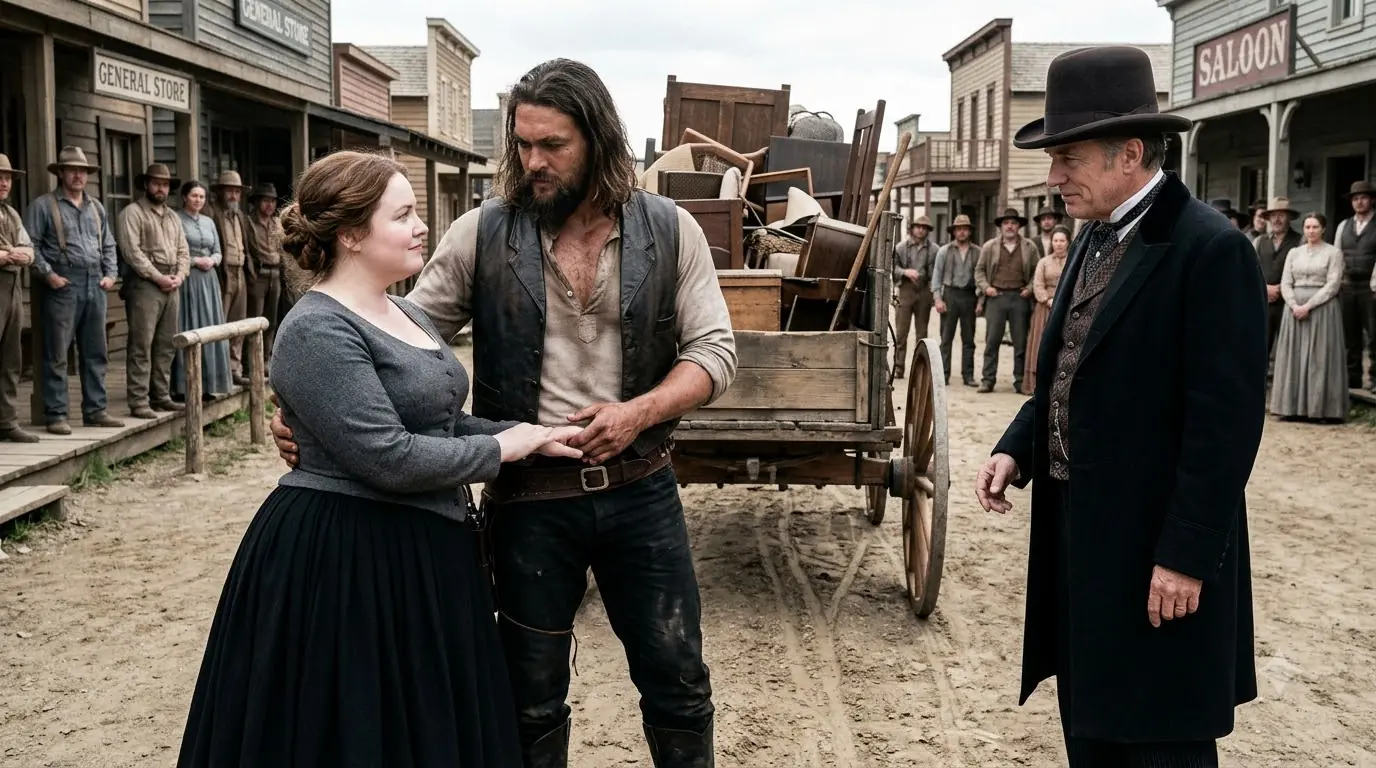
Thaddeus Blackwood standing in the front row in a black wool coat that probably cost more than Eleanor had spent feeding herself for the entire previous winter.
And the laughter.
That she remembered.
Eleanor stood alone in the middle of the main street while her life was arranged behind the sheriff like merchandise.
Two iron plows.
One seed drill.
Harness.
Hand tools.
Three dairy cows.
A wagon.
Crates containing what remained of her late husband’s equipment.
And, folded inside a leather document case resting on the auction table, the deed to the Vance farm.
The farm had been her home for fourteen years.
It had been Nathan’s dream long before it became hers.
Nathan Vance had built the first room of the farmhouse with his own hands and enough stubborn confidence to insist that one day the valley would recognize his land as some of the best ground west of the Missouri.
For a time, he had been right.
Then Nathan died.
A winter fever.
Five days from strong enough to split firewood to weak enough that Eleanor had to hold a cup against his lips.
He had been forty-one.
Eleanor thirty.
Everything after his death seemed to happen slowly until suddenly it happened all at once.
A failed crop.
Two sick cows.
A broken irrigation gate.
Interest.
Taxes.
A loan she had believed was temporary.
Then another note.
Then Thaddeus Blackwood appeared.
At first he was helpful.
That was the worst part.
He sent men to repair a washed-out ditch.
Offered an extension on a county assessment.
Introduced her to a merchant willing to extend credit for seed.
Each favor arrived with a smile.
Each smile eventually produced paper.
By autumn 1872, Eleanor owed more than she could pay.
Blackwood called it business.
Eleanor called it what it had become only when it was too late.
A trap.
Sheriff Dugan raised the gavel.
“Final opportunity.”
Eleanor looked toward him.
Dugan was not cruel by nature.
Weak, perhaps.
Too comfortable with men who had money.
Too concerned with keeping his office.
But not cruel.
That almost made it worse.
He refused to meet her eyes.
“Mrs. Vance, if payment in the amount recorded by the council is not produced today, the property listed here passes to public auction.”
Eleanor swallowed.
“I understand.”
A man near the saloon called:
“Speak louder, widow!”
Several people laughed.
Eleanor tightened her shawl.
She had always been a large woman.
Even as a girl.
Broad hips.
Full waist.
Heavy arms.
A body made for carrying flour sacks and moving furniture rather than fitting into the narrow ideal of beauty celebrated by women who spent afternoons discussing ribbons.
Nathan had loved every inch of her without apology.
After his death, that love disappeared from the room and suddenly everyone else’s judgment became louder.
Blackwood knew that.
He used it.
He stepped closer to the auction block.
“Let us move along, Sheriff.”
Dugan nodded.
“The Vance property, one hundred twenty-eight acres including primary residence, barn, water access, livestock structures—”
“Water access?”
Eleanor looked toward Blackwood.
He did not look back.
The sheriff continued.
“—shall be offered beginning at four hundred dollars.”
A murmur moved through the crowd.
Too low.
Eleanor knew it.
Blackwood knew it.
The farm was worth many times that amount in a normal sale.
But this was not normal.
Debts clouded the deed.
Winter approached.
And anyone interested in bidding understood that purchasing land Blackwood wanted was an invitation to become his enemy.
“Four hundred,” a merchant called.
“Four twenty.”
“Four fifty.”
Blackwood remained silent.
He did not need to bid yet.
Eleanor understood the performance.
Let the town believe this was a fair auction.
Let numbers rise.
Then step in.
Buy everything.
Smile.
The laughter came again.
A woman whispered something Eleanor could not hear.
A man answered:
“Who’d take the farm with her still attached?”
Another said:
“Blackwood might throw her in with the livestock.”
More laughter.
Eleanor’s cheeks burned.
She looked toward the wagon.
She could leave.
Nothing physically kept her there.
But she would not.
If they meant to strip away everything Nathan had built, they would do it while she watched.
Blackwood finally raised one gloved hand.
“Five hundred.”
Silence.
The merchant who had bid four fifty immediately looked down.
Sheriff Dugan scanned the crowd.
“Five hundred offered.”
No answer.
Blackwood smiled.
“Going once.”
Eleanor stared at him.
“Going twice.”
Then a leather pouch struck the wooden table.
Hard.
Coins spilled across the boards.
The sound stopped Dugan mid-sentence.
Every head turned.
A tall man stepped through the crowd.
Eleanor recognized him only vaguely.
Everyone in Cedar Rock knew of Jedediah Cain.
Few knew him.
Mountain man.
Trapper.
Former logger.
Hermit.
Depending on who told the story, Jed Cain had wrestled bears, killed wolves with a knife, survived avalanches, carried a wounded partner fifteen miles through snow, and once thrown three drunken miners through the same saloon window.
Eleanor suspected most of that was nonsense.
The man walking toward her was real enough.
Thirty-nine.
Perhaps six-foot-four.
Long dark-brown hair touching his shoulders.
Thick beard.
Weather-darkened skin.
A scar running along his jaw.
His black trousers and boots were mud-stained.
An open leather vest hung over a broad chest marked by old work scars.
He looked less like a legend and more like a man who had spent too many winters alone.
Jed stopped beside the table.
Dugan looked at the coins.
“What is this?”
“Payment.”
Blackwood frowned.
“For what?”
Jed finally looked toward him.
“Enough to stop the sale.”
“That isn't how this works.”
Dugan began counting.
His fingers slowed.
Then he counted again.
Blackwood stepped closer.
“Cain.”
Jed ignored him.
Dugan said:
“This covers the arrears scheduled for collection today.”
A murmur moved through the crowd.
Blackwood’s face hardened.
“Those debts are attached to the property.”
Dugan nodded uncertainly.
“Some are.”
“Some?”
Eleanor looked toward him.
The sheriff swallowed.
“The immediate tax seizure can be suspended if payment is made.”
Blackwood snapped:
“You told me the auction was final.”
Dugan looked miserable.
“I said unless payment was produced.”
Blackwood turned toward Jed.
“You intend to purchase her debt?”
Jed’s gaze finally shifted toward Eleanor.
She felt strangely exposed beneath it.
Not because he looked at her body the way some of the men in town did.
He did not.
He looked at her face.
Directly.
Then he said:
“No.”
Blackwood scoffed.
“Then what exactly are you doing?”
Jed’s voice was low.
“Keeping a promise.”
Eleanor’s heart stumbled.
“What promise?”
He looked toward her.
“Your husband asked me years ago that if something happened to him, I wasn't to let wolves strip you clean.”
Blackwood laughed.
“Very moving.”
Jed turned.
Blackwood continued.
“But she still has debts.”
“I know.”
“She can't pay them.”
Jed nodded.
“I know.”
“She has nowhere to go.”
Jed glanced at Eleanor.
Then back.
“She does now.”
The crowd became very quiet.
Blackwood looked amused.
“Is that so?”
“Yes.”
“And what do you intend to do with her?”
The question sounded dirty even without explicit words.
Several men smiled.
Eleanor felt heat climb her throat.
Jed’s expression did not change.
Blackwood continued:
“Cain, have you looked at what you're volunteering for?”
Jed stared.
Blackwood gestured openly toward Eleanor’s body.
“That's a great deal of woman to drag up your mountain.”
Laughter.
Eleanor wanted the ground to swallow her.
Instead, something unexpected happened.
Jed walked directly to her.
He stopped close enough that she could smell pine smoke and leather.
Then he offered his hand.
Not grabbed.
Offered.
Eleanor stared at it.
He said quietly:
“You don't have to take it.”
The town disappeared.
Not literally.
Eleanor still heard horses.
Still smelled dust.
Still felt dozens of eyes.
But for one moment, there was only his hand.
Choice.
She had not been offered much choice lately.
Eleanor put her hand in his.
Jed closed his fingers gently around hers.
Blackwood laughed again.
“Good Lord, Cain. You really plan to take all of that home?”
Jed slowly turned his head.
His hand remained around Eleanor's.
“I’ve spent ten winters alone in a cabin cold enough to freeze water inside the bucket.”
Blackwood smirked.
Jed glanced toward Eleanor.
“I'm not frightened by a woman who might finally keep the place warm.”
The crowd reacted.
A few laughs.
But different now.
Not cruel.
Eleanor’s cheeks flamed for an entirely different reason.
Jed looked back at her.
His expression softened.
Only slightly.
She surprised herself.
She stepped closer.
Close enough that the front of her dress brushed his vest.
“If you keep talking that way, Mr. Cain,” she murmured, “I might expect you to prove how much warmth you can handle.”
His eyes changed.
Darkened.
Eleanor's breath caught.
Jed leaned slightly toward her.
“Only if you ask me.”
Her fingers tightened around his hand.
“Then you had better listen carefully when I do.”
Someone in the crowd coughed.
Another laughed awkwardly.