On hot evenings in California’s Sacramento Valley, rice country could fool anybody who only saw it from the road.
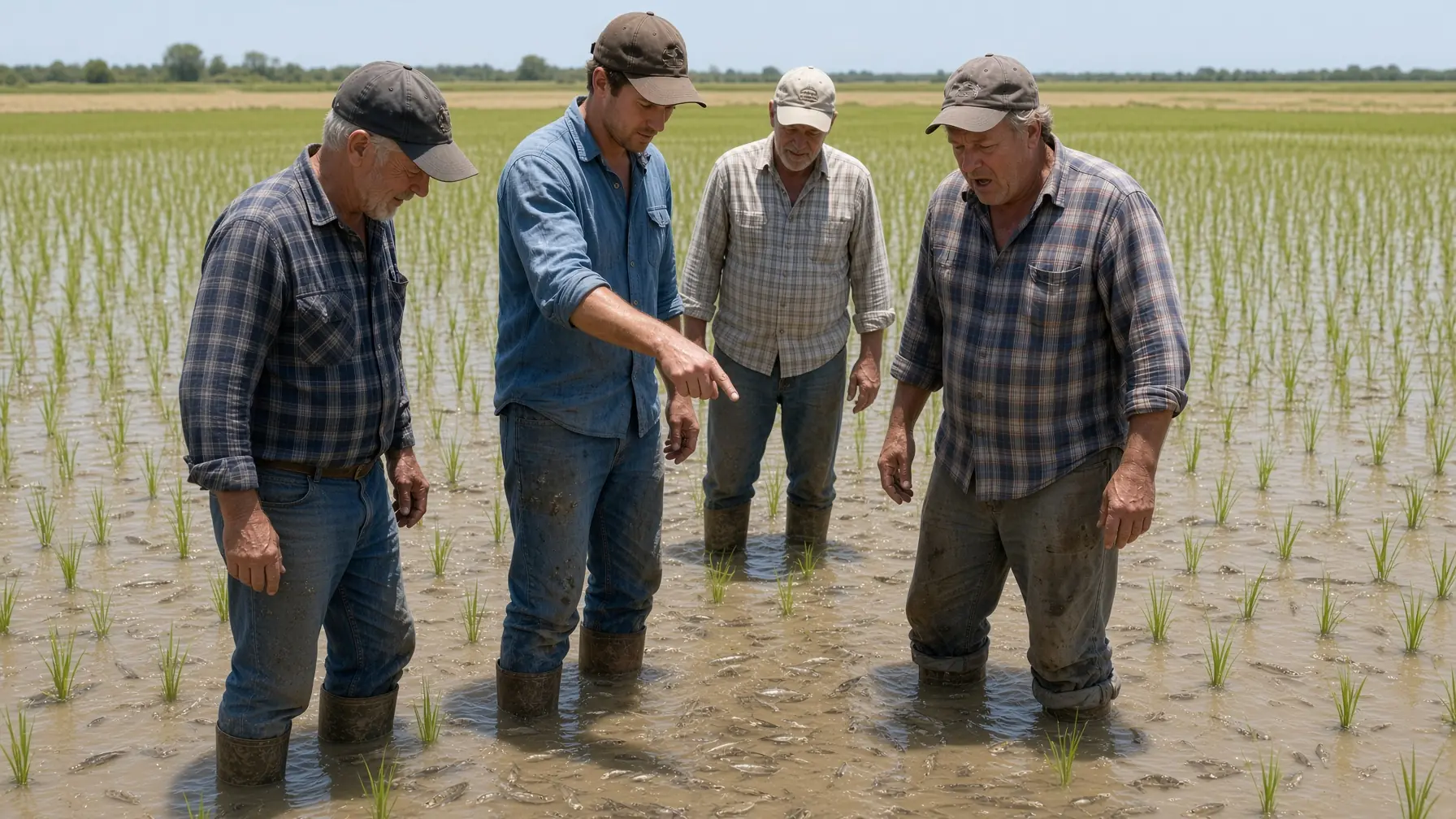
At sunset, the fields looked peaceful.
Water glimmered between rows of green rice. White egrets stood motionless along the levees. Mountains rested blue and quiet in the distance. The flooded acres reflected the sky so perfectly that tourists sometimes pulled onto the shoulder just to take photographs.
But the farmers who lived there knew what happened after the sun dropped.
The mosquitoes came.
Not the normal few that circled porch lights in July.
That summer, they rose out of drainage ditches and flooded fields in dark clouds.
They followed workers back to pickups.
They covered wrists, ears, and necks while men checked irrigation gates.
They drifted toward farmhouses.
They filled screened porches.
County mosquito-control phones rang from morning until closing.
And the mosquitoes were not the only problem.
Warm standing water also supported countless tiny organisms that most people never noticed until some of them began feeding on young rice or disturbing the balance farmers depended on.
Some growers treated once.
Then again.
Then watched pressure return.
Chemical bills climbed.
Neighbors complained.
Workers hated evening checks.
And around coffee-shop tables from Colusa to Marysville, an old sentence returned again and again.
“You can’t grow rice without fighting the water.”
Daniel Harper had heard that sentence his entire life.
He simply wasn’t sure it was true.
Daniel was twenty-seven when he returned full-time to Harper Farms outside Gridley.
His grandfather had purchased the first acreage in the 1960s. His father, Ray, expanded it slowly until the family cultivated just under six hundred acres.
Daniel had grown up there.
He knew rice before he knew algebra.
He knew how water sounded when an aluminum gate was opened correctly.
He knew the sweet, earthy smell of freshly flooded soil in spring.
He could look across young plants and tell which section was short on nitrogen before most people noticed a color difference.
He also knew how quickly a clogged drain could destroy an afternoon.
But Daniel had spent four years away at UC Davis studying agricultural systems and aquatic ecology.
That worried some people.
His uncle joked that college had taught him “how to use six words where a farmer only needs one.”
Ray Harper was less sarcastic.
But only slightly.
“Education is useful,” Ray once told him. “Right up until the tractor quits.”
Daniel understood.
His father did not dislike science.
He disliked certainty from people who had never stood ankle-deep in mud trying to repair something after dark.
So when Daniel returned with an idea involving fish, Ray reacted exactly as expected.
It started because Daniel stopped thinking about the rice field as only a crop field.
A flooded rice field was shallow aquatic habitat.
That did not mean it was wild.
Farmers controlled depth, flow, timing, drainage, and crop management.
But water created an ecosystem whether anyone wanted one or not.
Mosquito larvae lived there.
Aquatic insects lived there.
Microorganisms lived there.
Birds hunted there.
Organic material decomposed there.
Daniel’s question was simple:
If the field already behaved partly like a pond, could a carefully managed aquatic species perform some useful work inside it?
Fish.
Small ones.
Nothing exotic.
Nothing that would grow large enough to damage rice.
Fish adapted to warm shallow water and capable of feeding on mosquito larvae and other small aquatic organisms.
Daniel knew he had not invented the concept.
Integrated rice-fish systems had existed in different forms across Asia and other parts of the world for centuries.
But history did not automatically make an idea practical in California.
Different fields.
Different regulations.
Different species.
Different equipment.
Different economics.
Daniel’s father cared about exactly one question.
Would it work here?
Daniel began with a green waterproof notebook.
Across the first page he drew columns.
FIELD
DATE
WATER DEPTH
TEMPERATURE
MOSQUITO LARVAE
PEST OBSERVATIONS
FISH SURVIVAL
SPRAY APPLICATIONS
LABOR
PLANT CONDITION
YIELD
At the bottom, he added another category.
WHAT WENT WRONG
That one eventually became the most important.
Ray found the notebook on the kitchen table one morning.
“What’s this?”
“An experiment.”
“That word costs money.”
Daniel smiled.
“Not necessarily.”
“It always does when my son says it.”
Linda Harper, Daniel’s mother, sat at the table with coffee and wisely said nothing.
Daniel spread out a field map.
“One hundred forty acres on the west side.”
Ray frowned.
“The mosquito field.”
“Exactly.”
“That field also grows rice.”
“I noticed.”
Ray stared at him.
Daniel pointed toward two edges.
“I want refuge channels here and here. Slightly deeper than the rest of the field. Screens on the outlets. Once the rice is established, I stock fish.”
Ray did not speak for several seconds.
Then:
“You want to put fish in my rice.”
“One field.”
“When the water gets hot?”
“Deeper refuge channels.”
“When they clog the drains?”
“Screens.”
“When birds eat them?”
“Some will.”
Ray leaned back.
“And when all the fish die?”
Daniel shrugged.
“Then I write that down.”
Linda covered a smile with her coffee cup.
Ray pointed at his son.
“You think this is funny?”
“No.”
“You look like you're enjoying yourself.”
“A little.”
Ray looked back at the map.
“What are these fish supposed to do?”
“Eat mosquito larvae. Maybe some soft-bodied pest organisms. Stir the water. Cycle nutrients.”
“Maybe?”
“I’m not promising anything.”
“Good.”
Ray pushed the map toward him.
“Because people who promise miracles usually invoice before harvest.”
Daniel waited.
Finally Ray sighed.
“One field.”
Daniel tried not to smile.
“One season.”
“Okay.”
“You pay for the fish.”
“Fine.”
“You build whatever ridiculous little fish ditch you need without interfering with equipment.”
“Fine.”