London, March 1876.
Frost Veil House. The chandeliers burned like captive suns above the Grand Ballroom, and beneath them, the finest families of England moved in slow, glittering circles. Silk rustled against marble. White gloves lifted crystal glasses. Fans fluttered before painted lips, and behind every fan lived a whisper sharp enough to cut skin. 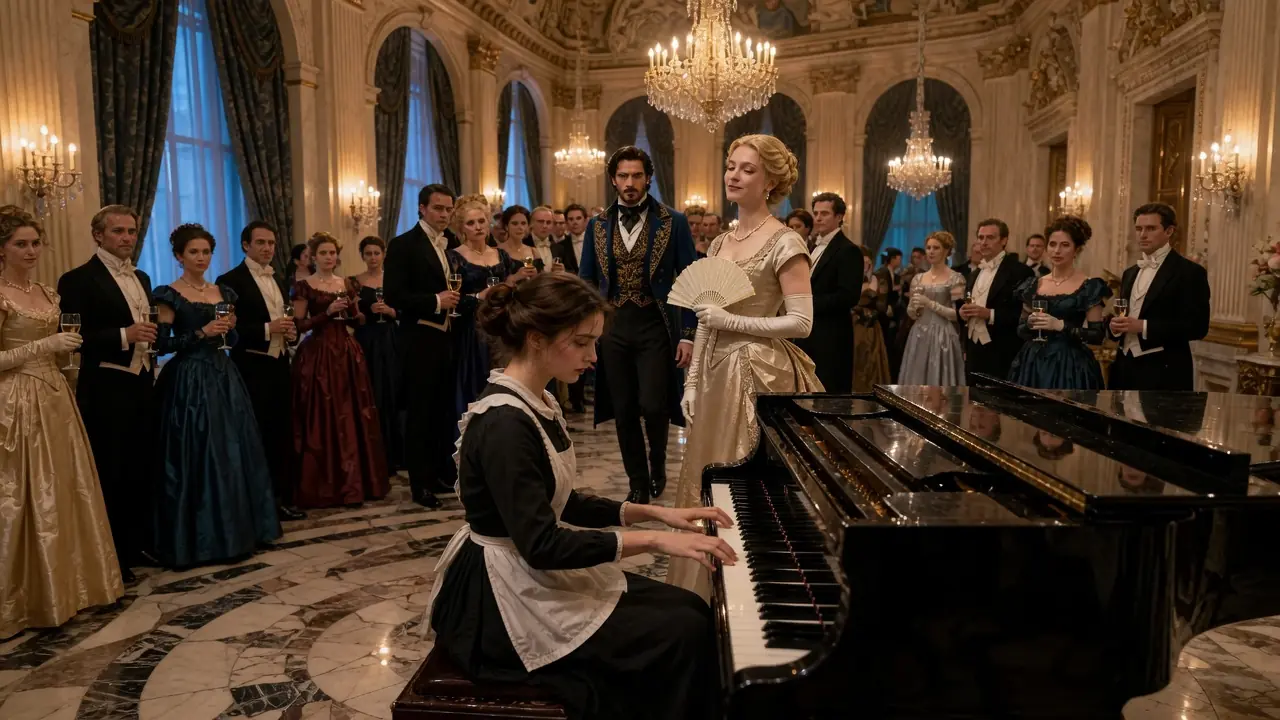
Isabel Dean stood at the edge of it all, a maid in a plain black dress and a white apron, holding a silver tray of empty glasses that trembled only slightly in her work-roughened hands. She was never meant to be noticed. Her duty that evening was simple: carry trays, lower her eyes, avoid the guests, and disappear before anyone remembered that servants had faces.
But the grand piano stood open near the tall windows, its black lacquer gleaming, its ivory keys bare beneath the candlelight. Isabelle had made one mistake—one small, human mistake—while clearing glasses from the table beside it. Her fingers had drifted, just for a breath, across the cool surface of the keys. She had not pressed them. She had only touched them the way a starving woman might touch the window of a bakery.
Lady Alice Sterling saw it. Lady Alice, gowned in champagne silk, pearls at her throat, a fan in her gloved hand—the woman every guest in that room believed would soon be Duchess of Frost Veil. Her smile formed slowly, the way frost forms on glass. Beautiful, cold, deadly.
"How charming," she said, her voice carrying across the music and laughter until both began to die. "It seems even the servants of Frost Veil are drawn to fine instruments. Come forward, girl. Don't be shy."
Isabelle's heart dropped through the floor. Every face in the ballroom turned toward her. Hundreds of eyes, bright with jewels and curiosity, settled on her apron, her pinned brown hair, and her chapped hands. Heat crawled up her neck. She knew this game; servants were not invited into the light for kindness.
"My lady, forgive me," Isabelle said quietly, eyes down. "I was only clearing the glasses."
"Nonsense." Lady Alice's fan snapped open like a blade being drawn. "You touched the keys with such longing. Surely you must play. Go on. Give us a little servant's tune—something from the kitchens. Perhaps we could all use the amusement."
The first laughter was polite, a ripple behind gloves. Then it grew. A gentleman near the punch table chuckled that a maid's fingers were better suited to polishing silver than touching ivory. A lady in emeralds laughed so hard her diamonds shivered. Isabelle stood very still in the center of that laughter, and inside her chest, something old and tired whispered the lesson she had learned all her life: *Bow your head. Apologize. Become invisible. Survive.*
Across the room, near the tall windows, stood the Duke of Frost Veil. Valkcon Frostfang wore a deep royal blue dress coat embroidered in gold, polished buttons catching the candlelight, and a dark cravat at his throat. He was tall, broad through the shoulders, his dark hair thick and waving, his beard neatly groomed, and his face carved from winter itself. He had not laughed; he had not smiled. He watched the scene with the unreadable stillness that had earned him a reputation colder than his name.
"Sit," Lady Alice said sweetly, gesturing to the piano bench as if granting a great honor. "Play for us, girl. Unless, of course, you cannot."
There was no escape. To refuse a lady before two hundred guests was its own ruin.
Isabelle set down her tray. Her legs felt like water as she crossed the floor past smirking faces and lifted lorgnettes, lowering herself onto the bench her father would have given his life to sit upon. Her hands hovered above the keys. They trembled. Somewhere behind her, a woman whispered loudly enough to be heard that this was the finest entertainment of the season.
Isabelle closed her eyes, and in the darkness behind them, she saw a small, cold room, a single candle, torn sheets of music spread across a crate, and her father's gentle voice saying again and again that music does not ask who you are; it only asks if you are listening.
Her fingers came down.
The first notes rose into the ballroom, soft and aching, like snow falling on an open grave. Not a nursery tune, not a kitchen song—a melody of such strange, sorrowful beauty that the laughter faltered, stumbled, and died. By the eighth measure, the room had gone still. By the twelfth, the Duke of Frost Veil had turned fully toward the piano, and his unreadable face was unreadable no longer. His lips had parted. His eyes, dark and guarded for so many years, were wide with something that looked almost like pain.
Because he knew this music. No one alive should have known this music. It was a Frost Veil duet—private, unfinished, believed lost for fifteen years, buried with his mother in a scandal his family never spoke of aloud.
And a maid in a white apron was playing it from memory.
The Duke crossed the ballroom. Guests stepped back from him as if from an advancing storm. He did not look at Lady Alice, whose smile had frozen into something brittle. He did not look at anyone. He reached the piano, swept back the tails of his coat, and sat down on the bench beside the trembling servant girl.
A gasp moved through the room like wind through wheat. Then the Duke of Frost Veil lifted his hands to the keys, found the second part of the duet as if fifteen years were nothing at all, and began to play beside her.
And the ballroom that had laughed at Isabel Dean fell utterly, helplessly silent, realizing far too late that the servant they had mocked had just opened a secret buried inside one of the coldest dukedoms in England.
To understand what happened at that piano, we must return to the morning of that same day, before the chandeliers were lit, before the carriages arrived, before the laughter.
Frost Veil House woke in the dark, as great houses always do. Below stairs, in the long stone kitchen where copper pots hung like dull moons, Isabel Dean was already on her knees, blacking the grate of the servants' hall fire, her sleeves rolled to the elbow and a smudge of soot along one cheekbone. She was twenty-four years old, and she had learned to make herself small in the way that only the poor truly master. Her brown hair was pinned into a practical knot, though strands always escaped near her temples—soft and rebellious, the last evidence of a girl who had once been allowed to be lovely. Her face was gentle, her eyes expressive in a way she had taught herself to hide, for expressive eyes in a servant were considered insolence. She had been at Frost Veil House for eleven months—eleven months of rising before dawn, carrying water, and curtsying to people who looked through her as if she were a window. Eleven months of pretending the name Frost Veil meant nothing to her at all, when in truth it had been carved into her family's ruin like a brand.
Maya Sutton dropped onto the bench beside her with a basket of silver to polish and a grin that could warm a cellar. "You've soot on your face again," Maya said. "If you're trying to catch the eye of the second footman, I'd suggest a different shade. He prefers his girls covered in flour."
"I'm trying to catch nothing but my breath," Isabelle said, but a small smile escaped her anyway.
Jacob Goodwin swept through the kitchen door with three chairs stacked in his arms and the put-upon expression of a man carrying the entire aristocracy on his back. He was young, neat in his footman's livery, and blessed with a tongue that would have gotten him dismissed from a stricter house years ago.
"Fair warning to all souls present," he announced. "There's to be a charity musicale tonight, which means two hundred of England's finest will descend upon us by eight. I've served at three of these now, and I can tell you with authority that aristocrats at a musicale behave worse than horses at feeding time. At least the horses don't pretend the hay is beneath them while eating all of it."
Maya threw a polishing rag at his head. Isabelle laughed—truly laughed—and then a sound from above stairs reached the kitchen, and the laugh died in her throat.
A piano being tuned. Each note struck slowly, deliberately, climbing the scale like footsteps climbing a stair she had not walked in fifteen years.
Her hands went still on the grate. Her chest tightened until breathing became a careful, deliberate act. She knew that instrument's voice the way a daughter knows her father's: the Frost Veil Grand, the piano her father had spoken of in the years before his death, in the small hours when grief loosened his tongue with a tenderness most men reserved for the dead.
Maya noticed. Maya noticed everything. "Isabel, you've gone white as the good linen."
"It's nothing. The cold."
It was not the cold, and they both knew it. But Maya did not press, because friendship below stairs was built on knowing exactly which doors to leave closed.
Above them, the great house dressed itself for the evening. Joel Barker, the steward, moved through the corridors like a man inspecting troops—his collar stiff, his shoes polished to black mirrors, his ring of keys riding his hip with quiet authority. He was not a large man, but he carried himself with the dangerous neatness of someone who believed order was a weapon. The servants feared him not because he shouted—for he never shouted—but because he remembered every error, every absence, every word.
That afternoon, Isabelle watched him do something she had seen him do a dozen times without ever truly seeing it. He paused outside the music room, tried the handle, confirmed the lock, and touched the keys at his hip as if counting them. No other room in the house received such devotion—not the silver vault, not the wine cellar. The music room.
By six o'clock, Lady Alice Sterling's carriage swept up the drive, and Frost Veil House stood at attention. She entered as if the marble had been laid for her personally—champagne silk, pearls, gloves to the elbow, a fan held like a scepter. She had visited four times that season, each time with more authority, each time speaking to the housekeeper about arrangements as though the keys of Frost Veil were already hanging at her own waist. Society had decided she would be duchess; she was merely waiting for the Duke to be informed.
And the Duke himself? Isabelle saw him only once that day, passing through the upper hall as she carried fresh candles. Valkcon Frostfang, thirty-four years old, master of one of the great fortunes of England, moved through his own house like a man walking through a museum of someone else's life. Tall, severe, beautiful in the way winter is beautiful from a distance behind glass. The servants said he had not entered the music room in fifteen years. They said he had loved his mother, the late Duchess, beyond all reason, and that when she died, the music in that house had died with her.
Isabelle pressed herself to the wall as he passed, eyes lowered, candles in her arms. He did not look at her. Of course, he did not look at her—dukes did not see maids. But as he passed, she caught the faint scent of cedar and snow, and felt, absurdly, her pulse stumble. She scolded it back into place. *Foolish heart. Foolish, suicidal heart.* Women like her did not survive noticing men like him.
That evening, as the chandeliers were lit one by one and the great house began to glow, Maya caught Isabelle's arm in the corridor. "Whatever that piano is to you," Maya said quietly, "keep it buried tonight. Houses like this one eat secrets, Isabelle. And then they eat the people who carried them."
Isabelle nodded. She intended to obey. She had no way of knowing that before midnight, the secret would claw its way out of her hands and into the light in front of two hundred witnesses, with the Duke of Frost Veil himself sitting close enough for her to feel the warmth of his shoulder against hers.
At four o'clock that afternoon, the housekeeper pressed a feather duster into Isabelle's hands and gave her the one order she had prayed for eleven months never to receive.
"The music room. Mr. Barker's unlocked it for the tuner, and it wants dusting before the guests arrive. Quick about it, girl, and touch nothing but what needs touching."
Isabelle's feet carried her up the back stairs while her heart begged them to turn around.
The music room of Frost Veil House was a cathedral of silence. Tall windows poured the gray March light across a floor of polished oak. Gold-framed portraits watched from the walls, and beneath the largest of them—a painting of a dark-haired woman with kind, sorrowful eyes—stood the grand piano. Black lacquer, ivory keys: a presence more than an instrument.
Isabelle stood in the doorway and felt fifteen years collapse. Her father's voice came back to her across all that ruin. Anthony Dean, organist, music copyist, a man whose hands had been trusted with the private compositions of a duchess. He had described this room to his daughter a hundred times by candlelight: the windows, the portraits, the piano, and one detail more—a small thing, a secret thing that he had made her repeat until she could say it in her sleep.
*Beneath the lid, near the hinge of the left side, my Isabel, there is a carving. Two letters twined together. Find them, and you will know that everything I told you was true.*
She had been nine years old when the world ended. Nine, when the men came to their cottage and spoke the word 'thief', when her father's name was dragged through every drawing room in London, when the work vanished and the money vanished, and her mother's health vanished after them. Anthony Dean had died seven years later in two rented rooms that smelled of damp, still whispering that he had never stolen anything, that he had been protecting something, that one day the music itself would speak for him.
Isabelle dusted the windowsills. She dusted the frames. She dusted everything in that room except the one thing that pulled at her like a tide. Then, because she was human, and because grief is stronger than caution, she crossed to the piano. Her fingers found the underside of the lid near the left hinge, searching, trembling—and there, worn smooth by time but unmistakable beneath her fingertips, were two letters carved into the wood and twined together like clasped hands.
Her breath broke. He had told the truth about this. About all of it. He had told the truth, and he had died with no one believing him.
She should have left then. She knew she should have left. Instead, she sat down on the bench, her hands rose to the keys on their own, and she played only a phrase. Eight notes. Nine. The opening line of the melody her father had taught her from a torn and half-burned page—the music he had guarded like a relic. It had lived in her hands all these years, silent, waiting. Now it slipped out into the room where it had been born, soft as a confession.
"Where did you learn that?"
The voice came from the doorway, low and controlled, and Isabelle's whole body turned to ice.
The Duke of Frost Veil stood there, not in his evening finery yet—only a dark coat, his cravat loose, his face very still. There was no telling how long he had been standing there. Long enough. His eyes were fixed on her hands where they rested, guilty, on his mother's keys.
Isabelle shot to her feet so fast the bench scraped. "Your Grace. Forgive me. I was sent to dust. I never meant... I should not have touched it. I beg your pardon."
"That was not my question." He came into the room slowly, the way a man approaches something he is afraid will vanish. Up close, he was taller than she had realized, and his eyes were not cold at all. They were dark, burning, and fixed on her with an intensity that made the air feel thin. "That melody. Where did you learn it?"
And here was the cliff's edge of her entire life. Tell him, and speak her father's name in the one house where that name meant 'thief'. Lie, and lie to a duke in his own music room.
"I heard it somewhere, Your Grace," she whispered. "Long ago. I don't remember where."
Something flickered across his face—disappointment, suspicion, or recognition of a lie told by someone who clearly hated telling it. He opened his mouth to press further.
"Your Grace." Joel Barker stood in the doorway, and though his voice was perfectly servile, his knuckles were white around his ring of keys. "Forgive the intrusion. This girl's duties are elsewhere. I cannot think why she is at the instrument. It will not happen again."
"She was dusting, Barker, at the housekeeper's order." The Duke's voice had gone flat and cool again, the mask sliding back into place, but his eyes moved from Isabelle to the steward and lingered there. "You came very quickly."
"I keep a close watch on this room, Your Grace. Out of respect for the late Duchess."
"Yes," the Duke said slowly. "You always have."
Isabelle curtsied and fled, her pulse hammering in her throat, the feather duster clutched like a shield. But at the turn of the corridor, she glanced back just once. The Duke had not moved. He stood beside the piano, one hand resting on its black lid, staring down at the keys as if they had spoken to him in a voice he had buried fifteen years deep.
And Joel Barker was watching the Duke with an expression no servant should ever wear. Not deference—fear.
That night, the chandeliers were lit. The carriages came. Lady Alice Sterling heard from a steward's careful whisper that a certain maid had been found at the late Duchess's piano, and in the glittering cruelty of her mind, an entertainment began to take shape. The trap was set. The maid was mocked. The room laughed. And then the maid played, and the Duke crossed his own ballroom and sat down at her side, and the laughter died forever.
Return now to the ballroom, to the moment the laughter began, and see it this time from inside the trap.
Lady Alice Sterling had planned the evening like a general plans a battle. She had heard from Joel Barker, in the careful, deniable way that information moved between the steward and the woman he intended to serve as duchess, that a maid had been found seated at the late Duchess's piano—found *playing* it. The insolence of it was a gift. Alice had spent four seasons waiting for Valkcon Frostfang to do his duty and propose—four seasons watching his cold courtesy and telling herself it was devotion in disguise. A small, public lesson in the natural order of things would entertain the guests, flatter her own authority in his house, and remind the Duke that a duchess defends what is hers. So when she saw the same maid's fingers drift across the keys that evening, she did not see an accident. She saw an opening.
"Come forward, girl. Don't be shy."
You have heard the laughter already, but understand what it was like to stand inside it. Isabelle stood in the blazing center of two hundred amused aristocrats, and the laughter pressed against her skin like heat from an open oven. It was not honest laughter; it was the laughter of people relieved that tonight, at least, the cruelty had found someone else.
"Play for us," Lady Alice said, and her smile was a masterpiece—gracious to every guest, a blade to the woman it was aimed at. "A little servant's tune. We are all friends of charity tonight, are we not? Consider it your contribution."
Isabelle looked once, only once, toward the tall windows. The Duke stood there in blue and gold, and his face told her nothing. He did not intervene. He watched.
And something in Isabelle—something that had been bowing and apologizing and shrinking for fifteen years—quietly broke.
*Let them laugh,* the broken thing whispered. *But let them laugh at the truth.*
She sat. She breathed. She remembered the candle, the torn pages, her father's hands over hers, and she played his music in the house that had destroyed him.
The melody rose, sorrowful, strange, and beautiful. The laughter thinned, the whispers stopped, silk stopped rustling, and somewhere a glass was set down and no one lifted another. Isabelle's back straightened. Her chapped, work-roughened hands moved across the keys with a certainty that no scullery could explain. And the woman the room had mocked vanished, and in her place sat someone none of them could name.
Valkcon Frostfang stood by the windows and felt his entire careful world tilt. He knew it in four notes. By eight, his chest had seized. It was his mother's duet—the piece she had played on summer evenings with the door open to the garden, the piece she had never finished, the piece that had vanished in the scandal that poisoned his family's grief. Every page of it gone, presumed stolen, presumed destroyed. He had spent fifteen years refusing to enter the room where it had lived. He had buried it so deep he believed it gone even from his own hands. And now it poured from the fingers of a housemaid, note for note, with the same gentle hesitation his mother had used at the turn of the seventh bar. Not an approximation, not a memory of a memory—the thing itself.
He was moving before he decided to move. The crowd parted for him. He saw Lady Alice's triumphant expression curdle into confusion at the edge of his vision and did not care. He reached the piano. The maid's eyes lifted to his—wide and terrified, brown and bright with unshed tears—and her hands faltered on the keys.
"Don't stop," he said quietly.
He sat down beside her. The bench was small. His shoulder came against hers, warm through silk and wool, and he felt her tremble, and felt something in himself tremble in answer, which had not happened in so long that he had forgotten the sensation had a name. Then he lifted his hands and joined her.
The second part of the duet rose beneath the first—deep where hers was bright, grieving where hers was tender, two halves of one buried thing finding each other across fifteen years of silence.
Isabelle's breath caught. He heard it. He felt her gather herself, felt her music open to make room for his. And then they were no longer a duke and a maid; they were two pairs of hands inside one piece of music, moving together, answering each other, and the great ballroom of Frost Veil House stood in absolute, ringing silence around them.
Isabelle had played this melody a thousand times alone. She had never once heard it whole. Tears slid down her face, and she let them fall, because her father had copied these very harmonies by candlelight, and now they filled a ballroom, and the man playing them beside her was the son of the woman who had written them.
The duet reached the place where the manuscript had always ended—mid-phrase, unfinished, a sentence broken off forever. They stopped together on the same suspended chord.
Silence. Complete, unbearable silence.
The Duke turned his head and looked at her, and in front of two hundred witnesses, the coldest man in England looked at a maid as if she were the answer to a question he had stopped asking years ago.
"What is your name?" he asked.
"Isabelle, Your Grace. Isabel Dean."
She saw it strike him. *Dean.* The name from the old scandal, the name his family had cursed. His face went through grief and shock and something darker, swift as weather, and then closed.
Across the ballroom, Lady Alice Sterling's fan had stopped moving. And by the service door, unnoticed by every guest, Joel Barker stood gripping his keys, his neat face the color of ash, looking at Isabel Dean as a man looks at his own gallows being built.
The Duke rose, bowed to the room as if nothing extraordinary had occurred, and ordered the musicians to resume. But the evening was already ruined and remade. Nothing at Frost Veil would ever be the same.
By morning, the story had escaped the house, and stories, once escaped, grow teeth in the drawing rooms of Mayfair. Ladies told one another over chocolate that the Duke of Frost Veil had abandoned Lady Alice Sterling in the middle of her own triumph to sit at a piano with a servant. Some said the maid had bewitched him. Some said she was an actress planted for scandal. One countess declared with great satisfaction that the Frostfang blood had always run strange, and now everyone could see it.
Below stairs at Frost Veil House, the kitchen had divided like a parliament. Half the servants treated Isabelle with an awed new respect; the other half drew their skirts aside when she passed, as if ambition were contagious.
"They're saying you've enchanted him," Maya reported, plunking down beside Isabelle at the long table with two cups of tea, one of which she pushed firmly into Isabelle's cold hands. "Cook says you must have gypsy blood. The second housemaid says you've been practicing in secret to trap a husband. And the hallboy says—and I quote him exactly—that it was the most beautiful thing he's ever heard, and he doesn't care who knows it. The hallboy is now my favorite person in this house, present company accepted."
Isabelle managed half a smile, but her hands would not warm. She had not slept. Every time she closed her eyes, she felt the Duke's shoulder against hers, the heat of him through her sleeve, the way his eyes had changed when she said her name. She had spent eleven months being invisible; now the whole of London was looking at her, and most of it with knives.
Jacob slid onto the bench opposite, glancing at the door first, his usual humor banked low. "There's something you ought to know," he said quietly. "The night before the ball, I was up late fetching wine for Barker—his orders, mind. Only when I came back up, I saw him coming out of the archive room—the locked one off the music room. Past one in the morning, carrying papers. And when he saw me, he looked like I'd caught him robbing graves. Told me to forget it. I'm constitutionally incapable of forgetting things I'm told to forget."
The archive room. Isabelle's pulse quickened. Her father had spoken of it; the late Duchess's compositions had been kept there, every page he had ever copied.
Before she could answer, the kitchen door opened, and silence fell like a dropped sheet. Joel Barker stood there, immaculate, his eyes finding Isabelle with the precision of a hawk finding a mouse.
"Dean. With me."
He led her to the steward's room and did not invite her to sit. For a long moment, he simply looked at her, and Isabelle understood that this man had decided she was an enemy long before last night.
"I knew your father," he said at last, softly. "A clever man. Clever men forget that this house has destroyed better than them. You made a spectacle of yourself. You embarrassed Lady Sterling, and you have caught His Grace's eye, which you imagine is fortune. It is not. Servants who reach above their station fall, Dean, and they fall from a very great height. Keep to your floors and your fires, and perhaps you will still have a roof in summer."
Every word was a hand pressing her head back down into the dark. Isabelle lowered her eyes, curtsied, said, "Yes, Mr. Barker," and hated herself for the smallness of her own voice.
Upstairs, a different battle was being fought. Lady Alice had arrived at eleven, uninvited, gowned in cream and fury. She found the Duke in his study and did not trouble with grace.
"You will dismiss her," she said, "today. The girl made fools of us both. London is laughing, Valkcon—at me, who only offered the room a harmless amusement, and at you, who sat down beside a servant like a lovesick music master. Dismiss her, and by Friday this is a story about a duke's eccentric kindness. Keep her, and it becomes something neither of us will survive."
The Duke stood at the window with his hands clasped behind him, and for a long moment he said nothing, because he was discovering with cold clarity exactly what he thought.
"The amusement was not harmless," he said. "It was cruelty, and it was yours. The girl will stay."
Alice's fan creased in her grip. She left with her smile intact and murder behind it. On the stairs, she passed Joel Barker. Their eyes met for one held breath, and an old, silent partnership stirred awake.
That evening, the Duke sent for Isabel. She came to the library with her heart in her throat, certain of dismissal despite everything, because her life had taught her that hope was simply pain that had not arrived yet.
He stood by the fire. The light moved in his dark hair and caught the gold thread of his waistcoat, and when he turned, his eyes on her were not a master's eyes at all, and her breath misbehaved.
"They will make this house cruel for you," he said. "I am told the kindest thing would be to send you somewhere quiet with a character and a year's wages. Tell me to do that, and I will."
Isabelle's hands twisted in her apron. "And the music, Your Grace?"
"The music," he said, very low, "is the first true thing I have heard in fifteen years. If you go, it goes with you. So you see my difficulty." He stepped closer. The fire crackled. She could see the pulse beating at his throat above the cravat, fast—much too fast for a man made of winter. "Stay, Isabel Dean. Not as a curiosity, not as a scandal. Stay, because there is a buried thing in this house, and you and I are the only two people alive who carry pieces of it."
"Your Grace, you will ruin yourself for a maid."
"Then the ruin is already done," he said. "Because I find I cannot send you away."
She should have refused. Every lesson of her life said refuse. Instead, she heard herself whisper that she would stay, and saw something fierce and famished flash through his composure before he mastered it. She walked back down to the servants' hall on legs that did not feel like her own, carrying a hope so dangerous it felt like a stolen jewel sewn into her hem.
April came to London with rain, and with rain came the reckoning Isabelle had dreaded for fifteen years: the truth.
The Duke summoned her to the music room on the first Sunday of the month, when the family floor stood empty and the servants were on their half-day. He had opened the curtains; gray light lay across the piano like a shroud pulled back.
"Dean," he said without preamble, because he had clearly rehearsed this, and rehearsal had not made it easier. "Anthony Dean was the copyist accused of robbing my mother's archive—the man my family ruined. And you have carried that name into my house in silence for eleven months. I have not slept for asking myself why. So you will tell me now, plainly: what was he to you?"
Isabelle looked at the piano, at the portrait of the dark-haired Duchess above it. There was no path left but through.
"He was my father, Your Grace."
She watched him absorb it. He did not rage. He sat down slowly on the piano bench, this immense, controlled man, as if his strength had quietly excused itself, and said, "Tell me everything."
And so, standing in the room where her family's destruction had been decided, Isabelle told the story she had never told a living soul.
Anthony Dean had served the late Duchess of Frost Veil for nine years. He was not a servant of the house; he was an artist she trusted, an organist and copyist who set her private compositions into fair copies. Because the Duchess of Frost Veil, unknown to society, wrote music of devastating beauty, and her rank forbade her to publish it. The duet was her masterwork. She was still composing its final pages in her last illness. When she died, the household sealed the archive, and within a month, the duet's original manuscript was gone.
Suspicion fell on the copyist within days. He had keys; he had access. Pages in his hand were found where pages in his hand should not have been. The family, drowning in grief, wanted a culprit, and the steward's careful evidence gave them one. Anthony Dean was dismissed without prosecution—to spare the house a public trial—which meant he was condemned without ever being allowed to answer.
"The word went quietly through every great house in London," Isabelle said, her voice steady though her hands were not. "No church would have him at its organ. No publisher would touch his copying. We lost the cottage by Christmas. My mother followed the Duchess within three years. My father lived seven more, and every one of those years he spent trying to be believed. He wrote letters. He was turned from doors.
"And at night, by one candle—because we could not afford two—he taught me music. He had fragments, Your Grace: torn working pages, half-burned drafts he had rescued from the copying fires, the lawful scraps of his trade. He taught me to read from them. He taught me the duet from memory, his and mine together, hands over hands, because he said the music was the only witness left who knew he was innocent." She lifted her eyes. "He died when I was sixteen. His last words were, *'Her music, Isabelle. Keep her music alive.'* I went into service because orphans of disgraced men do not have choices. And when a place opened at Frost Veil House, I took it, though it terrified me, because it was the nearest I could come to the truth of what killed him."
Silence filled the music room, and the rain spoke against the windows. When the Duke finally raised his head, his eyes were wet, and he made no effort to hide it. That undid her more than any words.
"My mother died when I was nineteen," he said. "And one month later, they told me her copyist had stolen the duet. And I believed them, because I was a boy drowning in grief, and hatred is easier to carry than sorrow. I closed this room. I have not played in fifteen years. I thought the silence was loyalty." He looked at the keys. "But you played her music as she played it, Isabelle—the hesitation in the seventh bar, the softness in the left hand. A thief's daughter could not know those things. Only a guardian's daughter could."
He stood, crossed to her, and stood close—too close, improperly close—and neither of them moved away.
"Your father did not steal that manuscript. I would stake Frost Veil on it. Which means someone else did, and let him burn for it, and has lived comfortably inside that lie for fifteen years. Possibly inside this house."
"Joel Barker fears that piano," Isabelle whispered. "He watches it like a guilty conscience."
"Yes," the Duke said. "I have begun to notice what Barker watches."
They stood a breath apart in the gray light. Isabelle could see the rise and fall of his chest, the rain shadow moving on his cheek, and she understood with a sweet, sinking helplessness that the danger in this room was no longer only the truth.
He lifted one hand slowly, as if against his own better judgment, and tucked a loosened strand of hair behind her ear. His fingertips grazed her cheek, and her whole body lit like a struck match.
"I am going to clear your father's name," he said, his voice rough. "Not quietly—publicly, in front of the same world that ruined him. And I am going to require your help to do it, which means hours in this room, with this music, with you. Tell me honestly if I should hire some respectable widow to sit in the corner and protect us both from talk."
Isabelle, who had been taught all her life to choose the safe and shrinking answer, heard herself say, "I think, Your Grace, that talk has never once protected the innocent in this house. I should rather we found the truth."
And the Duke of Frost Veil smiled—truly smiled—for the first time in fifteen years, and it was a dangerous, beautiful thing to have caused.
In the third week of April, a second storm arrived at Frost Veil House—this one wearing crimson silk and arriving twenty minutes late on principle.
Scarlet Wade was the most celebrated performer in London that season, engaged months before to headline the next Frost Veil charity concert in May. She swept into the entrance hall, trailed by two trunks of gowns, one trunk of music, and a maid who looked like she had not rested since Epiphany. Scarlet was beautiful in the practiced, lacquered way of women who are looked at for a living, and she surveyed the marble hall of Frost Veil House with the cool assessment of a queen inspecting a rival's palace. Her eyes passed across Isabelle, who stood with the assembled staff, and dismissed her between one blink and the next: a maid, furniture that curtsied.
For three days, Scarlet rehearsed in the music room, filling the house with brilliance, and treated the servants like weather—present, occasionally inconvenient, beneath discussion. When she learned through gossip that the Duke had played a duet with a housemaid, she laughed her famous silver laugh and remarked that the aristocracy would do anything to avoid paying professionals.
On the fourth day, everything changed.
Isabelle was laying the fire in the small salon next to the music room, and she was tired. And when she was tired, the music slipped its leash. She hummed, barely above breath, six bars of the duet—the turn at the seventh, her father's ghost moving in her throat.
In the music room, Scarlet Wade stopped playing mid-phrase, and the silence that followed had the quality of a held knife. The salon door opened. Scarlet stood in it, her famous composure gone, and underneath it was something Isabelle had never expected to see on that lacquered face: fear.
"Where did you hear that?" Scarlet asked. "Don't curtsy at me, girl, and don't you dare say 'nowhere'. The phrase you just hummed, the turn in it—where?"
What followed took place an hour later in the Duke's study, because Scarlet Wade had demanded an audience, and Scarlet Wade did not wait for anything. What she said there changed the shape of the war.
"Eleven years ago," she said, pacing the carpet, her skirts hissing, "I was twenty and clawing my way up, and a man came to me privately with a sonata for sale. Unpublished, he said, the work of a gifted amateur lady, deceased, whose family wished the music quietly sold and her name kept out of it. Discretion was part of the price; I paid it. I performed that sonata for two seasons. It made my name, if you want the truth. It was the most beautiful thing I had ever played, and I have spent eleven years telling myself the story I bought with it." She stopped pacing. "Your maid just hummed its central theme in a servant salon, note for note. So either your housemaid haunts the same dead amateur lady, or I performed stolen music, Your Grace, and built my career on a crime I did not know I was committing. I find I would very much like to know which."
The Duke had gone very still behind his desk. "The man who sold it to you—describe him."
"Careful. Neat—the sort of neatness that makes your skin crawl. Not a gentleman, but dressed at the very ceiling of his station." Scarlet's eyes narrowed, reaching back eleven years. "He never gave a true name, but the papers of sale were drawn by an agent, and the agent's instructions came signed by a household officer. I keep everything, Your Grace. Singers who keep nothing end in the workhouse. The name on the instructing letter was Barker."
The word fell into the study like a body falling. Isabelle, who had been summoned to stand witness by the window, felt the floor tilt.
Eleven years. Her father had still been alive eleven years ago, still writing his desperate letters, still being turned from doors, while his Duchess's stolen pages were being sold under a false story and applauded in concert halls.
"There is more," Scarlet said, and for the first time her voice lost its performance polish entirely. "The sale was arranged in two parts. I bought the sonata, but the agent let slip that there was a greater work—a duet—that the seller was holding back. Waiting, he said, until certain interested persons stopped asking questions. I thought nothing of it then." She looked at Isabelle, truly looked at her for the first time. "Certain interested persons. That was your father, wasn't it? The one asking questions."
"Yes, madam," Isabelle said quietly. "Until the day he died."
Something moved across Scarlet Wade's painted face, and it was shame. She did not perform it; she simply suffered it, which told Isabelle everything she would ever need to know about the woman underneath the lacquer.
"Then I have been the ornament on a grave," Scarlet said. "Your Grace, I'll stand witness, papers and all, and society may make of me what it likes. I have sung for my supper my whole life; I won't sing for a thief's anymore."
When she had gone, the Duke stood at the window a long time.
"He kept the duet," he said at last. "Fifteen years, Isabel. He sold the rest and kept the duet back, because the duet was the one piece the family would recognize, the one piece your father could prove. Which means it still exists. Somewhere, a careful man keeps careful things." He turned, and the winter in his face had become something harder and brighter—the look of a hunter granted, at last, an enemy he was permitted to fight. "Barker knows we are close. From this hour, watch your back, your room, and your belongings. Cornered, careful men do desperate, careful things."
He was right. Down in the steward's room at that very hour, Joel Barker sat composing a letter to Sterling Hall, and his pen was perfectly steady. For Joel Barker had survived one Dean already, and he saw no reason in the world he could not bury a second.
And now we must speak of what was growing between them. Because while stewards schemed and ladies sharpened their fans, something far more dangerous was happening in the music room of Frost Veil House. Two people were falling in love, and both of them knew it, and neither of them could stop.
It began as strategy. The Duke meant to perform the duet publicly at the May concert—whole, named, and credited, the late Duchess's masterwork restored before all of society, the perfect stage upon which to break the truth open. For that, the duet had to be rebuilt from two imperfect memories: his and hers.
And rebuilding meant rehearsal, and rehearsal meant hours alone in candlelight on one piano bench.
They met in the evenings after the house slept, because daylight had too many eyes. Maya kept watch in the corridor with mending in her lap and a cough that could wake the dead—her own invention. One cough for a passing servant, two for Barker. Jacob found urgent reasons to polish things near every staircase. Below stairs, without one word spoken aloud, Isabel's people had quietly gone to war for her.
Inside the music room, the war was of a different kind.
She would play her father's part, and he would stop her with a touch—two fingers laid across the back of her hand, sending a warmth through her like fine wine. He would lean close to mark a correction on the page, and she would feel his breath stir the loose hair at her temple and lose her place entirely, and he would pretend not to notice. His pretending was the worst lie either of them told all evening.
"Your wrist drops at the seventh bar," he murmured one night. His hand closed gently around hers, lifting it, shaping it, his thumb resting against her racing pulse where no thumb of a duke had any business resting. "Like that. Softly."
"Your Grace issues instructions to the piano as though it were a regiment about to disgrace itself at parade," Isabelle said, breathless, reaching for safety in teasing.
He laughed out loud, helplessly—a rusty, astonished sound—and then looked as startled by it as she was. And that was the night Isabel Dean understood she was lost. Not because he was handsome in his shirt sleeves with the candlelight in his dark hair, though heaven knew he was, but because she had just heard fifteen years of grief crack open. She was the crack, and a woman can be wise about many things, but not about that.
For Valkcon, the losing had happened earlier and harder. He had been raised on restraint the way other men are raised on bread. Desire in his world was a thing managed by arrangement, dressed in settlements and pedigrees. Nothing had prepared him for this slow, devouring hunger that had nothing to do with arrangement and everything to do with a woman's hands on his mother's keys, her stubborn chin, and the soot she never quite scrubbed from her knuckles. He lay awake at night composing arguments against her, and lost every one. He had stopped wanting her gone. He had started wanting her near, then nearer, then permanently, terrifyingly his.
One evening late in April, the candle burned down while they worked, and neither rose to fetch another. The dark drew in close and warm around the piano. They had been rebuilding the unfinished ending, trading fragments—her father's scraps against his boyhood memory. Somewhere in the middle of it, their hands had ended side by side on the keys, his smallest finger resting against hers, one point of touch carrying more heat than the dying fire.
"Isabel."
Her name—only her name in the dark, in that low voice—was more intimate than a kiss.
"You should know what this is becoming. I should send you from this room every night, yet I sit here inventing reasons to keep you another hour. I am not a boy. I know precisely what I feel and precisely what the world will say I am permitted to do about it. And I find that for the first time in my life, the world can go hang."
Her heart was a wild thing against her stays. Every lesson of her life stood up screaming: *He is a duke. You are nothing. This road ends with you ruined in a hedgerow and him married to pearls and silk.*
"And what the world will say of me, Your Grace," she whispered, "is that the maid got what maids who reach get."
"Then the world will answer to me." He turned on the bench to face her, and in the last of the candlelight, his eyes were not cold—had perhaps never truly been cold, only banked, and now they burned. He lifted her hand from the keys, turned it over, and pressed his lips to her work-roughened palm, to the calluses, to the proof of every floor she had ever scrubbed.
Isabelle forgot how breathing was accomplished.
"I will take nothing from you in the dark, Isabel Dean," he said against her palm. "Nothing. When I claim you—and I mean to—it will be in daylight, before the same world that laughed at you. Until then, this house may watch me wait and learn what wanting with honor looks like."
She did not remember leaving the music room. She remembered standing in the dark corridor afterward with her palm cradled against her heart like something rescued from a fire, and Maya peering out of the shadows, taking one look at her face and saying, "Oh, Lord, help us all."
They were seen, of course. Houses like Frost Veil have walls with eyes. Lady Alice, calling on the third of May, caught a glimpse through the music room door of a duke and a maid bent close over one sheet of music, his hand at the small of the maid's back. Both of them were lit up like windows at Christmas, and Alice stood in the corridor with her gloved hands curling into claws.
That evening she summoned Joel Barker to her carriage, and the conversation was short. "He means to ruin us both for a scullery nightingale," she said. "You have until the May ball, Barker. Whatever it is you have spent fifteen years protecting, protect it now. Destroy her."
And Joel Barker, who had a manuscript hidden and a ledger that could hang him, inclined his neat gray head and went inside to do what careful men do. He began to build a thief.
It happened on the second Tuesday of May, four days before the ball, and it was done with the terrible neatness that was Joel Barker's signature upon the world.
A manuscript vanished from the Frost Veil archive—not the duet, which had been missing fifteen years, but a bound folio of the late Duchess's early songs, cataloged, known, and unmistakably hers. Barker himself reported the loss to the Duke at breakfast, his face arranged into grave sorrow, and requested, in the interest of the house's honor, permission to search the servants' quarters.
The Duke's eyes rested on his steward for a long, cold moment. What Barker could not know was that the Duke had been waiting for this move, the way a chess player waits for a known gambit. Permission was granted; refusing it would only have spared the trap for a worse hour.
They found the pages in Isabelle's room within the half-hour, because of course they did. Four leaves of copied music tucked beneath the mattress of her narrow bed, and on them, music from the missing folio in a hand that, to an untrained eye, looked uncomfortably like the careful copperplate of a copyist's trained daughter.
By noon, Lady Alice Sterling had arrived, summoned by a note she pretended she had never received, and the accusation was made in the great hall in front of the assembled upper staff. Because Alice understood that humiliation, like fire, needs air.
"I take no pleasure in this," she announced, taking visible pleasure in it. "But the girl's history speaks for itself. The father stole from the Duchess living; the daughter from the Duchess dead. Blood, I am afraid, will out. She wormed her way into this house under a hidden name. She practiced her little performance to snare His Grace's sympathy, and she has been copying the archive to sell, exactly as her father did before her. Send for the magistrate, or send her out tonight. The Sterlings will not cross a threshold that shelters a thief."
The hall held its breath. Servants who had eaten beside Isabel for a year looked at the floor. Disgrace is contagious in great houses; everyone knows it, and no one stands too near the infected.
Isabel stood in the center of it with the copied pages displayed before her like a verdict, feeling fifteen years close over her head like dark water. This was how it had been for her father. Exactly, precisely this: the neat evidence, the reasonable voices, the way innocence weighed nothing at all against a story people preferred.
She looked up past Alice and found the Duke. He was watching her, his face terrible, and she realized he was one breath from declaring before the entire household that the evidence was false because he had spent half the nights of April alone with her. That would save her from the charge of thief by convicting her of something society punished in women far more gladly.
He took a step forward.
"Your Grace!" Isabelle's voice rang out clear and steady, stopping him where he stood. She was done being saved into deeper drowning. "I ask for no protection. I ask for examination. My father begged fifteen years for someone to look at the evidence against him—truly look. And no one ever did. I will not run from a lie, and I will not have it merely overruled by your kindness, because then it lives forever. Look at the pages, Your Grace. Truth is not afraid of looking. Only thieves are."
For a moment, no one moved. Then the Duke turned to the room, his voice coming down like winter. "No magistrate will be sent for on the word of pages under a mattress, which any hand in this house could have placed there. Miss Dean keeps her place. The pages will be examined. And I give this household warning: whoever built this little theater has made one error already, and will be given every opportunity to make another. The ball proceeds on Saturday. All of you will attend your duties. That is all."
It was not all. It was the beginning of the swiftest, quietest four days of warfare Frost Veil House had ever seen.
Maya went through the laundry like a customs inspector and came back with a singular fact: the mattress pages smelled faintly of pipe smoke. No one in the maids' wing smoked a pipe, but the steward's room reeked of it. Then she planted herself among the laundry maids and gathered fifteen years of below-stairs memory: who had carried which keys, who had been turned away from the archive corridor on which nights, and what the cook's late husband had seen being burned in the kitchen yard the week after the old Duchess died.
Jacob did something braver: he followed Joel Barker. For three nights, the footman who joked his way through every disaster became a shadow with the patience of a cat. On the third night, his patience paid off. Past one in the morning, Barker left the house by the service door, crossed the dark yard to the stables, and spent a quarter of an hour at the back wall of the disused harness room. When he had gone, Jacob examined that wall by a shuttered lantern and found a loose board, behind it a cavity, and inside the cavity an oilskin packet and a thin ledger bound in marbled paper. Jacob Goodwin, to his everlasting credit, took nothing, moved nothing, and reported everything.
Scarlet Wade, in her guest suite, laid the planted mattress pages—which she had demanded to see with the imperiousness only a celebrated soprano can produce—beside her own eleven-year-old purchased sonata. She studied the handwriting of both against a true sample of Isabelle's copying, then sat back with the smile of a woman who has found the wrong note in an orchestra.
"The mattress pages match my sonata," she told the Duke. "Same hand, same little vanity in the clefs. And neither of them matches the girl's hand at all. Your thief, Your Grace, has been copying the Duchess's music for fifteen years, and he has just signed his work."
The Duke stood in the lamplight with the pages fanned before him, and the last piece settled into place with an almost audible click.
"Saturday," he said. "He believes the trap is his. Let him keep believing it until the doors are closed."
Saturday evening, the thirteenth of May, 1876. The second great ball of the Frost Veil season arrived, and London came to it the way crowds come to a hanging. Every invitation had been accepted; the scandal had seen to that.
Two hundred guests filled the gold ballroom, and beneath the silk and the violins ran a current of delicious expectation. Everyone had heard that the maid accused of theft was still unaccountably in the house, that the Duke had lost his reason over her, and that Lady Alice Sterling had come to finish what she had started in March.
Isabelle dressed that evening in her plain black dress and white apron with hands that would not stop shaking. Maya stood behind her, pinning her soft brown hair as fiercely as a squire arming a knight.
"Whatever happens up there," Maya said, "you remember one thing: you walk into that room with more honor in your apron strings than the lot of them have in their family vaults."
Lady Alice struck within the hour, exactly as the Duke had predicted, because cruelty, like music, has its compulsions. She chose the moment the dancing paused, her voice trained and carrying across the polished floor.
"Your Grace, forgive me, but the conscience of your guests demands it. There is a thief in this house. Evidence has been found, and yet she stands among your servants tonight as though Frost Veil honor were a thing of no account. If you will not act, then society must ask why." She let the pause bloom. "Or perhaps society should ask what hold a servant girl could possibly have upon a duke."
The whisper that ran through the ballroom was ugly and hungry. Guests stepped back from where Isabelle stood by the wall, withdrawing their skirts and their shadows, leaving her alone in a widening circle as if disgrace were a plague. Joel Barker stood near the service door, hands folded, the picture of a grieving, loyal officer ready to testify.
The Duke of Frost Veil set down his glass. "You are quite right, Lady Sterling," he said, and his calm was the calm of deep water. "There is a thief in this house. There has been a thief in this house for fifteen years. And since society is gathered, society shall sit as jury. Miss Wade, I believe you wish to say something before you sing."
Scarlet Wade rose in crimson silk and absolute command, and two hundred people leaned toward her because she was famous and they were trained to obey elegance.
"Eleven years ago, I bought a sonata from a man who told me a pretty lie about a dead amateur lady," she said. "I have performed it across England. I learned this spring that it was written by Margaret Frostfang, late Duchess of Frost Veil, and stolen from her archive after her death. The agent's instructions in that sale, which I have kept, and which lie tonight in His Grace's strongbox, are signed by an officer of this household. I was deceived, and through me, so were you—every one of you who ever applauded that music under a false name. I will not be a thief's instrument twice."
The ballroom's whisper changed key. Lady Alice's fan had gone still.
"Hearsay," Barker said smoothly from the doorway. His voice was steady, but he had begun very slightly to move toward the corridor. "Forged papers, bought witnesses. The girl's people are clever, Your Grace. The father was clever, too."
"Then let us speak of papers," said the Duke. "Goodwin."
Jacob stepped forward in his livery, and if his hands were nervous, his voice was not. He told the ballroom plainly what he had seen: the midnight visits to the stable wall, the loose board. And then, at the Duke's nod, he produced it—the thin marbled ledger, recovered that afternoon by the Duke's own solicitor with two witnesses standing by.
Fifteen years of careful entries in Joel Barker's unmistakable hand: sales of music through agents, sums received, and one entry fifteen years old recording payment to the household of Sterling for 'considerations rendered in the matter of the archive'—in a season when the Sterling fortunes, as all London remembered, had risen suddenly and without explanation.
Lady Alice went as white as her pearls. "That is a lie! Whatever my father did... whatever arrangements... I was a child! I knew nothing of—"
She heard it leave her mouth. Everyone heard it leave her mouth. *Whatever my father did.*
The ballroom drew one long, collective breath, and in it, fifteen years of Sterling respectability quietly burned to the ground.
Barker ran. He went through the service door fast, ledger or no ledger, making for the corridor, the carriage yard, and whatever escape a careful man keeps prepared. And he might have reached it, except that the corridor was not empty. Jacob Goodwin had not spent three nights learning Barker's paths for nothing. Footmen came through the far door at a dead run, meeting near the carriage entrance in a brief, graceless struggle that ended with Joel Barker face down on the flagstones beneath a footman and a candle sconce, a packet of oilskin skidding from inside his coat across the floor.
He had emptied the stable wall of it at first light, hours before the solicitor came for what remained, carrying it against his ribs all evening—the one thing too dangerous to leave behind and too precious to burn until the last possible hour. He never knew the ledger was already gone.
They brought the packet to the ballroom. The Duke opened the oilskin with steady hands before two hundred silent witnesses and lifted out a manuscript—pages soft with age, written in a graceful feminine hand, and across the first page in faded ink, a title and a dedication in the writing of Margaret Frostfang herself:
*For my son. We will finish it together.*
The Duke of Frost Veil stood in the middle of his blazing ballroom and wept openly before all of society, and not one soul in that room dared think less of him.
"Fifteen years ago," he said at last, "Anthony Dean discovered the steward of this house selling my mother's music. He gathered proof, and before he could bring it to my grieving family, the proof was destroyed. The evidence was turned against him, and we, in our sorrow, did the thief's work for him. We ruined an innocent man. This house ruined him."
He turned and found Isabel at the edge of the light, alone in the circle the crowd had made around her. He walked to her, and the crowd's circle meant nothing at all.
"His daughter has more honor in her two hands than this entire room showed her in March. I include myself in that judgment." He held out his hand, palm up, before two hundred witnesses. "Miss Dean, the duet is found. Will you finish it with me?"
Isabelle looked at the offered hand of the Duke of Frost Veil, behind it the watching faces of the world that had laughed at her, and behind them fifteen years of her father's lonely, unheard voice. She hesitated; anyone would have. The last time she had walked toward that piano, the walk had ended in laughter, and the body remembers laughter long after the heart forgives it.
"They laughed, Your Grace," she whispered, for him alone.
"They will listen this time," he said. "And if they do not, Isabelle, then we shall play for the only two listeners in this room who matter: your father and my mother."
She put her hand in his.
He led her across the ballroom floor past Lady Alice, standing ruined and rigid in her champagne silk, past the lords and ladies who could no longer meet the maid's eyes. The crowd parted for them, and there was no sound at all but her plain shoes and his polished ones on the marble. He seated her at the piano as a man seats a queen. He set his mother's manuscript on the stand—the true, whole, and finished manuscript, with its ending that no living soul had ever heard. And he sat down beside her, shoulder-to-shoulder, where he had sat in March, where, if heaven was kind, he intended to sit for the rest of his life.
They played.
The duet rose through the ballroom of Frost Veil House, complete for the first time in fifteen years: the bright voice and the deep one, the mother's grief and the father's faith, every phrase the two of them had rebuilt by candlelight. And then, at the place where memory had always broken off, they turned the page together and played on into the ending Margaret Frostfang had written for her son.
It answered, almost note-for-note, the ending they had rebuilt together through all those April nights, as if the dead Duchess had been guiding their candlelit guesses all along. And it was forgiveness—that ending. Anyone with ears could hear it was forgiveness, and it filled the gold room to the ceiling and pressed tears from eyes that had not wept in public for decades.
When the final chord faded, the silence was total. The silence was the answer; the room that had laughed could not so much as breathe.
Then one person began to applaud. Scarlet Wade, on her feet, clapping with her gloves off like a market woman, tears cutting through her paint. Then Maya from the servants' door, propriety be hanged. Then an old general by the fireplace. Then the applause took the room the way fire takes a field, rising and rising—not because society had grown kind in a single evening, but because the truth had become too large and too beautiful to deny, and even cruelty, when it is utterly defeated, knows when to put its hands together.
The Duke rose, drew Isabelle up beside him, and held her hand high before them all.
"Anthony Dean was innocent," he said over the applause, and the room stilled to hear him. "His name is restored from this night, and Frost Veil will say so in print, in the courts, and in every drawing room that once said otherwise. The music you have heard tonight survived because he protected it, and because his daughter carried it. Look at her well, my lords and ladies. In March, you laughed at her. I ask you now to remember which of you, in your silks, has ever served truth at such a price."
What became of the guilty was settled before the month was out. Joel Barker was handed to the law with his ledger as his confession—careful men, it turns out, keep careful records of their own crimes, and the records spoke for the prosecution most eloquently. Lady Alice Sterling left London within the fortnight for a long, indefinite visit to a distant aunt in the North, and the invitations that had papered her seasons simply, quietly stopped. Society did not forgive her cruelty; society never forgives being made to feel complicit. Sterling Hall closed its London house.
Scarlet Wade gave a benefit concert in June with the Duchess's true name printed in gold upon the program and Anthony Dean's name beneath it as guardian of the work. She sang to a full house, and her honesty, which she had feared would ruin her, made her beloved instead.
And in the music room of Frost Veil House, in the first week of June, with the windows open to the summer evening, the Duke of Frost Veil proposed.
Not as a rescuer—he was careful about that, almost stern about it. He came to her where she sat at the piano, no servant now, but the acknowledged daughter of the archive's restored guardian. And he knelt—this man who knelt to no one—and his voice, which could silence ballrooms, shook.
"I am not asking you to be saved, Isabelle. You saved yourself, my mother's music, and very probably my soul. You need nothing from me. I am asking because I am hungry for you in every way a man can hunger: your hands, your stubbornness, your mornings, your quarrels about phrasing, your whole life laid alongside mine. Marry me. Not quietly, not abroad—here, in daylight, before the same world that laughed."
Isabel looked at him a long moment—this winter man kneeling in the summer light—and let him suffer just a little, because she had earned it.
"On one promise, Your Grace," she said. "You will never hide me. Not when society sneers, not when it is easier, not ever. I have lived one whole life in the shadows; I will not be married into another."
"Hide you?" he said, rising and taking her face in both hands, his thumbs brushing her cheekbones, his forehead coming down to rest against hers. She could feel him trembling—the Duke of Frost Veil trembling. "Isabel Dean, I intend to spend the rest of my life pointing at you."
And then, at last, after all the months of waiting with honor, he kissed her. It was nothing like winter; it was the breaking of it—slow, deep, and starving. Fifteen years of silence and three months of candlelit restraint poured through one kiss, until her hands fisted in his lapels to keep the floor beneath her.
When they finally parted, both of them unsteady, both of them laughing, the piano stood beside them like a witness. And the house, above and below stairs, listening at every door, by morning knew everything and rejoiced.
They were married in July 1876 at Saint George's before a crammed and craning congregation: the Duke in blue and gold, the bride in white silk with no jewels but a small, worn keepsake of her father's at her throat. Maya Sutton stood up with her—soon to be mistress of the new Duchess's household, and unbearable about it. Jacob Goodwin, newly promoted for conspicuous bravery near a carriage entrance, handled the wedding arrangements with great dignity, and only one audible joke during the ceremony itself.
By Michaelmas, three months wed, the Duchess of Frost Veil was known to be carrying a child, and the house treated the news not as gossip, but as harvest—joy moving through every floor of it equally, above stairs and below, for the first time in living memory.
In April of 1877, nine months after the wedding, in the great south bedroom of Frost Veil Hall in Northumberland, Isabel was safely delivered of a son. The heir of Frost Veil came into the world red-faced, indignant, and yelling in excellent voice. His father held him with the terrified gentleness of a man holding the future, and his mother laughed through her tears and said he had his grandmother's lungs and would certainly have her piano.
The house that had been ruled by silence was ruled by silence no more.
One year on. Frost Veil Hall, Northumberland, on a morning in spring, with the windows open and the moors gold with gorse beyond them.
The piano that was once a weapon of humiliation stands open in the morning room, and the morning light lies kindly across its keys. Isabel, Duchess of Frost Veil, sits at it in a simple gray gown, her hands resting near the keys—no apron now, though her hands will always carry the honest history of what they were. Beside the piano, in a cradle of white linen, the Frost Veil heir sleeps the furious, total sleep of the very young, watched over by a house no longer divided by cruelty.
The Duke comes in, shrugs out of his riding coat, and sits down beside his wife on the bench without ceremony, the way a man sits down beside his own heart. He plays the first notes of the old duet. Isabelle smiles and joins him.
This time, no one laughs. The music does not need to prove anything anymore. It does not defend a father, expose a thief, or silence a ballroom. It simply belongs—as she does, as at long last they all do.