The first thing people noticed about Sterling Row was how quiet it was.
The luxury shopping district sat in the center of Marlowe City, surrounded by glass office towers, private clubs, and restaurants where the menus did not show prices. Black town cars waited along the curb while doormen in dark coats opened doors for women carrying handbags that cost more than most families earned in a month. Even the sidewalks seemed polished, as if ordinary dirt had been instructed to stay away.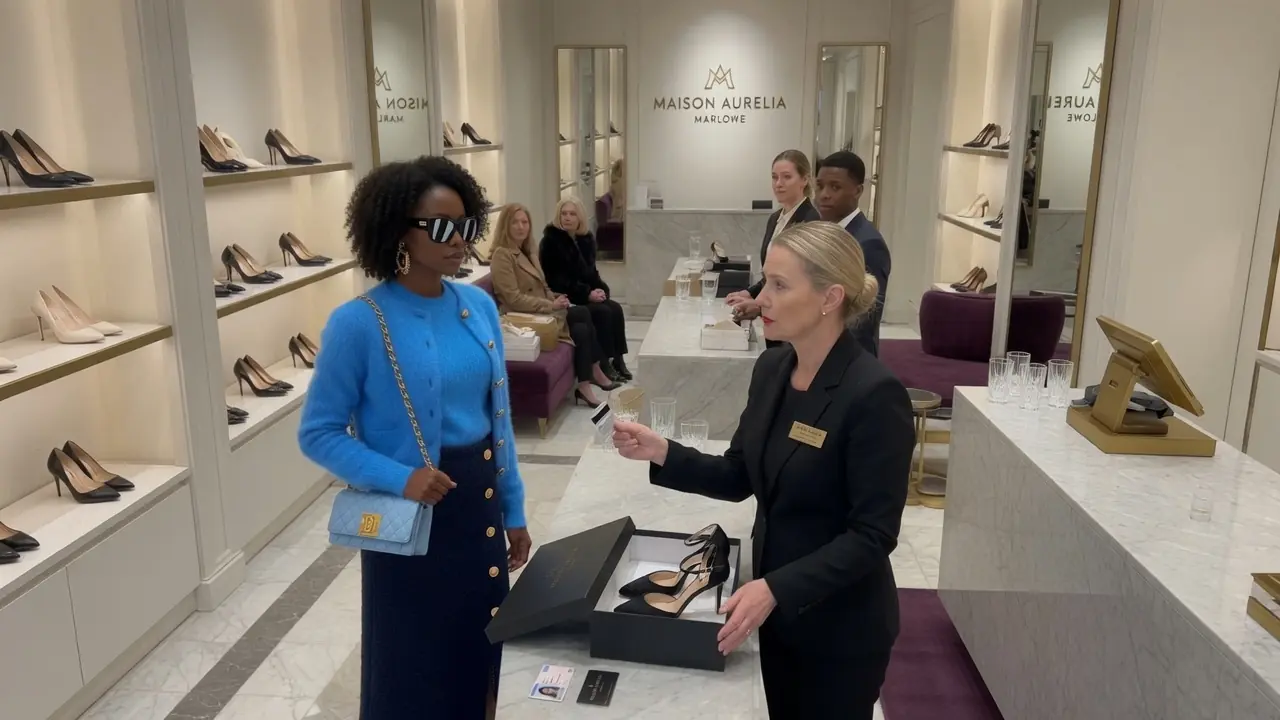
At the corner of Sterling Row and Hanover Avenue stood Maison Aurelia, the most exclusive shoe boutique in the city.
The store occupied two floors of a restored limestone building, with tall arched windows and gold lettering so discreet that customers were expected to recognize the name without needing to read it. Inside, handmade heels rested on individual shelves beneath soft lights, each pair displayed like an artifact in a museum. Some shoes cost two thousand dollars, while limited-edition pieces could reach ten times that amount.
At eleven thirty on a rainy Thursday morning, a young Black woman named Camille Brooks stepped through the front door.
She wore light blue jeans, a simple cream blouse, white sneakers, and a tan trench coat that still carried a few drops of rain on the shoulders. Her curly black hair fell around her face, and a small brown crossbody bag rested against her hip. There was nothing careless about her appearance, but she did not look like the women Maison Aurelia usually featured in its advertising campaigns.
Camille paused just inside the entrance and smiled.
She had spent the past six weeks traveling between manufacturing facilities, investor meetings, and distribution centers. This was the first morning she had taken entirely for herself in almost a year. Her younger sister was getting married in three weeks, and Camille had promised to find a pair of black heels that would work with the bridesmaid dress she had not yet taken out of its garment bag.
The boutique seemed almost empty.
A well-dressed couple stood near the front counter discussing a pair of leather loafers with a male associate. Two women in designer coats sat near the mirrored wall while another employee brought them sparkling water. At the rear of the showroom, a blond saleswoman in a fitted black suit was arranging shoes on a velvet-covered display table.
Camille waited for someone to greet her.
No one did.
She told herself they were busy, although the receptionist behind the marble desk had already looked directly at her twice. The woman glanced down at Camille’s sneakers, then returned to typing on a tablet. The other associates continued their conversations as if the bell above the door had never rung.
Camille walked toward a display of black pumps.
One pair immediately caught her attention. They had a narrow heel, a clean satin finish, and a small silver detail near the ankle. They were elegant without being excessive, and Camille could already imagine her sister approving of them.
She reached toward the shoe.
“Careful.”
The voice came sharply from behind her.
Camille turned and saw the blond saleswoman approaching. Her name tag read Elaine Mercer, Senior Style Consultant. She appeared to be in her early forties, with perfectly straight hair, bright red lipstick, and an expression that was technically a smile but contained no warmth.
“I’m sorry?” Camille asked.
“Those are part of our private collection,” Elaine said. “We prefer that customers not handle them without assistance.”
Camille withdrew her hand. “No problem. I was hoping to try them on.”
Elaine looked at Camille’s clothes again.
“The Aurelia Noire starts at twenty-eight hundred dollars.”
Camille waited for the rest of the sentence.
Elaine did not offer one.
“I didn’t ask the price,” Camille said.
“No, but we like to make sure guests are aware before we begin a fitting.” Elaine gestured toward another section of the store. “We have a few more accessible styles near the entrance. Some of those begin around nine hundred.”
The receptionist behind the counter lowered her eyes to hide a smile.
Camille noticed.
For a moment, she considered leaving. She had dealt with this kind of judgment before, sometimes in conference rooms and sometimes in hotel lobbies. It always arrived dressed as helpfulness, wrapped in polite words that allowed the speaker to deny what everyone in the room understood.
But Camille had not entered the store accidentally.
She wanted the shoes.
“I’d still like to try these,” she said.
Elaine gave a small sigh. “Do you have an appointment?”
“No.”
“Maison Aurelia strongly recommends appointments for private-collection fittings.”
“Is an appointment required?”
Elaine paused. “Not technically.”
“Then I’d like to try a size eight.”
A flicker of irritation crossed Elaine’s face.
The boutique was not busy enough for her to claim she had other customers waiting. Still, she glanced toward the receptionist as though hoping someone might rescue her from the inconvenience. When no one intervened, she picked up the display shoe with two fingers.
“I’ll check whether we have your size.”
“Thank you.”
Elaine disappeared through a door behind the counter.
Camille examined the other shoes while she waited. Several minutes passed. The receptionist answered a phone call, laughed softly with the caller, and then walked to the back office without acknowledging Camille.
The well-dressed couple finished their purchase and left.
The male associate who had helped them looked toward Camille, but before he could approach, Elaine returned carrying a shoe box. She placed it on a bench without offering Camille a seat.
“Size eight,” she said.
Camille removed her sneakers and tried on the shoes.
They fit perfectly.
She stood and walked a few steps across the carpet. The heels were surprisingly comfortable, and the satin matched her dress better than she had expected. She looked at herself in the mirror and smiled for the first time since entering the store.
“I’ll take them.”
Elaine stared at her.
“Would you like a moment to consider the price?”
“No.”
“We have a strict final-sale policy on private pieces.”
“That’s fine.”
Elaine folded her arms. “The total with tax will be just over three thousand dollars.”
Camille picked up her phone from the bench. “All right.”
Something in Elaine’s expression changed.
Until that moment, she had expected Camille to become embarrassed, make an excuse, and leave. The certainty in Camille’s voice disrupted the story Elaine had already created about her. Instead of reconsidering her behavior, Elaine became more suspicious.
“How will you be paying?” she asked.
“With a card.”
Elaine nodded slowly. “We’ll need identification.”
“Is that store policy for every purchase?”
“For purchases of this size.”
Camille looked toward the two women seated by the wall.
One of them had just handed another sales associate a black credit card for what appeared to be three pairs of shoes. No identification had been requested. The associate was already wrapping the boxes while laughing about an upcoming vacation.
Camille turned back to Elaine.
“I have identification.”
“Good.”
Elaine carried the box toward the register.
Camille followed, placing her sneakers inside a cloth bag she had taken from her purse. At the counter, Elaine entered the item into the system while the receptionist returned and watched from a few feet away.
Camille handed over a metal credit card.
Elaine examined the name.
“Camille Brooks.”
“That’s right.”
Elaine looked at Camille and then back at the card. “Is this your card?”
Camille’s smile disappeared. “You just read my name.”
“I’m confirming.”
“My name is printed on the card, and I’m standing in front of you with identification.”
Elaine’s voice remained calm. “There’s no need to become defensive.”
The statement was deliberate.
It shifted the focus from Elaine’s accusation to Camille’s reaction. If Camille raised her voice, she would become the problem. If she stayed silent, Elaine could continue without consequence.
Camille reached into her bag and placed her driver’s license on the counter.
Elaine compared the photograph, the name, and Camille’s face. She took longer than necessary. The receptionist watched with open curiosity now, as though waiting to see whether Camille would be exposed as a thief.
“Satisfied?” Camille asked.
Elaine slid the license back.
“I’m simply protecting the store.”
“From what?”
“Fraud is common in luxury retail.”
“I’m sure it is.”
Elaine inserted the card into the terminal. “You’d be surprised how often people enter stores like this without understanding what they can afford.”
Camille looked directly at her.
“What exactly made you believe I didn’t understand what I could afford?”
Elaine’s hands stopped moving.
“I didn’t say that.”
“You told me the price before I asked. You tried to send me toward cheaper shoes. You questioned whether my card belonged to me even after reading my name. Now you’re talking about people who don’t understand what they can afford.”
“I think you’re misinterpreting normal customer-service procedures.”
“Then why weren’t those procedures used with the women sitting behind me?”
The receptionist looked away.
Elaine’s cheeks tightened. “Every situation is different.”
“How?”
“I don’t discuss other clients.”
“You don’t have to. I watched what happened.”
The two women by the wall had become quiet.
One of them lowered her glass of sparkling water. The sales associate helping them pretended to adjust tissue paper inside a box, though he was clearly listening. The showroom suddenly felt much smaller.
Elaine removed Camille’s card from the terminal before completing the transaction.
“I don’t think this is going to work,” she said.
Camille glanced at the screen. “What isn’t going to work?”
“This purchase.”
“Why?”
“Because your behavior is making our staff uncomfortable.”
Camille almost laughed.
“My behavior?”
“You’re questioning store policy, speaking aggressively, and creating a scene.”
Camille looked around.
She had not raised her voice once.
The only scene inside the boutique was the one Elaine was now building to justify refusing service. Camille recognized the strategy. Elaine wanted her gone, and she needed a version of events that would sound acceptable when repeated later.
“I came here to buy a pair of shoes,” Camille said. “You decided I didn’t belong here before asking my name.”
Elaine’s expression hardened.
“I’m going to ask you to leave.”
The receptionist looked satisfied.
Camille glanced at the shoe box on the counter. “Are you refusing to sell them to me?”
“I am declining the transaction.”
“Based on what policy?”
“Management reserves the right to refuse service.”
“Is a manager available?”
“I’m the senior consultant on the floor.”
“That isn’t what I asked.”
Elaine leaned closer across the counter. “You need to go.”
Camille remained still.
Behind Elaine, one of the sales associates shifted uncomfortably. He was a young man named Marcus Reed who had worked at Maison Aurelia for less than six months. He had witnessed Elaine treat other customers dismissively, but never this openly.
“Elaine,” Marcus said quietly, “maybe we should call Ms. Doyle.”
Elaine shot him a warning look.
“There is no reason to disturb the regional director over a routine customer issue.”
Camille noticed the title.
“Ms. Doyle is the regional director?”
Elaine turned back to her. “That information is not relevant to you.”
“Actually, it might be.”
Elaine laughed once under her breath. “Of course.”
The sound contained every assumption she had not spoken aloud.
Camille picked up her phone.
Elaine crossed her arms. “Calling someone won’t change our decision.”
Camille unlocked the screen and searched through her contacts.
“I’m not calling someone to change your decision.”
“Then what are you doing?”
“I’m making sure it’s documented.”
Elaine’s confidence faltered for the first time.
Camille tapped a name and placed the phone to her ear. The call connected almost immediately.
“Camille?” a woman answered. “Is everything all right?”
“I’m at Maison Aurelia on Sterling Row,” Camille said. “I need you to come downstairs.”
There was a brief silence.
“You’re in the building?”
“Yes.”
“I’ll be there in two minutes.”
Camille ended the call.
Elaine stared at her. “Who did you call?”
Camille slipped the phone into her bag. “You’ll find out.”
The receptionist gave Elaine an uncertain look.
Maison Aurelia occupied the first two floors of the building, but the upper four floors contained the company’s North American executive offices. Most store employees never interacted with the executives above them. They entered through a private elevator in the rear lobby and rarely crossed the showroom.
Elaine knew that, but she did not understand why Camille did.
“Security,” Elaine said to the receptionist.
Marcus stepped forward. “That seems unnecessary.”
“I asked her to leave.”
“She hasn’t done anything.”
Elaine turned on him. “Are you questioning me in front of a customer?”
“I’m saying we should wait for Ms. Doyle.”
“This has nothing to do with Ms. Doyle.”
The receptionist reached for the phone.
Before she could call, the private elevator doors at the back of the showroom opened.
A woman in her late fifties stepped out wearing a dark green suit. Her silver hair was cut neatly at her jaw, and two executives followed behind her. Every employee in the boutique immediately recognized Eleanor Doyle, Maison Aurelia’s regional director for North America.
Elaine’s face lost its color.
Eleanor crossed the showroom quickly.
“Camille, what happened?”
She did not greet Elaine.
She did not look at the other customers.
She went directly to Camille and placed one hand on the counter, her expression filled with concern. Elaine stared between them, trying to understand the familiarity in Eleanor’s voice.
Camille gestured toward the shoe box.
“I came in to buy these for my sister’s wedding.”
Eleanor looked at the black satin heels. “Those are from the collection you approved last spring.”
“Yes.”
The store became completely silent.
Elaine’s mouth opened, but no words came out.
Camille Brooks was not a celebrity, and her face did not appear in fashion magazines. She had deliberately avoided becoming the public image of her companies. To most consumers, her name meant nothing.
Within the luxury retail industry, however, she was one of the most powerful women in the country.
Camille was the founder and majority owner of Brooks Meridian Holdings, an investment group that had purchased Maison Aurelia eighteen months earlier. She controlled the parent company, approved its expansion strategy, and personally selected the executive team responsible for modernizing the brand. Maison Aurelia’s employees had seen her name in company reports, but few had ever seen her photograph.
Elaine had just refused service to the woman who owned the company.
Eleanor looked at her. “Ms. Mercer, explain.”
Elaine recovered enough to straighten her shoulders.
“There was a misunderstanding.”
Camille said nothing.
Elaine continued quickly. “The customer became confrontational when I explained our private-collection procedures. I was trying to protect the merchandise and maintain a comfortable environment for the other clients.”
Eleanor’s eyes narrowed. “The customer?”
Elaine swallowed.
“I wasn’t aware of Ms. Brooks’s position.”
“That is not the issue.”
“I understand, but if I had known—”
Eleanor cut her off. “You should not need to know who owns the company before treating someone with respect.”
The sentence landed heavily.
The receptionist took a step backward from the counter. Marcus looked down, though relief passed across his face. The customers by the wall exchanged embarrassed glances.
Elaine turned to Camille.
“I apologize if my tone seemed unwelcoming.”
Camille held her gaze. “It didn’t seem unwelcoming. It was unwelcoming.”
“I was following policy.”
“No, you were using policy selectively.”
Elaine looked at Eleanor. “That isn’t true.”
Camille pointed toward the women by the wall.
“You didn’t request identification when they used a black card. You didn’t warn them about prices before allowing them to try on several pairs. You offered them water and a seat. I stood near the entrance for several minutes before anyone acknowledged me.”
Eleanor looked at the receptionist. “Is that accurate?”
The woman hesitated.
“Answer her,” Elaine said sharply.
Eleanor’s expression changed. “Do not instruct her.”
The receptionist pressed her lips together. “Yes. Ms. Brooks waited for a while.”
“And was identification requested from the other clients?”
“No.”
“Why not?”
“I don’t know.”
One of the customers stood.
“For what it’s worth,” she said, “the saleswoman was rude to her from the beginning.”
Elaine stared at her.
The woman picked up her handbag. “You told her the price before she even asked to try the shoes. I heard it.”
Her companion nodded. “So did I.”
Elaine’s control began to unravel.
“They didn’t see the entire interaction.”
“We saw enough,” the first woman replied.
Marcus stepped closer to Eleanor. “Ms. Doyle, I also witnessed most of it.”
Elaine looked betrayed. “Marcus.”
He ignored her.
“Ms. Brooks never raised her voice,” he said. “Elaine canceled the transaction after Ms. Brooks asked why the identification policy wasn’t applied equally.”
Eleanor’s jaw tightened.
She turned to one of the executives who had followed her downstairs. His name was Victor Han, the head of human resources.
“Pull the security footage.”
Victor nodded. “Immediately.”
Elaine’s breathing quickened.
“There’s no need for that. I’ve already explained what happened.”
Camille folded her arms. “Then the footage should support your explanation.”
The boutique remained silent while Victor walked behind the counter and spoke quietly to the receptionist about accessing the camera system. Elaine watched him, realizing that every expression, every gesture, and every word had likely been recorded.
Her voice softened.
“Ms. Brooks, may I speak with you privately?”
“No.”
“I would like an opportunity to apologize without an audience.”
“You were comfortable humiliating me with an audience.”
Elaine looked around at the customers and employees.
The same room that had given her power minutes earlier now felt like a courtroom. Every person she had expected to remain silent was watching her. Her title, her suit, and her years of authority could no longer control the story.
“I made a mistake,” she said.
Camille shook her head.
“A mistake is bringing the wrong size. A mistake is entering the price incorrectly. You made a series of decisions, and every one of them was based on what you assumed when I walked through the door.”
Elaine’s eyes filled with anger beneath the fear.
“You can say that because you already know how this ends.”
Camille studied her.
“How do you think it ends?”
“You’re the owner. I’m going to be punished because you’re embarrassed.”
“No,” Camille said. “You’re going to face consequences because this probably wasn’t the first time.”
Elaine went still.
Eleanor looked toward Victor.
“Pull all complaints connected to Ms. Mercer for the last three years.”
Elaine turned quickly. “There are no formal complaints.”
Marcus looked up.
Camille noticed.
“Marcus?”
He hesitated before speaking. “There were complaints.”
Elaine’s face tightened. “Be careful.”
“There were at least four,” Marcus said. “Two customers asked to speak to management. One emailed the store.”
Eleanor looked at Elaine. “Why were they not escalated?”
Elaine said nothing.
The receptionist began to cry quietly.
Eleanor turned to her. “What happened to the emails?”
The receptionist wiped her cheek. “Elaine told me to mark them resolved.”
Elaine’s composure finally broke.
“They were unreasonable customers. One of them accused us of following her around the store when she was handling merchandise without permission.”
“Was she Black?” Camille asked.
Elaine looked away.
“Was she?”
“Yes.”
“And the others?”
Elaine remained silent.
Marcus answered. “Two were Black. One was Latina. The fourth wore a cleaning uniform and came in during her lunch break.”
Camille felt something cold settle in her chest.
Her own experience had lasted less than thirty minutes. She had the power to summon executives from upstairs, but the other women did not. They had probably walked away believing no one would care, carrying humiliation that Elaine had already forgotten.
Camille looked at Eleanor.
“Close the store for the rest of the day.”
Eleanor nodded immediately.
Elaine stared at her. “You can’t be serious.”
“I am.”
“We have appointments.”
“They will be rescheduled.”
“This is our busiest weekday.”
Camille’s expression did not change. “Then we’ll lose money.”
Elaine gave a disbelieving laugh. “Over one uncomfortable interaction?”
“No. Over a culture that allowed you to decide who deserved service.”
Eleanor instructed Marcus to escort the customers to the front desk so their contact information could be collected and their appointments handled properly. The other associates began quietly closing display cases. The receptionist turned the sign on the door from OPEN to CLOSED.
Elaine remained behind the counter.
“What happens to me?” she asked.
Eleanor looked at Victor. “Place Ms. Mercer on immediate suspension while we complete the investigation.”
Camille shook her head.
Everyone looked at her.
“She admitted she buried complaints,” Camille said. “The receptionist confirmed it, Marcus confirmed it, and we have footage from today. There is nothing left to investigate about whether she should represent this company.”
Elaine’s eyes widened. “You’re firing me?”
Camille looked at her calmly.
“Yes.”
“You can’t make that decision in front of customers.”
“I can make it wherever your conduct becomes clear.”
“I’ve worked here for eleven years.”
“And how many people did you treat this way during those eleven years?”
Elaine’s face turned red.
“I built the client base of this store.”
“You served the clients you considered worthy. That isn’t the same thing.”
Elaine looked to Eleanor for help.
The regional director did not move.
“You heard Ms. Brooks,” Eleanor said. “Your employment is terminated effective immediately. Victor will escort you upstairs to collect your personal belongings.”
Elaine stared around the showroom as though someone might object.
No one did.
Even the receptionist looked away from her.
“Over shoes,” Elaine whispered.
Camille glanced at the box between them.
“This was never about the shoes.”
Elaine removed her name tag and placed it on the counter.
For the first time since Camille entered the store, the superiority disappeared from her posture. Without the title pinned to her jacket, she looked smaller, though not necessarily sorry. She walked toward the private elevator with Victor beside her, heels clicking against the marble floor.
Just before the doors closed, she turned toward Camille.
“You could have told me who you were.”
Camille met her eyes.
“You showed me who you were before I had the chance.”
The elevator doors closed.
No one spoke for several seconds.
Then the receptionist began sobbing.
Camille walked around the counter and handed her a tissue. The young woman looked surprised by the gesture.
“Am I fired too?” she asked.
“What’s your name?”
“Lauren.”
“Lauren, did Elaine tell you to ignore me?”
Lauren wiped her face. “Not directly.”
“What did she tell you?”
“She said we should prioritize customers who matched the Maison Aurelia profile.”
“What does that mean?”
Lauren lowered her eyes. “She never explained it clearly.”
“She didn’t need to, did she?”
“No.”
Camille nodded.
Lauren had participated in what happened, but she had also been trained to recognize a coded hierarchy. Firing Elaine would remove one person, but it would not erase the system that had rewarded her.
“You should have greeted me,” Camille said. “You should have checked on me when you saw how she was speaking to me. You should not have hidden customer complaints.”
“I know.”
“Do you?”
Lauren looked up. “I do now.”
Camille was quiet for a moment.
“You’re suspended for one week. When you return, whether you keep this job will depend on what you do next.”
Lauren nodded rapidly. “Thank you.”
“Don’t thank me. Learn from it.”
Camille turned to Marcus.
“You spoke up when it could have cost you your job.”
“I should have spoken sooner.”
“Yes,” Camille said. “You should have.”
Marcus accepted the criticism without defending himself.
“But you did speak,” she continued. “That matters.”
Eleanor joined them at the counter.
“We need to discuss how this happened.”
Camille looked around the showroom.
The boutique still appeared flawless. The lights were soft, the shelves were polished, and the shoes remained perfectly aligned. Nothing in the room revealed how quickly beauty could become a weapon when people used it to decide who belonged.
“This didn’t happen today,” Camille said. “Today is simply when we were forced to see it.”
By late afternoon, Maison Aurelia’s Sterling Row location was empty.
The employees had been sent home after providing written statements. Eleanor, Victor, Marcus, and Camille remained in the conference room upstairs, reviewing complaints, training materials, and internal performance reports. The deeper they looked, the clearer the pattern became.
Elaine had been praised for high sales numbers and strong relationships with wealthy clients.
Customer complaints had been treated as isolated misunderstandings. Employees were rewarded for identifying “high-value shoppers,” a phrase that was never officially defined but was understood throughout the store. Associates had been trained to study clothing, jewelry, handbags, and mannerisms before deciding how much attention a customer deserved.
No document mentioned race.
It did not need to.
Bias had been built into the store’s habits, hidden beneath the language of luxury. Employees learned to offer champagne to one woman and suspicion to another. The brand claimed to sell craftsmanship, but the store had begun selling social permission.
Camille closed the final report.
“We created this.”
Eleanor looked uncomfortable. “Elaine made her own choices.”
“Yes, she did. But the company rewarded the results without questioning the method.”
“We never instructed employees to discriminate.”
“We instructed them to judge who was valuable before providing service.”
Eleanor sat back.
Camille looked through the conference-room windows at the city below. Rain streaked the glass, blurring the traffic into lines of red and white.
“When my mother was twenty-six, she worked two jobs to buy one pair of good shoes,” Camille said. “She needed them for an interview at a bank. A saleswoman followed her through the store because she thought my mother was going to steal them.”
No one interrupted.
“My mother bought the shoes anyway. She wore them to the interview, got the job, and worked there for twenty-nine years. She still remembered how that saleswoman made her feel until the day she died.”
Marcus lowered his eyes.
Camille continued. “People think these moments disappear when the customer leaves. They don’t. The employee forgets by lunch, but the customer may remember for decades.”
Eleanor closed her laptop.
“What do you want to do?”
“Everything we should have done before today.”
Over the next month, Maison Aurelia changed more than its training manual.
Every North American store suspended its customer-profiling system. Secret shoppers from a wide range of backgrounds were sent into stores to document how they were treated. Complaint records were moved away from local managers and reviewed by an independent customer-equity team.
Employees could no longer receive bonuses based solely on sales.
Part of their performance review would now depend on consistent service, verified through customer feedback and unannounced evaluations. Every visitor was to be greeted, offered assistance, and allowed to browse without assumptions about spending power. Identification policies had to be applied equally or not at all.
Camille also ordered the company to contact the customers whose complaints Elaine had buried.
Some refused to speak with Maison Aurelia.
One woman said the apology was too late. Another said she had cried in her car after leaving the boutique and had never entered a luxury store again. A third agreed to meet Camille but made it clear she did not want free shoes.
“I don’t need a gift,” the woman said. “I needed someone to believe me when it happened.”
Camille understood.
The company issued refunds where appropriate, but she knew money could not rewrite memory. The only useful apology was one that changed what happened to the next person.
Marcus was promoted to assistant store manager three months later.
He nearly declined the position because he believed he had waited too long to intervene. Camille told him that leadership did not require pretending he had acted perfectly. It required remembering the moment he almost stayed silent.
Lauren returned after her suspension.
For the first several weeks, she appeared nervous whenever Camille entered the store. Over time, the fear changed into focus. She became one of the strongest advocates for the new service policies and eventually volunteered to speak during employee training sessions about how easily silence turned into participation.
As for Elaine, she filed a complaint claiming wrongful termination.
The security footage, buried customer emails, and employee statements ended the claim quickly. She found another retail job several months later, though not in luxury fashion. Whether she truly changed, Camille never learned.
The black satin shoes remained at the Sterling Row store.
Camille had left without purchasing them on the day Elaine was fired. By the time she returned two weeks later, her sister’s wedding was only days away. Marcus brought the shoes to her himself.
“They’re still available,” he said.
Camille examined them.
For a moment, she wondered whether wearing them would remind her of the humiliation. Then she thought about her mother and the shoes she had bought for the bank interview so many years earlier. Objects did not own the memories attached to them unless people allowed it.
“I’ll take them,” Camille said.
Marcus smiled. “Would you like me to ring them up?”
“Yes.”
He did not ask whether she understood the price.
He did not request identification he would not have requested from someone else. He did not treat her better because she owned the company, nor did he perform exaggerated kindness to prove he had learned a lesson.
He simply treated her like a customer.
At the wedding, Camille’s sister noticed the shoes before the ceremony began.
“You finally found a pair,” she said.
“You have no idea.”
“Are they comfortable?”
“Surprisingly.”
Her sister narrowed her eyes. “Why do I feel like there’s a story?”
Camille smiled. “There’s always a story.”
She did not tell it that day.
The wedding belonged to her sister, not to Elaine or Maison Aurelia. Camille danced for hours in the black satin heels, laughed with her family, and forgot about the boutique for most of the night. By the time she returned to her hotel, one of the silver ankle details had come loose.
She held the shoe in her hand and laughed.
Three thousand dollars, and it still needed repairing.
A year later, Camille visited the Sterling Row location without announcing herself.
She wore an old college sweatshirt, black leggings, and running shoes. Her hair was pulled into a loose bun, and she carried a canvas tote bag rather than a designer purse. Eleanor offered to accompany her, but Camille declined.
She wanted to see what happened when no one knew she was coming.
The bell above the door rang.
A new associate looked up from a display and smiled.
“Good afternoon. Welcome to Maison Aurelia.”
Camille thanked her.
“Feel free to look around,” the associate said. “I’m Nina. I’ll be nearby when you’re ready, and you’re welcome to try on anything you like.”
No one studied Camille’s clothes.
No one redirected her toward cheaper merchandise.
No one decided what she could afford.
Near the front window, another customer stood beside a shelf of limited-edition heels. She was a Black woman in a navy hospital uniform, with tired eyes and a lunch bag still hanging from one shoulder. She touched a shoe carefully, then pulled her hand away when she noticed the price.
Nina walked over.
“Those are beautiful, aren’t they?”
The woman looked embarrassed. “I’m just looking.”
“That’s what the display is for.”
“I probably can’t afford them.”
Nina smiled. “You don’t have to buy anything to be welcome here.”
Camille stopped walking.
The woman relaxed.
Nina brought her a seat, asked her size, and offered to let her try the shoes simply because she wanted to know how they felt. There was no pressure, no suspicion, and no hidden calculation about whether the interaction would lead to a sale.
Camille watched from across the showroom.
The shoes had always been expensive.
The marble floors had always been polished. The gold lettering, soft lights, and private collections had not changed. What changed was the belief that luxury belonged to one kind of person.
Elaine had believed respect should follow wealth.
Camille believed respect should come first.
One phone call had ended Elaine’s career at Maison Aurelia, but the phone call was never the real source of Camille’s power. Her power came from refusing to accept a familiar humiliation as something normal. It came from understanding that exposing one rude employee was not enough if the rules that protected her remained untouched.
The hospital worker laughed as she looked at herself in the mirror.
Nina laughed with her.
Camille quietly turned toward the door, satisfied that no one had recognized her. She stepped back onto Sterling Row, where the afternoon sunlight reflected from the glass towers and black cars moved slowly through traffic.
Behind her, the boutique doors remained open.
That was the difference.
Not that Camille could walk through them.
But that the next woman could too.