Rosalie Bennett knew something was wrong before the train finished stopping.
People were staring.
Not the casual curiosity common in frontier towns whenever a new passenger stepped off the train. This was different. Men on the depot platform whispered behind their hands. Two women near the ticket office looked at Rosalie, then quickly looked away. A young stable boy grinned as though he had heard a joke but had been warned not to repeat it in front of the person who was the joke.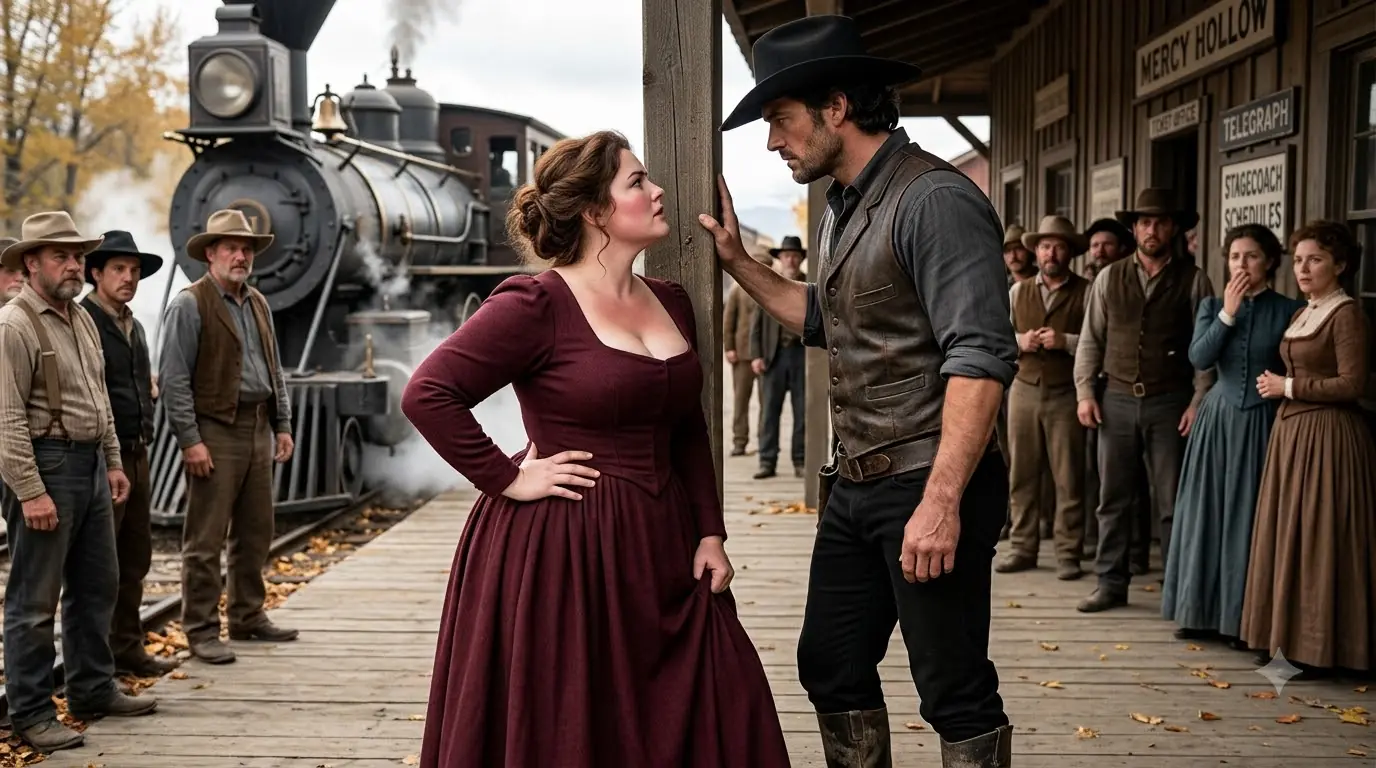
Rosalie remained seated until the conductor opened the carriage door.
She adjusted the front of her deep burgundy dress, gathered the heavy skirt with one hand, and forced herself to breathe.
Three days on the train had left her exhausted.
Three years of widowhood had taught her not to show it.
“Mercy Hollow, Montana Territory,” the conductor called.
Rosalie stood.
At thirty, she was used to the way people looked at her before they decided what kind of woman she must be. She had a full, lush figure that no amount of corseting had ever disguised: generous breasts, broad hips, thick thighs, soft arms, and a body that took up more space than fashionable magazines believed respectable women should occupy.
Back in St. Louis, women had whispered.
Men had stared.
Some wanted her privately but pretended not to see her in public.
Her late husband, Arthur Bennett, had been the only man who once looked at her without embarrassment.
At least, that was what Rosalie had believed before his death exposed how little she had understood about the life they built together.
Arthur died suddenly from pneumonia.
Then came the debts.
Notes Rosalie had never signed.
Loans she had never known existed.
A failed investment in a freight business.
Three months after burying him, she sold their small house.
A year later, she sold most of the furniture.
By the third year, respectable widowhood had become another word for surviving quietly enough that nobody asked how little money remained.
Then a letter arrived from Montana.
It carried the name Blackwood Ranch.
The writer claimed a rancher named Silas Blackwood was seeking an experienced household manager for his large cattle property outside Mercy Hollow. The wages were excellent. Housing included. The letter specifically mentioned that Rosalie’s experience managing her husband’s accounts and household had been recommended by someone who knew Arthur.
Rosalie had stared at the page for an hour.
She knew no one in Montana.
But wages were wages.
And St. Louis had begun to feel like a room where all the windows had been nailed shut.
So she came west.
Now she stepped onto the Mercy Hollow platform and immediately knew the letter had lied about something.
Steam rolled past the locomotive.
A porter lowered her trunk.
Rosalie felt every pair of eyes.
Then a man shouted from the far side of the platform.
“Well, Blackwood!”
Laughter followed.
Rosalie turned.
A group of men stood near the freight office.
At their center was Clyde Mercer, though Rosalie did not know his name yet. He was forty, narrow-faced, expensively dressed for a cattle town, with a waxed mustache and the smug confidence of a man who had rarely suffered consequences for saying cruel things.
He raised his voice.
“Your bride finally arrived!”
The platform erupted.
Rosalie went cold.
Bride?
She stared at him.
Clyde continued.
“We told you we’d find a woman sturdy enough to survive Blackwood winters!”
Another wave of laughter.
Someone shouted:
“Hope you reinforced the bed!”
That broke something inside Rosalie.
Not because she had never heard worse.
Because she finally understood.
The letter.
The journey.
The whispers.
She had not been invited for work.
She had been sent across the country as entertainment.
Her face burned.
She looked toward the train.
For one wild second, she considered climbing back aboard.
Too late.
The conductor had already signaled departure.
Then the crowd changed.
Not silent.
Quieter.
Rosalie followed their attention.
A man had stepped from beside the freight shed.
He was enormous.
Not grotesquely so.
Simply built on a scale that made other men appear unfinished.
Six feet four, perhaps taller.
Broad shoulders.
Narrower waist.
Powerful forearms exposed beneath rolled charcoal sleeves.
A weathered brown leather vest fit across his chest. Black trousers disappeared into dusty riding boots. A dark gun belt sat low at his hips, and a black cowboy hat shadowed a face hardened by sun, work, and more years of grief than the man appeared old enough to possess.
His beard was short but heavy.
His dark hair curled at the edges beneath the hat.
Gray eyes fixed first on Clyde Mercer.
Then on Rosalie.
She expected the same reaction she had seen from men all her life.
Surprise.
Assessment.
Embarrassment.
Perhaps amusement.
Silas Blackwood did none of those things.
He looked at her.
Really looked.
His gaze moved from her face to the deep burgundy dress, to the shape of her waist, down the heavy fall of her skirt, then deliberately back to her eyes.
Not mocking.
Not polite.
Interested.
Rosalie’s humiliation collided with anger.
She walked directly toward him.
The crowd opened.
Silas remained still.
Rosalie stopped almost chest-to-chest with him and had to tilt her head back.
“You Silas Blackwood?”
“Yes.”
His voice was low.
Rough.
Dangerously calm.
“Did you send me that letter?”
“No.”
“You know about it?”
“I learned this morning.”
Rosalie laughed without humor.
“Convenient.”
His jaw tightened.
“It is not.”
“You expect me to believe half this town arranged to parade me in front of you and nobody thought to send a telegram?”
Silas looked toward Clyde.
“I expect you to believe Mercy Hollow contains more cowards than telegraph operators.”
A few people stopped smiling.
Clyde spread his hands.
“Oh, don’t ruin the fun, Blackwood.”
Silas did not turn.
Rosalie did.
Clyde grinned at her.
“Ma’am, no harm meant.”
“No harm?”
“Just a wager.”
Rosalie’s hand curled into a fist.
“A wager?”
Clyde laughed.
“Silas here swore he would never marry again.”
Rosalie looked at Silas.
Again?
That meant widowhood or divorce.
Something.
Clyde continued.
“We figured the only woman stubborn enough to tolerate him would need to be…”
He paused.
His eyes dropped openly over Rosalie.
“Substantial.”
The laughter this time was weaker.
Even some of the men understood he had gone too far.
Rosalie stepped toward Clyde.
Silas moved first.
Not blocking her.
Just shifting enough that Clyde suddenly had six feet four inches of Blackwood rancher between himself and the widow he had insulted.
Silas spoke quietly.
“You’re finished.”
Clyde smiled.
“Sensitive today?”
“Finished.”
Something in Silas’s voice erased Clyde’s grin.
Rosalie stared at Silas’s back.
He was defending her.
That irritated her almost as much as Clyde.
“I don’t need you fighting my battles.”
Silas looked over one shoulder.
“No.”
His gray eyes met hers.
“You seem perfectly equipped.”
Several women in the crowd almost smiled.
Rosalie folded her arms.
“Then move.”
Silas did.
Immediately.
That surprised her.
She faced Clyde.
“You forged a letter.”
Clyde shrugged.
“A friend wrote it.”
“You knew I would travel two thousand miles.”
“We paid the ticket.”
“How generous.”
“We thought Blackwood could use company.”
Rosalie stepped closer.
“And you thought I would be grateful enough for any man’s attention to forgive being used as a joke.”
Clyde hesitated.
There.
The truth.
Rosalie nodded.
“I see.”
She turned away.
Humiliation felt worse once anger cooled enough to let shame underneath.
She reached for her trunk.
Silas’s hand closed around the handle first.
Rosalie looked up.
“Leave it.”
“I’ll carry it.”
“No.”
“You planning to carry a trunk through town?”
“If necessary.”
His gaze dropped briefly to her hand.
“I wasn’t questioning whether you could.”
“Then what?”
“It has wheels on one side and a broken handle on the other.”
She looked.
He was right.
Silas lifted it.
Rosalie planted one hand on her hip.
“Where exactly do you think you’re taking that?”
“Hotel.”
“I can afford a hotel.”
“I didn’t say you couldn’t.”
“Then why are you paying?”
“Because the lie used my name.”
Rosalie stared.
Silas continued.
“That makes part of the damage mine whether I caused it or not.”
She hated that the answer made sense.
Behind them, Clyde called:
“Blackwood! Thought you didn’t like big women.”
Silas stopped.
Rosalie closed her eyes.
Not again.
Silas slowly set down the trunk.
He turned.
Every sound on the platform died.
Clyde’s smile faltered.
Silas spoke:
“I never said that.”
Clyde laughed nervously.
“Everybody has a type.”
Silas looked toward Rosalie.
Then back at Clyde.
“Yes.”
The crowd waited.
Silas said:
“Mine is women who don’t make me ashamed to stand beside them.”
A few people murmured.
Clyde’s face reddened.
Silas picked up the trunk again.
Rosalie followed him toward the hotel without deciding to.
The Mercy Hollow Hotel stood across from the depot, two stories of weathered pine with a narrow porch and a dining room that smelled of coffee, beef, and wood smoke.
The proprietor, Mrs. Adelaide Finch, knew enough about the prank to look mortified.
“Mrs. Bennett, I’m terribly sorry.”