The morning they arrested Margaret Hill began like any other Sunday in the small town of Ashton Creek.
The church bells had just finished ringing when the patrol car rolled into the gravel lot. Red and blue lights flickered against the white wooden walls of the century-old chapel. Parishioners froze mid-conversation. A hymn drifted faintly from inside.
Margaret stepped out onto the church steps clutching her worn brown Bible. She wore a pale cream dress with lace cuffs and a wide-brimmed hat that shaded her silver curls. At seventy-eight, she walked slowly but upright, dignity stitched into every movement.
“Ma’am, we need you to come with us,” Officer Daniels said.
His voice carried the clipped confidence of a man certain he was right.
“For what, son?” Margaret asked gently.
“For trespassing and theft.”
The words rippled through the crowd like cold wind.
Margaret blinked. “Theft?”
Pastor Eugene hurried forward, flustered. “Officers, there must be a misunderstanding—”
Daniels held up a hand. “We have a signed complaint from Mr. Leonard Pritchard. Says she stole important documents from his property last night.”
At the edge of the parking lot, a black SUV idled. Inside sat Leonard Pritchard, the wealthiest developer in three counties and the man currently trying to buy the church’s land for a luxury condominium project.
Margaret’s eyes found him through the windshield.
Ah, she thought. So that’s how it would be.
“I haven’t stolen anything,” she said calmly.
Officer Briggs stepped closer. “Ma’am, you can explain that downtown.”
When they took her arms, the congregation gasped. Margaret did not resist. She allowed herself to be led forward, Bible pressed to her chest, chin lifted.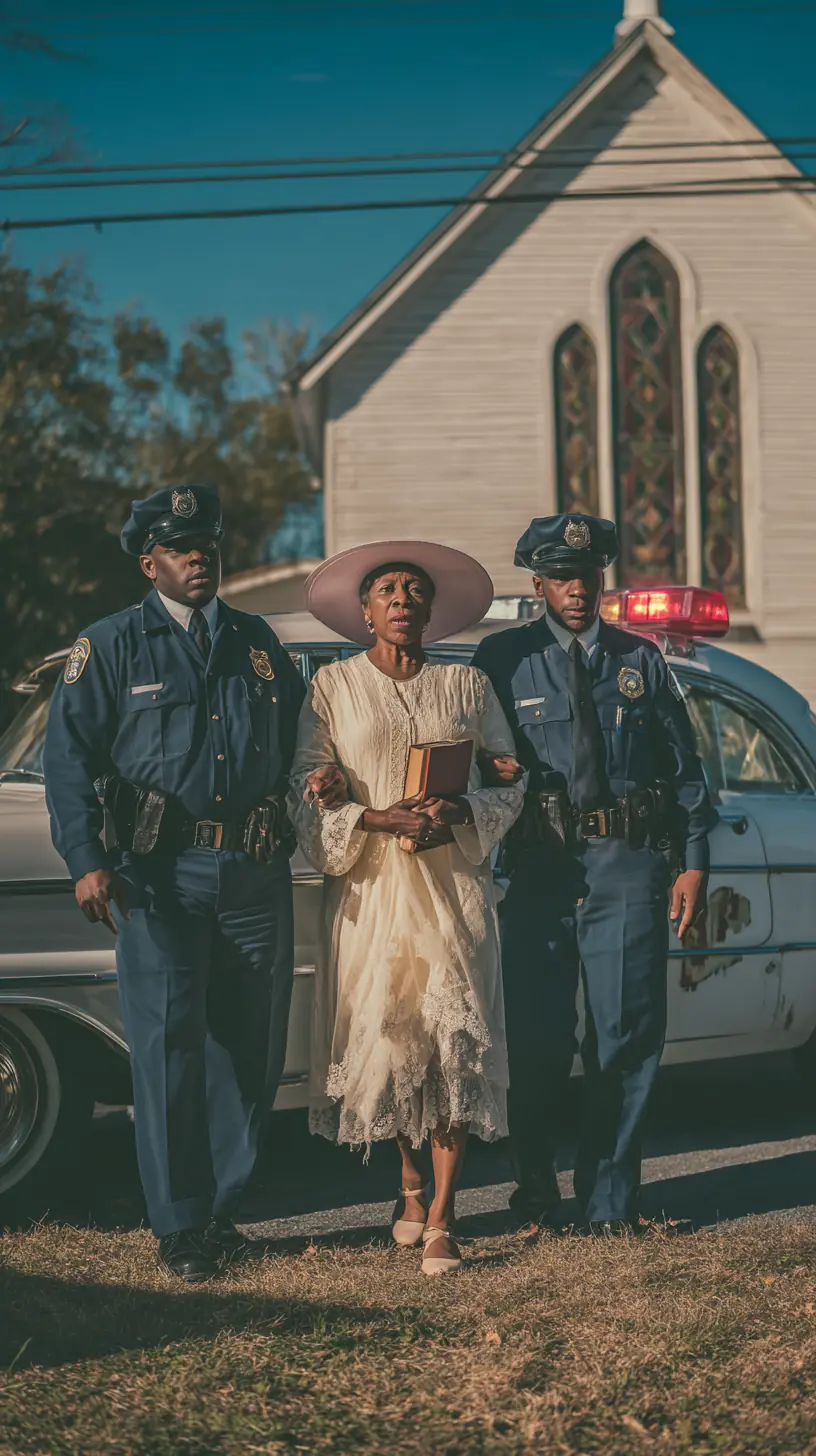
Pritchard smiled.
He believed this would be simple.
He believed she was just an elderly woman.
He did not know who her son was.
Three states away, in a secured operations room without windows, a satellite phone buzzed on a steel desk.
Captain Elijah Hill glanced at the screen. The call wasn’t from his chain of command.
It was from home.
He hesitated only a fraction of a second before answering.
“Mom?”
Static crackled.
Then Pastor Eugene’s voice came through, shaking. “Elijah… they arrested your mother.”
The room grew impossibly still.
Elijah’s men—operators hardened by deployments in places that did not officially exist—looked up from maps and weapon schematics.
“Who?” Elijah asked, voice level.
“Local police. They say she stole documents from Leonard Pritchard.”
Elijah stood slowly.
“That’s not possible,” he said.
“No. It isn’t,” the pastor agreed. “But they took her. And Pritchard’s already talking to the media.”
Elijah’s jaw tightened.
He had survived firefights in desert cities, jungles, mountains. He had planned operations that required flawless timing down to the second. He had made decisions that cost enemies their lives.
But nothing in his career prepared him for this.
“I’ll handle it,” he said quietly.
When he hung up, one of his teammates—Mason—spoke first. “Problem?”
Elijah didn’t look at him.
“They arrested my mother.”
The room absorbed that.
“And?” Mason asked carefully.
“And I’m going home.”
Margaret sat in the holding cell with surprising composure.
The metal bench was cold. The fluorescent lights buzzed. Across from her, a younger woman with smeared mascara stared at her in confusion.
“What’d you do?” the woman asked.
Margaret smiled softly. “Apparently, I’m a criminal mastermind.”
The woman snorted despite herself.
Hours passed. No formal questioning. No booking paperwork. Just waiting.
Margaret knew why.
This wasn’t about theft.
This was pressure.
Leonard Pritchard had offered to buy the church for months. When the congregation refused, he began buying surrounding properties. Then came zoning complaints. Fire inspections. Noise violations.
Margaret had organized resistance. She’d spoken at council meetings. She’d filed public records requests. She’d found inconsistencies in his development permits.
And last week, she’d discovered something far worse.
She’d discovered proof that Pritchard’s company was illegally diverting environmental funds meant to reinforce the town’s aging flood barrier.
If exposed, it would collapse his entire project.
So he decided to collapse her instead.
He thought age meant weakness.
He thought quiet meant harmless.
He thought wrong.
The black SUV door opened outside the station.
Leonard Pritchard stepped inside wearing a tailored navy suit and a politician’s smile.
He approached the desk sergeant. “Has she signed the confession?”
“Not yet,” the sergeant muttered.
Pritchard sighed theatrically. “Such stubbornness at her age. It’s sad.”
From the holding area, Margaret could see him through the bars.
He walked toward her cell.
“Mrs. Hill,” he said softly. “All this trouble over a building that’s falling apart.”
“It’s not the building,” she replied.
“Then what?”
“It’s the people.”
He leaned closer. “Sign the statement. Admit you took those files from my office. Pay a small fine. I’ll drop further charges.”
“And if I don’t?”
His smile thinned. “The court won’t be kind. At your age, a felony conviction is… unfortunate.”
Margaret studied him.
“You’re afraid,” she said.
His eyes flickered.
“Of what?”
“Of the truth.”
Before he could respond, the station doors burst open.
Every head turned.
A tall man in civilian clothes walked in with calm, deliberate steps. He wore no uniform, no insignia. But there was something unmistakable in the way he moved—controlled, precise, dangerous.
Elijah Hill stopped at the desk.
“I’m here for Margaret Hill.”
The sergeant frowned. “Visiting hours—”
“I’m not visiting.”
He slid a card across the counter.
The sergeant looked down.
His face changed.
He looked up again, slower this time.
Pritchard watched from the hallway, irritation flashing. “Who is this?”
Elijah turned his head slightly.
“I’m her son.”
“That doesn’t give you special privileges.”
Elijah’s gaze settled fully on him now.
“No,” he agreed. “It doesn’t.”
He stepped closer.
“But you filing a false police report is a felony.”
Silence.
Pritchard scoffed. “That’s a serious accusation.”
“So is theft,” Elijah replied evenly. “You claimed she stole documents. Security footage from your office building between 8 p.m. and midnight last night shows no entry. No breach. No alarm.”
Pritchard blinked.
“How would you know that?”
Elijah held his stare.
“Because I checked.”
The truth was far more complicated than that.
Within thirty minutes of the phone call, Elijah had contacted someone who owed him a favor—someone in a federal cybercrime division. They’d pulled traffic cam feeds, building security backups, and phone pings.
Leonard Pritchard hadn’t even been in town the night of the alleged theft.
He’d fabricated the entire timeline.
The sergeant cleared his throat. “Mr. Pritchard, do you have evidence?”
Pritchard shifted. “My office manager said—”
“Your office manager wasn’t on shift last night,” Elijah interrupted.
“How do you—”
“Careful,” Elijah said quietly.
There was no raised voice.
No threat.
Just certainty.
And that frightened Pritchard more than shouting ever could.
Margaret was released an hour later.
No charges filed.
Outside the station, the sun was beginning to set.
Elijah walked beside her, hands in his pockets.
“You didn’t have to come,” she said.
“Yes, I did.”
She glanced at him. “You look tired.”
“Long week.”
They reached the church parking lot, now empty except for Pastor Eugene.
Margaret stopped.
“You didn’t come home just to intimidate a developer,” she said softly.
Elijah didn’t answer immediately.
“No,” he admitted. “I came because I think this is bigger.”
She nodded.
“I found something,” she said.
From her Bible, she removed a folded packet of papers.
“Elijah, he’s been siphoning federal flood mitigation funds. If the barrier fails next storm season…”
“People could die,” Elijah finished.
“Yes.”
He scanned the documents.
Wire transfers. Shell corporations. False compliance reports.
This wasn’t small-town corruption.
This was federal fraud.
He looked up at his mother.
“You were never the target,” he said.
She smiled faintly. “Oh, I know.”
“He was trying to find out what you had.”
“Yes.”
“And you let him think he’d scared you.”
She adjusted her hat.
“Sometimes,” she said, “people underestimate you. It can be useful.”
Elijah laughed softly.
“You planned this?”
“I suspected he’d push too far.”
“And if I hadn’t come?”
She met his eyes steadily.
“You would have.”
Three weeks later, federal agents raided Leonard Pritchard’s offices.
News vans lined the street.
Indictments were unsealed: fraud, embezzlement, falsifying environmental compliance documents.
The stolen flood funds were traced back to luxury overseas accounts.
Pritchard was arrested—this time in handcuffs that weren’t symbolic.
As cameras flashed, he caught sight of two figures across the street.
Margaret Hill.
And her son.
He finally understood.
She had never been defenseless.
She had been patient.
And the man beside her—calm, watchful, unreadable—was not just a son.
He was Delta Force.
But the final twist wasn’t his military career.
It was this:
The investigation that brought Pritchard down had already been quietly underway for months.
And the anonymous whistleblower who triggered it?
Margaret Hill.
She had contacted federal authorities long before her arrest.
She had gathered evidence carefully, methodically.
Her “shock” that Sunday morning?
Convincing.
Her fear?
Performance.
She had allowed herself to be underestimated.
Because sometimes the most powerful weapon is not force.
It’s perception.
As the patrol car carried Pritchard away, Margaret squeezed Elijah’s hand.
“You see?” she said gently.
“They thought I was just an elderly woman.”
Elijah smiled.
“They didn’t expect you to be the most dangerous person in the room.”
She laughed.
“No, son,” she said.
“They didn’t expect us.”