Chinese researchers have developed an artificial intelligence (AI) model for astronomical imaging that enhances the ability to observe the deepest regions of the universe.
A multidisciplinary research team from Tsinghua University has created the model, named ASTERIS (Astronomical Spatiotemporal Enhancement and Reconstruction for Image Synthesis), based on principles of computational optics and AI algorithms.
According to findings published in the journal Science on February 20, the model can decode signals from extremely faint celestial objects, detect galaxies more than 13 billion light-years away, and produce the deepest space images known to date.
Distant and faint celestial bodies contain crucial information for understanding the origin and evolution of the universe. However, astronomers face a major challenge, as weak signals from remote objects are often obscured by background sky noise and thermal radiation noise from telescopes.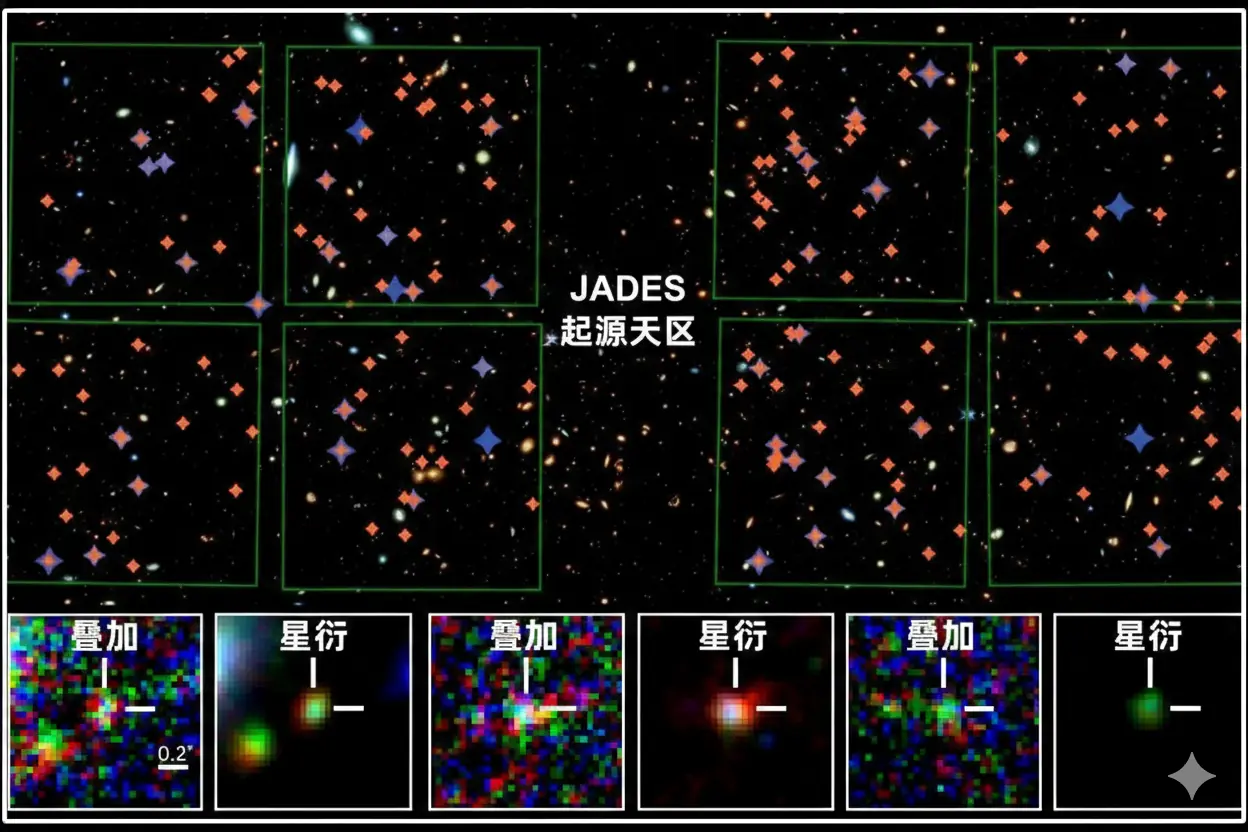
Comparison image of potential galaxies identified in previous studies (purple) and by ASTERIS (orange). Photo courtesy of the interviewee.
The study shows that applying ASTERIS’s “self-supervised spatiotemporal denoising” technology to the James Webb Space Telescope (JWST) can extend its coverage from visible light at around 500 nanometers to the mid-infrared region at 5 micrometers. This increases deep-space detection depth by one magnitude and detection accuracy by 1.6 magnitudes—equivalent to increasing the telescope’s aperture from about 6 meters to nearly 10 meters—enabling it to detect objects 2.5 times fainter than previously possible.
According to Associate Professor Tai Zheng of Tsinghua University’s Department of Astronomy, a leading member of the research team, using this model the team has identified more than 160 potential galaxies from the early universe, approximately 200 million to 500 million years after the Big Bang. Previously, only about 50 galaxies from this same epoch had been discovered worldwide.
Researchers said the AI model can decode massive volumes of data from space telescopes and is compatible with multiple observation platforms, giving it the potential to become a universal deep-space data enhancement platform.
Professor Dai Qionghai of Tsinghua University’s Department of Automation, one of the project leaders, said that faint celestial objects obscured by light interference in astronomical observations can be reconstructed with high accuracy using the model. In the future, the technology is expected to be deployed on next-generation telescopes to help address major scientific questions related to dark energy, dark matter, the origin of the universe, and exoplanets.