The loading docks at Harrington Supply opened before sunrise, before the city had fully decided whether it wanted to wake up.
Forklifts beeped through the gray morning light, metal doors rattled upward, and the smell of cardboard, diesel, burnt coffee, and floor cleaner hung in the air like something permanent. Workers moved through the warehouse with the tired rhythm of people who had learned to save their strength before the yelling started. Nobody spoke too loudly near the supervisors’ office unless they wanted their name remembered for the wrong reason.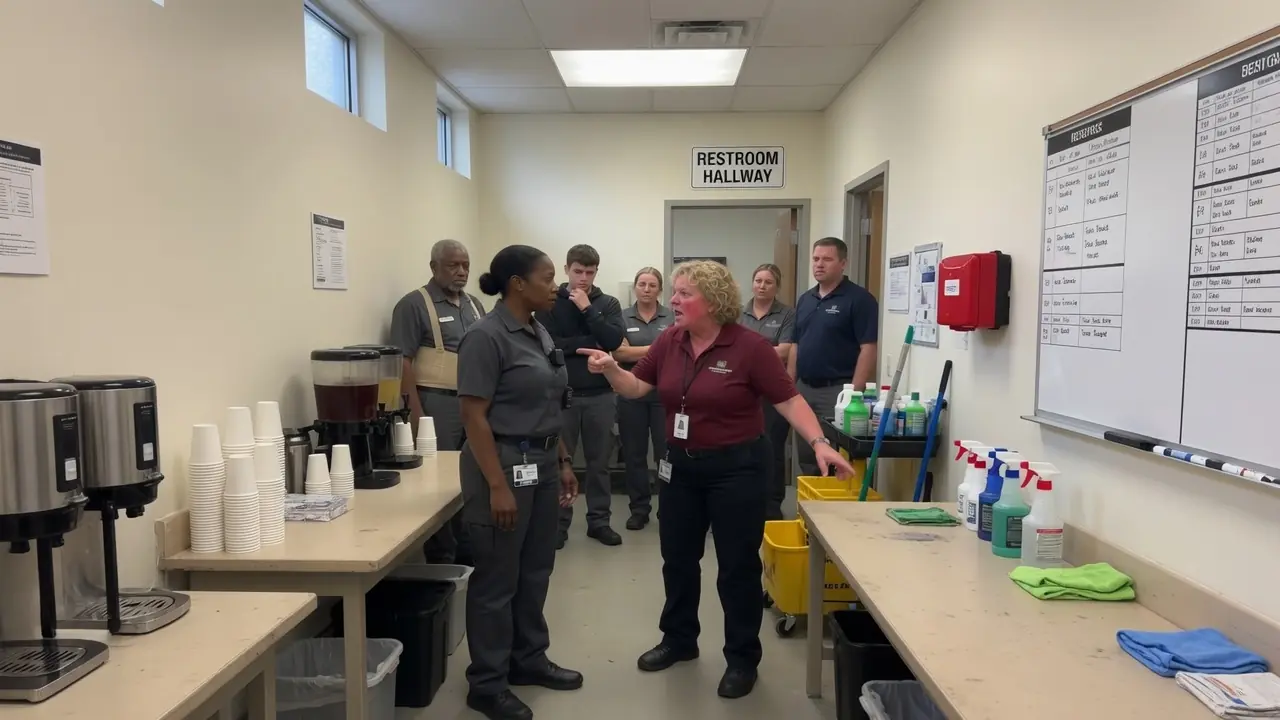
That was exactly why Camille Brooks walked in alone.
She wore plain black work pants, worn sneakers, a faded navy jacket, and no jewelry except a small watch tucked under her sleeve. Her hair was pulled back simply, and the badge clipped to her jacket only said temporary operations support. Nothing about her looked important, and that was the point.
Camille did not come to Harrington Supply to be recognized.
She came to see what happened when people believed nobody powerful was watching.
For six months, reports had reached her office in quiet, frightened waves. Employees described public humiliation, unpaid extra tasks, cruel jokes, threats of termination, and supervisors who acted less like leaders than owners of trapped people. The official numbers looked clean. Productivity was high, complaints were low, turnover was explained away as seasonal pressure.
But Camille had built Harrington Supply from a single rented warehouse in Georgia into one of the largest regional logistics companies in the country, and she knew numbers could lie when people were too afraid to speak.
Her father had taught her that.
He had worked thirty years in warehouses where men in clean shirts shouted down at workers whose backs did the real carrying. He used to tell Camille that bad leadership never starts with a broken policy. It starts in the everyday moments everyone pretends are too small to matter.
So Camille chose a cold Tuesday morning, before the corporate visitors arrived, before managers had time to polish the place for inspection.
She entered through the employee side door and stood near the breakroom coffee machine with a paper cup in her hand. Nobody asked who she was. Nobody had been trained to notice a quiet Black woman unless she was carrying a mop, a box, or someone else’s mistake.
Around her, the breakroom filled slowly.
A young packer named Eli sat with his head down, rubbing his wrists like they hurt. Two women from inventory whispered over microwaved oatmeal. An older janitor adjusted his back brace and stared at the floor every time footsteps passed the door.
The room carried the strange silence of people who were not resting, only waiting.
Then Denise Ralston walked in.
Even before she spoke, the whole room changed. Chairs stopped scraping. Conversations died mid-sentence. A man near the vending machine straightened so quickly his coffee spilled onto his hand, but he did not complain.
Denise Ralston was the floor supervisor for the morning shift, and she wore authority like a weapon she was eager to use.
She had a sharp blond bob, red nails, and a company radio clipped to her belt like a sheriff’s badge. Her boots struck the floor hard, not because she was in a hurry, but because she liked people hearing her arrive. Behind her came two assistant leads, both younger, both eager, both smiling the way people smile when cruelty is not aimed at them.
Denise scanned the breakroom with open disgust.
“Why is everybody sitting like we’re at a church picnic?” she snapped. “We’ve got trucks waiting, orders backed up, and half of you look like you need a nap and a prayer.”
Nobody answered.
She pointed at Eli. “You. Move faster today or I’ll move you out permanently.”
Eli nodded quickly. “Yes, ma’am.”
Denise turned toward one of the women by the microwave. “And if I find another mislabeled pallet from your section, I’m writing up the whole team. I’m tired of babysitting grown people.”
The woman lowered her eyes.
She had read words like hostile environment and supervisor misconduct in reports, but reports were too clean for the way this felt. They did not capture the little flinches. They did not show how employees folded themselves smaller when Denise spoke. They did not record the laughter from the assistant leads, the kind that told everyone the cruelty had permission.
Then Denise saw Camille.
Her eyes stopped, traveled from Camille’s shoes to her jacket to her face, and settled there with immediate dismissal.
“You,” Denise said.
Camille looked up calmly. “Yes?”
Denise tilted her head. “Why are you standing around my breakroom?”
“I’m waiting for instructions.”
“Perfect,” Denise said. “Bathrooms are disgusting. Grab a bucket and get started.”
A few people looked away.
One of the assistant leads snorted.
Camille set her coffee down slowly. “I wasn’t assigned to restroom cleaning.”
Denise’s eyebrows rose as if she had just heard a joke in another language. “Assigned? Honey, in this building, people are assigned to whatever I say they’re assigned to.”
“I understand work needs to be done,” Camille replied. “I’m asking why you chose me.”
The question landed harder than defiance.
Denise took one step closer. “Because you’re standing here doing nothing, and because I don’t like people acting delicate on my floor.”
“I’m not acting delicate.”
“Then prove it.” Denise turned toward the storage closet and pointed. “Mop. Gloves. Toilet cleaner. Move.”
The room went painfully still.
Camille could feel people watching her without wanting to be caught watching. She saw warning in their eyes, not judgment. They were silently telling her the same thing: do not make this worse.
But Camille had not come to Harrington Supply to keep the peace.
She had come to find out what peace was costing.
“Is this how you normally speak to employees?” she asked.
Denise laughed.
Not because anything was funny, but because she wanted the room to know she still owned it.
“Employees?” Denise said. “Let me explain something. This isn’t a college seminar. This is a warehouse. Around here, people do what they’re told, especially new people who haven’t earned the right to ask questions.”
Camille’s expression did not change. “And if I refuse?”
Denise smiled wider. “Then I call security, have you removed, and make sure you never work another shift here.”
Someone near the back whispered, “Denise, come on.”
Denise whipped around. “Who said that?”
No one answered.
“That’s what I thought.” She turned back to Camille. “You people always want to test boundaries until consequences show up.”
The words did not explode.
They slid into the room, ugly and familiar.
Camille heard a woman inhale sharply. Eli stared at the table. The older janitor closed his eyes for half a second, like he had heard that sentence in different forms for most of his life.
Camille nodded once.
“You people,” she repeated softly.
Denise’s smile twitched. “Don’t twist my words.”
“I’m not twisting them. I’m remembering them.”
Denise stepped closer until only a few feet separated them. “You need to worry less about remembering and more about scrubbing. I don’t know who hired you, but I can promise you this. If you want to last in my facility, you’ll stop standing there like you’re too good for honest work.”
Camille looked around the room.
At the tired faces.
At the frightened silence.
At the supervisors who had mistaken fear for loyalty.
Then she looked back at Denise. “Your facility?”
Denise lifted her chin. “That’s right.”
A voice came from the doorway before she could say another word.
“Denise.”
Everyone turned.
Paul Mercer, the regional operations director, stood at the breakroom entrance in a dark coat, his face drained of color. He had arrived too late to stop the damage and just early enough to understand he was part of it. His eyes were not on Denise.
They were on Camille.
“Ms. Brooks,” he said, barely above a whisper. “I didn’t know you were already here.”
The room froze.
Denise frowned. “Ms. who?”
Paul swallowed. “Camille Brooks.”
Denise’s face showed irritation first, then confusion, then the first flicker of fear.
Camille reached into her jacket and removed a slim black credential card. She held it up, not dramatically, not proudly, simply so the room could see it clearly.
“Camille Brooks,” she said. “Founder and chief executive officer of Harrington Supply.”
Nobody moved.
A plastic spoon slipped from someone’s hand and clattered against the tile. One of the assistant leads took a step backward. Denise stared at the card as if the letters might rearrange themselves into something survivable.
For once, she had no voice ready.
Camille put the card away. “You told me to scrub toilets.”
Denise opened her mouth. “I didn’t know—”
“That I owned the company?”
Denise’s lips trembled.
Camille’s eyes hardened, but her voice stayed even. “That is not a defense. That is the confession.”
Paul stepped forward quickly. “Ms. Brooks, I’m sure there’s context. Denise can be direct, but she runs a tight floor. Productivity numbers here are among the best in the region.”
Camille turned toward him slowly.
Paul stopped walking.
“Productivity bought with fear is not leadership,” she said.
He lowered his eyes. “Of course.”
“No, Paul. Not of course. If it were obvious to you, I would not have needed to stand in this room dressed like someone you believed had no power.”
Denise found her voice at last. “This is being blown out of proportion. I was enforcing standards. People here get lazy if you don’t stay on them.”
The older janitor lifted his head.
Camille noticed.
“What’s your name?” she asked him.
He blinked, surprised to be addressed directly. “Raymond, ma’am. Raymond Ellis.”
“Mr. Ellis,” Camille said, “has this happened before?”
Denise snapped, “Don’t answer that.”
Camille did not look away from Raymond. “You may answer.”
Raymond’s hands trembled around his coffee cup. For a moment, he seemed to carry the weight of every shift he had survived by staying quiet. Then he set the cup down.
“Yes, ma’am,” he said. “It happens every day.”
The breakroom changed.
Not loudly.
Not all at once.
But something broke open.
A woman from inventory raised her hand like she was back in school. “She called me stupid in front of my whole team because English is my second language.”
Another worker said, “She threatened to cut my hours when I asked about overtime pay.”
Eli lifted his head. “She made me keep working after I told her my wrist was swollen. Said if I could hold a phone, I could hold a scanner.”
One of the assistant leads muttered, “That’s not fair.”
Camille looked at him. “Which part?”
He went silent.
Then more voices came.
Stories spilled across the room faster than anyone could organize them. A pregnant employee had been mocked for needing bathroom breaks. A single father had been assigned the heaviest aisle after requesting one schedule change for his child’s doctor appointment. Complaints had been filed and disappeared. Witnesses had been warned not to “make drama.”
Paul Mercer stood by the doorway, every sentence landing on him like a verdict.
Camille listened to all of it.
She did not interrupt.
She did not ask anyone to calm down.
For years, the people in that room had been forced to swallow their own truth so the warehouse could keep running smoothly. Now their words filled the space Denise had controlled with fear, and fear began losing its shape.
Denise started crying when she realized the room was no longer hers.
“Please,” she said. “I need this job. I have bills. I have a family.”
Camille looked at her for a long moment.
“So do they.”
Denise wiped her face. “I made mistakes.”
“No,” Camille said. “A mistake is misreading a label. A mistake is entering the wrong quantity. What you built here was a pattern.”
Paul cleared his throat. “Camille, if I may—”
“You may not.”
He closed his mouth.
Camille faced Denise fully. “You used your title to humiliate people who needed their paychecks too badly to answer back. You turned work into punishment. You taught your assistants to laugh while others were degraded. And when you thought I was powerless, you treated me exactly how you treat them.”
Denise shook her head. “I can change.”
“You should,” Camille said. “But not here.”
Denise’s eyes widened.
“Denise Ralston, your employment is terminated effective immediately.”
A sound moved through the room, half gasp, half release.
Denise grabbed the back of a chair. “You can’t just fire me in front of everybody.”
Camille’s voice remained calm. “You humiliated people in front of everybody. Accountability feels public because abuse was public first.”
Security appeared at the door.
Denise looked toward Paul, desperate for help, but Paul would not meet her eyes. The assistant leads stood frozen, suddenly aware that proximity to power was not the same as protection.
As security escorted Denise from the breakroom, her cries echoed down the hall.
No one laughed.
No one cheered.
The people in that room had been hurt too long to mistake consequences for entertainment.
When Denise was gone, Camille turned to Paul.
He lifted both hands slightly. “I didn’t know it was this bad.”
Raymond let out a bitter breath.
Camille heard it.
She stepped closer to Paul. “How many complaints came through your office?”
Paul’s face tightened. “Some.”
“How many?”
“I’d have to check.”
“I already checked.”
His shoulders dropped.
Camille removed a folded paper from her jacket and opened it. “Thirty-seven complaints in eighteen months. Twelve involved Denise directly. Seven included claims of retaliation after reporting supervisor conduct. Four mentioned you by name as the person who said you would handle it.”
Paul’s mouth went dry. “I was trying to avoid instability.”
“You protected instability.”
“I had regional targets.”
“You had human beings.”
The words hit harder than shouting would have.
Paul looked around the room then, really looked, maybe for the first time. He saw workers who no longer lowered their eyes. He saw people holding their breath because the man who had ignored them was finally being forced to stand inside the consequences of that silence.
Camille folded the paper.
“Paul Mercer, you are terminated effective immediately.”
He stared at her. “After fourteen years?”
“After thirty-seven ignored warnings.”
Security stepped back into the room.
Paul did not argue the way Denise had. His face went slack, almost gray, as if part of him knew he had been fired long before this moment. He had simply stayed employed because nobody with enough authority had cared to look.
As he walked out, the breakroom remained quiet.
Camille let that quiet stay.
Some rooms need silence after the truth arrives.
Then she addressed the workers.
“No one in this room will be punished for speaking today,” she said. “No hours will be cut. No schedules will be changed in retaliation. If anyone attempts it, that person will answer directly to my office.”
A woman near the microwave began crying softly.
Camille continued. “At noon, this entire facility will pause operations for a mandatory staff meeting. Tomorrow, outside investigators will begin interviews. Payroll, injury reports, disciplinary records, and prior complaints will be reviewed. Every supervisor in this building will be retrained, replaced, or removed.”
Eli wiped his eyes with the heel of his hand.
Camille looked at him. “And medical accommodations will be handled by policy, not personality.”
He nodded, unable to speak.
Raymond stood slowly. “Ma’am?”
“Yes, Mr. Ellis?”
He hesitated. “Are you really going to fix it?”
Camille felt the question more than heard it.
Not because it challenged her, but because it revealed how many promises had been made before hers. Workers did not lose faith all at once. It was taken from them shift by shift, complaint by complaint, after every person in power said the right words and changed nothing.
Camille walked toward him.
“I’m not going to fix this with a speech,” she said. “I’m going to fix it with records, consequences, better leadership, and people who understand that respect is not a bonus.”
Raymond nodded slowly.
That answer, practical and plain, meant more to him than comfort.
By noon, the warehouse floor had gone still.
The forklifts were parked. The dock doors were closed. Employees gathered between rows of stacked pallets while Camille stood on a low metal platform near the shipping office. She had changed nothing about her appearance. Same jacket, same sneakers, same calm face.
But everyone saw her differently now.
That was not what she wanted.
She did not want respect because of the executive card in her pocket. She wanted a company where the person without the card still received basic dignity. Still, she understood the reality. Sometimes people had to see power defend the powerless before they believed anything could change.
She spoke without notes.
“My father worked in warehouses most of his life,” she said. “He came home exhausted, but the work was not what broke him. What broke him was being treated like his body mattered to the business, but his dignity did not.”
The workers listened.
No one shifted.
No one whispered.
“I built this company because I wanted to prove a place could move goods without crushing people. Somewhere along the way, parts of this organization forgot that. Or maybe they never learned it. Either way, today ends that excuse.”
She looked toward the supervisors standing in a stiff line near the office.
“Leadership is not permission to be cruel. Seniority is not a shield from accountability. Silence is not neutrality when people are being mistreated in front of you.”
Janice from inventory pressed a tissue to her nose.
Camille continued. “Some of you have been afraid for a long time. I cannot undo what happened. But I can make sure the people who caused it, ignored it, or benefited from it do not keep deciding your future.”
The applause began with Raymond.
Then Eli joined.
Then one by one, the sound spread through the warehouse, not wild or theatrical, but steady and deep. It echoed off the metal racks, rose toward the high ceiling, and filled a building that had spent too many mornings swallowing fear.
Camille did not smile until it faded.
After the meeting, she stayed.
Not for photographs.
Not for a press release.
She sat in a small office beside HR and listened to employees for six straight hours. Some brought written notes. Some brought pay stubs. Some brought nothing but memories they had been carrying too long.
She listened until the winter sun disappeared behind the loading docks.
By the end of the week, Harrington Supply looked different in ways visitors could not immediately see. The breakroom tables were the same. The forklifts still beeped. The orders still had to go out on time.
But people stood straighter.
Supervisors spoke more carefully.
The assistant leads who had laughed behind Denise were suspended pending review, then reassigned only after formal training and direct apologies. Two resigned rather than apologize, which told Camille the training had worked in its own way.
Raymond was promoted to facilities coordinator with a raise and a staff of three.
Eli received medical care for his wrist and was moved to a safer assignment until he healed. The pregnant employee who had been mocked received back pay for hours unfairly cut. The woman from inventory who had been insulted for her accent became part of a new employee advisory council.
And every complaint now went through a system Denise Ralston could never have buried.
Three months later, Camille returned to the warehouse without warning.
This time, people recognized her immediately, but she still stopped by the coffee station first. Raymond was there, pinning a new safety notice to the bulletin board. Eli stood nearby, laughing with two coworkers while flexing his healed wrist.
The room did not go silent when a supervisor entered.
That was how Camille knew change had started to become real.
A young temporary worker hurried in, nervous and new, wearing the same kind of uncertain expression Camille had worn on purpose months earlier. She dropped her lunch bag, and an orange rolled across the floor toward the old storage closet.
Before she could panic, Raymond picked it up and handed it back.
“First week?” he asked.
She nodded.
He smiled. “You’ll be all right here.”
Camille stood near the doorway, hearing the words settle into the room.
You’ll be all right here.
It was a small sentence.
But in a place where fear had once passed for discipline, it sounded almost revolutionary.
As Camille walked back toward the warehouse floor, the morning shift moved around her with energy instead of dread. Machines hummed. Trucks backed into docks. Orders rolled through scanners and conveyors.
The work was still hard.
Warehouses always were.
But hard work and humiliation were never the same thing.
Denise Ralston had believed power meant deciding who could be degraded. Paul Mercer had believed leadership meant protecting numbers from human truth. Both of them had learned too late that unchecked authority can look strong right up until the person it underestimates owns the whole building.
Camille Brooks had not raised her voice that morning.
She had not needed to.
She walked in as a woman they thought they could command, watched the cruelty reveal itself, and left behind a warehouse where dignity was no longer treated like a privilege.
And from that day forward, every supervisor at Harrington Supply understood the lesson written quietly into the company’s new training manual.
Respect does not begin when someone important enters the room.
Respect begins before you know who they are.