The morning air in Willow Creek Estates was always carefully manufactured.
It smelled faintly of cut Kentucky bluegrass and commercial fertilizer. A neighborhood designed to look like a sanctuary, but managed like a military base.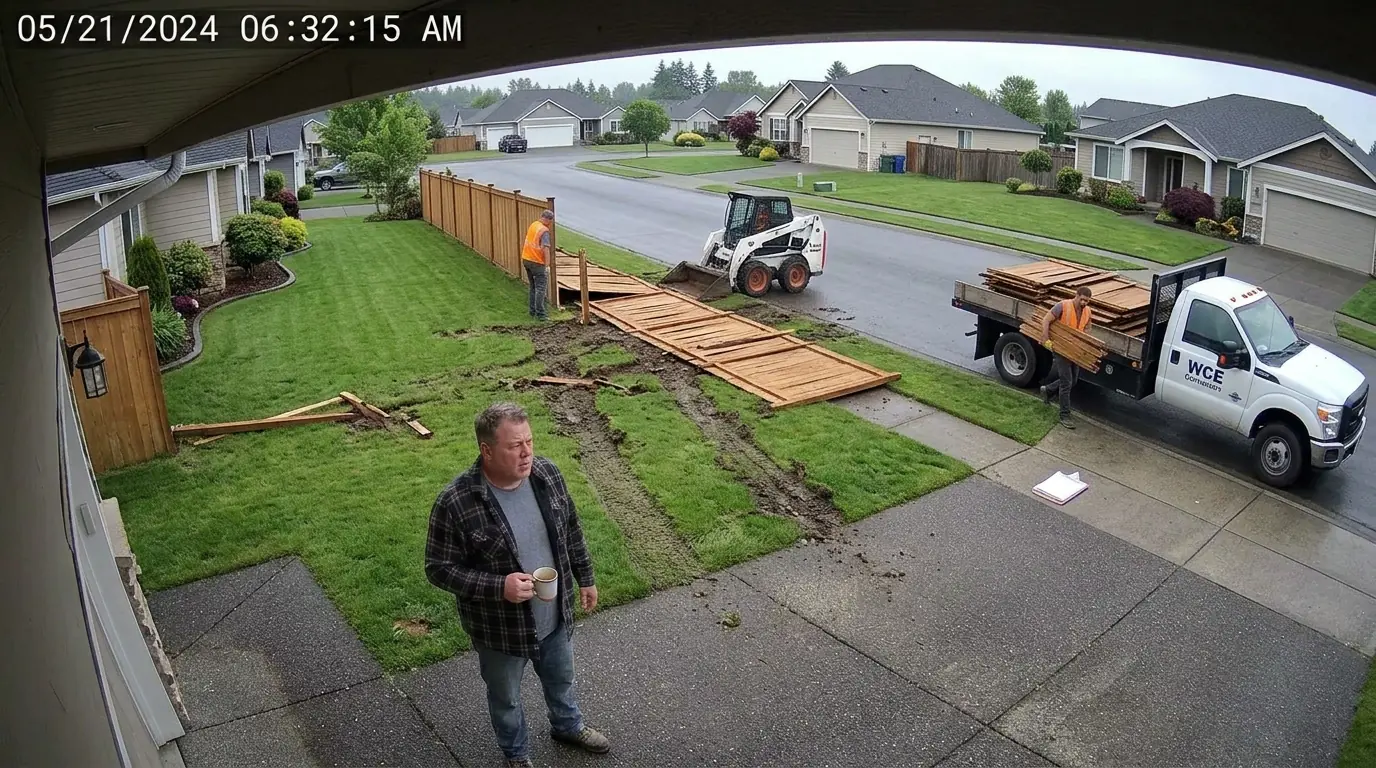
I stood at the edge of my driveway, a half-empty mug of black coffee cooling in my hand, staring at the physical wreckage of my property line.
My cedar fence, all 80 ft of it, was lying flat in the mud. The posts hadn't just been unbolted. They had been sheared off base by a skid steer.
My name is Ethan Walker. For 15 years, I've managed municipal infrastructure contracts across three states. I've overseen highway expansions, heavy utility routing, and drainage grids that keep entire counties from washing away during flash floods.
I bought this lot because it was built over a master easement I actually consulted on a decade ago. I thought I was buying peace. I thought after years of dealing with corrupt city councils and aggressive labor unions, a quiet cul-de-sac would be a retirement for my nerves.
I was wrong.
I had simply traded corporate bureaucracy for Karen Whitmore. Karen was the HOA president, a woman who treated the community bylaws like her personal constitution. She drove a pristine white Lexus SUV through the streets every morning at precisely 7:00 a.m., moving at 5 mph, her eyes scanning lawns for rogue weeds or non-compliant trash cans.
Two days ago, she stopped outside my house, rolled down her window, and adjusted her sunglasses.
"Ethan," she had said, her voice dripping with artificial neighborly warmth. "The board reviewed your fence. The stain is three shades darker than the approved desert sand palette. It reduces the visual continuity of the block. Our analysts estimated it impacts collective property values by roughly 0.8%."
"It's weather-sealed cedar, Karen," I replied calmly. "It's built to last 20 years without rotting into the water table."
"Rules are what keep this community from becoming a slum, Ethan." She smiled, a cold, practiced expression. "Compliance is non-negotiable."
I thought it was just the usual HOA posturing until 24 hours later when an official citation was taped to my front door. It wasn't a warning. It was an enforcement order claiming the structure violated section 4B of the aesthetic compliance standards.
No county inspector had ever flagged my fence. It was fully permitted under municipal code. But in Willow Creek Estates, Karen considered her board to be the Supreme Court.
Now, looking at the splintered wood, I heard the high-pitched beep of a diesel engine reversing. A commercial flatbed truck was parked at the curb and two contractors in high-visibility vests were already tossing my cedar panels into the back.
I walked down the driveway, my boots crunching on the gravel. "Who authorized this?" I asked, keeping my voice level, completely devoid of anger. In my line of work, losing your temper is the first step to losing a contract.
The lead worker, a guy with a clipped beard and an uncomfortable look on his face, wiped his brow. "Look, man, we just got the work order from the management company. Signed by a Ms. Whitmore. Says it's an unauthorized structure on an HOA-controlled easement. We're just doing the haul away."
"Do you have the county-approved permit for structural demolition?" I asked.
He pointed a gloved finger toward a handwritten directive on his clipboard. "Just this, boss."
I pulled out my phone, stepped back, and began taking high-resolution photos of the damage, the truck's license plate, and the work order. "Take what you want," I said softly, "but make sure you don't lose that clipboard."
By midmorning, the contractors had cleared the debris, leaving nothing behind but a jagged line of empty post holes and ruined turf. The physical barrier that separated my property from the open common area was gone, but as I stood there tracing the property line with a digital laser measure, I knew the legal boundary hadn't moved an inch.
Lines on a property deed don't dissolve just because a bulldozer destroys the wood marking them.
I walked back inside my home office. The air conditioning hum provided a steady backdrop to the anger I was systematically suppressing. I opened my heavy steel filing cabinet and pulled out the thick leather-bound binder containing my original property purchase records from 2018.
Most homeowners sign their closing paperwork without reading the fine print, trusting the title company to handle the details. But I don't trust systems I haven't audited myself.
Buried on page 42 of the master development agreement, beneath the standard clauses about roof shingles and commercial vehicle parking, was the golden thread: a subsurface utility easement (SUE).