My name is Maya Bennett, and somewhere around the age of twelve, I learned that people could form an entire opinion about you before they knew a single true thing.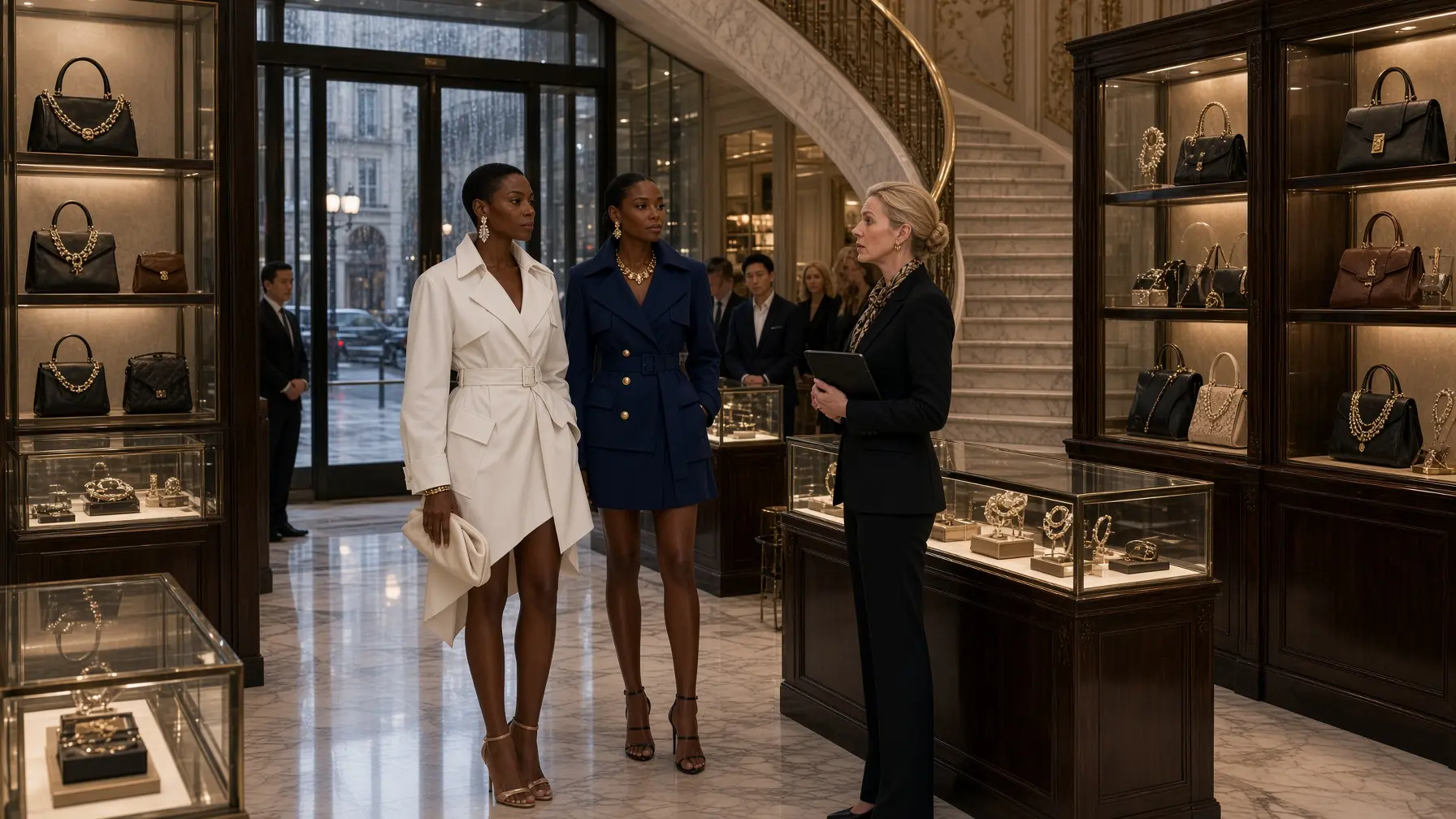
Sometimes it happened through a question. Sometimes it happened through the way somebody’s smile disappeared when you stepped into the room. More often, it happened silently, through eyes that traveled from your face to your clothes, then back again as though calculating whether you belonged where you were standing. My twin sister, Camille, learned the same lesson seven minutes before I did, which she would probably insist was another advantage of being older.
Camille and I were identical enough that teachers confused us long after we stopped dressing alike. Same dark brown eyes, same high cheekbones, same thick black curls inherited from our mother, and the same habit of raising one eyebrow when somebody said something ridiculous. Our personalities were different enough that nobody who spent more than ten minutes around us had trouble telling us apart. Camille walked toward conflict; I usually measured it first.
She became a fashion designer. I became a corporate finance consultant. Nobody in our family found either choice surprising.
As children, Camille could turn an old curtain into a dress before I understood why anyone would want to. She studied how people stood when they felt uncomfortable in their clothes, how women tugged sleeves over their wrists when they were nervous, and how the right jacket could make somebody walk into a room differently. I was fascinated by numbers in the same way. We both liked structure; hers happened to move when people breathed.
Our mother used to joke that Camille dressed the world while I tried to balance its books. She worked as a respiratory therapist, often taking overnight shifts while our father drove city buses, and neither of them had much patience for children who believed talent was enough without discipline. If Camille wanted fabric, she saved for it. If I wanted a calculator more expensive than the school issued, I did the same.
By twenty-five, Camille had created a label called Aveline Row from the second bedroom of the apartment we shared in downtown Meridian Heights. There was nothing glamorous about the beginning. Fabric rolls leaned against the washing machine, shipping boxes filled half our hallway, and the old printer jammed so often that I once threatened to throw it out the window. Camille kept it because she said suffering built character.
Her first collection sold twenty-three pieces. Twelve went to friends, five went to women who found her online, and the rest took almost four months to move. Camille celebrated every order as though somebody had bought a couture gown in Paris. I handled her bookkeeping at the kitchen table because paying an accountant was still a luxury.
Then a woman in Oregon ordered a dress after leaving a marriage of eighteen years. She wrote afterward that she had not felt beautiful in years until she wore Camille’s design to her daughter’s graduation. Camille printed the message and taped it over her sewing machine. It remained there through every difficult month that followed.
Aveline Row grew slowly enough that we had time to understand what growth actually cost. First came weekend pop-ups, then local boutiques, then online features from fashion bloggers whose audiences were larger than our entire customer list. Camille learned manufacturing, vendor negotiations, textiles, shipping, returns, and the specific misery of discovering that one mislabeled box could create two days of customer-service chaos. I learned cash-flow forecasting for a company that seemed determined to spend tomorrow’s money today.
By thirty-two, Camille had stopped sewing every garment herself because thousands of customers were buying them. A singer wore one of her coats during an interview, a television actress appeared in an Aveline Row dress at a film premiere, and suddenly people who once called the company a hobby were using phrases like breakout brand and emerging luxury. Camille pretended not to notice the change in vocabulary. I noticed for both of us.
The invitation from Maison Laurentier arrived on a Tuesday afternoon. Camille called before I finished lunch. The sound of her voice told me immediately that something significant had happened.
“Maya.” She rarely used my name without explanation. “Maison Laurentier wants a meeting.”
I stopped typing. “The Maison Laurentier?” Camille laughed nervously.
“There is only one worth saying like that.” I leaned back in my chair. “What do they want?”
“A partnership discussion.” She paused. “Possibly a capsule collection.”
Maison Laurentier had been part of the American luxury landscape for nearly seventy years. Its flagship in Bellhaven City occupied an entire corner of Prescott Avenue, where storefronts had brass doors, private security, and window displays changed often enough to become neighborhood events. People visiting the city photographed themselves outside even if they never intended to buy anything. The company’s reputation could move a young designer into rooms that usually opened much more slowly.
“That is huge.” My voice came out softer than I intended. Camille did not answer immediately.
Then she said, “I want you there.” I laughed. “Camille, I do not know the difference between organza and chiffon unless you label them.”
“You know exactly what it cost to build this company.” Her tone became serious. “You were there when nobody would extend credit.”
“You built the first financial model.” Another pause followed. “You sat beside me when I thought I was going to lose everything after that manufacturing disaster.”
I smiled despite myself. “That was a terrible month.” Camille answered, “That is why you are coming.”
The morning of the meeting, Camille arrived at my condo carrying two garment bags and the expression of somebody who had already found fault with my clothing before entering the room. I was wearing charcoal trousers, a navy cardigan, and the blouse I normally used for conservative client meetings. Camille stared at me. “Absolutely not.”
“It is a good cardigan.” She moved past me. “It says you can locate the office printer during an emergency.”
“I can.” Camille opened one garment bag. “That is not the point.”
She put me in wide-leg black trousers, a cream silk blouse, a long camel coat, and small gold earrings. The shoes were lower than I expected, which told me she had actually considered whether I needed to walk. When I looked at myself in the mirror, I did not see a different woman. I saw a version of myself Camille apparently believed I forgot to introduce often enough.
She adjusted the collar behind me. “There.” I looked at her in the mirror.
“Do I pass?” Camille shook her head. “You are not applying for permission.”
Her expression softened. “You know you belong.” I nodded.
“Good.” Camille reached for her bag. “Sometimes the room needs to catch up.”
Maison Laurentier stood at the corner of Prescott and Eleventh beneath a slate-gray sky. Rain had been falling since breakfast, turning the pavement dark and reflecting the warm gold light from the store windows. A mannequin in a deep green evening gown stood behind glass, and Camille slowed just enough for me to notice. “That shoulder construction is beautiful.”
“I assume that is serious praise.” Camille nodded. “Very.”
We crossed beneath the awning and entered through tall glass doors. City noise disappeared almost completely. Inside was marble, brass, velvet furniture, art books, muted music, and the expensive stillness luxury stores often cultivate deliberately.
The first person who looked at us was standing near fine jewelry. Her eyes moved to Camille’s face, then mine, then our coats and shoes. Another associate behind handbags noticed the first woman noticing us and looked too. The reaction was subtle enough to deny and familiar enough that both Camille and I recognized it immediately.
She leaned toward me. “Keep walking.” I nodded. We had an appointment.
Nobody greeted us during the first minute. Customers entering after us received immediate smiles. A man shaking rain from a gray umbrella was offered sparkling water almost before he removed his coat.
Camille looked toward the reception desk. I could see the change in her posture. Not fear. Preparation.
A woman approached. Her badge read Margaret Sloan, Client Experience Manager. She was perhaps fifty, white, blond hair pinned neatly at the base of her neck, and dressed in a black suit so well fitted it looked like part of the architecture.
“Can I help you?” The smile was professional. The warmth was absent.
Camille answered politely. “Yes. I have a two o’clock meeting with your partnerships team.”
Margaret looked toward Camille, then her tablet. “A meeting?” The slight emphasis made me look at her more closely.
“Yes.” Camille smiled. “Camille Bennett, founder of Aveline Row.”
Margaret entered the name. Her finger stopped on the screen. She looked back up.
“Bennett?” Camille nodded. “Correct.”
Something recalibrated in Margaret’s face. Not enough to become respect. Enough to show surprise.
“Aveline Row.” She repeated it as though testing whether the name belonged to the woman standing in front of her. Camille’s smile did not move.
“Yes.” Margaret glanced toward me. “And you?”
“Maya Bennett.” I extended my hand. “I’m Camille’s sister and financial advisor.”
Margaret looked at my hand briefly before shaking it. “Financial advisor.” She repeated that too. I had spent sixteen years in corporate finance and knew what disbelief sounded like when it wore professional clothing.
Camille pulled up the confirmation email. “The meeting was scheduled by your partnerships office last week.” Margaret looked at the screen for less than a second.
“There may be a scheduling issue.” Camille frowned. “The email has the date, time, and location.”
Margaret’s smile tightened. “Please wait while I verify.” She gestured toward a seating area beside the entrance.
Behind a brass divider, several velvet chairs sat near the private client suites. She did not direct us there. She pointed to two smaller chairs facing the doors.
Camille noticed. I knew she noticed because her jaw tightened slightly. Neither of us said anything.
We sat. Five minutes passed. Then ten.
A white woman entered carrying a small designer dog. Two associates greeted her by name. Another customer walked in without an appointment, asked about a new handbag collection, and was immediately escorted toward a private viewing area.
At twenty minutes, I checked my phone. “Want me to email partnerships?” Camille was already typing. “Done.”
At twenty-eight minutes, a young associate approached. His name badge read Daniel Cho. He looked maybe twenty-five and uncertain whether he was supposed to be speaking to us.
“Hi.” He smiled carefully. “Are you waiting for an associate?” Camille looked up.
“A meeting.” She showed him the confirmation. Daniel actually read it.
His eyebrows rose. “This says partnerships, executive level.”
“Yes.” Camille folded her hands. “That is what I have been trying to explain.”
Daniel looked toward the reception desk. “I’m going to check upstairs.” He hurried away before anybody could stop him.
Margaret returned seven minutes later. Daniel was not with her. She wore the expression of somebody who had decided the problem should now be treated as settled.
“I’m sorry.” She looked toward Camille. “There appears to be some confusion regarding where your appointment was scheduled.”
Camille stood. “What confusion?” Margaret gestured vaguely.
“Independent brands sometimes meet at our corporate offices rather than the flagship.” Camille pulled up the email again. “The address in this message is the address where we are standing.”
Margaret gave the screen a longer glance. “I understand that may be frustrating.” Camille’s face went still.
“You keep explaining how I might have made a mistake.” Her voice remained calm. “You have not explained why nobody has checked whether your staff made one.”
Margaret crossed her arms lightly. “I am trying to help you.” Camille nodded.
“No.” She looked toward the private waiting lounge. “You are trying to manage us until we leave quietly.”
The music continued. Several customers nearby stopped pretending they could not hear. Margaret’s expression tightened.
“I do not appreciate your tone.” Camille smiled slightly. “There it is.”
Margaret frowned. “Excuse me?” Camille answered, “The moment the person questioning poor treatment becomes the behavior problem.”
Daniel stood near a scarf display now. His tablet remained in his hand. He looked uncomfortable enough that I suspected he had discovered something upstairs and had not yet found the courage to interrupt his manager.
Before he could act, the front doors opened. A white woman in a powder-blue raincoat entered. Three things happened immediately.
One associate took her umbrella. Another said, “Welcome back, Mrs. Chandler.” A third appeared with a garment bag and told her the fitting room had already been prepared.
Mrs. Chandler smiled. “Perfect.” She walked toward the private salon without being asked for confirmation, identification, or any evidence that she belonged there.
Camille watched. I watched. Margaret knew we were watching.
My sister turned back to her. “Can I ask you one question?” Margaret’s smile disappeared. “Certainly.”