The storm over Oberon Pass did not sound like weather.
It sounded alive.
Wind struck the log walls of Norah Vale’s way station hard enough to shake flour from the rafters. Snow hissed beneath the door. The iron latch shuddered every few minutes as if someone outside had wrapped both hands around it and was trying to tear the entrance from its hinges.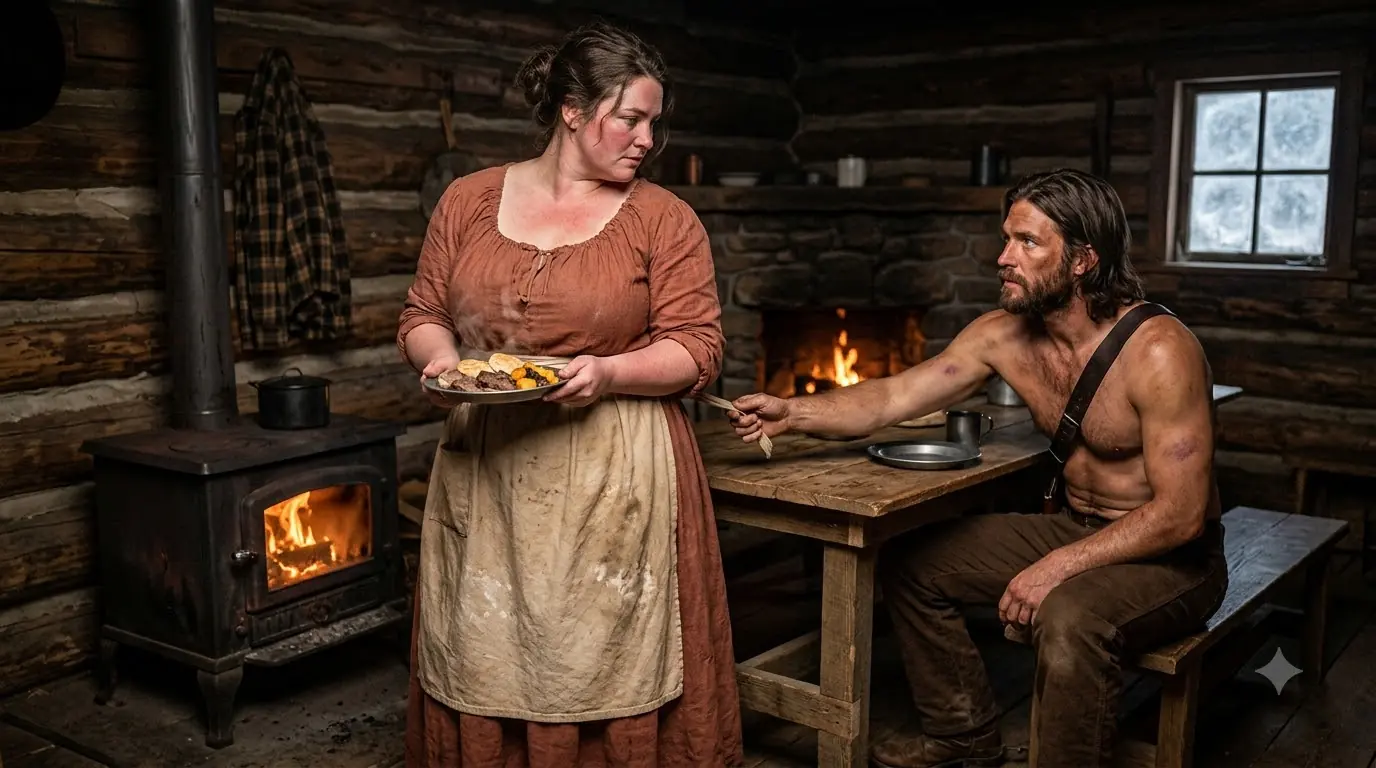
Norah ignored it.
She had lived at the station for six winters.
She knew which noises meant danger and which merely meant Wyoming being Wyoming.
The violent rattle near the western wall was loose chinking.
The groaning overhead was the roof beam contracting in the cold.
The tapping near the pantry was a branch.
The sound of a human body crashing through her front door was something else entirely.
Norah turned from the stove.
A man stumbled across the threshold.
For half a second he remained upright.
Then his knees folded.
He struck the floor hard enough to make the tin cups on the shelf tremble.
Cold air rushed into the cabin behind him.
Norah crossed the room, shoved the door closed with one powerful shoulder, and dropped the bar into place.
The stranger did not move.
He was tall even collapsed.
Long dark hair was plastered across his face. Snow clung to his beard. His heavy canvas coat was soaked black along one side, and beneath the wet fabric Norah could see the darker stain of blood.
She crouched.
Her knees complained immediately.
She ignored them too.
“Can you hear me?”
His eyelids moved.
That was enough.
Norah grabbed him beneath both arms and pulled.
He was not light.
She was simply stronger than most men expected.
Her boots slid once on the wet floorboards. She widened her stance, leaned back, and dragged him toward the hearth.
The stranger made a low sound.
“Good,” Norah muttered. “If you can complain, you can live.”
He did not answer.
By the time she got his coat off, she knew the blood was not the worst problem.
A bullet had cut a trench along his ribs.
Ugly.
Painful.
But not immediately fatal.
The fever was worse.
His skin burned beneath her hand despite the ice in his hair.
His breathing rattled.
Pneumonia.
Norah stared at him for several seconds.
Outside, the wind screamed.
She could not send him anywhere.
She could not leave him.
And if he died, she would have to bury him.
The ground outside was frozen solid enough to turn a shovel blade.
“Absolutely not,” she said.
The unconscious man did not object.
For three days Norah fought the frontier for possession of him.
She cleaned the wound.
Changed the linen.
Forced broth between his cracked lips.
Packed yarrow against the inflamed flesh.
Kept water near the hearth.
Fed the fire.
She slept sitting upright in the heavy rocking chair because moving to her bed seemed irresponsible.
At some point during the second night, the stranger began thrashing.
His hand struck the blanket.
His body twisted.
Norah placed one thick forearm across his chest.
“Stop.”
He fought weakly.
“You tear those stitches and I will sew you twice as badly.”
His eyes opened.
Pale blue.
Confused.
For one brief moment they focused on her face.
Then he went still.
“Good,” Norah said.
His eyes closed again.
On the fourth morning, his fever broke.
Norah was slicing salt pork when she heard the word.
“Water.”
She finished the cut first.
Then she wiped the knife.
Then she crossed the room.
She had learned long ago never to let another person’s urgency become ownership of her movements.
The man was awake.
Weak.
Sweating.
But awake.
Norah dipped a tin cup from the barrel and handed it to him.
He drank too quickly.
Coughed.
Drank again.
Finally he lowered the cup.
“Tobias.”
Norah looked at him.
“My name.”
She nodded.
“Norah.”
Tobias closed his eyes.
“Norah.”
Something about the way he repeated it bothered her less than it should have.
She stood.
“You can introduce yourself properly after you stop leaking on my rug.”
One corner of his mouth lifted.
It disappeared almost immediately.
That was the first time Tobias Kane smiled in her house.
It would not be the last.
The snow deepened.
By the seventh day the lower half of the windows disappeared behind white drifts.
By the tenth, Oberon Pass was completely closed.
No stagecoach.
No riders.
No supply wagons.
No mail.
No one in.
No one out.
Norah and Tobias became unwilling residents of the same small world.
At first he stayed out of her way.
She appreciated that.
Most men who passed through her station felt compelled to fill silence.
They asked where her husband was.
Asked how she managed the place alone.
Asked whether she had ever considered losing weight.
Asked whether she was lonely.
Asked whether she was frightened at night.
Asked questions as if curiosity entitled them to answers.
Tobias asked almost nothing.
When he grew strong enough to stand, he began tending the fire.
When he could walk, he carried water.
When he could lift without reopening the wound, he moved a sack of flour from the floor onto a bench so Norah would not have to bend so far.
He did not announce these things.
He simply noticed what needed doing and did it.
That made Norah suspicious.
Kindness without performance was unusual.
She watched him carefully.
He watched her too.
Not in the way travelers watched.
Norah knew those looks.
Men looked at her body with one of three expressions.
Mockery.
Disgust.
Or the crude fascination of someone staring at something too large to understand.
Tobias looked differently.
His gaze lingered.
But never with contempt.
When she stretched for a jar on a high shelf, he watched the movement of her body with a stillness that made warmth creep beneath her collar.
When she rolled dough, he watched her hands.
When she carried firewood against her hip, he looked at the strength in her arms.
Norah pretended she did not notice.
Tobias pretended he did not know she noticed.
The arrangement worked.
Until the tenth evening.
Norah had venison.
Winter squash.
Three biscuits’ worth of buttermilk.
And enough butter to justify using some.
She cooked because cooking was the only place where the world had never successfully made her small.
Her hands knew what to do.
Heat skillet.
Butter.
Juniper.
Wild garlic.
Sear meat.
Remove.
Reduce stock.
Finish with butter.
Rest venison.
Roast squash.
Black pepper.
Biscuits into the Dutch oven.
Do not rush.
Do not hesitate.
She moved quickly through the cramped kitchen.
Tobias sat at the timber table whittling a spoon.
At some point he stopped.
Norah felt him watching.
She kept working.
When she set the plate in front of him, his expression changed.
He cut the venison.
Took one bite.
Stopped.
Norah sat across from him.
Tobias chewed slowly.
Swallowed.
Took a piece of biscuit.
Then another bite of meat.
He did not speak until the entire plate was clean.
He set the fork down.
The small metallic sound was strangely loud.
“Who taught you to cook like that?”
Norah stopped breathing.
The fork in her hand remained halfway to her mouth.
The cabin vanished.
St. Louis returned.
A windowless kitchen.
Heat trapped beneath a low ceiling.
Cigar smoke.
Gin.
Sweat.
A wooden table slick with spilled sauce.
A leather strap slamming against the boards.
Do it again.
The sauce is broken.
Do it again.
You stupid fat cow.
Do it again.
You are good for nothing else.
Do it again.
Norah blinked.
The cabin came back.
Tobias was still sitting across from her.
His face had changed.
He had seen something happen.
Norah put down the fork.
Her hand shook once.
She hated that.
She pushed away from the table.
The chair legs scraped loudly.
Tobias did not move.
Norah took the skillet from the stove, carried it into the lean-to, and stood in the cold.
She did not need the skillet.
She needed the cold.
Air bit through her dress.
Her lungs tightened.
She stared at the dark wall.
Twenty years old.
Afraid.
Hungry.
Standing over a ruined sauce while Silas Rourke told her the only reason anyone tolerated looking at her was because she could cook.
Norah closed her eyes.
Behind her, the door opened.
Tobias did not come outside.
He simply placed her heavy wool shawl on the threshold.
Then the door closed again.
Norah stared at the shawl.
No question.