Everyone believed the Duke had shut himself away because a devastating accident had confined him to a wheelchair. They were wrong. The truth was far more heartbreaking. 3 years after the accident, every woman had walked away from him. Until one young lady agreed to become his wife without asking for anything in return.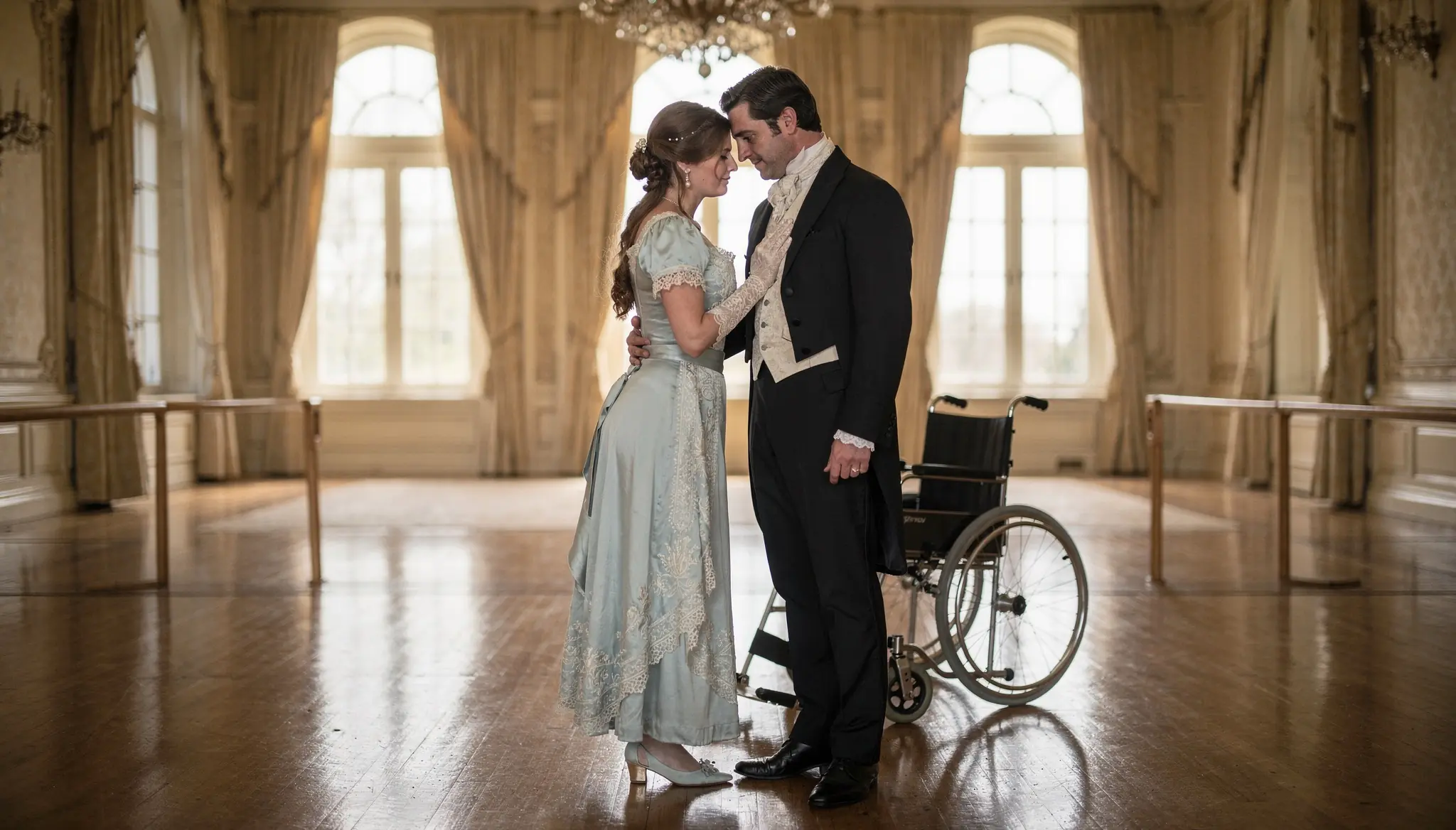
But on the night she finally kissed him, he whispered the one question that had haunted him ever since the accident. I'm still a man. You think I can't satisfy you? What she said next didn't just change his life. It exposed a conspiracy that had been stealing far more than his ability to walk.
Roselene Edwin never imagined that before she reached her 23rd birthday, she would become both mother and father to two frightened children. When her father died after a brief illness, grief settled over the Edwin estate like an endless winter. Before the family had learned to live with that loss, tragedy struck again. Less than a year later, her mother passed away, leaving Roselene alone with her 12-year-old brother, Henry, and 8-year-old sister, Florence.
From that day forward, every decision she made revolved around them. She learned to manage the household accounts, oversaw the estate workers, comforted Florence through nightmares, and helped Henry shoulder responsibilities no boy his age should have known. Every promise she made at her parents' grave became the purpose of her life. No matter what happened, she would keep their family together.
But not everyone shared that promise. Her father's younger brother, Albert Edwin, saw opportunity where Roselene saw responsibility. Within weeks of the funeral, he petitioned the court, arguing that an unmarried woman lacked both the legal authority and political influence to oversee an estate or remain guardian to two noble children. If the judges ruled in his favor, Henry and Florence would be placed under his care, while control of the Edwin estate would pass into his hands.
Roselene knew exactly what that meant. Her uncle had never cared for the children. He cared for the fortune. Every letter from the court tightened the knot in her stomach. Every passing day brought the hearing closer.
She explored every legal avenue she could find, but each answer led to the same conclusion. A married noblewoman carried far more authority than an unmarried one. Marriage was no longer a matter of love. It had become the only shield standing between her siblings and a man driven by greed.
When the proposal from Duke Benedict Valmont arrived, it seemed less like fate and more like an impossible bargain. The Duke sought a wife. She needed a husband. Neither expected anything beyond that.
Miles away, behind the towering walls of Valmont Manor, Duke Benedict Valmont had become little more than a rumor among the aristocracy. Three years earlier, his carriage had overturned on a rain-soaked mountain road. The accident claimed the lives of two guards and left Benedict with injuries so severe that he never walked unaided again. The once-admired Duke disappeared from public life almost overnight. He resigned from nearly every social gathering, declined invitations from influential families, and rarely allowed anyone beyond his closest servants to enter his private chambers.
Society reached its own conclusion. The Duke had become a broken man. They pitied him. They whispered about him.
Some even called him cursed. None of them understood the truth. Benedict did not isolate himself because he sat in a wheelchair. He isolated himself because he could not bear the thought of asking any woman to spend her life beside a husband who believed he could never give her the future she deserved.
Before the accident, several noble families had eagerly sought an alliance through marriage. Afterward, those same families quietly withdrew their daughters. Some offered polite excuses; others simply stopped responding. After enough disappointments, Benedict refused every new introduction before it could begin.
Loneliness, he had decided, was kinder than becoming someone's lifelong burden. So when his steward informed him that Miss Roselene Edwin had accepted his proposal without requesting additional wealth, titles, or guarantees, confusion outweighed relief. He could not understand why. She knew about the accident. She knew about the wheelchair, yet she still said yes.
Their wedding reflected the nature of their agreement. There was no extravagant celebration, no lavish banquet, only a quiet ceremony witnessed by close servants, a handful of legal officials, and Roselene's younger siblings, whose anxious faces softened for the first time in months. That evening, silence settled over the Duke's private sitting room. Benedict rested a neatly folded document on the table between them.
"I had this prepared before the wedding," he said calmly.
"It states that you will have complete freedom within this marriage. You may come and go as you please. You'll never be expected to share my bed, nor will I demand affection you cannot freely give. And if one day you decide this life is no longer what you want," he paused briefly before finishing, "I'll never stand in your way."
For a long moment, she said nothing. She unfolded the document, read every line, then carefully folded it again. Instead of signing it, she slid it back across the table. Benedict looked at her, puzzled. Roselene met his eyes with quiet certainty.
"I didn't marry you because I expected perfection. I married you because I keep my promises."
The room fell silent. There was no pity in her voice, no hesitation, no sacrifice, only sincerity. For the first time since the accident had changed his life, someone looked at Benedict Valmont not as a broken duke, but simply as a man worthy of honesty. And without realizing it, duty had taken its first quiet step toward something far more difficult to earn: respect.
The days that followed settled into a quiet rhythm, but Roselene quickly realized that silence did not always mean peace. Valmont Manor was magnificent, yet something about it felt strangely lifeless. The halls were immaculate. The servants performed their duties without fault, and every room reflected the wealth of generations past.
Yet beneath that polished surface lingered an unease that no amount of luxury could disguise. The servants lowered their voices whenever the Duke's name was mentioned. Conversations stopped the moment someone entered the room. It was as though the entire household had learned to live around an invisible tension no one dared acknowledge.
Roselene refused to let rumors shape her opinion of the man she had married. Instead, she chose to watch. To her surprise, Duke Benedict Valmont bore little resemblance to the cold, ruthless nobleman society had described. He thanked servants by name. He never raised his voice.
Whenever Henry and Florence visited the manor, he made certain they felt welcome, arranging books for Henry in the library and having Florence's favorite pastries prepared without ever mentioning that he had noticed what she liked. He carried himself with quiet dignity, never asking for sympathy despite the obvious difficulties even simple tasks demanded of him.
The only person who seemed unable to see his kindness was Benedict himself. Whenever Roselene offered assistance, he accepted only when absolutely necessary, always apologizing afterward, as though requiring help was some unforgivable burden. It saddened her more than she expected.
She soon met the two people who managed nearly every affair of the duchy. The first was Lord Evander Valmont, Benedict's uncle. He welcomed her with impeccable manners and an easy smile.
"My dear niece," he said warmly, taking her hand. "You've brought fresh life to this old manor. His Grace is fortunate."
His words sounded sincere. His eyes did not. There was something calculating behind every pleasant expression, as though each sentence had been carefully measured before leaving his lips. Later, Roselene learned why.
Since Benedict's accident three years earlier, Evander had acted as steward of the duchy. Every financial decision, every contract, every estate matter passed through his hands before reaching the Duke. The arrangement had begun as a temporary necessity. It had quietly become permanent.
The second man was Dr. Roland, the family's longtime physician. Unlike Evander, the doctor inspired immediate confidence. He spoke gently, examined Benedict with practiced care, and carried the reputation of a man who had devoted his life to healing others. Even Roselene found herself wanting to trust him at first. Then she began noticing things that refused to make sense.
Every evening, Dr. Roland delivered the Duke's medicine himself. Within an hour, Benedict's strength seemed to vanish. His shoulders sagged. His speech slowed. Even holding a teacup appeared to require effort.
Yet one afternoon, the physician was unexpectedly delayed by heavy rain. Benedict missed his usual dose. Instead of growing weaker, he spent nearly an hour reviewing estate correspondence with remarkable focus. His voice carried more energy than Roselene had heard since arriving, and his hands remained steady as he signed document after document. The difference was impossible to ignore.
Another day, the doctor completed his examination before lunch. Benedict had entered the dining room with a healthy appetite. He barely touched a single bite after Dr. Roland left.
On another occasion, Roselene watched a servant accidentally spill the evening medicine before it reached the Duke. A replacement was delayed. That night, Benedict remained alert long past his usual hour of exhaustion.
Then came the tremors. Some mornings his fingers shook so badly he struggled to lift a pen. Other mornings those same hands turned the pages of a book without the slightest hesitation. His condition seemed to change according to no illness Roselene had ever heard described.
She said nothing. She accused no one. Instead, she watched more carefully. The answers, she believed, would reveal themselves if she remained patient.
To occupy the long afternoons, Roselene volunteered to reorganize decades of neglected estate records stored in the manor's aging archives. There she met the elderly chief steward, Mr. Alden, a quiet man who had served Benedict's father long before Benedict inherited the title. Unlike many servants, he spoke openly with her, not because she was the duchyss, but because he recognized genuine concern when he saw it.
As they sorted brittle ledgers and faded correspondence, he noticed the questions she asked, not about titles, not about wealth, always about Benedict. Had His Grace always worked this hard? Did he enjoy riding before the accident? Had he always preferred keeping to himself? Each question convinced the old steward of something he had almost stopped believing: someone finally cared about the Duke more than his title.
Weeks later, illness confined Mr. Alden to his bed. Roselene visited him every evening. She read letters when his eyesight failed, adjusted blankets when the nights grew cold, and remained beside him even after physicians admitted there was little they could do. On his final evening, the old steward reached beneath his pillow with trembling fingers. He withdrew a small iron key worn smooth by time and closed Roselene's hand around it.
He struggled to whisper one final warning. "If anything happens to me, don't let Lord Evander reach the West Archive before you do."
Before she could ask what he meant, his hand slipped from hers. By sunrise, the old steward was gone.
That night, long after the manor had fallen silent, Roselene carried a single lantern through the deserted corridors until she reached a weathered wooden door hidden behind years of dust and neglect. Her fingers tightened around the iron key. With a slow, careful turn, the old lock finally gave way. The forgotten West Archive opened before her.
Roselene stood motionless for a long moment, her lantern casting long shadows across the forgotten West Archive. Dust covered nearly every shelf, and the stale air carried the scent of old paper that had not been disturbed in years. Whatever the elderly steward had wanted to protect had remained hidden here for a very long time. She began searching carefully.
At first, she found nothing unusual: old land deeds, tax records, correspondence dating back decades. But tucked behind a row of weathered account books sat several ledgers bound in cracked black leather. Unlike the others, they bore no official seal. Roselene opened the first one. Within minutes, her heartbeat quickened.
Large sums had been withdrawn from the duchy's treasury under the names of companies she had never heard of. The businesses appeared legitimate on paper, yet none listed physical offices or identifiable owners. Every trail ended with another company, then another, creating a maze designed to hide the money's final destination. She reached for the second ledger.
This one revealed regular payments made to Dr. Roland, not ordinary physician fees. These amounts were far beyond what any doctor should have received. She compared the dates. The first payment had been authorized only weeks after Benedict's carriage accident. The transfers continued month after month, year after year.
Roselene closed the ledger slowly. Mr. Alden had not hidden financial records. He had hidden evidence.
Someone had been stealing from the duchy for years, and somehow the family's trusted physician stood at the center of it. She copied several figures onto a sheet of paper before carefully returning every ledger to its original place. If anyone realized the records had been disturbed, they might disappear before she understood the full truth.
The following evening, she found Benedict alone in his study reviewing correspondence.
"There was something inside the West Archive," she said quietly.
His eyes lifted from the letter in his hands. "The West Archive?"
She nodded. "Mr. Alden gave me a key before he died."
Benedict frowned. "He never mentioned a key to me."
"I don't think he wanted anyone else to know." She placed the old iron key on the desk between them. "I found records that shouldn't have been hidden."
Benedict looked from the key to her face. "What kind of records?"
Roselene hesitated. She trusted her husband, but trust alone was not enough to expose powerful men. "I need more proof before I tell you everything. If I'm wrong, I'll have accused innocent people. If I'm right, whoever hid those ledgers won't hesitate to destroy them."
Benedict studied her for a moment before quietly nodding. "I trust your judgment."
Those four words strengthened her resolve more than he could have imagined.
Unfortunately, she was not the only one paying attention. Lord Evander noticed subtle changes almost immediately. The new duchess spent more time in the record rooms. She asked careful questions instead of casual ones. She watched people instead of merely speaking to them.
Most importantly, she had stopped accepting appearances at face value. He had seen enough investigations begin to recognize one before it reached him.
That same evening, Evander requested a private meeting with Dr. Roland. The conversation lasted less than fifteen minutes. Neither man raised his voice. Neither needed to. By the time they left the room, they had reached the same conclusion.
Roselene Edwin had become dangerous. She needed to be removed before she uncovered the truth.
The opportunity arrived sooner than expected. One evening, Benedict declined assistance from every servant except his wife. As had become their quiet routine, Roselene personally collected his supper tray and carried it to his private chambers. They shared a simple meal while discussing letters from Henry and Florence before she wished him good night. Nothing about the evening seemed unusual until sunrise.
A frantic knock echoed through the breakfast room. Dr. Roland rushed inside, his face drained of color. "His Grace has been poisoned."
Every conversation stopped. Servants abandoned their duties. Within moments, members of the household and several estate trustees gathered outside the Duke's chambers. The physician spoke with practiced urgency.
"The poison was mixed with last night's meal." His eyes swept across the room. "Who prepared the Duke's supper?"
A young maid stepped forward, visibly shaken. "My lord, Lady Roselene collected the tray herself and carried it to His Grace's chambers."
Silence swept through the room. Before Roselene could respond, another servant hurried inside, carrying a small glass vial.
"I found this hidden among Her Grace's belongings."
The physician accepted it carefully before uncorking the bottle. His expression darkened. "Poison."
The accusation spread through the manor faster than wildfire. Whispers followed Roselene through every corridor. Servants who had greeted her warmly only yesterday now avoided her gaze. The trustees exchanged uneasy glances before one finally spoke.
"Until this matter is resolved, Her Grace should be removed from the Duke's care."
Several voices quickly agreed. The room turned toward Benedict. He remained silent for a long moment, his eyes moving from the physician to the vial to his wife. Roselene said nothing. She refused to plead for belief she had not earned.
Finally, Benedict spoke. "My wife is innocent."
Dr. Roland stepped forward. "Your Grace, the evidence cannot be ignored."
Benedict's expression never changed. "Evidence can be manufactured. Character cannot."
The room fell silent once again. No one challenged him directly. Yet neither did they abandon the accusation. By order of the trustees, Roselene was temporarily forbidden from entering Benedict's private chambers while the investigation continued. As she was escorted from the corridor, she looked back only once.
Benedict met her eyes with the same quiet certainty he had shown on their wedding night. He believed her, and that was enough.
Later that evening, after the household had settled into uneasy silence, Benedict summoned the one man outside the manor he trusted without reservation, his oldest friend. Unable to continue the investigation with Roselene at his side, he entrusted it to the man who had stood beside him long before the accident.
"If my wife cannot search for the truth," Benedict said quietly, placing the iron key into his friend's hand, "then we'll find it another way."
The accusation against Roselene did not end the investigation. It merely changed who carried it forward. Faithful to the promise he had made, Benedict's oldest friend worked quietly beyond the walls of Valmont Manor, following the trail Roselene had uncovered.
The hidden ledgers led to merchants who had never conducted legitimate business with the duchy. One shell company pointed to another, but patient questioning slowly unraveled the deception. Former clerks admitted they had processed unusual transfers under Lord Evander's authority. A retired bookkeeper recalled signing documents that were never entered into the official accounts. Piece by piece, witnesses began speaking, especially those who believed enough time had passed for the truth to remain buried.
Each statement strengthened the case. None of it, however, was enough to clear Roselene.
Inside the manor, the trustees enforced their decision without exception. She was forbidden from entering Benedict's private chambers or participating in matters concerning his health. Servants watched her movements more closely than before, and conversations fell silent whenever she approached. She accepted every restriction without protest. Arguing would only convince her enemies they had been right.
Instead, she found quieter ways to care for the man who had defended her when no one else would. She asked the kitchen staff which meals he had managed to finish and requested lighter dishes whenever his appetite failed. She made certain fresh flowers were placed where he would see them during his morning reading, though no one told him where they came from. Whenever Henry and Florence visited, she encouraged them to spend time with their brother-in-law, knowing their laughter briefly eased the heaviness that had settled over the manor. She remained distant by order, never in devotion. Benedict understood without either of them speaking a word.
One evening, unable to sleep, Roselene stood beside her window, overlooking the eastern courtyard. A faint movement below caught her attention. A single lantern drifted across the darkness. Curious, she watched until she recognized the servant pushing Benedict's wheelchair through the gardens. The direction surprised her.
He was not heading toward the library, the chapel, or his study. He was going toward an abandoned wing of the manor that had remained locked since her arrival.
When the servant disappeared inside, Roselene waited only long enough to avoid being seen before quietly following. The old corridor was covered in dust, its portraits draped with faded cloth. At the very end stood a pair of tall wooden doors left slightly open. Soft sounds echoed from within, not voices, strained breathing. Roselene stepped inside.
The forgotten ballroom stretched before her, untouched by celebrations for years. Moonlight spilled across the polished floor, illuminating a pair of sturdy wooden rails that ran several yards across the center of the room. Between them stood Benedict. His hands gripped the rails so tightly his knuckles had turned white. His legs trembled violently beneath him. Every step demanded every ounce of strength he possessed.
He shifted one foot forward, then the other. A sharp breath escaped him as his balance faltered before he could steady himself. His knees buckled. Roselene rushed forward. She reached him just before he struck the floor, wrapping an arm around him as they both sank to one knee.
For a moment, neither of them spoke. Benedict closed his eyes. When he finally looked at her, disappointment weighed heavier than pain.
"I wanted this to be a surprise."
Roselene searched his face, unable to understand. He glanced toward the length of the ballroom. His voice was quiet, almost embarrassed.
"I wanted to stand beside you. I wanted to welcome you properly as my duchess." His gaze drifted across the empty ballroom as though he could still imagine it filled with music and guests. "I want to lead you into our first ball. And I wanted to give you the wedding dance you deserved."
The final words barely rose above a whisper. Roselene felt every carefully built wall around her heart begin to crumble. She had believed his greatest struggle was the pain left by the accident. She understood now that it was something far deeper. He had never been fighting to prove anything to society. He had been fighting against the belief that he could never stand beside the woman he had married as an equal.
Not once had he complained. Not once had he asked for sympathy. He had carried that burden alone, hoping that one day he could give her a moment she had never even demanded.
Without saying another word, Roselene slipped beneath his arm and helped him back toward the wheelchair. He leaned on her reluctantly, frustrated by the weakness that refused to obey his determination. She did not rush him. Each careful step was taken together until he lowered himself back into the chair with a weary breath.
As she adjusted the blanket across his knees, her hand brushed against his. Neither moved away. Their fingers remained together in the quiet stillness of the ballroom. There was no awkwardness, no pity, only a silence that said more than either of them could have spoken.
For the first time since their marriage, Roselene no longer saw a union born of necessity. She saw a man who had offered her freedom before asking for anything in return. A man who had trusted her when every voice in the manor demanded otherwise. A man who had quietly endured humiliation, loneliness, and relentless effort not to reclaim his title, but to give his wife a single dance. As their hands remained entwined, Roselene realized the truth she could no longer deny. Somewhere between keeping her promise and earning his trust, she had fallen in love with her husband.
The truth that had been buried for three years refused to stay hidden. Working quietly beyond the manor, Benedict's oldest friend continued gathering evidence from the names recorded in the concealed ledgers. Every discovery led to another. Payments had passed through shell companies that existed only on paper before finding their way back into private accounts connected to Lord Evander's authority. What had first appeared to be isolated irregularities revealed a carefully maintained system of theft.
The witnesses Roselene had hoped for finally found the courage to speak. A former estate clerk admitted he had been ordered to alter financial records before presenting them for the Duke's approval. A merchant confessed that his company had accepted generous payments in exchange for lending its name to transactions that never represented real business.
Even a retired courier recalled delivering sealed packets to Dr. Roland far more often than ordinary medical correspondence required. Each statement supported the last. Together they formed a pattern too consistent to dismiss.
Word of the growing evidence reached the trustees. The confidence they had once placed in Lord Evander began to weaken. Questions replaced unquestioning acceptance, and requests for original records became more frequent. Evander understood exactly what that meant. He could no longer rely on reputation alone.
His first response was to erase whatever remained. Records vanished from storage rooms overnight. Account books that should have been preserved for decades were suddenly declared damaged beyond repair. Several clerks discovered entire shelves had been emptied before sunrise, leaving only dust where documents had once been stacked. The destruction itself became another warning. An innocent man had no reason to hide the past.
Dr. Roland proved no more convincing. During one meeting with the trustees, he insisted Benedict's condition had remained unchanged since the accident. Days later, while answering the same questions, he claimed the Duke's health had steadily declined over recent years. Pressed to explain the contradiction, he blamed imperfect memory. No one appeared satisfied.
The physician who had once inspired unquestioned trust now struggled to keep his own account consistent. For the first time, doubt settled over both men.
Evander realized the conspiracy was collapsing. If the investigation continued much longer, the evidence would reach Benedict himself in full. He decided there was only one move left.
Roselene disappeared before dawn. A carriage bearing no family crest intercepted her while she traveled between the village chapel and the manor. The attack was swift and carefully planned. By the time anyone realized she was missing, the road had fallen silent.
When she regained consciousness, she found herself inside an isolated hunting lodge deep within the Valmont forests. Lord Evander stood waiting beside a heavy wooden table. A single document rested before him.
"I had hoped matters wouldn't come to this," he said evenly. "But you forced my hand."
Roselene looked at the paper without touching it. Its contents were clear. The declaration claimed Duke Benedict Valmont was mentally incapable of governing the duchy. Upon its approval, authority over every estate, title, and financial decision would pass immediately to Lord Evander as acting guardian.
He placed a pen beside the document. "Sign it."
Roselene met his gaze without moving. "No."
The pleasant expression he had worn for months disappeared. "You still think this ends with you?" He stepped closer. "Your brother and sister remain remarkably vulnerable. A single legal petition could separate them forever."
She remained silent.
"If Benedict refuses to cooperate, accidents have happened before." Her heartbeat quickened, but her resolve did not. "And without this estate, everything your parents built will belong to someone else." He pushed the document toward her again. "Sign."
Roselene looked down at the page only long enough to slide it back across the table. "I won't."
The refusal was calm, certain. Evander's patience finally gave way. Outside the lodge, additional guards took their positions. Inside, the unsigned document remained exactly where it was.
Miles away, Benedict listened as his oldest friend finished delivering the latest report. A witness had seen an unmarked carriage leaving the main road before sunrise. Its tracks led toward the abandoned hunting lodge hidden deep within the Valmont forests. Without another word, Benedict ordered his carriage prepared and followed the trail.
The hunting lodge doors burst open before Lord Evander could force another demand. Benedict entered first, his oldest friend at his side, followed by the local authorities and the trustees who had insisted on witnessing the matter themselves. Roselene looked toward her husband, and for the first time since her abduction, she allowed herself to believe the nightmare was ending.
Evander tried to recover his composure. "You've misunderstood what has happened," he said smoothly. "Your wife has become confused. I brought her here for her own safety."
No one answered. Benedict's oldest friend stepped forward and placed a stack of ledgers on the table beside the unsigned declaration.
"We found the West Archive."
The room fell silent. One by one, the evidence that had been hidden for years came together. The concealed ledgers documented money siphoned from the duchy's treasury through shell companies that existed only on paper. Witnesses confirmed they had been instructed to falsify financial records under Evander's direction. The late steward's records matched the missing transactions exactly, proving that he had uncovered the fraud long before his death.
Medicine samples taken from Benedict's prescriptions were examined alongside uncontaminated ingredients, revealing substances that had steadily weakened him instead of aiding his recovery. Every piece supported the next. Nothing stood alone. The conspiracy that had once depended upon secrecy collapsed beneath its own weight.
Dr. Roland tried to defend himself, but every explanation contradicted the statements he had already given. Faced with the ledgers, the witness testimony, and the medical findings, his confidence disappeared. At last, he lowered his head.
"I altered the medicine," he admitted quietly. "Lord Evander paid me to keep His Grace weak. The longer the Duke depended on others, the longer Evander controlled the duchy."
The confession ended any remaining doubt. The authorities immediately placed Dr. Roland under arrest. Lord Evander attempted one final denial, but it no longer mattered. Years of manipulation, stolen wealth, and calculated deception had been laid bare before every trustee who had once trusted him. He was arrested beside the very document that would have handed him the duchy.
Roselene's name was cleared completely. The accusation of poisoning was formally withdrawn, and every false claim against her was dismissed. The court confirmed Benedict's authority over his estate, ending Evander's control once and for all. Henry and Florence's place within the Edwin family was secured beyond challenge, ensuring no future petition could separate them from the sister who had sacrificed everything to protect them.
In the weeks that followed, Valmont Manor slowly came back to life. The whispers disappeared. Doors that had long remained closed were opened again. Servants smiled without fear, and laughter echoed through the halls where silence had ruled for years.
One quiet evening, Benedict found Roselene in the gardens. With a gentle smile, he held out his hand.
"Would you meet me in the ballroom?"
Weeks passed, and with each new day, Valmont Manor felt less like a house haunted by secrets and more like the home it had once been. The ledgers were no longer hidden. The lies had been replaced by truth. Justice had restored the duchy, but healing took longer than justice ever could.
Benedict continued his rehabilitation in private. The poison that had weakened him for years was gone. Yet rebuilding strength demanded patience that no victory could shorten. Every step remained difficult.
Every success came only after countless failures. Still, he refused to stop. Roselene never asked him to. She simply stood beside him, encouraging him without pressure, believing in his progress without measuring it.
One evening, remembering his invitation from weeks before, she walked through the familiar doors of the abandoned ballroom. The room had changed. Dust no longer covered the polished floor. The broken curtains had been drawn back to welcome the fading light, and the wooden rails still stood where they always had, a quiet reminder of every painful step Benedict had taken in secret.
He waited for her near the center of the ballroom. The wheelchair remained nearby. He looked at her with the same gentle calm she had first seen on their wedding night.
"I wanted you here," he said softly.
Roselene smiled. "I'm here."
Benedict drew a slow breath before placing both hands on the wooden rails. Carefully, he pushed himself upright. His legs trembled immediately, but they held. He released one hand, then the other. With every ounce of concentration, he took a single unsteady step toward her, then another, then one more.
Each movement demanded enormous effort. His breathing grew heavier, and exhaustion quickly settled into every muscle. His balance began to falter, yet before he could lose it completely, he stopped. He had come far enough. Roselene stood only a few steps away.
Benedict slowly raised his hand toward her. Without hesitation, she crossed the remaining distance. Their hands met. She steadied him, not because he had failed, but because they no longer needed to carry life's burdens alone.
Benedict lifted his free hand and gently touched her face. His fingertips lingered against her cheek as though he wanted to remember the moment forever. Then he leaned forward and kissed her slowly. There was no urgency, no uncertainty, only the quiet certainty of two hearts that had chosen each other through every trial. Roselene kissed him back with the same tenderness.
When they finally parted, neither stepped away. Their foreheads rested together. Benedict closed his eyes for a brief moment before speaking the words that had lived inside him ever since the accident.
"I'm still a man," he paused, his voice barely above a whisper. "You think I can't satisfy you?"
Roselene looked into his eyes, seeing not the fear he had hidden, but the courage it had taken to finally speak it aloud. A gentle smile touched her lips. She answered without hesitation.
"I've never been afraid of what you can give me." She lifted her hand and placed it over his heart. Its steady rhythm beat beneath her fingertips. "I've only been afraid of how completely I've fallen in love with you."
For a long moment, Benedict could not find the words to answer. He had spent three years believing the accident had stolen the most important part of who he was. He had measured himself by everything he thought he could no longer offer. He had believed every broken engagement proved that love would always end where hardship began. He understood now how wrong he had been.
The accident had taken many things from him. It had never taken away his capacity to love, and standing before him was the proof. Roselene had not remained because of duty. She had not stayed out of pity. She had not sacrificed her happiness for his. She had chosen him freely, completely, because she loved the man he had always been.
A quiet smile spread across Benedict's face as he extended his hand once more. Roselene accepted it. Together they took a few slow, imperfect steps across the ballroom floor. There was no orchestra, no audience, no grand celebration. Only the husband who had dreamed of giving his wife a wedding dance, and the wife who had never needed perfection to know she was exactly where she belonged.