“You’re Just a Kid,” the Prosecutor Mocked Him — Then Black Teen Won the Case With ONE Question

“You’re Just a Kid,” the Prosecutor Mocked Him — Then Black Teen Won the Case With ONE Question

Chapter 1

Theme:
Font Size:
24px

"This isn't a daycare, boy. Take your raggedy little self and your trash bin briefcase out of my courthouse before I have the bailiff drag you out."
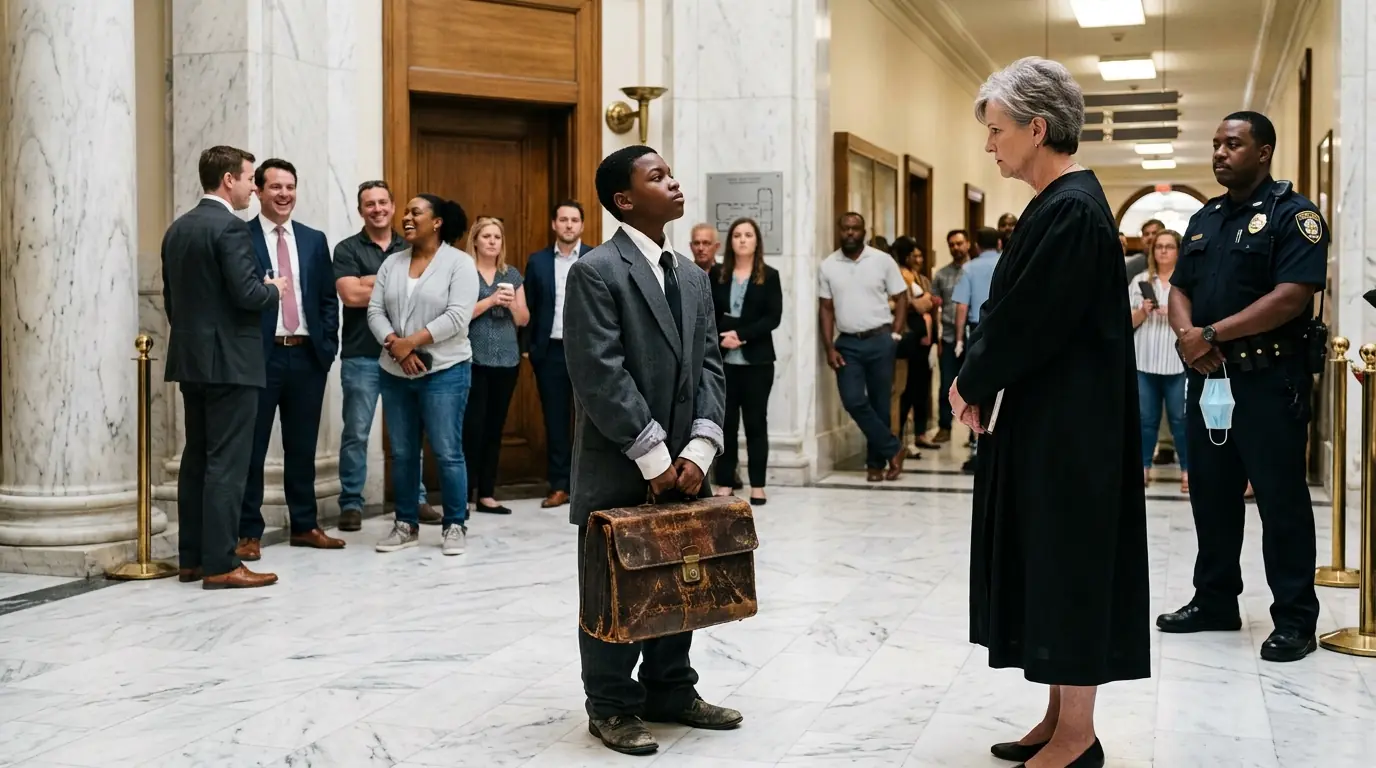
Judge Julia Blackwood said it loud enough for the back row to hear. Loud enough for the court reporter to type it. Loud enough for 40 people to laugh, and they did. They laughed.

The word boy hit different. Kendrick Jackson, 15 years old, knew exactly what it meant. So did every Black face in that gallery. They'd heard their fathers called that, their grandfathers. Three centuries of that word packed into one syllable, thrown at a kid in a hand-me-down suit.

He didn't flinch, didn't cry, didn't even tighten his grip on the cracked leather briefcase his grandfather had carried to a law school that wouldn't graduate him. He just looked Judge Blackwood dead in the eye and said very quietly:

"Your Honor, I'll leave when you answer one question."

Nineteen minutes later, that question would end her career, disbar her from North Carolina, trigger a federal investigation into a $4 million land theft scheme, and expose nine other judges who thought they were untouchable. All from a Black kid nobody in Ardmore County thought could read.

If you drove through Ardmore County, North Carolina on a Sunday afternoon, you'd call it charming. White steeples, oak trees lining the road—the kind that arched overhead and turned the asphalt gold in October. American flags on every porch, a barbecue joint that had been there since 1962 with the same pitmaster, the same screen door that slammed too loudly, the same line out front on Saturdays. The population was 11,000, depending on who was counting.

What you wouldn't notice unless you knew to look was the line.

Not a line on any map, but a line nobody talked about: the line between the side of town where the potholes got fixed and the side where they didn't; the side where new condos were going up and the side where the old ones were being torn down; the side where the streetlights got replaced when they burned out and the side where the city sent a contractor once a year, maybe, if somebody complained loud enough at a council meeting; the side where code inspectors never showed up and the side where they showed up every other Tuesday with a clipboard and a smile.

Ardmore was being developed. That was the word they used: development, progress, revitalization.

What it really meant was this: one by one, the small Black-owned homes and businesses on the south side of town were disappearing. A hair salon owned by a woman named Yvette who'd been cutting kids' hair for two generations. A laundromat where teenagers used to do their homework on top of the dryers. A car wash that had been there for 38 years, run by the same family still washing cars by hand because that's how they'd always done it.

Each one was bought up by a corporation called Belmont Holdings. And every time a family tried to fight it, every time a dispute went to court, the case landed on the same desk: Judge Julia Blackwood.

Sixty-one years old, 19 years on the bench, third-generation Ardmore. Her grandfather had been a magistrate. Her father had been a state senator. There was a portrait of him in the courthouse rotunda—oil paint, gold frame, his eyes following you no matter where you stood. In this county, the Blackwood name didn't carry weight; it was the weight.

No attorney in Ardmore would dare cross her. No ruling of hers had ever been overturned. And if you were Black and standing in her courtroom, the verdict was written before you opened your mouth. Everyone in Ardmore knew this. Nobody said it out loud.

In Ardmore County, justice had a color, and it was white.

On the other side of that invisible line sat a small auto body shop with a hand-painted sign that read, Burl & Sons Garage, Since 1971. The paint was peeling. The lot had cracks running through it like dry riverbeds. There was a tire swing nobody had used in 20 years hanging from a tree out back, slowly being swallowed by kudzu.

The man doing the work inside was Bobby Jackson.

Bobby was 47, lean from working harder than his body wanted, tired in a way that sleep didn't fix. His wife, Marsha, had died of pancreatic cancer 18 months ago. The medical bills had taken their savings, then their car, then the small house they'd been renting for nine years. Bobby had stood on the porch the day the eviction notice came taped to the door. He'd read it three times, then he'd taken it down, folded it, and put it in his jacket pocket. He'd never thrown it away.

Old man Burl, the white owner of the garage—71, no kids of his own who wanted the shop—had taken Bobby and his son in. He let them stay in the basement apartment underneath the building, cut the rent in half, and looked the other way when it didn't get paid at all. Burl wasn't a saint. He just remembered being poor. His daddy had been a sharecropper in Georgia. He told Bobby once over coffee on a slow morning, "Charity ain't a feeling, son. Charity is what you do when you remember what it felt like."

Bobby had nodded. He hadn't said anything. Some things didn't need answering.

Bobby fixed engines the way a surgeon fixes hearts: carefully, patiently. He could listen to a transmission for 10 seconds and tell you which gear was about to go. He could rebuild a carburetor blindfolded. He'd been doing this work since he was 19 years old.

He coughed sometimes, a deep, rattling thing he'd had since the funeral that he refused to see a doctor about, because doctors meant bills and bills meant choices he didn't want to make. Above the cash register, in a cracked frame, hung a photograph of a Black woman in a yellow Sunday dress. Marsha, two years before the diagnosis, smiling like she had nothing but time. Bobby looked at her sometimes when nobody was watching. He didn't say anything. He just looked.

The basement apartment under the garage was small and low-ceilinged, lit by a single bulb that buzzed faintly when the upstairs compressor kicked on. It smelled like motor oil, old paper, and the particular dampness that lives in places that don't see sunlight. A twin bed pushed against one wall, a desk too big for the room (Bobby had carried it down the stairs in three pieces), a folding chair, and every other surface—every wall, every corner, every shelf made of stacked milk crates—was covered in books.

Property law textbooks, civil procedure, North Carolina General Statutes, Volumes 1 through 9. A heavily marked-up copy of Black's Law Dictionary, the spine reinforced with electrical tape. Most of them had a name written inside the cover in faded fountain pen ink: Professor Claire Dennis, Howard University School of Law, 1987.

Above the desk, the wall was papered in sticky notes—yellow ones, green ones, pink ones—names, dates, lines of red string connecting one note to another the way a detective in a TV show maps out a conspiracy.

This was Kendrick Jackson's bedroom.

He was 15 years old. He'd lived in this basement for 14 months, and every night after his father went upstairs to sleep, he stayed up reading by that single bulb until 2:00 or 3:00 in the morning. Sometimes 4:00.

He had a notebook he carried everywhere—a blue, spiral-bound thing, college-ruled, dog-eared at every corner. He had filled four of them already. They were stacked on the corner of his desk in order, like a series of ledgers. This was his fifth.

In it, he wrote down everything: every conversation he overheard at the garage, every notice that came in the mail, every license plate of every black SUV that pulled up to the south side of town with a man in a suit inside. He noticed things other people didn't. He always had. Marsha used to say her son had been born with a quiet pair of eyes—the kind that see things twice, she'd called them. Once for what they were, and once for what they meant.

He didn't know yet that the notebook would become the most dangerous weapon in Ardmore County, but he was getting close.

Here is why Kendrick read law books.

News in the same category

“You’re Just a Kid,” the Prosecutor Mocked Him — Then Black Teen Won the Case With ONE Question

9 Part