In 1950, Black farmers owned 12 million acres of farmland across the American South. But by the year 2000, they had lost more than 90% of it. And the land was not the only thing that disappeared. The farming techniques these families had used for generations, methods rooted in centuries of West African agriculture, were buried right along with it. Today, billion-dollar organic food companies are selling those exact same techniques back to the public at premium prices and calling them innovative.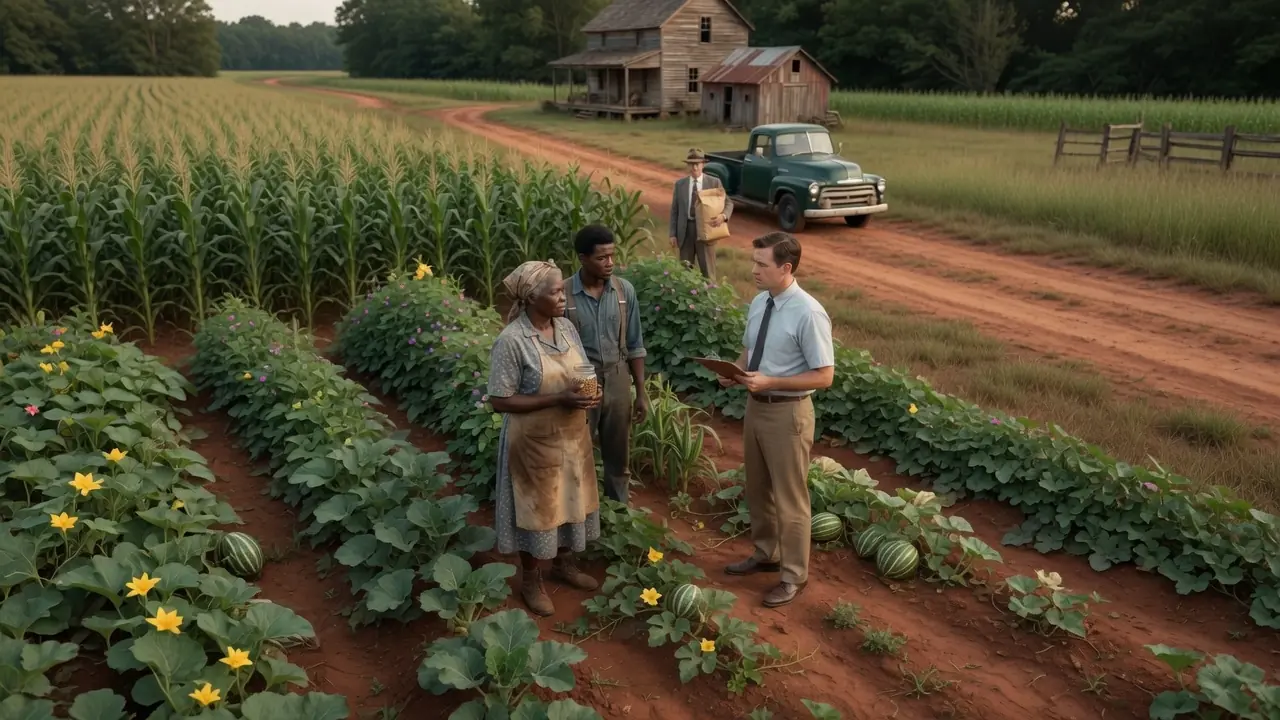
So, what were these methods? And why did big agriculture spend decades trying to erase them? Number one, companion planting. Walk onto any industrial farm today and you will see one thing, a single crop stretching to the horizon in perfectly straight rows. There were soybeans for miles, corn for miles, and nothing else.
That is called monoculture, and it is the foundation of modern American agriculture. But Black farmers in the 1950s did the exact opposite. They planted cowpeas right next to their corn. They grew squash underneath both of them. Okra went in beside the collard greens.
Watermelon vines spread between rows of sweet potatoes. To the agricultural extension agents driving by in their government trucks, it looked like a mess. It looked disorganized and primitive, but it was anything but. Those cowpeas pulled nitrogen out of the air and fed it directly into the soil, which meant the corn grew stronger without a single bag of store-bought fertilizer. The squash leaves spread wide across the ground and blocked weeds from growing, which eliminated the need for herbicides.
But companion planting was only effective if you had the right seeds. And that is where Black farmers built something even the chemical companies could not copy. Number two, underground seed saving networks. Every fall after the harvest, Black farming families across the rural South would set aside their best seeds. They saved the biggest ears of corn, the most productive cowpea pods, and the sweetest watermelon.
They dried these seeds, stored them in glass jars and cloth sacks, and traded them through networks that ran through Black churches, Masonic lodges, and family reunions. This was not casual gardening. This was an organized system of genetic preservation that kept the best crop varieties alive for generations. A farmer in Macon County, Alabama might trade his drought-resistant okra seeds with a cousin in the Mississippi Delta who had a sweet potato variety that could handle wet soil. And those trades happened without a single dollar changing hands.
By the 1950s, seed companies saw this as a direct threat. Corporations were developing hybrid seeds that produced big yields the first year, but could not reproduce. If you save seeds from a hybrid plant and planted them the next year, the crop would be weak and unpredictable. The whole point was to force farmers to buy new seeds every single season. Black farmers who kept saving their heirloom varieties were resisting this system without even realizing it.
Their seeds were free and reliable, adapted to local conditions over generations. A tomato seed that had been grown in the same county for 40 years knew that climate, it knew that soil. It could handle the late frost in March and the brutal heat in August. The hybrids from the catalog could not compete with that level of local adaptation, but they were expensive, required chemical fertilizers to perform, and locked farmers into a cycle of purchasing. The seed saving networks quietly kept an alternative alive right under the nose of an industry that wanted them gone.
Now, saving seeds and mixing the right crops together gave Black farmers control over what went into the ground. But these families went even further than that. They also controlled when those seeds went into the ground using a method that scientists spent decades trying to dismiss. Number three, lunar cycle planting. On farms throughout the rural South, planting day was not decided by a calendar from the feed store.
It was decided by the moon. Black farmers planted root crops like turnips, carrots, and sweet potatoes during the waning moon when the gravitational pull drew moisture downward into the soil. Leafy crops and above-ground vegetables went in during the waxing moon when moisture was rising. Agricultural scientists dismissed this as pure superstition. USDA agents told Black farmers they were being foolish and old-fashioned.
But some research published in later decades found correlations between lunar cycles and soil moisture movement. The gravitational pull of the moon moves water through the soil in ways that parallel how it moves ocean tides just on a smaller scale. Seed germination rates, root growth patterns, and even pest activity all appear to shift with the lunar cycle. These farmers did not have laboratory data. They had something different.
They had 300 years of observation passed down from parent to child, refined on every single harvest. Grandmothers in rural Georgia kept mental almanacs that tracked which moon phase produced the best snap beans, which phase was right for putting in watermelon, and which nights were best for setting out cabbage transplants. This was tested knowledge, refined season after season on the same plots of red Georgia clay. But knowing when to plant and what to plant still was not enough if the soil itself was dead. And that is where the next technique separated Black farmers from their industrial neighbors by a country mile.
Number four, living soil and natural composting. Behind every Black farmhouse in the South in the 1950s, you would find a compost heap. Chicken manure, pig waste, kitchen scraps, wood ash from the stove, and leaf litter from the surrounding woods all piled together. Farmers layered these materials and let them break down into rich, dark, crumbly soil that smelled like a forest floor after rain. This was not accidental.
Farmers knew exactly what each ingredient did. Chicken manure added nitrogen for leafy growth. Wood ash provided potassium for strong roots. Crushed eggshells supplied calcium. Worm castings, which they collected by the bucketful, were packed with beneficial microbes that helped plants absorb nutrients from the ground.
Meanwhile, the chemical fertilizer industry was booming after World War II. Factories that had manufactured ammonium nitrate explosives for the military were now producing that same ammonium nitrate as fertilizer. They needed customers, and the pitch was simple. Buy this bag of white pellets, spread it on your field, and watch your crops explode with growth. What they did not tell farmers was that synthetic nitrogen destroyed the living organisms in the soil, the bacteria, the fungi, the earthworms that had been building healthy topsoil for centuries.
After a few years of chemical application, the soil became lifeless and compacted. And then the only way to grow anything was to buy more chemicals. It was a dependency trap disguised as progress. The Black farmers who stuck with their compost heaps did not fall into it. Their soil kept getting richer every year, while their neighbors' soil kept getting poorer.
But even rich, healthy soil could not protect the crop from the insects that came for it every growing season. And the solution Black farmers came up with for that problem was so clever that pesticide companies pretended it did not exist. Number five, trap cropping. Imagine you have a field of collard greens and flea beetles are eating holes through every leaf. You could spray the entire field with pesticide and kill everything, including the bees that pollinate your squash and the ladybugs that eat aphids.
Or you could do what Black farmers did in the 1950s and plant a row of mustard greens along the edge of your field. Flea beetles love mustard greens even more than they love collards. So, the beetles swarm the mustard and leave the cash crop alone. The farmer sacrifices one cheap row to protect the rest of the harvest. No chemicals were needed and the only cost was a handful of mustard seed.
This technique required deep knowledge of which insects preferred which plants. That knowledge lived in the memories of grandmothers and grandfathers who had watched bugs in their gardens for decades. It was never written in a textbook. It was taught while working the rows, passed through conversation and demonstration. Pesticide companies had no interest in farmers learning they could control pests for free.
So, this knowledge was never included in the agricultural training programs that the USDA funded. It was simply ignored until it faded from practice. Number six, contour farming and rainwater harvesting. But, pest control was only part of the puzzle. Because if rain washed away the topsoil every time a storm rolled through, none of these other techniques mattered.
And that is where Black farmers on the hilly terrain of the Piedmont showed a level of engineering that history books never gave them credit for. On the hilly terrain of the Piedmont region stretching from Virginia down through the Carolinas and into Georgia, Black farmers did something that confused their flatland neighbors. Instead of plowing straight rows up and down the hillside, they plowed along the natural curves of the landscape. Each row followed the contour of the slope like a terrace on a mountainside. This was not a random choice.
Contour rows acted like tiny dams. When rain fell on the hillside, the water collected in each furrow instead of rushing straight downhill and carrying topsoil with it. The result was that every drop of rain soaked into the ground right where the crops needed it. There was no runoff, no erosion, and free irrigation straight from the sky. These techniques had roots in West African hillside farming, where farmers in places like modern-day Sierra Leone and Guinea had been terracing slopes for rice cultivation for thousands of years.
The knowledge traveled across the Atlantic in the minds of enslaved people and survived through oral tradition across generations on American soil. The USDA promoted flat field straight row industrial farming because it was easier to mechanize. Tractors drive in straight lines. Contour farming required more manual labor and more knowledge of the specific land being farmed. So, the government incentivized the industrial approach with cheap equipment loans, and the contour method slowly disappeared from practice.
Now, everything you have heard so far comes down to one idea. Black farmers built wealth and fed communities without depending on anyone to sell them inputs. They grew their own fertilizer, saved their own seeds, managed their own pests, and harvested their own rainwater. Now, these next four techniques are the ones that really got under big agriculture's skin because they threatened more than just product sales. They threatened the entire business model.
Number seven, cover cropping and green manure. After the fall harvest, most industrial farms left their fields bare all winter. The soil sat exposed to wind and rain for months, losing nutrients and eroding into ditches and streams. By spring, the field needed a heavy dose of chemical fertilizer just to grow anything at all. Black farmers handled the winter months differently.
As soon as the main crop came out of the ground, they planted crimson clover, hairy vetch, or winter rye across the entire field. These cover crops were never meant to be harvested. They were meant to protect the soil through the cold months, pull nitrogen from the air into the ground, and then get plowed under in the spring as green manure. When those cover crops decomposed in the soil, they released a slow, steady supply of nutrients that fed the next season's cash crop. The soil stayed loose and full of earthworms, water drained properly.
Weeds had a harder time establishing because the cover crop choked them out. This practice directly threatened the fertilizer industry. A farmer who grew his own fertilizer for the price of a few pounds of clover seed had no reason to buy bags of synthetic nitrogen from the co-op. And so, cover cropping was quietly excluded from the USDA recommended practices for decades. Today, regenerative agriculture conferences charge hundreds of dollars to teach this exact technique.
They call it cutting-edge. It is 300 years old. And the farmers who perfected it on small plots across Alabama and Mississippi never got a dime of credit. But, growing your own fertilizer was only half the battle against the chemical companies. Because the pesticide industry was pushing just as hard to make farmers dependent on their products.
And Black farming families had an answer for that, too, number eight, biological pest control. Black farming families in the 1950s did not just tolerate the wildlife around their fields. They actively managed it. They built birdhouses near their vegetable gardens because purple martins and bluebirds ate enormous quantities of mosquitoes, beetles, and caterpillars. They let certain weedy patches grow at the edges of their fields because those patches attracted parasitic wasps that laid their eggs inside hornworms, the fat green caterpillars that destroy tomato plants.
They planted marigolds between their tomato rows because the scent repelled nematodes and whiteflies. They crushed garlic cloves into water and sprayed it on their squash plants to keep vine borers away. They dusted their cabbage leaves with wood ash to stop slugs in their tracks. Every one of these methods was free, sustainable, and effective. And every one of them represented a lost sale for the pesticide companies that were flooding the market with DDT, chlordane, and other chemicals that would later be banned for causing cancer and devastating bird populations.
The farmers who were called backward for refusing to spray poison on their crops were actually decades ahead of the science that would eventually prove them right. Rachel Carson published Silent Spring in 1962, warning the world about the dangers of pesticides like DDT, but Black farm women in the Mississippi Delta had been saying the same thing for years before that book ever reached a shelf. They watched the birds disappear from their neighbor's sprayed fields. They saw the fish floating dead in the creeks downstream from the cotton plantations. They knew something was wrong long before any scientist put it in a book, but individual farming techniques were only part of the picture.
Because the real threat to the system was not any single method. It was what happened when Black farmers stopped working alone and started organizing together. Number nine, community land cooperatives. This one threatened more than just the chemical industry. It threatened the entire economic structure of the rural South.
In a region where sharecropping had kept Black families working land they would never own, a group of farmers pooling their money to buy acreage together was an act of economic rebellion. Community land cooperatives worked like this. 10 or 15 Black farming families would each contribute what they could. Some brought cash, others brought labor, equipment, or livestock. Together, they purchased a piece of land that none of them could have afforded alone.
The land was held collectively, which meant no single family could lose it to a predatory lender or a bad harvest. These cooperatives also gave farmers bargaining power at the market. Instead of one sharecropper negotiating a loan against a wealthy landowner, a group of independent Black farmers could negotiate prices for their crops as a block. They could share equipment, divide labor during planting and harvest, and support each other through drought years. USDA loan officers in county offices across the South systematically denied federal funding to these cooperatives.
Applications from Black farmers sat in desk drawers for months. Paperwork was conveniently lost. Deadlines were moved up without notice. This was documented decades later in the Pigford v. Glickman lawsuit, which proved that the USDA had discriminated against Black farmers for years in its lending practices. The settlement eventually awarded over $1 billion to affected families.
But by then, thousands of farmers had already lost their land. Not because they were bad farmers, but because the system was designed to push them out. And that brings us to the final technique. It might be the one that says the most about what was truly lost when these communities were broken apart. Number 10, soil reading by hand.
Before there were soil testing labs and pH meters and bags of lime with instructions printed on the side, Black farmers tested their soil with their own hands. They picked up a fistful of dirt and squeezed it. If it held together in a ball and then crumbled when poked, the soil had good structure. If it stayed in a hard clump, it had too much clay and needed organic matter. If it fell apart immediately, it was too sandy and would not hold water or nutrients.
They smelled the soil. Healthy, living soil has a rich earthy scent caused by a compound called geosmin, which is produced by beneficial bacteria in the ground. Soil that smelled sour metallic was unhealthy and needed compost or lime to restore it. They looked at the color. Dark brown or black soil was rich in organic matter and nutrients.
Pale gray soil had been stripped of its life and needed serious rehabilitation with compost and cover crops. Some of the oldest farmers even tasted the dirt. A slightly sweet taste indicated good mineral content. Bitterness meant the soil was too acidic.
Soil scientists today confirm that experienced farmers could accurately assess soil conditions through sensory analysis that matched laboratory results. This knowledge was never written down in any USDA manual. It lived in the calloused hands and sharp eyes of men and women who had farmed the same land their entire lives. When those farmers were pushed off their land by denied loans, discriminatory tax assessments, and predatory buying practices, that knowledge left with them.
It did not get passed to the next generation because there was no next generation on that land to receive it. And that is the real cost of what happened. They did not just take the land. They erased a library of farming knowledge that took centuries to build.
They erased techniques that worked with nature instead of against it. They erased methods that built wealth without debt. They erased systems that fed communities without poisoning the water or stripping the soil bare. The next time somebody at a farmers market tries to sell you on the latest regenerative agriculture breakthrough, remember that a Black grandmother in Alabama was doing the same thing before anybody gave it a fancy name.