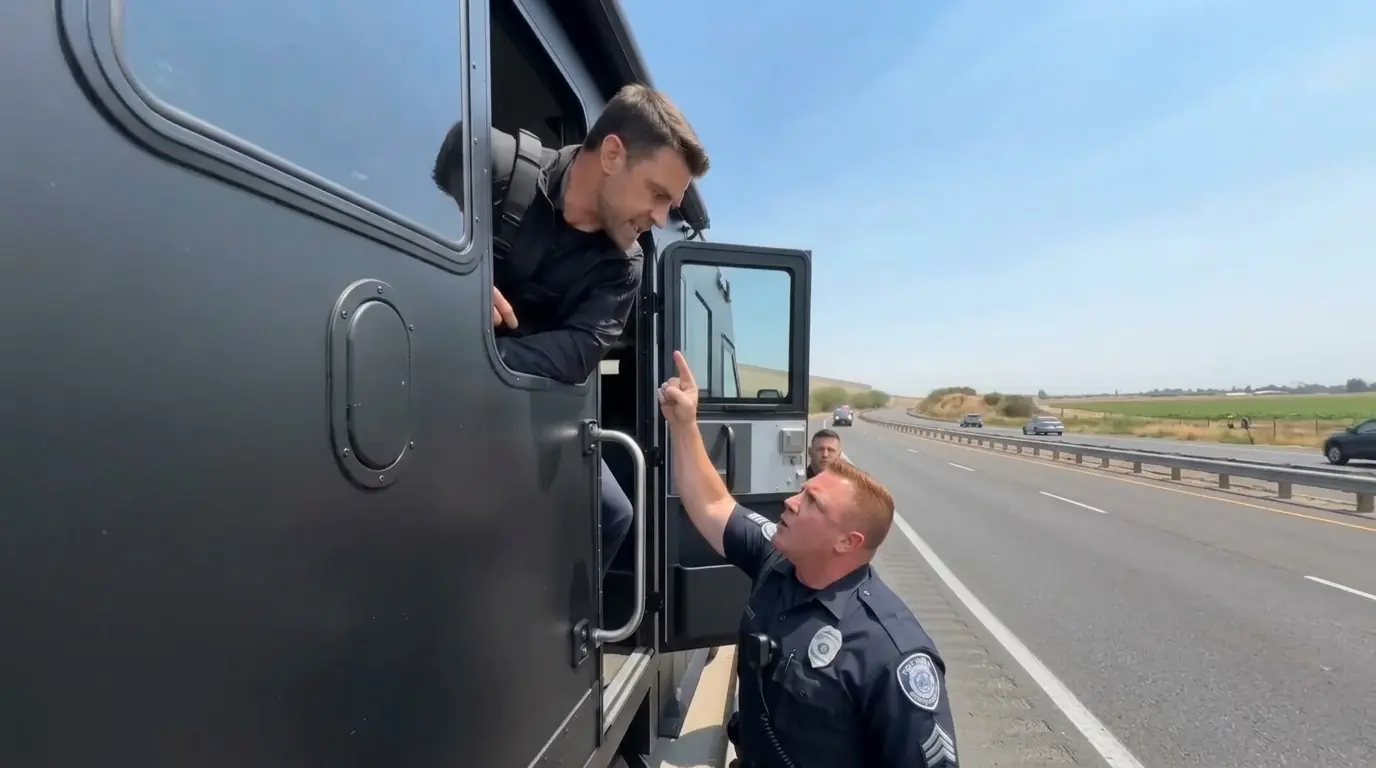
“Two grand, right now, or this truck disappears into county impound.”
Sergeant Travis Boone slapped the driver-side door of the black Peterbilt hard enough to make the mirror shake above his head. The Oklahoma sun had turned the interstate shoulder into a strip of white-hot concrete, and sweat darkened the collar of Boone’s uniform while his right hand hovered near his holster. Beside the patrol cruiser, Officer Caleb Mason stood with a citation book tucked beneath one arm and the uneasy expression of somebody who already knew this stop had gone too far.
From the cab, Luke Merritt looked down at both officers without moving. He was forty-four, lean through the shoulders, sun-browned from weeks on the road, and dressed in a faded work jacket that made him look exactly like the independent owner-operator his paperwork claimed he was. Nothing about the truck suggested federal law enforcement, and nothing about Luke suggested that eight agents were listening to the conversation through encrypted microphones less than two miles away. That was exactly how he wanted it.
“Sergeant,” Luke said, “you’ve had my license, registration, permits, and logbook for ten minutes, and you still haven’t identified one lawful reason to hold me here.” Boone tilted his head and smiled as though the trucker had told a joke. “The reason is whatever I put in my report when this is over.” Luke leaned one elbow against the open window and replied, “Then you should think carefully about what your report will need to explain.”
Mason glanced toward Boone. “Maybe we should run the permit number again.” Boone’s eyes snapped toward him. “Did I ask you to run anything?”
Mason lowered his gaze, but Luke noticed the hesitation. That hesitation mattered because investigators had spent six weeks trying to determine whether Mason was an active participant or simply an officer who had followed corrupt orders until he no longer knew how to leave. Boone, by contrast, had never shown much uncertainty. Every witness described him as a man who enjoyed the moment another person realized there was nobody nearby willing to help.
The truck sat near Exit 117 on an isolated stretch of interstate west of Tulsa. Dry grass moved along the guardrail while occasional tractor-trailers passed in the far lane, their drivers barely noticing the traffic stop. An abandoned billboard towered above the shoulder, casting a narrow strip of shade over Boone’s cruiser. Beyond the next overpass, an unmarked utility van contained the federal surveillance team monitoring three camera feeds and every word spoken beside the truck.
The refrigerated trailer attached to Luke’s cab contained no produce, meat, or retail freight. Behind its sealed doors sat a mobile federal surveillance unit with long-range optics, encrypted data servers, redundant audio storage, and secure communications equipment tied directly to the FBI field office. The exterior looked deliberately ordinary, with faded company markings belonging to a shell carrier called Prairie Star Transport. Boone believed he was stopping a struggling independent trucker carrying valuable cargo and no corporate lawyers.
Six weeks earlier, Special Agent Luke Merritt had never heard of Exit 117. Then the widow of a dead truck driver walked into a federal office carrying a manila envelope thick with medical records, dispatch notes, and unanswered letters. Her name was Sofia Delgado, and she had spent nearly a year trying to convince somebody that her husband had not died the way the county claimed.
Her husband, Roberto Delgado, had driven commercial routes for twenty-three years. He had no history of drug abuse, no disciplinary record, no failed commercial screening, and no reason to suddenly overdose inside his cab at an abandoned weigh station. The county report concluded that Roberto had ingested illegal narcotics after fleeing a traffic stop. Sergeant Travis Boone signed that report.
Sofia brought something more important than suspicion. She had Roberto’s final phone call. Less than forty minutes before his death, he told her two officers had stopped him and demanded cash.
“They say something’s wrong with my paperwork,” Roberto said. Sofia asked whether he had called his dispatcher. “They told me not to touch the phone again.”
“How much do they want?” she asked. Roberto answered, “Fifteen hundred now, or they say they’re taking the truck.” Then his voice dropped. “Something’s wrong, Sofi.”
The call ended abruptly. Roberto never called again. When his body was found, Boone claimed the driver had panicked because illegal narcotics were hidden inside his cargo.
Sofia did not believe it, so she borrowed against her house to hire an independent forensic pathologist. The second examination found bruising around Roberto’s wrists, one cracked rib, and a puncture mark beneath the jaw that had not been explained in the original autopsy summary. Toxicology showed a powerful synthetic opioid in his bloodstream, yet there were none of the physical markers expected in a long-term user. The pathologist concluded that forced administration could not be ruled out.
That report eventually reached Luke. He had spent fifteen years working public corruption, organized theft, and cases involving officers who used government authority as protection for private crime. The pattern was familiar to him. Corruption almost never announced itself as corruption.
It usually began with rationalization. A free meal became a favor, a favor became a missing evidence bag, a missing evidence bag became a supervisor deciding not to ask questions, and eventually everyone involved had crossed enough lines that turning back seemed more dangerous than continuing. Roberto’s death looked like the final stage of that process. Luke wanted to know where it began.
Federal analysts pulled Boone’s commercial-stop history. During eighteen months, he and Officer Caleb Mason had stopped more than one hundred independent truckers, usually on isolated road segments and usually far from fixed traffic cameras. Many of those stops produced no formal citation.
Their financial records told a different story. Boone made repeated cash deposits after several of the same shifts. The amounts were not enormous individually, but they were far beyond what his salary and known income explained.
Luke’s team contacted drivers quietly. Some refused to speak because they still passed through the county and feared retaliation. Others described nearly identical roadside conversations.
Boone would identify some problem with a permit, cargo seal, weight certificate, maintenance record, or insurance document. He would then explain that the truck could be towed and held for weeks while authorities “investigated” the violation. After allowing the driver to imagine lost contracts, spoiled freight, and crushing storage fees, Boone offered another solution. Cash.
The amount depended on how desperate the driver appeared. Five hundred dollars for minor freight. Two or three thousand when the load looked valuable.
Drivers who paid received no receipt. They were told to consider it a “roadside compliance settlement” or “administrative service fee.” Those who refused sometimes lost freight.
One electronics driver testified that six boxes disappeared after officers opened his trailer. A refrigerated hauler lost nearly nine thousand dollars of meat when Boone kept him on the shoulder until the shipment’s temperature limit expired. Another trucker claimed Boone punched him after he began recording the stop.
Every complaint went to Captain Everett Sloan. Sloan had supervised Boone for more than a decade and publicly defended him as one of the county’s hardest-working traffic officers. Internally, he classified complaint after complaint as unsubstantiated.
Then investigators found the freight connection. Several seized loads later appeared inside warehouses leased by Blackridge Logistics, a regional distribution company owned by Boone’s brother-in-law. Some trucks were searched and released without official documentation only hours before Blackridge received merchandise matching the missing cargo.
Luke began to suspect the operation served two purposes. Boone took quick cash from vulnerable drivers, and when the freight was worth more than the bribe, the county’s authority became a way to steal inventory. In some cases, the officers also appeared to wave certain trucks through without inspection.
Those trucks belonged to companies federal narcotics agents were already watching. Smugglers could pay Blackridge for guaranteed passage through the county. The roadside shakedown had become a complete commercial system.
Roberto Delgado had probably seen enough of it to become dangerous. Prosecutors had motive, patterns, financial anomalies, and witnesses, but direct proof remained difficult. Boone and Sloan controlled reports, body-camera files repeatedly disappeared, and most victims had criminal records or financial problems that defense attorneys could exploit.
Luke proposed an undercover operation. Make the next victim somebody Boone would underestimate. Let the officers build their own case in real time.
Prairie Star Transport was created through a federal shell company. Luke’s profile described him as a recently divorced owner-operator who had refinanced his house to purchase the truck and was struggling with debt. The rig appeared expensive enough to interest Boone but small enough to suggest the driver lacked institutional protection.
Luke knew commercial vehicles from an earlier undercover case but completed additional training before beginning the route. He learned the truck’s braking behavior, blind spots, inspection requirements, maintenance systems, and enough driver slang to avoid sounding like a federal agent pretending to understand trucking. The team even built several months of fake dispatch and fuel history.
The first four passes through Boone’s county produced nothing. Luke drove the route mornings, nights, weekdays, and weekends. Boone never stopped him.
Agents began worrying the department had learned about the investigation. Then Sofia remembered a detail from Roberto’s last call. He mentioned seeing a white cruiser parked near an abandoned billboard by Exit 117.
Luke’s team studied traffic patterns there. The location was almost perfect for Boone’s purposes. Vehicles leaving the interstate had several miles before the next town, and there were long stretches where no public cameras covered the shoulder.
The agents adjusted the schedule. Luke entered the area between commercial traffic waves shortly after noon. A white patrol cruiser sat partly hidden beneath the billboard.
Its lights activated before Luke reached the next marker. He pulled safely onto the shoulder. Inside the surveillance van, every monitor came alive.
Boone approached the cab while Mason remained several yards behind him. “License, registration, cargo manifest.” Luke handed everything through the window.
Boone barely looked. “Step out.” Luke asked why.
“Inspection.”
“What violation triggered the inspection?”
Boone looked up. “You independent?”
“Yes.”
“Anybody following your route?”
“My insurance company probably tracks the truck.”
“Dispatcher?”
“I dispatch myself.”
Boone’s mouth almost formed a smile. To the agents listening, the questions were obvious. He was not investigating a violation.
He was calculating vulnerability. Luke answered without showing that he understood. Mason walked forward carrying a handheld scanner.
“The plate shows a customs alert,” Mason said. Luke already knew the claim was false because federal technicians monitored every database search associated with Prairie Star. No officer had run the plate.
“What kind of alert?” Luke asked. Boone answered for him. “Possible contraband association.”
“Can I see it?”
“No.”
Luke nodded slowly. “Then what exactly are you asking me to do?”
“Open the trailer.”
Luke told him the refrigerated compartment used a digital commercial seal. That was technically true, although the seal actually protected millions of dollars in surveillance equipment and federal evidence.
Boone’s tone changed. “Open it anyway.” Luke shook his head. “You need a lawful basis.”
“I have probable cause.”
“From the alert you won’t show me?”
Boone stepped onto the truck’s lower step.
“You trying to make this difficult?”
“I’m trying to understand why you stopped me.”
Mason shifted beside the cruiser. Luke watched him glance toward the camera mounted near the truck mirror.
Boone lowered his voice. “Let me explain what happens when guys like you want to argue.” Luke waited.
“We tow the tractor and trailer. County investigators hold everything until the paperwork clears. Could be thirty days.”
Luke looked toward the trailer.
“Storage alone will bury you.”
“How much?”
“Depends.”
Luke let the silence work.
Boone leaned closer. “Twenty grand would not surprise me.”
“And my load?”
“Whatever condition it’s in when you get it back.”
Luke pretended to consider the financial damage.
“So what’s the alternative?”
“Two thousand.”
He allowed surprise into his face.
“Official citation?”
“No.”
“What is it?”
“Roadside compliance.”
“Receipt?”
Boone laughed. “Your receipt is getting to keep your truck.”
Inside the surveillance van, Special Agent Rachel Kim marked the timestamp. A federal prosecutor sitting behind her wrote DIRECT EXTORTION DEMAND across a yellow pad.
Luke continued. “I don’t carry that kind of cash.” Boone told him to transfer it electronically.
“To the county?”
“Blackridge Road Services.”
Luke looked at him. “That’s private.”
“They process impounds.”
Federal business records already proved they did not.
“What if I refuse?”
Boone put one hand against the door.
“Your rig disappears.”
“And what happens to me?”
The sergeant stared up.
“That depends how much trouble you decide to cause.”
Luke waited five seconds. Then he asked the question the team had planned but hoped they would not need.
“Is that what Roberto Delgado did?”
Everything changed.
Boone’s hand stopped on the door. Mason turned toward the cab.
“I don’t know that name,” Boone said.
“You signed his death report.”
“Lots of drivers die.”
“Not many with restraint bruises and an unexplained puncture under the jaw.”
Boone stared.
His eyes lost the lazy contempt from earlier. Calculation replaced it.
“Open this door.”
“No.”
“You’re under arrest.”
“For asking about a dead trucker?”
“For threatening an officer.”
“I haven’t threatened anyone.”
Boone drew his expandable baton.
Mason stepped forward.
“Sergeant.”
“Back up.”
“Maybe we need Captain Sloan out here.”
“I said back up.”
Mason stopped.
Luke kept both hands visible on the steering wheel.
Boone struck the truck door with the baton.
The metallic crack echoed down the interstate.
“Two thousand dollars now,” Boone shouted, “or I seize the truck and drag you out myself.”
Luke leaned closer to the window.
“Hit that door again and you’re finished wearing that badge.”
Boone laughed.
“I’ll break your face before a jury believes some broke trucker over me.”
Luke opened his jacket.
The federal badge caught the Oklahoma sunlight.
“Then go ahead.”
Boone froze.
Luke’s voice remained steady.
“The FBI has been recording you since I left the interstate.”
For several seconds, nobody moved. Boone looked at the badge as though refusing to recognize it could somehow change what it was.
“Fake.”
Luke opened the door farther.
Behind his seat, Boone could now see a mounted camera unit, encrypted radio, and an identification panel carrying federal markings.
Mason went pale.
Luke touched the transmitter hidden beneath his sleeve.
“Move.”
The word was not directed at either officer.