The first sign of life was the flicker of a shadow where no shadow should be. Silas had been tracking the line of his creek bed, the mud still soft from a rare spring rain when he saw it. A bundle of rags and bones tucked against the gnarled roots of an old cottonwood. He'd lived on this patch of Texas dust long enough to know the shapes of death. Coyotes left clean skeletons.
Vultures left scattered messes. This was something else. This was quiet. He approached slowly, his hand resting on the worn grip of the pistol at his hip, a habit ingrained by years of solitude. The land was a harsh god, and it demanded constant vigilance.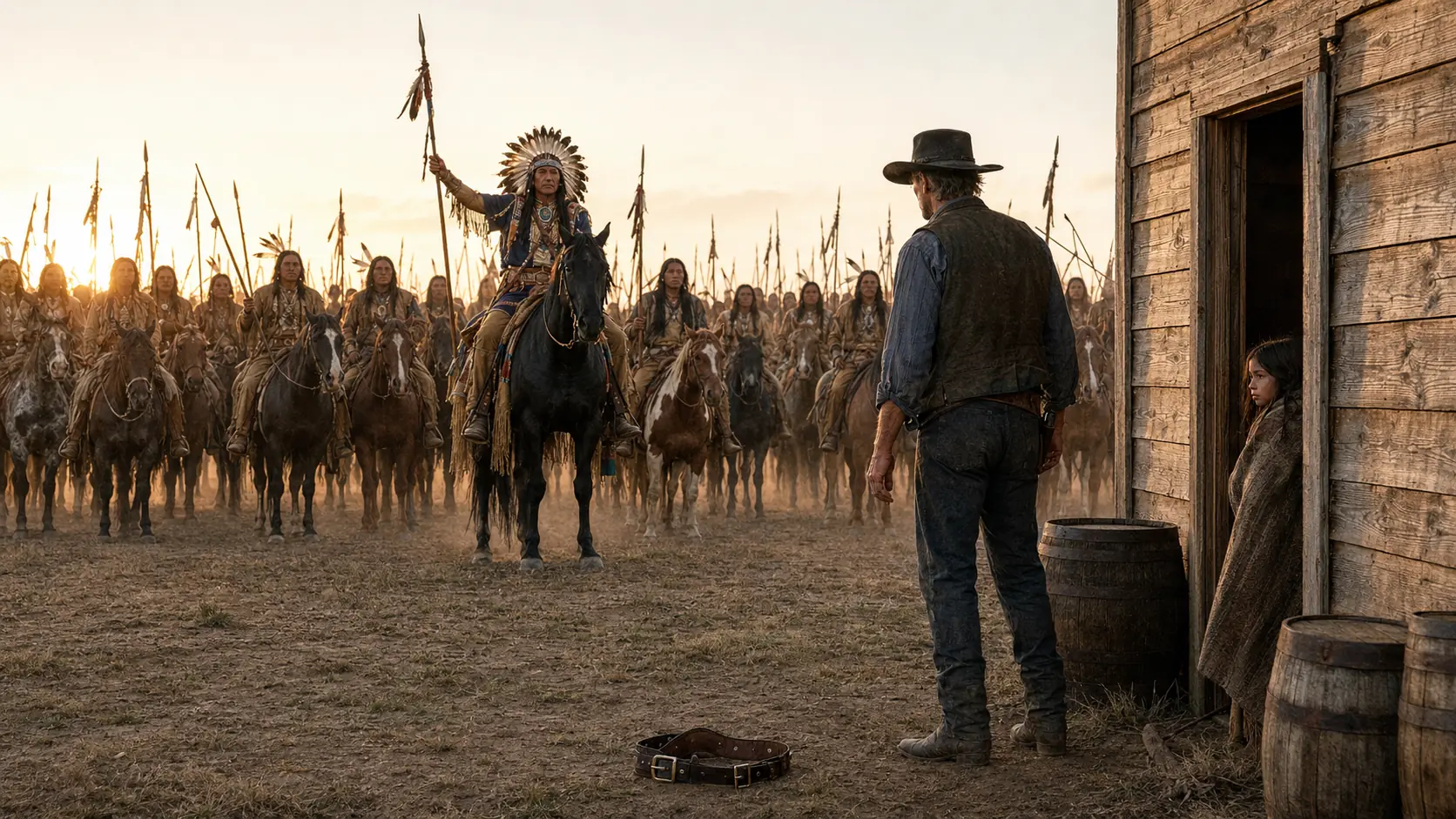
As he drew closer, he saw the tangle of black hair, the small shoulder blades pushing against a deerskin tunic worn thin as paper. A child. A Comanche child. Her chest rose and fell in a rhythm so shallow it was more a memory of breathing than the act itself. Her lips were cracked the color of dried clay.
Starvation was a hollow-eyed predator he knew all too well. He knelt, his old knees protesting, the smell of river mud and silent suffering filling his senses. He uncorked his canteen, the slosh of water sounding like a monsoon in the stillness. He knew what his neighbors would say. "Leave it.
Not your trouble." Calling her "it," not "her." They saw the Comanche not as people, but as a force of nature, like a wildfire or a drought, something to be endured or extinguished. Silas had lost his own family to a world that didn't care. His wife Martha to a fever that burned through their small home.
His son, a ghost he no longer spoke of, was lost to the unforgiving machinery of a war he hadn't understood. All that was left was this ranch, a monument to ghosts and a stubborn refusal to let the world's cruelty have the final word. He dipped his fingers in the water and touched them to the girl's lips. Her eyes fluttered open. They were deep, dark, and held a fear so profound it had burned past, screaming into a state of pure animal terror. ""Easy now," Silas whispered, the words rusty in his throat.
He wasn't talking to her as much as to the trembling part of himself that wanted to turn and walk away. He scooped her up. She weighed nothing. A bird with broken wings. As he stood, her head lulled against his chest, a gesture of surrender not to him, but to the abyss.
He carried her back toward his barn, each step a defiance. He was bringing the wildfire into his home, and he knew with a certainty that settled cold and heavy in his bones, that the wind was about to change. He laid her on a clean horse blanket near the hearth, the only place in the small cabin that held any real warmth. The fire popped and hissed, casting long, dancing shadows that made the room feel both smaller and more haunted. For a long while, he just watched her breathe.
Each inhale was a victory. He mixed a little broth, thin and watery, and patiently, drop by drop, brought it to her lips with a spoon. At first, she wouldn't take it, her jaw locked tight, but the smell, the warmth, the sheer persistence of his gentle offering eventually wore down her defenses. She swallowed. Then again.
It was the smallest of miracles, but it felt like watching the sun rise after a lifetime of darkness. He worked in silence, the cabin filled only with the crackle of pine and the soft sounds of the girl's slow return to the world of the living. He saw the intricate beadwork on her worn moccasins, a pattern of bluebirds and river reeds. Someone had made them with love. A mother perhaps, an older sister.
Having another soul in his house, even a silent half-conscious one, only amplified the emptiness of the spaces she didn't fill. He saw Martha's ghost sitting in the rocking chair, her hands busy with mending. He saw his boy, barely seven, sleeping in the small cot where the girl now lay. The past wasn't just a memory; it was a room he lived in. And tonight, a stranger had walked through the door.
Before he turned in, he stood by the window and looked out at the vast indifferent darkness. The prairie was a sea of black dotted with the cold, distant light of stars. Out there under that same sky were her people. They would be looking for her. They would follow her tracks to his door.
And when they arrived, they would not come asking questions. They would come with righteous fury, with the conviction that one of their own had been stolen. He was one man, one cabin, one gun, against a grief that could summon an army. He knew he should be afraid. But as he looked back at the child, her breathing now a little deeper, a little more steady, he felt something else take root in his heart.
A grim, unmovable resolve. Let them come. The morning arrived, not with light, but with sound. It started as a low, distant hum, a vibration he felt in the floorboards before he heard it with his ears. A tremor in the soul of the earth.
Silas was awake instantly, his body attuned to the subtle languages of the plains. This was not the rumble of a coming storm. This was deliberate. This was alive. He moved to the small window, his heart beginning a slow, heavy drum beat against his ribs.
He pushed aside the burlap curtain and peered out into the gray pre-dawn light, and the world fell away. The horizon was gone. In its place was a living wall of men and horses. They weren't a disorganized mob. They were a force array in a silent perfect crescent that cupped his small ranch in a hand of impending violence.
Three hundred, maybe more, warriors mounted and armed, their faces grim masks in the growing light. Sunlight glinted off the tips of lances, the barrels of old rifles, and the sharp edges of war axes. They were utterly still, a painted army waiting for a signal. The sound he'd heard was the thunder of their arrival, and the silence they now held was a thousand times more terrifying. A single horse could be a curiosity, a dozen, a threat.
This was an execution. He felt a dry, bitter laugh catch in his throat. All for a bowl of broth and a warm blanket. His gaze swept over the line of riders, searching for a leader, and found him easily. He sat taller than the others on a powerful black stallion, a war bonnet of eagle feathers spilling down his back.
His face was a carving of grief and fury. Even from this distance, Silas could feel the heat of his hatred. This was the father. This was the man whose heart he had broken without ever knowing his name. Silas let the curtain fall.
The cabin, his only sanctuary, suddenly felt like a trap. A wooden coffin he had built with his own hands. The girl was still asleep, her face peaceful, unaware of the judgment waiting outside. To them she was a stolen child. To him she was the reason the sun might not set on his life today.
Every instinct screamed at him to hide, to barricade the door, to make his last stand. But what would that prove? It would only confirm their story. Seal his fate and perhaps hers. No, he had started this with an act of humanity.
He had to see it through, even if it ended with his blood soaking into the very dirt he had come to call home. There was only one path, out the door. What would you do when the world you know shrinks to a single wooden door and on the other side an ocean of warriors has gathered to watch you drown? He took a deep breath, the air in the cabin tasting of woodsmoke and finality. He checked the pistol at his hip, not to use it, but for the familiar weight.
It was a piece of the man he used to be. Then he unbuckled the belt and laid it on the table. He would not face them as a threat. He would face them as he was, one man with nothing but the truth on his side. He walked to the door, his boots loud on the floorboards.
The handle was cold iron. He pulled it open and stepped out onto the porch. The world went quiet. Or perhaps it had been quiet all along, and he was only now hearing the depth of it. The collective gaze of three hundred warriors fell upon him, a physical weight that pressed the air from his lungs.
The silence was an accusation, a verdict, a eulogy. He stood there, his hands open at his sides, letting them see he held no weapon. He met the eyes of the chief across the fifty yards of trampled dust that separated them. The chief's face was impassive, but his eyes burned with a cold fire that promised a painful death. He urged his horse forward, the stallion moving with a fluid grace that defied its size.
The other warriors remained perfectly still, a silent chorus to this grim opera. The chief stopped ten feet from the porch. He carried no rifle, only a long, feather-adorned lance that he held loosely, its tip aimed at the ground. It was not a weapon at this moment. It was a symbol of his authority.
He spoke, and his voice was like rocks grinding together, low and rough with a sorrow that had curdled into rage. The words were in the Comanche tongue, but the meaning was universal. "You." The word was an indictment. He gestured with his chin toward the cabin.
"Her? Why?" Silas's throat was dry. He had to speak. But what could he say that they would possibly believe?
"She was by the creek," he said, his own voice sounding thin and foreign. "Starving. She would have died." The chief's expression did not change. He did not understand the words, but he understood what he believed was a lie.
He saw only a white man, a member of the people who had taken their lands, broken their treaties, and slaughtered the buffalo until the great herds were but a memory. To him, Silas was not a man. He was a symptom of a disease. He spoke again a short, sharp phrase, and this time the meaning was even clearer. It was a demand.
"Show me." He wanted to see his daughter or her body. Silas knew with chilling certainty that whatever happened in the next minute would determine everything. He could not force the girl to come out. And if he turned his back to get her, a lance might find its way between his shoulders.
The chief's gaze was relentless. It stripped Silas down to his bones, searching for the deceit he was so sure was there. The silence stretched, becoming a taut wire of suspense. Behind the chief, the warriors watched, their hands resting on bows and rifles, their patience as thin as a razor's edge. Every rustle of the wind, every nervous snort from a horse sounded like a prelude to violence.
Silas knew he was being judged not for who he was, but for what he represented. To them he was every broken promise, every acre of stolen land, every shallow grave. His innocence was irrelevant. "I gave her food," Silas said again, speaking slowly, hoping the tone of his voice might carry the truth his words could not. ""Water. Shelter."
He gestured toward the cabin, an open palmed plea. ""She is safe."" The chief, Corit, let out a short guttural sound. It was not a laugh. It was the sound of pure contempt. "Safe." His daughter was in the house of his enemy.
The word was a poison. He had tracked her for two days, his heart a cold stone in his chest. He had found her trail near the creek, then the heavier prints of a white man's boots leading away from it. He had found her small, discarded pouch of dried berries. The story wrote itself.
A predator had found his lost child. He raised his lance slightly, the tip lifting from the dirt. It was a small movement, but it sent a ripple of tension through the assembled warriors. They shifted, their horses sensing the change, their grips tightening on their weapons. The air grew thick, electric.
This was the moment, the breaking point. Silas held his ground, his gaze locked on Corit's. He could feel his life balanced on the tip of that lance. He had to do something, something to shatter the terrible certainty in the chief's eyes. He thought of the girl inside, her peaceful sleep, a stark contrast to the storm gathered at her door.
And then, as if summoned by the sheer force of the confrontation, the cabin door creaked open behind him. The sound was deafening in the charged silence. Every head, including Silas's, turned. There she was, Nia. She stood framed in the doorway, clutching the horse blanket around her thin shoulders.
She was pale, her legs unsteady, but her eyes were wide and clear. She saw her father. She saw her people. The blanket slipped from one shoulder, revealing the clean deerkin tunic, free of the mud and grime from the creek. She was weak, but she was unharmed.
The sight struck the warriors like a physical blow. A collective audible intake of breath swept through the line. She was alive. But the relief was instantly tangled with suspicion. She was standing in the white man's doorway, wrapped in his blanket.
The story in their minds shifted, but it did not soften. He had not killed her. He had lured her. He had captured her. Corit's face, which had for a fleeting second shown a flicker of stunned relief, hardened again into a mask of granite.
He saw his daughter alive but a prisoner. The crime was different, but the verdict was the same. Nia took a tentative step onto the porch, her gaze fixed on her father. A soft name escaped her lips, carried on the wind. "Ta.
Father." The word was a fragile thread thrown across a chasm of violence. Corit's horse shifted beneath him, sensing the storm of emotion raging within its rider. The chief's knuckles were white where he gripped his lance. He had his daughter back, but she was on the wrong side of the battlefield.
He had to close the distance, but he could not show weakness. He could not simply ride forward and embrace her. Not here. Not in front of his warriors who had ridden with him, fueled by his rage and his grief. To them, this was not over.
An injustice had still occurred. He issued a sharp command in Comanche. It wasn't directed at Silas, but at Nia. "Come here." It was an order, not an invitation.
Nia flinched, her eyes filling with a confusion that tore at Silas's heart. She looked from the terrifying figure of her father, a man she knew and loved, transformed by anger to Silas, the stranger who had shown her inexplicable kindness. She was trapped between two worlds on a porch that had become a no man's land. Silas understood none of the words, but he understood the command in the chief's tone. He knew this was the critical moment.
If Nia walked to her father now, it would be over for him. Her return would be seen as an escape, a rescue. His part in the story would be cemented as that of a captor. He needed to prove that he was not her jailer. Slowly, deliberately, Silas took a step back, moving away from the girl, creating space.
He then turned slightly, presenting his side to the chief, a gesture of non-aggression. He gave a small almost imperceptible nod toward Nia as if to say, ""She is free to go. She was always free."" It was a massive gamble, a subtle act of trust in a situation that had none. Corit saw the gesture. It was small, almost insignificant, but it didn't fit with the narrative of a kidnapper.
A man holding a hostage does not step away from them. A man who has committed a crime does not willingly cede control. For the first time, a flicker of doubt, small as a cinder, entered the chief's eyes. He barked another command, this one sharper, more insistent. "Nia."
Now he needed this to be simple. He needed her to run to him to confirm his version of the truth. But she didn't. She took another shaky step forward and spoke. Her voice was still weak but gaining strength.
She spoke in her own tongue. Her words directed at her father. Silas didn't understand them, but he could hear the plea, the earnestness. She was not crying out in fear. She was explaining.
Nia's voice, though frail, cut through the tension. She spoke a few short sentences, her hand gesturing weakly, first toward the creek, then toward Silas, then to the blanket she clutched. She was telling the story, her story. Corit listened, his face an unreadable stone mask. Some of the warriors shifted, murmuring to one another.
They were straining to hear their chief's daughter, their own narrative of righteous vengeance being challenged by the testimony of the victim herself. Silas stood perfectly still, feeling like a man on trial, unable to understand the language of his own defense. Everything rested on the small, determined girl on his porch. Corit dismounted. The movement was fluid, powerful.
He handed the reins of his stallion to a nearby warrior without looking and began to walk toward the cabin. He did not look at Silas. His eyes were locked on his daughter. This was the test, not for Silas, but for himself. He had to cross the line to step onto the enemy's land, to close the distance his own rage had created.
His warriors watched, silent and tense. Their chief was making himself vulnerable, entering the kill zone. Silas held his breath. Corit walked past him, so close Silas could smell the scent of horse and leather and the faint, dusty smell of war paint. The chief ignored him completely as if he were a rock or a fence post.
He stopped in front of Nia. He did not reach for her. He did not speak. He simply stood there, his great height and warrior's bearing a stark contrast to her fragile frame. He was looking for the truth in her eyes.
He was searching for any sign of a lie, any trace of coercion. What he saw was his daughter, weak and thin, but with a clarity in her gaze that spoke more powerfully than words. He knelt. The act was so unexpected, so profound that it sent a shock wave through the onlookers. A Comanche chief, a proud warrior who bowed to no man, knelt on the porch of a white settler.
He knelt to be level with his daughter. He reached out a hand, not to grab her, but to lay it open on his knee as an invitation. Nia took a final faltering step and collapsed into his arms. The chief's powerful arms wrapped around her, pulling her into an embrace that was both fierce and infinitely gentle. He buried his face in her hair.
And for a moment, the warrior was gone. There was only a father holding his lost child, the rigid lines of his anger melting away to reveal the raw, aching heart of a man who had feared the worst and found a miracle instead. A long moment passed. The prairie was silent, save for the wind whispering through the grass. The army of warriors watched, their aggression dissolving into a shared, profound relief.
They were not just soldiers. They were fathers, brothers, sons. They understood the scene before them in a language deeper than words. Corit finally looked up, his eyes meeting Silas's over the top of Nia's head. The fire was gone.
In its place was something complex and difficult to name. Gratitude, confusion, a grudging respect. The chasm between them had not vanished, but a bridge had been built, fragile and astonishing across the divide. A warrior, older than the rest, with a face like a weathered map, dismounted, and walked toward the porch. He stopped beside his chief and spoke in a low voice, pointing toward Nia's feet.
He had noticed her moccasins. He had seen that they were caked with the dark mud of the deep creek bed, not the dry dust of the plains. He pointed to the faint, almost invisible scuffs on the leather, marks of a desperate crawl up the embankment. His words were quiet, but they confirmed Nia's story. She had fallen.
She had been too weak to climb out. The stranger hadn't taken her. The creek had. Silas had not been a predator. He had been a rescuer.
Corit listened, his gaze never leaving Silas. Then Nia spoke again, her voice muffled against her father's shoulder. She said one word, pointing a thin finger at Silas. Silas braced himself, not knowing what to expect. A young warrior stepped forward to translate, his voice hesitant.
"She says he is a good man." The words hung in the air, simple and monumental. "A good man." In that place at that time, for a Comanche to say that of a white man was to rename the world. The translator looked at Silas, his expression a mixture of awe and disbelief, as if he were seeing a ghost.
Corit nodded slowly. He had seen enough. The truth once revealed was as clear and undeniable as the morning sun. He had come here for vengeance. He had found an uncomfortable piece of grace.
Corit rose to his feet, lifting Nia effortlessly into his arms. She was safe now, her head resting on his shoulder, her eyes fluttering closed in exhausted relief. He turned to face Silas fully. The fifty yards of dust between them had been a battlefield. Now it was just land, empty land, filled with a new unspoken understanding.
The chief did not say thank you. The words did not exist for this situation. Gratitude was a debt and this was something else. This was a moment of shared humanity that defied easy language. Instead, he gave Silas a slight formal nod.
It was a gesture of acknowledgment from one man to another, a recognition of the courage it had taken to stand alone against a force of nature and be proven right. He turned and walked back toward his stallion, his daughter held securely in his arms. The warriors parted for him, their expressions changed. The hard lines of hatred had softened into a quiet awe. They looked at Silas not as an enemy to be killed, but as a strange anomaly, a man who had defied their expectations, and in doing so, had spared them from committing a terrible injustice.
One by one, in silence, they began to turn their horses. There was no victory cry, no sound of triumph. The departure was as quiet and deliberate as the arrival. They moved like a receding tide, a river of men and horses flowing back toward the horizon, leaving the land as they had found it, but forever changed. The older warrior who had noticed the moccasins was the last to leave.
He paused his horse beside the porch and looked at Silas. From a pouch at his side, he pulled a small, intricately carved bone talisman on a leather cord. He held it out. Silas hesitated, then stepped forward and took it. The warrior nodded once, a gesture of profound respect, and then turned and rode away, melting into the dust of the departing company.
Silas stood on his porch. The small carving was warm in his palm as he watched until the last rider was a mere speck against the rising sun. The thunder of their hooves faded, replaced by the familiar sounds of the prairie, the call of a distant hawk, the rustle of the wind. He was alone again. The silence that descended was deeper than the one that had come before.
It was not empty. It was filled with the echo of what had just happened, with the ghost of a battle that was never fought. He looked at his cabin, at the open door, at the horse blanket still lying by the hearth. The house felt larger now, emptier. The loneliness that returned was not the sharp, bitter kind from the night before.
It was softer, more contemplative, tinged with a strange, bittersweet sense of connection. He walked to the edge of his property, to the line where three hundred horses had stood just an hour ago. The ground was churned, a testament to the storm that had gathered and passed. He looked out at the horizon, now clear and vast, an endless expanse of blue sky and golden grass. He had faced down an army by refusing to be an army.
He had won a war by refusing to fight. It was a victory that felt more like a quiet prayer. His gaze fell upon the creek, the water sparkling in the morning light. It was just a creek, a simple line of water carving its way through the dirt. But it was different now.
It was the place a life was almost lost, and the place a bridge was found. It was the border between two worlds, and for one morning he had stood in the middle and held it open. He opened his hand and looked at the bone talisman. It was a horse carved with exquisite detail, a symbol of strength, of journey, of spirit. It was a gift he could never repay, a story he could never fully tell.
He slipped the leather cord over his head, the smooth bone cool against his skin. He didn't know what the future held. The peace of this morning was fragile. A single candle flame in a vast and violent wind, but it was real. For a moment, two enemies had looked at each other and seen a human being.
Silas turned and walked back to his cabin. The door was still open. The fire in the hearth had burned down to glowing embers, waiting to be stirred back to life. He stepped inside, a man alone in his quiet house, but no longer just a survivor. He was a caretaker of a strange and sacred memory, a testament to the simple, terrifying, and world-changing power of a single act of kindness. The prairie held its breath, and for a little while there was peace.