The scent of burnt rubber and ozone hung heavy in the air, a metallic tang that clung to the back of Jackson Ryder’s throat, thicker than the dust his mangled Harley had kicked up. Pain was a white-hot symphony playing in his left leg, a brutal crescendo that drowned out the distant wail of approaching sirens. He lay on the gritty shoulder of the old county highway, the chrome of his once-pristine machine now twisted into a grotesque sculpture of failure.
Failure, however, felt a lot like survival. His gaze drifted past the wreckage to the yellow school bus, now safely stopped a hundred yards down the road. Children’s faces, pale and wide-eyed, were pressed against the glass like a gallery of ghosts he had narrowly avoided creating. His sergeant-at-arms, a mountain of a man known only as Grizz, was kneeling beside him.
His meaty hands were surprisingly gentle as they hovered over Jax’s shattered limb. “Don’t you move, brother,” Grizz’s voice was a low rumble, a gravelly counterpoint to the screaming sirens. “Just breathe. Medics are almost here.”
Jax grunted, his teeth clenched. The world was starting to swim at the edges, the vibrant green of the Havenwood pines blurring into a dark, pulsing vignette. He had seen the bus’s brakes fail. He had heard the driver’s terrified scream as the vehicle careened toward the blind curve where a minivan, a family inside, had just pulled over to admire the view.
There was no time for calculation, no room for thought. There was only instinct, a lifetime of it honed on asphalt and adrenaline. He had yanked his handlebars, throwing the full weight of himself and his thousand-pound bike into a controlled, suicidal skid, positioning his machine as a partial, screeching barrier. The bus had clipped him, a monstrous metal slap that had sent him flying, but it had been enough.
The bus had swerved, its momentum broken, shuddering to a halt just feet from the minivan’s bumper. He had traded his leg for their lives. A fair trade in his book. “The kids,” Jax rasped, the words scraping his throat raw. “The family, they okay?”
Grizz’s hand finally rested on his shoulder, a solid, grounding weight. “They’re fine, Jax. Not a scratch on them. You saved them. All of them.”
A grim smile touched Jax’s lips before another wave of agony crashed over him, pulling him down into a merciful darkness. The Iron Sentinels Motorcycle Club did not have a health insurance plan. They had a brotherhood. They had a slush fund for funerals, bail, and clubhouse repairs.
They did not have deductibles and co-pays. They had loyalty and blood. But a helicopter flight, emergency surgery to piece a tibia and fibula back together with titanium rods, and a multi-day hospital stay were a different kind of enemy. One that could not be met with fists or threats.
This enemy sent bills, invoices with cold, unforgiving numbers that climbed into the stratosphere. The club president was a hero, but heroism came with a price tag that made even the most hardened bikers flinch. The bill, when it arrived at the clubhouse days later, was a quiet bomb. Fifty-three thousand dollars.
The number sat on the scarred wooden bar, stark and black on white paper, more intimidating than any rival gang’s colors. The club’s emergency fund would be gutted, leaving them vulnerable. Jax, laid up on a reinforced couch in the main room, his leg imprisoned in a massive cast, was adamant. “No,” he growled, his voice flat. “The club’s money is for the club. For an emergency. This was my choice. My screw-up.”
Grizz slammed a bottle of beer on the table, making the offending paper jump. “Your screw-up? You call saving a bus full of kids a screw-up? That money is for protecting our own. And right now, that’s you. This is the definition of a club emergency, you stubborn ox.”
The argument raged for an hour, a familiar dance of Jax’s pride and Grizz’s pragmatism. In the end, Jax was immovable. He would figure it out. He would sell his other bike. He would take out a loan. Whatever it took.
The small pile of crumpled dollar bills and loose change on her kitchen table was a familiar, disheartening landscape. After a ten-hour shift at the Greasy Spoon Diner and four hours cleaning offices downtown, the total came to $47.62. She sighed, rubbing her temples where a headache was beginning to bloom. It would be enough for groceries. Just enough.
The rent was due next week, a looming monster that haunted her sleep. Her life was a tightrope walk over a canyon of debt and anxiety, and her daughter Pippa was the only thing that kept her from looking down. Pippa was six years old, a whirlwind of bright curiosity and untarnished joy wrapped in a tiny frame. She was currently sitting on the floor, her tongue sticking out in concentration as she drew a family of purple unicorns with a stubby crayon.
For Pippa, the world was still a place of magic. For Naomi, it was a place of harsh realities, a place she had run to, not from. She carried the ghost of her past life like a shroud. A life in a sprawling mansion with a man named Richard Vance, whose love was a cage gilded with diamonds and reinforced with steel-cold control.
His wealth had been a comfort at first, then a weapon. He dictated her friends, her clothes, her thoughts. His compliments were hooks, his anger a swift, silent poison that left bruises on her soul long before his hands ever left marks on her skin. The escape had been a desperate, terrifying flight in the dead of night with a duffel bag of clothes and a sleeping Pippa in her arms.
She had left behind the cars, the jewelry, the money, all of it tainted. She had chosen freedom, even if freedom tasted like instant noodles and smelled like bleach from her cleaning job. Here in Havenwood, they were anonymous. They were safe, but they were poor.
The town itself was a character in their story: quaint, quiet, and deeply suspicious of outsiders, especially the leather-clad, engine-revving variety. The Iron Sentinels’ clubhouse, located on an old industrial plot on the edge of town, was a source of constant low-grade gossip and fear. The townsfolk saw them as a menace, a blight on their peaceful existence. Naomi, conditioned by Richard’s paranoia, had taught Pippa to be wary.
“We don’t go near there, sweetie,” she would say, pulling her daughter a little closer whenever they drove past the gates adorned with the club’s snarling wolf emblem. But Pippa did not see a menace. She saw magnificent, gleaming machines. She heard the thunder of their engines, not as a threat, but as a promise of adventure.
“They’re like dragons, Mommy,” she had once whispered, her eyes wide with wonder. “Loud, shiny dragons.” Naomi had smiled, a sad, tired thing. She wished she could still see dragons instead of just fire.
The news of the biker’s accident traveled through Havenwood on currents of gossip, transforming from diner chatter to front porch speculation. The story was fragmented, dramatic. A reckless biker. A near disaster. A school bus.
But then the bus driver, a woman named Carol, started talking, and the family in the minivan, the Hendersons, started talking. The narrative began to shift. He was not reckless. He was heroic. He had not caused the accident. He had prevented a tragedy.
Naomi heard the story in pieces during her shift at the diner. “Saved the whole bus,” one customer said, shaking his head in disbelief. “My nephew was on that bus,” another added, her voice trembling. “That biker, he’s a hero.”
The conversation at the next table over was what truly caught Naomi’s attention. It was Martha, the town’s most prolific gossip, holding court. “A hero he may be,” Martha said, lowering her voice conspiratorially, “but I heard from my cousin who works in hospital billing that he’s got no insurance. The bill is astronomical. Over fifty thousand dollars.”
“The club is trying to figure it out, but he’s refusing their help. Too proud, they say.” A wave of something cold and familiar washed over Naomi. Pride, the kind of masculine pride that chose suffering over accepting help. She had known that pride intimately.
Richard’s pride had been a weapon he used to isolate her, convincing her that any help from her family or friends was an insult to his ability to provide, to own. But this was different. This biker’s pride was not about control. It was about protecting his family, his club.
Still, the result was the same. A man in need, suffering alone. That evening, as she tucked Pippa into bed, she found herself telling her daughter a sanitized version of the story. “There was a brave man today, sweetie,” she said, smoothing Pippa’s hair.
“He rides one of those loud, shiny motorcycles, and he got hurt trying to keep a lot of people safe.” Pippa’s eyes, the color of warm chocolate, grew wide. “Is he okay?” “He will be,” Naomi said softly. “But it costs a lot of money to get better when you’re hurt that badly.”
She did not mean for it to sound so sad, but the weight of her own financial fears bled into her words. She kissed Pippa’s forehead, turned on her unicorn nightlight, and went back to the kitchen to stare at the pile of bills on the table. Her own heroics, the daily silent battle for survival, remained unseen and unpaid.
In the quiet of her room, Pippa lay awake. The story of the brave motorcycle man echoed in her mind. He was a hero, like in her cartoons, but he was hurt and he was sad because of money. Money was a word she heard a lot.
It was the reason Mommy looked tired. It was the reason they could not get the big box of crayons with a sharpener in the back. Money was a grown-up problem, big and confusing. But helping was not.
Helping was simple. An idea, pure and bright as her nightlight, sparked in her mind. She slipped out of bed, her bare feet silent on the cool floorboards. In the corner of her room, on top of her small dresser, sat her most prized possession: a ceramic piggy bank painted a cheerful shade of pink with a chipped ear from a tumble last year.
It was a gift from her grandma before she had gone to live in the stars. It was heavy. Heavy with eighteen months of found pennies, birthday dimes, and the occasional precious dollar bill from Mommy for being extra good. It was her treasure.
It was her money. She looked from the pig to the window, in the direction of the edge of town where the dragons lived. The brave man was hurt. He needed help. It was just that simple.
The next morning, the air was crisp with the promise of autumn. Naomi left for her early shift at the diner before the sun had fully risen, leaving a sleeping Pippa in the care of their elderly neighbor, Mrs. Gable, who was mostly deaf and spent her mornings watching game shows at a deafening volume. Pippa woke up with a singular mission.
She ate the cereal Naomi had left for her, her mind not on the sugary loops, but on the weight of the ceramic pig in her room. She knew the way. Mommy had pointed it out a hundred times. That’s the bad place, Pippa. We never go there.
But Mommy had also said the man was brave. Brave people could not be in a bad place. Her logic was unassailable. She scribbled a note in her best wobbly printing: Gone to help the man. She hoped Mrs. Gable would find it.
With the piggy bank clutched to her chest with both arms, she slipped out the back door. The journey was an odyssey. The familiar neighborhood streets gave way to the cracked pavement of the old industrial road. The houses grew sparse, replaced by chain-link fences and overgrown lots.
The world felt bigger out here, emptier. A truck rumbled past, and she dove behind a bush, her heart hammering. She was a small knight on a grand quest, and her treasure was her sword and shield. Finally, she saw it: the gate.
It was taller than she had imagined, a formidable black iron structure with the snarling wolf’s head at its center. The clubhouse behind it looked like a sleeping beast, low and dark with no windows she could see. A deep, guttural roar suddenly erupted from inside the compound. A moment later, a motorcycle shot out of an open garage, a huge bearded man at the helm.
He was heading for the gate. Pippa froze, hidden behind a thick telephone pole, her knuckles white where she gripped the pig. The biker stopped at the gate, pulling a chain to slide it open. It was Grizz.
His face, usually set in a permanent scowl, was etched with worry. He was heading to the pharmacy to pick up more of Jax’s pain medication. As the heavy gate slid open, his eyes, scanning the road out of habit, caught a flash of pink behind the pole. He squinted.
A kid out here? He cut the engine, and the sudden silence was startling. “Hey,” he called out, his voice a low growl that he tried to soften. “You lost, little bit?”
Pippa peeked out. The man was enormous, covered in leather and tattoos. He looked like every monster from her scariest storybooks. But his eyes were not mean. They were tired, just like Mommy’s.
She took a deep breath, straightened her small shoulders, and stepped out from behind the pole. She held the piggy bank out in front of her like an offering. “I’m not lost,” she said, her voice a tiny, trembling whisper. “I’m here to see the brave man, the one who got hurt.”
Grizz stared, completely bewildered. He looked from the tiny girl in the pink dress to the piggy bank she was holding as if it were the crown jewels. He was used to dealing with rival gangs, suspicious cops, and bar fights. He had absolutely no idea what to do with this.
“The brave man,” he repeated, his gruff voice cracking slightly. “You mean Jax?” Pippa nodded, her chin wobbling. “He needs this,” she said, giving the pig a little shake. It rattled with the sound of a hundred tiny hopes. “It’s for his surgery.”
Grizz felt something shift inside his chest, a tectonic plate of cynicism and world-weariness grinding against a feeling he had not experienced in decades. He slowly swung his leg off his bike, his knees popping. He knelt down, a difficult and creaky process to bring himself closer to her eye level. The sheer scale of him was still terrifying, but being on her level helped.
“What’s your name, kid?” “Pippa.” “Well, Pippa,” Grizz said, his voice now impossibly gentle, “Jax is inside. Why don’t you and I go talk to him together?”
He looked down at her offering, at the chipped ear of the ceramic pig, and felt a lump form in his throat. This little girl with her pocket full of change was showing more courage than half the men he knew. He stood up and gestured toward the now-open gate. “Come on. The dragons are friendly today.”
The interior of the Iron Sentinels’ clubhouse was a cavern of shadows, chrome, and the lingering scent of leather and stale beer. Sunlight struggled to pierce the grimy windows, illuminating dust motes dancing in the air. For a six-year-old, it should have been terrifying. But with Grizz’s enormous form beside her, Pippa felt strangely safe.
Every biker in the room, and there were at least a dozen, stopped what they were doing. Conversations died. A game of pool froze mid-shot. Heads turned, and a collective, baffled silence fell over the room as Grizz led the tiny girl in the pink dress toward the back.
Their eyes, hard and weathered, followed her every step. Jax was where he had been for days, laid up on the worn leather couch, his casted leg propped up on a stack of pillows. He was staring at the ceiling, his face a mask of pain and frustration. The numbers on the hospital bill were seared into his mind, a brand of failure.
He heard the sudden silence and turned his head, his expression souring, ready to bite the head off whoever was disturbing him. Then he saw her. He saw Grizz, looking utterly lost, and beside him, a little girl who could not be much older than his niece. She was clutching a pink piggy bank to her chest like a holy relic.
“Grizz, what the hell is this?” Jax demanded, his voice rough. Grizz just shook his head, gesturing toward Pippa. “She, uh... she has business with you.” Pippa, emboldened by her mission, did not wait for an invitation.
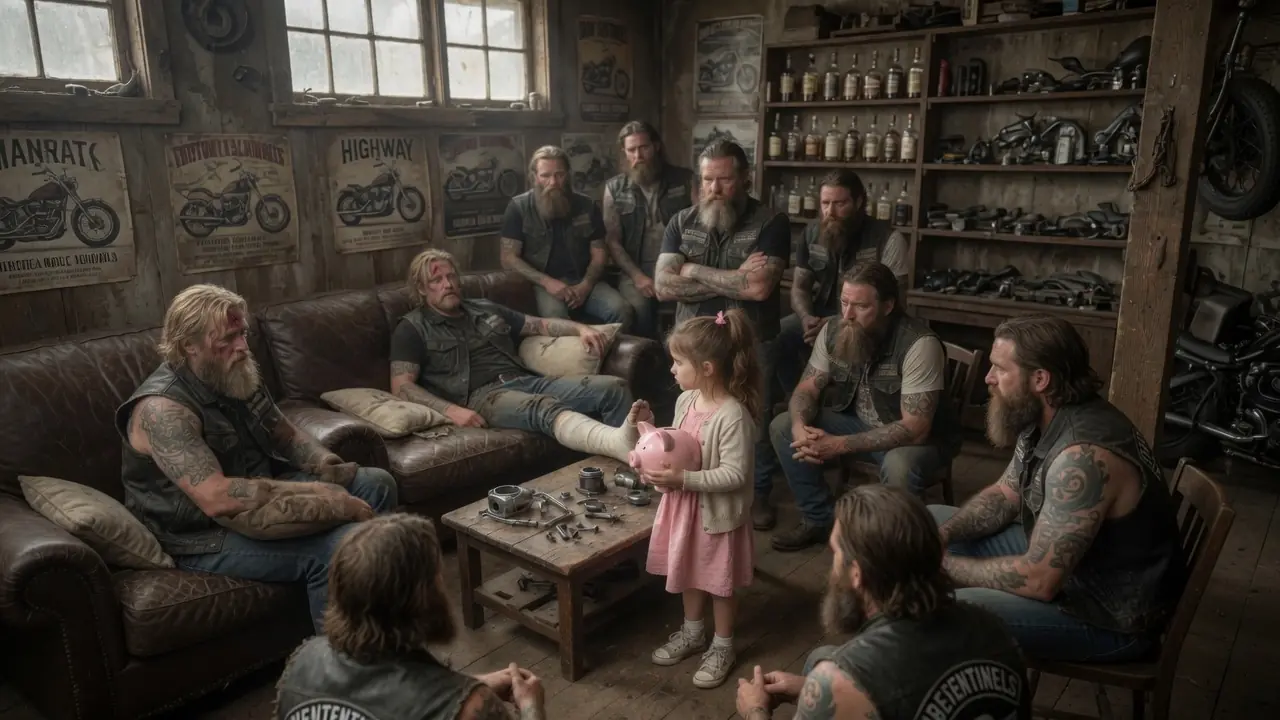
She walked right up to the low-slung coffee table in front of the couch, a slab of wood covered in beer rings and old magazines. With a determined grunt, she lifted the heavy ceramic pig over her head, and she turned it upside down. The effect was astonishing. A cascade of coins, pennies, nickels, dimes, and quarters, tumbled out, clattering and ringing against the wood.
They rolled and spun, a chaotic metallic flood. A few crumpled dollar bills fluttered down like tired leaves, followed by a shiny silver button and a smooth gray stone from the riverbank. The noise, so small yet so significant, echoed in the stunned silence of the room. Every battle-hardened biker stared, mesmerized by the tiny fortune spread across the table.
Pippa set the empty pig down carefully and looked Jax straight in the eye, her own wide and serious. “This is for your surgery,” she announced, her voice clear and unwavering. “So you can get better.” The world stopped.
For Jackson Ryder, everything fell away: the pain in his leg, the crushing weight of the bill, the smoky clubhouse, all of it. He saw only the girl’s earnest face and the small, heartfelt sacrifice scattered on the table. He saw the shiny button and the river stone, items clearly worth more than money, included in the payment. A memory, sharp and painful, lanced through him.
His little sister Sarah, twenty years gone. She had been eight. He had been sixteen, all teenage swagger and impotent rage. He remembered her coming to him after their father, a different kind of monster, one who lived inside the house, had left him with a split lip and a bruised ego.
She had offered him her entire collection of bottle caps, her most prized possession, to make it better. He had brushed her off, too consumed by his own anger to see the love in her offering. Two years later, she was gone, a victim of the same quiet in-house violence he had failed to stop. He had spent the rest of his life trying to atone for that failure.
Building a fortress of leather and steel around a core of unresolved guilt. And now here was another little girl with another treasure, offering it up with the same pure, heartbreaking innocence. He could not breathe. The tough, unshakable president of the Iron Sentinels, the man who had faced down guns without flinching, was completely and utterly undone by a six-year-old girl and her piggy bank.
A single hot tear escaped Jax’s eye, tracing a path through the grime on his cheek. He swiped at it angrily, but another followed. He dropped his head into his hands, his broad shoulders shaking with a silent, racking sob. The sound in the quiet room was more shocking than a gunshot.
The Iron Sentinels looked on, frozen, witnessing something they never thought possible. Their leader, their rock, was weeping. Grizz, seeing Jax’s breakdown, finally snapped into action. He put a hand on Pippa’s shoulder.
“You wait here a second, sweetie,” he murmured, his voice thick. He strode to the clubhouse door, pulling out his phone. He found Naomi’s number, given to him by the diner owner for their takeout orders. The call was brief.
“Your daughter, Pippa,” he said, skipping any pleasantries. “She’s at the Iron Sentinels’ clubhouse. She’s safe, but you need to get here now.” On the other end of the line, Naomi’s heart stopped.
The clubhouse. The place she had warned Pippa about a thousand times. A wave of pure, unadulterated terror washed over her. She ripped off her apron, shouting a garbled apology to her boss, and sprinted out of the diner, her mind a maelstrom of horrific possibilities.
She ran the six blocks to the edge of town, her lungs burning, tears of fear streaming down her face. When she finally arrived, breathless and frantic at the iron gates, Grizz was waiting for her. He saw the panic in her eyes and immediately held up his hands. “Whoa, easy there,” he said gently. “She’s okay. I promise. She’s more than okay. She did something. You just got to see it.”
His tone, devoid of any threat, calmed her slightly. He led her through the gate and into the lion’s den. The scene that greeted her was surreal. A dozen of the town’s most feared men were standing around like statues, their gazes fixed on the couch.
And there in the center of it all was her daughter, Pippa, patting the arm of the huge, leather-clad man who was crying into his hands. Naomi rushed forward. “Pippa.” Pippa looked up, her face bright.
“Mommy, I’m helping the brave man. I gave him my money.” Naomi’s eyes fell to the coffee table, to the scattered coins and the empty pink pig. And in that moment, she understood. The terror receded, replaced by a wave of emotion so powerful it made her knees weak.
Her daughter, her tiny, brave daughter, had walked into the heart of what she feared most and offered them everything she had. Jax finally lifted his head, his eyes red-rimmed but clear. He looked at Naomi, then at Pippa, then at the pathetic, beautiful treasure on his table. He scooped up the smooth gray river stone, its coolness a balm against his skin.
“Thank you,” he whispered to Pippa, his voice rough. “No one’s ever... Thank you.” He then looked at Naomi, a world of apology and gratitude in his gaze. “Your daughter, she has more courage than all of us put together.”
Grizz gently guided the stunned Naomi to a chair. He explained the whole story. Pippa’s quest, her declaration, the impact it had on every man in the room. He explained how her simple act of kindness had shattered Jax’s hardened shell, reaching a part of him that had been locked away for twenty years.
As she listened, Naomi’s fear dissolved completely, replaced by an overwhelming sense of pride and awe. Her daughter had not seen monsters. She had seen a person in need, and she had acted. The bikers began to move, to speak in hushed tones.
One of them, a lanky man with a scarred face, started carefully gathering the coins, placing them in a respectful pile. Another biker put a fresh bottle of water in front of Jax. The entire atmosphere of the place had changed. The hard edges had softened.
The air, once thick with tension, now hummed with a strange, fragile reverence. Grizz insisted on driving Naomi and Pippa home. The rumbling journey in his sidecar was a world away from Naomi’s frantic run. As they pulled up to their small house, the story was already beginning its journey.
One of the younger bikers, tasked with a food run, had stopped at the Greasy Spoon. He had told the story to the cook, his voice full of a strange wonder. “This little kid, man, she just walked in and emptied her piggy bank for the pres. Cried like a baby, he did.” The cook told the waitress.
The waitress, wiping down the counter, told Martha, the town gossip, who was back for her afternoon coffee. Martha, for once, was speechless. She left her coffee half-finished, her mind racing. This was a story unlike any she had ever had.
It was not just gossip. It was something more. It was a legend in the making. By the time the sun began to set, the story had woven its way through the fabric of Havenwood.
It was shared over garden fences, whispered across grocery store aisles, and discussed in hushed tones at the post office. The postman told the librarian. The librarian told the high school history teacher. Each telling stripped away another layer of the town’s prejudice.
The image of the fearsome biker boss brought to his knees, not by a rival, but by a child’s kindness, was a powerful one. It was disarming. It humanized the men they had all feared. They were not a faceless monolith of leather and noise anymore.
One of them was a hero who had saved their children, and he was so humbled by a little girl’s generosity that he had wept. At the clubhouse, the mood was transformed. The bikers, men who communicated in grunts and nods, were talking. Really talking.
They talked about Jax’s reaction, about the little girl, about the feeling in the room when the coins had spilled onto the table. They carefully counted Pippa’s treasure. The grand total was $38.42, plus a button and a stone. A younger member, a prospect named Sketch, shook his head.
“Thirty-eight bucks against a fifty-thousand-dollar bill. It’s nothing.” Grizz, who had returned from dropping off Naomi and Pippa, rounded on him. “It’s not nothing,” he growled, his voice low and fierce. “It’s everything. Don’t you get it? That kid gave us all she had. All of it. Without a second thought. When was the last time any of us did that?”
The room fell silent again. Grizz was right. They lived by a code of brotherhood, of giving their all for each other. But this was different.
This was a gift from an outsider, a child with no expectation of anything in return. It was a pure, undiluted act of grace. Jax, still on the couch, finally spoke, his voice quiet but firm. He held up the gray river stone Pippa had given him.
“This stone is worth more than that fifty grand. This is a reminder of what we’re supposed to be about. Not just protecting our own, but protecting the innocence this world is so quick to crush.” He looked around the room, his gaze locking with each of his men.
“We’re not selling my bike. We’re not touching the club’s fund. But we’re going to pay that bill, and we’re going to accept that little girl’s donation as the first payment.” He placed the stone on the pile of coins. “And we’re going to find a way to pay her back. All of her.”
The ripple effect had begun. A small stone of kindness had been dropped into the stagnant pond of Havenwood’s fear, and the circles were spreading wider and wider, touching everything. The next morning, the change was palpable. It started at the Greasy Spoon.
The owner, a gruff man named Sal, had heard the story from Naomi herself when she had come back to finish her shift, her eyes still shining. He grunted, polished a glass, and said nothing. But this morning, a large pickle jar sat on the counter next to the register. A handwritten sign was taped to it: For the Hero Biker. Let’s Help Him Out.
Sal seeded it with a fifty-dollar bill from his own wallet. By noon, it was half full. Down the street at the town garage, the owner, a man who had once called the cops on the bikers for revving their engines too loudly, flagged down one of the Iron Sentinels on a parts run. “Hey,” he yelled. “You tell your boss for the next six months, any work your club needs, parts are at cost and labor’s free. Tell him it’s from the town.”
The news reached the town council, the same council that had been trying to find a zoning violation to evict the clubhouse for two years. The debate was heated, but the tide had turned. Councilwoman Miller, whose own granddaughter had been on that bus, made an impassioned speech. They voted not to censure the club, but to issue a formal commendation for Jackson Ryder’s heroism.
But the most profound change was happening on a personal level. People, ordinary citizens of Havenwood, started showing up at the clubhouse gates, not with anger, but with offerings. Mrs. Gable, Naomi’s neighbor, arrived with a freshly baked apple pie. The Hendersons, the family from the minivan, brought a card signed by everyone in their neighborhood and an envelope thick with cash they had collected.
Carol, the bus driver, came with a delegation of tearful, grateful parents. They brought casseroles, lasagna, and more envelopes. The bikers, awkward and overwhelmed, accepted the gifts, mumbling their thanks. Grizz stood at the gate, directing the strange, heartwarming traffic.
He felt like a guard at a holy site. Inside, Jax watched the procession, his heart a tangled mess of disbelief, humility, and a pain that had nothing to do with his broken leg. This was the community he had held himself apart from, the people he had dismissed as weak and judgmental, and they were coming to his aid, inspired by the faith of a single child.
By late afternoon, the coffee table was overflowing. The pile of coins and Pippa’s stone were now buried under a mountain of get-well cards and cash-stuffed envelopes. The bikers had counted over ten thousand dollars. Jax knew he had to address them.
Using Grizz and another biker’s crutches, he hobbled out to the front of the clubhouse, where a small crowd had gathered, a mix of curious onlookers and well-wishers. He stood before them, not as an intimidating outlaw, but as a humble, broken man. “I... I don’t know what to say,” he began, his voice cracking. He had given speeches to his club a hundred times, speeches full of fire and fury.
This was harder. “For years, we’ve kept to ourselves. We figured you didn’t want us here, and maybe we didn’t want you either. We were wrong.” He paused, his eyes finding the Hendersons in the crowd.
“I just did what anyone would do. But what you all are doing now, what a little girl named Pippa started, that’s real courage. That’s real community.” He looked around at the faces, seeing not suspicion, but warmth. “I can’t accept this for myself,” he said, gesturing to the money.
“But I will accept it on behalf of this town. We’ll use it to pay the bill. Whatever is left over, we’re starting a fund, the Pippa Fund, for any family in Havenwood that finds themselves in trouble, for anyone who needs a little help.” A stunned silence fell over the crowd, followed by a surge of applause.
It was a roar, not of engines, but of a community being reborn. Jax, the outlaw biker, had not just been saved by the village. He had just pledged his allegiance to it. The tears that came to his eyes this time were not of grief, but of profound, overwhelming grace.
The weeks that followed were a blur of healing, both for Jax’s leg and for the town’s soul. The Pippa Fund became a phenomenon. Donations poured in, not just from Havenwood, but from neighboring towns. As word of the story spread, the final tally was enough to pay Jax’s medical bills three times over.
The remainder, as promised, became the seed of a new town charity administered by a board consisting of the town mayor, Councilwoman Miller, Naomi, and to everyone’s surprise, Grizz, representing the Iron Sentinels. The club itself underwent a quiet transformation. The bikers were still loud. Their leather was still worn, but their presence was no longer a source of fear.
They became a part of the town’s landscape. They were seen fixing the roof on the community hall, volunteering to direct traffic at the fall festival, and running a toy drive at Christmas that was so successful it needed a separate storage unit. Their reputation shifted from outlaws to guardians. A pack of gruff, snarling sheepdogs watching over their flock.
For Naomi and Pippa, life changed most of all. They were no longer anonymous. They were the mother and daughter who had started it all. But more than that, they had gained a family. A very large, very loud, very protective family.
Jax, once he was mobile on crutches, made it his personal mission to repay Pippa’s kindness. He showed up at their house one Saturday with the entire club in tow. They descended on the small rental like a whirlwind of productive chaos. They patched the leaky roof.
They replaced the balding tires on Naomi’s old sedan and changed the oil. They fixed a squeaky floorboard in the hallway that had been driving Naomi crazy for a year. They mowed the lawn and planted new flowers in the front garden. Naomi tried to protest, to offer them food or money, but Jax just shook his head.
“This isn’t charity,” he told her, his voice soft. “This is what family does. We take care of our own, and you two, you’re our own now.” The shadow of Richard Vance and his controlling, conditional love began to fade, replaced by the unconditional support of two dozen unlikely uncles who would have torn down the world for her and her daughter.
The culmination of this new beginning came a month later. The Iron Sentinels hosted a barbecue at their clubhouse, throwing the gates wide open to the entire town. The place had been cleaned from top to bottom. Strings of lights were hung between the trees, and long tables laden with food replaced the usual rows of motorcycles.
The sound of laughter and children’s shouts mingled with classic rock playing from speakers. It was a scene no one in Havenwood could have imagined just a few months prior. Bikers and townsfolk, old ladies and youths, all sharing food and stories. Near the end of the evening, Jax, now walking with just a slight limp, called for everyone’s attention.
He knelt down in front of Pippa, who was happily eating a hot dog. He presented her with a gift. It was a new piggy bank. This one was a sleek black ceramic motorcycle, and painted on its side in gleaming silver was the Iron Sentinels’ snarling wolf emblem.
It was heavy. Jax had started it with a hundred-dollar bill folded into a tiny square. “Every hero needs a treasury,” Jax said, his eyes twinkling. “This one’s for your next big adventure.”
Pippa hugged the motorcycle bank, her eyes shining brighter than any coin. Naomi watched, tears welling in her eyes, tears of pure, unadulterated joy. She caught Jax’s eye over her daughter’s head and mouthed a silent thank you. He simply nodded, a small, genuine smile on his face.
The man who thought he had nothing left to lose had gained everything. The village, once divided by fear, was now united in a bond forged by the courage of a child and the humility of a hero. As the sun set, casting a golden glow over the unlikely gathering, the scene left the entire village and everyone who heard their story in tears of hope, a powerful testament to the fact that sometimes the biggest changes start with the smallest act of kindness.
The world is full of heroes in disguise and people in need. Sometimes, all it takes is one person, no matter how small, to see past the leather and the fear to the heart underneath.