“Families like yours do not usually fit here.”
The words were spoken softly, almost politely, but every person in the admissions hall heard them.
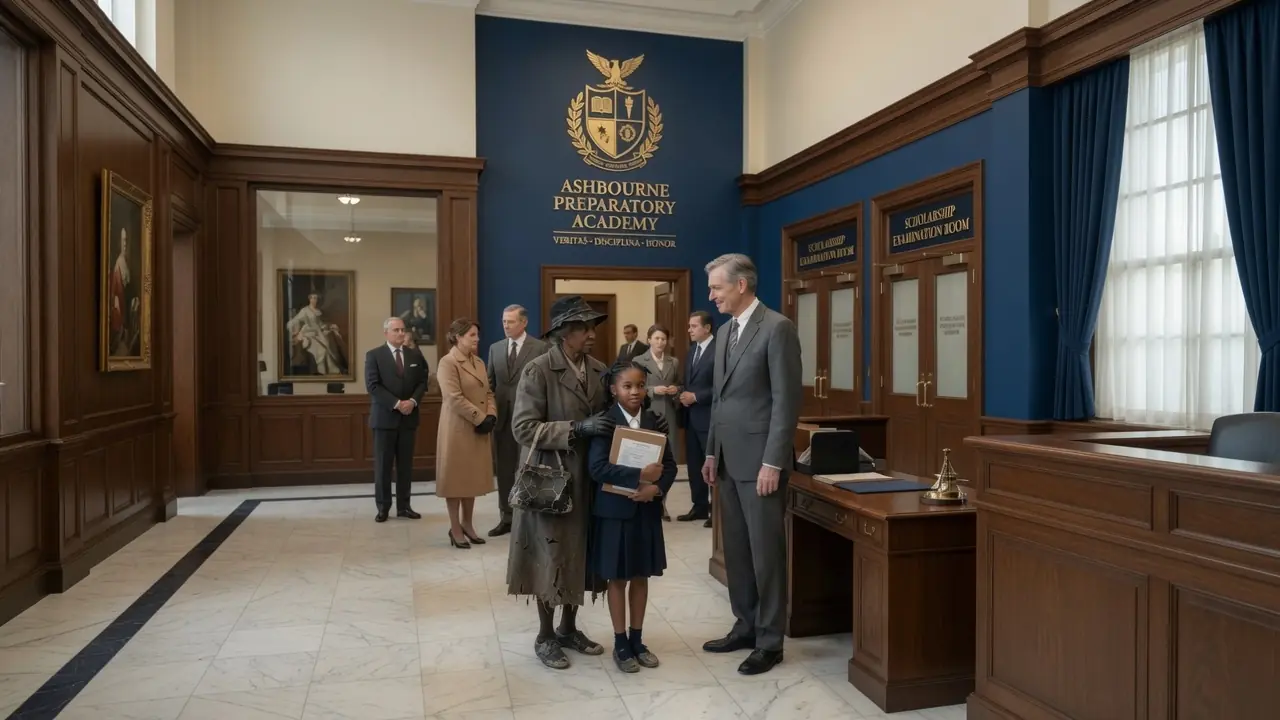
Dr. Arthur Whitmore stood beside the polished oak desk with one hand tucked into the pocket of his gray suit. Behind him, the crest of Ashbourne Preparatory Academy gleamed in gold against the navy wall. Latin words curled beneath it in carved letters.
Veritas. Disciplina. Honos.
Truth. Discipline. Honor.
Evelyn Carter looked at the crest for a moment.
Then she looked back at the man who had just insulted her.
She was seventy years old, Black, and dressed in a navy church coat she had owned for nearly fifteen years. The cuffs were slightly worn. Her shoes were polished but old. Her silver hair was pinned neatly beneath a simple black hat, and her right hand rested gently on the shoulder of the twelve-year-old girl standing beside her.
The girl’s name was Amara Carter.
She wore a white blouse, a pleated skirt, and a navy blazer borrowed from a neighbor whose daughter had outgrown it two years earlier. The blazer fit poorly at the shoulders, but Amara had pressed it herself that morning until every crease looked intentional.
She carried a folder against her chest with both hands.
Inside it were her report cards, recommendation letters, math competition certificates, and one sheet of notebook paper she had almost left at home.
Evelyn felt Amara’s shoulder stiffen beneath her hand.
“Dr. Whitmore,” Evelyn said calmly, “my granddaughter has an interview for the Whitlock Scholarship at nine o’clock.”
Dr. Whitmore smiled.
Not kindly.
Professionally.
“That may be so, Mrs…”
“Carter.”
“Mrs. Carter. But I am only trying to spare the child unnecessary embarrassment. Ashbourne is a demanding environment. The scholarship process is extremely competitive.”
Amara looked up.
“I know, sir.”
Dr. Whitmore’s eyes lowered to her.
“Do you?”
He let the question sit in the air.
A few parents near the reception desk pretended not to listen. A white woman in a camel coat looked at Evelyn’s shoes, then at Amara’s borrowed blazer, then turned slightly away as if poverty were contagious.
Evelyn’s grip on Amara’s shoulder remained steady.
“My granddaughter has prepared,” she said.
“I’m sure she has,” Dr. Whitmore replied. “But preparation is not the same as belonging.”
Amara’s face tightened.
Evelyn felt it.
That small closing of the spirit before a child learns how to hide hurt.
She had seen it too many times in too many classrooms.
Before she could answer, a younger admissions assistant hurried over with a clipboard.
“Dr. Whitmore, the scholarship candidates are being seated in the examination room.”
“Excellent,” he said. “Send the other four in.”
The assistant looked at Amara.
“And Miss Carter?”
Dr. Whitmore paused.
Then said, “Yes. Let her take the assessment. We follow procedure.”
He turned back to Evelyn.
“Parents and guardians wait outside.”
Evelyn nodded.
“Of course.”
Amara looked up at her grandmother.
Evelyn bent slowly, her knees not as forgiving as they once were, and straightened the collar of the borrowed blazer.
“Look at me, baby.”
Amara looked.
“You earned the room before you entered it.”
Amara swallowed.
“Yes, Grandma.”
“No matter what anyone says in there.”
“Yes, Grandma.”
Evelyn kissed the top of her head.
Then Amara walked through the tall double doors.
Dr. Whitmore watched her go.
When the doors closed, he turned to Evelyn.
“The waiting area for scholarship guardians is down the hall,” he said. “Not this lobby.”
Evelyn glanced around.
The lobby had leather chairs, fresh flowers, and silver coffee service.
Down the hall, through an open doorway, she could see a narrow bench beside a vending machine.
She understood.
The paying families waited in comfort.
The scholarship families waited out of sight.
She gave him a small nod.
“Thank you for telling me where you prefer to hide us.”
Dr. Whitmore’s smile disappeared.
Evelyn walked down the hall without waiting for his answer.
Ashbourne Preparatory Academy was the kind of school that used words like legacy and excellence until they sounded like property deeds.
It sat on fourteen acres outside Philadelphia, surrounded by iron gates and old trees. Families paid more than most people earned to send their children through its stone archways.
Its graduates became senators, judges, university presidents, CEOs, surgeons, and the kind of people whose portraits eventually returned to school hallways framed in brass.
The Whitlock Scholarship was Ashbourne’s most prestigious academic award.
Private mentorship.
Summer research placement.
A guaranteed interview with two Ivy League partner programs.
In fifty-eight years, only eleven children from public schools had ever won it.
Only one had been Black.
And that had been thirty-nine years ago.
Her name had vanished from the official history.
Evelyn Carter sat on the narrow bench beside the vending machine and folded her gloved hands in her lap.
The hallway smelled faintly of lemon polish and old money.
She looked across at the framed photographs lining the wall.
Founders.
Trustees.
Headmasters.
Prize-winning students.
Debate champions.
Math team captains.
No one looked like Amara.
No one looked like her.
Not anymore.
Evelyn closed her eyes.
For one moment, the hallway changed.
The lemon polish became chalk dust.
The vending machine became a wooden desk.
The murmur of admissions staff became the sound of frightened teachers whispering after the worst year in Ashbourne history.
Forty years earlier, Evelyn Carter had stood in this same building under a different name.
Dr. Evelyn Mae Carter.
Mathematics teacher.
Curriculum consultant.
Acting headmistress for eight months during the crisis no one wanted to remember.
She had not been supposed to lead Ashbourne.
She had not even been supposed to teach there.
In 1984, Ashbourne Preparatory nearly lost its accreditation after three consecutive years of declining scores, faculty resignations, and a cheating scandal involving two board members’ sons.
The school needed someone brilliant enough to rebuild its academic program and invisible enough not to frighten its donors.
Evelyn had been thirty years old then, a Black woman with a doctorate in mathematics education from Howard, a fellowship offer she had declined to care for her dying mother, and a reputation for turning failing classrooms into places where children learned to think instead of memorize.
They hired her quietly.
Consultant.
Not department chair.
Never headmistress in name, though for eight months she did the job.
She rewrote the mathematics curriculum.
She rebuilt the scholarship examination.
She trained teachers who resented needing her.
She created the problem-solving sequence that made Ashbourne famous.
And then, when the school’s scores rose, when inspectors praised the turnaround, when donors returned, the board thanked her with a private check, a letter without letterhead, and a suggestion that “the institution required a familiar public face.”
A white man named Jonathan Reeves became headmaster.
He gave a speech about restoring Ashbourne’s tradition.
He used Evelyn’s curriculum.
He published her examination framework under his own committee’s name.
He received the credit.
Evelyn left.
Not because she was weak.
Because her husband had died that winter, her daughter was six, and she did not have enough money or institutional protection to fight a school whose board included judges and newspaper owners.
She kept one thing.
A leather folder containing her original handwritten curriculum notes, board memos, dated examination drafts, and the first version of a problem she had designed to test not calculation, but courage.
The Carter Sequence.
Though Ashbourne never called it that.
It became famous under another name.
The Whitmore Challenge.
Arthur Whitmore, the man who had just told her granddaughter she did not belong, built his career on a mathematics program born from Evelyn Carter’s hand.
Evelyn opened her eyes.
A woman in a camel coat passed the hallway and noticed her sitting there.
The woman slowed.
“You’re waiting for someone?”
“My granddaughter.”
“Oh.” The woman glanced toward the double doors. “For the scholarship?”
“Yes.”
The woman gave a sympathetic smile.
“How sweet.”
Evelyn looked at her.
Sweet.
That was the word people used when they wanted to make ambition harmless.
Before Evelyn could respond, the woman added, “It’s wonderful the school gives children like that opportunities.”
Evelyn’s expression did not change.
“Children like what?”
The woman blinked.
“Oh, I didn’t mean—”
“No,” Evelyn said gently. “People rarely do.”
The woman hurried away.
Inside the examination room, Amara sat at the fifth desk.
Four other scholarship candidates sat in a semicircle: two boys in tailored blazers, a girl with a gold bracelet and a monogrammed pencil case, and another girl whose father had arrived in a black car with a driver.
Amara placed her folder under her chair.
Dr. Whitmore stood at the front beside a whiteboard.
“Today’s assessment will be slightly different from previous years,” he said. “We are not interested in memorization. We are interested in reasoning, composure, and intellectual maturity.”
His eyes moved across the students.
They paused on Amara.
“Some of you may find the material beyond your current experience. That is not a failure. It is simply information.”
One of the boys smirked.
Amara looked down at her pencil.
The test packets were distributed.
Amara opened hers.
The first page was ordinary.
Logic.
Patterns.
Algebra.
She completed the first six problems quickly.
The seventh made her pause.
Not because it was too hard.
Because it was familiar.
It described a row of lamps in a corridor, each lamp controlled by certain switches according to a pattern. The student had to determine which lamps would remain lit after a sequence of operations. It looked like a puzzle about parity, but the structure underneath was about proof by invariance.
Amara had seen this kind of problem before.
Not in school.
At her grandmother’s kitchen table.
Evelyn had taught her with pennies, bottle caps, and sugar packets.
“Do not chase every movement,” Grandma had said. “Find what refuses to change.”
Amara smiled a little.
Then she solved it.
At the front of the room, Dr. Whitmore noticed the smile.
His jaw tightened.
Problem eight was harder.
Problem nine was elegant.
Problem ten was strange.
It was not multiple choice. It was written in a different style from the others, longer, almost old-fashioned in its phrasing.
A square garden is divided into smaller paths according to a rule no gardener remembers. Each year, one path is moved, but the number of crossings changes predictably. Prove that no matter how the paths are moved, one hidden crossing remains fixed.
Amara read it twice.
Then a third time.
Her pencil did not move.
Dr. Whitmore walked slowly behind her desk.
“Difficulty?” he asked softly.
The other students heard.
Amara did not turn.
“No, sir.”
“Then why are you not writing?”
“I’m listening to the problem.”
He gave a quiet laugh.
“Problems do not speak, Miss Carter.”
Amara looked up.
“The good ones do.”
The room went still.
Dr. Whitmore’s eyes cooled.
“Careful. Cleverness is not the same as intelligence.”
Amara’s cheeks warmed, but she lowered her eyes to the page.
Listening.
That was what Evelyn had taught her.
A hard problem was not a locked door. It was a room with the light off. You did not break it down. You let your eyes adjust.
The phrase hidden crossing bothered her.
Not because it was unclear.
Because it felt too deliberate.
She drew a square.
Then another.
Then a path.
Then crossings.
She tested small cases, the way her grandmother had taught her.
One.
Two.
Three.
Then she saw it.
The crossing did not remain fixed because of geometry.
It remained fixed because the path changes preserved parity under transformation.
She wrote slowly, carefully, explaining every step.
When she finished, only three minutes remained.
She turned the page.
There was one final question.
Optional.
For distinction.
It had no diagram.
Only a sentence.
Explain why a school that values tradition must still question who is allowed to define it.
Amara stared at it.
This was not mathematics.
Not exactly.
She thought of her grandmother sitting on the bench outside.
She thought of Dr. Whitmore saying families like yours.
She thought of the school crest.
Truth.
Discipline.
Honor.
Then she began to write.
Outside, Evelyn was still waiting when the doors opened.
The first four children came out with their parents gathering around them.
“How was it?”
“Too easy?”
“Did they ask the Reeves sequence?”
“Did Whitmore mention early placement?”
Amara came out last.
She walked toward Evelyn, holding her folder tightly.
Evelyn stood.
“How did it feel?”
Amara thought about it.
“Like somebody hid a song inside a locked drawer.”
Evelyn’s eyes softened.
“And?”
“I heard it.”
Before Evelyn could answer, Dr. Whitmore appeared in the doorway.
“Mrs. Carter. Miss Carter. Please remain.”
The hallway quieted.
A few parents glanced over.
Evelyn took Amara’s hand.
“Is there a problem?”
Dr. Whitmore smiled.
“There may be.”
They followed him into a smaller conference room where three adults were seated: Mrs. Eleanor Whitlock from the scholarship board, Mr. Graves the admissions director, and Dr. Lena Morris, a visiting mathematics professor from Bryn Mawr invited to observe the assessment.
Dr. Morris was Black, in her fifties, with silver at her temples and eyes that missed nothing.
Amara sat beside Evelyn.
Dr. Whitmore remained standing.
“Miss Carter’s work is unusual,” he said.
Evelyn did not speak.
Mrs. Whitlock looked uncomfortable.
“In what way?”
Dr. Whitmore placed Amara’s paper on the table.
“She solved the final mathematical problem using an advanced invariance argument. It is not part of standard middle school training.”
Dr. Morris leaned forward.
“That is correct. It was also beautifully done.”
Whitmore’s mouth tightened.
“My concern is not quality. My concern is origin.”
Evelyn’s hand stilled in her lap.
Amara looked confused.
“Origin?”
Dr. Whitmore looked at her.
“Did someone prepare you for this exact problem?”
“No, sir.”
“Did someone show you a version of it?”
Amara hesitated.
“My grandmother teaches me with puzzles.”
“With this puzzle?”
“No.”
“But similar?”
“She teaches me how to think.”
Dr. Whitmore turned toward the board members.
“You see the issue.”
Dr. Morris’s eyes narrowed.
“No. I do not.”
Whitmore smiled thinly.
“Then allow me to be plain. The final problem is derived from the Whitmore Challenge, a protected Ashbourne reasoning sequence. It would be highly unusual for a public school applicant to independently produce such a refined solution unless exposed to the framework.”
Evelyn looked at him then.
For the first time, really looked.
“Protected,” she said softly.
Whitmore glanced at her.
“Yes.”
“And you believe my granddaughter had improper access?”
“I believe we must ask the question.”
Amara’s face burned.
“I didn’t cheat.”
Whitmore did not look at her.
“No one used that word.”
“You meant it.”
The room fell silent.
Evelyn placed one hand over Amara’s.
“Baby.”
“No,” Amara whispered. “He meant it.”
Dr. Morris sat back.
“She is right.”
Mrs. Whitlock cleared her throat.
“Dr. Whitmore, perhaps we should review the paper without making assumptions.”
Whitmore lifted the final page.
“There is also the matter of the essay response.”
He read aloud.
“A school that values tradition must ask who was not allowed to become tradition. If the same people write every rule, then tradition is not memory. It is a locked gate.”
Nobody spoke.
Whitmore placed the page down.
“This is not the tone we expect from a scholarship candidate.”
Evelyn’s voice entered the room quietly.
“What tone do you expect from a child accused without evidence?”
Whitmore looked at her.
“With respect, Mrs. Carter, this is an academic matter.”
“Yes,” Evelyn said. “It is.”
Something in her tone made Dr. Morris look at her more closely.
Evelyn opened her handbag and removed a leather folder.
Old.
Brown.
Cracked slightly at the spine.
Whitmore barely glanced at it.
“If you have additional certificates, Mrs. Carter, they should have been submitted with the application.”
“These are not certificates.”
She placed the folder on the table.
“These are originals.”
Mr. Graves looked impatient.
“Originals of what?”
Evelyn untied the folder.
The first sheet she removed was yellowed with age.
At the top, in neat handwriting, it read:
Ashbourne Preparatory Academy
Mathematical Reasoning Reform
Draft Sequence, 1984
Prepared by Dr. Evelyn Mae Carter
Dr. Morris leaned forward sharply.
Whitmore went still.
Evelyn placed another sheet beside it.
Then another.
And another.
Handwritten diagrams.
Board meeting notes.
Typed memos.
A letter dated March 12, 1985, thanking Dr. Evelyn Mae Carter for “consulting services rendered during the academy’s transitional period.”
Not leadership.
Not authorship.
Consulting services.
Evelyn reached deeper into the folder and removed one final page.
It was the original version of the problem Amara had solved.
The square garden.
The hidden crossing.
But the title at the top was not Whitmore Challenge.
It read:
Carter Sequence, Problem 9: Invariance And Moral Structure
Dr. Morris whispered, “My God.”
Evelyn looked at Arthur Whitmore.
“You asked whether my granddaughter had seen your protected sequence.”
Her voice remained calm.
“I wrote it before you were old enough to teach it.”
The conference room changed.
It was not loud.
No one gasped dramatically.
But power shifted in the quietest possible way.
Whitmore stared at the paper.
“That is not possible.”
Evelyn gave a small smile.
“People have said that to me in this building before.”
Mrs. Whitlock lifted one of the documents with trembling fingers.
“Dr. Carter… are you saying you worked here?”
“I am saying I saved this school when it was failing, wrote the mathematics framework it later made famous, and was erased when the board decided a Black woman could repair Ashbourne but not represent it.”
Mr. Graves looked pale.
Dr. Morris picked up the original problem.
“I studied the Whitmore Challenge in graduate school,” she said slowly. “It was cited as one of the most important secondary reasoning frameworks of the late twentieth century.”
Evelyn nodded.
“I know.”
“You wrote it?”
“Yes.”
Whitmore recovered enough to speak.
“These documents would need authentication.”
Evelyn turned to him.
“Of course. I expected nothing less.”
Then she removed a smaller envelope from the folder.
Inside was a photograph.
Black and white.
A younger Evelyn stood in front of a chalkboard in this very building. Behind her, written in chalk, was the same garden problem. Around her sat faculty members, including a much younger Jonathan Reeves, the man Ashbourne credited with the curriculum revival.
On the back of the photograph, in blue ink:
Dr. Carter training faculty, November 1984.
Evelyn placed it on the table.
Then she removed one more item.
A cassette tape.
Whitmore frowned.
“What is that?”
“A recording of the board meeting where they thanked me privately for writing the program they later attributed to Mr. Reeves.”
Mrs. Whitlock covered her mouth.
“You kept it all?”
Evelyn looked at her.
“When people tell you they may forget you, you learn to keep receipts.”
Amara stared at her grandmother.
“Grandma?”
Evelyn turned to her.
The strength in her face softened.
“I was going to tell you when you were older.”
“You worked here?”
“For a little while.”
“You wrote that problem?”
“Yes.”
Amara looked at the paper.
Then at Dr. Whitmore.
“He called it his.”
Evelyn did not look away from her granddaughter.
“People often rename what they cannot create.”
For the first time, Whitmore looked afraid.
Not of Evelyn.
Of the documents.
Of the tape.
Of the visiting professor sitting across from him.
Of the possibility that the story Ashbourne had told about itself for forty years had a Black woman’s name buried beneath it.
Dr. Morris stood.
“I think we need the head of school.”
“We need discretion,” Mr. Graves said quickly.
Dr. Morris turned on him.
“No. You have had forty years of discretion.”
The sentence landed hard.
One hour later, the head of school, the board chair, two trustees, and the academy’s legal counsel sat in the main conference room.
Evelyn was offered coffee.
She declined.
Amara sat beside her, still holding the folder with both hands.
Dr. Whitmore sat across the table, silent now.
Very silent.
The tape had been digitized quickly by the media department.
The room listened.
Static first.
Then voices.
A man speaking.
“We all understand Dr. Carter’s contribution has been invaluable.”
Another voice.
“But a public appointment may not be well received by certain families.”
A third.
“We can recognize her privately. The important thing is preserving the institution.”
Then Evelyn’s younger voice on the tape.
Clear.
Controlled.
“You are asking me to disappear so Ashbourne may survive.”
A pause.
Then the board chair from 1985.
“Not disappear, Dr. Carter. Step back.”
The recording clicked.
The modern conference room was silent.
Nobody looked at Evelyn.
That told her enough.
The head of school, Margaret Ellison, closed her eyes briefly.
When she opened them, they were wet.
“Dr. Carter,” she said, “I am ashamed.”
Evelyn’s face did not change.
“Ashbourne has been ashamed before. It survived.”
Mrs. Ellison flinched.
“You are right.”
The board chair, a man named Robert Haines, cleared his throat.
“We will conduct a full historical review and issue a formal—”
“No,” Evelyn said.
The single word stopped him.
She folded her hands.
“You will not bury this in a review that takes eighteen months and produces a plaque no child reads.”
Haines sat back.
“What are you asking for?”
Evelyn looked at Amara.
Then back at the board.
“My granddaughter’s application will be judged on merit, not suspicion.”
“Of course.”
“You will restore my name to the mathematics program publicly.”
“Yes.”
“You will rename the Whitmore Challenge.”
Dr. Whitmore closed his eyes.
Evelyn continued.
“You will create a full scholarship for Black girls entering mathematics, funded for a minimum of twenty years.”
The legal counsel shifted.
“That may require—”
Evelyn looked at him.
“Do not finish that sentence unless you want the recording released before dinner.”
He stopped.
Dr. Morris almost smiled.
The board chair nodded slowly.
“We can discuss structure.”
“You can discuss structure after you agree to principle.”
He looked at the head of school.
Mrs. Ellison said, “Agreed.”
Evelyn leaned back.
“Good.”
Then Amara spoke.
Everyone turned.
Her voice was small but steady.
“I want one more thing.”
Evelyn looked at her.
“What is it, baby?”
Amara looked across the table at Dr. Whitmore.
“I want him to grade my paper out loud.”
Whitmore’s head lifted.
Amara’s hands trembled, but her voice did not.
“He said I didn’t belong. He said my work was suspicious. I want him to say whether it was correct.”
No one spoke.
Then Dr. Morris said, “That is a fair request.”
Whitmore looked at the board chair.
No rescue came.
The examination room was reopened.
Not publicly to the whole school, but to the scholarship panel, the four other candidates and their parents, the admissions staff, the head of school, and the trustees.
Enough witnesses.
Amara’s paper was projected onto the screen.
Problem by problem.
Dr. Whitmore stood at the front.
His face was pale.
His voice was controlled at first.
“Problem one. Correct.”
He cleared his throat.
“Problem two. Correct.”
The room remained silent.
“Problem three. Correct.”
By problem seven, his voice had thinned.
“Correct.”
Problem eight.
“Correct.”
Problem nine.
The garden.
The hidden crossing.
The Carter Sequence.
Whitmore stared at Amara’s solution on the screen for a long time.
Then he said, “The proof is correct.”
Dr. Morris spoke from the back.
“Complete?”
Whitmore swallowed.
“Yes. Complete.”
Evelyn watched her granddaughter’s face.
Not triumphant.
Not proud in the ordinary way.
Something steadier.
A child learning that truth could stand upright if someone gave it room.
Whitmore reached the final essay.
He hesitated.
Then read it aloud.
“A school that values tradition must ask who was not allowed to become tradition. If the same people write every rule, then tradition is not memory. It is a locked gate.”
His voice faltered.
He looked at Amara.
“This response is… insightful.”
Dr. Morris said, “And?”
Whitmore closed his eyes for one second.
“And correct.”
The room exhaled.
Mrs. Whitlock stood.
“As chair of the scholarship committee, I move to award the Whitlock Scholarship to Amara Carter.”
One trustee seconded.
Then another.
The vote was unanimous.
Amara did not move.
Evelyn squeezed her hand.
“Stand up, baby.”
Amara stood.
The applause began quietly.
Then grew.
Some parents clapped because they understood.
Some because they were ashamed.
Some because not clapping would reveal too much.
Evelyn did not clap.
She stood beside her granddaughter, one hand on the borrowed blazer, and let the sound wash past them both.
Forty years earlier, no one had applauded when she left Ashbourne through the side door with her papers in a box.
Now the room stood for her blood.
For her work.
For the name they had tried to remove and accidentally preserved in the mind of a child.
Dr. Whitmore resigned before the end of the week.
The official statement said he wished to pursue other academic opportunities.
No one believed it.
Three months later, Ashbourne Preparatory Academy held a public ceremony in the main auditorium.
This time, Evelyn did not sit on a bench beside a vending machine.
She sat in the front row.
Her name appeared on the program.
Dr. Evelyn Mae Carter
Mathematician, Educator, Architect of the Carter Reasoning Sequence
The school crest hung above the stage.
Truth.
Discipline.
Honor.
For the first time in many years, Evelyn could look at those words without feeling only anger.
The head of school stepped to the microphone.
“For forty years, Ashbourne benefited from work it failed to honor. Today, we begin the process of correcting that failure, not with private regret, but with public truth.”
A curtain was pulled from a new plaque beside the stage.
The Evelyn Mae Carter Center For Mathematical Reasoning
Underneath:
Founded in recognition of the educator whose brilliance preserved Ashbourne’s academic future and whose name should never have been erased.
Amara sat beside Evelyn, wearing a new blazer that fit perfectly.
Not borrowed.
Earned.
When Evelyn was asked to speak, she walked to the podium slowly. Her knees hurt. Her hands shook slightly on the rail. But her voice, when it came, was clear.
“I was once told that Ashbourne needed my work, but not my face.”
The auditorium went still.
“I was told that tradition mattered more than truth. I was told to step back so the institution could move forward.”
She looked out at the students.
“Never believe people who ask you to disappear for the sake of harmony. Harmony built on erasure is only silence wearing perfume.”
A few adults shifted uncomfortably.
Good, Evelyn thought.
Let them.
She continued.
“I am not here because a school finally gave me permission to matter. I mattered before Ashbourne named me. My work mattered before it carried the right title. My students mattered before the world knew what to do with them.”
Her eyes found Amara.
“This plaque is not an ending. It is a warning. Every institution has locked gates somewhere inside its history. If you are brave enough, you will find them. If you are honest enough, you will open them.”
The applause came slowly.
Then fully.
Evelyn stepped down.
Amara met her at the stairs and took her arm.
“You okay, Grandma?”
Evelyn smiled.
“I am seventy years old, baby. Okay is a moving target.”
Amara laughed softly.
For a moment, the sound felt like justice.
Years later, people at Ashbourne would tell the story in different ways.
Some would soften it.
Some would say the school had simply rediscovered an overlooked contributor.
Some would say the past was complicated.
But Amara always told it plainly.
“My grandmother wrote the problem. They stole her name. Then they accused me of cheating for knowing how to solve it.”
That version made people uncomfortable.
She liked that.
By sixteen, Amara was leading the math team.
By seventeen, she had published her first paper on educational equity and mathematical creativity.
By eighteen, she gave the student address at graduation beneath the same crest that once hung over her grandmother’s humiliation.
In the audience, Evelyn sat in the front row.
Seventy-six now.
Cane beside her chair.
Silver hair shining under the auditorium lights.
Amara looked down at her before beginning the speech.
Then she said, “Tradition is not what survives because powerful people protected it. Tradition is what remains true after the hidden names are restored.”
Evelyn closed her eyes.
Somewhere far behind her, forty years of silence loosened its grip.
After the ceremony, Amara found Evelyn standing in the mathematics wing before the framed original of the Carter Sequence.
The garden problem.
The hidden crossing.
The question that had waited four decades to come home.
Amara stood beside her.
“Do you ever wish you had fought them back then?”
Evelyn was quiet for a long time.
“Yes,” she said.
Amara looked at her.
Evelyn continued.
“And no.”
“How can both be true?”
“Because life is not a proof where every line follows cleanly from the last. I had your mother to feed. I had grief. I had rent. I had a world that was very skilled at punishing Black women who told the truth too loudly.”
She touched the frame gently.
“I kept the papers. That was the fight I could afford then.”
Amara leaned her head against her grandmother’s shoulder.
“It was enough.”
Evelyn looked down at her.
“No, baby. It became enough because you walked into the room.”
Outside the window, students crossed the lawn.
Some in expensive coats.
Some in scholarship blazers.
Some Black.
Some brown.
Some carrying calculators.
Some carrying instruments.
All of them passing beneath the name Evelyn Mae Carter carved into stone.
The old school had not become perfect.
Institutions rarely transform completely just because truth knocks once.
But something had changed.
A locked gate had opened.
And through it walked children who now knew that brilliance did not need permission from tradition.
It only needed room.
On the day Amara left for college, Evelyn handed her the old leather folder.
Amara stared at it.
“Grandma, no. This is yours.”
Evelyn shook her head.
“It was mine when no one believed me. Now it is yours because people still need proof.”
Amara touched the cracked spine.
“What if I lose it?”
“You won’t.”
“What if I do?”
“Then remember what I taught you.”
Amara smiled.
“Find what refuses to change.”
Evelyn nodded.
“That’s right.”
Amara opened the folder one last time before packing it carefully into her bag. The original problem lay on top.
A square garden.
Moving paths.
A hidden crossing.
A thing preserved no matter how much the surface changed.
She finally understood why her grandmother had written it that way.
It was never only about mathematics.
It was about people.
About names.
About truth.
About what remains fixed beneath every attempt to rearrange the world.
At the bottom of the page, in Evelyn’s young handwriting, was a note Amara had never noticed before.
A good problem does not ask who belongs. It reveals who was always there.
Amara read it twice.
Then she closed the folder.
Evelyn watched her from the doorway.
“You ready, baby?”
Amara looked at her grandmother, then at the folder, then at the road ahead.
“Yes,” she said. “I’m ready.”
And this time, when she walked through the gates of an institution built long before anyone expected girls like her to enter, she did not wonder whether she belonged.
She already knew.
Her grandmother had written the door.