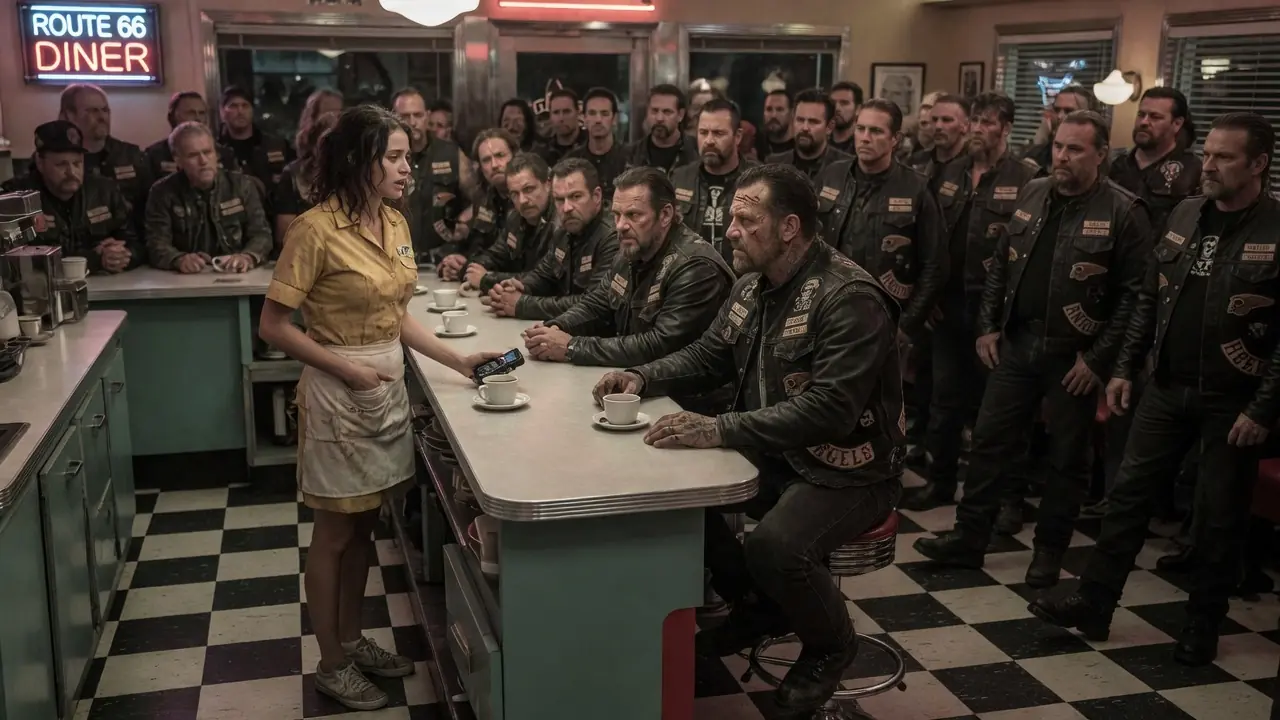
I know you didn't kill my brother because he died protecting one of you. Forty bikers sat in dead silence, and a 23-year-old waitress stood alone in the center of it all, hands steady, chin up, eyes locked on the most feared man in the room. Everyone in Black Ridge knew the rule. When the Hell's Angels roll in, you sit down, shut up, and pray they leave fast.
Savannah Cole didn't sit down. She walked straight toward them. The heat that afternoon was the kind that didn't just sit on your skin. It pushed down on your chest like a hand trying to hold you in place. Black Ridge, Arizona had that effect on people even on a normal day. But that Tuesday in August wasn't a normal day. It hadn't been a normal day in Black Ridge for a very long time.
Savannah Cole had been awake since 4 in the morning. She'd worked the breakfast rush, mopped the floor twice, refilled the sugar dispensers, and smiled at every single customer the way her mama had taught her, wide enough to mean it, but not so wide it looked desperate. She was good at that, smiling through things. She'd gotten a lot of practice over the past six months.
The Route 66 roadside diner wasn't much to look at. Cracked vinyl stools, a counter that tilted slightly to the left, a ceiling fan that clicked on every third rotation like it was reminding you it was still there. But it was hers in the way that a place can belong to you when you've spent more hours inside it than anywhere else on Earth. She knew every scratch on the counter. She knew which booth wobbled if you leaned too hard to the right. She knew that the coffee in the back pot was always 30 seconds stronger than the pot up front.
And she knew from the moment she heard the first rumble in the distance, low and thick and rolling like thunder that hadn't decided yet how serious it was going to get, exactly what was coming. Savannah, that was Pete the cook. He was 54 years old, built like a man who had once been strong and was now just dense. And in all the years she'd worked with him, she had never once seen him look genuinely afraid. He was looking at her now through the pickup window with an expression she didn't have a name for.
Savannah, you hear that? She heard it. The whole diner heard it. The sound grew from a rumble into a roar. And then it wasn't just sound anymore. It was vibration. It moved through the floor, through the soles of her sneakers, up through the bones in her legs. She felt it in her teeth. The coffee cups on the counter trembled. A little girl in booth 4 grabbed her mother's arm without saying a word.
The first Harley came through the window view like a dark comet, chrome catching the white Arizona sun, the deep-throated engine cutting off every other sound in the world for just a second. Then the second. Then the tenth. Then she stopped counting. Forty motorcycles, maybe more. Death's head patches. Hell's Angels. The man at the register, a truck driver named Denny who came in every Tuesday and always ordered the same thing, black coffee and two eggs over easy, pushed back his stool and stood up so fast he knocked his mug clean off the counter. It shattered on the tile floor. Nobody reacted. Nobody even looked at it.
Back door, Pete said from the kitchen. His voice was flat and very quiet. Savannah, get to the back door now. She didn't move. Savannah, I heard you, Pete. She was watching the parking lot, watching them roll in one by one. The noise of all those engines filling the air until conversation was physically impossible. Until the world outside the diner windows was nothing but leather and chrome and the smell of hot asphalt.
They moved with the kind of coordinated ease that told you this wasn't chaos. This was order. This was a machine that knew exactly what it was doing and had been doing it for a very long time. The engines cut out almost simultaneously and the silence that followed was worse than the noise. Inside the diner, nobody breathed. The little girl in booth 4 had buried her face in her mother's shoulder. Denny, the truck driver, had pressed himself back against the far wall like he was trying to become part of it.
Three other customers, a couple and a man traveling alone, had already disappeared into the restroom hallway without a word. Savannah didn't blame them. She understood the instinct. She just didn't share it. The door opened. He came in first. She would learn his name later. Maddox Kane, National Enforcer, the man the entire Hell's Angels chapter answered to when things got serious. But in that first moment, walking through the diner door with 40 men at his back, he was just a wall of presence.
Six-foot-three, built like consequence, with a face that had lived through things most people only heard about in cautionary stories. He had dark eyes that moved slowly across the room, not nervously, not quickly, just slow and deliberate. The way a man's eyes move when he is absolutely certain that nothing in the room is a threat to him. Those eyes landed on her. She didn't look away. Something shifted in his expression. So small you might have missed it. A fractional hesitation like a man who had been walking down a familiar road and stepped on a stone he hadn't expected to find.
He walked to the counter and sat down. The rest of them filed in behind him, filling every booth, every stool, standing along the back wall. The diner that felt perfectly sized on a normal Tuesday suddenly had no room in it at all. The air changed texture. Pete had gone completely silent in the kitchen. Savannah picked up her order pad. She walked to the counter. She stood directly in front of Maddox Kane and she said, Coffee.
He looked at her for a long moment. Then he said, Yeah. She poured it. Her hand didn't shake. She was proud of that later when she had time to think about it, that her hand didn't shake. She set the mug in front of him and then she turned and started taking the orders of the men on the nearest stools. Same as she would for any other customer. Same tone, same practiced efficiency moving down the line like the most ordinary afternoon in the world.
Behind her, she heard one of the bikers say something low to another in a voice not quite meant for her ears. Something with a laugh in it. Something about the waitress having nerve. She didn't respond to it. For 20 minutes, the diner operated almost normally. Savannah took orders. Pete cooked. Coffee was poured. Food was delivered. The other customers had quietly, completely disappeared. She noticed this in the periphery of her attention without addressing it directly.
At some point, Denny, the truck driver, had simply ceased to exist inside the diner. She didn't know exactly when he'd gone. It was when she refilled Maddox's cup for the second time that it happened. One of the older bikers, broad with a gray beard and arms covered in ink from wrist to collarbone, leaned over from his stool and said to Maddox loud enough for the whole counter to hear, This is the place. This is where he used to work.
The words dropped into the room like a stone dropped into still water, and everything that had been almost normal suddenly wasn't. Savannah set the coffee pot down. She turned around. Where? Who used to work? she said. The gray-bearded man looked at her. Something crossed his face. Surprise, maybe. Or a quick recalculation. He glanced at Maddox. Maddox hadn't moved. He was watching her.
Ethan Cole, she said, not a question, a statement. You're talking about my brother. The counter went very quiet. She had their attention now. All of it. The full weight of 40 sets of eyes converging on one 23-year-old woman with an apron around her waist and six months of grief pressed flat beneath her sternum like a stone she carried everywhere.
You knew him, she said, still not a question. Her voice was steady in the way a river is steady, not because it isn't moving, but because it's been moving so long it knows exactly where it's going. Maddox said nothing. He's been gone six months, she said. Nobody in this town will tell me anything. The police say there's no evidence of a crime. The FBI won't return my calls. I've filed four missing persons reports and I have heard nothing. Nothing?
She paused. And now you're sitting in his diner. It's not his diner, the gray-bearded man said. No, she agreed. It's mine. But he worked here and you knew him. And I am asking you directly right now to your face what happened to my brother. Maddox looked at her for a long time. When he spoke, his voice was low and unhurried. The voice of a man who chose his words like he was choosing tools from a case precisely for a specific purpose.
You shouldn't be asking that question. I've been told that before, Savannah said. It hasn't stopped me yet. Something moved in his eyes. Not warmth, not exactly. More like recognition. Like the moment you realize the person across from you is playing a different game than you thought. Your brother made some choices, he said. Some of those choices put him in dangerous company.
I know, she said. Then you understand why there are things we can't. I found the recordings. The sentence hit the room differently than anything else she'd said. She felt it, felt the change in air pressure. The way bodies shifted slightly on their stools. The gray-bearded man straightened. Two of the bikers near the back wall exchanged a look. Maddox didn't move, but his eyes, those slow, deliberate eyes, sharpened in a way that changed his whole face.
What recordings? he said flat. Not a question. The ones Ethan hid in the house before he disappeared, Savannah said. I found them two weeks ago. I've been listening to them ever since. And here's what I know. She held his gaze. He didn't betray you. He was set up. And whoever set him up is still inside your organization.
Absolute silence. He died protecting one of your men, she said. I know this because I heard him say it on tape in his own voice. And then she said the sentence, the one she'd rehearsed a hundred times in her car on the way to work. The one she'd said into her bathroom mirror at 2:00 in the morning. The one she'd been building toward since the moment she heard those engines in the distance and understood somehow that this was her moment, the thing she'd been waiting six months for.
I know you didn't kill my brother, she said, looking directly at Maddox Kane. Because he died protecting one of you. The silence that followed that sentence was the deepest silence she had ever heard. She held it. She didn't look away. She didn't fidget. She had one job in this moment, and it was to stay exactly where she was standing behind this counter, chin level, eyes steady.
And then he turned back to her. You're going to want to sit down, he said. I'll stand, she said. He almost smiled. Not quite, but almost. All right, he said. Then stand. He picked up his coffee cup, took a slow drink, set it down. Your brother, he began, and the world changed.
She had known in the abstract way you can know something that lives in the back of your mind like a shadow, that whatever Ethan had been involved in was bigger than she could fully see. She'd known it from the recordings, from the way his voice dropped when he spoke about certain things, from the specific silences between sentences that told her more than the words did. She'd known it the way you know something is coming before it arrives, not from evidence, but from the particular quality of the air.
But knowing a storm is coming and standing in the rain are two different things. Maddox spoke slowly and without apology the way a man speaks when he's decided to tell the truth and isn't going to dress it up in anything softer. He told her that Ethan hadn't stumbled into their world by accident. He'd been recruited carefully, deliberately as part of an operation Maddox didn't name directly, but described with enough specificity that she understood transporting evidence. Evidence against people in federal positions who had decided that the authority they'd been given was a blank check rather than a responsibility.
He told her the club had believed Ethan had run, had turned, had taken what he'd been trusted with and disappeared into whatever life that kind of man built for himself after burning every bridge down. You thought he was a traitor, she said. Yes, Maddox said, no hesitation, no softening of the word. And you were wrong. Another pause. It's looking that way.
She absorbed this. So the man who sold him out, he's still with you. If what you're saying is accurate, it is. He looked at her. You're very certain for someone who's working from voice recordings. I'm certain, she said, because Ethan named him, not directly, but he described him. And when I heard it, I knew. She met his eyes. You'll know too when you hear it.
Maddox was quiet for a moment. Around them, the diner had gone so still it felt sealed, like the outside world had been paused, like there was nothing beyond these walls right now, nothing that existed except this conversation and the weight of everything it was turning over. Why are you doing this? he said finally. His voice had shifted slightly, not softer, but more direct the way a voice gets when it stopped performing and started asking.
You could have taken those recordings to the press. You could have kept running. You walked in here alone and you handed us the most dangerous information you could possibly hold. Why? She looked at him for a long moment. Because Ethan is still alive, she said. I don't know where. I don't know what condition he's in, but I know, I know he isn't dead, and I know you have the resources to find him in a way I never could. I know you have reach that no journalist and no honest cop in this state has.
She paused. I'm not doing this for you. I'm doing this for him. He gave something to your people. Now I need something back. Maddox looked at her. You're not afraid of us, he said. It wasn't an accusation. It was an observation delivered with something close to bewilderment, the expression of a man who had spent decades being feared and had not recently encountered an exception.
I'm terrified, she said honestly. But I'm more terrified of the alternative. Of going another six months without knowing. Of filing another report nobody will act on. Of being the sister who was careful and quiet and well behaved and lost him anyway. Her jaw tightened. I'd rather be afraid in motion than safe and still.
The gray-bearded man let out a breath that was almost a laugh. Almost. It wasn't unkind. Maddox picked up his coffee, set it down without drinking, looked at the counter for a moment like he was reading something in the surface of it. Then he looked back up at her. If you're right about the recordings, he said, you understand what that means for the person who gave Ethan up.
Yes, she said. You understand what we do in that situation. Yes. And you're still here. I'm still here, she said. He nodded once, slow like a door closing or opening. She couldn't tell which. We're going to need to hear those recordings, he said. I know. Tonight. Tell me where.
He looked at her for a long moment and she saw something change in him. Not warmth, not softness, but a kind of settling the way a man looks when he's made a decision he isn't going to walk back. You're going to trust a room full of Hell's Angels, he said, with the only evidence you have. That's not a small thing.
No, she agreed. It's not. Why? She looked at him. Because Ethan trusted you, she said. And he was right to. Somebody else let him down, but not you. Not your people. She held his eyes. And because I have nowhere else left to go. The words sat in the air between them.
And for the first time since she'd walked out from behind the counter and stood in the center of everything, Savannah Cole allowed herself to feel the full weight of what she'd done. Not regret, not fear, but something heavier and more complicated. The particular gravity of a person who has put everything on the table and is waiting to see what the world does with it.
Maddox Kane, the most feared man, the person everyone in Black Ridge ran from, looked at a 23-year-old waitress who hadn't run and he said simply, You've got guts. I'll give you that. I've got a brother, she said. That's not the same thing, but it gets you to the same place.
Outside, the late afternoon sun was beginning to flatten against the desert. The heat was shifting, not cooling, not yet, but moving, changing quality the way Arizona heat does in the hour before dusk when the sky starts to go colors that have no name in other parts of the country. Inside the diner, 40 men who had never once in their collective memory been surprised by a single person in a single room had just been surprised by a girl in an apron who'd poured them coffee and then handed them the most dangerous truth any of them had heard in years.
And none of them, not one, had looked away from her since. Pete was still in the kitchen. She could hear him breathing from here. She reached under the counter, picked up the coffee pot, and topped off Maddox's cup. You want anything to eat? she said. He blinked, then slowly, genuinely, in a way that looked like it surprised even him, he laughed. It wasn't a loud laugh. It was brief and low and real.
Yeah, he said. Burger, whatever you've got. She wrote it down. She turned toward the kitchen window and she called out, Pete, one burger and don't burn it. A long pause from the kitchen. Then Pete's voice, slightly unsteady, coming right up. And Savannah Cole stood behind the counter of her diner, surrounded by 40 of the most feared men in the American Southwest. And she did what she'd been doing all day. She worked because her brother was alive out there somewhere in the dark and she had just started the clock on bringing him home.
The burger was half-eaten when Maddox pushed the plate aside and looked at her again. You said he named someone, he said, on the recordings. Not by name, Savannah said. By description, by detail. The kind of detail you only know if you were there. Walk me through it.
She had been waiting for this. She'd rehearsed it, not in the way you rehearse a lie, but in the way you rehearse something true that you need to say exactly right because the wrong word in the wrong place could collapse everything. She pulled a stool from behind the counter and sat down across from him and she told him.
She told him that six weeks after Ethan disappeared, she'd been going through his room for the third or fourth time, not looking for anything specific anymore, just unable to stop looking. The way grief makes you repeat certain motions because stopping them feels like giving up. She'd pulled his old work boots out from the back of his closet. The left one felt wrong, too heavy. She'd reached inside and found a small digital recorder wrapped in electrical tape, the kind you could buy at any hardware store for $20.
There were 11 recordings on it. The first three were short logistics, dates, locations, the dry language of someone documenting a situation they needed a record of. But starting with the fourth recording, Ethan's voice changed. He was alone, she could tell from the acoustics, and he was scared. Not panicked, Ethan had never been a man who panicked easily, but scared in the controlled, deliberate way of someone who has looked at the road ahead and understood that it doesn't go anywhere good.
He said, and I'm giving you his exact words here, he said, If something happens to me, it wasn't them. It was someone inside. Someone with a patch and a handshake and a face I trusted. The gray-bearded man she'd learned his name was Decker set his coffee cup down very slowly. He said that? Maddox said. He said that? And then what?
And then he described the meeting. Three weeks before he vanished, a man came to him alone without telling the club and offered him a way out. Said the federal heat was coming, said the operation was burned, said the smart move was to take what they'd gathered and hand it to a specific agent who could make everything disappear. He said this man told him it had already been cleared with leadership. Maddox's jaw tightened. It hadn't.
No, she said. It hadn't because Ethan called someone higher up that same night to confirm and that person had no idea what he was talking about, which meant the man who'd come to him was freelancing, was running his own play. She paused. And when Ethan figured that out, and when the man realized Ethan had figured it out, that's when everything went wrong.
Decker said, Who did he call higher up? He didn't say the name on the recording. He just said the old man. I don't know who that is. Maddox and Decker exchanged a look. Something passed between them in that look that she couldn't fully decode, but she felt the weight of it. It meant something specific to them. It answered a question she didn't even know had been hanging open.
The agent, Maddox said, the federal one. Did Ethan name him? Victor Hail? she said. The reaction in the room was immediate and physical. Two of the bikers near the window straightened. Someone at the back let out a sound that wasn't quite a word. Decker turned away from her and looked at the wall for a moment, like he needed somewhere to put his eyes that wasn't her face.
Maddox didn't move, but the stillness that came over him was a different kind of stillness than before. Not the calm of a man at rest, but the absolute zero movement of a man who is processing something at a speed his body can't keep up with. You know that name, she said. Yeah, he said quietly. We know that name. Tell me.
He looked at her. Victor Hail has been running an operation out of the Nevada field office for three years. Officially, it's a joint task force targeting trafficking routes between the cartels and domestic distributors. Unofficially, he stopped, chose his next words. Unofficially, Hail has been doing things that have nothing to do with stopping crime and everything to do with becoming rich off of it.
He's stealing cartel money, she said, and drugs and using clubs like ours as the fall guy when anything gets close to going sideways. He engineers the evidence. He controls which informants get burned and when. He's been running this for years and nobody has been able to touch him because every time someone gets close that someone disappears or discredits themselves or ends up dead.
He looked at her steadily. Or ends up in a hole somewhere in the Nevada canyons. She heard the last sentence land in her chest like a physical thing. That's where Ethan is, she said. It wasn't a question. We don't know that, but you think it. He didn't answer, which was its own answer.
She put her hands flat on the counter. She needed something solid under her palms. The recordings prove it, she said. They prove Ethan was feeding you legitimate intelligence. They prove he was set up by someone inside who then handed him to Hail. If we go public with this, you can't go public with this, Maddox said sharply, the first sharp thing he'd said all evening.
She looked at him. Why not? Because Hail has people in every newsroom that matters in this state. Because the moment those recordings surface publicly, they become evidence in a federal investigation that Hail controls. He'll have them sealed. He'll bury the chain of custody. And the person who handed them over becomes a witness in a case that will never go to trial.
He leaned forward slightly. And then you become a problem he needs to solve. She held his eyes. So what do we do? We find the recordings first, all copies. We verify them ourselves. And then we figure out who inside our organization sold your brother to that man.
You already have a suspect, she said. She watched his face. You've been thinking about someone this whole conversation. I can see it. Decker made a sound. Not quite a laugh, not quite a warning. Maddox looked at her for a long moment. You're perceptive, he said. I've been working tables since I was 16, she said. You learn to read people.
He was quiet. Then he said, There's a man, a captain, been with the club 14 years. His name is Bennett. The name dropped into the conversation and something shifted in the atmosphere of the room. Several of the men near the back went very quiet in a way that was different from the quiet before. This was the quiet of people who have just heard something said out loud that has previously only existed as a thought.
Cole Bennett, Decker said, and his voice had something in it she hadn't heard from him before. Something rougher. We call him Razer. He trained Ethan, she said slowly. The recordings came back to her, Ethan's voice, warm and grateful, talking about the man who'd shown him the ropes, who'd eaten dinner with him, who'd vouched for him to the leadership. She hadn't known the name then. She knew it now.
He trained my brother. Yes, Maddox said. And you think he's the one? I've thought it for two months, Maddox said. I don't have proof. Just a feeling and a few things that don't add up. But a feeling in this business can keep you alive long enough to find the proof. He paused. Does the voice on the recordings match anyone you have heard before?
I've never met any of you before tonight, she said. Describe what you remember, the specific phrases, anything unusual about the way he spoke. She closed her eyes. She'd listened to those recordings so many times she could play them back in her head with almost perfect fidelity. He said when he came to Ethan, he said, This is the cleanest exit you're going to get, brother. The highway's closing. That was how he put it. The highway's closing.
The silence that followed that sentence was different from every silence that had come before it. Different because it wasn't empty. She opened her eyes. Decker had turned back toward her and his face had gone a color she didn't like. Maddox's hand, resting on the counter, had curled slowly into a fist without him appearing to notice.
That's a phrase, she said carefully. Isn't it? That's something specific. Razer uses that phrase, Maddox said very quietly. He's used it for years. It's his. He looked up at her. You just confirmed something that I've been trying to confirm for 60 days.
She felt something surge through her. Not triumph because there was nothing to celebrate here. Nothing that felt like winning. More like the nauseating lurch of something enormous beginning to move. Like watching a boulder that has been balanced on a ledge finally tip past the point of return.
He's going to know, she said. When word gets out that I came here, that I talked to you, he'll know what it means. Yes, Maddox said. How long before? Not long. He looked at Decker. Something passed between them quick and decisive. Then he looked back at her. Where are the recordings?
My apartment. Hidden. You need to not be at your apartment tonight. I understand that. You need to tell me right now if there's anyone in this town, anyone at all, who knew you were planning to approach us today. She thought about it honestly, carefully. No, she said. I didn't tell anyone. I barely admitted it to myself until this morning.
He nodded. Good. That buys us a few hours. He stood up from the stool, all six-foot-three of him, rising in a single motion, and he looked down at her with an expression she couldn't quite categorize. It was the way you look at something that has surprised you, and you haven't fully decided yet how you feel about being surprised.
You're going to come with us tonight. You are going to retrieve the recordings from your apartment, and then we're going to listen to all of them together, every word. And then what? she said. And then we're going to find out exactly where Victor Hail is keeping your brother.
She stood up. She untied her apron. She folded it and set it on the counter with a particular care of someone performing a small gesture as a stand-in for a much larger one. A way of saying without saying it that some version of her normal life was being set down here, and she didn't know when she'd pick it back up again.
Pete appeared in the pickup window. He looked at her. He looked at Maddox. He looked back at her. His face held the expression of a man who wants very badly to say something and has decided very wisely not to. Lock up when you're done, Pete, she said.
Savannah, I'll call you tomorrow. Savannah, you don't have to. I know I don't have to, she said. She looked at him, good, reliable, frightened Pete, who had worked beside her for four years and never once let her down, and she let him see in her face that she wasn't being careless, that she'd thought about this, that she was doing it anyway. I know exactly what I'm doing.
He looked at her for a long moment, then he nodded once, and his face rearranged itself into something that wasn't acceptance exactly, but was close, the look of a person who loves someone enough to let them make the hard choice. You call me, he said. The second you can.
First thing, she said. They left the diner together, her surrounded by 40 Hell's Angels, walking out into the desert evening, with the sky going red and gold above the flat horizon, the air finally beginning to give up some of its heat. She heard one of the men, younger, maybe 25, say quietly to the man beside him, Who is this girl? And she heard the other man say just as quietly, Ethan Cole's sister.
A pause. Is she coming with us? Apparently. She's not afraid. A longer pause. I don't think afraid is a thing she does. She didn't react to it. She kept walking. But she felt it. The shift in how they moved around her. The slight but unmistakable adjustment of presence. The way 40 men who had spent their entire adult lives frightening people were now in some small but real way rearranging themselves to accommodate her.
They retrieved the recordings from her apartment in under 10 minutes. She knew exactly where they were inside the lining of Ethan's old leather jacket, which she kept hanging on the back of her bedroom door because taking it down felt too much like admitting something she wasn't willing to admit. She reached into the lining, pulled out the recorder and a small USB drive she'd made as backup, and held them in her palm for a moment before handing them over.
Maddox took them. He held the recorder in his large hand and looked at it for a moment, this small unremarkable thing that had been sitting in a dead man's boot for six months waiting for someone to find it. He planned for this, Maddox said quietly. Not to her specifically, more to the air. He always planned for everything, she said. Even as a kid, he used to drive me crazy with it. Had a plan B and a plan C before most people had finished thinking about plan A.
Her voice caught slightly on the last sentence. She pulled it back. He planned for the possibility that he wouldn't make it out. He planned for the possibility that someone would look. He planned for you, Maddox said. Yes, she said. He planned for me.
They listened to the recordings in the back of a reinforced van parked three miles outside of Black Ridge. All 11 of them, beginning to end. No one spoke during the playback. She watched their faces or tried to in the low light. And what she saw there was something she hadn't fully expected. Not just the hard calculation of men assessing tactical information. Something older than that, something closer to grief.
These men had known Ethan Cole, had trusted him, had in their way considered him one of their own. And they were now listening to his voice recorded months ago in a room alone, scared but steady, documenting betrayal with the methodical calm of someone who understood that the record might outlast him.
When the final recording ended, no one spoke for a full 30 seconds. Then one of the men near the front of the van, a big quiet man who hadn't said a word all evening, said, That's Razer's voice. Yeah, said another. That's Razer's voice, the first man repeated. Louder, not because he needed to be louder, because the statement required more weight the second time.
Maddox said nothing. He was looking at the recorder in his hand. His expression was the expression of a man who has just watched something he half-believed become fully, irreversibly real and who is now on the other side of that moment in the territory where disbelief is no longer an option and only action remains.
He looked up. He looked at Savannah. Razer rode out of camp this morning, he said. He said he had business in Nevada. She felt the implication of that settle through her like cold water. He knows, she said. Maybe not yet, but someone talked somewhere or he sensed it. He paused. He has a contact with Hail's operation. If he's reached out, then Hail knows about the recordings, she said. Then Hail knows about you, Maddox said.
She absorbed that. She turned it over. She looked at what it meant from every angle she could find, and every angle led to the same place. Then we don't have time, she said. No, he agreed. My brother, I know. If Hail thinks the recordings are about to surface, if he thinks we're coming. I know, Maddox said again. And there was something in his voice now that hadn't been there before. A hard, flat urgency that sounded less like planning and more like something that lived below planning, below strategy, in the place where men like him kept the things they didn't discuss but always carried.
I know. That's why we moved tonight. She looked at him. All of you. All of us. She looked around the van at 40 faces in various stages of the same expression. The look of men who have been handed something true and have already moved past the question of whether they believe it and into the territory of what happens next.
What do you need from me? she said. Maddox looked at her for a long moment. The recorder sat in his hand. Her brother's voice lived inside it. Somewhere in the Nevada canyon lands, Ethan Cole was alive. She knew it the way she knew her own heartbeat. Not from evidence alone, but from the particular stubbornness of a sister who had refused to let the alternative become real.
You know these recordings better than anyone, Maddox said. You've heard details in them that we haven't had time to process. Locations, dates, things that might mean nothing to us but might mean something when we're looking at the right map. He paused. I need you thinking all night. Whatever he said that you haven't told us yet, I need all of it.
Okay, she said. And I need you to understand something. His voice dropped. Not softer, just more direct in the way a conversation gets when someone decides to stop editing themselves. Where we're going tonight, it won't be a polite conversation. There will be no negotiating, no badge flashing, no legal framework that applies. When we find Razer, he stopped. When we find your brother, a deliberate correction. None of what happens next is going to be something you can unsee.
She met his eyes. She didn't flinch. She didn't look away. I know, she said. You're still in. My brother is alive in a hole in the ground, she said. I'm not going home to wait. He looked at her one more time. That evaluating, recalibrating look, the look of a man who keeps discovering that the person in front of him is not who he expected.
And then he turned toward the front of the van. All right, he said. Let's go get him. And the engine started up around them, one, then another, then another, until the whole Arizona night was nothing but sound and forward motion. Forty motorcycles and one girl who had stopped being afraid of the roar moving west toward the dark, toward whatever was buried out there in the canyon lands under the Nevada sky, toward Ethan.
They were 40 miles outside of Black Ridge when the first SUV appeared behind them. Savannah was riding in the van with Decker and two others she hadn't been introduced to yet. Men who spoke to each other in the shorthand of people who have operated together for a long time in half sentences and looks and small gestures that carried full conversations inside them.
She'd been going through the recordings again in her head, pulling details, trying to extract anything she'd heard but not yet processed, a road number Ethan had mentioned once in passing, a reference to a water tower, something about distance from a state line. She almost missed it when Decker's phone buzzed and he looked at the screen and his face changed.
We've got a tail, he said. Not loud, not alarmed. The flat operational tone of a man reporting a fact. The driver, a compact, dark-haired man named Luis, adjusted his mirror without turning his head. How many? One vehicle confirmed. Probably more. Federal plates are clean. Two clean. Decker looked at Savannah. You told nobody tonight. You're absolutely certain.
I'm certain, she said. Then Razer already called it in. He picked up a radio handset. Maddox. The response came back immediately. Maddox's voice steady and clipped through the static. I see it. Two more parallel on the Northern Service Road. They've been pacing us for six minutes. Coordinated, Luis said quietly. That's not surveillance, Decker said. That's positioning.
She understood what that meant before he finished the sentence. They weren't being followed. They were being corralled. Someone had set a perimeter while they were still inside the van listening to recordings, while she was still sitting in her own apartment, reaching into a dead man's jacket lining. The machinery had already been moving. Victor Hail hadn't waited to find out what she knew. He'd made a decision the moment Razer called, and the decision was not negotiation.
They're going to hit us on the road, she said. Decker looked at her. Smart girl. What do we do? We don't stop moving, he said. Then into the radio. Maddox, we're about four minutes from the Ridge Creek Junction. If they want to box us in, that's where they do it.
Agreed. Maddox's voice came back. Change of plan. We're not going to the bunker tonight. We go to ground first. Black Ridge Diner. It's solid walls, single road access. I know the layout, Savannah said. That's my diner. That's our diner tonight, Maddox said through the radio. Can you get us in?
I have keys, she said. Then we go back. The van turned hard. She grabbed the door handle and held on. Behind them, she heard the SUVs accelerate. No longer pretending, no longer maintaining the careful distance of vehicles that don't want to be identified. They were moving now. She could hear the engine note change even over the sound of 40 Harley engines around her. A higher, harder sound. The sound of vehicles no longer bothering with subtlety.
They made it back to Black Ridge in 11 minutes. She had the keys out before the van stopped moving. She was through the diner door in the next breath. Maddox right behind her, the rest of the men flowing in around and through her like water, finding a space. She heard the deadbolts going across. She heard the crash of a booth being overturned to reinforce the front door. She heard Maddox's voice cutting through the noise, controlled, authoritative, placing men at specific windows, specific walls, a different voice than the one that had sat at her counter and asked for a burger, harder and faster and completely certain of itself.
How many are we looking at? someone called. Minimum 12 vehicles. Could be 20 men, could be 40. That was a voice from the window. They're not in uniform. No badges, no lights. These aren't cops. They're Hail's people, Maddox said. Private contractors. He's been running them out of a black budget account for two years.
He looked at Savannah. Stay away from the windows. I know my diner, she said. The walk-in cooler has no exterior walls. It's the safest. I'm not hiding in the cooler. He looked at her. There was no time for the conversation that look implied. Fine, he said. And stay low and stay useful.
The first shot came through the front window 40 seconds later. Not a warning shot, not a signal. A direct deliberate shot that punched through the glass and buried itself in the back wall six inches above Pete's pickup window. She heard the glass come down. She heard the controlled chaos of 40 men responding with the synchronized efficiency of people who have trained for exactly this moment. Voices calling positions. Movement coordinated without panic. The particular sound of a group of people who are afraid but are not letting the fear run faster than the response.
Savannah pressed herself against the inside wall and she thought with a clarity that surprised her. This is real. This is actually happening. This is the thing she'd been told her whole life that girls like her didn't walk into and come back from. Then she stopped thinking about it and started thinking about what was useful.
The roof access, she said to Decker, who was crouched two feet away from her. Above the kitchen there's a hatch. From up there you can see the entire access road and the parking lot. He looked at her sharply. You're sure? I've been up there a hundred times to fix the ventilation unit. You can see everything from up there.
He relayed it. Two men were moving toward the kitchen within seconds. More shots came. Not sustained fire, controlled, targeted, the kind of shooting that's designed to keep people's heads down rather than eliminate them, which told her something. They weren't trying to kill everyone inside. They were trying to create pressure, to force movement, to flush someone, her, she understood, out through a specific exit.
They want me outside, she said to Maddox. He was beside her now, back against the same wall. Yes. They think if they apply enough pressure, you'll push the civilians out. That's the standard playbook, he said. Create a hostage scenario, force a separation, extract the target in the confusion. He looked at her sideways. You're not a civilian anymore, by the way. You understand that?
I understand that, she said. Whatever you knew about your life before tonight, Maddox, she said his name directly for the first time. He stopped. I don't need the speech. Tell me what I can do right now to help you. A beat, then, The recordings, the USB drive I gave you. Do you still have it?
She reached into her pocket. Yes. If something happens tonight, if we don't all walk out of here, that drive needs to survive. Those recordings are the only documented proof of what Hail has been running. Without them, everything dies with us. He held her eyes. You understand what I'm telling you.
I understand, she said. Good. Another burst of fire. The front window gave up its remaining glass entirely. She heard something heavy hit the door. Not a person, something thrown, something designed to test the barricade. From the radio on Decker's belt, a voice from the roof. I've got a count. 18 vehicles, mixed SUVs and two panel vans. The panel vans are parked at the rear access. They're planning a two-point entry.
Maddox processed this in approximately two seconds. Back entrance. Luis takes six men and holds the rear. Nobody comes through that kitchen door. He paused. And check under the panel vans. Hail's contractors have used vehicle-mounted breaching equipment before. Copy.
Savannah was thinking. She was running the diner's layout in her head, the floor plan she knew better than any blueprint because she'd lived it, walked it 10,000 times, knew which walls were load-bearing and which were drywall, knew where the utilities ran, knew every entrance and exit, including the ones that weren't officially entrances or exits.
There's a crawl space, she said, under the east side of the building. It connects to the drainage culvert that runs parallel to the main road. It's not big. You'd have to go one at a time, but it comes out behind the gas station 200 yards north. Maddox looked at her. You're suggesting an exit route.
I'm suggesting an exit route for the recordings, she said. And for one person who can carry them far enough that even if everything here goes wrong, they still get out. You volunteering? No, she said immediately. I'm staying. But one of your people, someone small enough to move through that crawl space fast, could be carrying the USB drive out of here in the next five minutes while Hail's people are focused on the front.
Maddox was quiet for exactly three seconds. Then he turned and called a name. Ricky. And a young man detached from the back wall. Slight, fast-looking, with the kind of eyes that assess physical spaces quickly and automatically. Savannah handed over the USB drive. She showed Ricky the crawl space access point behind the dishwasher unit. She described the route, the distance, the exit point. He listened with complete focus, nodded once, and was gone.
She turned back to Maddox. That was the backup plan, she said. Now tell me the real plan. He looked at her. In another circumstance, in a life that didn't include this particular night, that look might have been something else entirely, but right now it was simply the look of a man who had made a decision.
The real plan, he said, is that we've been doing what Hail expects, defending, holding ground, going reactive. He paused. I don't like playing defense. What are you saying? I'm saying that while his people are focused on this building, they're not focused on their vehicles. And unattended vehicles have a way of becoming problems for the people who own them.
He looked past her toward Decker. We go out the north side, six men. We move around the perimeter while they're still positioning for the two-point entry. We disable their transport. We cut their communications. And suddenly 20 contractors who were hunting us are 20 contractors stuck in the Arizona desert with no ride and no way to call for backup.
That's, she stopped. Crazy, he said. I was going to say aggressive. Same thing, Decker said from across the room. It works, Maddox said, because they're not expecting it. They came here to lay siege. They didn't come here expecting us to come to them. He paused. They made the mistake of thinking we'd be afraid.
She felt something shift in the room when he said it. Something collective, like a current running through the men around her, a single shared recognition that moved from person to person without anyone saying a word. She felt it even in herself, though she hadn't expected to, the strange electricity of people who have decided together not to be frightened anymore.
Thirty seconds, Maddox said. North side. Decker, you're with me. Torres, cover the front window. Make enough noise to keep their attention here. He looked at Savannah one final time. Stay inside. Stay down. If anyone comes through any door in the next 10 minutes and it's not one of us. I'll know what to do, she said.
Something moved in his face. Not a smile, but close. I believe you, he said. They went out the north side into the dark. What happened in the next 12 minutes, she pieced together afterward from what she heard and what she was told because she could only directly witness the part that happened inside the diner.
She heard the sounds, distant shouts, the crunch of something heavy, a car alarm screaming to life and then cutting off abruptly. She heard the pattern of gunfire change, heard it become confused, heard the controlled aggression of Hail's contractors dissolve into the disorganized reaction of people who suddenly don't understand where the threat is coming from. She heard someone outside give an order that was immediately countermanded by someone else.
She heard very clearly through the wall the sound of vehicles that would not start. And then she heard something she hadn't expected at all. She heard Maddox's voice close, just outside the north door, saying, We've got one of our barnet. The door opened. They brought in a man she'd never seen before. Thirties, tactical clothing, blood on his temple from something that had connected with it recently. His hands were behind his back. He was not in any condition to be uncooperative, but he was trying to be anyway, which she supposed she had to respect, even if she didn't sympathize.
Maddox crouched in front of him. Victor Hail, he said, not a question. Where is he running the operation from? The man said nothing. I'll ask once more, Maddox said. His voice hadn't raised at all. If anything, it had dropped, gotten quieter, and that quiet was much more frightening than volume would have been. Silence.
Decker stepped forward. The man looked at Decker, made a calculation. I want immunity, he said. You want, Decker started. I want immunity, the man repeated. I want it in writing before I say a single word. Maddox looked at him for a long moment. You're not in a position to negotiate.
Neither are you, the man said. You've got about 20 minutes before Hail sends a second team. The one I'm not part of. The one with real equipment and real authority and federal warrants with your names already filled in. He paused. He was scared. She could see it, could see the way his breathing was wrong, too controlled, the breathing of a man fighting to stay calm. But he was also calculating, and his calculation was not stupid.
You need what I know more than you need to be right about this conversation. So he held Maddox's eyes. Immunity and a road out of the state. Silence. Then Maddox said, Talk first. Write it out after. That's my offer. That's not, It's what I have, Maddox said. And I keep my word. Ask anyone in this room.
The man looked around. He looked at the faces around him. Big, hard, complicated faces. The faces of men who lived outside the system that this contractor had been paid to uphold and who had survived out there for a long time by operating on a code that was brutal but consistent. She watched him do the math. She watched him arrive at the same place she'd arrived at when she'd walked up to the counter and poured Maddox's coffee. Sometimes the most reliable person in the room isn't the one with the badge.
Hail is at the site, the man said. Has been for three days. He knows you found the recordings. He knows about the girl. He glanced at Savannah, looked away. He moved the prisoner two nights ago, deeper into the facility. There's a substructure below the main bunker floor. Interrogation rooms that don't appear on any official layout. He paused. The man you're looking for is in the third room on the left. He's alive. He was alive 48 hours ago. Another pause. That's all I can confirm.
The room went very still. She heard the words, He's alive. He was alive 48 hours ago, and she felt them hit her somewhere in the center of her chest like the first real breath after a long time underwater. She hadn't let herself feel it completely until this moment. She'd been holding herself at a functional distance from the full reality of it. The way you hold a wound shut with your own hands while you wait for help because if you look at it too directly, you'll lose the ability to keep the pressure on.
Ethan was in a hole under the desert floor. He was alive. He was waiting. Coordinates, Maddox said to the man. Flat and immediate. The man gave them. Maddox stood. He looked at Savannah across the wrecked interior of her diner, the overturned booth, the glass on the floor, the ceiling fans still clicking on every third rotation because some things just kept going regardless of everything else. And she saw in his face the same thing she felt in her chest. Not hope exactly. Hope was too fragile a word for what this was. This was certainty beginning to take shape. This was the moment before action when everything that has been abstract and terrible and theoretical becomes specific and navigable and real.
We move in two hours, he said, before the second team deploys. He looked around the room. Everyone rests, reloads, and is ready to roll at 0200. He looked back at her. You should eat something. She almost laughed. She didn't, but almost. You're telling me to eat something, she said.
You haven't eaten since this morning, he said. And where we're going tonight, you're going to need everything you've got. She looked around her diner at the chaos Hail's people had made of it. At the men who had stood inside these walls and held them. At Pete's pickup window, still perfectly intact, somehow the little order-up bell still sitting on the ledge where it always sat.
She walked behind the counter. She opened the grill. She started cooking. Not because she wasn't afraid, not because any of this was normal, but because Ethan was alive and she was going to bring him home. And between now and then, she was going to do the only thing she knew how to do, which was keep moving, keep her hands busy, keep the engine running.
She made food for 40 men in a shot-up diner in the middle of the Arizona night. And not one of them said a word about it. They just ate. They rode out at 2:00 in the morning. Savannah had not slept. She hadn't tried. She'd sat in the corner booth with a cup of coffee that went cold and then got replaced and went cold again. And she'd gone through everything in her head, every recording, every word, every silence between Ethan's sentences, mining it for anything she might have missed, any detail that could matter.
When they got to the bunker, the men around her moved with quiet efficiency, checking equipment, speaking in low voices, doing the particular kind of preparation that has no drama in it because the drama comes later and everyone knows it. Maddox had sat across from her at one point, maybe an hour before they moved out. He hadn't said anything immediately, just sat there with his own coffee, and for a moment they were just two people in a diner at 1:00 in the morning, which was the most ordinary thing about the entire night.
You should tell me what to expect, she said. The bunker is a decommissioned military installation, he said. Been off the federal books for 15 years officially. Hail's been using it unofficially for three. He runs interrogations there. Evidence storage. It's where he processes everything he takes from the operations he burns. He paused. It's not going to be a clean building, Savannah.
She understood what he meant. How many people has he held there? We don't know exactly. He looked at his coffee. Enough. And Razer, she said. Cole Bennett. If he's there, he'll be with Hail, Maddox said. Razer knows we're coming. He's not going to run. He'll stay close to whatever protection Hail is offering. He looked up at her. When we find him, let me handle it.
Okay, she said. He looked at her steadily. I mean it. I heard you, she said. He held her eyes for a moment longer, and she understood that he was trying to read her the same way she'd been reading rooms full of people her whole working life, trying to determine what was underneath the surface, whether the calm she was showing was real or performance. She let him look. She had nothing to hide. What she felt was real, and it was complicated. And it was not the clean, simple thing that revenge was supposed to feel like in the stories people told. It was something older and heavier than revenge. It was the feeling of a person who has been carrying a grief so long it has become structural, part of how she stood upright, and who is now two hours away from either having it resolved or having it confirmed as permanent.
You've been doing this alone for six months, he said. It wasn't a question. Yes. No one helped you. People were scared, she said. I don't blame them. This town, people here know better than to make noise about certain things. They learned it the hard way. She paused. Ethan knew it, too. He just decided it wasn't enough reason to stay quiet.
That's why he got into this, Maddox said. In the beginning. Not for money. Not for thrill. He was quiet for a moment. He told me once, and I don't share things people tell me, so understand this is a different circumstance. He said he was tired of watching people with authority use it like a private bank account. He said someone had to be the friction.
She felt something tighten in her throat. That was so completely and perfectly Ethan that it almost broke her composure right there in the booth. The specific phrasing of it, someone had to be the friction, was so thoroughly his voice, his way of framing things, that for a moment he was entirely present in the conversation, alive and opinionated and more real than anything else in the room. She pressed her thumb into her palm under the table and breathed through it.
Yeah, she said. That's him. He's a good man, Maddox said. Present tense. Deliberate. He is, she said. Same tense. Same deliberateness. They moved out at two. The convoy covered the distance in just under 90 minutes, running without headlights. For the last 20 miles on roads that weren't on any map, she'd seen the kind of roads that exist in the desert because people have driven them enough times that the land simply accepts the path.
She couldn't see much from inside the van, but she could feel the terrain changing, the surface getting rougher, the turns getting sharper, the whole character of the journey shifting into something more demanding. When they stopped, Maddox came to the van door. We're a quarter mile out, he said. From here, we go on foot. You stay with Decker. You do not move independently. You do not make decisions without clearing them through one of us. He looked at her. This is not negotiable.
Understood, she said. And Savannah. He waited until she was fully looking at him. Whatever we find in there, whatever condition he's in, you hold it together until we're out. You fall apart after, not during. She nodded. Her throat was too tight for words.
He's alive, Maddox said. We go in with that as the fact. Everything else is details. She nodded again. They moved through the dark on foot, 40 men and one woman, and the silence of it was something she felt in her whole body, the strange suspension of that many people moving with that much intention and making so little sound. She stayed close to Decker, matching his pace, watching where he put his feet and putting hers in the same places out of some instinct she didn't fully analyze.
The bunker entrance was not what she'd imagined. She'd pictured something obvious, a heavy door, signage, something that announced itself. What Maddox's advanced team had found and relayed back was a maintenance access point disguised as a utility shed, the kind of structure that sits in a landscape and becomes invisible because it looks like exactly what it's pretending to be.
The first entry team went in four minutes ahead of the main group. She stood in the dark with Decker and waited. Those four minutes were the longest of her life. She counted her own heartbeats without meaning to. She listened to the absolute silence of the desert at 2:00 in the morning, the specific quality of quiet that exists only in places very far from other people. And she thought about Ethan 48 hours ago, still alive in a room below the floor of this building. She thought about what those 48 hours had been like for him. She didn't let herself think about it for long.
The radio on Decker's belt clicked twice. The signal. Go, Decker said. Inside the bunker was larger than any exterior suggested. She felt the space before she could properly see it. The change in acoustics, the way sound moved differently, the particular flat echo of a space with concrete walls and low ceilings and no soft surfaces anywhere. It smelled like machinery and something older underneath that she didn't want to identify.
Men moved in every direction with the coordinated purpose of a team that has rehearsed this type of entry enough times that individual decision-making has been compressed into muscle memory. She stayed with Decker. She kept moving. They encountered the first resistance at the inner corridor. Two of Hail's contractors who had clearly been asleep and were now very much not, scrambling for weapons and finding the situation already too far gone to recover.
The confrontation was brief and loud and then it was over, and she didn't have time to process it because Decker was moving again and her job was to keep up. The radio erupted, multiple voices overlapping, positions being called, corridors being cleared. From somewhere deeper in the structure, she heard a heavy door, then shouting, then silence. Then Maddox's voice clear through the radio. Hail is in the eastern wing. He's got four men and he's moving toward the substructure access. A pause. And Razer is with him.
Decker looked at her. She looked back. Substructure? she said. That's where the rooms are. The ones the contractor described. I know, Decker said. That's where Ethan is. I know, he said again. Come on.
They moved fast. The corridor they went down was long, and she counted her steps, not because the count meant anything, but because her brain needed something to do, some small task to focus on so it didn't run too far ahead of her body into all the possible things waiting at the end of this hallway. She got to 47 before the corridor opened into a larger space. And she heard voices, two voices. One was Maddox. The other was a voice she didn't recognize from the recordings but knew immediately in the way you sometimes know things without being able to explain the mechanism. A voice that was trying very hard to sound composed and was not quite succeeding.
Cole Bennett. Razer. The man who had trained her brother and then sold him. She came around the corner into the space and she saw them. Maddox stood 15 feet from a man she'd never seen in person, broad-shouldered, gray at the temples, wearing a Hell's Angels patch that somehow looked wrong on him now, like a uniform worn by someone who had betrayed the institution it represented.
Razer's face was the face of a man who had rehearsed several different versions of this moment and was discovering that none of the rehearsals were adequate. Behind Razer, partly obscured, she could see another man, older, in civilian clothes, with the self-possessed bearing of someone accustomed to authority. Victor Hail. She recognized him from a photograph she had found during her six months of searching, a federal directory photo, official and unremarkable, the kind of face that's designed to be forgettable. He didn't look forgettable now.
And against the far wall, behind Hail's remaining contractors, she could see the substructure access, a heavy door or hammer-reinforced, currently open. Maddox was speaking. His voice was the lowest she'd heard it all night, stripped of everything except precision. Step away from the access door, Cole.
Razer didn't move. Maddox. You're going to listen to me, he said. His voice had a tremor in it that he was fighting. You're going to listen to me because I have been with this club for 14 years and you owe me that. You sold a member of this club to a federal contractor, Maddox said. You sat at our table and ate our food and slept under our roof while you were doing it. You don't have 14 years. You have nothing.
It wasn't, Razer stopped, started again. It was business. It was a decision I made because the operation was going sideways and someone had to. His name was Ethan Cole, Maddox said. Say his name. Silence. Say his name, Maddox said again. Still quiet. The quiet of something that has passed through anger and come out the other side into something colder and more permanent.
Razer's jaw tightened. Something moved across his face. Not remorse, not quite, but the shadow of a man who knows he is out of road. That was when he looked past Maddox and saw her. She hadn't meant to be visible. She'd come around the corner with Decker and stopped, and Decker had partially stepped in front of her, but Razer's eyes found her anyway, and she watched the calculation happen in real time on his face. The rapid assessment of leverage, of options, of what remained in his hand.
It happened fast, too fast for Decker, who was focused on Razer's right hand. Razer moved left around Maddox's outside, using the half second of Maddox's reaction time as the gap he needed. He covered the distance to Savannah in four steps. His hand closed around her arm and he pulled her in front of him and the gun was at her head before anyone in the room had fully processed the sequence.
Everything stopped. Forty men and Victor Hail and the remaining contractors, all of them frozen in the sudden crystallized stillness of a situation that has just become unnavigable by any normal set of rules. Maddox had gone absolutely motionless. His eyes were on her face, not on Razer, not on the gun, on her face. And what she saw in his expression was the thing she'd seen glimpses of all night but never this clearly, the cost of caring about something in this kind of work. The specific terrible vulnerability of a man who has allowed something to matter.
Let her go, Cole, Maddox said. His voice was completely flat. I walk out of here, Razer said. His voice was not flat. It was the voice of a man who knows he is holding his last card and is acutely aware of how thin it is. I walk out with her and I get to a vehicle and I get distance and then I let her go. That's the trade.
That's not a trade, Maddox said. That's a request. Call it whatever you want. If I let you walk out this door with her, Maddox said, you don't let her go. You know that. I know that. Everyone in this room knows that. So the negotiation you're proposing doesn't exist.
Razer's grip on her arm tightened. She felt the pressure of it, the physical reality of a frightened and desperate man holding on to the only thing he had left. She could feel his breathing against the side of her head, fast, shallow, the breathing of someone whose system is running on adrenaline and terrible decisions. She was afraid. She was genuinely, completely afraid in a way that was specific and physical and real.
But underneath the fear, something else was happening. She was thinking. She was thinking about the 11 recordings on a little digital device that had been sitting in a work boot for six months. She was thinking about Ethan's voice, controlled and deliberate, documenting betrayal from a room alone. She was thinking about what he had said in the seventh recording, the one she'd listened to so many times she could recite it from memory, when he talked about the moment he'd understood that the man who trained him had sold him.
He'd said the thing about Razer is he always telegraphs his left hand. You want to know what he's really doing? Watch the hand he's not showing you. She looked at Razer's right hand, the one holding the gun. She looked at his left hand, the one gripping her arm. His left hand was pulling her slightly backward, not toward the exit, toward the substructure door. He wasn't trying to get out of the building. He was trying to get into the room below it.
There's something in the substructure, she said out loud. Her voice was steadier than she expected. He's not trying to escape. He needs something in those rooms. Razer's grip spasmed on her arm. Files, she said, working it out in real time. Evidence. Something he's been keeping here that he can't leave behind because it connects him to Hail as much as it connects Hail to him.
She looked at Maddox. He's not holding me hostage to walk out. He's holding me hostage to buy time to destroy something. For a fraction of a second, the tiniest fraction, Razer's gun hand moved. Not much, but enough. She dropped straight down. Not forward, not sideways. Straight down. Knees hitting the concrete floor hard, ducking completely out of his grip in the single instant his attention split between her and the room and the gun and everything collapsing at once around him.
She heard the gunfire high into the ceiling. She heard Maddox move, felt the displacement of air that 40 men moving simultaneously creates. She pressed herself to the floor with her hands over her head and she stayed there breathing concrete dust while the room above her resolved itself in a matter of seconds that felt much longer.
When it was over, Decker's hand was on her shoulder. Up, he said. You're okay. Up. She got up. Razer was on the floor. Maddox stood over him. The gun was gone. Razer was not unconscious, but he was not going anywhere, held down by two men who were very much larger than the situation required but were using the excess as emphasis.
Victor Hail had his back against the far wall. His composure, which had been remarkable throughout, was finally showing cracks. She could see it in the set of his shoulders, in the way his eyes were moving around the room, calculating and recalculating and arriving repeatedly at the same answer, which was that he had no moves left.
She walked toward Maddox. She stopped beside him and looked down at Razer, at Cole Bennett who had eaten dinner beside her brother and trained him and called him family and then made a phone call that had put him in a hole under the desert floor. Razer looked up at her. She didn't say anything. There was nothing she needed to say. Everything she felt was probably visible on her face and she didn't try to manage it. The anger, the grief, the specific exhaustion of six months of looking in his direction without knowing she was looking in his direction.
The room, she said to Maddox. Ethan. Go, Maddox said. She went through the substructure door. The stairs went down farther than she expected. She counted them. 14 steps. The air changed as she went deeper, heavier, stalled, the air of a space that hasn't had a window in a long time. Decker was behind her with a flashlight. The beam moved ahead of her down the corridor. Three doors on the left. She stopped at the third one.
Her hand was on the handle and she couldn't make herself turn it for a moment. This was the moment she'd been moving toward for six months through every unanswered report, every sleepless night, every cup of cold coffee, every shift she'd worked with grief pressed flat beneath her sternum like a stone. This was the door. On the other side of it was either the thing she'd been holding on to or the thing she'd been afraid to confirm.
And her body, which had been so steady all night, had chosen this moment to remind her that it was made of something softer than the performance she'd been giving. She breathed in. She turned the handle. The door opened.
The room was small and dark and smelled like a place no one should be kept. Decker moved the flashlight beam and it found him, a shape on a cot against the far wall. Thin, in a way he hadn't been six months ago. Face that she'd known her whole life rearranged by what had happened to it, but still underneath all of it, completely and unmistakably him.
He turned toward the light. His eyes found her face. He said in a voice wrecked by weeks of disuse, cracked and barely there, Savannah. Just her name. Just that one word. And everything she'd been holding together for six months, every shift, every report, every cold coffee, every night she'd lain awake running his face through her mind to make sure she still had it exactly right, every single bit of it came apart at once, and she crossed the room in three steps, and she held on to her brother in the dark with both arms, and she did not let go.
Behind her, she heard Decker step back into the corridor and close the door partway, giving them a moment of privacy inside the chaos, this small and human gesture from a man who carried a death's head patch and had shot people tonight and was also, it turned out, paying attention to what mattered.
I knew you'd come, Ethan said into her shoulder. His voice was wrecked, but certain. I knew you'd figure it out. You left me a recorder in a boot, she said. Her voice was not steady anymore. She wasn't trying to make it steady. That's your idea of a hint. A sound from him that might in better circumstances have been a laugh.
Did it work? I'm here, aren't I? she said. She felt him exhale, a full, slow release, the exhalation of a man who has been holding himself together through sheer will for weeks and has just been given permission to stop. Yeah, he said. You're here.
Above them, the bunker was being systematically taken apart by 40 men who knew exactly what they were looking for, files, servers, records of everything Hail had run through this facility for three years, evidence that had been buried under the Nevada desert specifically because it was too damning to exist anywhere with a chain of custody.
Victor Hail, when they brought him out of the building into the cold desert air, said nothing. He was a man who had built his career on knowing when a situation could be managed and when it couldn't, and he was applying that knowledge now to the only thing he had left, which was silence and whatever deal he could construct between this moment and whatever came next.
Razer was less composed. She heard him from down the corridor still talking, still trying, still trying to find the angle, still working the room, even from the floor, because that was who he was. The man who had survived 14 years by always finding the angle. She didn't go back to see him. She stayed with Ethan.
When they finally brought Ethan up the stairs and out of the bunker, the sky was beginning to lighten in the east. Not sunrise yet, but the particular pre-dawn blue that arrives before color does, the sky's announcement that it intends to be a morning whether or not the night is finished with its business.
Maddox was waiting at the top of the stairs. He looked at Ethan. Ethan looked at him. Something passed between them that was dense with history she'd only partially been told, the specific recognition of two men who had trusted each other in a situation where trust had been a gamble and were now on the far side of what that gamble had cost.
You look terrible, Maddox said. You're late, Ethan said. His voice was still barely there, but the dry humor in it was entirely intact. Maddox looked at him for a moment. Then he put his hand on the back of Ethan's neck, not a grab, a grip, the gesture of a man placing his hand on someone he considers his own. And he said very quietly, Welcome back, brother.
Ethan closed his eyes for a second. Just a second. Then he opened them and looked past Maddox at the lightening sky, and she could see on his face the specific expression of a man seeing the outside world after a long time inside a room with no windows, something raw and private that she looked away from because some things belong only to the person feeling them.
She took his hand instead. He squeezed back hard. Around them, the desert held its silence the way the desert always does, absolute and old and indifferent to the particular human drama playing out across its surface. The bunker behind them, the files in the hands of men who would know what to do with them. The server drives already copied, already moving toward people who were not Victor Hail and who would not bury what was on them.
Somewhere in that building, Cole Bennett was coming to terms with the end of every calculation he had ever made. Somewhere east of here, Black Ridge was beginning its ordinary morning. Pete arriving early to assess the damage to the diner. The rest of the town waking up to a Tuesday that looked the same from the outside as every other Tuesday had.
But Ethan Cole was standing in the cold pre-dawn air, squinting at the lightening sky, and Savannah was standing beside him. And that was the only fact that mattered. The drive back to Black Ridge took two hours. Ethan slept for most of it, his head against her shoulder in the back of the van, his breathing slow and uneven in the way of someone whose body is doing serious repair work and has commandeered every available resource for that purpose.
She didn't move. She sat completely still and let him sleep against her and watched the desert lighten outside the window as the sun began its climb, the sky going from pre-dawn blue to gray to the particular pale gold of an Arizona morning that looks like it was designed by someone who wanted to prove a point about beauty existing in hard places.
Decker sat across from them. He didn't speak. He looked out the other window and let them have the silence. And she thought again of that gesture back in the bunker, stepping back, closing the door partway, the small human decency of a man who understood that some moments required privacy. She was going to remember that about him. She was going to remember a lot of things about all of them that didn't fit the version of these men that Black Ridge had always told itself.
When the van finally stopped and she heard the familiar crunch of the diner's gravel lot under the tires, she felt something in her chest loosen. Not fully, not completely, but enough to notice. Like a knot that has been pulled tight for so long you've forgotten it's there until someone finds the right end and eases it just slightly toward release.
Ethan stirred when the engine cut out. He lifted his head and looked around with the blinking, recalibrating expression of someone returning from a distance. And then he looked at her and she watched his face do the thing it had been doing since she found him in that room, confirming over and over in small involuntary moments that she was actually here, that this was actually real, that the thing he'd been holding on to in the dark had turned out to be true.
We're home, she said. He looked out the window at the diner. At the shot-out front window someone had already boarded over with plywood from Pete's truck. At the Route 66 sign still standing at the gravel lot he'd walked across a thousand times. It's the ugliest building I've ever seen, he said.
I know, she said. I missed it so much, he said, and his voice broke on the last word just slightly, and he looked away from her toward the window, and she let him have that, too. Pete was inside. She heard him before she saw him. The sound of a broom on tile. The particular rhythm of Pete cleaning something, which was what Pete did when he was worried or upset or processing something his words couldn't contain.
She pushed the diner door open and he turned and looked at her and his face did something complicated and complete. And then he looked past her at Ethan and the broom handle hit the floor and Pete crossed the diner in about four steps and grabbed Ethan by both arms and held on.
You look like something the desert coughed up, Pete said. His voice was extremely rough. Good morning to you, too, Ethan said. I ought to, Pete stopped. Started again. His jaw was working. Six months, he said. Six months, you, I ought to. Pete, Ethan said quietly. I know.
Pete pulled him in and held him the way men hold on to people they've been afraid of losing, not gracefully, not with any particular form, just with both arms in full sincerity and no self-consciousness about it whatsoever. She stood and watched and felt the specific bitter sweetness of witnessing someone else's relief, which is its own particular emotion distinct from your own relief but connected to it the way tributaries connect to the same river.
The Hell's Angels filtered into the diner around them. Some sat down. Some stayed standing. The booth in the back corner, the one Maddox had occupied the previous afternoon, was occupied again, and she poured coffee without being asked because her hands needed something to do and the motion of it, the familiar weight of the pot, and the sound of coffee hitting ceramic was more grounding than anything else available.
She set a mug in front of Maddox. He looked at it, then at her. You don't have to wait on us, he said. I know, she said. I'm doing it because I want to. She sat down across from him. What happens now?
He wrapped his hands around the mug. The files from the bunker servers get processed through channels that have nothing to do with Hail's network. People I trust who know how to move information in ways that don't leave footprints back to us. He paused. It'll take a week, maybe two, before it starts surfacing. And when it does, it won't come from us officially. It'll look like a leak from inside Hail's own operation.
And Hail, she said. What happens to him? Maddox looked at his coffee. He's in federal custody by this morning. We made an anonymous call with enough specifics that the right people couldn't ignore it. People who have been watching Hail for years and haven't had enough to move on. A pause. They have enough now.
Will it stick? The evidence on those servers would stick to anyone, he said. Hail built a very thorough record of everything he did. Arrogance of a man who thought he controlled all the variables. He looked up at her. He forgot about you.
She held his eyes. He forgot about Ethan, she corrected. Ethan built that record first. Everything on that recorder, everything I brought to you, that's what pointed us to the servers. That's what made last night possible. She paused. He's the reason any of this worked.
Maddox was quiet for a moment. Yes, he said. He is. I need you to say that to him, she said. When he's ready to hear it, I need him to know that you know. Maddox looked at her steadily. I will, he said. She believed him.
That was the thing that had happened somewhere between yesterday afternoon and this morning. She had developed a complete and specific belief in this man's word, which was not a thing she'd expected to be carrying out of this experience. It wasn't naivety. It wasn't the simple reversal of one judgment for its opposite. It was something more calibrated than that. The understanding that reliability is not distributed according to who wears a badge and who doesn't. And that the most dangerous assumption you can make about a person is that the category they belong to tells you everything you need to know about them.
Black Ridge had spent 20 years assuming it knew everything it needed to know about men like these. Black Ridge had been wrong. Cole Bennett, she said. Razer. The name still felt strange in her mouth, the ordinariness of it. Cole, a name that could belong to anyone, attached to a man who had done what he'd done. What happens to him?
Maddox was quiet for a long moment. Club justice, he said. Which I'm not going to describe to you. I'm not asking you to, she said. I'm asking if he understands what he did. He understands the consequences, Maddox said. Whether he understands what he did, whether he has the capacity to sit with what it cost, that's a different question, and I don't know the answer. He paused. Some men don't.
She thought about Razer's face when he'd looked up at her from the floor. What she'd seen there or hadn't seen. The absence of the thing she'd expected, which was some form of recognition, some acknowledgment in his eyes that the woman standing over him was the sister of the man he'd sold. There had been calculation, fear, the rapid assessment of remaining options, but not recognition. Not the thing that would have meant he understood the human dimension of what he'd done.
No, she said. I don't think he does. That's his punishment, Maddox said. Not understanding. Going through the rest of his life with only the money and the consequences and none of the understanding of what either of them cost. He picked up his coffee. That's worse than anything we could do to him.
She wasn't sure she believed that, but she appreciated the frame. Ethan came and sat beside her about an hour later, moving carefully, the physical caution of a body that has been through something and is still taking inventory of itself. He had eaten. Pete had produced food with the focused urgency of a man expressing love through the only language he fully trusted, and the food had put some color back in his face, though he still looked like a man who had weeks of recovery ahead of him.
He sat and looked around the diner at the plywood over the window, at the men filling the booths, at Pete behind the counter pretending to organize things he had already organized, staying close in the way of people who need proximity as confirmation. You came here, Ethan said, not to anyone specific, just to the air. You actually came here and walked up to them.
I heard the engines, she said. I recognized it as an opportunity. He turned and looked at her. His eyes were the same as they'd always been, that particular shade of brown that was darker than it looked in photographs, warm and direct and completely lacking in any of the social filters that most people installed between what they actually thought and what their face showed.
You could have been killed, he said. Yes, she said. Savannah. You could have been killed, too, she said. You went into something you knew was dangerous with a recorder in your boot because you decided someone had to be the friction. She held his eyes. So don't look at me like that.
He stared at her for a long moment. Then he laughed, a real laugh, rough and short and genuine, the laugh of someone who has just run out of the ability to argue because the argument has been definitively won. When did you get like this? he said.
I've always been like this, she said. You were just never in enough trouble before for it to come out. He put his arm around her shoulders. She leaned into it. They sat like that for a moment. Two people in a diner that smelled like coffee and plywood in the particular aftermath of a night that had rearranged everything.
And she let herself feel the completeness of it. Not the tidiness. It wasn't tidy. There was nothing tidy about any of what had happened or what would still need to happen, the recovery, the testimony, the weeks of aftermath that were already beginning to build on the horizon. But completeness was different from tidiness. Completeness was about whether the essential thing was in place, whether the center of it held.
The center held. Ethan was here. Everything else was details. Two days later, the first news reports began to surface. She heard about it from Pete, who had the radio on in the kitchen and came out with his apron still on to tell her what he was hearing, a federal official under investigation, a black site operation in the Nevada canyons, allegations of evidence tampering and financial crimes spanning three years.
The reports were careful. They named Hail, but not the sources. They described the bunker without describing the night that had unlocked it. They used phrases like confidential informant, anonymous tip, ongoing federal investigation, and they told exactly as much of the story as they had been given permission to tell, which was not the whole story.
The whole story would never make the news. The whole story involved a 23-year-old waitress who had walked up to the most feared men in the American Southwest and poured them coffee and then handed them the truth. It involved 40 men who had barricaded a diner and held it. It involved a brother who had put a recorder in a boot and trusted that someone who loved him would be stubborn enough to find it. It involved a federal agent in the Nevada field office who had made the mistake of believing that controlling the system meant controlling the outcome and had discovered the hard way that some outcomes move entirely outside the system he thought he controlled.
None of that was in the news. She didn't mind. A week after the night at the bunker, she was working the morning shift. The diner's window newly replaced, the vinyl stools repaired, the booth in the back corner releveled so it no longer listed to the right when she heard motorcycle engines in the distance.
She recognized the sound before she could see anything. She knew the specific character of it now, the depth of it, the rhythm, the way it occupied the air differently than any other sound. She set down the coffee pot. She walked to the window. Two motorcycles, just two, rolling slowly down the main street of Black Ridge, not stopping, not accelerating, just passing through with the unhurried motion of people who have somewhere to be and are not in a rush to get there.
The lead rider turned his head toward the diner as he passed. Maddox. He didn't stop. He didn't wave. He didn't make any of the gestures that would have required acknowledgment, that would have required the world around them to see and interpret and incorporate into the story it was telling itself about this town and these men.
He just nodded. One small, deliberate, completely unambiguous nod. Not at a waitress. Not at a witness. Not at a civilian who had wandered into something and needed to be managed or protected or accounted for. At a person he respected. She nodded back. He rode on.
Behind her, the diner continued its morning, the coffee brewing, the griddle heating, the sound of Pete in the kitchen beginning his familiar rhythm. A couple at the counter she'd never seen before, travelers passing through, the kind of people Route 66 delivered to you without warning or context.
The television mounted above the counter was running a cable news segment about the federal investigation, the anchor's voice smooth and practiced and completely ignorant of the fact that the primary reason the investigation existed was currently standing 10 feet away watching two motorcycles ride out of frame.
She picked up the coffee pot. She topped off a couple at the counter. Anything else? she said. The woman smiled at her. Just the check, honey. We've got miles to cover. Don't we all? Savannah said. She wrote it out. She set it on the counter. She turned back toward the kitchen.
And that was when she saw Ethan sitting in the corner booth he'd always claimed as his on the days he came in, thinner than before, moving with the careful deliberateness of a man still taking stock of what his body could do, but sitting upright, both hands around a mug of coffee, watching the window where the motorcycles had been.
He hadn't said anything during the pass-by, hadn't moved, just sat and watched. You okay? she said. He looked at her, the particular look that had been there since the bunker, gratitude and something more complicated than gratitude, something that didn't have a clean name, the expression of a man who went into the dark expecting not to come back and came back anyway and is still figuring out what to do with that.
Yeah, he said. You sure? He looked back at the window, thought about it honestly, the way Ethan always thought about things all the way through without shortcuts. I'm working on it, he said. Good enough, she said. She poured his coffee. She got back to work.