The candles in the side chamber had been burning for a long time. Vivian Russo could smell them. Warm wax and pine resin, and the faint cold edge of night air slipping under the heavy door. Beyond that door, carriages were still arriving. Horses breathed clouds of white into the frozen evening. Noble families laughed as they stepped out onto the torchlit path, adjusting velvet cloaks, smoothing gloves, preparing their smiles for the royal pack ball. Vivian did not adjust her smile. She did not have one ready.
She knelt on the cold stone floor before her three sons, her hands moving quickly and quietly, fixing the brass button on Theodore's left cuff, straightening the collar of Sebastian's dark blue coat, brushing a small crease from Julian's lapel. Her fingers did not tremble. She had promised herself on the carriage ride that her hands would not tremble tonight. Theodore was the eldest by four minutes. He stood still and let her fix his button without a word, the way he always did, watching her face the way her father used to watch the sky before a storm, quietly, carefully, already thinking ahead. Sebastian was beside him, bright-eyed and shifting his weight from one foot to the other, already bored by the waiting, already curious about the music drifting faintly through the walls.
He had asked her three times during the carriage ride whether alpha nobles danced differently from ordinary wolves. She had told him to sit still all three times. He had not sat still once. Julian was the youngest. He stood close enough to her that she could feel the warmth of him even through his coat. He was always like that, close, gentle, quieter than his brothers in a way that was not shyness but tenderness. He held a small paper boat in one hand that he had folded from a piece of the carriage journal. He had offered it to Theodore and then to Sebastian, and both had said no. He still carried it, not bothered. All three had the same silver eyes, the same dark hair, the same proud, even stillness in the jaw when they were paying attention to something.
Vivian rose from the floor and looked at them for one long aching second. Do not let anyone see how much they look like him. That was the only prayer she had said that evening. Not for safety, not for success, just that. Just one evening of invisibility. Celeste Harrington came to stand beside her, dressed plainly in servant's gray, though she was anything but a servant. She was Vivian's closest friend, a noble woman who had quietly closed her own doors and walked away from her title the day Vivian had needed someone to walk beside her. She had been doing it ever since.
"My name tonight," Vivian said, low and careful. "Say it." "Widow Monroe," Celeste replied, just as quietly. "And the boys?" "The Monroe children visiting from the southern border parishes." "If anyone asks about their father?" "Lost to fever three winters ago," Celeste said without blinking. "You never speak of it." Vivian gave a small nod. She turned back to her sons. Julian looked up at her with his wide, serious eyes.
"Are we supposed to be frightened?" he asked. She crouched down to his level and looked at him directly. "We are not frightened," she told him. "We are careful. Those are very different things. Being frightened means you are lost. Being careful means you are paying attention. We are always paying attention." Julian considered this. Then he nodded slowly, the same way Theodore nodded when he had decided he believed something. Sebastian said, without looking up from tugging at his own cuff, "I am not frightened or careful. I am hungry. They have food at these things, yes?"
And despite everything, despite the fear coiled quietly in her chest, despite the fact that she was about to walk through the doors of a palace that had once turned her out into the rain, Vivian almost smiled. Almost. She rose to her full height. She had dressed herself in deep green tonight, a color far enough from royal blue that no one would think of it. No jewels except small pearl drops at her ears. Hair pinned simply, without ceremony. She wanted to look like a respectable widow from the border parishes, not a woman who had once stood in this very palace in white and silver, with her mate's crest on her shoulder, the whole pack bowing before her.
Seven years. Seven years since the doors of Moonstone Palace had closed behind her. She had not chosen to leave. She wanted to be clear about that, even if only to herself, here in this side chamber with the candles burning and the music just barely audible through the walls. She had not left because she wanted to. She had been shown the door, gently but firmly, by a woman with cold eyes and a warm voice, and a very clear understanding of what she wanted. Lady Arabella Underwood, the Alpha King's mother, the woman who had decided that Vivian Russo was not the right Luna for the Moonstone Crown.
Vivian had left carrying something she had not yet known about at the time. She had found out three weeks later, alone in a rented room above a bakery in the nearest border town, staring at the ceiling and understanding, slowly, that she was going to have to become something she had never planned to be. She had become that thing. She had become it three times over. She had raised them. She had kept them safe. She had given them names that meant something to her. And she had told them every story she could think of, except the one she could not yet afford to tell.
A knock came at the chamber door. A young footman opened it from the other side, bowed slightly, and said, "The herald is ready for Widow Monroe, my lady." Vivian straightened her spine. She looked at her boys one last time. Theodore, watchful. Sebastian, already glancing past the footman at the glowing ballroom beyond. Julian, tucking the small paper boat carefully into his coat pocket. "Hold hands," she said. "No matter what happens, hold hands." They obeyed. She walked through the door.
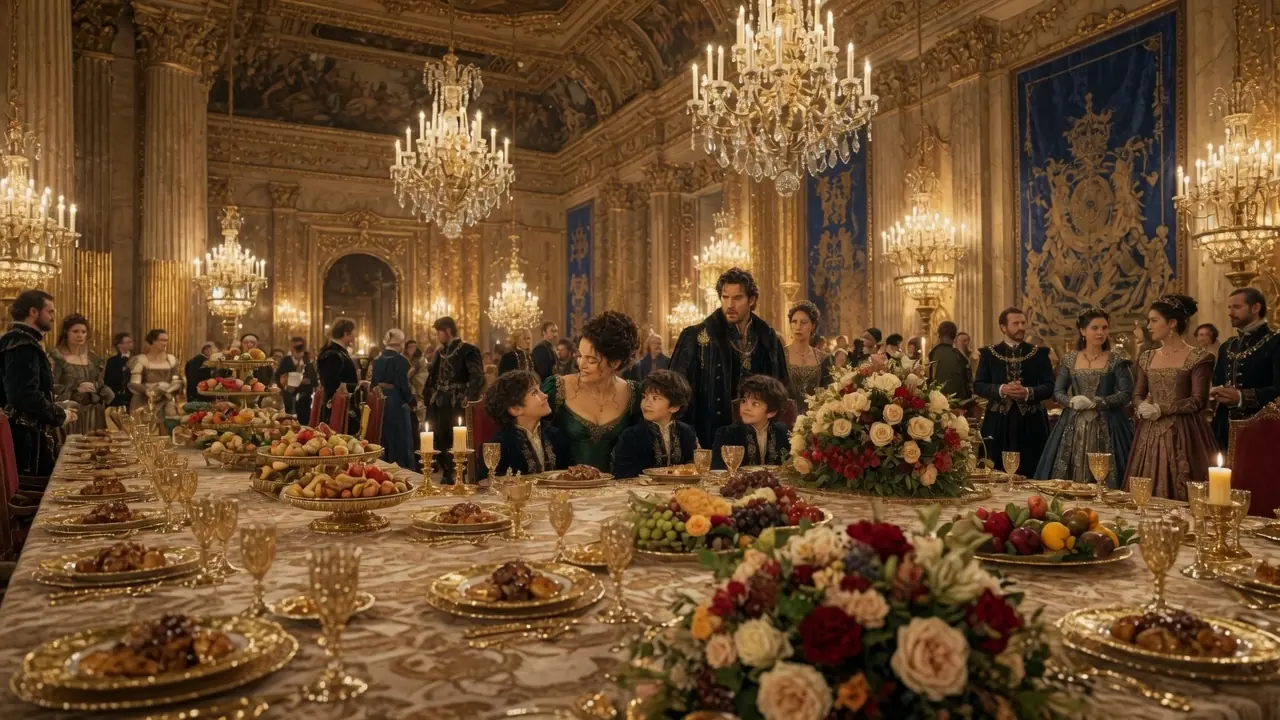
The Royal Pack Ballroom was the most beautiful room Vivian had ever hated. The ceilings were high enough that the candlelight from the moonstone chandeliers barely reached the upper arches. Silver wolf banners hung between every window, each one embroidered with the crest of the Underwood line, the crescent and the claw, done in thread so fine it caught the light like actual moonlight. The floor was pale marble, veined with gray, polished to a mirror's shine. The flowers were white and deep blue, arranged in columns along the walls, filling the room with a scent that was cold and sweet at the same time, like the first frost on a garden.
Music played, something slow and formal from the far end of the hall, where a string ensemble stood in a half circle near the great hearth. Couples moved in the center of the floor, ladies in velvet, gentlemen in dark coats, all of them performing the graceful, careful choreography of people who had been taught that elegance was more important than sincerity. Vivian had once stood in a room exactly like this one and believed that she belonged here. Now she moved through it like a woman moving through water, careful, measured, keeping close to the walls, keeping her face pleasant and her eyes down.
She had the boys in a tight line behind her, Theodore at the front with her, Sebastian in the middle, Julian at the end, all of them holding hands the way she had asked. Sebastian kept craning his neck to look at things, at the chandeliers, the banners, a very large hound sitting beside a nobleman near the far column. Julian was quiet, taking everything in without comment, the way he did when he was memorizing something. Theodore walked like he owned the place. That is his father's walk. Stop noticing that.
She spotted Lord Nathaniel Palmer near the card tables on the east side of the hall. He was a broad man in his fifties with silver at his temples and the relaxed expression of someone who had attended enough of these evenings to have stopped finding them interesting. He was speaking to another noble, gesturing with a glass of something dark red. She could reach him. She needed perhaps seven minutes of conversation, then she could leave. She was guiding the boys toward the east side when Julian stopped.
He simply stopped, the way children stop when something extraordinary appears in front of them with no warning. His hand tightened on Sebastian's, which made Sebastian stop, which made Theodore stop beside Vivian. Julian had found the honeyed moon berries. They sat on a silver tray carried by a passing attendant who had paused near them to allow a couple to cross. The berries were tiny and amber colored, coated in crystallized honey that made them glow under the chandelier light like something from a story. They smelled of warm sweetness and something faintly floral like summer kept in a jar.
Julian's face had gone completely still with a particular reverence that children reserve for things they find very beautiful. "Mama," he said in the hushed tone he used for important things. "What are those?" "Honeyed moon berries," she said. "Do not touch them. Come." "They look like tiny suns," he said. Sebastian leaned over his shoulder. "They look like food," he said more practically. "Can we have some?" "No. Come."
But the moment had already lasted too long. People near them had begun to notice. It was not any single thing. It was the combination. Three identical boys, silver eyed and dark haired, standing in a perfect still line beside a silver tray. Their young faces arranged in that particular way that was somehow both elegant and completely unselfconscious. The older one standing straight. The youngest with that expression of quiet wonder. A lady near the flowers leaned toward her companion and said something. Two gentlemen near the card tables looked up from their conversation. Lady Victoria Goodwin, seated near the window with a glass of white wine in one hand and an expression of permanent intelligent amusement in the other, turned her head and went still.
Vivian felt the shift in the room the way wolves feel weather before it arrives. Move. Move now. She opened her mouth to call the boys forward. And then she felt it. A gaze. Not curious. Not polite. Something older and heavier than that. Something that landed on the back of her neck like a hand and did not move. She looked up before she could stop herself.
He was standing at the far side of the ballroom near the great arched doors that led to the inner corridor. He wore black and silver. The Underwood colors. His coat cut simply and precisely in the way that powerful men often dressed as if they had nothing to prove and therefore needed no decoration. Rosalie Sutton was beside him saying something. Her hand near his arm. He was not listening to her. Oliver Underwood was looking at her boys.
Vivian watched it happen. She saw the exact moment the understanding arrived in his face. Not quickly. Not like a shout. But slowly. The way dawn arrives. His eyes moved across the three of them. Their hair. Their eyes. The set of their chins. The way Theodore stood. The color left his face. His hand still holding a glass went motionless at his side. Rosalie Sutton said something else. He did not hear it. He looked up from the boys slowly and found Vivian's eyes. Seven years collapsed. They were not in a ballroom. They were back in the corridor where she had last seen him. The night before she was told to go. The night she had not known would be the last. Him still trusting his house. Her already beginning to understand that something was wrong. Both of them too late for the thing they should have said. Then the ballroom returned. The music. The flowers. The chandeliers. The whispers.
Oliver set his glass down on the nearest surface without looking at it. Which told her everything about how steady he was not feeling right now. Because Oliver Underwood was a man who was always careful with objects. He set things down deliberately, always. And then he began walking toward her, slowly, through the middle of the room. People stepped back without quite knowing why. He stopped three feet from her, not two, not one. Three. Vivian noticed that. He had measured the distance deliberately, close enough to speak quietly, far enough that no one could call it intimate. He had always understood space. He had always understood what his body communicated before his mouth did.
The room was watching. She could feel it. That particular quality of silence that fills large spaces when everyone has decided to pay attention to one thing while pretending not to. Oliver Underwood bowed, not a small nod, a real bow, the kind given to equals, the kind that required something from the person giving it. His eyes went down. His head came down. He held it for one breath. Then he straightened.
"My lady," he said. His voice was exactly as she remembered it, low, even, the kind that did not need to raise itself to be heard. She had loved that voice once. She had fallen asleep beside it more times than she could count. She had not heard it in seven years, and she had not once stopped hearing it in her memory. "My lord," she replied. "Do not let him see anything. You are Widow Monroe. You are careful, not frightened."
Theodore had gone very still beside her. He was watching Oliver the way he watched everything unfamiliar, completely, without giving anything away. Sebastian had stopped fidgeting. Even he could feel the weight of this moment, though he could not have named it. Julian still had his hand in hers. Oliver's eyes moved to the boys, briefly, the quickest glance, so controlled, and then back to her. He said nothing about them. He did not say the word that was clearly sitting at the front of everything in his mind.
"There is a room," he said carefully, "behind the portrait gallery with a good fire and no guests. If you would permit me, perhaps a quarter of an hour, I would be grateful." "I am here on other business, my lord," Vivian said. "Lord Palmer. I know. I will have his signed agreement sent to your cottage by morning with my own seal beside it. You will not need to speak to him tonight."
The breath she pulled in was slow and did not show. He already knew. He knew why I came. He has been watching since the moment I arrived. Or he found out before I arrived. She did not know whether to be grateful or afraid. She chose to be careful.
Before she could answer, something happened. Julian reached into his coat pocket where he had kept the second moonberry he had quietly, without asking, taken from the silver tray when the attendant had not noticed. He had been holding it there this whole time, warming it in his small fist. Now he held it out, flat on his palm, toward Oliver. "You can have it," Julian said. "I took two, and Sebastian only wants cake anyway." Sebastian said beside him, "That is not what I said. I said the cake looks better. There is a difference." But Oliver was not looking at Sebastian. He was looking at Julian's open hand. A moonberry, amber and small, sitting in the palm of a six-year-old boy with silver eyes and dark hair and the same jaw as every portrait in the Underwood gallery.
Vivian watched something move through Oliver's face that he did not control in time. It was grief, just for a second. Then it closed again. He reached out and accepted the moonberry from Julian's hand, slowly and carefully, the way someone accepts something they know is irreplaceable. "Thank you," he said. His voice was steady, almost. Julian nodded seriously. "You are welcome. What is your name?" A pause. "Oliver." "I am Julian. That is Theodore. He will not say hello first, but he doesn't mean anything by it. And that is Sebastian." Sebastian, to his credit, gave a small dignified nod. Theodore gave nothing. He was still watching Oliver with that steady silver gaze.
Lady Victoria Goodwin appeared at Vivian's left side. She had moved through the room with the practiced ease of a woman who had spent forty years navigating spaces like this one. She was perhaps sixty, silver-haired with the sharp eyes of someone who had survived many difficult things and learned to notice everything. She looked at Vivian, then at the boys, then at Oliver. She put together everything she was seeing in approximately two seconds, and her expression did not change at all.
"What charming children," she said, addressing Vivian in a way that covered the room like a blanket, settling the whispers, giving everyone watching a narrative they could accept. "I was just telling Lady Camille that we never have enough young guests at these evenings. Would you allow me to take them to the portrait gallery? We have lemonade, and I believe someone has brought ginger cakes." Sebastian said, "I would like that very much." Theodore looked at Vivian. She looked at him. "I am asking you to trust me. I know you do not know why yet. Trust me anyway." Theodore looked at Lady Victoria. Then, with the composure of someone considerably older than he was, he said, "Yes, thank you." Julian let go of Vivian's hand. It was the hardest thing she had experienced in a long time. That small release, that hand leaving hers.
She watched Celeste move quietly to Lady Victoria's side as they led the boys away. Then she turned back to Oliver. "One quarter of an hour," she said. He gave the smallest nod. She walked ahead of him toward the portrait gallery. She did not look back.
The room behind the portrait gallery was small and quiet. Two armchairs faced a fireplace that had been burning long enough to have settled into a low steady heat. The window looked out over the palace gardens, which were silver and dark under a three-quarter moon. A writing desk stood against the far wall with an unlit candle on it. The rest of the room was books, floor to ceiling, old leather-bound volumes that smelled of paper and time.
Oliver closed the door. He did not lock it. She noticed that. He left it the way it was, closed but not sealed. She could leave whenever she wanted. She stood near the window. He stayed near the door. The distance between them was ten feet of firelit silence. He still had the moonberry. He had wrapped it in his handkerchief and held it quietly at his side. And she did not know if he realized he was doing it.
"Their names," he said. It was not quite a question. "Theodore, Sebastian, Julian." She said them clearly, the way she always said them, as if each one mattered separately, because each one did. Oliver repeated them softly, only to himself, not out loud enough for her to hear the whole thing, only the shape of the names. She watched his lips move. "Then, why?" One word, but she had been waiting for it for seven years, had rehearsed her answer ten thousand times during quiet evenings in the cottage, had known it would come eventually, had just not known it would come in a room that smelled of old books and wood smoke with the moon outside the window looking exactly as it always had.
"Your mother called me to her rooms," Vivian said, "twelve days before the winter ceremony. She told me the Alpha King had reconsidered his choice of Luna. She was very kind about it. She had tea brought. She spoke about bloodlines and political alliances and the importance of the pack standing in the Eastern territories. She told me I had been a pleasant presence in the palace and that no one wished me ill." Oliver had gone very still. "She offered me money. I refused it. She told me a carriage had been arranged for the following morning. She said if I made the departure quiet, there would be no unpleasantness. If I did not," Vivian paused. She did not finish that sentence. She didn't need to.
"I was told," Oliver said, and his voice was careful in the way that voices are when the person speaking is controlling something behind them very tightly, "that you chose to leave. That you had found the palace life too confining. That you had written to your cousin in the south and arranged your own departure." "I know what you were told." "Vivian, I found out three weeks later," she said. She kept her voice level. She had promised herself she would be level. "I was alone in a rented room. I was sick every morning. I understood what it meant and I made a decision."
The fire crackled. Outside, very faintly, the music from the ballroom moved through the walls. "I made a decision," she repeated, "to protect them from being used as evidence in a palace argument. From being claimed as heirs before they were old enough to understand what being an heir meant. From growing up inside a house that had already decided what kind of woman their mother was and sent her away in a carriage at dawn without the chance to say goodbye to the man she—" She stopped. She looked at the window. The moon sat there, patient and silver, the way it always was.
"You believed it," she said finally, "because it was easier to believe than to question your mother, than to question your council, than to ask where I had gone before the official explanation arrived." The silence after that was very long. Oliver did not defend himself. That was what she had not expected. In ten thousand rehearsals of this conversation, he had always defended himself, had given reasons, had explained the pressure he was under, the responsibility, the difficulty of questioning the people closest to him. He had always had words. He said nothing. He stood near the door with her handkerchief wrapped around an amber moonberry and said nothing.
Then, slowly, he crossed the room to one of the armchairs and sat down, not commanding the space, not filling it with himself the way alpha kings were trained to fill rooms. He sat the way a very tired person sits when they are done pretending. "Tell me something true about them," he said, "one thing each. That is all I am asking for tonight." Vivian turned from the window and looked at him. Something in his face had changed. The careful control was still there, but it had shifted. It was no longer covering authority or power. It was covering something much simpler, much more human. He is not asking as the alpha king. He is asking as a man who does not know his own children's names.
"Theodore," she said, moving to stand by the other chair without sitting, "reads everything, anything with words, labels on jars, the backs of trading cards, the borders of maps. He started reading before I had properly taught him. He taught himself the rest. He is the one who notices when something is wrong before it becomes wrong." Oliver listened without moving.
"Sebastian," she said, "can imitate any voice he hears. He did Lord Nathaniel Palmer's voice in the carriage tonight, so accurately that Julian asked if there was a man hiding under the seat. He does it without malice. He finds people interesting. He wants to understand how they work." She paused. "And Julian gives things away. His food, his toys, his paper boats. He gave you a moonberry tonight that he had been carrying all evening as his own private treasure. He did not think twice about it. That is who he is."
Oliver looked down at his closed hand, at the small shape of the moonberry wrapped in cloth. "He didn't know who I was," Oliver said. "No, but he gave it to me anyway. He would have given it to anyone who looked like they needed it," Vivian said. "That is who Julian is." Oliver was quiet for a moment. Then he said, "I am not going to ask for anything tonight, not tonight and not tomorrow. I am not going to arrive at your door with guards or with legal papers or with anything that resembles a claim. I need you to know that." Vivian said nothing.
"I know I have no right," he said. "I know what was done to you was done under my roof, with my name, and that my not knowing does not clean any of it. I am not asking you to forgive me tonight. I am not asking you to trust me tonight." He stood. "But I am asking you, when you are ready, if you are ever ready, to tell me what I can do that is not money and not a crown, because those are the only things I have ever been told I can offer, and I understand now that those were never what mattered to you."
She looked at him for a long moment. The fire had settled lower. The moon had moved slightly in the window. "Your quarter of an hour has passed," she said. He nodded. He moved to the door. He paused there with his hand on the frame, and she expected him to say one more thing, something that would undo the restraint of the last fifteen minutes, something that would make this harder. He said, "Theodore, Sebastian, and Julian." Just the names. Then he left.
The carriage home was quiet in the way that carriages are quiet when everyone inside them is very full of things they are not yet saying. The boys had fallen asleep before they left the palace grounds. Theodore against the window, his head tilted at an angle that would give him a stiff neck in the morning. Sebastian slumped sideways, his mouth slightly open, his dignified posture entirely abandoned. Julian curled against Vivian's side with his coat pulled up around his ears, breathing slowly.
Vivian kept her eyes on the dark road. Celeste sat across from her, not speaking. She was good at not speaking when it was needed. It was one of the things Vivian valued most in her. Julian, even in sleep, had his hand loosely in Vivian's. She could feel the slight stickiness of it. Honey, she realized. He had found a way to taste one of the moonberries after all. Of course he had. She pressed her lips together and did not smile because Celeste would notice, and they would have to talk about it, and she did not have room tonight for anything warm.
The cottage was dark when they arrived. It was always dark when they came home late. She had never paid for a lamp to be left burning because she had learned early that the things you paid for in comfort were often the things that reminded you most clearly of what you didn't have. The dark was fine. She knew every step and door and creaking board by feel. She had carried each boy up these stairs more times than she could count. And she carried Julian now. And he murmured something in his sleep that she didn't catch. She settled them all into their beds. Then she sat down at her small writing table in the kitchen and looked at the blank page in front of her for a long time.
I could say nothing. I could simply not write. The ball is over. Lord Palmer's agreement will come in the morning by his own word. I do not owe Oliver Underwood a letter except Julian gave him the moonberry. Theodore watched him with those careful eyes and did not look away. Sebastian will have questions by morning. Good ones. Ones I cannot deflect forever. And Oliver stood in that room and asked for nothing and said only their names as he left. She picked up the pen. She wrote for a long time. Crossed things out. Wrote again. She was careful with every sentence the way she was careful with everything. Not out of fear, but out of the same attention to detail that had kept her and her sons safe and fed and loved for seven years without anyone's help.
When she was done, the letter was short. It said, "If you want to know them, here is what that looks like. You write first. You do not arrive uninvited. You send no guards, no messengers in palace livery, no letters with royal seals. You bring nothing that cannot fit in a coat pocket. You tell me what you can offer that is not power and not a title. You arrive as a man, not as an alpha king, or you do not arrive at all. If you do not understand these conditions, you do not write back." She sealed it. She did not send it that night. She waited two days reading it again each morning. Both mornings it said the same thing. The third morning, she sent it.
His reply came on the fourth day, mid-morning, while the boys were in the garden and Sebastian was teaching Julian and a reluctant Theodore a complicated game he had invented involving a stick, a stone, and rules that changed every three minutes. The letter was not written by a secretary. She could tell from the handwriting. She had seen Oliver's handwriting before, years ago, on letters that had meant very different things. It was still the same, slightly forward-leaning, the letters even, the pressure consistent, a careful hand.
He wrote, "I can offer attention, not the divided kind, not the kind that is given while thinking about something else. I mean the kind that means I will actually listen when they speak and remember what they said the next time. I can offer patience because I understand I have no right to rush anything. I can offer truth, whatever portion of it you judge appropriate, at whatever time you judge appropriate, with no argument from me about the timing. I can offer to be present in a way that is useful and absent in a way that is clean, which is to say, if you ask me to leave, I will leave and I will not make the leaving complicated. I can offer to be unimportant for as long as it takes for them to decide whether they want me to be anything else. I am not offering any of this in exchange for forgiveness. I am not keeping score. These are simply what I have and I am giving you the honest list and nothing else."
She read it twice. Then she set it face down on the table and looked out the window at the garden where Sebastian had just changed the rules again and Julian was patiently relearning them and Theodore had sat down on the grass with a book and removed himself from the proceedings entirely. She picked up her pen. She wrote back, "You may come on Sunday. You will use the name Mr. Oliver Carlson, an old acquaintance from my father's parish. You will come without guards or livery. You will bring nothing. You will stay one hour. You will leave when the hour ends. You will not tell them anything I have not yet told them." She sent it. Then she told Celeste, who looked at her for a long moment and said nothing, which was exactly the right response.
On Saturday evening, Vivian told the boys they were having a guest the following day, someone she had known years ago. His name was Mr. Carlson. He was quiet and might seem formal at first. They should feel free to talk to him normally. Theodore looked up from his book. "Is he kind?" he asked. She considered the question carefully. "He is trying to be," she said. Theodore nodded once and went back to his book. Sebastian said, "I hope he likes stories." Julian said, "I will make him feel welcome. I am good at that." She put them to bed. She sat in the kitchen in the quiet dark of Saturday night and let herself feel, privately, in the space where no one could see, the smallest possible version of something she was not yet ready to name. Then she put it away. She went to sleep.
Sunday came. He arrived on foot. Vivian was watching from the kitchen window when he came up the lane, and the first thing she noticed was that he was genuinely on foot, not that he had climbed out of a carriage at the gate and walked the last one hundred yards. He had walked from the village, more than a mile, through the kind of morning that was still deciding whether to be cold or merely cool. He wore a plain dark coat, nothing special about the cut, no insignia on the buttons. His hair was not arranged the way it was at the ball. He looked, from a distance, like a reasonably well-dressed man from the parish who had decided to call on an acquaintance without making a production of it.
She watched him pause at the gate. She saw him look at the cottage, the stone walls, the herb garden along the south side, the washing line where the boys' things hung in the morning air, the small worn path between the gate and the front step that had been made by six feet going back and forth for years. His face did something she could not quite read from that distance. Then he opened the gate and came through.
She had the door open before he knocked. Sebastian was right behind her, because Sebastian was always right behind her when anything interesting was about to happen. Theodore had positioned himself at the kitchen table with his book, which was his way of being present while reserving the right to be unimpressed. Julian was sitting on the floor near the hearth with a piece of string doing something complicated with it that he had been trying to figure out for three days.
"Mr. Carlson," Vivian said. "Widow Monroe," he replied. And she could hear the care in those two words, the way he was holding the fiction exactly where she had placed it, precisely with both hands. "Come in. The tea is on." He stepped over her threshold. She watched him take in the cottage in the same way she had watched him take in the lane, quietly, attentively, without performance. The low ceilings, the worn wooden floor, the shelves of books along the east wall, mostly Theodore's, overflowing onto the floor in small careful stacks. The collection of paper boats Julian had made and then arranged on the window sill by size. The drawing of a horse Sebastian had done last month and pinned to the kitchen wall because he was proud of it, even though the horse's legs were slightly too long and it seemed to be running sideways.
Oliver looked at the horse drawing for a moment. Something in his expression settled. Sebastian appeared at his elbow. "I drew that," he said. "The legs are wrong, but I did not notice until it was already pinned up. And by then, I had decided I liked it anyway." Oliver said, "The way it's running reminds me of the horses in the old Livingston stables. They always looked like that. Like they were going slightly sideways towards something only they could see." Sebastian studied him with sudden interest. "Do you know horses?" "A little." "Do you have one?" A pause. "Several." Sebastian looked at Vivian with an expression that said he approved of this guest.
They moved to the kitchen table. Vivian poured tea. Oliver sat across from Theodore, who was still reading. The silence between them lasted perhaps forty seconds before Theodore looked up from his book and regarded Oliver with full attention. "Do you like stories?" Theodore asked. "I like true ones more than invented ones," Oliver said. "Most people say the opposite." "Most people find true ones more frightening," Oliver said. "Invented ones you can put down when they get difficult. True ones stay." Theodore considered this. Then he went back to his book, but he had put it down slightly, lowered it two inches the way he did when he was still reading, but also listening.
Julian had come to the table with his string, which he had finally managed to twist into something that was not quite a cat's cradle, but was not nothing either. He set it in front of Oliver without a word as an offering of some kind, and Oliver looked at it seriously and said, "That's the Eastern Bridge knot. I haven't seen someone do that in a long time." Julian's eyes went wide. "It has a name?" "It does. Here." He reached across the table and adjusted two loops of the string with careful fingers. "Like that. Now it's complete." Julian held the finished shape up and stared at it. "I have been trying to do that for three days," he said, "for three whole days." "I know. I could tell." Julian laughed. It was the sudden delighted laugh of someone who has been understood. Oliver looked at the laugh for a half second too long, and Vivian, watching from across the table, felt something tighten in her chest and then release. He is being careful. He is being kind. He is doing exactly what he said he would do and nothing more. I did not expect it to feel like this.
The hour passed in a way that hours rarely do, neither quickly nor slowly, but with the particular fullness of time that is being used well. Sebastian told a story about a goat in the village market that had eaten half of a wool merchant's sample book, and which had then seemed to be wearing a small hat made of thread. Oliver laughed properly, not the polite laugh of someone performing amusement. Theodore said, without looking up, that Sebastian had embellished several details. Sebastian said that details were meant to be embellished. Theodore said no, they were not. Oliver said that both approaches had their place, depending on the audience, which made Sebastian triumphant and Theodore thoughtful.
When the hour ended, Vivian said, quietly, "Mr. Carlson, the hour." Oliver looked at the clock on the mantel. He looked back at the table, at the boys, at the horse drawing, at Julian's string shape sitting beside the teacups. He stood. "Thank you for the tea," he said to Vivian. "To the boys, thank you for the company. Sebastian, the horse is very good. Julian, keep working on that knot. There's a harder version. Theodore." He paused. "I'll bring a book next time if you'll tell me what you've read." Theodore looked up. "You don't have to." "I know," Oliver said. He left. Julian ran to the window and watched him walk back down the lane. He watched until Oliver was out of sight, then turned around and said, "I like him." Sebastian said, "He owns several horses." Theodore said nothing for a moment. Then he said to Vivian carefully, "When will Mr. Carlson come again?" Vivian looked at the closed door. "Wednesday," she said. She did not examine how quickly that answer had come. She simply cleared the table.
Over the weeks that followed, Oliver came on Sundays and Wednesdays. Sometimes he brought a book for Theodore, always a good one, always chosen carefully. He learned that Sebastian needed an audience and gave him one without making him feel observed. He learned that Julian would accept help with things, but not before he had tried himself first. And so he always waited to be asked. He never stayed past the hour. He never brought anything he could not carry in a pocket. He never asked Vivian a single personal question, not in front of the boys.
One afternoon, an ordinary Wednesday, gray sky, the smell of rain on the way. She handed him his teacup and their hands were close together in the space above the table. And he looked up from the cup and their eyes met the way they had not quite met since the library at the ball. And she looked away first and he did not press it. And she thought, he has learned restraint. He did not have it before. He has learned it specifically for this, for us. I don't know what to do with that. She put it away. She waited for the next Wednesday.
The morning she decided to tell them was ordinary. There was no particular reason for it to be that morning and not another. The sky was pale and clear. The bread she had baked was good. Julian was singing something under his breath while he helped set the table. A song he had invented, tuneless but earnest. Theodore was already at his books. Sebastian was in the garden looking at something in the grass with the intense focus he gave to anything he decided was worth investigating. Oliver was due on Wednesday. It was Monday.
She had been thinking about it for three weeks quietly in the way she thought about things she was not yet ready to say. She had built the sentence in different shapes, tried different beginnings, discarded them all. In the end, she simply called them in. She sat them on the cottage sofa, the three of them in a row the way they always sat when she had something serious to say. Theodore at one end, straight-backed. Sebastian in the middle. Julian at the other end, already attentive. She sat in the chair across from them. She said, "I need to tell you something true. It is something I have been waiting to tell you until I believed you were ready. And until I believed the person it is about had earned the right to be told about. I think both of those things are now true."
Theodore set down his book. Sebastian went still. Julian folded his hands in his lap and looked at her. "Mr. Carlson," she said, "is not only an old acquaintance from my father's parish. His real name is Oliver Underwood. He is the alpha king of the Moonstone pack." A silence. "He is also your father."
Theodore's jaw tightened. His expression did not otherwise change, but she could see him working through it, absorbing the information, cataloging the implications, thinking three moves ahead the way he always did. He looked at her for a long moment and she looked back and let him see that she was not ashamed, not afraid, and not asking for forgiveness. Sebastian said, "The Alpha King." "Yes." A pause. "Does that mean we are princes?" "That is one part of what it means. There are other parts." Sebastian processed this. "Do princes still have to do chores?" "In this house, yes." He nodded slowly. "All right. I have more questions." "You may ask all of them." He did. He asked them carefully and in order, and she answered each one. Why had Mr. Carlson used a different name? Why had they not always known who he was? Why had she and Oliver not lived together? She answered honestly and in the language she used for true things, without decoration, without blame, without giving them the full weight of the pain that was hers to carry and not theirs.
Julian had not said anything. She looked at him when Sebastian's questions were finished. Julian was looking at his own hands. Then he looked up at her. "On the night of the ball," he said, "when I gave him the moonberry, he already knew, didn't he? He already knew who we were." "Yes. And he was still kind about the moonberry." "Yes." Julian nodded.
On Wednesday, Oliver arrived at the cottage gate to find all three boys standing in the garden. He stopped. He looked at Vivian, who stood in the doorway. She gave the smallest possible nod. He came through the gate. Theodore stepped forward and stopped two feet in front of him. He looked up at Oliver. They were almost the same height, which surprised Vivian again every time she noticed it, how quickly Theodore was growing into the shape of his own self, and said, in his even careful voice, "I want you to know that I understand what happened was not simple, and that my mother chose her decisions for my protection, and that I believe her. I also want you to know that I have been paying attention to you for several months, and that I have not yet found anything I distrust. Those are two separate things, and I want you to know both of them."
Oliver looked at him for a long moment. "Thank you, Theodore," he said. "Both of those things matter to me." Theodore stepped aside. Sebastian came forward. "I have one hundred seventeen questions. I have written them in a notebook. I will not ask all of them today, but I am keeping track." "I have been told I am a patient man," Oliver said, "though I am working on proving it. I would like very much to answer whatever you are ready to ask." Sebastian considered this. "All right. Today I will only ask twelve." Julian came last. He walked up to Oliver and looked at him for a moment, the way he looked at things he was deciding about. Then he reached out and took Oliver's hand. He simply took it and held it. He did not say anything. Oliver looked down at the small hand in his, and his face did the thing it had done in the library at the ball. That brief, uncontrolled moment where the grief and the wonder came through at the same time. And then he steadied himself and held Julian's hand back.
They went inside. That evening, a letter arrived with the Underwood seal. It was from Lady Arabella Underwood. Vivian did not open it. She set it on the kitchen table, and when Oliver came in from the garden, where he had been teaching Theodore and Sebastian a complicated card game, she nodded at it. He looked at it. He picked it up. He read the seal. He took it to the fireplace and set it in without opening it. "No one is taking them anywhere," he said. He was not loud about it. He did not raise his voice. It was simply a statement of something that was going to be true. Vivian watched the letter curl and go to gray ash.
Two weeks later, Oliver asked her to come to the pack council. Not for ceremony, not for display, for protection. He wanted to stand before the noble families and state clearly what was true. That Vivian Russo was the mother of his sons, that she had been wronged by his house, and that the boys were his heirs and lived where they chose to live under their mother's care. Vivian said she would come. She did not take back the Luna crown. When someone at the council asked about it, she said simply that trust was a living thing and that she would let it grow at the pace it chose. Oliver beside her said that was the most sensible thing he had heard said in a council chamber in seven years. Several nobles looked at him as if trying to decide if he was joking. He was not.
The boys sat in the gallery above the chamber. Visible to the whole council if anyone looked up. Theodore sat very straight. Sebastian was counting something under his breath. Julian waved at Vivian when she glanced up. A small private wave, the kind meant only for her. She looked back down before the feeling in her chest could become anything more specific than warmth.
That evening they returned to the cottage, all five of them. Oliver helped set the table. There were five chairs around it now. The four that had always been there and a fifth that Oliver had quietly brought one Wednesday. Setting it by the wall without comment, waiting to see if anyone objected. No one had. Julian had patted it once as if welcoming it. Theodore had noted its existence and filed it away. Sebastian had immediately sat in it and declared it had good balance. It was Oliver's chair now.
They ate together, simple food, the kind that tastes better than it should because of the company. Sebastian told a story that grew more impossible with every sentence until Theodore was actually smiling, which was a rare and precious thing. And Julian kept adding small details that made it worse and better at the same time. Oliver listened and ate and laughed and was, Vivian noticed, very present. Not thinking about the palace, not calculating what he owed or who was watching, just there.
After the boys were in bed, she and Oliver stood outside the cottage in the evening air. The moon was up. It was always up, steady and silver, unchanged. They stood side by side, not quite touching, looking at the garden and the lane and the dark shape of the hedge beyond the gate. Oliver said, "I still love you. I have been aware of it for some time, and I have been choosing not to say it because you did not need the additional weight, but it feels dishonest to keep not saying it."
Vivian was quiet for a moment. "You have changed," she said. "Yes. I don't know yet if it is enough." "I know." She looked at the moon. "Part of me," she said carefully, "never stopped knowing you. Even when I was angry, even when I was tired, even when I had decided I had put you down entirely, there was a part that kept knowing the shape of you." Oliver turned to look at her. "That doesn't mean I am forgiving everything tonight," she said. "Or asking for anything to go back to what it was. What it was is gone. I am not interested in what it was." "Neither am I," he said. "I am interested," she said, "in what it might be if it is built slowly on what is true, without crowns or history or anything that belongs to other people's stories."
He was looking at her with an expression she recognized from a long time ago. The one that meant he was paying complete attention and would not look away. "Then we build slowly," he said. She looked at him for a long moment. Then she turned her hand palm up beside her. He put his hand in hers, not tightly, not claiming, simply there. The way the moon was there. The way the cottage behind them was there with the window glowing warm and the sound of Sebastian's voice still drifting down from somewhere upstairs telling a story to himself or to Theodore or to no one. Just because he liked the way words sounded when he put them in order.
Vivian did not pull her hand away. Inside, Julian's paper boats sat in a row on the window sill. Inside, Theodore's books were stacked on the shelf exactly as he had arranged them, which was very precisely and by a system only he fully understood. Inside, the fifth chair sat at the table that had once had four. The cottage was not lonely anymore. The palace was not a cage anymore. And somewhere in the space between what had been broken and what was being built carefully, slowly, with two people paying full attention to every step, something was growing. Not restored, not recovered, something new.