The Duke of Allerdale was being dressed for the day when he said it. The light through the dressing room window was the color of weak tea, barely committed to morning. Marsh, who had served him for nine years and who understood his master's silences better than most men understand conversation, was easing the second arm of a freshly pressed coat over his shoulder when the Duke spoke, quite plainly, as though he were remarking on the arrangement of the breakfast table or the condition of the south lawn.
"I would marry her tomorrow," he said, "if she would have me." Marsh did not pause. He smoothed the shoulder seam with one practiced hand and moved to the cuffs. His face showed nothing because it was not his face's business to show anything, and because he had known this was coming since the evening of Lady Stanmore's dinner four days earlier, when the Duke had returned to his rooms at half past eleven and stood at the window for a quarter of an hour without removing his coat. Marsh had laid out the nightclothes and withdrawn, and he had thought, with the calm certainty of long service, that the Duke had finally encountered a problem he could not solve by ignoring it.
"She handled my aunt last night," the Duke continued, still looking at the mirror but not at himself, at something beyond the glass, some private architecture of thought. The table had gone silent. You could hear the candles, and she did not raise her voice. She did not need to. She said something about the quality of the pheasant that was so precisely, so devastatingly ordinary that my aunt had no surface to attach her next remark to. The conversation simply moved, as though nothing had happened, and my aunt knew. You could see it in her hands.
Marsh fastened the left cufflink. It was a small gold knot, one of a pair the Duke's father had worn. "I have been trying not to think about her for a fortnight," the Duke said. "I have failed completely."
In the doorway, the door had been left ajar, as it always was in the mornings when the household was stirring and the footmen were carrying hot water along the corridor. Thea Denby stood perfectly still, holding a book she had come to return to the library, and did not breathe. She had not meant to stop. She had been walking past. The library was at the end of this corridor, the guest rooms on the floor above, and she had risen early because she always rose early, and because the mornings at Allerdale Park were the only hours that belonged entirely to her before the other guests assembled and the business of being pleasant in company resumed.
She did not move. She listened to the rest of it, the part about the pheasant, the part about his aunt's hands, the part about the fortnight, with her back against the corridor wall and the book pressed to her chest, and her pulse doing something she would not have permitted it to do if she had been given any choice in the matter. Then she walked away. Her shoes made no sound on the carpet. She returned to her room, set the book on the small table beside her bed, and sat on the edge of the mattress for a long time, looking at her hands, which were steady. She was surprised by this. Everything else was not.
She had come to Allerdale Park a fortnight ago, in the first week of October, at the invitation of Mrs. Juliana Lee, who was a distant cousin of her mother's and who had been, in the years since Thea's mother's death, the nearest thing to a benefactress that Thea would tolerate. Juliana was not a subtle woman, but she was a warm one, and when she had written to say that the Duke of Allerdale, whom she knew through her husband's parliamentary connections, Mr. Lee having sat in the Commons for a Wiltshire borough for twelve years, was assembling a small party at his country house, and that Thea really must come, the invitation had carried the unmistakable scent of engineering. Thea had recognized it immediately. She had recognized it because she was twenty-four and unmarried and the daughter of Sir Edwin Denby, who had been a gentleman of moderate estate in Hampshire, and who had died three years earlier, leaving her with a house that was too large to heat, an income that was too small to live on with any ease, and a reputation for intelligence that was, in the marriage market, roughly as useful as a reputation for speaking Portuguese.
She was not plain. She knew this without vanity, the way she knew the color of her own hair, but she was not ornamental. And she had long since understood that the distance between a woman of good family and a woman of good family with four thousand a year was, in the eyes of the world, approximately the distance between the earth and the moon. She had come to Allerdale Park expecting to be managed. She had decided, on the carriage ride from Hampshire, that she would be pleasant, that she would be grateful to Juliana, that she would not embarrass herself, and that she would under no circumstances allow herself to want something that was not a serious possibility. A duke was not a serious possibility. She had repeated this to herself with the careful discipline of a woman who has learned that expectation is the thing that breaks you, not disappointment. Disappointment is only expectation's remainder.
The Duke of Allerdale had made this resolution difficult from the first evening. He was not what she had expected. She had expected a man who performed ease, who occupied a room the way a portrait occupies a wall, handsomely, completely, without effort. What she found instead was a man who entered rooms as though slightly surprised to find people in them. He was tall and dark-haired and had a way of listening to conversation with his head inclined that suggested he was genuinely interested, but also faintly baffled, as though he had been presented with an equation that was almost but not quite elegant. He spoke well, but not much. He was courteous to his guests with the particular courtesy of a man who finds large gatherings effortful and has decided to be good at them anyway, the way another man might decide to be good at a sport he does not naturally enjoy.
She had watched him for three days before she understood that he was watching her. It was not obvious. He did not seek her out, did not arrange to sit beside her, did not do any of the things that a man of lesser intelligence would have done. What he did was attend. When she spoke at dinner, he listened with a quality of attention that was different from politeness. It had weight to it, focus, the particular stillness of a man who is not merely hearing words but considering what they reveal about the person who chose them. When she made a joke, she made them rarely and dryly and usually at her own expense, his mouth moved in a way that was not quite a smile but was better than one. Once, crossing the lawn after a walk, she had turned to find him standing at the library window looking down at her. And when their eyes met, he did not look away. He held her gaze for a moment, then inclined his head, the smallest nod, and turned back to whatever he had been reading. She had felt it in her chest for the rest of the afternoon.
By the end of the first week, she had understood three things with the clarity that she brought to everything she understood: that the Duke of Allerdale was not performing interest, that his attention was not casual, and that she was in very serious danger of wanting something she had already decided she could not have. She had responded the only way she knew how. She had become very, very composed. Composure was not pretense for Thea Denby. It was architecture. She had built it over years, wall by careful wall, from the materials of her own intelligence and her mother's early death and her father's gentle decline and the long education in managing without that comes to women who have enough to be respectable and not enough to be free.
She did not perform serenity. She maintained it the way one maintains a house, with effort, with attention, with the understanding that the moment you stop the weather gets in. In company, she was pleasant and self-possessed. She conversed well, read widely, played the pianoforte competently, though not brilliantly, and managed the particular social challenge of being a guest of moderate means in a house of extraordinary wealth with a grace that drew no attention to the disparity. She did not compete with the other women at the party: Miss Elspeth Graves, the aunt's candidate, who was very beautiful and very wealthy, and who laughed at everything the Duke said with the mechanical brightness of a woman who has been coached; Lady Ferrin, who was married and therefore not competing, but who watched the proceedings with the sharp amusement of a spectator at a sport she has already won. And she did not, she told herself firmly, spend any time at all considering what it would mean if a man like the Duke of Allerdale looked at a woman like her and saw something worth the looking.
She told herself this every evening after dinner in her room while Tate unpinned her hair, and every evening she believed it a little less. The dinner at which everything shifted, the dinner the Duke had described to Marsh, the one with the pheasant and the silence, had taken place four nights before the morning in the doorway. It had been a Tuesday. Lady Stanmore, the Duke's aunt, who had arrived for the final week of the party with Miss Graves in tow and a program of gentle demolition already prepared, had turned the conversation to the subject of accomplishments, specifically the accomplishments expected of a woman who might manage a house such as Allerdale Park.
Lady Stanmore was not cruel in the way that small people are cruel. She was cruel in the way that large people are cruel, with the absolute conviction that she was being kind. She had spent forty years as the sister of a duke and the wife of a viscount, and she understood the world as a series of arrangements in which certain people belonged in certain rooms and the rest were guests who ought to be grateful for the invitation. She did not dislike Thea. She did not think about Thea at all except as an obstacle to be removed with the same courteous efficiency with which one removes a piece of furniture that does not suit a room.
"Of course," Lady Stanmore had said, addressing the table generally, but looking at Thea with the particular warmth reserved for women one is about to diminish. "The management of an estate such as this requires a certain breadth: languages certainly, music of a serious kind, a knowledge of society that can only come from having been raised within it. One cannot acquire these things late. They are absorbed from childhood, from the air of a certain kind of house." She had smiled. "Would you not agree, Miss Denby?"
The table had gone quiet. Not silent, quiet, which was worse because quiet meant that everyone had heard and everyone was waiting and everyone understood what had been said beneath what had been said. Thea had looked at Lady Stanmore. She had not looked away and she had not looked down and she had not flushed, though she had felt the heat rise to the base of her throat and stay there like a hand pressed flat against her skin. She had paused. The pause of a woman choosing her words not because she does not have them, but because she has too many and is selecting the ones that will leave no mark.
"I quite agree," she had said. "The pheasant this evening is particularly fine. I understand it was shot on the north coverts. Is that correct, Your Grace? My father always said that the quality of the bird reflects the quality of the land it was raised on. He was a great believer in the importance of what one absorbs from childhood." The Duke had looked at her across the candles. He had looked at her the way one looks at something one has suspected and has just confirmed, with a kind of arrested satisfaction, as though a theory he had been constructing in private had just been proven in public. He had said, "Your father was quite right," and the conversation had moved, and Lady Stanmore had been left holding a remark that no one had bothered to answer, which was for a woman of her skill a defeat more total than any argument could have delivered.
That had been Tuesday. On Wednesday, the Duke had walked with the party in the grounds, and Thea had found herself beside him for a quarter of a mile of the lime walk, and they had spoken about books, specifically about a line in Cowper that she had quoted and he had finished, and the small shock of recognition in his face when she completed the verse had made her look away because she could not trust what her own face was doing. On Thursday, she had played the pianoforte after dinner, not brilliantly, and when she finished, he had said, "Thank you," in a tone that contained none of the effusive praise the other guests offered and all of the sincerity. On Friday, he had been called away to his study for estate business. Mr. Doyle, his steward, had brought a matter concerning the tenants on the western farms, and he'd been absent from dinner, and she had felt his absence the way one feels a draft, not painfully, but persistently in a place one cannot cover.
On Saturday morning, she had risen early, taken the Cowper from her bedside table, and gone downstairs to return it, because keeping it any longer would have been an intimacy she had not been invited to, and because she had read the same passage four times the previous night without absorbing a word of it, and had understood that the book was no longer functioning as a book, but as a proxy for something she was not yet prepared to name. She had walked down the corridor. She had heard her name. She had stopped. And now she knew.
The difficulty, the exquisite impossible difficulty, was that knowing changed nothing she could act on. She could not acknowledge what she had heard without confessing that she had heard it, which would embarrass them both, which might embarrass him into withdrawing it, which would be worse than never having heard it at all. She could not pretend she had not heard it, because pretending required a composure that had for the first time in her adult life failed her at the foundations. And she could not leave. The party had four days remaining, and leaving early would have required an explanation she did not have, and would have caused Juliana precisely the kind of distress that Thea spent her life trying to prevent.
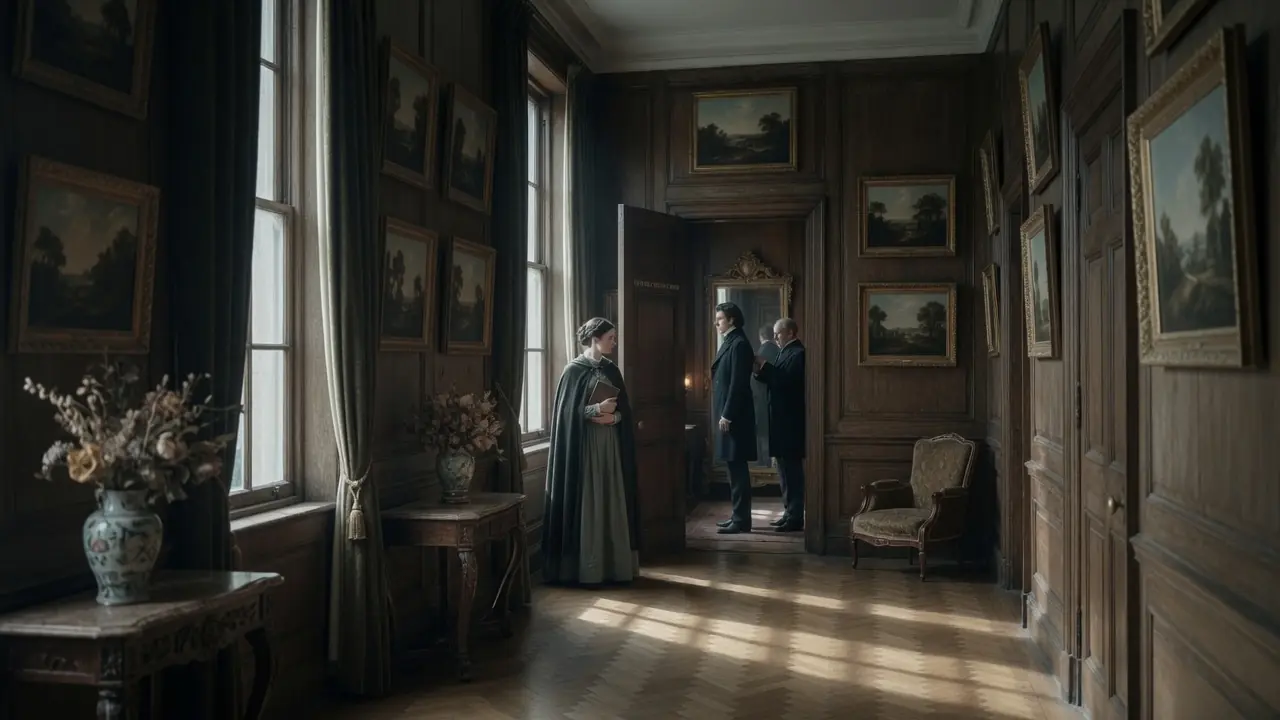
So she stayed. She came down to breakfast and sat where she always sat, and ate what she always ate, and spoke when she was spoken to, and avoided the Duke's eyes with a discipline that she recognized, even as she practiced it, as a form of cowardice she had not known she was capable of. He noticed. Of course he noticed. He had been watching her for a fortnight with the focused attention of a man who has stopped pretending to himself, and the shift in her manner, invisible to anyone who had not been studying her with care, was to him as legible as a change in the weather. She was not distant. She was not cold. She was careful. More careful than before, which was considerable. She held her teacup with both hands now, as though steadying something. She laughed at the right moments, but the laughter stopped too precisely, like a clock. She did not meet his eyes across the table, and the absence of it was louder than any look she'd ever given him.
He did not know why. He spent the better part of Sunday attempting to determine what he had done or said or failed to do or say that had caused this precise, devastating withdrawal, and he could identify nothing. He had not spoken to her improperly. He had not presumed. He had been, he thought, as correct as a man could be who was trying very hard not to reveal that he had spent a fortnight falling in love with a woman he was not yet certain he was permitted to fall in love with.
On Monday, he nearly asked her. They were alone briefly in the library. She'd come to find a book, and he had been there already, standing at the window with a volume of Gibbon he was not reading. And the room was quiet except for the fire and the faint sound of rain against the glass. And he had opened his mouth to say something plain and honest and potentially catastrophic, and she had looked up at him with an expression he could not read, and he had closed his mouth again and said instead, "The rain may clear by afternoon." She had said, "I hope so," and left the room, and he had stood there for a considerable time holding Gibbon and feeling like a man who has been handed a key to a door he cannot find.
That evening in the drawing room after dinner, Miss Graves played a sonata competently with the practiced brightness of a young woman who has been told that musical accomplishment is a currency and who spends it freely. And the Duke sat in the chair nearest the fire and did not hear a note of it. He was watching Thea, who was seated beside Juliana on the far settee, her hands folded in her lap, her face turned toward the pianoforte with the expression of attentive appreciation that she could summon at will and that he had learned over a fortnight to distinguish from her actual attention. Her actual attention had a quality of stillness to it, a settling as though the whole of her concentrated into a single point. This was not that. This was the surface. And the fact that he could see the difference, that he had studied her closely enough and long enough to know precisely where the performance ended and the person began, was, he thought, either the most useful or the most dangerous piece of knowledge he had ever acquired.
Lady Farren, who was seated beside him, and who had been observing the entire fortnight with the shrewd amusement of a woman who reads people the way other people read novels, leaned toward him and said very quietly, "You are not being as subtle as you believe, Your Grace." He looked at her. She smiled, not unkindly, and returned her attention to the sonata. Mrs. Yarrow, who had been housekeeper at Allerdale Park for fourteen years and who missed nothing that happened beneath its roof, watched the whole of it with the quiet comprehension of a woman who has seen a great deal of love conducted badly and a very small amount conducted well. She said nothing because it was not her place, but on Monday evening she instructed the kitchen to prepare the Duke's coffee exactly as he preferred it, strong, no sugar, served in the blue cup that his mother had used, and she placed it at his study door herself. And when he looked up from his papers with the slightly bewildered expression of a man who has been thinking about something else entirely, she said only, "The house party ends on Thursday, Your Grace," and withdrew. He understood her perfectly. Mrs. Yarrow had never been a woman who wasted words.
On Tuesday, Lady Stanmore made her final attempt. She had spent the party's remaining days positioning Miss Graves with increasing urgency, arranging walks and evening amusements and seating plans designed to place the girl directly in her nephew's line of sight. And she had watched with growing displeasure as the Duke's line of sight consistently found its way to a corner of the room where a woman of no particular fortune sat reading or conversing or simply being present in a way that drew the eye without any effort to draw it. It was at dinner that she spoke. The candles were lit, tall beeswax candles in the silver candelabra that the first Duke had commissioned, and the table was full, and the conversation had turned to the question of the London season and who would be in town for the spring.
And Lady Stanmore, with the timing of a woman who knows exactly what she is doing, turned to Thea and said with great warmth, "And you, Miss Denby, you must be so relieved to be returning to your own quiet life. Hampshire, is it not? Such a restful county. I always think there is something admirable about women who are content with a small life. It is a gift, really, the ability to want less." The table heard it. Everyone heard it. Miss Graves looked down at her plate with the uncomfortable expression of a woman who knows she is being used as a weapon and lacks the courage to object. Lady Farren raised one eyebrow, the left, with the precision of a woman marking a point on a scorecard. Juliana Lee, at the far end of the table, went very still.
Thea set down her fork. She did not do this dramatically. She did it the way she did everything, with a composure that was so complete it left no room for anyone to claim she was making a scene. She looked at Lady Stanmore. She did not smile, and she did not frown, and she did not lower her eyes. She said nothing. The silence was extraordinary. It lasted three seconds, perhaps four, and in those seconds the room understood that Thea Denby had chosen not to answer, and that the choice was not weakness, but a precision so exact it required no words. She had left Lady Stanmore's remarks sitting on the table like an object that no one wished to touch, and the longer it sat there, the more visible it became. Not as an observation about Thea, but as an exhibition of the woman who had made it.
The Duke set down his glass. "Miss Denby," he said, and his voice was quiet, and every person at the table turned to look at him because the quietness of it was the loudest thing in the room. "I wonder whether I might ask you something." Thea looked at him. For the first time in four days, she met his eyes, and what she saw there was not performance. It was not the careful composure of a man of rank making a social gesture. It was plain and unguarded, and it was the voice from the dressing room, the voice he used when he believed no one important was listening, except that now he was using it in front of everyone.
"Of course," she said. "Would you stay?" The table did not move. Lady Stanmore's hand, which had been reaching for her wine glass, stopped. Miss Graves looked up from her plate. Lady Farren's eyebrow, which had been raised, remained precisely where it was. "Not as a guest," the Duke said. He did not look at anyone else. He looked at her. "I am asking you plainly, Miss Denby, because I find that I have exhausted my capacity for asking any other way, and because Thursday is tomorrow, and after Thursday, I will have no reason to see you unless I make one, and I would very much like to make one."
Mrs. Yarrow, who was standing in the doorway to the serving passage, a different doorway in a different part of the house, but a doorway nonetheless, permitted herself one small inhalation, and then resumed her expression of professional neutrality. Thea looked at him. She looked at him the way she had looked at him through the doorway of his dressing room four mornings ago, except that then she had not been able to control her face, and now she chose not to. She let him see it, the whole of it, the thing she had spent a fortnight building walls against and four days pretending she had successfully contained. And his expression, when he understood what he was seeing, was the expression of a man who has been given an answer to a question he was not certain he had earned the right to ask.
"Yes," she said. She did not say it because she was grateful. She did not say it because she was relieved. She said it because she had had a fortnight to decide, and she had decided, quite precisely, in the moment she stood in the doorway and heard a man who did not know she was listening say the truest thing she had ever heard anyone say about her. She said it because she was twenty-four and intelligent and capable of assessing her own heart with the same unflinching accuracy she brought to everything else, and her heart had been assessed, and the assessment was that she wanted this man, and that wanting him was not a failure of expectation management, but the only reasonable conclusion that the evidence allowed.
The room exhaled. Juliana Lee, at the far end of the table, pressed her napkin to her mouth and made a sound that was not quite a laugh and not quite a sob, and was, in either case, entirely genuine. Lady Farren raised her wine glass a quarter of an inch from the tablecloth, a gesture so small that only the Duke saw it, and he understood it perfectly. It was a toast and a concession and an acknowledgement that she had been right about him since the second week and was pleased to have the confirmation. Miss Graves, who was young enough to recognize romance when she saw it and honest enough to be moved by it, looked at Thea with something that was not envy, but admiration. And Thea, who noticed because she noticed everything, gave her a look in return that contained neither triumph nor apology, but simply warmth, one woman to another across the ruins of an arrangement that neither of them had ever wanted.
Lady Stanmore did not make a scene because Lady Stanmore was not a woman who made scenes. She finished her dinner. She complimented the dessert, a syllabub that Mrs. Yarrow had ordered from the kitchen that morning with a prescience that later seemed almost supernatural. She retired at half past ten and was gone by Friday morning, taking Miss Graves with her. She did not return to Allerdale Park for the wedding, though she sent a gift, a set of silver candlesticks that had belonged to the Duke's mother, and a note of congratulations that was three lines long and perfectly correct and contained, in its brevity, the entirety of her adjustment.
The courtship that followed was brief, not because it was hasty, but because the work had already been done. What remained was formality: the letter to Mr. Doyle confirming the settlement arrangements, the notice in the papers, the visit to Hampshire to see the house where she had grown up, and the garden where her father had spent his last good summer reading in a chair beneath the copper beech. The Duke went with her. He stood in the garden and looked at the chair, which was still there, and said nothing. And she loved him for the nothing, because it was the right amount.
They were married in December, in the chapel at Allerdale Park, with Juliana Lee weeping in the front pew, and Marsh standing at the back in his best coat with an expression of professional satisfaction, and Mrs. Yarrow supervising the wedding breakfast with the quiet authority of a woman who has been planning it in some private corner of her mind since the second week of October. The Duke's seat in the House of Lords required him in London for the spring session, and Thea went with him and managed the London house with the same careful competence she had brought to her father's declining estate, except that now the rooms were large and warm and full of light, and the competence was not a necessity, but a choice, which made it, she discovered, an entirely different thing. She hired a new cook. She reorganized the linen cupboard. She wrote to Juliana every Thursday. She attended dinners and assemblies with her husband and discovered that she was good at them, not brilliantly, not dazzlingly, but in the steady, perceptive way that made people feel attended to, which was, it turned out, the rarer and more valuable skill.
She did not tell him about the doorway, not in December when they were first married and everything was new and tender and slightly astonishing. Not in January when she found she was with child and the Duke received the news with an expression of such bewildered happiness that she laughed aloud and he looked at her and said, "I did not think I had," and stopped, and she kissed him, and he was quiet for a long time. Not in the spring when the baby moved and she placed his hand on her belly and watched his face. Not in August when their son was born, a boy they named Edwin after her father, and the Duke held him in the crook of his arm with the careful intensity of a man holding something he has not yet decided he deserves.
She told him in October on the anniversary of the morning she had heard him. They were in the library, the same library where she had borrowed the Cowper a year ago. And the fire was lit and the evening was closing in and Edwin was asleep upstairs with Tate, who had become the nursemaid because Thea had asked and because Mrs. Yarrow had agreed that there was no one more suitable. The book was on the table between them. She had brought it down from their bedchamber where it had sat on her bedside table for twelve months unread because she had never been able to read it again without hearing his voice over the words.
"I should tell you something," she said. He looked up from his papers. He had the expression he always wore in the evenings, slightly less guarded than his public face, slightly more amused, the expression of a man who has discovered that happiness is not a state he needs to perform but one he can simply occupy. "The morning you spoke to Marsh," she said, "about the pheasant, about the fortnight, about marrying me tomorrow." She paused. "I was in the doorway."
He was silent. She watched the understanding arrive in his face, not as a shock, but as a slow rearrangement, the way a landscape changes when the light shifts. He looked at her, and then he looked at the book on the table, and then he looked at her again. "How much did you hear?" he said. "All of it." He was quiet for another moment, then he said, "What did you do with the book?"
She looked at it. It sat between them on the library table, its spine faintly creased from a year of being kept close and never opened. "I never returned it," she said. "I can see that." He picked it up. He turned it over in his hands. He opened it to the page she had marked. She had pressed a strand of dried lavender between the pages from the garden at Allerdale, from the afternoon he had walked beside her on the lime walk, and he looked at it for a long time. "You have had this beside your bed for a year," he said. "Yes."
He set it down. He looked at her with the expression of a man who has just been informed that the key he spent months looking for had been in someone else's pocket the entire time, and who has not yet decided whether he finds this infuriating or wonderful. She found this satisfying. Outside, the October evening settled over Allerdale Park the way it always did, slowly, gently, the light withdrawing from the gardens and the lime walk and the north coverts, where the pheasant were quiet now, the whole estate folding into itself with the particular contentment of a house that is no longer too large or too quiet, but precisely, exactly the right size for the life being lived inside it.
Upstairs, Edwin stirred in his cot and was still. In the kitchen, Mrs. Yarrow was counting the silver as she did every evening, though she had never once found a piece missing. In the dressing room at the end of the corridor, Marsh was laying out the Duke's nightclothes with the quiet efficiency of a man who has seen a great deal, understood most of it, and intends to say nothing about any of it until he is very old and the story is very funny. In the library, the fire burned low and the book lay on the table between them and neither of them reached for it. They had time. They arrive here like a voice heard through an open door whenever they are ready.