Elaine Carter had imagined the moment differently.
For nearly thirty years, whenever she pictured herself walking into a store like Bellmont & Hart without first checking the price tags, she imagined hearing her mother’s voice.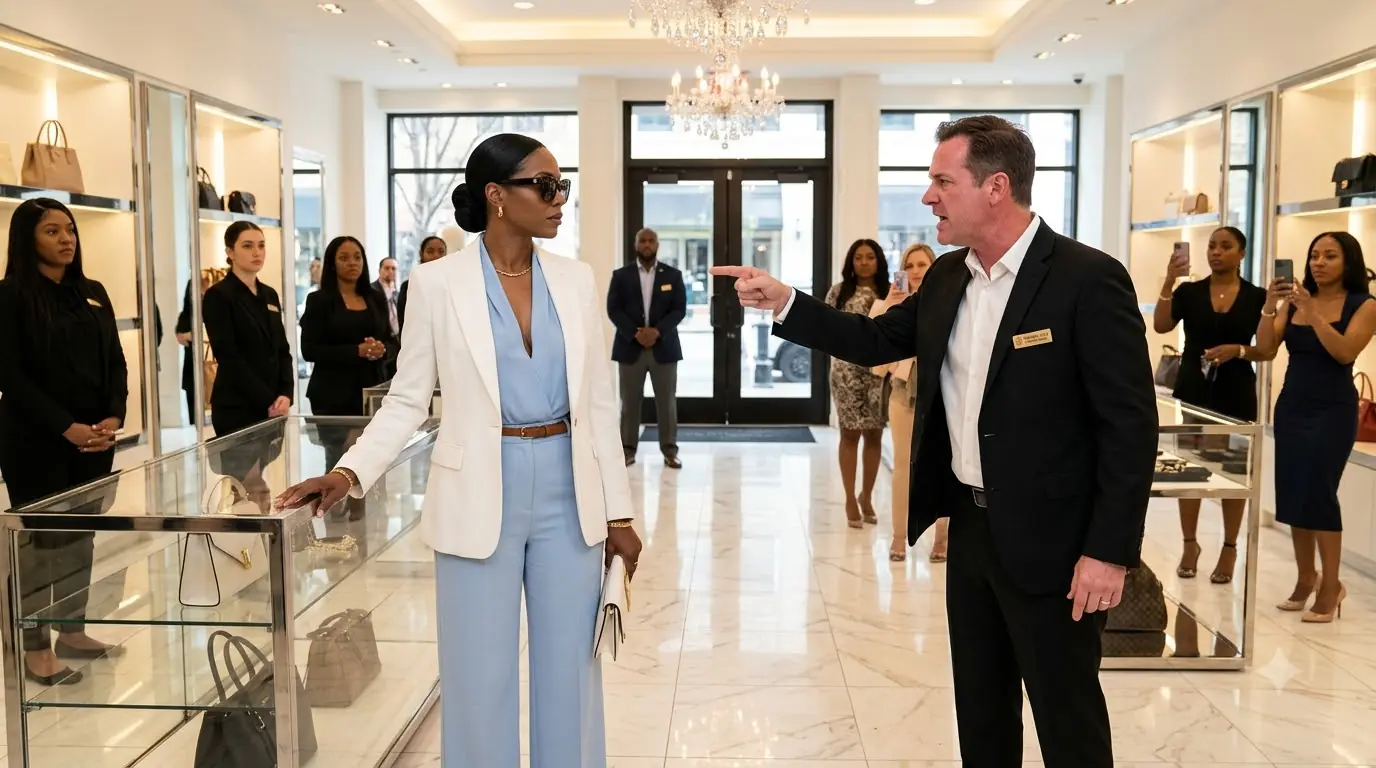
Someday, baby.
That was what her mother had always said.
Someday.
When Elaine was eight years old, “someday” meant being able to buy the beautiful handbag displayed behind thick glass without worrying about next month’s electric bill.
At eighteen, it meant graduating from college.
At twenty-seven, it meant building a company.
At thirty-six, it meant buying her mother the house she had always wanted.
At forty, it meant something Elaine’s younger self would never have believed.
She had purchased the entire chain.
Bellmont & Hart had existed for more than seventy years.
Thirty-two stores.
Six flagship locations.
Luxury handbags, jewelry, watches, custom clothing, imported leather goods, and private-client services.
The brand was older than Elaine.
Older than her career.
Older than most of the executives who had spent the previous six months explaining to her why acquiring it would be complicated.
Elaine liked complicated.
Complicated was where people made assumptions.
And Elaine Carter had built most of her fortune by noticing when assumptions were more expensive than facts.
At 6:42 that morning, she had signed the final acquisition document.
Carter Meridian Holdings now owned Bellmont & Hart.
Not a minority stake.
Not a partnership.
Every share included in the transaction had transferred.
The chain was hers.
The lawyers celebrated first.
Then the bankers.
Then the investment team.
Elaine smiled, thanked everyone, refused champagne, and left.
Her chief of staff, Olivia Grant, followed her toward the elevator.
“Where are you going?”
“To the store.”
Olivia stopped.
“What store?”
“The flagship.”
“In Atlanta?”
Elaine looked at her.
“We are in Atlanta.”
“I know.”
“Then that seems convenient.”
Olivia laughed nervously.
“You’re serious.”
“Very.”
“The management team is expecting you at two.”
“They can keep expecting.”
“Elaine.”
She pressed the elevator button.
“Yes?”
“You bought the company this morning.”
“I remember.”
“You should probably let them know you’re coming.”
“No.”
Olivia stared at her.
“That sounds like the beginning of a problem.”
Elaine smiled.
“That’s what I’m trying to find out.”
The elevator doors opened.
Olivia did not move.
Elaine stepped inside.
“You want security?”
“No.”
“A driver?”
“I already have one downstairs.”
“Corporate counsel?”
“Definitely not.”
“Assistant?”
“No.”
Olivia folded her arms.
“You’re intentionally walking into a flagship store without telling anybody who you are.”
“Yes.”
“Why?”
Elaine considered the question.
Because she remembered being nine years old outside a luxury department store with her mother.
Because she remembered the security guard following them through cosmetics even though they bought nothing.
Because she remembered her mother pretending not to notice.
Because she remembered asking later why the man had followed them.
Her mother had smiled.
Some people decide who you are before you get a chance to tell them.
Elaine had never forgotten.
She looked at Olivia.
“I want to know what the company feels like before everybody starts behaving for the new owner.”
Olivia became serious.
“That makes more sense.”
“I know.”
“It also makes me more nervous.”
Elaine smiled.
“Good.”
Twenty-eight minutes later, Elaine stepped out of a black sedan on Peachtree Street.
No photographer.
No executive.
No welcome sign.
She had changed clothes after signing.
Not because she wanted to look ordinary.
Because the navy suit she wore during the acquisition meeting felt too formal for what she planned to do.
Elaine wore a fitted powder-blue blouse beneath a sharply tailored white blazer. The blouse opened low enough at the collar to look elegant rather than corporate. Matching high-waisted powder-blue trousers fell loosely over her shoes. A thin brown leather belt rested at her waist.
Oversized dark sunglasses covered her eyes.
Small gold earrings.
A few bracelets.
Nothing about her outfit was cheap.
But nothing screamed billionaire either.
She carried a structured white clutch in one hand.
The Bellmont & Hart flagship occupied nearly twenty thousand square feet across two floors of a restored historic building.
Glass doors.
Gold trim.
Marble.
Crystal chandeliers.
Handbags displayed like artwork.
Jewelry cases spaced far enough apart to create the feeling that the merchandise did not need to compete for attention.
Elaine paused outside.
For one second, she saw her mother beside her.
Not literally.
Memory.
Her mother had died six years earlier.
Cancer.
Fast.
Too fast.
But Elaine could still remember the feel of her hand.
Strong fingers.
Short nails.
Always warm.
Someday, baby.
Elaine looked through the glass.
Then entered.
A soft bell sounded.
A sales associate near the entrance smiled.
“Good morning.”
Elaine returned it.
“Good morning.”
The associate was young.
Maybe twenty-five.
Asian American.
Name badge:
MAYA LIN.
“Please let me know if I can help you with anything.”
“I will.”
Maya smiled again and stepped back.
Exactly right.
No pressure.
No judgment.
Elaine walked deeper into the store.
She liked the layout.
Mostly.
The lighting was better than the photographs.
The central display needed less product.
The jewelry section felt cramped.
The leather goods wall was excellent.
She quietly noticed everything.
That was what she did.
Elaine was not interested in ownership as a trophy.
She wanted operations.
Margins.
Customer flow.
Staffing.
Training.
Inventory behavior.
Human behavior.
Especially human behavior.
She stopped near a glass handbag display.
There it was.
A Bellmont Heritage No. 14.
Dark caramel leather.
Structured shape.
Gold clasp.
The design had existed, with modifications, for decades.
Elaine knew it immediately.
Her mother had once wanted one.
Not that exact version.
An older model.
They had seen it in a magazine when Elaine was twelve.
Her mother had laughed at the price.
“If I spend that much on a bag, it better cook dinner too.”
Elaine had laughed.
Then secretly memorized the name.
Years later, after making her first million, Elaine tried to buy one for her mother.
Her mother refused.
“I need you to stop proving things with money.”
Elaine protested.
“I’m not proving anything.”
“Yes, you are.”
“What?”
“That we survived.”
Elaine remembered her mother touching her cheek.
Baby, I knew that before the money came.
Elaine stared at the bag.
A smile appeared.
She reached toward the display.
“Excuse me.”
The voice behind her was male.
Controlled.
Polished.
Elaine turned.
Richard Hale stood several feet away.
Forty-eight.
White.
Tall.
Sandy-brown hair combed back.
Black suit.
White shirt.
Dark tie.
Gold name badge.
STORE DIRECTOR.
He smiled.
But only with his mouth.
“May I help you?”
Elaine looked toward the handbag.
“I’m just looking.”
Richard’s eyes moved over her slowly.
White blazer.
Powder-blue trousers.
Clutch.
Sunglasses.
Then her face.
Then the bag.
“I see.”
Elaine waited.